IT, Cloud & Cybersecurity • Certification
Cisco Certified Network Professional Wireless
Professional enterprise wireless
Researched and maintained by TestPrepPilot Editorial BoardCloud, IT & cybersecurity certifications desk · Figures last verified August 2026
The short version
What is the Cisco Certified Network Professional Wireless and is it worth it?
The wireless track is a CCNP Enterprise concentration (ENWLSI) layered on the ENCOR core, focusing on Cisco wireless LAN.
- Professional wireless
- ENCOR-based
- Renews every 3 years
What is it?
What exactly is the Cisco Certified Network Professional Wireless?
Professional enterprise wireless
CCNP Enterprise with the wireless concentration (ENWLSI 300-430) certifies professional skills in Cisco wireless design, deployment and troubleshooting.
Before you book
Who is eligible to sit the Cisco Certified Network Professional Wireless?
Who it is for: Wireless network engineers
The test itself
What is the format of the Cisco Certified Network Professional Wireless?
The Cisco Certified Network Professional Wireless is administered by Pearson VUE and runs 90 minutes, contains 55–65 (concentration) questions and requires ~825 of 1000 to pass.
| Administered by | Pearson VUE |
|---|---|
| Questions | 55–65 (concentration) |
| Time limit | 90 minutes |
| Pass mark | ~825 of 1000 |
| Exam fee | $300 |
| Format | Multiple-choice and simulations |
Content outline
What topics are on the Cisco Certified Network Professional Wireless?
The Cisco Certified Network Professional Wireless is weighted across 4 domains; the largest are Wireless design (25%), Deployment (25%), Troubleshooting (25%).
Weightings come from the official exam outline. Study time is best allocated in roughly these proportions rather than evenly across domains.
- Wireless design 25%
- Deployment 25%
- Troubleshooting 25%
- Security 25%
Money & time
How much does the Cisco Certified Network Professional Wireless cost?
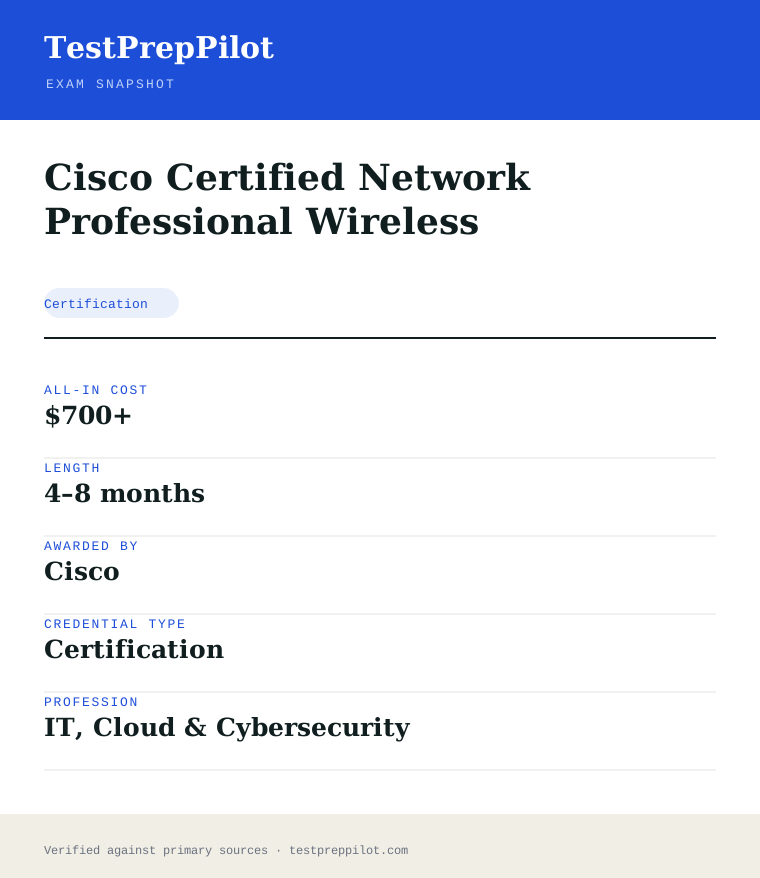
For the Cisco Certified Network Professional Wireless, the exam fee is $300; the all-in cost is typically $700+; most candidates spend 4–8 months preparing.
Cost breakdown
| ENCOR | $400 |
|---|---|
| ENWLSI | $300 |
| Typical total | $700+ |
Each exam paid separately.
Timeline
- Pass ENCOR test day
- Pass ENWLSI test day
Typical prep: 4–8 months
The path
How do you register for the Cisco Certified Network Professional Wireless?
- 1
Create a Cisco & testing account~15 minutes
Set up a free Cisco profile and a Pearson VUE (or Certiport for CCST) candidate profile to schedule and track exams.
- Register at the Cisco Certification Tracking System
- Create a Pearson VUE / Certiport candidate profile
- Confirm your ID documents meet testing requirements
- 2
Choose your certification & exam1-2 hours planning
Select the target credential and note the exact exam code (e.g., 100-160, 200-201, 350-701 + a concentration).
- Review the official exam blueprint and topic weights
- Decide self-study, Cisco U., or instructor-led training
- 3
Prepare with official trainingVaries (weeks-months)
Use Cisco Networking Academy, Cisco U. courses, official labs, and practice tests aligned to the blueprint.
- Complete the aligned Cisco U. / NetAcad course
- Hands-on labs and practice exams
- 4
Schedule the exam via Pearson VUE~10 minutes
Book a test-center slot or online OnVUE appointment; pay the exam fee (or redeem Cisco Learning Credits).
- Pick date, time, and location/time zone
- Pay fee (CCST $125; Associate $300; SCOR $400; concentration $300)
- 5
Take the proctored exam50-120 minutes
Arrive with valid government ID; complete the exam at a Pearson VUE center or via online proctoring.
- Check in and pass security/room scan (online)
- Complete the timed exam
- 6
Get results & digital badgeWithin 48 hours
Receive a pass/fail result (usually within 48 hours) and, on passing, a Credly digital badge plus certificate; track status in the Certification Tracking System.
- View section-level score report
- Accept Credly badge and share it
The fine print
What are the retake and renewal rules for the Cisco Certified Network Professional Wireless?
- Proctoring & delivery
- Delivered by Pearson VUE: at authorized test centers or online via OnVUE remote proctoring (CCST uses the Certiport/Pearson VUE platform). A government-issued photo ID is required; online tests include a room/environment scan.
- Retake policy
- If you fail, Cisco requires a waiting period of 5 calendar days before you may retake the same exam. Each attempt requires full payment of the exam fee. Cisco does not cap total attempts, but some exams limit attempts within a 12-month window.
- Score reporting
- Results are reported as pass/fail and made available online (Cisco Certification Tracking System) typically within 48 hours. A section-level performance breakdown is provided to help target further study; scaled scores use a 300-1000 range (CCNA/CCNP-style exams).
- Recertification
- All Cisco certifications are valid for 3 years from the date earned. Recertify before expiry by (a) passing a higher-or-equal level qualifying exam, (b) earning Continuing Education (CE) credits through eligible training/activities, or (c) a combination of exam + CE. For associate-level certs 30 CE credits are required; for professional-level 40 CE credits. Certificates can also be extended via the Cisco Continuing Education program.
- Refunds & rescheduling
- Exam fees are generally non-refundable once scheduled, but Pearson VUE allows rescheduling or cancellation up to 24-48 hours before the appointment without penalty; no-shows forfeit the fee. CCST/Certiport policies may differ by region.
Context
Cisco cybersecurity certifications compared
| Credential | Level | Focus | Exam | Validity | |
|---|---|---|---|---|---|
| CCST Cybersecurity | Foundational / Entry | Entry-level security concepts & support | 100-160 (1 exam, ~$125) | 3 years | |
| CCNA Cybersecurity | Associate | SOC analyst: monitoring, intrusion & incident analysis | 200-201 CBROPS (1 exam, $300) | 3 years | |
| CCNP Cybersecurity | Professional | Professional security core + concentration | SCOR 350-701 ($400) + 1 concentration ($300) | 3 years |
What it pays
How much does this credential pay?
$130,390 median for computer network architects (BLS, May 2024)
There is no Bureau of Labor Statistics occupation called "wireless engineer" or "CCNP Wireless" — the credential validates professional-level wireless networking skill, and the wage question belongs to the role you perform with it. The closest official BLS occupation is Computer Network Architects, SOC 15-1241, which had a May 2024 median wage of $130,390 ($62.69 per hour), with the lowest 10 percent earning less than $79,520 and the highest 10 percent more than $198,030. The fit is deliberate: wireless professionals with this credential work as senior network engineers and architects who design, implement and operate enterprise wireless LANs — access-point deployment, controllers, RF design, roaming, and security — which is precisely the network design and implementation work the computer network architect occupation describes. BLS counted 179,200 computer network architect jobs in 2024 and projects 12 percent employment growth from 2024 to 2034, much faster than the average for all occupations, with about 11,200 openings a year, driven by firms building new networks and upgrading existing ones as they invest in cloud, AI and infrastructure. The limitation to state plainly: the BLS median covers the whole occupation at all levels and across all industries, and wireless specialists are a slice of that workforce — enterprise wireless roles range from campus wireless engineers to architect-level WLAN leads, and pay within that range follows experience, industry and geography rather than the certificate; employer surveys, which are not BLS data, typically place senior wireless architects above the median. Read the government figure as the market level for the occupation the credential serves, not as a measure of the certificate’s premium, and remember the credential itself does not appear in wage data because BLS classifies by job duty rather than by certificate. The credential is best understood as a signal that moves a network engineer toward the architect tier, where the occupation’s upper half of the distribution lives.
| Measure | Figure | Source / note |
|---|---|---|
| Median annual wage, computer network architects | $130,390 | BLS OOH, SOC 15-1241, May 2024 |
| Lowest 10 percent | Under $79,520 | BLS OOH, SOC 15-1241, May 2024 |
| Highest 10 percent | Above $198,030 | BLS OOH, SOC 15-1241, May 2024 |
| Employment, 2024 | 179,200 jobs | BLS OOH Quick Facts, 2024 |
| Projected annual openings | ~11,200 per year | BLS OOH Job Outlook, 2024-34 — 12% growth, much faster than average |
Job growth.BLS projects 12 percent growth for computer network architects from 2024 to 2034, about 11,200 openings per year.
Source: BLS Occupational Outlook Handbook - Computer Network Architects
Your odds
What are the pass rates?
Standalone CCNP Wireless was retired on 24 February 2020 — today the wireless path runs through CCNP Enterprise (ENCOR 350-401 + a wireless concentration), graded pass/fail with no published rate
The single most important fact for anyone searching for "CCNP Wireless" is that the standalone certification no longer exists: Cisco retired it on 24 February 2020, the last date to test on the old wireless exams (300-360 WIDESIGN, 300-365 WIDEPLOY, 300-370 WITSHOOT and 300-375 WISECURE) was 23 February 2020, and wireless content moved into the CCNP Enterprise track, where it survives as two concentration exams — 300-425 ENWLSD for wireless design and 300-430 ENWLSI for wireless implementation. A candidate pursuing wireless today passes the CCNP Enterprise core exam, 350-401 ENCOR, plus one of those wireless concentrations, and the same path feeds CCIE Enterprise Wireless at the expert level. On pass rates, Cisco publishes none: it reports exam results as scaled pass/fail with outcomes online within 48 hours, and it does not publish a fixed numeric passing score for ENCOR or the concentration exams, so any percentage you see quoted online — including the widely repeated "825 out of 1000" figure for ENCOR — is a third-party estimate, not an official threshold, and we do not restate one as fact. What Cisco does publish is the format and economics: ENCOR is a 120-minute exam of roughly 90 to 110 questions priced at US$400 (English and Japanese), each wireless concentration is 90 minutes at US$300, and the resulting CCNP Enterprise certification is valid for three years, renewable through continuing education credits or by passing a qualifying exam. The practical reading is unchanged from the old credential: wireless at the professional level rewards hands-on knowledge of RF design, controllers, roaming and security, and the absence of a published pass rate means your preparation competes with the syllabus, not a cohort.
Read this before quoting the number.The standalone CCNP Wireless was retired on 24 February 2020. Cisco publishes no pass rate and no fixed numeric passing score for the current wireless exams (ENCOR and the wireless concentrations); results are reported as scaled pass/fail.
Source: Cisco - CCNP Enterprise exams and training, and the CCNP Wireless retirement notice
Your schedule
How long should I study for it?
150-250 hours over 12-16 weeks (core), plus 40-80 hours for the wireless concentration exam of focused study
Because the standalone CCNP Wireless no longer exists, the study plan for a wireless-focused candidate is the CCNP Enterprise path: the 350-401 ENCOR core exam (120 minutes, about 90-110 questions, US$400) plus one wireless concentration — 300-425 ENWLSD for design or 300-430 ENWLSI for implementation — each 90 minutes and US$300. ENCOR covers the enterprise network at the professional level, and crucially for a wireless candidate, it includes a wireless and mobility architecture block alongside architecture, virtualisation, infrastructure, network assurance, security and automation, so the core is not wasted effort even though it is broad. A defensible plan runs 150 to 250 hours over 12 to 16 weeks for the core, with 40 to 80 hours on top for the wireless concentration. Weeks 1-4 build the routing and switching core: OSPF, EIGRP, BGP at the professional level, Layer 2 technologies and redundancy, with heavy lab work, because ENCOR items present real configurations. Weeks 5-7 cover architecture, virtualisation and wireless: SD-Access and SD-WAN concepts, device virtualisation, and the wireless block — RF fundamentals, controller-based design, roaming, and wireless security — which is where a wireless candidate should invest extra time because the ENCOR wireless block tests it. Weeks 8-10 cover automation and programmability: Python for network engineers, REST APIs, NETCONF/RESTCONF and controller-based automation. Weeks 11-12 drill security fundamentals and integration scenarios. Weeks 13-16 add question-bank drilling, two full timed practice exams, then the wireless concentration plan: site surveys, wireless design and high availability for ENWLSD, or implementation, deployment and troubleshooting for ENWLSI. The plan is lab-heavy because both exams reward configuration and design knowledge, and a wireless candidate should rehearse controller and access-point configuration hands-on.
- Weeks 1-460
Routing and switching core
- OSPF, EIGRP and BGP at the professional level
- Layer 2 technologies and redundancy
- Lab every protocol until configuration is fluent
- Weeks 5-745
Architecture, virtualisation, wireless
- SD-Access and SD-WAN concepts
- Device virtualisation and network assurance
- Wireless block: RF, controllers, roaming, security — invest extra time here
- Weeks 8-1045
Automation and programmability
- Python for network engineers
- REST APIs, NETCONF/RESTCONF
- Controller-based automation labs
- Weeks 11-1230
Security fundamentals
- Security controls in the enterprise network
- Integration scenarios across the domains
- First full practice exam
- Weeks 13-1440
Drill and timed practice
- Question-bank drilling in volume
- Second full timed practice exam
- Re-lab every miss by domain
- Weeks 15-1640
Wireless concentration
- ENWLSD: site surveys, design, mobility, high availability
- ENWLSI: implementation, deployment, troubleshooting
- One full practice exam for the concentration
Adjusting the pace
Wireless engineer with controller experience.Compress the wireless block of the core and the concentration; spend the recovered time on routing, automation and the security domain, which are the areas wireless jobs do not cover.
Enterprise network engineer moving into wireless.Budget the upper end and add dedicated RF, roaming and controller study, which are the biggest gaps between wired and wireless networking.
Choosing design vs implementation.ENWLSD fits architects and design roles; ENWLSI fits deployment and operations roles. Review both blueprints and pick the one aligned with your job.
How to study
How do I prepare most effectively?
For a wireless-focused candidate, the prep strategy starts with accepting that the old CCNP Wireless materials are worthless for the current path: the retired 300-360/365/370/375 exams tested a different blueprint, and buying old wireless courseware wastes both money and study time. The current path rewards hands-on configuration and design knowledge, so the dominant strategy is lab work: routing, switching and wireless configurations should all be practised in a lab environment — controllers, access points, RF design tools and roaming — until the work is fluent, because ENCOR and the wireless concentrations test what a professional wireless engineer does, not what a textbook says. Second, treat the ENCOR wireless block as first-class content rather than a footnote: RF fundamentals, controller-based design, roaming mechanisms and wireless security appear in the core exam, and a wireless candidate who skips them because they feel familiar loses points and misreads the scope. Third, use the official Cisco exam topics as the scope map and Cisco’s practice materials where available, because third-party courses drift from the current exam and Cisco has announced updates to its enterprise and wireless certifications, so confirm the current blueprint before buying anything. Fourth, take at least two full timed practice exams; roughly 90 to 110 questions in 120 minutes is about a minute per item, and the scenario and configuration items are reading-heavy, so the pace must be drilled under a running clock. Fifth, plan the wireless concentration deliberately: ENWLSD for design roles, ENWLSI for implementation roles, and the choice shapes the final weeks of the plan. Finally, budget for the three-year renewal cycle from the start, because the certification expires if you neither earn continuing education credits nor pass a qualifying exam before the date.
Ignore the retired wireless exams
The old CCNP Wireless exams (300-360/365/370/375) were retired on 23 February 2020 and tested a different blueprint; old courseware is worthless for the current path.
Lab the wireless and network core
Configure controllers, access points, routing and switching until fluent; the exams test professional practice and present real configurations.
Treat the ENCOR wireless block as first-class
RF, controllers, roaming and wireless security appear in the core exam; a wireless candidate who skips them loses points and misreads the scope.
Use the official exam topics
The authoritative scope; third-party courses drift from the current exam, and Cisco has announced updates to enterprise and wireless certifications.
Run two full simulations
About 90-110 questions in 120 minutes; drill the pace on scenario and configuration items.
Plan the wireless concentration early
ENWLSD for design roles, ENWLSI for implementation; the choice shapes the final weeks of the plan and the certification timeline.
What to buy
Which study resources are worth paying for?
For a candidate pursuing wireless today, the buying logic is the CCNP Enterprise path: the two required exams anchor the budget — ENCOR is US$400 and each wireless concentration is US$300, so the two-exam certification costs $700 in exam fees alone, before any training, books or labs, and a realistic total budget including training and materials is $900 to $2,500. Cisco’s official learning resources include the exam topics documents (free), Cisco U. courses and the Cisco Learning Network, and the official Cisco Press books for ENCOR and the wireless concentrations are the standard references, running roughly $50-$80 each. Third-party training companies offer full ENCOR and wireless courses from roughly $100 to $1,000 depending on format, with self-paced video courses at the low end and instructor-led programs at the high end. Lab access is non-negotiable — either a paid lab subscription (roughly $50-$200) or a local virtual lab environment — because both exams reward configuration and design practice, and wireless candidates specifically need access to controller and access-point simulation. The single most important buying warning is version: any course, book or question bank built for the retired CCNP Wireless exams (300-360/365/370/375) is obsolete and should be avoided, and candidates should check the cover for the current ENCOR and wireless concentration codes before paying. The exam fee is payable with Cisco Learning Credits, which employers often provide, so checking your employer’s training budget before paying list price is a genuine cost lever. Prices below are list prices as of mid-2026 and change frequently; we rank nothing by commission.
| Resource | Price | Format | Best for |
|---|---|---|---|
| Cisco exam topics + Learning Network | Free | Official scope and community | The authoritative map; read it first |
| Cisco Press ENCOR + wireless concentration guides | $50-$80 each | Printed or digital books | Structured references for the two-exam path |
| Cisco U. / official courses | $100-$800 | Self-paced or instructor-led | Official instruction aligned to the current exams |
| Third-party courses + labs | $100-$1,000 | Video courses with lab environments | Structured learners needing lab time |
| Standalone lab subscriptions | $50-$200 | Online or local virtual lab | Controller, access-point and routing practice |
| ENCOR core + wireless concentration exam | $400 + $300 = $700 | Pearson VUE, centre or online | The required exams for the wireless path |
List prices as of mid-2026, subject to change; ENCOR is $400 and concentration exams $300. Avoid any material written for the retired CCNP Wireless exams. No commission or affiliate ranking is implied.
Avoid these
What mistakes do candidates most often make?
The most common mistakes on the wireless path today are version errors and the perennial lab and pace failures, and the version error is unique to this credential. First, candidates buy and study material written for the retired CCNP Wireless exams: books and courses for 300-360, 300-365, 300-370 and 300-375 are still on sale and still rank well in search, but they cover a blueprint that died on 23 February 2020, and the fix is to confirm the current codes — ENCOR 350-401 plus 300-425 ENWLSD or 300-430 ENWLSI — before paying. Second, candidates study without labs: those who read the guides but never configure a controller, access point or routing protocol find the configuration-heavy items impossible to answer confidently, and the fix is lab time from week one. Third, wireless specialists under-prepare the ENCOR non-wireless domains: the core exam is broad, and a candidate who skips routing, automation or security because wireless is their day job loses whole domains; the fix is to study the full ENCOR blueprint in proportion. Fourth, candidates plan only the core exam and stall on the concentration choice; the certification requires two passes, so deciding between design (ENWLSD) and implementation (ENWLSI) early shapes the entire timeline. Fifth, many candidates skip full timed simulations and misjudge the one-minute-per-item pace on reading-heavy scenario questions, then run out of clock on the real exam. Finally, ignoring the three-year renewal cycle is a quiet mistake: the certification expires if you neither earn continuing education credits nor pass a qualifying exam, and candidates who discover the lapse at interview time have paid twice for the same credential.
✕Studying retired CCNP Wireless material
✓The old wireless exams were retired on 23 February 2020. Confirm the current path — ENCOR 350-401 plus 300-425 ENWLSD or 300-430 ENWLSI — before buying any book or course.
✕Studying without labs
✓Configure controllers, access points and routing in a lab until fluent; the exams test practice, and configuration items cannot be answered from reading alone.
✕Skipping the non-wireless ENCOR domains
✓The core exam is broad — routing, automation and security are first-class domains. A wireless specialist who skips them loses whole sections; study the full blueprint in proportion.
✕Planning only the core exam
✓The wireless path requires two exams; decide between design (ENWLSD) and implementation (ENWLSI) early so the certification timeline is set.
✕Skipping timed simulations
✓About 90-110 questions in 120 minutes; run two full timed practice exams to drill the pace on scenario and configuration items.
✕Ignoring the renewal cycle
✓The certification expires in three years; earn CE credits or pass a qualifying exam before the date, and diary the expiry the week you pass.
What you'll face
What question types will I see?
The current wireless path uses the same exam mechanics as the rest of the Cisco professional program: the 350-401 ENCOR core exam has about 90 to 110 questions in 120 minutes, mixing single-answer multiple choice, multiple-response, drag-and-drop and scenario-based items, and it is delivered at Pearson VUE centres or through online proctoring in English and Japanese. The wireless concentrations — 300-425 ENWLSD for design and 300-430 ENWLSI for implementation — follow the same question mix in a 90-minute format and drill wireless in depth: site surveys, wired and wireless infrastructure, mobility, WLAN high availability and design for ENWLSD, and deployment, configuration and troubleshooting for ENWLSI. The ENCOR core includes a wireless and mobility architecture block, so a wireless candidate faces RF fundamentals, controller-based design, roaming mechanisms and wireless security items even in the core, alongside the routing, virtualisation, assurance, security and automation domains. Many items across both exams present an actual configuration, topology or design scenario and ask for the correct command, fix or analysis, the style that rewards hands-on practice over memorisation. Cisco reports results as pass/fail on a scaled score with no published numeric threshold, so there is no official percentage to target, and the score report shows relative performance by topic area. At roughly one minute per item in the core, the scenario and configuration items consume most of the clock, so candidates should flag uncertain items early and budget the reading-heavy questions deliberately rather than answering in presented order. The samples below are editor-written illustrations of the published exam topics and the configuration-flavoured style of the real items, not live exam items.
Concept, configuration and troubleshooting items across the ENCOR domains and the wireless concentration blueprint.
Configurations, topologies or design scenarios with the correct command, fix or analysis.
Matching concepts, steps or wireless network components.
Try these
Q1A wireless engineer is designing a campus WLAN and needs clients to roam quickly between access points with minimal disruption to voice calls. Which capability is the correct design feature?
Answer:A
Fast secure roaming, typically 802.11r combined with controller mobility groups, lets clients move between access points with minimal disruption, which is what real-time voice needs. A single access point cannot cover a campus, disabling roaming breaks service, and using only 2.4 GHz does not solve roaming. This reflects the wireless design and mobility items in the blueprint.
Q2A network engineer automates device configuration using a model-driven approach. Which protocol is designed for this purpose?
Answer:A
NETCONF with YANG data models is the standard model-driven configuration protocol, tested in the ENCOR automation domain. Telnet and TFTP are legacy tools without structured data models, and SNMPv1 polling is primarily monitoring, not configuration. This is the shape of the automation items a wireless candidate must not skip.
Q3A campus network has redundant switches and a client cannot reach its gateway after a link failure. Which technology provides first-hop redundancy so the virtual gateway IP stays reachable?
Answer:A
First-hop redundancy protocols such as HSRP and VRRP maintain a virtual gateway IP across redundant switches, keeping the default gateway reachable through a failure. NAT, DNS and DHCP each solve a different problem and do not provide gateway redundancy. This reflects the infrastructure and network-assurance items in the ENCOR blueprint.
Samples are editor-written illustrations of the published blueprint, not live exam items.
The big day
What should I expect on exam day?
Because the wireless path is the CCNP Enterprise track, exam day is the 350-401 ENCOR core exam — a computer-based test of about 90 to 110 questions in 120 minutes, delivered at a Pearson VUE centre or through online proctoring, priced at US$400, and graded pass/fail with results available online within 48 hours — followed by one 90-minute US$300 wireless concentration exam. Bring a valid government-issued photo ID matching your registration name and your appointment confirmation; personal items go in the locker at a centre, and online candidates must clear the desk and room per Pearson VUE rules. Arrive 30 minutes early; late arrivals forfeit the appointment and the fee. Pace at about a minute per item, flag uncertain items for review, and budget extra time for the scenario and configuration items, which take longer than multiple choice. The clock does not stop, there is no on-screen calculator, and Cisco exams generally do not allow returning to a submitted question, so answer deliberately. You receive the pass/fail outcome online within 48 hours; if you fail, Cisco’s retake policy applies — a waiting period between attempts and the full exam price each time — and the score report shows performance by topic area, which is the study plan for the retake. On a pass, schedule the wireless concentration while the ENCOR material is fresh, and note that passing the core alone earns the Cisco Certified Specialist - Enterprise Core credential. Record the three-year validity date the moment the full certification is earned, and plan the CE-credit or qualifying-exam renewal before it lapses.
Bring
- Valid government-issued photo ID matching your registration name
- Appointment confirmation
- For online proctoring: a phone for check-in photographs, a cleared desk, and a private room with a door
Leave at home
- Phone, smartwatch and all electronics
- Notes and study materials
- Personal bags beyond what the centre allows
- Second monitors, unplugged and turned away, and any other person in the room for online delivery
How the day runs
Rules in the room
- No personal electronics in the testing room; the clock does not pause.
- About 90-110 questions in 120 minutes for ENCOR; 90 minutes for the wireless concentration exams.
- Grading is pass/fail with results online within 48 hours; Cisco publishes no pass rate and no fixed numeric passing score.
- Cisco retake policy applies after a fail, with a waiting period and the full exam price each attempt.
- The certification is valid for three years, renewable through continuing education credits or a qualifying exam.
Afterwards.Pass ENCOR to earn the Cisco Certified Specialist - Enterprise Core credential immediately, then pass one wireless concentration (300-425 ENWLSD for design or 300-430 ENWLSI for implementation) to complete the wireless professional path within CCNP Enterprise. The certification is valid for three years, renewable with continuing education credits or by passing a qualifying exam, so diary the expiry the week you complete the path. On a fail, use the domain-by-domain score report to target the retake. Remember there is no "CCNP Wireless" to search for — the standalone credential was retired on 24 February 2020, and the current path is the one described on Cisco’s CCNP Enterprise pages, so confirm the current blueprint before booking, because Cisco has announced updates to its enterprise and wireless certifications.
Reference
What are the key facts about the Cisco Certified Network Professional Wireless?
Cisco Certified Network Professional Wireless is a certification credential; awarded by Cisco; the exam fee is $300; typical preparation is 4–8 months; holders typically earn $85,000 – $120,000.
| Credential | Cisco Certified Network Professional Wireless |
|---|---|
| Abbreviation | CCNP Wireless |
| Type | Certification |
| Profession | IT, Cloud & Cybersecurity |
| Specialty | Cisco |
| Awarded by | Cisco |
| Difficulty | Hard |
| Typical prep time | 4–8 months |
| All-in cost | $700+ |
| Typical salary range | $85,000 – $120,000 |
| Core | ENCOR 350-401 |
| Concentration | ENWLSI 300-430 |
| Scope | National / Multi-state |
| Also known as | 350-101 WLCOR |
Real questions
Frequently asked questions about the Cisco Certified Network Professional Wireless
Is wireless a separate CCNP?
It is a concentration within CCNP Enterprise, so you earn it alongside the ENCOR core.
Does it expire?
Yes, after three years via exam or continuing education.
How do I register for cisco-ccnp-wireless?
You register and schedule cisco-ccnp-wireless through Pearson VUE. Pick a test-centre appointment or online proctoring, then sit the exam on your booked date.
What is the cisco-ccnp-wireless exam format?
The exam is delivered as Multiple-choice and simulations, with about 55–65 (concentration) items, in 90 minutes. The published pass mark is ~825 of 1000.
How long is the cisco-ccnp-wireless certification valid?
All Cisco certifications are valid for three years and renewed through re-examination, continuing education credits or higher-level passes.
How much does cisco-ccnp-wireless cost?
The exam fee is $300. Optional study materials and retakes are priced separately.
How long is a Cisco certification valid, and how do I renew it?
Every Cisco certification is valid for 3 years. You can recertify by passing a qualifying exam at or above the current level, by earning Continuing Education credits, or by combining both before the expiry date.
Where do I take Cisco exams and what ID do I need?
Cisco exams are delivered by Pearson VUE at test centers or online via OnVUE (CCST via Certiport/Pearson VUE). You must present a valid government-issued photo ID; online exams also require a room/environment scan.
What happens if I fail a Cisco exam?
You must wait 5 calendar days before retaking the same exam, and each retake requires paying the full exam fee again. Your score report shows section-level feedback to guide further study.
In short
Is the Cisco Certified Network Professional Wireless worth it?
- Wireless is a CCNP Enterprise concentration.
- It builds on the ENCOR core.
- It renews every three years.
Same awarding body
What other credentials does Cisco award?
Worth comparing
How does the Cisco Certified Network Professional Wireless compare with similar credentials?
Trust
Where does this information come from?
Everything above is taken from the awarding body's own published material. Fees, question counts and domain weights are revised regularly — check the official page before you pay.
- Cisco Awarding body
- Official Cisco Certified Network Professional Wireless exam page Exam page
- Cisco certification programme Programme rules
Research confidence: high · Last reviewed 2026-08