IT, Cloud & Cybersecurity • Certification
Cisco Certified Network Professional Security
Professional security engineering
Researched and maintained by TestPrepPilot Editorial BoardCloud, IT & cybersecurity certifications desk · Figures last verified August 2026
The short version
What is the Cisco Certified Network Professional Security and is it worth it?
CCNP Security pairs the SCOR core (350-701) with a concentration such as SISE or SNCF.
- Professional security
- Maps to SecOps roles
- Renews every 3 years
What is it?
What exactly is the Cisco Certified Network Professional Security?
Professional security engineering
CCNP Security certifies professional skills in securing Cisco networks, including firewall, VPN, intrusion and identity. It requires the SCOR core exam plus a concentration.
Before you book
Who is eligible to sit the Cisco Certified Network Professional Security?
Who it is for: Security engineers
The test itself
What is the format of the Cisco Certified Network Professional Security?
The Cisco Certified Network Professional Security is administered by Pearson VUE and runs 120 minutes (core), contains 90–110 (core) questions and requires ~825 of 1000 to pass.
| Administered by | Pearson VUE |
|---|---|
| Questions | 90–110 (core) |
| Time limit | 120 minutes (core) |
| Pass mark | ~825 of 1000 |
| Exam fee | $400 per exam |
| Format | Multiple-choice and simulations |
Content outline
What topics are on the Cisco Certified Network Professional Security?
The Cisco Certified Network Professional Security is weighted across 4 domains; the largest are SCOR: perimeter security (20%), SCOR: cloud/email/web security (20%), SCOR: VPN and secure access (20%).
Weightings come from the official exam outline. Study time is best allocated in roughly these proportions rather than evenly across domains.
- SCOR: perimeter security 20%
- SCOR: cloud/email/web security 20%
- SCOR: VPN and secure access 20%
- SCOR: analytics and visibility 20%
Money & time
How much does the Cisco Certified Network Professional Security cost?
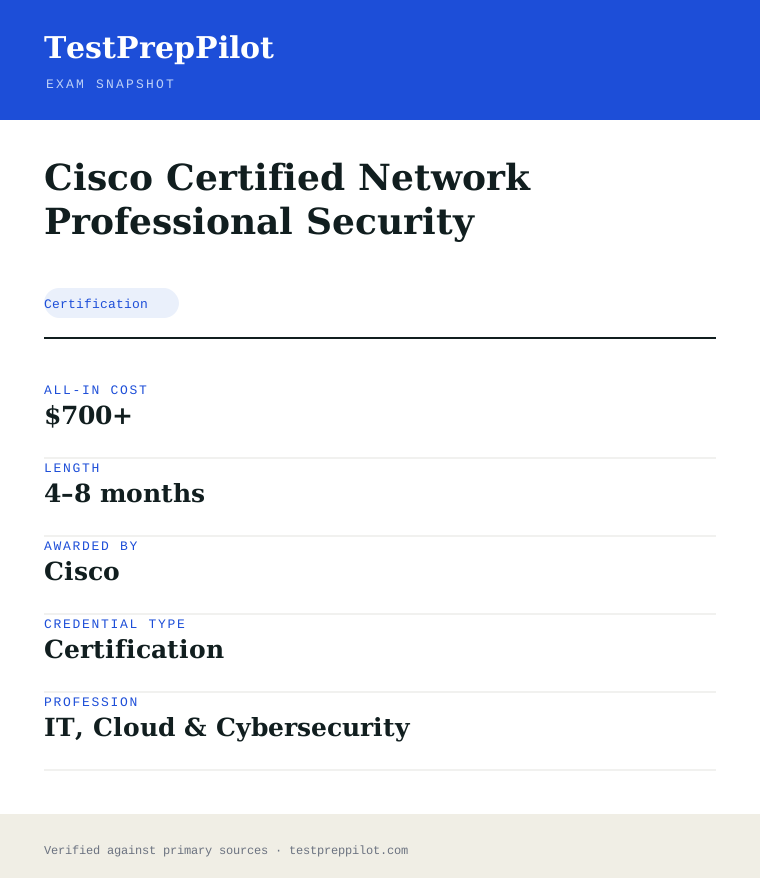
For the Cisco Certified Network Professional Security, the exam fee is $400 per exam; the all-in cost is typically $700+; most candidates spend 4–8 months preparing.
Cost breakdown
| SCOR | $400 |
|---|---|
| Concentration | $300 |
| Typical total | $700+ |
Each exam paid separately.
Timeline
- Pass SCOR test day
- Pass a concentration test day
Typical prep: 4–8 months
The path
How do you register for the Cisco Certified Network Professional Security?
- 1
Create a Cisco & testing account~15 minutes
Set up a free Cisco profile and a Pearson VUE (or Certiport for CCST) candidate profile to schedule and track exams.
- Register at the Cisco Certification Tracking System
- Create a Pearson VUE / Certiport candidate profile
- Confirm your ID documents meet testing requirements
- 2
Choose your certification & exam1-2 hours planning
Select the target credential and note the exact exam code (e.g., 100-160, 200-201, 350-701 + a concentration).
- Review the official exam blueprint and topic weights
- Decide self-study, Cisco U., or instructor-led training
- 3
Prepare with official trainingVaries (weeks-months)
Use Cisco Networking Academy, Cisco U. courses, official labs, and practice tests aligned to the blueprint.
- Complete the aligned Cisco U. / NetAcad course
- Hands-on labs and practice exams
- 4
Schedule the exam via Pearson VUE~10 minutes
Book a test-center slot or online OnVUE appointment; pay the exam fee (or redeem Cisco Learning Credits).
- Pick date, time, and location/time zone
- Pay fee (CCST $125; Associate $300; SCOR $400; concentration $300)
- 5
Take the proctored exam50-120 minutes
Arrive with valid government ID; complete the exam at a Pearson VUE center or via online proctoring.
- Check in and pass security/room scan (online)
- Complete the timed exam
- 6
Get results & digital badgeWithin 48 hours
Receive a pass/fail result (usually within 48 hours) and, on passing, a Credly digital badge plus certificate; track status in the Certification Tracking System.
- View section-level score report
- Accept Credly badge and share it
The fine print
What are the retake and renewal rules for the Cisco Certified Network Professional Security?
- Proctoring & delivery
- Delivered by Pearson VUE: at authorized test centers or online via OnVUE remote proctoring (CCST uses the Certiport/Pearson VUE platform). A government-issued photo ID is required; online tests include a room/environment scan.
- Retake policy
- If you fail, Cisco requires a waiting period of 5 calendar days before you may retake the same exam. Each attempt requires full payment of the exam fee. Cisco does not cap total attempts, but some exams limit attempts within a 12-month window.
- Score reporting
- Results are reported as pass/fail and made available online (Cisco Certification Tracking System) typically within 48 hours. A section-level performance breakdown is provided to help target further study; scaled scores use a 300-1000 range (CCNA/CCNP-style exams).
- Recertification
- All Cisco certifications are valid for 3 years from the date earned. Recertify before expiry by (a) passing a higher-or-equal level qualifying exam, (b) earning Continuing Education (CE) credits through eligible training/activities, or (c) a combination of exam + CE. For associate-level certs 30 CE credits are required; for professional-level 40 CE credits. Certificates can also be extended via the Cisco Continuing Education program.
- Refunds & rescheduling
- Exam fees are generally non-refundable once scheduled, but Pearson VUE allows rescheduling or cancellation up to 24-48 hours before the appointment without penalty; no-shows forfeit the fee. CCST/Certiport policies may differ by region.
Context
Cisco cybersecurity certifications compared
| Credential | Level | Focus | Exam | Validity | |
|---|---|---|---|---|---|
| CCST Cybersecurity | Foundational / Entry | Entry-level security concepts & support | 100-160 (1 exam, ~$125) | 3 years | |
| CCNA Cybersecurity | Associate | SOC analyst: monitoring, intrusion & incident analysis | 200-201 CBROPS (1 exam, $300) | 3 years | |
| CCNP Cybersecurity | Professional | Professional security core + concentration | SCOR 350-701 ($400) + 1 concentration ($300) | 3 years |
What it pays
How much does this credential pay?
$130,390 median for computer network architects (BLS, May 2024)
There is no Bureau of Labor Statistics occupation called "CCNP Security" — the Cisco Certified Network Professional Security credential validates professional-level security engineering skill, and the wage question belongs to the role you perform with it. The closest official BLS occupation is Computer Network Architects, SOC 15-1241, which had a May 2024 median wage of $130,390 ($62.69 per hour), with the lowest 10 percent earning less than $79,520 and the highest 10 percent more than $198,030. The fit is deliberate: CCNP Security holders work as network security engineers, security architects and security operations leads — the professional tier that designs and runs the secure networks, firewalls, VPNs and identity systems that the network architect occupation describes — so the realistic benchmark for the credential sits in the upper half of the distribution. BLS counted 179,200 computer network architect jobs in 2024 and projects 12 percent employment growth from 2024 to 2034, much faster than the average for all occupations, with about 11,200 openings a year, driven by firms building new networks and upgrading existing ones as they invest in cloud, AI and security infrastructure. The limitation to state plainly: the BLS median covers the whole occupation at all levels, and senior security engineers with a CCNP Security and several years of incident-response and architecture experience typically earn well above it in employer surveys, which are not BLS data; read the government figure as the market level for the occupation the credential serves, not as a measure of the certificate’s premium. The credential itself does not appear in wage data because BLS classifies by job duty rather than by certificate, and security specialists who move into management roles are counted under different SOC codes entirely.
| Measure | Figure | Source / note |
|---|---|---|
| Median annual wage, computer network architects | $130,390 | BLS OOH, SOC 15-1241, May 2024 |
| Lowest 10 percent | Under $79,520 | BLS OOH, SOC 15-1241, May 2024 |
| Highest 10 percent | Above $198,030 | BLS OOH, SOC 15-1241, May 2024 |
| Employment, 2024 | 179,200 jobs | BLS OOH Quick Facts, 2024 |
| Projected annual openings | ~11,200 per year | BLS OOH Job Outlook, 2024-34 — 12% growth, much faster than average |
Job growth.BLS projects 12 percent growth for computer network architects from 2024 to 2034, about 11,200 openings per year.
Source: BLS Occupational Outlook Handbook - Computer Network Architects
Your odds
What are the pass rates?
Cisco publishes no pass rate and no fixed numeric passing score — SCOR is a 120-minute, $400 pass/fail core exam
Cisco does not publish cohort pass rates for its certification exams, and it reports results as a scaled pass/fail: the 350-701 SCOR exam page states "grading is pass/fail and results are available online within 48 hours," and Cisco does not publish a fixed numeric passing score for this exam, so any percentage you see quoted online — including the commonly repeated "750 to 850 out of 1000" range — is a third-party estimate, not an official threshold, and we do not restate one as fact. What Cisco does publish is the format and the economics: SCOR is a 120-minute computer-based exam with roughly 90 to 110 questions, priced at US$400 (payable with Cisco Learning Credits), delivered at Pearson VUE centres or through online proctoring in English and Japanese, and passing it automatically earns the Cisco Certified Specialist - Security Core certification while satisfying the core exam requirement for CCNP Security and the qualifying exam requirement for CCIE Security. Earning the full CCNP Security requires passing SCOR plus one concentration exam, each priced at US$300 and running 90 minutes, and the certification is valid for three years, renewable through continuing education credits or by passing a qualifying exam. The absence of a published pass rate is not an absence of standards: the exam rewards hands-on configuration knowledge of firewalls, VPNs, endpoint protection, cloud security, content security and identity systems, and the report you receive shows performance by topic area so a failed attempt produces a study plan rather than guesswork. The practical reading: aim for high-single-digit percentages above comfort on practice exams, use Cisco’s official exam topics and practice materials, and treat the reported pass/fail as the only official outcome.
Read this before quoting the number.Cisco publishes no pass rate and no fixed numeric passing score for SCOR; results are reported as scaled pass/fail. Any numeric threshold circulating online is a third-party estimate.
Your schedule
How long should I study for it?
150-250 hours over 12-16 weeks (core), plus 40-80 hours for the concentration exam of focused study
The CCNP Security is a two-exam certification: the 350-701 SCOR core exam (120 minutes, about 90-110 questions, US$400) plus one concentration exam such as 300-710 SNCF on firewalls or 300-715 SISE on Identity Services Engine, each 90 minutes and US$300. SCOR covers six domains of professional-level security engineering: security concepts and threats, network security (firewalls, IPS, segmentation, VPN), securing the cloud, content security (email and web), endpoint protection and detection, and secure network access, visibility and enforcement. A defensible plan runs 150 to 250 hours over 12 to 16 weeks for the core, with 40 to 80 hours on top for the concentration. Weeks 1-3 build the security concepts foundation — cryptography, PKI, vulnerabilities, threat intelligence, and incident-response frameworks — because candidates who skip the abstract domains under-perform on scenario items. Weeks 4-7 cover network security in depth: next-generation firewalls, IPS, VPN architectures, segmentation, and Cisco Secure Firewall policy configuration, with heavy lab work, because the exam rewards configuration knowledge. Weeks 8-9 cover cloud and content security — cloud access security, workload protection, Cisco Umbrella, email and web security appliances. Weeks 10-11 cover endpoint protection and secure access — Cisco Secure Endpoint, 802.1X, identity services, and the visibility and telemetry stack. Weeks 12-14 add question-bank drilling and two full timed practice exams. Weeks 15-16 pivot to the chosen concentration exam, since the full certification is not earned until both exams pass. The plan is lab-heavy because SCOR items present real configurations and ask for the correct command, fix or analysis, and candidates who only read guides find the simulation-style items impossible to answer confidently.
- Weeks 1-345
Security concepts foundation
- Cryptography, PKI and VPN technologies
- Vulnerabilities, threat intelligence and incident response
- Phishing and social-engineering controls
- Weeks 4-760
Network security core
- Next-generation firewalls, IPS and segmentation
- Cisco Secure Firewall policy configuration in the lab
- VPN architectures and zero-trust frameworks
- Weeks 8-930
Cloud and content security
- Cloud access security and workload protection
- Cisco Umbrella, email and web security appliances
- DLP and traffic redirection
- Weeks 10-1130
Endpoint and secure access
- Cisco Secure Endpoint, EDR and posture assessment
- 802.1X, identity services and CoA
- Visibility, telemetry and enforcement
- Weeks 12-1440
Drill and timed practice
- Question-bank drilling in volume
- Two full 120-minute practice exams
- Re-lab every miss by domain
- Weeks 15-1640
Concentration exam
- Pick the concentration aligned to your job
- Study the 90-minute concentration blueprint
- One full practice exam for the concentration
Adjusting the pace
CCNA already earned.Compress the foundation; the professional-level depth, cloud and automation are the new material. Expect to skip the routing and switching review entirely.
Security engineer with firewall experience.Move faster through network security and spend the recovered time on cloud security, endpoint detection, and the concentration exam, which are the areas job experience alone does not cover.
Choosing the concentration.SNCF (firewalls) and SISE (identity) are the most common picks; review the concentration exam topics before committing, and note that some older concentrations have published retirement dates.
How to study
How do I prepare most effectively?
The SCOR exam rewards hands-on configuration knowledge across six security domains, so the dominant strategy is lab work: every product and protocol should be configured in a lab environment until the configuration is fluent, because the exam items test what a professional security engineer does, not what a textbook says, and candidates who read guides without touching a firewall console find the simulation-style items impossible to answer with confidence. Second, treat the security-concepts domain as first-class content rather than theory: cryptography, PKI, vulnerabilities and threat intelligence together form the largest domain on the paper, and candidates who skip it because it has no product to configure routinely leave the biggest block of points on the table. Third, use the official Cisco exam topics as the scope map and Cisco’s practice materials where available, because third-party courses drift from the current exam and some concentration exams are being retired — the SCOR core is current, but check published retirement dates before committing to a concentration, since at least two older security concentrations have announced last test dates. Fourth, take at least two full timed practice exams; roughly 90 to 110 questions in 120 minutes is about a minute per item, and the scenario and configuration items are reading-heavy, so the pace must be drilled under a running clock rather than studied leisurely. Fifth, plan the concentration exam deliberately: the two-exam structure means the certification timeline includes the concentration choice, and candidates who pick a concentration aligned with their job (firewalls for firewall engineers, identity for access-control roles) study more efficiently. Finally, budget for the three-year renewal cycle from the start, because CCNP Security expires if you neither earn continuing education credits nor pass a qualifying exam before the date, and a lapsed credential is the most expensive way to take these exams twice.
Lab every product and protocol
Configure firewalls, VPNs, endpoint policies and identity services until fluent; the exam tests professional practice and presents real configurations.
Master the security-concepts domain
Cryptography, PKI, vulnerabilities and threat intelligence form the largest single domain; treat it as first-class exam content, not theory.
Use the official exam topics
The authoritative scope; third-party courses drift from the current exam, and concentration exams have published retirement dates.
Run two full simulations
About 90-110 questions in 120 minutes; drill the pace on scenario and configuration items.
Plan the concentration early
Pick the concentration aligned with your job; it shapes the whole study timeline and the two-exam certification path.
Plan the three-year renewal
The certification expires; earn CE credits or pass a qualifying exam before the date, and diary it the week you pass.
What to buy
Which study resources are worth paying for?
CCNP Security prep centres on lab access plus a course, and the buying logic starts with the fact that the two required exams anchor the budget: the SCOR core exam is US$400 and each concentration exam is US$300, so the two-exam certification costs $700 in exam fees alone, before any training, books or labs, and a realistic total budget including training and materials is $900 to $2,500. Cisco’s official learning resources include the exam topics documents (free), Cisco U. courses and the Cisco Learning Network, and the official Cisco Press SCOR Official Cert Guide is the standard reference for the core exam, running roughly $50-$80. Third-party training companies offer full SCOR courses and labs from roughly $100 to $1,000 depending on format, with self-paced video courses at the low end and instructor-led programs at the high end. Lab access is non-negotiable — either a paid lab subscription (roughly $50-$200) or a local virtual lab environment — because the exam rewards configuration practice on firewalls, VPNs and endpoint platforms, and candidates who try to save money by skipping the lab typically pay the $400 retake fee instead. The exam fee is payable with Cisco Learning Credits, which employers often provide, and vouchers occasionally appear in promotions, so checking both the Cisco store and your employer’s training budget before paying list price is a genuine cost lever. Candidates should also confirm the current status of concentration exams before buying material, because Cisco publishes retirement dates for some older concentration exams and has announced updates coming to the CCNP and CCIE Security certifications; studying a concentration that is about to be retired wastes both money and study time. Prices below are list prices as of mid-2026 and change frequently; we rank nothing by commission.
| Resource | Price | Format | Best for |
|---|---|---|---|
| Cisco exam topics + Learning Network | Free | Official scope and community | The authoritative map; read it first |
| Cisco Press SCOR Official Cert Guide | $50-$80 | Printed or digital book | The standard structured reference for the core exam |
| Cisco U. / official courses | $100-$800 | Self-paced or instructor-led | Official instruction aligned to the exam |
| Third-party courses + labs | $100-$1,000 | Video courses with lab environments | Structured learners needing lab time |
| Standalone lab subscriptions | $50-$200 | Online lab environments | Hands-on configuration practice |
| SCOR core + one concentration exam | $400 + $300 = $700 | Pearson VUE, centre or online | The required exams for the full certification |
List prices as of mid-2026, subject to change; SCOR is $400 and concentration exams $300, and some concentrations have published retirement dates — confirm before buying. No commission or affiliate ranking is implied.
Avoid these
What mistakes do candidates most often make?
The most common CCNP Security mistakes cluster around the two-exam structure, the abstract domains and the absence of labs, and recognizing the pattern before you start is the cheapest way to avoid paying retake fees. First, candidates study without labs: those who read the official guide but never configure a firewall policy, VPN or endpoint rule find the exam’s configuration-heavy items impossible to answer confidently, and the fix is lab time from week one, because the simulation-style items reward practice over memorisation. Second, candidates under-prepare the security-concepts domain because it has no product to configure — but cryptography, PKI, vulnerabilities and threat intelligence form the largest domain on SCOR, so skipping it means leaving the biggest block of points on the table while the abstract scenario items quietly consume the clock. Third, candidates plan only the core exam and stall on the concentration choice; the full CCNP Security requires two passes, so deciding the concentration early shapes the entire timeline, and candidates should check published retirement dates before committing because some older concentrations are being phased out. Fourth, many candidates skip full timed simulations and misjudge the one-minute-per-item pace on reading-heavy scenario questions, then run out of clock on the real exam; two full 120-minute practice exams fix that. Fifth, some candidates rely on a single third-party course without reading the official exam topics, losing the exact scope and, worse, studying a blueprint that is about to be retired. Finally, ignoring the three-year renewal cycle is a quiet mistake: the certification expires if you neither earn continuing education credits nor pass a qualifying exam, and candidates who discover the lapse at interview time have paid twice for the same credential.
✕Studying without labs
✓Configure firewall policies, VPNs and endpoint rules in a lab until fluent; the exam tests practice, and configuration items cannot be answered from reading alone.
✕Under-preparing the security-concepts domain
✓Cryptography, PKI, vulnerabilities and threat intelligence form the largest domain on SCOR; drill it as first-class exam content rather than theory.
✕Planning only the core exam
✓The CCNP Security is two exams; decide the concentration early and check retirement dates, since some older concentrations are being phased out.
✕Skipping timed simulations
✓About 90-110 questions in 120 minutes; run two full timed practice exams to drill the pace on scenario and configuration items.
✕Ignoring the renewal cycle
✓The certification expires in three years; earn CE credits or pass a qualifying exam before the date, and diary the expiry the week you pass.
What you'll face
What question types will I see?
The 350-701 SCOR exam has about 90 to 110 questions in 120 minutes, mixing single-answer multiple choice, multiple-response, drag-and-drop and scenario-based items, and the exam is delivered at Pearson VUE centres or through online proctoring in English and Japanese. The content spans six security domains — security concepts, network security, cloud security, content security, endpoint protection and detection, and secure network access, visibility and enforcement — and many items present an actual configuration, topology or security event and ask for the correct command, fix or analysis, the style that rewards hands-on practice over memorisation. The concentration exams follow the same question mix in a shorter 90-minute format and drill one domain in depth: 300-710 SNCF on firewall security, 300-715 SISE on identity services, or the VPN, email, web and cloud concentrations, so the candidate who has configured the relevant product in a lab has a decisive advantage on the scenario items that make up a meaningful share of the paper. Cisco reports results as pass/fail on a scaled score with no published numeric threshold, so there is no official percentage to target and the exam cannot be gamed against a cut line; the score report shows relative performance by topic area, which is the most useful feedback a candidate gets. Because the item count and mix can vary slightly between exam forms, pacing matters more than any single-item expectation: at roughly one minute per item, the scenario and configuration items consume most of the clock, so candidates should flag uncertain items early, avoid dwelling on a single drag-and-drop, and budget the reading-heavy questions deliberately rather than answering in presented order. The samples below are editor-written illustrations of the published exam topics and the configuration-flavoured style of the real items, not live exam items.
Concept, configuration and troubleshooting items across the six security domains.
Configurations, topologies or security events with the correct command, fix or analysis.
Matching concepts, steps or security components.
Try these
Q1A security engineer must enforce identity-based network access on a wired switch port using Cisco Identity Services Engine. Which protocol is the standard mechanism for this?
Answer:A
IEEE 802.1X is the port-based network access control standard that authenticates devices and users before allowing access, and it is the mechanism ISE uses for identity-based wired access. SNMP polling, TFTP and syslog are management and transfer protocols with no access-control role. This reflects the secure-network-access items in the blueprint.
Q2A firewall engineer needs to inspect traffic at the application layer and enforce granular policy on modern web traffic. Which deployment is the correct choice?
Answer:A
Next-generation firewalls inspect at the application layer and integrate intrusion prevention and granular policy, which is what modern web-traffic enforcement requires. A stateful packet filter with static ACLs lacks application-layer inspection, a NAT-only gateway enforces no policy, and a wireless access point is not a firewall. This is the shape of the network-security configuration items.
Q3A security operations analyst observes repeated failed login attempts from a single IP address against a VPN endpoint, followed by a successful login and large data exfiltration to the same address. Which is the most appropriate first response?
Answer:A
Failed attempts followed by a successful login and exfiltration indicate a compromised account; the appropriate first response is to isolate the account, revoke its credentials and investigate. Ignoring it, waiting passively, or deleting the whole VPN configuration over-react or under-react. This reflects the visibility, detection and response items in the blueprint.
Samples are editor-written illustrations of the published blueprint, not live exam items.
The big day
What should I expect on exam day?
The 350-701 SCOR exam is a computer-based exam of about 90 to 110 questions in 120 minutes, delivered at a Pearson VUE centre or through online proctoring, priced at US$400, and graded pass/fail with results available online within 48 hours; the full CCNP Security then requires one 90-minute US$300 concentration exam. Bring a valid government-issued photo ID matching your registration name and your appointment confirmation; personal items go in the locker at a centre, and online candidates must clear the desk and room per Pearson VUE rules. Arrive 30 minutes early; late arrivals forfeit the appointment and the fee. Pace at about a minute per item, flag uncertain items for review, and budget extra time for the scenario and configuration items, which take longer than multiple choice. The clock does not stop, there is no on-screen calculator, and Cisco exams generally do not allow returning to a submitted question, so answer deliberately. You receive the pass/fail outcome online within 48 hours; if you fail, Cisco’s retake policy applies — a waiting period between attempts and the full exam price each time — and the score report shows performance by topic area, which is the study plan for the retake. On a pass, schedule the concentration exam while the SCOR material is fresh, and note that passing the core alone earns the Cisco Certified Specialist - Security Core credential, a useful milestone before the full certification completes. Record the three-year validity date the moment the full certification is earned, and plan the CE-credit or qualifying-exam renewal before it lapses.
Bring
- Valid government-issued photo ID matching your registration name
- Appointment confirmation
- For online proctoring: a phone for check-in photographs, a cleared desk, and a private room with a door
Leave at home
- Phone, smartwatch and all electronics
- Notes and study materials
- Personal bags beyond what the centre allows
- Second monitors, unplugged and turned away, and any other person in the room for online delivery
How the day runs
Rules in the room
- No personal electronics in the testing room; the clock does not pause.
- About 90-110 questions in 120 minutes for SCOR; 90 minutes for concentration exams.
- Grading is pass/fail with results online within 48 hours; Cisco publishes no pass rate and no fixed numeric passing score.
- Cisco retake policy applies after a fail, with a waiting period and the full exam price each attempt.
- The certification is valid for three years, renewable through continuing education credits or a qualifying exam.
Afterwards.Pass SCOR to earn the Cisco Certified Specialist - Security Core credential immediately, then pass one concentration exam to earn the full CCNP Security. The certification is valid for three years, renewable with continuing education credits or by passing a qualifying exam, so diary the expiry the week you complete the path. On a fail, use the domain-by-domain score report to target the retake — the report is the closest thing to diagnostic feedback Cisco offers on these exams. Schedule the concentration while the core material is fresh, and check the current status of your chosen concentration before booking, because Cisco publishes retirement dates for some older exams.
Reference
What are the key facts about the Cisco Certified Network Professional Security?
Cisco Certified Network Professional Security is a certification credential; awarded by Cisco; the exam fee is $400 per exam; typical preparation is 4–8 months; holders typically earn $90,000 – $130,000.
| Credential | Cisco Certified Network Professional Security |
|---|---|
| Abbreviation | CCNP Security |
| Type | Certification |
| Profession | IT, Cloud & Cybersecurity |
| Specialty | Cisco |
| Awarded by | Cisco |
| Difficulty | Hard |
| Typical prep time | 4–8 months |
| All-in cost | $700+ |
| Typical salary range | $90,000 – $130,000 |
| Core | SCOR 350-701 |
| Plus | 1 concentration |
| Scope | National / Multi-state |
| Also known as | 350-701 SCOR |
Real questions
Frequently asked questions about the Cisco Certified Network Professional Security
Is CCNP Security harder than CCNA?
Yes. It expects deeper, role-specific security knowledge and adds a concentration exam.
Does it expire?
Yes, after three years via exam or continuing education.
How do I register for cisco-ccnp-security?
You register and schedule cisco-ccnp-security through Pearson VUE. Pick a test-centre appointment or online proctoring, then sit the exam on your booked date.
What is the cisco-ccnp-security exam format?
The exam is delivered as Multiple-choice and simulations, with about 90–110 (core) items, in 120 minutes (core). The published pass mark is ~825 of 1000.
How long is the cisco-ccnp-security certification valid?
All Cisco certifications are valid for three years and renewed through re-examination, continuing education credits or higher-level passes.
How much does cisco-ccnp-security cost?
The exam fee is $400 per exam. Optional study materials and retakes are priced separately.
How long is a Cisco certification valid, and how do I renew it?
Every Cisco certification is valid for 3 years. You can recertify by passing a qualifying exam at or above the current level, by earning Continuing Education credits, or by combining both before the expiry date.
Where do I take Cisco exams and what ID do I need?
Cisco exams are delivered by Pearson VUE at test centers or online via OnVUE (CCST via Certiport/Pearson VUE). You must present a valid government-issued photo ID; online exams also require a room/environment scan.
What happens if I fail a Cisco exam?
You must wait 5 calendar days before retaking the same exam, and each retake requires paying the full exam fee again. Your score report shows section-level feedback to guide further study.
In short
Is the Cisco Certified Network Professional Security worth it?
- CCNP Security = SCOR core + 1 concentration.
- It targets Cisco security technologies.
- It renews every three years.
Same awarding body
What other credentials does Cisco award?
Worth comparing
How does the Cisco Certified Network Professional Security compare with similar credentials?
Trust
Where does this information come from?
Everything above is taken from the awarding body's own published material. Fees, question counts and domain weights are revised regularly — check the official page before you pay.
- Cisco Awarding body
- Official Cisco Certified Network Professional Security exam page Exam page
- Cisco certification programme Programme rules
Research confidence: high · Last reviewed 2026-08