IT, Cloud & Cybersecurity • Certification
PCEP - Certified Entry-Level Python Programmer
PCEP - Certified Entry-Level Python Programmer — Technology credential from Python Institute
Researched and maintained by TestPrepPilot Editorial BoardDeveloper & systems certifications desk · Figures last verified August 2026
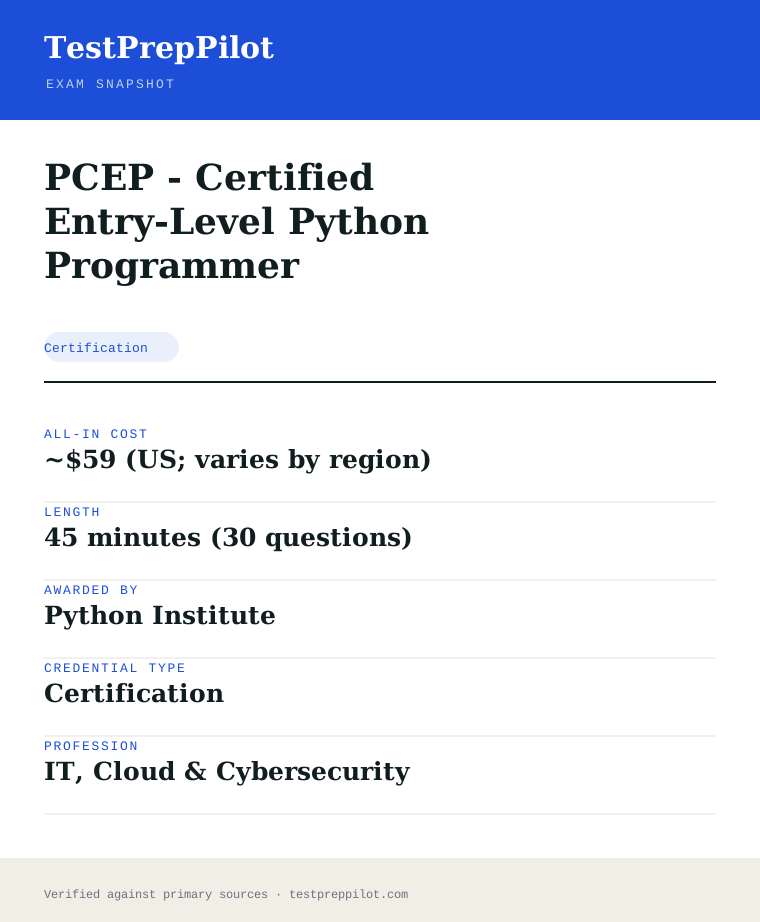
The short version
What is the PCEP - Certified Entry-Level Python Programmer and is it worth it?
PCEP - Certified Entry-Level Python Programmer is a professional credential administered by Python Institute. It validates job-ready knowledge and skills in the Technology field and is used for career entry, advancement, or compliance.
- Recognized credential from Python Institute
- Demonstrates verified competence in Technology
- Supports career advancement and may satisfy licensing or employer requirements
What is it?
What exactly is the PCEP - Certified Entry-Level Python Programmer?
PCEP - Certified Entry-Level Python Programmer — Technology credential from Python Institute
Entry-level Python Institute exam covering syntax, data types, control flow, functions, lists and basic error handling in Python. Offered by Python Institute, it is designed for candidates who need to demonstrate verified competence in the Technology field. The credential is commonly used for career entry, advancement, regulatory compliance, or employer requirements. Candidates should review the official handbook for eligibility, exam format, and scoring before registering.
The path in brief
- Confirm you meet any eligibility or prerequisites
- Review the official handbook and study materials
- Register and pay through the awarding body or authorized provider
- Schedule and take the exam (test center or online proctoring)
- Receive your score and, if passed, your credential
Before you book
Who is eligible to sit the PCEP - Certified Entry-Level Python Programmer?
Eligibility varies; many credentials are open to all, while others require coursework, work experience, or sponsorship.
Who it is for: Professionals and candidates seeking to validate Technology competence.
The test itself
What is the format of the PCEP - Certified Entry-Level Python Programmer?
The PCEP - Certified Entry-Level Python Programmer is administered by Python Institute and runs 45 minutes and contains 30 (all scored) questions.
| Administered by | Python Institute |
|---|---|
| Questions | 30 (all scored) |
| Time limit | 45 minutes |
| Pass mark | Passing score set by the awarding body; see the official score report |
| Exam fee | ~$59 (varies by region and delivery channel) |
| Format | Proctored, computer-based (test center or online remote proctoring) |
Content outline
What topics are on the PCEP - Certified Entry-Level Python Programmer?
The PCEP - Certified Entry-Level Python Programmer covers 4 content domains.
Weightings come from the official exam outline. Study time is best allocated in roughly these proportions rather than evenly across domains.
- Foundational concepts
Topic area tested on the exam; see the official blueprint for the detailed breakdown.
- Configuration & deployment
Topic area tested on the exam; see the official blueprint for the detailed breakdown.
- Security & compliance
Topic area tested on the exam; see the official blueprint for the detailed breakdown.
- Operations & troubleshooting
Topic area tested on the exam; see the official blueprint for the detailed breakdown.
The path
How do you register for the PCEP - Certified Entry-Level Python Programmer?
- 1
Visit the awarding body’s official website and create an account
- 2
Select the credential and review its specific requirements
- 3
Complete any required eligibility (education, experience, or training)
- 4
Pay the registration fee
- 5
Schedule the exam at a test center or online
- 6
Take the exam and receive your results
The fine print
What are the retake and renewal rules for the PCEP - Certified Entry-Level Python Programmer?
- Proctoring & delivery
- Proctored, computer-based delivery (test center or remote online proctoring), varying by exam.
- Retake policy
- Varies by credential — most bodies permit retakes after a waiting period and full or partial fee.
- Score reporting
- Scores are reported per the body’s timeline, typically electronically after the exam.
- Recertification
- Varies; many credentials require renewal every 2–3 years via continuing education or a recertification exam.
What it pays
How much does this credential pay?
$132,270 median for software developers (BLS, May 2024)
There is no Bureau of Labor Statistics occupation called "PCEP" — the PCEP-30-02 certifies entry-level Python programming skill, and the wage question belongs to the role you perform with it. The closest official BLS occupation is Software Developers, SOC 15-1252, which had a May 2024 median wage of $132,270, with the lowest 10 percent under $84,060 and the highest 10 percent above $208,500. The fit is direct but must be read with an honest caveat: PCEP is an entry-level literacy credential, so the realistic benchmark for a new holder is far below the developer median — the credential typically appears on the resume of a student, a career-changer or an IT professional adding scripting skill, and the developer wage applies only after the experience that the median describes. BLS counted 1,684,900 software developer jobs in 2024 and projects 17 percent growth from 2024 to 2034, far faster than the average for all occupations, with about 150,000 openings a year. The limitation to state plainly: the BLS median covers the whole occupation at all levels, credentialed or not, and an entry-level certificate carries no wage premium in BLS data. Read the number as the market for the occupation the certificate is a step toward.
| Measure | Figure | Source / note |
|---|---|---|
| Median annual wage, software developers | $132,270 | BLS OOH, SOC 15-1252, May 2024 |
| Lowest 10 percent | Under $84,060 | BLS OOH, SOC 15-1252, May 2024 |
| Highest 10 percent | Above $208,500 | BLS OOH, SOC 15-1252, May 2024 |
| Projected openings per year | ~150,000 | BLS OOH, SOC 15-1252, 2024-2034 |
Job growth.BLS projects 17 percent growth for software developers from 2024 to 2034, about 150,000 openings per year.
Source: BLS Occupational Outlook Handbook - Software Developers
Your odds
What are the pass rates?
The Python Institute publishes the passing standard — 70% (21 of 30) — and no cohort pass rate
The Python Institute (OpenEDG) does not publish cohort pass rates for the PCEP exam, and third-party estimates are not official data, so we do not treat them as authoritative. What the Python Institute does publish is the format and the passing standard: the PCEP-30-02 exam has 30 questions with a 45-minute time limit, and a passing score of 70 percent — at least 21 correct answers. The exam is delivered online through the OpenEDG Testing Service with proctoring, and the fee varies by region and purchasing channel, typically around $59 in the US at the time of writing. The exam content follows the published syllabus: computer programming and Python fundamentals, control flow, data collections (sequences, dictionaries, sets), functions and exceptions, and the basics of Python modules and packages. The absence of a published pass rate is not an absence of standards: the 70 percent line is an accessible bar for a genuinely entry-level exam, and the syllabus is narrow and clearly published. The practical reading: a beginner with a few weeks of consistent practice passes comfortably, and the credential's value is as a structured first step — the PCEP feeds directly into the PCAP (Certified Associate in Python Programming), which is the more career-relevant credential.
Read this before quoting the number.The Python Institute publishes the 70% cut score but no cohort pass rate; the fee varies by region and channel.
Source: Python Institute - PCEP Certified Entry-Level Python Programmer (PCEP-30-02)
Your schedule
How long should I study for it?
30-60 hours over 3-4 weeks of focused study
The PCEP-30-02 is a 30-question, 45-minute exam with a 70 percent passing line, and its syllabus is narrow: computer programming and Python fundamentals, control flow, data collections (sequences, dictionaries, sets), functions and exceptions, and the basics of modules and packages. The exam is genuinely entry-level — no prior programming is required — and the Python Institute's free course, "Python Essentials 1", covers the entire syllabus. A defensible plan runs 30 to 60 hours over 3 to 4 weeks. Week one: work the Python Essentials 1 course and the fundamentals — variables, operators, data types and input/output. Week two: control flow — conditionals, loops and the logic the exam tests with code-tracing items. Week three: collections, functions, exceptions and modules, writing small programs to practise each. Week four: drill the sample questions and practice exams, then schedule the online exam. The plan is code-heavy because the exam includes code-tracing items — you must read code and determine its output — so typing the examples and experimenting with variations is the core practice.
- Week 112
Fundamentals
- Python Essentials 1 course material
- Variables, operators, data types
- Input/output and basic programs
- Week 212
Control flow
- Conditionals and loops
- Code-tracing practice
- Logic and comparison operators
- Week 314
Collections, functions, modules
- Sequences, dictionaries and sets
- Functions, exceptions and modules
- Small programs for each topic
- Week 410
Drill and exam
- Sample questions and practice exams
- Review weak syllabus sections
- Schedule and sit the online exam
Adjusting the pace
Experienced programmer, new to Python.Compress to 2 weeks; focus on Python-specific syntax and the exam style.
Complete beginner.Stretch to 5-6 weeks; the exam rewards writing and tracing code, not just reading.
How to study
How do I prepare most effectively?
The PCEP exam rewards code literacy, so the dominant strategy is writing and tracing code: type every example from the course, run it, and predict the output before you run it, because the exam includes code-tracing items that test exactly that skill. Second, use the free Python Essentials 1 course as the primary resource — it is the official syllabus in course form, and the exam is built from it. Third, master the exam's item style through the sample questions and practice exams the Python Institute publishes; the 70 percent line is accessible, but the code-tracing format should not be met cold. Fourth, learn the specific Python details the exam tests — how slice notation works, how range() behaves, the difference between lists and tuples, and how exceptions propagate — because entry exams concentrate on the language's exact behaviour. Finally, plan the path: the PCEP is the first rung, and the PCAP (associate-level) is the credential that matters for employment; treat the PCEP as structured momentum, not the destination.
Write and trace code
Predict output before running; the exam tests code tracing.
Use the free official course
Python Essentials 1 is the syllabus in course form.
Learn the exact language details
Slices, range(), list-vs-tuple and exception behaviour are tested precisely.
Practise the item style
Sample questions and practice exams prevent a cold first meeting.
Plan for the PCAP
The PCEP is the first rung; the associate credential matters for jobs.
What to buy
Which study resources are worth paying for?
PCEP prep is inexpensive because the primary resource is free: the Python Institute's Python Essentials 1 course covers the whole syllabus at no cost, and the published sample questions and practice exams are free or low-cost. The exam fee itself is typically about $59 in the US, varying by region and purchasing channel. Third-party options — Python books ($30-$60), Udemy-style courses ($10-$50) and practice-question sites — add value but are optional; the free official stack is sufficient for a disciplined beginner. A realistic total budget is $60 to $150 including the exam fee. Prices below are list prices as of mid-2026 and change frequently; we rank nothing by commission.
| Resource | Price | Format | Best for |
|---|---|---|---|
| Python Essentials 1 course | Free | Official online course | The entire syllabus; the primary resource |
| Published sample questions | Free | Official practice items | The item style before the exam |
| Python books | $30-$60 | Printed or digital books | Reference and depth beyond the course |
| Video courses | $10-$50 | Online video courses | Alternate explanations for beginners |
| PCEP exam | ~$59 (US) | Proctored online exam | The certification itself |
List prices as of mid-2026, subject to change; the exam fee varies by region and channel; no commission or affiliate ranking is implied.
Avoid these
What mistakes do candidates most often make?
The most common PCEP mistake is reading about Python instead of writing it: candidates who watch courses but never type code meet the code-tracing items unable to predict output. The fix is typing and running every example. The second mistake is memorising syntax without learning the language's exact behaviour — slice bounds, range() endpoints and exception propagation are tested precisely, and fuzzy understanding costs points. Third, beginners skip the sample questions and meet the item style cold; the format is learnable, so practise it. Fourth, some candidates over-prepare for a 30-question entry exam and under-prepare the career step: the PCEP is the first rung, and the time is better invested with the PCAP in mind. Finally, underestimating the exam because it is entry-level is a quiet trap — the 70 percent line is accessible but not free, and code-tracing items punish candidates who never ran the code.
✕Reading instead of coding
✓Type and run every example; predict output before running.
✕Fuzzy language details
✓Learn slice bounds, range() and exception behaviour exactly.
✕Skipping the sample questions
✓Practise the item style; do not meet it cold.
✕Under-planning the career step
✓Treat the PCEP as momentum toward the PCAP.
✕Underestimating the exam
✓The 70% line is accessible but not free; code-tracing rewards practice.
What you'll face
What question types will I see?
The PCEP-30-02 is a 30-question multiple-choice exam in 45 minutes, delivered online under proctoring. The items mix knowledge questions — Python syntax and language behaviour — with code-tracing items that present a short program and ask for the output, and code-completion items that ask for the correct expression. The exam covers the published syllabus: fundamentals, control flow, data collections, functions and exceptions, and modules. Samples below are editor-written illustrations of the published syllabus, not live exam items; they show the code-tracing style of the real items.
Short programs with the correct output or behaviour.
Syntax, operators and language rules.
The correct expression or construct for a described result.
Try these
Q1What is the output of the following code? print(2 ** 3 + 1)
Answer:A
The exponentiation operator binds before addition: 2 ** 3 = 8, then 8 + 1 = 9. Answer B forgets the addition, and the others misapply the precedence.
Q2Which expression returns the last character of the string s?
Answer:A
Negative indexing counts from the end, so s[-1] is the last character. s[1] is the second, s[len(s)] is out of range, and s[0] is the first.
Q3What is the output of the following code? for i in range(1, 4): print(i, end=" ")
Answer:A
range(1, 4) produces the values 1, 2 and 3 — the stop value is exclusive. Answer B includes 4, C starts at 0, and D reverses the order.
Samples are editor-written illustrations of the published syllabus, not live exam items.
The big day
What should I expect on exam day?
The PCEP exam is taken online through the OpenEDG Testing Service with proctoring, at a time you schedule. Confirm your system meets the proctoring requirements — webcam, stable internet and a quiet space — and close unrelated applications; the proctor monitors the session. The exam is 30 questions in 45 minutes, so pace at 90 seconds per item; there is no scheduled break. Your result is reported immediately on completion, and the Python Institute issues the digital certificate on a pass. If you do not pass, you can retake per the program's retake policy after additional study. On a pass, the certification is permanent — it does not expire — and you can proceed directly to the PCAP (associate) level. The afterwards matters: the credential is a foundation, so move to the PCAP while the language is fresh, and add your work to a portfolio of small programs that demonstrates the skill behind the certificate.
Bring
- Computer with webcam and stable internet
- A quiet, private testing space
- Your OpenEDG account login
Leave at home
- Phone and other devices within the proctor's view
- Notes and open browser tabs — the exam is closed book
How the day runs
Rules in the room
- Closed-book online exam under proctoring
- 45 minutes for 30 questions; the clock does not pause
- The certification does not expire
Afterwards.On a pass, your PCEP is permanent; proceed to the PCAP. On a fail, retake per the policy after additional code practice.
Reference
What are the key facts about the PCEP - Certified Entry-Level Python Programmer?
PCEP - Certified Entry-Level Python Programmer is a certification credential; awarded by Python Institute; the exam fee is ~$59 (varies by region and delivery channel); typical preparation is 45 minutes (30 questions); holders typically earn $60,000-$100,000.
| Credential | PCEP - Certified Entry-Level Python Programmer |
|---|---|
| Abbreviation | PCEP |
| Type | Certification |
| Profession | IT, Cloud & Cybersecurity |
| Specialty | Programming & Development |
| Awarded by | Python Institute |
| Difficulty | Intermediate |
| Typical prep time | 45 minutes (30 questions) |
| All-in cost | ~$59 (US; varies by region) |
| Typical salary range | $60,000-$100,000 |
| Credential | PCEP - Certified Entry-Level Python Programmer |
| Awarding body | Python Institute |
| Exam format | Proctored, computer-based |
| Validity | The PCEP does not expire. |
| Languages | Varies — see awarding body |
| Scope | National / Multi-state |
| Also known as | PCEP-30-02 |
Real questions
Frequently asked questions about the PCEP - Certified Entry-Level Python Programmer
How do I register for the PCEP - Certified Entry-Level Python Programmer exam?
Register through Python Institute's official portal or an authorized test provider (e.g., Pearson VUE or Prometric where applicable). Create an account, select the exam, pay the fee, and schedule a date.
How much does the exam cost?
Fees vary by location and currency. Confirm the current fee on the official registration page before scheduling.
How long is the credential valid, and how do I renew?
The PCEP certification does not expire — it is a lifetime entry credential; the next step on the Python Institute track is the PCAP (Certified Associate in Python Programming).
What if I do not pass?
Most bodies allow retakes after a waiting period and payment of the full or partial fee. Check Python Institute's retake policy before rescheduling.
How do I register for a Python Institute credential?
Register through the official website, select your exam, pay the fee, and schedule a date.
How do I renew a credential?
Renewal policies vary by credential; check the specific program page for requirements and cycles.
In short
Is the PCEP - Certified Entry-Level Python Programmer worth it?
- PCEP - Certified Entry-Level Python Programmer is awarded by Python Institute.
- Validates job-ready competence in Technology.
- Registration is through the awarding body or an authorized test provider.
- Renewal and retake policies vary — confirm before scheduling.
Same awarding body
What other credentials does Python Institute award?
Worth comparing
How does the PCEP - Certified Entry-Level Python Programmer compare with similar credentials?
Trust
Where does this information come from?
Everything above is taken from the awarding body's own published material. Fees, question counts and domain weights are revised regularly — check the official page before you pay.
- Python Institute Awarding body
Research confidence: low · Last reviewed 2026-08