Food Safety & Hospitality • Certification
WSET Level 3 Award in Wines
WSET Level 3 Award in Wines — Beauty, Food, Security & Recreation credential from Wine & Spirit Education Trust
Researched and maintained by TestPrepPilot Editorial BoardWine & hospitality education desk · Figures last verified August 2026
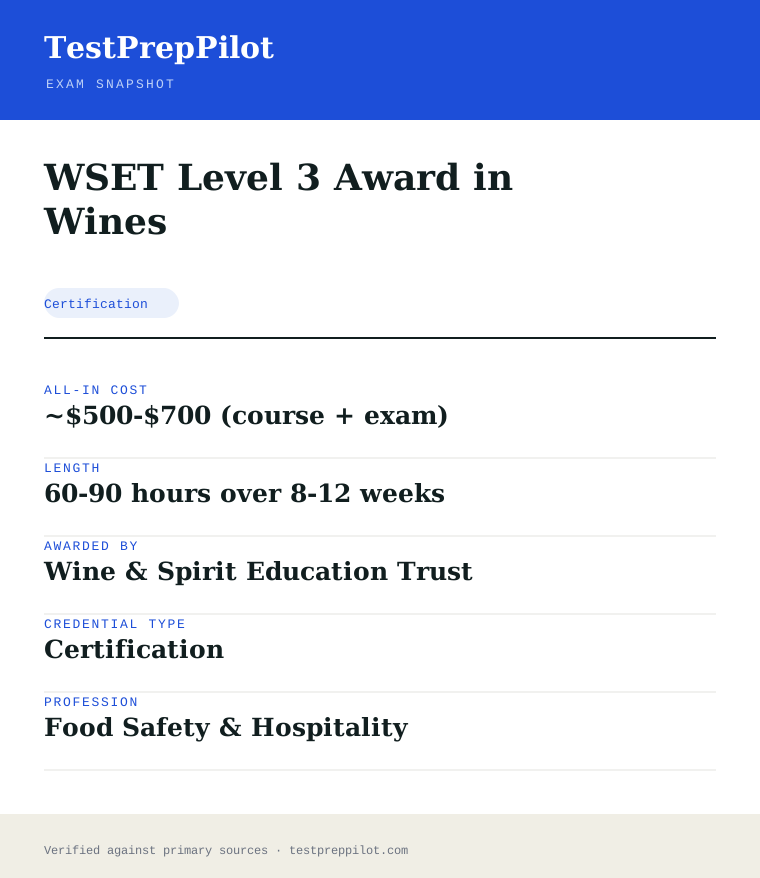
The short version
What is the WSET Level 3 Award in Wines and is it worth it?
WSET Level 3 Award in Wines is a professional credential administered by Wine & Spirit Education Trust. It validates job-ready knowledge and skills in the Beauty, Food, Security & Recreation field and is used for career entry, advancement, or compliance.
- Recognized credential from Wine & Spirit Education Trust
- Demonstrates verified competence in Beauty, Food, Security & Recreation
- Supports career advancement and may satisfy licensing or employer requirements
What is it?
What exactly is the WSET Level 3 Award in Wines?
WSET Level 3 Award in Wines — Beauty, Food, Security & Recreation credential from Wine & Spirit Education Trust
Advanced wine qualification with multiple-choice, short-written and blind tasting papers on production factors and style drivers. Offered by Wine & Spirit Education Trust, it is designed for candidates who need to demonstrate verified competence in the Beauty, Food, Security & Recreation field. The credential is commonly used for career entry, advancement, regulatory compliance, or employer requirements. Candidates should review the official handbook for eligibility, exam format, and scoring before registering.
The path in brief
- Confirm you meet any eligibility or prerequisites
- Review the official handbook and study materials
- Register and pay through the awarding body or authorized provider
- Schedule and take the exam (test center or online proctoring)
- Receive your score and, if passed, your credential
Before you book
Who is eligible to sit the WSET Level 3 Award in Wines?
Eligibility varies; many credentials are open to all, while others require coursework, work experience, or sponsorship.
Who it is for: Professionals and candidates seeking to validate Beauty, Food, Security & Recreation competence.
The test itself
What is the format of the WSET Level 3 Award in Wines?
The WSET Level 3 Award in Wines is administered by Wine & Spirit Education Trust and runs 1h + 45m + 45m and contains 50 MC + 2 short-answer papers questions.
| Administered by | Wine & Spirit Education Trust |
|---|---|
| Questions | 50 MC + 2 short-answer papers |
| Time limit | 1h + 45m + 45m |
| Pass mark | Passing score set by the awarding body; see the official score report |
| Exam fee | Included in the course fee |
| Format | Proctored, computer-based (test center or online remote proctoring) |
Content outline
What topics are on the WSET Level 3 Award in Wines?
The WSET Level 3 Award in Wines covers 4 content domains.
Weightings come from the official exam outline. Study time is best allocated in roughly these proportions rather than evenly across domains.
- Core techniques
Topic area tested on the exam; see the official blueprint for the detailed breakdown.
- Sanitation & safety
Topic area tested on the exam; see the official blueprint for the detailed breakdown.
- Client / guest service
Topic area tested on the exam; see the official blueprint for the detailed breakdown.
- Regulations
Topic area tested on the exam; see the official blueprint for the detailed breakdown.
The path
How do you register for the WSET Level 3 Award in Wines?
- 1
Visit the awarding body’s official website and create an account
- 2
Select the credential and review its specific requirements
- 3
Complete any required eligibility (education, experience, or training)
- 4
Pay the registration fee
- 5
Schedule the exam at a test center or online
- 6
Take the exam and receive your results
The fine print
What are the retake and renewal rules for the WSET Level 3 Award in Wines?
- Proctoring & delivery
- Proctored, computer-based delivery (test center or remote online proctoring), varying by exam.
- Retake policy
- Varies by credential — most bodies permit retakes after a waiting period and full or partial fee.
- Score reporting
- Scores are reported per the body’s timeline, typically electronically after the exam.
- Recertification
- Varies; many credentials require renewal every 2–3 years via continuing education or a recertification exam.
What it pays
How much does this credential pay?
No dedicated occupation — Level 3 is the sommelier-track standard, and the roles it feeds sit inside food service management at $65,310 median (BLS, May 2024) and the wine-touching tiers above it in fine dining
The direct answer is that WSET Level 3 has no BLS occupation of its own — it is the industry-recognised advanced wine qualification for hospitality and retail professionals, not a licence — and the roles it supports are classified by BLS within food service management (SOC 35-3031, May 2024 median $65,310) and the serving occupations (bartenders, SOC 35-3011, median $33,530). The honest salary story is that Level 3 is the point where the credential becomes a career marker: while Level 2 is the qualification many restaurants list for roles that touch wine, Level 3 — the Award in Wines at the advanced level — is the qualification many sommelier, wine-buying and wine-programme positions list, and it is the standard on the sommelier and beverage-management track toward the WSET Diploma. Because BLS has no separate sommelier code, the income effect shows up in the fine-dining and management tiers within the food service categories — wine directors and beverage managers in upscale venues earn well above the occupation medians, though no government series isolates them. BLS projects about 6 percent growth for food service managers from 2024 to 2034, with about 42,000 openings a year. The practical read: invest in Level 3 if you are working in or entering a wine-touching role with serious intent — it typically costs $600 to $900 including the exam, demands a minimum of 51.5 hours of private study on top of the guided hours, and signals a level of wine competence that differentiates you from the general hospitality pool and prepares the Diploma step. The progression that compounds the value runs Level 2 to Level 3 (the sommelier-track standard) and then to Level 4 Diploma for serious wine-careerists, and Level 3 is explicitly the prerequisite for the Diploma. For a candidate deciding between the levels, Level 3 is where the credential transitions from "holds the recognised qualification" to "on the professional wine track."
| Measure | Figure | Source / note |
|---|---|---|
| Median annual wage, food service managers | $65,310 | BLS OOH, May 2024 (SOC 35-3031) |
| Median annual wage, bartenders | $33,530 | BLS OOH, May 2024 (SOC 35-3011) |
| Projected growth, food service managers, 2024-34 | +6% | BLS Employment Projections, ~42,000 openings/yr |
| The qualification itself | No direct occupation | Industry-recognised advanced wine qualification, the sommelier-track standard |
Job growth.BLS projects about 6% growth for food service managers from 2024 to 2034; sommelier and wine-programme roles sit within these occupation categories and the fine-dining tiers above them.
Source: BLS OOH — Food Service Managers
Your odds
What are the pass rates?
WSET publishes no pass rate for Level 3 — it publishes the pass marks (55% on both parts of the theory paper and 55% combined on the tasting), and the qualification specification is the authoritative document; treat any online pass-rate percentage as an estimate
The core fact is that WSET does not publish pass rates for the Level 3 Award in Wines, and no independent national figure exists, so treat online percentages — such as the "55 to 60 percent globally" figures circulating on prep sites — as unofficial estimates rather than published statistics. What WSET does publish is the assessment structure and the pass marks, which are the numbers that matter for planning. The assessment is split into two units examined in person on the same day. Unit 1 is a closed-book theory exam in two parts, completed in two hours: Part 1 is 50 multiple-choice questions assessing knowledge and understanding across the unit, and Part 2 is a short-answer paper of four questions worth 25 marks each, assessing the ability to apply that knowledge; you must attain a minimum mark of 55 percent in both parts to pass Unit 1. Unit 2 is a blind tasting of two still wines completed in 30 minutes, using the WSET Systematic Approach to Tasting, and you must attain a combined mark of 55 percent across the two wines. Overall results are reported in bands — Pass at a mean average of 55 to 64 percent, Pass with Merit at 65 to 79 percent, and Pass with Distinction at 80 percent or above with no individual paper below 65 percent — and results arrive approximately 10 weeks after the exam. The preparation implication is clear: the 55 percent line on each part of Unit 1, plus the separate 55 percent tasting line, means candidates must prepare for three distinct challenges — the recall of the 50 multiple-choice items, the structured writing of the four short-answer questions, and the descriptor discipline of the blind tasting — and a pass on one does not carry the others.
Read this before quoting the number.No official pass rate is published by WSET. What is published is the assessment structure: 50 multiple-choice questions plus four short-answer questions in the closed-book theory paper (55% needed in both parts), and a two-wine blind tasting (55% combined), with overall bands of pass, merit and distinction.
Source: WSET — Level 3 Award in Wines
Your schedule
How long should I study for it?
60-90 study hours (WSET specifies a minimum of 51.5 hours of private study plus guided tuition) of focused study
Plan for 8 to 12 weeks and 60 to 90 hours of study, of which WSET specifies a minimum of 51.5 hours of private study on top of the guided tuition, because Level 3 is a demanding qualification with three distinct assessment challenges — 50 multiple-choice questions, four short-answer questions, and a two-wine blind tasting — and a 55 percent line on each. The syllabus covers the key factors in wine production (location, grape growing, winemaking, maturation and bottling); the principal still, sparkling and fortified wines of the world by region; how to make appropriate wine recommendations; and the WSET Level 3 Systematic Approach to Tasting. The most effective sequence is: first, read the official study guide and course specification cover to cover, highlighting the region-grape-style-quality facts; second, build a region-by-region reference for the old and new world, since the short-answer paper is scenario-based and rewards specific, accurate region detail; third, drill the multiple-choice style against provider sample questions to hold the 55 percent line; fourth, practise the short-answer format specifically — the four questions are marked on specific factual descriptors, so learn to answer the command verbs (identify, describe, explain) and to structure answers to extract maximum marks; and fifth, build reference tastings into the plan, because the tasting paper is failed disproportionately by candidates who read about wines but never practised describing them against the published SAT grid. In the final weeks, run a timed practice of the whole paper — the theory questions in two hours and the two-wine tasting in 30 minutes — and confirm the exam date, results timing and provider logistics with your course provider. The most common study error is over-weighting famous regions and under-preparing the short-answer writing skill and the tasting discipline, which are the two places Level 3 candidates actually lose the qualification.
- Weeks 1-410-12 hrs/week
Syllabus coverage
- Read the official study guide and course specification cover to cover
- Build region-by-region reference sheets: grape, style, climate, soil, quality factors
- Study the factors in production: location, grape growing, winemaking, maturation, bottling
- Cover sparkling and fortified wines in depth — a dependable share of the paper
- Weeks 5-78-10 hrs/week
Multiple-choice drilling and short-answer technique
- Drill provider sample multiple-choice questions to hold the 55% line
- Practise the four short-answer question types: describe, explain, compare, recommend
- Learn the command verbs and how to structure an answer for maximum marks
- Map every practice answer against the mark scheme style
- Weeks 8-98-10 hrs/week
Tasting practice and timed rehearsal
- Practise blind tasting against the published SAT grid with reference wines
- Run a timed rehearsal of the theory paper (2 hours) and the tasting (30 minutes)
- Re-study the weakest regions and production topics
- Confirm the exam date, venue and results timing with the provider
Adjusting the pace
Coming straight from Level 2.The intended path. Use the Level 2 base and focus the extra hours on the short-answer writing skill and the blind tasting, which Level 2 does not test.
Entering via the Online Entry Test.If you hold the knowledge but not Level 2, pass the Level 3 Online Entry Test first, then follow the full plan — the entry test is a gate, not a substitute for the Level 3 study.
Working full-time.Stretch to 12-14 weeks at 5-8 hours a week, and schedule reference tastings on weekends — the tasting skill cannot be built by reading alone.
How to study
How do I prepare most effectively?
The strategy that reliably passes WSET Level 3 is "cover the whole specification, practise the short-answer writing skill, and build real tasting discipline," because the qualification has three separate 55 percent lines and a pass on the multiple-choice part does not carry the others. A second proven approach is treating the short-answer paper as a skill to be drilled: the four questions are marked on specific factual descriptors, and most candidates lose marks not because they lack knowledge but because they do not format answers to extract the points — learn the command verbs (identify, describe, explain) and match the detail to the marks. Third, give the production-factors content its due, because the style-quality-price questions reward understanding how climate, soil, grape growing and winemaking choices produce the wine in the glass. Fourth, build reference tastings into the plan: the tasting paper is failed disproportionately by candidates who never practised describing wines against the published SAT grid, and generic descriptors earn partial or zero credit where specific, evidence-based descriptors earn full marks. Fifth, drill sparkling and fortified wines as a dedicated block, since they are a consistent share of the paper and easy points once learned. Finally, use the margin honestly: 55 percent on each part is forgiving enough that when a question genuinely stumps you, eliminate obviously wrong options, guess and move on rather than burning time — but the three separate lines mean no single strength can rescue a weak part, so prepare all three.
Prepare for three separate pass lines
50 multiple-choice, four short-answer questions, and a two-wine blind tasting each carry a 55% line. A strong multiple-choice performance does not rescue a weak tasting or a weak written paper.
Drill the short-answer format
The four questions are marked on specific factual descriptors. Learn the command verbs — identify, describe, explain — and structure answers to extract maximum marks; this is where most candidates lose the qualification.
Own the production-factors content
Style, quality and price questions reward understanding how location, grape growing, winemaking, maturation and bottling produce the wine. Study the chain of cause and effect.
Build real tasting discipline
Practise blind tasting against the published SAT grid with reference wines. Specific, evidence-based descriptors earn full marks; generic ones earn partial or zero credit.
Drill sparkling and fortified as a block
A consistent share of the paper and easy points once learned — do not let the less glamorous syllabus sections go unstudied.
Use the 55% margin honestly
The line is forgiving enough to guess and move on when stumped — but only if the other two parts are genuinely prepared, because each carries its own pass mark.
What to buy
Which study resources are worth paying for?
WSET Level 3 pricing runs roughly $600 to $900 through approved program providers, with the official study guide and course specification included, and those official materials are the authoritative study source — the exam is drawn from the specification, and the tasting is scored against the published SAT grid. The comparison below separates the official course, the official materials, and optional reinforcement, with prices current to this review. The buying rule is to choose an approved program provider (APF/APP), treat the study guide and specification as the syllabus, and spend the real budget on reference wines for tasting practice rather than on third-party content.
| Resource | Price | Format | Best for |
|---|---|---|---|
| WSET Level 3 course + exam (approved provider) | ~$600-900 | Multi-day class or guided study + in-person exam | The qualification itself — only approved providers can deliver it |
| Official Level 3 study guide and specification | Included | Book + specification PDF | The exact syllabus the exam and the SAT grid are drawn from |
| Provider sample questions | Included | Practice papers | Confirming the 55% line on the multiple-choice and short-answer parts |
| Reference wines for tasting practice | ~$100-300 depending on the set | Tasting flights | Building the tasting discipline the Unit 2 paper rewards |
| WSET Level 4 Diploma (next step) | ~$3,000-6,000 across units | Multi-unit advanced course | The serious wine-career step that Level 3 is the prerequisite for |
Prices approximate and dated to this review; only WSET-approved program providers can deliver the exam, and course fees vary by provider and region. We do not rank by commission.
Avoid these
What mistakes do candidates most often make?
The most common mistake on WSET Level 3 is treating it like a bigger Level 2 — an assumption that fails because Level 3 adds two challenges Level 2 never tests: the short-answer written paper and the blind tasting, each with its own 55 percent line. The second is under-preparing the short-answer technique: most candidates lose marks not from a lack of knowledge but from answers that do not match the mark scheme — generic statements earn less than specific, structured, evidence-based descriptors. A third recurring error is skipping reference tastings and reading about wine instead of tasting it, which is the single most common cause of failing Unit 2. Candidates also routinely over-weight famous regions and under-study sparkling, fortified and the less glamorous syllabus sections, and many book the exam before finishing the specification, converting a fair pass line into a guessing exercise. Finally, some candidates neglect the results timing — results take approximately 10 weeks — and plan a job or career step around a result that has not arrived.
✕Treating it like a bigger Level 2
✓Level 3 adds the short-answer paper and the blind tasting, each with its own 55% line. Budget real study time for the writing skill and the tasting discipline, not just more multiple-choice drilling.
✕Answering short answers without the mark scheme in mind
✓The four questions are marked on specific factual descriptors. Learn the command verbs and structure each answer to the marks — specific, evidence-based points beat generic statements.
✕Reading about wine instead of tasting it
✓The tasting paper rewards descriptor discipline against the SAT grid. Build reference tastings into the plan — candidates who never practised tasting are the ones who fail Unit 2.
✕Over-weighting famous regions
✓Sparkling, fortified and the less glamorous syllabus sections are a consistent share of the paper. Cover the whole specification rather than the regions you enjoy.
✕Booking the exam before finishing the specification
✓The exam is drawn from the specification and the SAT grid. Finish the study guide, a timed theory rehearsal and a tasting rehearsal before scheduling the sitting.
✕Ignoring the results timing
✓Results take approximately 10 weeks after the exam. Plan any job or career step around that window rather than expecting an immediate result.
What you'll face
What question types will I see?
The WSET Level 3 Award in Wines assessment is split into two units examined in person on the same day. Unit 1 is a closed-book theory exam in two parts, completed in two hours: Part 1 is 50 multiple-choice questions assessing knowledge and understanding, and Part 2 is a short-answer paper of four questions worth 25 marks each, assessing the ability to apply knowledge — you must attain 55 percent in both parts. Unit 2 is a blind tasting of two still wines in 30 minutes, scored against the WSET Level 3 Systematic Approach to Tasting, with 55 percent combined required. The multiple-choice items test recall of regions, grapes, styles and production factors; the short-answer questions present region or production scenarios and ask candidates to describe, explain, compare or recommend; and the tasting rewards specific, evidence-based descriptors. The samples below are editor-written illustrations of the published specification, not live exam items.
Recall of regions, grapes, styles, production factors, and sparkling and fortified wines across the whole specification.
Region or production scenarios requiring structured written answers — describe the factors, explain the style, compare two regions, recommend a wine — marked on specific factual descriptors.
Systematic description of appearance, nose and palate using the SAT grid, with conclusions on quality and readiness for drinking — scored on specific, evidence-based descriptors.
Try these
Q1Which grape variety and region pairing is correct for Sancerre?
Answer:B
B is correct — Sancerre is the crisp, aromatic Sauvignon Blanc of the Upper Loire (the Central Vineyards), and the region-grape pairing is a core Level 3 recall item. A is wrong because Chablis is Chardonnay in Burgundy, not Sancerre. C is wrong because Alsace Riesling is a different region-grape pairing. D is wrong because Vouvray is Chenin Blanc, also in the Loire but a different style and grape. The item tests the region-grape-style mapping that the multiple-choice paper leans on.
Q2Explain how the climate and soil of a region can influence the style and quality of the wines produced there. (6 marks)
Answer:B
B is the structure a full-marks short answer needs — it links specific climate factors (temperature, rainfall, sunshine) and soil characteristics (drainage, heat retention) to how the grapes ripen and how the resulting wine style and quality follow, which is what the mark scheme rewards. A, C and D are wrong because they earn partial or minimal credit: naming a region, a general statement, or a grape list does not explain the cause-and-effect chain the question commands. The item illustrates the short-answer format, where specific, structured, evidence-based answers extract the marks.
Q3During a blind tasting, a wine shows a deep ruby colour, pronounced aromas of dark fruit and spice, high tannins, full body and high alcohol. Which of the following is the most likely conclusion about its style?
Answer:B
B is the logical conclusion from the evidence — deep colour, dark fruit and spice, high tannins, full body and high alcohol describe a full-bodied red wine from a warm or ripe vintage. A is wrong because the descriptors are clearly red (deep ruby, high tannins), not white. C is wrong because there is no mention of bubbles or a sparkling character. D is wrong because while high alcohol fits fortified wines, the other descriptors describe still red wine, not a sweet fortified style. The item illustrates the tasting-conclusion style, where the SAT descriptors drive the quality and style conclusions.
Samples are editor-written illustrations of the published specification, not live exam items.
The big day
What should I expect on exam day?
The WSET Level 3 exam day is an in-person sitting at your approved provider, with both units examined on the same day and a short break between the papers: Unit 1, the closed-book theory exam of 50 multiple-choice questions and four short-answer questions, is completed in two hours, and Unit 2, the blind tasting of two still wines, in 30 minutes, and you must pass both units. Bring photo ID and nothing else, because the exam is closed-book — no notes, no phones, no reference material — and arrive on time, since the papers are timed together. The core rules: write answers by hand for the short-answer paper (a good level of written English is expected), answer all 50 multiple-choice questions since there is no penalty for a wrong guess, and pace the tasting using the SAT grid and the two-wine time budget. The most useful exam-day habits: in the multiple-choice part, aim to finish with margin so the short-answer part has your full attention; in the short-answer part, match the detail to the marks and use the command verbs; and in the tasting, describe what you actually observe in SAT terms rather than what you hope the wine is. Results arrive approximately 10 weeks after the exam, reported as pass, merit or distinction, and certificates and lapel pins follow — with digital certificates and badges now standard since August 2025. After the paper, if you are on the sommelier or buying track, plan the Level 4 Diploma step, because Level 3 is its stated prerequisite.
Bring
- Photo ID
- Arrive on time for the in-person sitting
- Writing materials if your provider does not supply them
Leave at home
- Study notes, phones and reference material — the theory exam is closed-book
- The Level 2 assumption that the exam is multiple-choice only
- Any expectation of same-day results — results take approximately 10 weeks
How the day runs
Rules in the room
- Unit 1 is closed-book: 50 multiple-choice questions and four short-answer questions in two hours.
- Unit 2 is a blind tasting of two still wines in 30 minutes.
- You must attain 55% in both parts of Unit 1 and 55% combined on Unit 2 to pass.
- Photo ID is required; notes, phones and reference material are not permitted.
- Results take approximately 10 weeks and are reported as pass, merit or distinction.
Afterwards.Passing earns the WSET Level 3 Award in Wines — the sommelier-track standard — with the overall band (pass, merit or distinction) reported approximately 10 weeks after the exam, followed by the certificate and lapel pin, and digital certificates and badges have been standard since August 2025. The qualification signals a level of wine competence that differentiates you in hospitality and retail wine roles, and for a serious wine career the natural next step is the WSET Level 4 Diploma, for which Level 3 is the stated prerequisite — plan that step and the study time it demands. If you fell short, use the results to target the failed part: the three separate 55 percent lines mean the fix is specific — more recall drilling if the multiple-choice failed, mark-scheme practice if the short answers failed, or reference tastings if the tasting failed — and a resit targets the weak unit rather than the whole qualification. Whichever way it goes, the Level 3 sits inside the hospitality economy that BLS reports at a $65,310 food-service-manager median with 6 percent growth, and the wine-touching tiers above it in fine dining are where the credential compounds into career earnings.
Reference
What are the key facts about the WSET Level 3 Award in Wines?
WSET Level 3 Award in Wines is a certification credential; awarded by Wine & Spirit Education Trust; the exam fee is Included in the course fee; typical preparation is 60-90 hours over 8-12 weeks; holders typically earn $30,000-$80,000 (35-3031 median $65,310 for managers).
| Credential | WSET Level 3 Award in Wines |
|---|---|
| Type | Certification |
| Profession | Food Safety & Hospitality |
| Specialty | Food Safety & Culinary |
| Awarded by | Wine & Spirit Education Trust |
| Difficulty | Entry to Applied |
| Typical prep time | 60-90 hours over 8-12 weeks |
| All-in cost | ~$500-$700 (course + exam) |
| Typical salary range | $30,000-$80,000 (35-3031 median $65,310 for managers) |
| Credential | WSET Level 3 Award in Wines |
| Awarding body | Wine & Spirit Education Trust |
| Exam format | Proctored, computer-based |
| Validity | WSET certification is permanent (Level 3) |
| Languages | Varies — see awarding body |
| Scope | National / Multi-state |
Real questions
Frequently asked questions about the WSET Level 3 Award in Wines
How do I register for the WSET Level 3 Award in Wines exam?
Register through Wine & Spirit Education Trust's official portal or an authorized test provider (e.g., Pearson VUE or Prometric where applicable). Create an account, select the exam, pay the fee, and schedule a date.
How much does the exam cost?
Fees vary by location and currency. Confirm the current fee on the official registration page before scheduling.
How long is the credential valid, and how do I renew?
Validity varies by credential (commonly 2–3 years). Renewal usually requires continuing education or a recertification exam — see Wine & Spirit Education Trust's policy.
What if I do not pass?
Most bodies allow retakes after a waiting period and payment of the full or partial fee. Check Wine & Spirit Education Trust's retake policy before rescheduling.
How do I register for a Wine & Spirit Education Trust credential?
Register through the official website, select your exam, pay the fee, and schedule a date.
How do I renew a credential?
Renewal policies vary by credential; check the specific program page for requirements and cycles.
In short
Is the WSET Level 3 Award in Wines worth it?
- WSET Level 3 Award in Wines is awarded by Wine & Spirit Education Trust.
- Validates job-ready competence in Beauty, Food, Security & Recreation.
- Registration is through the awarding body or an authorized test provider.
- Renewal and retake policies vary — confirm before scheduling.
Same awarding body
What other credentials does Wine & Spirit Education Trust award?
Worth comparing
How does the WSET Level 3 Award in Wines compare with similar credentials?
Trust
Where does this information come from?
Everything above is taken from the awarding body's own published material. Fees, question counts and domain weights are revised regularly — check the official page before you pay.
Research confidence: low · Last reviewed 2026-08