Food Safety & Hospitality • Training
Learn2Serve Alcohol Seller-Server Training
Learn2Serve Alcohol Seller-Server Training — Beauty, Food, Security & Recreation credential from 360training
Researched and maintained by TestPrepPilot Editorial BoardFood safety & hospitality certifications desk · Figures last verified August 2026
The short version
What is the Learn2Serve Alcohol Seller-Server Training and is it worth it?
Learn2Serve Alcohol Seller-Server Training is a professional credential administered by 360training. It validates job-ready knowledge and skills in the Beauty, Food, Security & Recreation field and is used for career entry, advancement, or compliance.
- Recognized credential from 360training
- Demonstrates verified competence in Beauty, Food, Security & Recreation
- Supports career advancement and may satisfy licensing or employer requirements
What is it?
What exactly is the Learn2Serve Alcohol Seller-Server Training?
Learn2Serve Alcohol Seller-Server Training — Beauty, Food, Security & Recreation credential from 360training
National responsible alcohol service course on intoxication signs, age verification and liability, with separate state-approved versions. Offered by 360training, it is designed for candidates who need to demonstrate verified competence in the Beauty, Food, Security & Recreation field. The credential is commonly used for career entry, advancement, regulatory compliance, or employer requirements. Candidates should review the official handbook for eligibility, exam format, and scoring before registering.
The path in brief
- Confirm you meet any eligibility or prerequisites
- Review the official handbook and study materials
- Register and pay through the awarding body or authorized provider
- Schedule and take the exam (test center or online proctoring)
- Receive your score and, if passed, your credential
Before you book
Who is eligible to sit the Learn2Serve Alcohol Seller-Server Training?
Eligibility varies; many credentials are open to all, while others require coursework, work experience, or sponsorship.
Who it is for: Professionals and candidates seeking to validate Beauty, Food, Security & Recreation competence.
The test itself
What is the format of the Learn2Serve Alcohol Seller-Server Training?
The Learn2Serve Alcohol Seller-Server Training is administered by 360training and runs 1-2 hours.
| Administered by | 360training |
|---|---|
| Questions | ~40-70 questions |
| Time limit | 1-2 hours |
| Pass mark | Passing score set by the awarding body; see the official score report |
| Exam fee | ~$10-$20 |
| Format | Proctored, computer-based (test center or online remote proctoring) |
Content outline
What topics are on the Learn2Serve Alcohol Seller-Server Training?
The Learn2Serve Alcohol Seller-Server Training covers 4 content domains.
Weightings come from the official exam outline. Study time is best allocated in roughly these proportions rather than evenly across domains.
- Core techniques
Topic area tested on the exam; see the official blueprint for the detailed breakdown.
- Sanitation & safety
Topic area tested on the exam; see the official blueprint for the detailed breakdown.
- Client / guest service
Topic area tested on the exam; see the official blueprint for the detailed breakdown.
- Regulations
Topic area tested on the exam; see the official blueprint for the detailed breakdown.
The path
How do you register for the Learn2Serve Alcohol Seller-Server Training?
- 1
Visit the awarding body’s official website and create an account
- 2
Select the credential and review its specific requirements
- 3
Complete any required eligibility (education, experience, or training)
- 4
Pay the registration fee
- 5
Schedule the exam at a test center or online
- 6
Take the exam and receive your results
The fine print
What are the retake and renewal rules for the Learn2Serve Alcohol Seller-Server Training?
- Proctoring & delivery
- Proctored, computer-based delivery (test center or remote online proctoring), varying by exam.
- Retake policy
- Varies by credential — most bodies permit retakes after a waiting period and full or partial fee.
- Score reporting
- Scores are reported per the body’s timeline, typically electronically after the exam.
- Recertification
- Varies; many credentials require renewal every 2–3 years via continuing education or a recertification exam.
What it pays
How much does this credential pay?
Seller-server certification is an employment gate for alcohol work: bartenders earned a $33,530 median in May 2024 (BLS OOH, SOC 35-3011)
The Learn2Serve Alcohol Seller-Server Training is a responsible-alcohol training certificate, not a licence for a specific occupation, so there is no single BLS SOC code attached to it; what it does is satisfy the alcohol-seller training requirement that many state liquor agencies and most employers impose on anyone who serves or sells alcoholic beverages. The salary story belongs to the occupations that require it. BLS reported that bartenders (SOC 35-3011), the occupation most closely associated with seller-server certification, earned a median annual wage of $33,530 in May 2024, with employment of 756,700 and growth projected at 6 percent from 2024 to 2034 — faster than the average for all occupations — and about 129,600 openings projected each year. The broader serving occupations sit nearby, and the structural point for workers is that the certificate is cheap (typically $10 to $50 for the Learn2Serve course depending on the state version), quick (usually completed in about two hours, with state-specific courses up to four), and widely required, so it functions as a hireability gate at the entry level: in the roughly 13 states where alcohol seller training is mandatory, and in many municipalities beyond them, you cannot legally serve without an approved certificate. For employers it is a compliance and liability tool — certified staff support the establishment’s responsible-vendor standing and its insurance position. BLS classifies workers by job duty, not certificates, so no credential maps to a specific wage; the certificate removes a hiring barrier, and the wage follows the job — which for bartenders is a $33,530 median with a wide tip-inclusive range.
| Measure | Figure | Source / note |
|---|---|---|
| Bartenders median, May 2024 | $33,530 | BLS Occupational Outlook Handbook, SOC 35-3011 |
| Bartenders employment, 2024 | 756,700 jobs | BLS OOH Quick Facts, 2024 |
| Bartenders projected growth, 2024-34 | +6% | BLS OOH Quick Facts — faster than average, ~129,600 openings/yr |
| The certificate itself | No direct occupation | A training certificate, not a licence; state liquor agencies and employers set who must hold it |
Job growth.BLS projects 6% growth for bartenders from 2024 to 2034, faster than the average for all occupations, with about 129,600 openings a year; seller-server certification is the entry gate into that workforce in mandatory-training states.
Your odds
What are the pass rates?
Learn2Serve publishes the exam requirement — a passing score of 70% (72% in some states) on the final exam, with two attempts allowed — but no pass-rate statistics
The core fact is that Learn2Serve by 360training does not publish pass-rate statistics for its alcohol seller-server courses, and no state agency publishes a national figure, so any percentage you see online is a vendor estimate rather than an official outcome. What Learn2Serve does publish is the exam mechanics: the course ends with a multiple-choice final exam, the minimum passing score is 70 percent for most state versions (360training lists 72 percent as a baseline that may vary by state), and candidates typically receive two attempts at the final exam before the course restarts. The question count is set by state requirements and varies by course version — it is not a single published number, so candidates should check the specific course they are enrolled in rather than relying on a generic count. The course itself is delivered online, self-paced, and mobile-friendly, with course hours that follow state requirements — commonly about two hours, with some state-specific courses running longer — and it covers alcohol’s effects on the body, recognising intoxicated customers, preventing disturbances, minors and liability, refusing a sale, checking IDs and spotting fakes, and state-specific regulations. Because the content is a finite set of responsible-service rules and retakes are built into the platform, the practical pass rate among people who complete the course is high, but that is an inference from the design, not a published statistic. The score that matters is the passing threshold on the final exam, and because the course is short, state-specific, and retake-friendly, the honest summary is that completion is the realistic bar: the certificate’s value is in satisfying the state and employer training requirement, not in competitive scoring.
Read this before quoting the number.Learn2Serve publishes the exam requirement — a passing score of 70% (72% in some states) with two attempts — but no pass-rate statistics. The question count and course hours are set by state requirements and vary by course version.
Source: Learn2Serve by 360training — Alcohol Server Training
Your schedule
How long should I study for it?
1-4 hours of course time (state-specific) plus the final exam of focused study
The Learn2Serve Alcohol Seller-Server Training is short and self-paced, so a study plan is measured in hours rather than weeks: plan for one to four hours of course time depending on your state’s version, followed by the final exam in the same sitting, and remember that the course is state-specific, so the content you study is the one approved for the state where you work. The core content is consistent across state versions: how alcohol affects the body and blood alcohol concentration; recognising the behavioural cues of intoxication; preventing disturbances and handling difficult situations; the legal framework of minors and liability, including second-party sales; how to refuse a sale with minimal conflict; and accurate ID checking, including recognising clues of a fake ID — plus the state-specific regulations that the version of the course you enrolled in covers. A realistic plan: session one (one to three hours, depending on the state requirement) works through the course modules in order, paying attention to the state-specific section; session two (20 to 40 minutes) takes the final exam, aiming for the 70 percent line (72 percent in some states) with the two attempts the platform allows; if you need a retake, session three reviews only the topics behind the missed questions before the second attempt. Because the course is not timed and progress is saved, you can pause and resume, but the efficient path is to finish in one or two focused sittings while the rules are fresh. The highest-yield study habit is treating the recognition-of-intoxication and refusal-of-service sections as the core, because the exam rewards applying those procedures to scenarios — the cautious, intervention-first answer is the pattern the items are built around.
- Session 11-3 hrs (state-specific)
Course modules
- Work through the modules in order, including the state-specific section
- Note the intoxication cues and the refusal-of-service procedures
- Check the course version matches the state where you work
- Session 20.5-1 hr
Final exam
- Take the final exam targeting the 70% passing line (72% in some states)
- Review any missed questions
- Retake with the second attempt if needed
Adjusting the pace
Mandatory-training states.In states like Texas, Louisiana, Illinois, Washington and others with mandatory seller-server requirements, confirm the exact course version and hours your state agency approves before enrolling, and note the certificate’s validity window, which is set by the state (commonly two to four years).
Employer-sponsored training.Many establishments pay for or assign the course; if an employer assigns it, the course key routes the certificate to them, and the state compliance record is filed for you.
How to study
How do I prepare most effectively?
The most effective strategies for the Learn2Serve alcohol seller-server exam are about memorising a small set of responsible-service rules and applying them to scenarios. Strategy one: learn the recognition-of-intoxication cues and the intervention-first response pattern, because the exam’s scenario items are built around detecting intoxication and refusing service safely — when a question presents a situation, the cautious, intervention-first answer is the pattern the items reward, and a candidate who answers from customer-service instinct instead loses that cluster. Strategy two: master the minors-and-liability content, including the mechanics of checking IDs, spotting fake-ID clues and recognising second-party sales, since underage-service liability is a core legal theme of every state version and the ID items are among the most predictable on the paper. Strategy three: understand blood alcohol concentration and how alcohol affects the body — the definitions and the factors that influence intoxication appear in direct knowledge items, and the BAC basics anchor the effects section. Strategy four: study the state-specific section of your course deliberately, because the exam includes the regulations of the state where you work and the version you enrolled in is the one tested — a candidate who studies only the general responsible-service rules misses the state content. Strategy five: take the exam in the same sitting as the course, while the rules are fresh, using the two attempts the platform allows — delaying means re-learning, and the content is small enough that same-day testing is the efficient path. Finally, confirm before enrolling that the course version is approved for your state and that your employer accepts it, because an unapproved certificate satisfies neither the state nor the job and the fee is lost.
Learn the intoxication cues
Recognising signs of intoxication and the intervention-first response is the core of the exam’s scenario items — the cautious, proactive answer is the pattern the questions are built around.
Master the ID-checking content
Checking IDs accurately, spotting fake-ID clues and recognising second-party sales are core legal content in every state version and a dependable share of the items.
Understand BAC basics
Blood alcohol concentration, how alcohol affects the body, and the factors that influence intoxication appear in direct knowledge items.
Study the state-specific section
The exam includes your state’s regulations, so the version you enrolled in is the one tested — give the state section deliberate attention.
Test in the same sitting
Take the final exam while the rules are fresh, using the two attempts the platform allows; the content is small enough that same-day testing is the efficient path.
Confirm the approval first
Verify the course version is approved for your state and accepted by your employer before enrolling — an unapproved certificate satisfies neither the state nor the job.
What to buy
Which study resources are worth paying for?
The Learn2Serve resource market is simple because Learn2Serve by 360training owns the approved course content for its state versions: the official Learn2Serve course includes the training modules and the final exam, priced by state version at roughly $10 to $50, and buying the official course is the standard path because the certificate must come from a state-approved provider — no third-party product can issue the certificate that satisfies the requirement. State liquor agency websites are free and authoritative for the requirements — which states mandate training, which providers are approved, how long the certificate stays valid — and are the right first stop before purchasing, because the course you buy must match the state approval. Third-party quiz sites exist for free or a few dollars, but they are unnecessary and sometimes quote pass marks or question counts that do not match a given state version, which is a real risk because the exam is drawn from the specific course content. The comparison below separates the official path from the free reference resources, with prices current to this review. The honest ranking: confirm the state requirement on the agency website, buy the official Learn2Serve course for your state, and nothing else — the total cost of certification is the course price plus any state fee, and the preparation content is the course itself.
| Resource | Price | Format | Best for |
|---|---|---|---|
| Official Learn2Serve course for your state | ~$10-50 by state version | Online, self-paced, includes the final exam and certificate | The required training — the certificate must come from an approved provider |
| Your state liquor agency website | Free | Official state web pages | The authoritative requirements — which training is mandatory, which providers are approved, certificate validity |
| Third-party quiz sites | Free-$10 | Online practice quizzes | Unnecessary; may quote pass marks or counts that do not match your state version |
Prices dated 2026-08 and vary by state version and promotion; only state-approved providers issue certificates that satisfy the requirement. We do not rank by commission.
Avoid these
What mistakes do candidates most often make?
The most common mistake on the Learn2Serve seller-server path is enrolling in the wrong course version — one not approved for the state where you work — and discovering the certificate satisfies neither the state nor the employer, after the fee is spent and the refund window has passed. The second is rushing the final exam without studying the state-specific section, which is a dependable share of the items and where candidates who studied only the general responsible-service rules lose points. A third recurring error is answering scenario questions from customer-service instinct rather than the intervention-first pattern the training teaches, which costs the recognition-of-intoxication and refusal items — the most heavily tested cluster. Candidates also routinely treat the certificate as a licence and ignore the state validity window: certificates expire on a state-set cycle, commonly two to four years, and must be renewed, and an expired certificate fails the same compliance check the original satisfied. Finally, some candidates assume a passing score of 70 percent applies everywhere when some states and course versions set the line at 72 percent, so a candidate who aimed at the wrong threshold can fail a near-pass. The fix for each is to confirm the state version before enrolling, study the state content, apply the training’s intervention pattern, and check the validity and passing rules for the specific course.
✕Enrolling in the wrong course version
✓Confirm the Learn2Serve version is approved for the state where you work and accepted by your employer before paying. An unapproved certificate satisfies neither the state nor the job — and the refund window is short.
✕Skipping the state-specific section
✓The exam includes your state’s regulations, and the version you enrolled in is the one tested. Give the state content deliberate attention rather than assuming the general responsible-service rules are enough.
✕Answering from customer-service instinct
✓The scenario items reward the training’s intervention-first pattern — detect intoxication, refuse the sale safely, prioritise safety over the sale. Apply the taught procedures rather than your instinct about what a customer would expect.
✕Treating the certificate as a licence
✓The certificate is training evidence with a state-set validity window (commonly two to four years). Diary the expiry date the week you pass and renew on the state cycle, or you fail the same compliance check the original satisfied.
✕Assuming one passing score fits all
✓Learn2Serve sets the final exam at 70% for most versions but 72% in some states. Check the passing score on the specific course you enrolled in, and aim above it with margin rather than at it.
✕Trusting third-party quiz content
✓Third-party sites sometimes quote pass marks or question counts that do not match your state version. Study the official course content, which is what the exam is drawn from.
What you'll face
What question types will I see?
The Learn2Serve alcohol seller-server final exam is a multiple-choice assessment taken online at the end of the course, with a passing score of 70 percent for most state versions (72 percent in some states) and typically two attempts allowed before the course restarts. The question count is set by state requirements and varies by course version, so it is not a single published number — candidates should check the specific course they are enrolled in rather than relying on a generic count. The items are drawn from the course content: how alcohol affects the body and blood alcohol concentration; recognising intoxicated customers; preventing disturbances; minors and liability, including ID checking and second-party sales; refusing a sale; and the state-specific regulations of the version you enrolled in. The item mix is roughly a third direct knowledge questions and two-thirds scenario questions that describe a situation and ask what the server should do, with the intervention-first pattern rewarding the cautious, safe-service answer. Because the exam is unproctored in most state versions and the course is short, the practical challenge is completion and the state content, not the difficulty of the items. Samples below are editor-written illustrations of the published course content, not live exam items.
Definitions and facts: BAC, the effects of alcohol, the legal age, the signs of a fake ID, and the state-specific regulations.
A described situation — an intoxicated customer, a minor attempting a second-party purchase, a customer without valid ID — asking what the server should do. These reward applying the intervention-first procedures the course teaches.
Try these
Q1A customer orders another drink but is showing clear behavioural signs of intoxication — slurred speech and loss of coordination. What should the seller-server do?
Answer:B
B is correct — the server should refuse the sale and use the intervention techniques the course teaches (calm, non-confrontational communication) to manage the situation safely. A is wrong because serving a clearly intoxicated person violates responsible-service law and creates liability. C is wrong because serving while warning does not remove the legal exposure. D is wrong because moving the customer does not address the intoxication and continues the service risk. This is the core scenario-item pattern the exam is built around.
Q2A customer appears to be about 20 years old and hands the server a driver’s licence. The licence looks altered, and the server is not certain it is genuine. What should the server do?
Answer:B
B is correct — when ID is questionable or appears altered, the safe and compliant response is to refuse the sale and follow the establishment’s procedure for reporting. A is wrong because accepting a possibly altered licence risks an underage sale. C is wrong because selling with a note does not remove the liability. D is wrong because a second customer’s word does not verify age or ID. The item tests accurate ID verification and the refusal protocol, a core legal theme of every state version.
Q3Which of the following best describes blood alcohol concentration (BAC)?
Answer:A
A is correct — BAC measures the amount of alcohol in the bloodstream, which is the basis for legal intoxication thresholds. B is wrong because the number of drinks is an input that affects BAC, not a measure of it. C is wrong because metabolism time is a factor influencing BAC, not the measure itself. D is wrong because beverage alcohol percentage is about the drink, not the drinker’s blood. This is a direct knowledge item from the alcohol’s-effects-on-the-body section.
Samples are editor-written illustrations of the published course content, not live exam items.
The big day
What should I expect on exam day?
There is no physical test centre for the Learn2Serve alcohol seller-server course: the training and the final exam are completed online through your Learn2Serve account, at any time, on any device with an internet connection, and there is no proctor for most state versions. The core rules: complete the course modules first — the exam does not unlock until they are done — then take the final exam targeting the passing score of 70 percent (72 percent in some states), with the two attempts the platform allows before the course restarts. Before you begin, confirm two things: that the course version is the one approved for the state where you work, and the certificate’s validity window, which the state sets and which is commonly two to four years — you need the certificate to be current for the job you are taking, and a certificate from the wrong version satisfies neither the employer nor the regulator. The efficient exam-day plan is a single focused sitting: work the modules in order, note the intoxication cues and the refusal-of-service procedures, then take the exam while the rules are fresh, answering the scenario items with the intervention-first pattern in mind. On passing, download or print your certificate of completion immediately — it is your proof until the state record and card are processed — and note that in states with a state-issued card, such as Louisiana’s Responsible Vendor card, the official card is issued by the state agency after your provider reports the completion, so allow for that processing time before you need the card for work.
Bring
- Your Learn2Serve account and course access
- A stable internet connection
- One to four hours of uninterrupted time, depending on your state’s course hours
- Your state’s training requirement and the certificate validity window, confirmed in advance
Leave at home
- A proctor or appointment — there is none for most state versions
- The assumption that the same course works everywhere — the version must match your state
- The assumption that the certificate is permanent — validity is state-set, commonly 2-4 years
How the day runs
Rules in the room
- The course and final exam are completed online; most state versions are unproctored.
- The exam requires 70% (72% in some states) and typically allows two attempts before the course restarts.
- The course version must be approved for the state where you work.
- Certificate validity is set by the state — commonly two to four years — and renewal follows the state cycle.
Afterwards.On a pass, download and save your certificate of completion immediately — it is your proof of training until the state record and any official card are issued, and in states with a state-issued card the official document comes from the state agency after your provider reports the completion. Diary the certificate’s expiry date the week you pass, because validity is state-set — commonly two to four years — and an expired certificate fails the same compliance check the original satisfied. On a fail, use the second attempt after reviewing only the topics behind the missed questions — the content is finite and the scenario pattern is consistent, so the second attempt usually clears the line. Whichever way it goes, remember that this credential is an entry gate, not a career endpoint: the certificate satisfies the training requirement, and the wage story belongs to the occupation — bartenders at a $33,530 median with strong projected growth — where the certified, reliable worker is the one employers keep and promote.
Reference
What are the key facts about the Learn2Serve Alcohol Seller-Server Training?
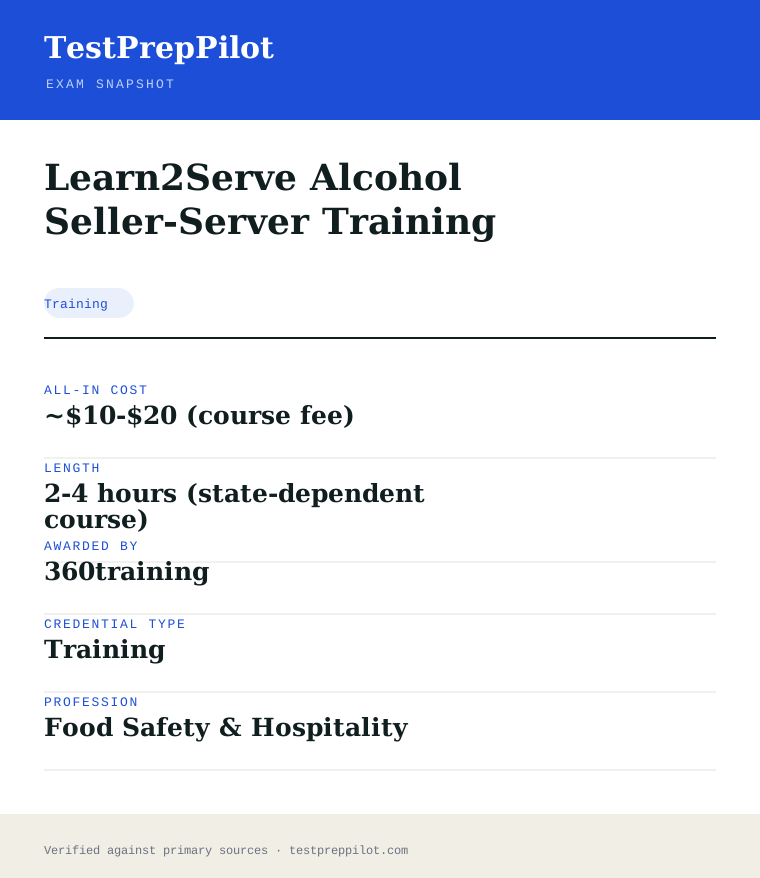
Learn2Serve Alcohol Seller-Server Training is a training credential; awarded by 360training; the exam fee is ~$10-$20; typical preparation is 2-4 hours (state-dependent course); holders typically earn $24,000-$45,000 (35-3011 median $29,820).
| Credential | Learn2Serve Alcohol Seller-Server Training |
|---|---|
| Type | Training |
| Profession | Food Safety & Hospitality |
| Specialty | Food Safety & Culinary |
| Awarded by | 360training |
| Difficulty | Entry to Applied |
| Typical prep time | 2-4 hours (state-dependent course) |
| All-in cost | ~$10-$20 (course fee) |
| Typical salary range | $24,000-$45,000 (35-3011 median $29,820) |
| Credential | Learn2Serve Alcohol Seller-Server Training |
| Awarding body | 360training |
| Exam format | Proctored, computer-based |
| Validity | Valid 1-3 years depending on state (renewal required) |
| Languages | Varies — see awarding body |
| Scope | National / Multi-state |
Real questions
Frequently asked questions about the Learn2Serve Alcohol Seller-Server Training
How do I register for the Learn2Serve Alcohol Seller-Server Training exam?
Register through 360training's official portal or an authorized test provider (e.g., Pearson VUE or Prometric where applicable). Create an account, select the exam, pay the fee, and schedule a date.
How much does the exam cost?
Fees vary by location and currency. Confirm the current fee on the official registration page before scheduling.
How long is the credential valid, and how do I renew?
Validity varies by credential (commonly 2–3 years). Renewal usually requires continuing education or a recertification exam — see 360training's policy.
What if I do not pass?
Most bodies allow retakes after a waiting period and payment of the full or partial fee. Check 360training's retake policy before rescheduling.
How do I register for a 360training credential?
Register through the official website, select your exam, pay the fee, and schedule a date.
How do I renew a credential?
Renewal policies vary by credential; check the specific program page for requirements and cycles.
In short
Is the Learn2Serve Alcohol Seller-Server Training worth it?
- Learn2Serve Alcohol Seller-Server Training is awarded by 360training.
- Validates job-ready competence in Beauty, Food, Security & Recreation.
- Registration is through the awarding body or an authorized test provider.
- Renewal and retake policies vary — confirm before scheduling.
Trust
Where does this information come from?
Everything above is taken from the awarding body's own published material. Fees, question counts and domain weights are revised regularly — check the official page before you pay.
Research confidence: low · Last reviewed 2026-08