Food Safety & Hospitality • Certification
Certified Cicerone
Certified Cicerone — Beauty, Food, Security & Recreation credential from Cicerone Certification Program
Researched and maintained by TestPrepPilot Editorial BoardFood, beverage & hospitality certification desk · Figures last verified August 2026
The short version
What is the Certified Cicerone and is it worth it?
Certified Cicerone is a professional credential administered by Cicerone Certification Program. It validates job-ready knowledge and skills in the Beauty, Food, Security & Recreation field and is used for career entry, advancement, or compliance.
- Recognized credential from Cicerone Certification Program
- Demonstrates verified competence in Beauty, Food, Security & Recreation
- Supports career advancement and may satisfy licensing or employer requirements
What is it?
What exactly is the Certified Cicerone?
Certified Cicerone — Beauty, Food, Security & Recreation credential from Cicerone Certification Program
Second-level beer credential combining written, tasting and demonstration testing on styles, service, pairing and draught systems. Offered by Cicerone Certification Program, it is designed for candidates who need to demonstrate verified competence in the Beauty, Food, Security & Recreation field. The credential is commonly used for career entry, advancement, regulatory compliance, or employer requirements. Candidates should review the official handbook for eligibility, exam format, and scoring before registering.
The path in brief
- Confirm you meet any eligibility or prerequisites
- Review the official handbook and study materials
- Register and pay through the awarding body or authorized provider
- Schedule and take the exam (test center or online proctoring)
- Receive your score and, if passed, your credential
Before you book
Who is eligible to sit the Certified Cicerone?
Eligibility varies; many credentials are open to all, while others require coursework, work experience, or sponsorship.
Who it is for: Professionals and candidates seeking to validate Beauty, Food, Security & Recreation competence.
The test itself
What is the format of the Certified Cicerone?
The Certified Cicerone is administered by Cicerone Certification Program and runs ~4 hours total.
| Administered by | Cicerone Certification Program |
|---|---|
| Questions | ~60 questions + tasting + service |
| Time limit | ~4 hours total |
| Pass mark | Passing score set by the awarding body; see the official score report |
| Exam fee | ~$495-$695 |
| Format | Proctored, computer-based (test center or online remote proctoring) |
Content outline
What topics are on the Certified Cicerone?
The Certified Cicerone covers 4 content domains.
Weightings come from the official exam outline. Study time is best allocated in roughly these proportions rather than evenly across domains.
- Core techniques
Topic area tested on the exam; see the official blueprint for the detailed breakdown.
- Sanitation & safety
Topic area tested on the exam; see the official blueprint for the detailed breakdown.
- Client / guest service
Topic area tested on the exam; see the official blueprint for the detailed breakdown.
- Regulations
Topic area tested on the exam; see the official blueprint for the detailed breakdown.
The path
How do you register for the Certified Cicerone?
- 1
Visit the awarding body’s official website and create an account
- 2
Select the credential and review its specific requirements
- 3
Complete any required eligibility (education, experience, or training)
- 4
Pay the registration fee
- 5
Schedule the exam at a test center or online
- 6
Take the exam and receive your results
The fine print
What are the retake and renewal rules for the Certified Cicerone?
- Proctoring & delivery
- Proctored, computer-based delivery (test center or remote online proctoring), varying by exam.
- Retake policy
- Varies by credential — most bodies permit retakes after a waiting period and full or partial fee.
- Score reporting
- Scores are reported per the body’s timeline, typically electronically after the exam.
- Recertification
- Varies; many credentials require renewal every 2–3 years via continuing education or a recertification exam.
What it pays
How much does this credential pay?
$33,530 median for bartenders (BLS, May 2024) — SOC 35-3011, and the figure excludes tips
The direct answer is that bartenders, SOC 35-3011, earned a median of $33,530 per year in May 2024, the most recent BLS Occupational Employment and Wage Statistics survey, and that number must be read with one giant caveat before it is used to value a Cicerone credential: BLS wage data for bartenders excludes tips, and tips are routinely the majority of take-home pay in this occupation, so the published median substantially understates what a working bartender at a serious beer venue actually earns. The Certified Cicerone credential sits on top of that occupation as a professional differentiator rather than a wage catalyst of its own: it is the second level of the Cicerone Certification Program, above the Certified Beer Server, and its practical value is that it verifies real depth — beer styles, draft systems, off-flavour identification, and food pairing — to employers hiring for beer-program roles such as beverage director, beer buyer, brewery sales representative, or head bartender at a beer-focused venue. Employment in the occupation is large and stable: BLS counts 756,700 bartenders in 2024 and projects 6 percent growth from 2024 to 2034, with about 129,600 openings a year, most from the constant churn of a high-turnover industry — which is exactly why a portable, recognised credential matters, because it moves with you between venues. The honest economics are these: the credential does not change the BLS median, but it changes the role — a Certified Cicerone is rarely standing at the well pouring rail lagers; the credential routes a bartender toward beer-program management, purchasing and education roles that pay above the occupation median and are far less tip-dependent. The investment profile matches: a roughly $450 exam (written plus tasting/demonstration portions purchased separately), months to a year-plus of study, and a pass rate Cicerone itself states at just below 50 percent — so the cost of failure is real, and the payoff is a professional beer credential that survives job changes and commands premium hiring consideration in the craft-beer segment.
| Measure | Figure | Source / note |
|---|---|---|
| Median annual wage, bartenders | $33,530 | BLS Occupational Outlook Handbook, May 2024 (SOC 35-3011, $16.12/hr) — excludes tips |
| Employment, 2024 | 756,700 jobs | BLS OOH Quick Facts, 2024 |
| Projected annual openings | ~129,600 per year | BLS OOH Job Outlook, 2024-34 — a high-turnover occupation |
| Certified Cicerone exam fee | ~$450 total | $250 written + $200 tasting/demonstration, per the current Cicerone overview page |
| Published pass rate | Just below 50% | Per Cicerone's own FAQ — fluctuates year to year |
Job growth.6% projected change 2024-34 for bartenders, with ~129,600 openings a year; the credential's value is mobility into beer-program roles, which pay above the tip-dependent occupation median
Your odds
What are the pass rates?
Cicerone states the pass rate at just below 50% across all candidates — and the passing standard is 80% overall with at least 70% on the tasting portion
The direct answer is that the pass rate for the Certified Cicerone exam is published, by the certification body itself: Cicerone's support centre states that "the pass rate fluctuates year to year; currently the average pass rate is just below 50% across all candidates." That makes the Certified Cicerone one of the hardest exams on this site, and it is worth understanding why before blaming the candidate pool. The exam is not a single multiple-choice paper; it is three separate portions — a written section of short-answer and fill-in-the-blank questions plus three essays, allowed up to three hours; a tasting section of three exercises (off-flavour identification, style discrimination, and quality assessment) allowed up to 45 minutes; and a three-minute video-recorded service demonstration — and the passing standard is a combined 80 percent overall with at least 70 percent on the tasting portion specifically. The tasting requirement is the structural reason the pass rate sits below half: off-flavour identification asks a candidate to recognise specific flaws in spiked beer samples — diacetyl, DMS, acetaldehyde, oxidation — and this is a skill that cannot be crammed, only built through structured tasting practice, which is why candidates who study only books fail the tasting even when their written scores are strong. The written and tasting/demonstration portions are also purchased and scheduled separately, so a candidate can pass one portion and retake the other, with published retake fees ($200 written and $150 tasting per the current Cicerone overview page; earlier published schedules listed lower figures). The practical reading of the just-below-50 figure is that the credential is genuinely selective and is designed to be: it certifies professional beer competence for hiring, so the exam behaves like a gate. Budget for the possibility of at least one retake, build the sensory practice into your plan from week one, and treat the published pass rate as a warning about under-preparation, not a reason to avoid the exam.
Read this before quoting the number.Cicerone publishes the pass rate in its own FAQ: just below 50% across all candidates, fluctuating year to year. The passing standard is 80% overall with at least 70% on the tasting portion. Retakes are purchased per portion.
Source: Cicerone Certification Program — Certified Cicerone FAQ and Overview
Your schedule
How long should I study for it?
150-300 hours over 6-18 months, dominated by tasting practice rather than reading of focused study
Plan six to eighteen months, and be honest about which end of that range you are on: Cicerone's own guidance says an experienced professional with strong tasting skills might prepare in as little as six months, while many candidates should plan for one to two years, and the reason is the tasting portion — off-flavour identification and style discrimination are sensory skills that take calendar time to build, not a weekend. The exam has three portions: a written section of short-answer and fill-in-the-blank questions plus three essays, allowed up to three hours; a tasting section of off-flavour identification, style discrimination and quality assessment, allowed up to 45 minutes; and a three-minute video-recorded service demonstration. The passing standard is 80 percent overall with at least 70 percent on tasting, and the portions are scheduled and purchased separately. The written syllabus is defined by the Certified Cicerone Syllabus and its five knowledge areas with their weights: Keeping and Serving Beer 25 percent, Beer Styles 25 percent, Beer Flavor and Evaluation 25 percent, Beer Ingredients and Brewing Processes 15 percent, and Pairing Beer with Food 10 percent. Structure the plan in phases: months one to four on the written foundation — storage, draft systems, and glassware; world beer styles with their histories and classifications; beer ingredients and the brewing process; and pairing principles — using the syllabus, the Oxford Companion to Beer, and Cicerone's Road to Cicerone courses if you want guided structure. Months five to eight are the sensory build: buy or build a structured tasting practice, work through the Cicerone off-flavour kit or equivalent spiked samples repeatedly until each flaw is reflexive, and practise style discrimination blind. Months nine to twelve are the application phase: full-length practice against the syllabus, the three essays under a timer, and the service demonstration rehearsed to the published criteria. The final month is logistics: schedule the written and tasting/demonstration sessions, and remember the prerequisite — you must have passed the Certified Beer Server exam and be of legal drinking age before you can sit the Certified Cicerone.
- Months 1-44-6 hrs/week
Written foundation — keeping, styles, ingredients
- Study the Certified Cicerone Syllabus cover to cover — it defines the entire written scope
- Master Keeping and Serving Beer: storage conditions, draft systems, line cleaning, glassware
- Learn world beer styles in depth: origins, ingredients, flavour profiles, and classifications
- Cover ingredients and the brewing process, and pairing principles, at syllabus depth
- Months 5-84-6 hrs/week
Sensory build — off-flavours and style discrimination
- Work the Cicerone off-flavour samples or an equivalent kit repeatedly until each flaw is reflexive
- Practise style discrimination blind: identify style, typical flaws, and quality from a sample
- Build a tasting journal that records each sample's appearance, aroma, flavour and conclusion
- Pair the sensory work with the Beer Flavor and Evaluation knowledge area (25% of the syllabus)
- Months 9-125-7 hrs/week
Application — essays, demonstration, and full practice
- Write the three essay types under a timer to rehearse the written section's pacing
- Rehearse the 3-minute service demonstration against the published criteria, on video, and review it
- Run full-length written practice against the five knowledge areas and close every gap
- Take timed tasting practice sessions including all three tasting exercises in sequence
- Final month4-5 hrs/week
Logistics, retake budget, and taper
- Confirm you hold the Certified Beer Server prerequisite and are of legal drinking age
- Purchase and schedule the written and tasting/demonstration portions
- Light review of the highest-weight knowledge areas; one or two more timed tasting sessions
- Rest before each portion — sensory acuity degrades badly with fatigue
Adjusting the pace
Working bartender or server in a beer-focused venue.Eight to twelve months. Your daily work builds the keeping-and-serving knowledge for free; spend your study hours on the tasting kit, the beer-styles breadth you do not pour, and the three essays, which written-only candidates under-rehearse.
Studying without industry access to beer.Fourteen to eighteen months. Add an extra month of tasting practice with a structured off-flavour kit, and consider a Cicerone training course to supply the structured samples and feedback that self-study cannot.
How to study
How do I prepare most effectively?
The strategy that reliably moves a Certified Cicerone score is "start the sensory practice in month one, build the written work around the five syllabus areas, and rehearse the demonstration on video," because the just-below-50 pass rate is driven almost entirely by candidates who read their way to the written portion and then meet the tasting section with no sensory mileage. The single biggest error is treating this like a book exam — it is a skills exam, and the tasting and demonstration portions decide most outcomes. The structure that should drive the plan is Cicerone's own: the exam has three separately scheduled portions — a written section of short-answer, fill-in-the-blank and three essays with up to three hours; a tasting section of off-flavour identification, style discrimination and quality assessment with about 45 minutes; and a three-minute video-recorded service demonstration — and the passing standard is 80 percent overall with at least 70 percent on the tasting portion specifically, which is the gate that makes the just-below-50 pass rate what it is. The sensory work therefore starts in month one, not the final weeks: off-flavour identification — recognising diacetyl, DMS, acetaldehyde, oxidation and the other flaws in spiked samples — is built across calendar weeks of structured tasting, and no amount of reading substitutes for it, which is why the off-flavour kit is the highest-value purchase on this exam. The written work follows the five syllabus areas with their weights — Keeping and Serving Beer 25 percent, Beer Styles 25 percent, Beer Flavor and Evaluation 25 percent, Ingredients and Brewing Processes 15 percent, and Pairing 10 percent — and the essays are rehearsed under a timer, because the written section has no guessing advantage and a vague answer scores nothing. The demonstration is rehearsed on video against the published criteria, because the three minutes are graded offsite and a candidate who has never seen themselves pour cannot fix the technique in the room. A candidate who builds sensory mileage from month one, weights the syllabus, and rehearses both the essays and the demonstration is the one the just-below-50 pass rate stops being a worry for.
Build tasting mileage from week one, not week twelve
Off-flavour identification is the highest-failure skill on the exam, and it cannot be crammed. Work a structured off-flavour kit repeatedly — diacetyl, DMS, acetaldehyde, oxidation, lightstruck, and the rest — until each flaw is reflexive, and practise style discrimination blind with a tasting journal that records every sample. Calendar time is the only way to build this.
Let the syllabus weights drive the reading
Keeping and Serving Beer, Beer Styles, and Beer Flavor and Evaluation are each 25 percent of the syllabus; Ingredients and Brewing Processes is 15 percent and Pairing 10. Read in that order of weight, and use the Certified Cicerone Syllabus as the checklist — candidates who study a favourite topic in depth and skim the rest discover the gaps on the written.
Write the three essays under a timer
The written section is short answer and fill-in-the-blank plus three essays, allowed up to three hours. The essays reward organised, examinable knowledge — structure, examples, and correct terminology — so rehearse them under the clock. Written-only candidates routinely finish the short answers comfortably and then watch the essays eat the remaining time.
Rehearse the demonstration on video
The three-minute service demonstration is video-recorded and graded offsite, so the criteria are visible before you sit it. Rehearse opening, pouring and serving to the published standards, record yourself, and review the footage — candidates who have never seen themselves pour run out the three minutes on fumbled technique and unfilled criteria.
Budget for a retake on one portion
The just-below-50 pass rate and the separate scheduling of the written and tasting/demonstration portions mean a realistic candidate plans for the possibility of retaking one of them. Portions are purchased separately, so a partial pass is banked — pass the written, and only the tasting stands between you and the credential.
What to buy
Which study resources are worth paying for?
The buying decision for the Certified Cicerone is unusual because the highest-value purchases are the exam portions themselves and the sensory kit, not books — the syllabus is free and defines the scope, while the off-flavour kit is the resource that actually builds the failing skill. The current fee schedule from the Cicerone overview page is $250 for the written portion and $200 for the tasting and demonstration portion, purchased separately, with retakes at $200 (written) and $150 (tasting); earlier published schedules listed lower figures, so confirm the current price on the exam schedule rather than trusting either number blindly, and note that because the portions are purchased separately, a pass on one is banked and only the failed portion's retake fee applies. The buying order that makes sense: the syllabus first, because it is free and defines the written scope; then the off-flavour training kit, because the tasting portion's 70 percent gate is the reason the pass rate sits just below 50 percent and the kit is what builds that skill; then, for a candidate without industry beer access, Cicerone's Road to Cicerone courses, which supply the structured samples and feedback that self-study cannot. The Oxford Companion to Beer and the recommended reading cover the depth behind the syllabus, and the workbook-equivalent materials the program provides round out the stack. Books are the cheapest item on the table and the least decisive: a candidate can read for a year and still fail the tasting, while a candidate with structured sensory practice passes despite a smaller library. For a candidate serious about the credential, the honest budget is the exam portions (about $450 total at the current schedule), the off-flavour kit, and a realistic retake on one portion — which is the difference between passing and joining the just-below-50 majority.
| Resource | Price | Format | Best for |
|---|---|---|---|
| Certified Cicerone exam — written portion | ~$250 (confirm current) | Online or in-person, up to 3 hours | Short answer, fill-in-the-blank, and 3 essays |
| Certified Cicerone exam — tasting & demonstration | ~$200 (confirm current) | In-person, ~45 min tasting + 3-min demo | Off-flavour ID, style discrimination, quality, service demo |
| Certified Cicerone Syllabus | Free | Official PDF | The full written scope, with knowledge-area weights |
| Off-flavour training kit (spiked samples) | ~$150-300 depending on kit | Physical or video-guided tasting kit | The single highest-value resource for the failing skill |
| Road to Cicerone courses | Per-course pricing | Online courses with quizzes | Guided structure and end-of-course badges |
| Oxford Companion to Beer and style references | ~$30-60 | Print or digital | Reference depth for styles, history, and ingredients |
Prices checked 2026-08 in USD and approximate; Cicerone's current overview lists $250 written + $200 tasting/demonstration, with retakes at $200/$150, but pricing has changed over time, so confirm on the official exam schedule before purchase. We do not rank by commission.
Avoid these
What mistakes do candidates most often make?
The mistakes that cost Certified Cicerone candidates the credential are almost all sensory-practice errors rather than knowledge errors: studying books instead of building tasting mileage, starting the off-flavour work too late, and treating the demonstration as a formality. With the pass rate at just below 50 percent and the tasting portion gated at 70 percent, the difference between passing and failing is almost always the structured sensory practice, not intelligence or reading volume. The book-exam error is the most insidious because it feels like preparation: a candidate who reads the syllabus, the style references and the brewing texts for months has built genuine knowledge and then meets the tasting section — off-flavour identification, style discrimination, quality assessment — with no sensory mileage, and the 70 percent tasting gate converts that knowledge into a fail. The too-late error is the most common because of the calendar illusion: sensory recognition is built across weeks of spaced practice — the flaw signature must become reflexive, not just familiar — and a candidate who starts the off-flavour kit in the final month discovers that the skill cannot be compressed, which is the structural reason the pass rate sits where it does. The demonstration error is the most mechanical: the three-minute service demonstration is video-recorded and graded offsite against published criteria, so a candidate who never rehearsed on video runs out the three minutes on fumbled technique and unfilled criteria, losing a portion that a single rehearsal session would have salvaged. Add the essay-pacing error — treating the written section's short answers as the whole task and letting the three essays consume the three-hour clock — and the list covers most of the difference between the just-below-50 group and the rest. Every one of these is fixable with an off-flavour kit started early, a video rehearsal, and timed essay practice.
✕Treating the exam like a book exam
✓The written portion is real and carries its own 80-percent-with-70-on-tasting standard, but the tasting and demonstration portions decide most outcomes. Start the off-flavour kit and blind style-discrimination practice in the first month, not the last, because sensory recognition is built across calendar weeks, not study weekends.
✕Reading the syllabus but never tasting spiked samples
✓Off-flavour identification is the classic failure: candidates can recite the textbook description of diacetyl and still not recognise it in a sample. Buy or build the off-flavour kit, work it repeatedly until each flaw is reflexive, and keep a tasting journal that forces the describe-and-conclude habit the exam scores.
✕Under-rehearsing the three essays
✓The written section is short answer and fill-in-the-blank plus three essays in three hours. Candidates who practise only the short answers watch the essays consume the clock. Write essays under a timer against the syllabus weights — Keeping and Serving, Beer Styles, and Flavor and Evaluation are each 25 percent.
✕Skipping the demonstration rehearsal
✓The three-minute service demonstration is video-recorded and graded offsite against visible criteria. Rehearse it on video, review the footage, and correct the technique — opening, pouring, serving — before the exam. Candidates who have never seen themselves pour run out the three minutes.
✕Forgetting the Certified Beer Server prerequisite and retake budget
✓You must pass the Certified Beer Server exam before sitting the Certified Cicerone, and with a pass rate just below 50 percent you should plan for the realistic possibility of one portion retake. Check the current fee schedule, bank a partial pass if it happens, and treat the separate portions as separate chances rather than a single do-or-die day.
What you'll face
What question types will I see?
The Certified Cicerone is not a single question paper; it is three separately scheduled and scored portions, which is the structural reason it behaves differently from a multiple-choice certification. The written portion is largely short-answer and fill-in-the-blank questions plus three essay questions, with up to three hours allowed; the tasting portion consists of three exercises — off-flavour identification, style discrimination, and quality assessment — with up to 45 minutes total; and the demonstration portion is a three-minute, video-recorded answer to a beer-service question in which you use a provided item to demonstrate your answer. The passing standard is a combined 80 percent overall with at least 70 percent on the tasting portion specifically, so the tasting exercises are the gate — and because the portions are scheduled and purchased separately, a pass on the written is banked even if the tasting falls short, which makes the retake economics more forgiving than a single-sitting exam. The written content follows the five knowledge areas of the Certified Cicerone Syllabus — Keeping and Serving Beer 25 percent, Beer Styles 25 percent, Beer Flavor and Evaluation 25 percent, Beer Ingredients and Brewing Processes 15 percent, and Pairing Beer with Food 10 percent — and the short-answer format means there is no guessing advantage: a blank or a vague answer scores nothing, unlike a four-option multiple-choice exam, so precise terminology and complete answers are the scoring currency. The three tasting exercises reward exactly the sensory mileage described throughout this file, and the demonstration rewards rehearsed service technique scored against published criteria by offsite graders. The samples below are editor-written illustrations of the written style, not live items, and the standing note applies: no live-item reproduction is possible for an exam whose tasting and demonstration portions are inherently practical.
Direct, examinable questions on keeping, styles, ingredients, and pairing — no guessing advantage, so precise terminology and complete answers are the scoring currency.
Organised, examinable knowledge under a time limit — structure, examples, and correct terminology across the high-weight knowledge areas.
Recognise specific flaws in spiked samples — diacetyl, DMS, acetaldehyde, oxidation, and others — the highest-failure skill on the exam.
Identify style and judge quality from a sample, combining sensory recognition with the Beer Flavor and Evaluation knowledge area.
Answer a beer-service question using a provided item, scored against published criteria by offsite graders.
Try these
Q1A keg of lager is served with a pronounced buttery aroma and slick mouthfeel. The most likely cause and the flaw it represents are:
Answer:A
A buttery aroma and slick mouthfeel are the classic signature of diacetyl, a buttery off-flavour usually caused by bacterial contamination or yeast-derived precursors, and it is one of the off-flavours the tasting portion expects you to recognise. B is wrong — clean lager character does not taste buttery. C produces a sharp, foamy mouthfeel, not buttery slickness. D produces stale, papery or sherry-like character, not butter.
Q2Which of the following is the correct temperature guidance for keeping most ales and lagers in good serving condition?
Answer:B
Beer is best kept cold and stable, but ideal serving temperature varies by style — fuller-bodied ales and strong beers warm up well while light lagers serve colder — so the correct statement is the one that treats temperature as style-dependent rather than a single universal figure. A's "near freezing" is too cold for most ales and risks flavour flattening. C accelerates staling and foaming. D is false: temperature is one of the central variables in keeping beer.
Q3Which pairing principle is most appropriate when matching a heavily hopped IPA with food?
Answer:B
The guiding pairing principle is to match intensity and use bitterness as a counterweight — a heavily hopped IPA cuts rich, fatty or spicy food, while its hop character would overwhelm delicate dishes. A wastes the beer's function, C ignores the beer entirely, and D is a generalisation that fails for most savoury courses. The syllabus expects pairing decisions justified by the interplay of flavours, not by fixed rules.
Samples are editor-written illustrations of the published blueprint, not live exam items.
The big day
What should I expect on exam day?
There is no single Certified Cicerone exam morning, because the credential is split into separately scheduled and purchased portions: a written section (short answer, fill-in-the-blank, and three essays, up to three hours, taken online or in person), and a tasting-plus-demonstration session (three tasting exercises in about 45 minutes plus a three-minute video-recorded service demonstration, taken in person). The logistics you control in advance are the ones that matter: confirm you hold the Certified Beer Server prerequisite and are of legal drinking age, purchase each portion on the official exam schedule, and arrive with the right identification and a rested palate — sensory acuity is the thing that degrades most with fatigue, so the tasting session rewards a normal night's sleep over a final cram. For the written portion, treat the three hours as a real time budget: the short answers should move briskly so the three essays have room, and because there is no guessing advantage, every answer should be complete and use correct terminology rather than a hopeful keyword. For the tasting session, work the three exercises in the order presented, describe what you actually perceive rather than what you expect, and keep the demonstration inside its three minutes by rehearsing the technique — opening, pouring, serving — on video beforehand. Scores take time to arrive: results typically come by email within about six weeks, and your status is then updated on the public roster, with the lapel pin, patch and certificate mailed afterwards. Because the portions are separate, a pass on one is banked — if the written passes and the tasting does not, only the tasting retake stands between you and the credential, at its published retake fee.
Bring
- Government-issued photo ID and confirmation of your registration for the specific portion
- Proof you hold the Certified Beer Server prerequisite if the system does not have it on file
- For the written portion: a quiet, stable connection and the system-checked computer if taken online
- For the tasting session: a rested palate, water to rinse, and nothing aromatic that could interfere
- A rehearsal in your pocket — the demonstration criteria and your three-minute plan
Leave at home
- Fatigue — sensory acuity is the first thing sleep deprivation destroys
- Perfume, strong coffee or food aromas before a tasting session
- Cramming on the exam morning; the written rewards organised knowledge, the tasting rewards rest
- Vague essay answers — a written portion with no guessing advantage scores what you actually write
- An unrehearsed demonstration — the three minutes are video-recorded and graded offsite
How the day runs
Rules in the room
- The exam has three portions: written (up to 3 hours), tasting (about 45 minutes), and a 3-minute service demonstration; portions are scheduled and purchased separately.
- Passing requires 80% overall with at least 70% on the tasting portion specifically.
- The Certified Beer Server exam and legal drinking age are prerequisites.
- The demonstration is video-recorded and graded offsite; it is always administered with the tasting portion.
- Exam fees are non-refundable; rescheduling within 30 days of the date may incur a fee, and a no-show forfeits the registration.
Afterwards.Results arrive by email, typically within about six weeks, and a passing score updates your listing on the public Cicerone roster and triggers the mailed lapel pin, iron-on patch and certificate. Because the portions are purchased separately, a pass on one is banked: if only the tasting stands between you and the credential, the retake is a defined, fee-bounded step at the published tasting retake price rather than a full restart. If you do not pass, read the outcome against the three portions — written, tasting, demonstration — and put the time into the one that failed, which is almost always the sensory mileage. The credential itself is the professional beer qualification above the Certified Beer Server, recognised across the beverage industry for beer-program, purchasing and education roles; it does not change the $33,530 bartender median in the BLS tables (which excludes tips), but it changes the role you are hired for, and it survives every job change you make after earning it.
Reference
What are the key facts about the Certified Cicerone?
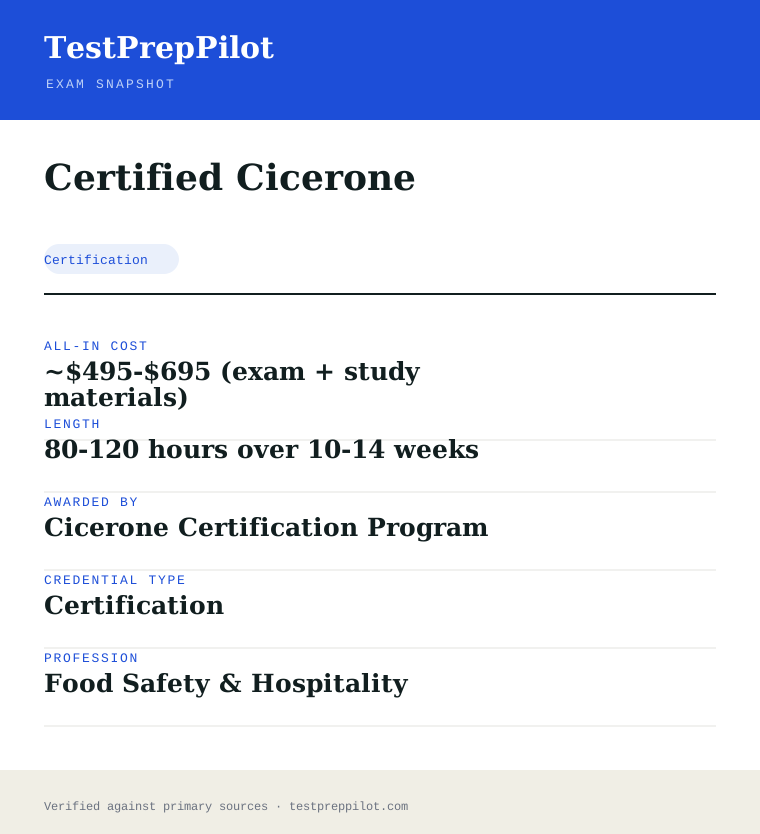
Certified Cicerone is a certification credential; awarded by Cicerone Certification Program; the exam fee is ~$495-$695; typical preparation is 80-120 hours over 10-14 weeks; holders typically earn $24,000-$50,000 (35-3011 median $29,820).
| Credential | Certified Cicerone |
|---|---|
| Type | Certification |
| Profession | Food Safety & Hospitality |
| Specialty | Food Safety & Culinary |
| Awarded by | Cicerone Certification Program |
| Difficulty | Entry to Applied |
| Typical prep time | 80-120 hours over 10-14 weeks |
| All-in cost | ~$495-$695 (exam + study materials) |
| Typical salary range | $24,000-$50,000 (35-3011 median $29,820) |
| Credential | Certified Cicerone |
| Awarding body | Cicerone Certification Program |
| Exam format | Proctored, computer-based |
| Validity | Certified Cicerone requires recertification every 5 years |
| Languages | Varies — see awarding body |
| Scope | National / Multi-state |
Real questions
Frequently asked questions about the Certified Cicerone
How do I register for the Certified Cicerone exam?
Register through Cicerone Certification Program's official portal or an authorized test provider (e.g., Pearson VUE or Prometric where applicable). Create an account, select the exam, pay the fee, and schedule a date.
How much does the exam cost?
Fees vary by location and currency. Confirm the current fee on the official registration page before scheduling.
How long is the credential valid, and how do I renew?
Validity varies by credential (commonly 2–3 years). Renewal usually requires continuing education or a recertification exam — see Cicerone Certification Program's policy.
What if I do not pass?
Most bodies allow retakes after a waiting period and payment of the full or partial fee. Check Cicerone Certification Program's retake policy before rescheduling.
How do I register for a Cicerone Certification Program credential?
Register through the official website, select your exam, pay the fee, and schedule a date.
How do I renew a credential?
Renewal policies vary by credential; check the specific program page for requirements and cycles.
In short
Is the Certified Cicerone worth it?
- Certified Cicerone is awarded by Cicerone Certification Program.
- Validates job-ready competence in Beauty, Food, Security & Recreation.
- Registration is through the awarding body or an authorized test provider.
- Renewal and retake policies vary — confirm before scheduling.
Same awarding body
What other credentials does Cicerone Certification Program award?
Worth comparing
How does the Certified Cicerone compare with similar credentials?
Trust
Where does this information come from?
Everything above is taken from the awarding body's own published material. Fees, question counts and domain weights are revised regularly — check the official page before you pay.
Research confidence: low · Last reviewed 2026-08