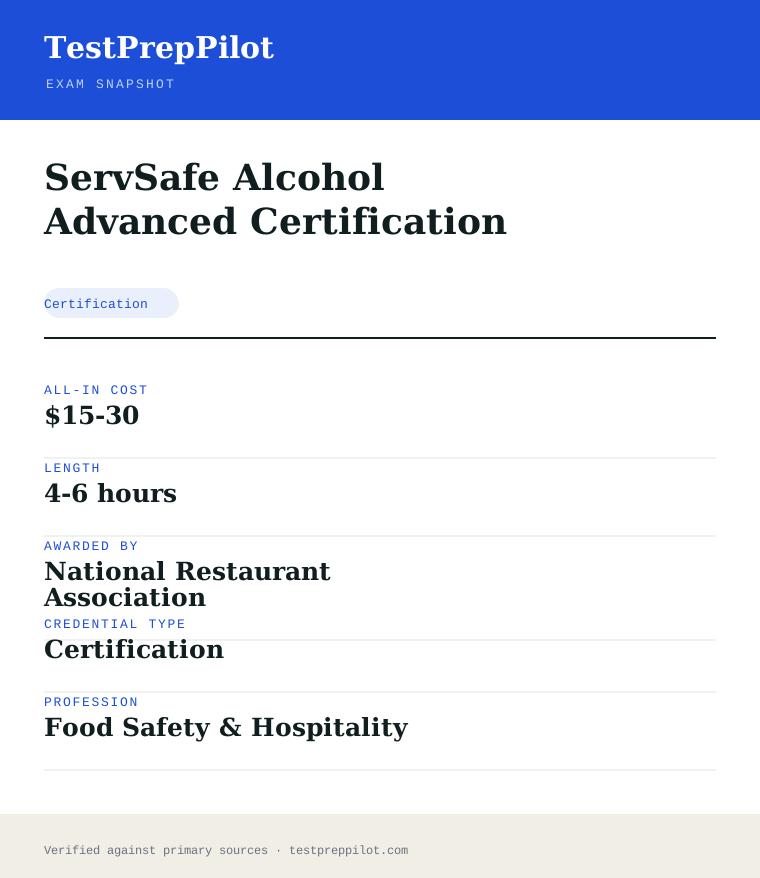
The short version
What is the ServSafe Alcohol Advanced Certification and is it worth it?
ServSafe Alcohol Advanced Certification is a professional credential administered by National Restaurant Association. It validates job-ready knowledge and skills in the Beauty, Food, Security & Recreation field and is used for career entry, advancement, or compliance.
- Recognized credential from National Restaurant Association
- Demonstrates verified competence in Beauty, Food, Security & Recreation
- Supports career advancement and may satisfy licensing or employer requirements
What is it?
What exactly is the ServSafe Alcohol Advanced Certification?
ServSafe Alcohol Advanced Certification — Beauty, Food, Security & Recreation credential from National Restaurant Association
Advanced responsible alcohol service examination for managers covering policy, documentation, intervention and liability exposure. Offered by National Restaurant Association, it is designed for candidates who need to demonstrate verified competence in the Beauty, Food, Security & Recreation field. The credential is commonly used for career entry, advancement, regulatory compliance, or employer requirements. Candidates should review the official handbook for eligibility, exam format, and scoring before registering.
The path in brief
- Confirm you meet any eligibility or prerequisites
- Review the official handbook and study materials
- Register and pay through the awarding body or authorized provider
- Schedule and take the exam (test center or online proctoring)
- Receive your score and, if passed, your credential
Before you book
Who is eligible to sit the ServSafe Alcohol Advanced Certification?
Eligibility varies; many credentials are open to all, while others require coursework, work experience, or sponsorship.
Who it is for: Professionals and candidates seeking to validate Beauty, Food, Security & Recreation competence.
The test itself
What is the format of the ServSafe Alcohol Advanced Certification?
The ServSafe Alcohol Advanced Certification is administered by National Restaurant Association and runs 60 minutes and contains 40 questions.
| Administered by | National Restaurant Association |
|---|---|
| Questions | 40 questions |
| Time limit | 60 minutes |
| Pass mark | Passing score set by the awarding body; see the official score report |
| Exam fee | $15-30 |
| Format | Proctored, computer-based (test center or online remote proctoring) |
Content outline
What topics are on the ServSafe Alcohol Advanced Certification?
The ServSafe Alcohol Advanced Certification covers 4 content domains.
Weightings come from the official exam outline. Study time is best allocated in roughly these proportions rather than evenly across domains.
- Core techniques
Topic area tested on the exam; see the official blueprint for the detailed breakdown.
- Sanitation & safety
Topic area tested on the exam; see the official blueprint for the detailed breakdown.
- Client / guest service
Topic area tested on the exam; see the official blueprint for the detailed breakdown.
- Regulations
Topic area tested on the exam; see the official blueprint for the detailed breakdown.
The path
How do you register for the ServSafe Alcohol Advanced Certification?
- 1
Visit the awarding body’s official website and create an account
- 2
Select the credential and review its specific requirements
- 3
Complete any required eligibility (education, experience, or training)
- 4
Pay the registration fee
- 5
Schedule the exam at a test center or online
- 6
Take the exam and receive your results
The fine print
What are the retake and renewal rules for the ServSafe Alcohol Advanced Certification?
- Proctoring & delivery
- Proctored, computer-based delivery (test center or remote online proctoring), varying by exam.
- Retake policy
- Varies by credential — most bodies permit retakes after a waiting period and full or partial fee.
- Score reporting
- Scores are reported per the body’s timeline, typically electronically after the exam.
- Recertification
- Varies; many credentials require renewal every 2–3 years via continuing education or a recertification exam.
What it pays
How much does this credential pay?
Expect bartender roles — the jobs this certification gates — at a May 2024 median of $29,820 (BLS), with managers who oversee alcohol service earning $65,310
The direct answer is that the ServSafe Alcohol certification does not have its own BLS occupation, but it is the responsible-alcohol-service credential required or preferred in thousands of bars, restaurants, and hospitality venues, and the occupations it gates are bartenders (SOC 35-3011) at a May 2024 median annual wage of $29,820, with the highest 10 percent above about $55,000, and food service managers (SOC 35-3031) at a May 2024 median of $65,310 for the staff who supervise alcohol service. The honest framing is that the certification is a legal-responsibility gate, not a wage multiplier: employers require it to hire you behind the bar or to keep the establishment compliant with state responsible-service laws, and the pay is set by the venue, tip culture, and local market rather than by the credential itself. Because bartending is a tipped occupation, actual earnings are heavily venue- and volume-dependent, and the BLS median understates what experienced bartenders at high-volume venues take home. The certification matters most as an employability checkbox: many state alcohol-beverage control agencies mandate responsible-service training for servers and sellers, and venues list a current ServSafe Alcohol card as a hiring condition. The career-relevant detail is that the course also teaches the policies managers need — checking IDs, recognising impairment, refusing service, and handling liability — which is why the advanced version of the course is common among bar managers and beverage directors on the way to food service management roles with the higher median above. BLS projects about 5 percent growth for bartenders from 2024 to 2034, with about 100,000 openings per year, most from turnover and the churn of the hospitality workforce. The practical read: take the course as a required-responsibility credential, expect the pay to come from the tipped role or the manager track it supports, and keep the certification current since many states and venues tie it to employment.
| Measure | Figure | Source / note |
|---|---|---|
| Median annual wage, bartenders | $29,820 | BLS Occupational Outlook Handbook, May 2024 (SOC 35-3011) |
| Median annual wage, food service managers | $65,310 | BLS OOH, May 2024 (SOC 35-3031) |
| Projected growth, bartenders, 2024-34 | +5% | BLS Employment Projections |
| The certification itself | No direct occupation | Responsible-alcohol-service credential |
Job growth.BLS projects about 5% growth for bartenders from 2024 to 2034, with roughly 100,000 annual openings, largely from turnover.
Source: BLS OOH — Bartenders
Your odds
What are the pass rates?
No pass rate is published — the ServSafe Alcohol exam requires 75% and retakes are common and allowed; the certification is a training credential, not a licensure gate
The core fact is that the National Restaurant Association does not publish pass rates for the ServSafe Alcohol exam, and none is available from an independent national source, so treat any percentage you see online as anecdotal. What is published is the exam structure: the ServSafe Alcohol Primary exam contains 40 multiple-choice questions with a passing score of 75 percent (30 of 40 correct), you have 60 minutes, and you can retake the exam after review if you do not pass the first time. The course itself is typically delivered in a few hours — online self-paced or in-person — and covers the core responsible-service topics: how alcohol affects the body, recognising signs of intoxication, checking identification, refusing service, and preventing and managing liability. Because it is a training credential rather than a professional licensure exam, the practical pass rate is high among candidates who complete the course, and the common failure mode is rushing through the online version without absorbing the ID-checking and impairment-recognition material. The certification is valid for three years, after which you must renew by retaking the course. The preparation implication is straightforward: complete the course content rather than skimming, take the practice questions the course provides, and remember the exam rewards the specific policy answers the National Restaurant Association teaches — for example, when an ID looks suspicious, the trained response is to refuse service regardless of the patron’s age. If your employer or state requires the certification, confirm whether the primary course satisfies the requirement, since some states accept the course while others require an additional state-specific module.
Read this before quoting the number.No official pass rate is published; the exam requires 75% (30/40) with retakes permitted.
Source: ServSafe — Alcohol certification
Your schedule
How long should I study for it?
4-6 hours total (course + exam) of focused study
Plan for roughly 4 to 6 hours total — the ServSafe Alcohol course takes about 3 to 4 hours (online self-paced or a half-day class) plus 1 to 2 hours of review and the 40-question exam. The curriculum covers six content areas: the effects of alcohol on the body and behaviour, recognising intoxication and impairment, checking identification and spotting fakes, refusing service and handling difficult situations, preventing and managing alcohol-related liability, and state laws that vary by jurisdiction. The highest-yield study sequence is: first, master the impairment-recognition section, because exam items repeatedly ask you to identify behavioural signs of intoxication from a described patron; second, learn the ID-checking rules — the documents that are valid, how to spot alterations, and the "look, feel, ask" style checks the course teaches; third, review the refusal-of-service scenarios, since the correct answer is almost always refusing service when in doubt; and fourth, run the course’s practice questions to confirm you can hold the 75 percent line. Because the exam rewards the course’s specific policies over general knowledge, the most efficient preparation is to work through the course materials in order and use the built-in practice items rather than outside resources. Budget the final hour for a quiet exam sitting with the 60-minute limit in mind — 40 questions in 60 minutes is comfortable, but only if you do not second-guess yourself into time pressure. After passing, keep the certificate and note the three-year validity, and check your state’s specific requirements, since some states add a local module or mandate a renewal cadence.
- Session 1 (3-4 hrs)4
Course content
- Complete the ServSafe Alcohol course modules
- Note the ID-checking and impairment-recognition rules
- Do the built-in practice questions
- Session 2 (1 hr)1
Exam
- Review weak areas from practice
- Take the 40-question exam (60 min, 75% to pass)
Adjusting the pace
ServSafe Alcohol Advanced.A deeper program for managers and owners covering policy, liability management, and staff training.
State-specific modules.Some states require an additional state-law component alongside the national course.
How to study
How do I prepare most effectively?
The strategy that reliably passes ServSafe Alcohol is "learn the course’s specific policies, not your intuition about drinking," and the single biggest error is bringing personal beliefs about alcohol into a test that rewards the National Restaurant Association’s trained responses. A second proven approach is memorising the impairment-recognition framework — the exam presents a described patron and asks which signs indicate intoxication, so build a checklist of behavioural cues from the course rather than relying on experience. Third, internalise the ID rules as absolute: when an ID is altered, damaged, or looks fake, the trained answer is to refuse service, and the exam tests that boundary repeatedly. Fourth, practise the refusal-of-service phrasing, since scenario items ask what you should say or do when a patron argues. Fifth, run the practice questions twice — once after the course and once the morning of the exam — because the second pass confirms the 75 percent line. Finally, take the exam in a quiet, uninterrupted sitting; the 60-minute limit is generous, but split attention is the most common reason candidates miss easy policy items.
Learn the course policies, not intuition
The exam rewards the Association’s trained responses over personal judgement.
Build an impairment cue checklist
Scenario items describe a patron; identify the behavioural signs of intoxication.
Treat ID rules as absolute
Altered or suspicious IDs mean refusing service — the exam tests this boundary.
Practise refusal scenarios
Know the trained phrasing for declining service to an intoxicated patron.
Take the exam uninterrupted
The 60-minute limit is generous; split attention costs easy policy items.
What to buy
Which study resources are worth paying for?
ServSafe Alcohol preparation is dominated by the official course itself — the exam is only valid when you take it through the National Restaurant Association or an authorized proctor — and the total cost is typically $15 to $30 for the online course with exam included. The comparison below separates the official course, state-mandated alternatives, and optional practice materials, with prices current to this review. The buying rule is to confirm your employer or state’s accepted provider before paying, since some venues sponsor the course and some states accept only the official ServSafe credential.
| Resource | Price | Format | Best for |
|---|---|---|---|
| ServSafe Alcohol Primary (official) | ~$15-30 | Online self-paced + 40-question exam | The standard certification |
| Employer-sponsored training | Often free | In-house or paid course | Hiring-time candidates |
| ServSafe practice questions | Included | Online | Confirming the 75% line |
| State alcohol-beverage courses | ~$10-40 | State platform | Candidates in states with separate mandates |
Prices approximate and dated to this review; certification is valid 3 years and renewal requires retaking the course.
Avoid these
What mistakes do candidates most often make?
The most common mistake is answering from personal judgement about alcohol instead of the course’s trained policies, which fails the scenario items that make up most of the exam; the second is being overly confident about ID assessment and missing the "refuse when in doubt" boundary. A third recurring error is misidentifying impairment signs — confusing normal social behaviour with intoxication cues, or missing the cumulative signs the course teaches. Candidates also routinely skip the practice questions and then discover the 75 percent cut score is less forgiving than expected, and many fail to check whether their state requires the official ServSafe credential or accepts a different course, wasting money on the wrong provider. Finally, some candidates lose the exam by rushing in a shared or noisy setting despite the generous 60-minute window.
✕Answering from personal judgement
✓Learn the Association’s trained responses; scenario items test policy, not opinion.
✕Overconfident ID assessment
✓When an ID is suspicious, the trained answer is to refuse service — memorise that boundary.
✕Missing impairment cues
✓Build the course’s behavioural checklist; the exam describes patrons and asks you to identify signs.
✕Skipping practice questions
✓Run the built-in practice items twice to confirm you hold the 75% line.
✕Wrong provider for your state
✓Confirm your state or employer accepts the official ServSafe credential before paying.
What you'll face
What question types will I see?
The ServSafe Alcohol exam contains 40 multiple-choice questions answered in 60 minutes, with a passing score of 75 percent (30 correct). The item mix is dominated by scenario questions: a described patron, ID, or service situation with the trained response as the correct answer. Content areas include alcohol effects and intoxication recognition, ID checking, refusing service, and liability management. The samples below are editor-written illustrations of the published curriculum, not live exam items.
Identifying behavioural signs of intoxication in described patrons.
Valid documents, alterations, and refusing service on suspicious IDs.
Handling intoxicated patrons and difficult situations.
How alcohol affects the body and behaviour.
Preventing and managing alcohol-related liability.
Try these
Q1A patron who appears under 30 presents a driver’s license with a rough, uneven edge. What should you do?
Answer:B
An altered or damaged ID is suspicious; the trained response is to refuse service.
Q2Which signs may indicate a patron is becoming intoxicated?
Answer:A
Loud, rapid speech and other behavioural changes are among the signs of intoxication the course teaches.
Q3A patron argues that refusing service is unfair. What is the trained response?
Answer:A
The trained approach is to explain the policy calmly and firmly refuse service.
Samples are editor-written illustrations of the published curriculum, not live exam items.
The big day
What should I expect on exam day?
The ServSafe Alcohol exam is taken online through the ServSafe platform (or on paper in some classroom courses), with 40 questions and a 60-minute time limit; a score of 75 percent (30 of 40) passes. The core rules: complete the exam in one sitting, keep your course materials and notes handy if the online version is open-book (most are closed-book by design, so prepare accordingly), and have a quiet, stable connection. The certification is valid for three years. After passing, you can print or download your certificate immediately; employers and state agencies accept the card or PDF as proof of completion. If you fail, review the missed content and retake — the platform permits retesting. The most useful exam-day habits: do the practice questions first to warm up, answer every item (there is no penalty for guessing on unanswered questions you skip, but answering everything maximises your shot at 30 correct), and do not second-guess the trained policy answers — the exam wants the course’s response, not your debate.
Bring
- ServSafe account login
- Quiet, stable connection
- Review notes on ID rules and impairment cues
Leave at home
- Distractions — the exam is a single-sitting, 60-minute assessment
- The urge to argue with the policy answers
How the day runs
Rules in the room
- 75% (30/40) to pass
- 60-minute limit
- Single sitting
- Valid 3 years, then renewal
Afterwards.Passing issues the ServSafe Alcohol certification (3 years); present it to employers, keep the PDF, and renew before expiry.
Reference
What are the key facts about the ServSafe Alcohol Advanced Certification?
ServSafe Alcohol Advanced Certification is a certification credential; awarded by National Restaurant Association; the exam fee is $15-30; typical preparation is 4-6 hours; holders typically earn $29,820 median, bartenders (BLS May 2024).
| Credential | ServSafe Alcohol Advanced Certification |
|---|---|
| Type | Certification |
| Profession | Food Safety & Hospitality |
| Specialty | Food Safety & Culinary |
| Awarded by | National Restaurant Association |
| Difficulty | Entry to Applied |
| Typical prep time | 4-6 hours |
| All-in cost | $15-30 |
| Typical salary range | $29,820 median, bartenders (BLS May 2024) |
| Credential | ServSafe Alcohol Advanced Certification |
| Awarding body | National Restaurant Association |
| Exam format | Proctored, computer-based |
| Validity | Valid 3 years, then renewal |
| Languages | Varies — see awarding body |
| Scope | National / Multi-state |
Real questions
Frequently asked questions about the ServSafe Alcohol Advanced Certification
How do I register for the ServSafe Alcohol Advanced Certification exam?
Register through National Restaurant Association's official portal or an authorized test provider (e.g., Pearson VUE or Prometric where applicable). Create an account, select the exam, pay the fee, and schedule a date.
How much does the exam cost?
Fees vary by location and currency. Confirm the current fee on the official registration page before scheduling.
How long is the credential valid, and how do I renew?
Validity varies by credential (commonly 2–3 years). Renewal usually requires continuing education or a recertification exam — see National Restaurant Association's policy.
What if I do not pass?
Most bodies allow retakes after a waiting period and payment of the full or partial fee. Check National Restaurant Association's retake policy before rescheduling.
How do I register for a National Restaurant Association credential?
Register through the official website, select your exam, pay the fee, and schedule a date.
How do I renew a credential?
Renewal policies vary by credential; check the specific program page for requirements and cycles.
In short
Is the ServSafe Alcohol Advanced Certification worth it?
- ServSafe Alcohol Advanced Certification is awarded by National Restaurant Association.
- Validates job-ready competence in Beauty, Food, Security & Recreation.
- Registration is through the awarding body or an authorized test provider.
- Renewal and retake policies vary — confirm before scheduling.
Trust
Where does this information come from?
Everything above is taken from the awarding body's own published material. Fees, question counts and domain weights are revised regularly — check the official page before you pay.
Research confidence: low · Last reviewed 2026-08