Food Safety & Hospitality • Certification
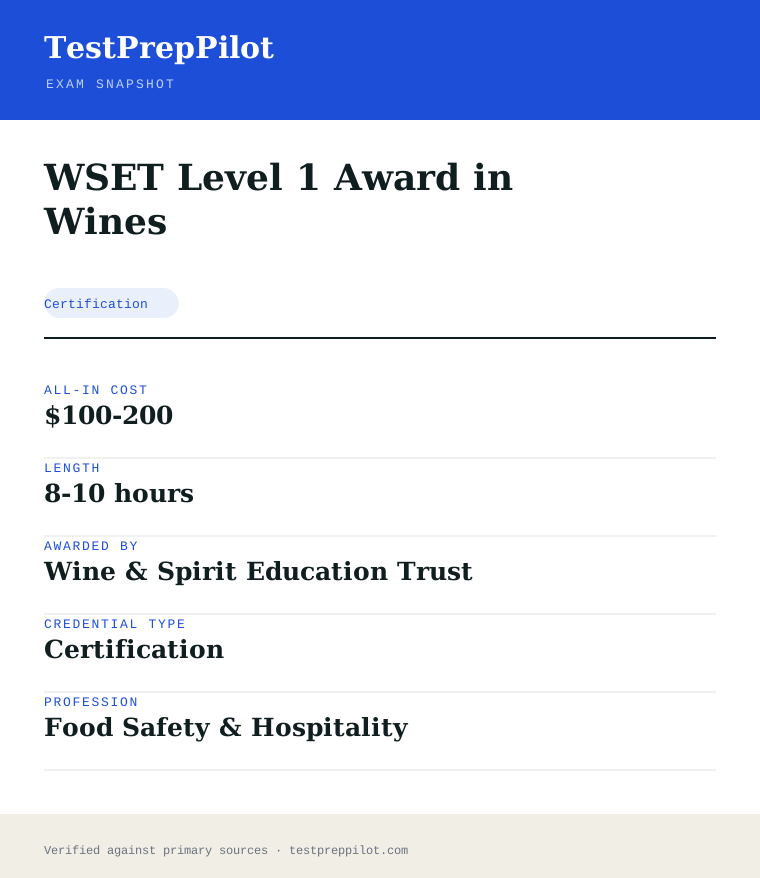
WSET Level 1 Award in Wines
WSET Level 1 Award in Wines — Beauty, Food, Security & Recreation credential from Wine & Spirit Education Trust
Researched and maintained by TestPrepPilot Editorial BoardWine & hospitality education desk · Figures last verified August 2026
The short version
What is the WSET Level 1 Award in Wines and is it worth it?
WSET Level 1 Award in Wines is a professional credential administered by Wine & Spirit Education Trust. It validates job-ready knowledge and skills in the Beauty, Food, Security & Recreation field and is used for career entry, advancement, or compliance.
- Recognized credential from Wine & Spirit Education Trust
- Demonstrates verified competence in Beauty, Food, Security & Recreation
- Supports career advancement and may satisfy licensing or employer requirements
What is it?
What exactly is the WSET Level 1 Award in Wines?
WSET Level 1 Award in Wines — Beauty, Food, Security & Recreation credential from Wine & Spirit Education Trust
Beginner wine qualification with a thirty-question examination on main grape varieties, styles, storage and food pairing. Offered by Wine & Spirit Education Trust, it is designed for candidates who need to demonstrate verified competence in the Beauty, Food, Security & Recreation field. The credential is commonly used for career entry, advancement, regulatory compliance, or employer requirements. Candidates should review the official handbook for eligibility, exam format, and scoring before registering.
The path in brief
- Confirm you meet any eligibility or prerequisites
- Review the official handbook and study materials
- Register and pay through the awarding body or authorized provider
- Schedule and take the exam (test center or online proctoring)
- Receive your score and, if passed, your credential
Before you book
Who is eligible to sit the WSET Level 1 Award in Wines?
Eligibility varies; many credentials are open to all, while others require coursework, work experience, or sponsorship.
Who it is for: Professionals and candidates seeking to validate Beauty, Food, Security & Recreation competence.
The test itself
What is the format of the WSET Level 1 Award in Wines?
The WSET Level 1 Award in Wines is administered by Wine & Spirit Education Trust and runs ~45 minutes and contains 30 questions.
| Administered by | Wine & Spirit Education Trust |
|---|---|
| Questions | 30 questions |
| Time limit | ~45 minutes |
| Pass mark | Passing score set by the awarding body; see the official score report |
| Exam fee | $100-200 |
| Format | Proctored, computer-based (test center or online remote proctoring) |
Content outline
What topics are on the WSET Level 1 Award in Wines?
The WSET Level 1 Award in Wines covers 4 content domains.
Weightings come from the official exam outline. Study time is best allocated in roughly these proportions rather than evenly across domains.
- Core techniques
Topic area tested on the exam; see the official blueprint for the detailed breakdown.
- Sanitation & safety
Topic area tested on the exam; see the official blueprint for the detailed breakdown.
- Client / guest service
Topic area tested on the exam; see the official blueprint for the detailed breakdown.
- Regulations
Topic area tested on the exam; see the official blueprint for the detailed breakdown.
The path
How do you register for the WSET Level 1 Award in Wines?
- 1
Visit the awarding body’s official website and create an account
- 2
Select the credential and review its specific requirements
- 3
Complete any required eligibility (education, experience, or training)
- 4
Pay the registration fee
- 5
Schedule the exam at a test center or online
- 6
Take the exam and receive your results
The fine print
What are the retake and renewal rules for the WSET Level 1 Award in Wines?
- Proctoring & delivery
- Proctored, computer-based delivery (test center or remote online proctoring), varying by exam.
- Retake policy
- Varies by credential — most bodies permit retakes after a waiting period and full or partial fee.
- Score reporting
- Scores are reported per the body’s timeline, typically electronically after the exam.
- Recertification
- Varies; many credentials require renewal every 2–3 years via continuing education or a recertification exam.
What it pays
How much does this credential pay?
No dedicated occupation — but WSET Level 1 is the entry credential for wine service roles, where food service managers earn a May 2024 median of $65,310 and experienced sommelier-track staff earn well above it in fine dining
The direct answer is that WSET Level 1 has no BLS occupation of its own because it is a foundation qualification for people working with wine, not a licence — the closest occupations are food and beverage serving and supervision roles. The honest salary story: food service managers (SOC 35-3031) earn a May 2024 median annual wage of $65,310, bartenders (SOC 35-3011) $29,820, and the wine-specialist track — sommeliers and beverage directors — sits above the general hospitality medians, though BLS has no separate "sommelier" code and classifies them within food service management and serving occupations. The qualification’s value is positional: Level 1 is the standard first step for front-of-house staff and wine retailers, teaching grape varieties, wine styles, food-and-wine pairing basics, and responsible service, and it signals employability for entry wine roles more than it moves pay by itself. The career ladder that matters is the WSET progression: Level 1 is a one-day foundation course, Level 2 is the qualification most employers recognise for serious wine roles, and Level 3 plus the Court of Master Sommeliers track is where the income effect shows up in fine-dining and beverage-director positions. BLS projects food service manager employment to grow about 5 percent from 2024 to 2034. The practical read: take Level 1 as the affordable on-ramp if you are entering wine service or retail — it is a half-day to one-day course, costs roughly $100 to $200 including the exam, and gives you the vocabulary and pairing fundamentals that make you hirable in wine-forward venues — and expect the credential’s pay impact to compound as you advance to Level 2 and into roles where wine knowledge drives revenue.
| Measure | Figure | Source / note |
|---|---|---|
| Median annual wage, food service managers | $65,310 | BLS OOH, May 2024 (SOC 35-3031) |
| Median annual wage, bartenders | $29,820 | BLS OOH, May 2024 (SOC 35-3011) |
| Projected growth, food service managers, 2024-34 | +5% | BLS Employment Projections |
| The qualification itself | No direct occupation | Foundation wine qualification, not a licence |
Job growth.BLS projects about 5% growth for food service managers from 2024 to 2034; sommelier-track roles sit within these occupation categories.
Source: BLS OOH — Food Service Managers
Your odds
What are the pass rates?
WSET does not publish pass rates — the Level 1 exam is a closed-book 30-question multiple-choice paper with a pass mark of 55%, and completion rates are high because the course teaches exactly what the exam asks
The core fact is that the Wine & Spirit Education Trust does not publish pass rates for Level 1, and none is available from a national source, so any figure you see online is anecdotal. What is published is the exam structure: the Level 1 Award in Wines exam is a closed-book, 30-question multiple-choice paper, with a pass mark of 55 percent (17 of 30 correct) and about 45 minutes allowed, and there is no coursework or practical component. The course itself is a one-day (about 6 to 7 hours) introduction covering the main grape varieties and styles of wine, key wine-producing regions, the principles of food and wine pairing, and responsible service of wine. Because the exam is drawn directly from the course content and the syllabus is tightly defined, completion and pass rates are high for candidates who attend and follow along; the classic failure mode is skipping the course’s tasting and pairing discussion and then missing the applied questions. The exam is graded by WSET and results come back in a few weeks, reported as pass, merit, or distinction based on the raw score bands WSET applies to its qualifications. The preparation implication is simple: attend the course, taste actively, and review the course booklet the night before — the 55 percent line means you can miss 13 questions and still pass, which makes Level 1 a low-stress credential. The qualification is the foundation of the WSET system, and the pass standard tightens considerably at Level 2 (the exam there is 50 questions with a 55 percent pass mark and a written section at Level 3), so treat Level 1 as the confidence-building entry rather than the benchmark for the system.
Read this before quoting the number.No official pass rate is published; the exam requires 55% (17/30) to pass.
Source: WSET — Level 1 Award in Wines
Your schedule
How long should I study for it?
8-10 hours total (1-day course + review) of focused study
Plan for the one-day course plus 1 to 2 hours of review the evening before and the morning of the exam — the total investment is roughly 8 to 10 hours, and because the exam is drawn from the course, attendance is the real preparation. The Level 1 syllabus covers: the main styles and categories of wine; the principal grape varieties (Chardonnay, Sauvignon Blanc, Pinot Grigio, Riesling, Cabernet Sauvignon, Merlot, Pinot Noir, Syrah/Shiraz) and how climate and winemaking shape them; the key regions that produce them; the basics of tasting and describing wine; food and wine pairing principles; and responsible service of alcohol. The most efficient study sequence is: first, during the course, taste every wine with the tasting-grid vocabulary in hand, since the exam rewards knowing how to describe and pair what you tasted; second, the evening before, re-read the course booklet and memorise the grape-to-region pairings — the exam asks which region or style matches a described wine; third, the morning of the exam, run through the pairing principles one more time. Because the exam is only 30 questions with a 55 percent pass mark, the strategy is breadth over depth: be comfortable with every section rather than expert in one. The most common study error is over-investing in regions and vintage details that Level 1 does not test — save that for Level 2. After the exam, results arrive by email or through your course provider in a few weeks, and the certificate is the foundation for Level 2 if you are building a wine career.
- Course day7
Syllabus + tasting
- Attend the full 6-7 hour course
- Taste actively with the tasting-grid vocabulary
- Take notes on grape-region pairings
- Evening before the exam1.5
Review
- Re-read the course booklet
- Memorise grape-to-region pairings
- Review food-and-wine pairing principles
- Exam day1
30-question paper
- Arrive on time with photo ID
- Answer all 30 questions
- Target 17+ to clear the 55% line
Adjusting the pace
WSET Level 2 Award in Wines.The industry-recognised next step: 50 multiple-choice questions, deeper region and production content, roughly 2-3 days of study.
Level 1 Beer / Spirits.Sister qualifications on the same one-day model for beer and spirits service.
How to study
How do I prepare most effectively?
The strategy that reliably passes WSET Level 1 is "taste actively during the course, then review the grape-to-region map the night before," and the single biggest error is treating the exam as a trivia test of facts you can cram. Because the 30 questions are drawn from the course and the pass mark is 55 percent, the highest-yield habit is simply being present and tasting — the applied items about pairing and style descriptions are answered by what you experienced in the glass. A second proven approach is learning the "grape style" shorthand: each of the eight principal varieties has a one-line identity (e.g. Chardonnay is full-bodied white aged in oak; Sauvignon Blanc is aromatic and zesty), and pairing items follow from those identities. Third, memorise the big region-to-grape matches — Bordeaux for Cabernet and Merlot, Burgundy for Pinot Noir and Chardonnay, Champagne for sparkling — because region questions recur in nearly every exam. Fourth, use the responsible-service section as free points: it is short, policy-based, and nearly every candidate answers it correctly. Fifth, practise with any sample questions your provider offers, not to learn content but to get comfortable with the question style. Finally, sleep normally and trust the course — candidates who attend and review the booklet essentially always clear the 17-correct line, and the marginal hour is better spent tasting or resting than re-reading trivia.
Taste actively
Applied pairing and style items are answered by what you experienced in the glass.
Learn the eight grape identities
One-line style summaries drive pairing and description answers.
Memorise region-to-grape matches
Bordeaux, Burgundy, Champagne pairings recur in nearly every exam.
Bank the service-section points
Responsible-service items are short, policy-based, and reliably correct.
Do not over-prepare trivia
55% to pass; breadth over depth — skip vintage and detail trivia for Level 2.
What to buy
Which study resources are worth paying for?
WSET Level 1 is priced through approved course providers — typically $100 to $200 including the exam and the official course booklet — and the official materials are included, so the total outlay is low. The comparison below separates the official course, the included booklet, and optional study aids, with prices current to this review. The buying rule is to choose an approved program provider (ATF) near you or online, since only approved providers can administer WSET exams.
| Resource | Price | Format | Best for |
|---|---|---|---|
| WSET Level 1 course + exam (approved provider) | ~$100-200 | 1-day class + closed-book exam | The certification itself |
| WSET Level 1 course booklet | Included | Printed booklet | The exact syllabus the exam draws from |
| WSET Level 2 course (next step) | ~$300-500 | 2-3 day class + exam | Candidates building a wine career |
| Free wine-education content | Free | Articles/videos | Optional background, not syllabus-matched |
Prices approximate and dated to this review; only WSET-approved program providers can deliver the exam.
Avoid these
What mistakes do candidates most often make?
The most common mistake is treating Level 1 as a trivia exam and cramming vintage and producer details the syllabus does not test; the second is skipping the tasting and pairing discussion and then missing the applied items. A third recurring error is confusing the eight principal grape varieties’ style identities — swapping Sauvignon Blanc and Chardonnay characteristics, or Pinot Grigio and Riesling — which costs pairing and description points. Candidates also routinely overthink the exam and second-guess the obvious course-taught answers, and many miss the region-to-grape matches that appear in nearly every paper. Finally, some candidates book a non-approved provider and discover the certificate is not a valid WSET qualification, wasting both money and time.
✕Cramming trivia
✓The syllabus tests styles and pairings, not vintage details — study breadth.
✕Skipping the tasting
✓Applied items are answered by what you experienced; taste actively.
✕Mixing up grape identities
✓Learn one-line style summaries for the eight principal varieties.
✕Overthinking course-taught answers
✓Trust the syllabus; the obvious answer is usually the trained one.
✕Using a non-approved provider
✓Only WSET-approved program providers issue valid certificates.
What you'll face
What question types will I see?
The Level 1 exam is a closed-book 30-question multiple-choice paper with a 55 percent pass mark, answered in about 45 minutes. Items test the main wine styles and categories, the principal grape varieties and their key regions, tasting and describing wine, food and wine pairing, and responsible service. The samples below are editor-written illustrations of the published syllabus, not live exam items.
Still, sparkling, fortified, sweet, and rosé wines; body and sweetness levels.
Eight varieties and their signature styles.
Key regions and the grapes they are known for.
Pairing principles and matching wines to dishes.
Service of wine and basic tasting description.
Try these
Q1Which grape variety is most associated with the Bordeaux region of France?
Answer:B
Bordeaux is known for Cabernet Sauvignon and Merlot in its red blends.
Q2Which of the following is the style description of a typical Chardonnay?
Answer:B
Chardonnay is typically a full-bodied white that is often fermented or aged in oak.
Q3Which wine would you most likely pair with a lightly flavoured fish dish?
Answer:B
Light, delicate dishes call for lighter wines; a light white wine is the classic pairing.
Samples are editor-written illustrations of the published syllabus, not live exam items.
The big day
What should I expect on exam day?
The Level 1 exam is a short, low-pressure paper: 30 closed-book multiple-choice questions, about 45 minutes, with a 55 percent pass mark, administered at the end of your one-day course by the approved provider. The core rules: bring photo ID, arrive on time, and do not bring study notes into the exam room. There is no practical or tasting component at Level 1 — tasting is taught and practised during the course but not examined separately. Results come back from WSET in a few weeks via your provider, reported as pass, merit, or distinction. The most useful exam-day habits are simple: read each question for what the syllabus teaches rather than over-interpreting, answer every item (there is no penalty for a wrong guess, and 17 correct is all you need), and trust the course-taught answers over second-guessing. After the paper, you can immediately register for Level 2 if you are building a wine career — the certificate is the entry ticket. If you do not pass, providers typically allow you to resit the exam for a fee, and because the pass line is 55 percent, a resit after reviewing the booklet is very likely to succeed.
Bring
- Photo ID
- Arrive on time for the paper
Leave at home
- Study notes (closed-book exam)
- Overthinking — 55% to pass
How the day runs
Rules in the room
- Closed-book exam
- 30 questions, ~45 minutes
- 55% (17/30) to pass
- Photo ID required
Afterwards.Passing earns the WSET Level 1 Award in Wines certificate — the foundation credential for wine service and retail roles and the entry to Level 2.
Reference
What are the key facts about the WSET Level 1 Award in Wines?
WSET Level 1 Award in Wines is a certification credential; awarded by Wine & Spirit Education Trust; the exam fee is $100-200; typical preparation is 8-10 hours; holders typically earn $65,310 median, food service managers (BLS May 2024).
| Credential | WSET Level 1 Award in Wines |
|---|---|
| Type | Certification |
| Profession | Food Safety & Hospitality |
| Specialty | Food Safety & Culinary |
| Awarded by | Wine & Spirit Education Trust |
| Difficulty | Entry to Applied |
| Typical prep time | 8-10 hours |
| All-in cost | $100-200 |
| Typical salary range | $65,310 median, food service managers (BLS May 2024) |
| Credential | WSET Level 1 Award in Wines |
| Awarding body | Wine & Spirit Education Trust |
| Exam format | Proctored, computer-based |
| Validity | No expiry (qualification is permanent) |
| Languages | Varies — see awarding body |
| Scope | National / Multi-state |
Real questions
Frequently asked questions about the WSET Level 1 Award in Wines
How do I register for the WSET Level 1 Award in Wines exam?
Register through Wine & Spirit Education Trust's official portal or an authorized test provider (e.g., Pearson VUE or Prometric where applicable). Create an account, select the exam, pay the fee, and schedule a date.
How much does the exam cost?
Fees vary by location and currency. Confirm the current fee on the official registration page before scheduling.
How long is the credential valid, and how do I renew?
Validity varies by credential (commonly 2–3 years). Renewal usually requires continuing education or a recertification exam — see Wine & Spirit Education Trust's policy.
What if I do not pass?
Most bodies allow retakes after a waiting period and payment of the full or partial fee. Check Wine & Spirit Education Trust's retake policy before rescheduling.
How do I register for a Wine & Spirit Education Trust credential?
Register through the official website, select your exam, pay the fee, and schedule a date.
How do I renew a credential?
Renewal policies vary by credential; check the specific program page for requirements and cycles.
In short
Is the WSET Level 1 Award in Wines worth it?
- WSET Level 1 Award in Wines is awarded by Wine & Spirit Education Trust.
- Validates job-ready competence in Beauty, Food, Security & Recreation.
- Registration is through the awarding body or an authorized test provider.
- Renewal and retake policies vary — confirm before scheduling.
Same awarding body
What other credentials does Wine & Spirit Education Trust award?
Worth comparing
How does the WSET Level 1 Award in Wines compare with similar credentials?
Trust
Where does this information come from?
Everything above is taken from the awarding body's own published material. Fees, question counts and domain weights are revised regularly — check the official page before you pay.
Research confidence: low · Last reviewed 2026-08