The short version
What is the Introductory Sommelier Course and Examination and is it worth it?
Introductory Sommelier Course and Examination is a professional credential administered by Court of Master Sommeliers, Americas. It validates job-ready knowledge and skills in the Beauty, Food, Security & Recreation field and is used for career entry, advancement, or compliance.
- Recognized credential from Court of Master Sommeliers, Americas
- Demonstrates verified competence in Beauty, Food, Security & Recreation
- Supports career advancement and may satisfy licensing or employer requirements
What is it?
What exactly is the Introductory Sommelier Course and Examination?
Introductory Sommelier Course and Examination — Beauty, Food, Security & Recreation credential from Court of Master Sommeliers, Americas
Two-day course and written examination introducing wine regions, viticulture, spirits and professional beverage service. Offered by Court of Master Sommeliers, Americas, it is designed for candidates who need to demonstrate verified competence in the Beauty, Food, Security & Recreation field. The credential is commonly used for career entry, advancement, regulatory compliance, or employer requirements. Candidates should review the official handbook for eligibility, exam format, and scoring before registering.
The path in brief
- Confirm you meet any eligibility or prerequisites
- Review the official handbook and study materials
- Register and pay through the awarding body or authorized provider
- Schedule and take the exam (test center or online proctoring)
- Receive your score and, if passed, your credential
Before you book
Who is eligible to sit the Introductory Sommelier Course and Examination?
Eligibility varies; many credentials are open to all, while others require coursework, work experience, or sponsorship.
Who it is for: Professionals and candidates seeking to validate Beauty, Food, Security & Recreation competence.
The test itself
What is the format of the Introductory Sommelier Course and Examination?
The Introductory Sommelier Course and Examination is administered by Court of Master Sommeliers, Americas and runs ~1.5 hours.
| Administered by | Court of Master Sommeliers, Americas |
|---|---|
| Questions | ~70 MC + service component |
| Time limit | ~1.5 hours |
| Pass mark | Passing score set by the awarding body; see the official score report |
| Exam fee | ~$395 |
| Format | Proctored, computer-based (test center or online remote proctoring) |
Content outline
What topics are on the Introductory Sommelier Course and Examination?
The Introductory Sommelier Course and Examination covers 4 content domains.
Weightings come from the official exam outline. Study time is best allocated in roughly these proportions rather than evenly across domains.
- Core techniques
Topic area tested on the exam; see the official blueprint for the detailed breakdown.
- Sanitation & safety
Topic area tested on the exam; see the official blueprint for the detailed breakdown.
- Client / guest service
Topic area tested on the exam; see the official blueprint for the detailed breakdown.
- Regulations
Topic area tested on the exam; see the official blueprint for the detailed breakdown.
The path
How do you register for the Introductory Sommelier Course and Examination?
- 1
Visit the awarding body’s official website and create an account
- 2
Select the credential and review its specific requirements
- 3
Complete any required eligibility (education, experience, or training)
- 4
Pay the registration fee
- 5
Schedule the exam at a test center or online
- 6
Take the exam and receive your results
The fine print
What are the retake and renewal rules for the Introductory Sommelier Course and Examination?
- Proctoring & delivery
- Proctored, computer-based delivery (test center or remote online proctoring), varying by exam.
- Retake policy
- Varies by credential — most bodies permit retakes after a waiting period and full or partial fee.
- Score reporting
- Scores are reported per the body’s timeline, typically electronically after the exam.
- Recertification
- Varies; many credentials require renewal every 2–3 years via continuing education or a recertification exam.
What it pays
How much does this credential pay?
$65,310 median for food service managers (BLS, May 2024) — SOC 35-3031
The direct answer is that the closest BLS occupation to the career an Introductory Sommelier credential feeds — food service managers, SOC 35-3031 — earned a median of $65,310 per year in May 2024, the most recent BLS Occupational Employment and Wage Statistics survey, and it is the right series to cite because there is no BLS occupation called "sommelier" and BLS classifies by job duties rather than by certificate. That choice deserves two notes of honesty. First, the Introductory level is exactly what its name says — the first rung of a four-level Court of Master Sommeliers pathway — so it is a career-entry credential for beverage-service professionals, not a wage catalyst; the median it most directly affects is the restaurant-and-beverage service band, and the credential's real payoff is that it is the mandatory gateway to the Certified, Advanced, and Master levels, where the top of the profession earns far above any occupation median. Second, the food service manager median of $65,310 is the managerial line, not the server line: a sommelier who becomes a beverage director or wine-program manager is competing in that manager band and above it, while a server who takes the Introductory exam is using it to become the candidate restaurants promote. Employment of food service managers is large and steady — BLS counts 352,800 in 2024 and projects 6 percent growth from 2024 to 2034 — and the beverage-program roles this credential unlocks are a meaningful differentiator in a crowded hospitality labour market. The practical economics for a candidate are clean: the in-person Introductory course and exam runs about $899 (wines included for tasting) or about $599 online (wines sold separately) depending on the option and current CMS-A pricing, the exam itself is a 70-question paper with a 60 percent pass mark, and the return is the first official CMS credential plus the eligibility to sit the Certified Sommelier Examination. Older guides that cite a ~$395 fee predate the current CMS-A pricing and should not be trusted for budgeting.
| Measure | Figure | Source / note |
|---|---|---|
| Median annual wage, food service managers | $65,310 | BLS Occupational Outlook Handbook, May 2024 (SOC 35-3031) |
| Employment, 2024 | 352,800 jobs | BLS OOH Quick Facts, 2024 |
| Projected growth, 2024-34 | 6% | BLS OOH Job Outlook, 2024-34 |
| Introductory course and exam (in-person) | ~$899 | CMS-A pricing, wines included; confirm current fee at registration |
| Introductory course and exam (online) | ~$599 | CMS-A pricing, wines sold separately; confirm current fee at registration |
Job growth.6% projected change 2024-34 for food service managers; the Introductory Sommelier credential is the mandatory entry rung to the Certified, Advanced and Master levels, where earnings sit far above the occupation median
Source: BLS Occupational Outlook Handbook — Food Service Managers
Your odds
What are the pass rates?
The Court publishes no pass rate for the Introductory exam — what it publishes is the format (70 multiple-choice questions, 45 minutes) and the cut score (60%)
There is no published pass rate for the CMS Introductory Sommelier examination, because the Court of Master Sommeliers, Americas, does not release aggregate pass statistics for this level, and we will not supply a guessed one — third-party prep sites estimate a high pass rate, but those are estimates without an official source and they carry a hidden selection effect, because candidates typically take the exam only after completing the course it follows. What the Court does publish, on its official examination pages, is the complete test specification: the examination consists of 70 multiple-choice questions reflecting the course content and workbook, must be completed within 45 minutes, and requires a minimum score of 60 percent — 42 correct answers — to earn the Introductory Sommelier certificate and lapel pin. That 60 percent cut is low for a professional credential, which is the right way to read the level: the Introductory exam is designed as the orientation rung of the four-level CMS pathway, testing that you absorbed the course and workbook rather than that you are ready to run a wine program, and its purpose is to qualify candidates to sit the Certified Sommelier Examination, which is the first genuinely selective gate of the program. The exam follows a two-day in-person course (or an online course of up to six months) and the pass mark applies to the multiple-choice paper; some CMS chapters describe the examination as including a short elementary practical service test alongside the theory paper, and candidates for the in-person course are expected to arrive already holding a reasonable foundation in world wine regions, since the course is an intensive review rather than an introduction from zero. The honest planning implication is that the Introductory exam is winnable with straightforward preparation — study the workbook before the course, attend the course, and review the syllabus afterward — and the published 60 percent cut score is the number to aim well above, because the course is only the first day of a career pathway whose later exams are substantially harder.
Read this before quoting the number.The Court of Master Sommeliers does not publish a pass rate for the Introductory exam. The published figures are the format (70 multiple-choice questions in 45 minutes) and the passing standard (60%). Third-party pass-rate estimates are unofficial and we have not reproduced them as fact.
Source: Court of Master Sommeliers, Americas — Introductory Sommelier Course and Examination
Your schedule
How long should I study for it?
40-60 hours of pre-course study plus the 2-day course and a short post-course review of focused study
Plan roughly four to eight weeks of study around a two-day experience, and understand the real sequencing: the in-person Introductory Sommelier Course and Examination is an intensive two-day program (the Court's own pages describe the course as two days with the examination at the end; an online option runs up to six months), and the candidates who pass are the ones who arrive already holding the workbook knowledge, because the course is a fast-paced review taught by Master Sommeliers, not an introduction from zero. The examination is 70 multiple-choice questions in 45 minutes with a 60 percent passing standard, drawn from the course content and the Introductory workbook, so the study plan is really a pre-course reading plan plus a short post-course review. Start four to six weeks out: acquire a general guide to wine and work the major wine-producing countries and regions — France, Italy, Spain, Germany, Portugal, the United States, Australia, New Zealand, South America, South Africa — plus the basics of spirits, beer and saké, because the course assumes this foundation. In the final two weeks before the course, read the CMS Introductory workbook cover to cover once you have access to it (you receive it on enrolment), and memorise the two frameworks the exam leans on: the wine-law and classification systems of the principal regions, and the CMS Deductive Tasting Method order — sight, nose, palate, conclusion — which the course teaches and the later levels examine in depth. Attend the two days, use the tastings to fix the region-to-grape connections, and do one focused review pass over the workbook in the days before the exam, drilling the label terms, the classic region-grape pairings, and the service basics. Budget for the fee (about $899 in-person including wines, or about $599 online with wines separate), confirm the exam-day logistics with the Court, and note that while the course is open to anyone over 21 in the hospitality, wholesale or retail sectors of the beverage industry, the Court recommends some industry experience because of the service element of the pathway.
- Weeks 1-45-7 hrs/week
World wine foundation before the course
- Work the principal wine-producing countries and regions in a general wine guide
- Learn the classic grape variety to region to appellation connections — Nebbiolo to Barolo, Sangiovese to Chianti, and so on
- Cover the basics of spirits production, beer and saké at introductory depth
- Practise reading wine labels and the classification terms of the leading countries
- Final 2 weeks before the course6-8 hrs/week
Workbook mastery and the Deductive Tasting Method
- Read the CMS Introductory workbook cover to cover once you have enrolment access
- Memorise the Deductive Tasting Method order — sight, nose, palate, conclusion
- Drill the wine-law and classification systems: AOP/DOC/DOCG/AVA, Prädikat levels, and Champagne sweetness designations
- Review the basics of wine service: presentation, opening, pouring, and temperature
- Course daysFull two days
The two-day in-person course and examination
- Attend the lectures and tastings led by Master Sommeliers — the course is an intensive review, not an introduction
- Use every tasting to reinforce region-grape-character connections
- Note the service demonstration and the service elements the exam can reference
- Sit the 70-question, 45-minute exam at the end and aim well above the 60% cut
- Post-courseLight review
Results and the path to Certified
- Review the workbook for the few days before results if you want reassurance
- Plan the next step: the Introductory certificate qualifies you to sit the Certified Sommelier Examination
- Note that CMS-A no longer requires the Certified exam within three years of Introductory
- Decide between further study and the Certified level based on the results
Adjusting the pace
Working hospitality professional with service experience.Three to four weeks of pre-course study. Your service background covers the practical elements; spend the study time on world wine regions and wine law, the content the exam actually weights, and on the workbook in the final weeks.
Studying without industry experience.Eight to ten weeks. Add two weeks on the service side — the Court's pages note the service element and recommend some experience — and arrive at the course having read the workbook at least once, because the two-day pace assumes the foundation.
How to study
How do I prepare most effectively?
The strategy that moves an Introductory Sommelier score is "read the workbook before the course, connect grape to region, and aim well above the 60 percent cut," because the exam is drawn directly from the course and workbook, the course is a two-day intensive review rather than a classroom from zero, and the pass mark is 60 percent of 70 questions — 42 correct — which a prepared candidate clears with room to spare. The single biggest error is attending the course cold and treating it as the instruction, when the Court expects you to arrive with the foundation already in place. The sequencing that works is the reverse of how most candidates approach it: the four-to-six weeks before the course are the study period, not the days after, because the exam is written to the workbook and the course content, and the two-day pace assumes prior reading. Start with a general wine guide to build the world-wine map — France, Italy, Spain, Germany, Portugal, the United States, Australia, New Zealand, South America and South Africa — plus the basics of spirits, beer and saké, then switch to the CMS Introductory workbook itself once you have enrolment access, reading it cover to cover and memorising the two frameworks the exam leans on: the wine-law and classification terms of the principal regions (AOP/DOC/DOCG/AVA, Prädikat levels, Champagne sweetness designations) and the Court's Deductive Tasting Method order — sight, nose, palate, conclusion. The in-person course days then become what they are designed to be: a fast-moving review in which the lectures and tastings fix the region-grape-character connections you already studied, and the service demonstration covers the practical elements. The exam itself is 70 questions in 45 minutes with a 60 percent cut, so the pacing is about 38 seconds per question, answer everything, and flag the hard law items — and a candidate who aimed at 42 correct instead of memorising the material will pass, but a candidate who aimed to understand the material will pass comfortably and walk out ready for the Certified level, which is the real purpose of the Introductory rung.
Read the workbook before the course, not after
The exam reflects the course content and the Introductory workbook, and the course moves at a two-day pace that assumes prior reading. Read the workbook cover to cover once you have enrolment access, so the lectures and tastings reinforce what you have studied rather than introduce it — the candidates who struggle are the ones meeting the material for the first time in the room.
Fix the region-grape-appellation triangle
The exam leans on wine law and classifications: Nebbiolo to Barolo, Sangiovese to Chianti, Riesling to Mosel, Pinot Noir to Burgundy. Drill the classic connections until they are automatic, and learn the label terms — AOP/DOC/DOCG/AVA, Prädikat levels, Champagne sweetness designations — because the label-reading items are free points for anyone who has studied the list.
Memorise the Deductive Tasting Method order
The course teaches the CMS Deductive Tasting Method — sight, nose, palate, conclusion — and it is the framework the Certified and later exams examine in depth. Learn the order and what each stage records; it is tested at Introductory level and it is the single most reusable thing you take from the course.
Aim well above the 60 percent cut
The pass mark is 60 percent — 42 of 70 questions — which is a low bar for a professional credential, so a bare pass should not be the target. The course is the first rung of a four-level pathway and the Certified Sommelier Examination follows, so study to understand the material, and let a comfortable margin on the Introductory exam signal readiness for the next level.
Bring the service foundation if you can
The Court's own pages note the service element of the pathway and recommend some industry experience. If you work in service, bring your practical knowledge to the wine-service items; if you do not, spend extra time on presentation, opening, decanting and temperature before the course, because the service concepts appear in the content and matter more at the Certified level.
What to buy
Which study resources are worth paying for?
The buying decision for the Introductory Sommelier exam is dominated by one required purchase — the course and exam itself — and a handful of small, official supplements, because the exam is drawn from the course content and the Introductory workbook that you receive on enrolment. The current CMS-A pricing puts the in-person course and exam at about $899 (wines included for the tastings) and the online version at about $599 (wines sold separately), and older guides that cite a ~$395 fee predate that pricing, so budget against the current figure and confirm it at registration — the wine-included detail matters, because the in-person tastings are part of the course and the online version sells the wines separately. The Court recommends Brian K. Julyan's "Sales and Service for the Wine Professional" as the companion text, and candidates should acquire a general guide to wine for the pre-course foundation, because the two-day pace assumes you can already find the major regions on the mental map; the Court's online learning resources and suggested reading list round out the stack at no cost. The buying order that makes sense: the course and exam first, because it is the only required purchase and the workbook it includes is the exact source of the exam content; a general wine guide second, because it is the pre-course foundation; and the Julyan text third, for candidates planning the pathway beyond Introductory. Nothing expensive is required beyond the course itself, and the single highest-value preparation — reading the workbook before the course — costs nothing beyond the time, which is the honest bottom line: this is a credential whose cost is dominated by the required program, not by the prep stack, and a candidate who budgets the current course fee correctly and spends the study time has the whole economics of the exam in hand.
| Resource | Price | Format | Best for |
|---|---|---|---|
| CMS-A Introductory course and exam (in-person) | ~$899 (wines included) | 2-day intensive course + 70-question exam | The credential itself — confirm current CMS-A pricing |
| CMS-A Introductory course and exam (online) | ~$599 (wines sold separately) | Online course up to 6 months + proctored exam | Flexible scheduling; the exam is live-proctored |
| Introductory workbook (received on enrolment) | Included with the course | Official PDF | The exact source of the exam content |
| General wine guide | ~$20-40 | Print or digital | The pre-course foundation on world wine regions |
| Sales and Service for the Wine Professional (Julyan, 5th ed.) | ~$40-60 | ePub or PDF via the Court | The Court-recommended companion text |
| CMS-A online learning resources and reading list | Free with the course | Web portal | Syllabus guidance and supplementary reading |
Prices checked 2026-08 in USD and approximate; CMS-A course pricing varies by format and is set at registration — older guides citing ~$395 predate the current schedule. Confirm the fee and the wines-included status on the registration page before purchase. We do not rank by commission.
Avoid these
What mistakes do candidates most often make?
The mistakes that cost Introductory Sommelier candidates the credential are almost all preparation-timing errors: arriving at the two-day course without the workbook foundation, treating the 60 percent cut as a reason not to study, neglecting the label-and-law items that are the easiest points, and ignoring the service element the Court itself flags. The exam is genuinely winnable — the pass mark is 60 percent of 70 questions — but the course pace punishes a cold start, and the difference between a comfortable pass and a near-miss is mostly reading done before the classroom door opens. The cold-start error is the most common and the most ironic, because the course is explicitly billed as an intensive review: candidates who attend without the workbook foundation spend the two days catching up on material the rest of the room is reinforcing, and the exam at the end finds the gaps. The cut-as-licence error is the second: a 60 percent pass mark reads like a low bar, so some candidates barely study, and while 42 of 70 is indeed reachable, the exam still punishes gaps, and a bare pass gives no signal about readiness for the Certified Sommelier Examination that follows — the real purpose of the level. The label-and-law error is the most wasteful because it leaves the easiest points on the table: the classification terms, Prädikat levels, Champagne sweetness designations and region-grape connections are the most memorisable items on the paper, and candidates who skip them because they seem dry forfeit exactly the questions that should have been banked. The service error is the most structural, because the Court's own pages flag the service element and recommend some industry experience, and a candidate who never practised opening, pouring and temperature basics meets those items cold. Each of these is fixed by the same plan: read the workbook before the course, memorise the lists, and arrive with the service basics practised.
✕Attending the course without reading the workbook first
✓The course is a two-day intensive review taught by Master Sommeliers, not an introduction from zero, and the exam reflects the course and workbook. Read the workbook cover to cover once you have enrolment access, and build the world-wine foundation in a general guide before the first lecture — a cold start is the most common way a prepared candidate becomes a surprised one.
✕Treating the 60% cut as a licence not to study
✓Sixty percent of 70 questions is 42 correct — winnable, but the exam still punishes gaps, and a bare pass tells you nothing about readiness for the Certified level that follows. Study to understand the material, and use a comfortable margin on the Introductory paper as the signal that the pathway is realistic for you.
✕Skipping the label, law and classification items
✓The label-reading and classification questions — AOP/DOC/DOCG/AVA, Prädikat levels, Champagne sweetness terms, region-grape connections — are the most memorisable points on the paper. Drill the lists; candidates who skip them because they seem dry leave the easiest questions on the table.
✕Ignoring the service element
✓The Court's pages note the service element of the pathway and recommend some industry experience. Even at Introductory level, wine-service content — presentation, opening, decanting, temperature, pouring — appears in the material, and the service component is examined for real at the Certified level. Practise the basics whether or not you work in service.
✕Budgeting against outdated fee figures
✓Older guides cite a ~$395 fee, but current CMS-A pricing is about $899 in-person (wines included) or about $599 online (wines separate). Budget against the registration page, confirm the format and the wines-included status before paying, and remember the fee covers the course — the exam is part of the program, not a separate charge.
What you'll face
What question types will I see?
The Introductory Sommelier examination is a single 70-question multiple-choice paper, completed in 45 minutes, with a passing standard of 60 percent, and it is drawn directly from the course content and the Introductory workbook. The questions span the breadth of the curriculum the Court's pages describe — the principal wine regions of the world and their grape varieties; winemaking procedures and classifications; wine law and label terms; the production and flavour of spirits, beer and saké; wine service; food pairing; and the Court's Deductive Tasting Method — so the practical breakdown is roughly: the largest share on world wine regions and grape varieties, a solid share on wine law and classification systems, a share on spirits, beer and saké, and a smaller share on service, pairing and the tasting method. All 70 questions are worth one point and there is no penalty for guessing, so the pacing mathematics are simple: roughly 38 seconds per question, answer everything, and flag the hard label or law items for a second pass rather than sitting on them. The paper rewards memorised facts over reasoning — the exam is an orientation rung, not an IQ test — which is why the preparation advice throughout this file centres on the workbook and the region-grape-law lists rather than on analytical skills, and why a candidate who has studied the workbook and the course material is reliably positioned above the 60 percent line. Because the exam is drawn from a fixed scope, the question types are correspondingly predictable — region-to-grape connections, classification and label reading, production basics, and the tasting-method sequence — and the samples below are editor-written illustrations of those published styles, not live exam items, with the standing note applying to the whole file.
The major wine-producing countries and regions, the classic grape varieties, and the region-to-grape-to-appellation connections the course covers.
AOP/DOC/DOCG/AVA and other classification terms, Prädikat levels, and label-reading items — the most memorisable points on the paper.
Elementary practices in the vineyard and winemaking procedures, plus the production methods of the principal wines.
The production, raw materials and flavours of spirits and liqueurs, plus basic beer and saké awareness.
Wine service basics, fundamentals of food pairing, and the Deductive Tasting Method order — sight, nose, palate, conclusion.
Try these
Q1Which grape variety is the classic variety of the Barolo and Barbaresco appellations of Italy's Piedmont region?
Answer:B
Nebbiolo is the classic variety behind Barolo and Barbaresco — the item tests the region-grape-appellation connection that the course and workbook drill. Sangiovese belongs to Tuscany (Chianti and Brunello di Montalcino), which is the classic distractor for Italian-red questions. Barbera and Dolcetto are also Piedmont varieties, which makes the item reward precision rather than mere region knowledge.
Q2Which sparkling wine sweetness designation indicates a dry style on a Champagne label?
Answer:C
Brut is the standard dry designation on Champagne labels, containing very low residual sugar — the benchmark "dry" term. Doux is the sweetest end of the scale, Demi-Sec is medium-sweet, and Extra-Sec (confusingly) is slightly sweeter than Brut. The item tests the sweetness ladder the workbook lists, and the trick is that Extra-Sec sounds dry but is not the driest — Brut is.
Q3In the Court of Master Sommeliers Deductive Tasting Method, which of the following is the correct order of the four assessment stages?
Answer:B
The Deductive Tasting Method proceeds in a fixed order — sight, nose, palate, conclusion — and the Introductory course teaches it because the Certified and later exams examine it in depth. The other options scramble the stages; the item rewards knowing the sequence exactly, because the method is presented as a disciplined progression rather than a flexible checklist.
Samples are editor-written illustrations of the published blueprint, not live exam items.
The big day
What should I expect on exam day?
The Introductory Sommelier examination is a 45-minute, 70-question multiple-choice paper taken at the end of a two-day in-person course (or, for the online option, as a live-proctored exam within your up-to-six-month course window), and the exam-day story is mostly a story about the course days that precede it. The in-person program runs roughly 8:00 AM to 6:00 PM across two days of lectures, tastings and a service demonstration led by Master Sommeliers, with the examination at the end; because the exam is drawn from the course and the workbook, the best exam-day preparation is arriving at day one already having read the workbook, then using the two days to fix the tasting and region connections. On the day itself, the paper is 70 multiple-choice questions in 45 minutes — about 38 seconds per question — with a 60 percent passing standard, so the pacing rule is to move, answer everything, and flag the hard label and law items for a second pass rather than sitting on them; there is no penalty for guessing. Bring the practical identity items any professional exam expects — a government-issued photo ID matching your registration, and for the online format the system-checked computer, webcam, microphone and a clean room, because the online exam is live-proctored. Leave phones, watches, notes and any electronics out of reach under the proctoring rules, and for the online option confirm the Court's exam-site policy, which can restrict where you may sit depending on your geographic location and exam history. Results follow the course rather than the moment: the Court communicates outcomes after grading, and on a pass you receive the Introductory Sommelier certificate and lapel pin and become eligible to sit the Certified Sommelier Examination — which CMS-A no longer requires you to take within three years of the Introductory level, so the next step is yours to pace.
Bring
- Government-issued photo ID matching your registration exactly
- For the online format: the system-checked computer, webcam, microphone and stable connection, and a clean, private room
- The Introductory workbook for the final review pass before the exam
- A water bottle and a rested state — the course is two long days
- Confirmation of the exam-site policy for your location
Leave at home
- Phones, smartwatches and all electronics — out of reach under the proctoring rules
- Notes and study aids in the exam room; the paper is closed-book
- The assumption that the course is an introduction — the candidates who struggle arrived cold
- Cramming on the exam morning; the two course days plus the workbook is the preparation
- Any guest or second screen during the online proctored exam
How the day runs
Rules in the room
- The examination is 70 multiple-choice questions in 45 minutes with a minimum score of 60% required.
- The exam reflects the course content and the Introductory workbook; it is closed-book.
- The online exam is live-proctored via webcam; confirm the Court's exam-site policy, which varies by geographic location and exam history.
- The in-person course is open to anyone 21 or over in the hospitality, wholesale or retail sectors of the food and beverage industry.
- Passing earns the Introductory Sommelier certificate and lapel pin and qualifies you to sit the Certified Sommelier Examination; CMS-A no longer requires that within three years.
Afterwards.Results arrive after grading, and on a pass you hold the first official credential of the four-level Court of Master Sommeliers pathway, with the certificate and lapel pin to mark it and eligibility to sit the Certified Sommelier Examination — which CMS-A no longer binds to a three-year window, so you can pace the next step against your career. Read the pass honestly: the Introductory level is the orientation rung, and the Certified examination that follows tests theory, blind tasting and practical service in a single day at a pass rate the Court reports in the 60-to-65 percent range, so the hours that produced a comfortable Introductory pass are the foundation, not the ceiling. On a fail, the exam is part of the course program rather than a standalone fee, so confirm the retake terms with the Court and treat the missed items as a study list for the next attempt. Either way, the credential sits at the entry to a career line whose managerial rung earns a $65,310 median (BLS, May 2024) and whose top level is among the most selective professional credentials in hospitality — and the Introductory paper's 60 percent cut, achieved with the workbook read before the course, is the most winnable step in that entire pathway.
Reference
What are the key facts about the Introductory Sommelier Course and Examination?
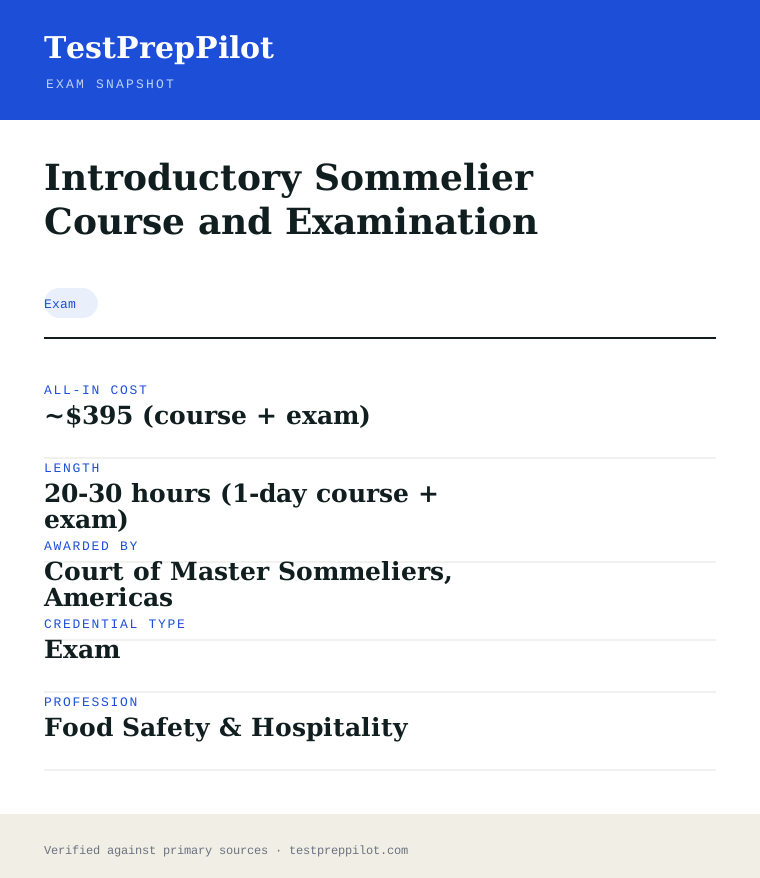
Introductory Sommelier Course and Examination is a exam credential; awarded by Court of Master Sommeliers, Americas; the exam fee is ~$395; typical preparation is 20-30 hours (1-day course + exam); holders typically earn $30,000-$80,000 (35-3031 median $65,310 for managers).
| Credential | Introductory Sommelier Course and Examination |
|---|---|
| Type | Exam |
| Profession | Food Safety & Hospitality |
| Specialty | Food Safety & Culinary |
| Awarded by | Court of Master Sommeliers, Americas |
| Difficulty | Entry to Applied |
| Typical prep time | 20-30 hours (1-day course + exam) |
| All-in cost | ~$395 (course + exam) |
| Typical salary range | $30,000-$80,000 (35-3031 median $65,310 for managers) |
| Credential | Introductory Sommelier Course and Examination |
| Awarding body | Court of Master Sommeliers, Americas |
| Exam format | Proctored, computer-based |
| Validity | CMS certification is permanent |
| Languages | Varies — see awarding body |
| Scope | National / Multi-state |
Real questions
Frequently asked questions about the Introductory Sommelier Course and Examination
How do I register for the Introductory Sommelier Course and Examination exam?
Register through Court of Master Sommeliers, Americas's official portal or an authorized test provider (e.g., Pearson VUE or Prometric where applicable). Create an account, select the exam, pay the fee, and schedule a date.
How much does the exam cost?
Fees vary by location and currency. Confirm the current fee on the official registration page before scheduling.
How long is the credential valid, and how do I renew?
Validity varies by credential (commonly 2–3 years). Renewal usually requires continuing education or a recertification exam — see Court of Master Sommeliers, Americas's policy.
What if I do not pass?
Most bodies allow retakes after a waiting period and payment of the full or partial fee. Check Court of Master Sommeliers, Americas's retake policy before rescheduling.
How do I register for a Court of Master Sommeliers, Americas credential?
Register through the official website, select your exam, pay the fee, and schedule a date.
How do I renew a credential?
Renewal policies vary by credential; check the specific program page for requirements and cycles.
In short
Is the Introductory Sommelier Course and Examination worth it?
- Introductory Sommelier Course and Examination is awarded by Court of Master Sommeliers, Americas.
- Validates job-ready competence in Beauty, Food, Security & Recreation.
- Registration is through the awarding body or an authorized test provider.
- Renewal and retake policies vary — confirm before scheduling.
Trust
Where does this information come from?
Everything above is taken from the awarding body's own published material. Fees, question counts and domain weights are revised regularly — check the official page before you pay.
Research confidence: low · Last reviewed 2026-08