Food Safety & Hospitality • Certification
ServSafe Alcohol Primary Certification
ServSafe Alcohol Primary Certification — Beauty, Food, Security & Recreation credential from National Restaurant Association
Researched and maintained by TestPrepPilot Editorial BoardFood safety & hospitality certifications desk · Figures last verified August 2026
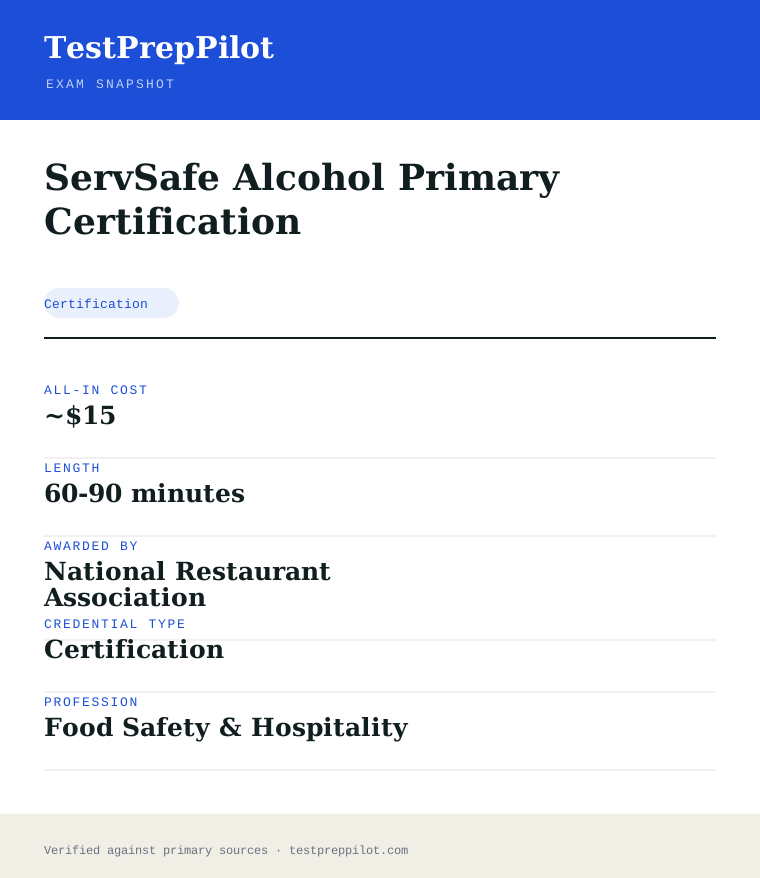
The short version
What is the ServSafe Alcohol Primary Certification and is it worth it?
ServSafe Alcohol Primary Certification is a professional credential administered by National Restaurant Association. It validates job-ready knowledge and skills in the Beauty, Food, Security & Recreation field and is used for career entry, advancement, or compliance.
- Recognized credential from National Restaurant Association
- Demonstrates verified competence in Beauty, Food, Security & Recreation
- Supports career advancement and may satisfy licensing or employer requirements
What is it?
What exactly is the ServSafe Alcohol Primary Certification?
ServSafe Alcohol Primary Certification — Beauty, Food, Security & Recreation credential from National Restaurant Association
Responsible alcohol service training and examination on intoxication assessment, identification checks and refusal techniques. Offered by National Restaurant Association, it is designed for candidates who need to demonstrate verified competence in the Beauty, Food, Security & Recreation field. The credential is commonly used for career entry, advancement, regulatory compliance, or employer requirements. Candidates should review the official handbook for eligibility, exam format, and scoring before registering.
The path in brief
- Confirm you meet any eligibility or prerequisites
- Review the official handbook and study materials
- Register and pay through the awarding body or authorized provider
- Schedule and take the exam (test center or online proctoring)
- Receive your score and, if passed, your credential
Before you book
Who is eligible to sit the ServSafe Alcohol Primary Certification?
None - open to all servers and sellers
Who it is for: Professionals and candidates seeking to validate Beauty, Food, Security & Recreation competence.
The test itself
What is the format of the ServSafe Alcohol Primary Certification?
The ServSafe Alcohol Primary Certification is administered by National Restaurant Association and runs ~30 min and contains 25 (75% passing) questions.
| Administered by | National Restaurant Association |
|---|---|
| Questions | 25 (75% passing) |
| Time limit | ~30 min |
| Pass mark | Passing score set by the awarding body; see the official score report |
| Exam fee | ~$15 |
| Format | Proctored, computer-based (test center or online remote proctoring) |
Content outline
What topics are on the ServSafe Alcohol Primary Certification?
The ServSafe Alcohol Primary Certification covers 4 content domains.
Weightings come from the official exam outline. Study time is best allocated in roughly these proportions rather than evenly across domains.
- Core techniques
Topic area tested on the exam; see the official blueprint for the detailed breakdown.
- Sanitation & safety
Topic area tested on the exam; see the official blueprint for the detailed breakdown.
- Client / guest service
Topic area tested on the exam; see the official blueprint for the detailed breakdown.
- Regulations
Topic area tested on the exam; see the official blueprint for the detailed breakdown.
The path
How do you register for the ServSafe Alcohol Primary Certification?
- 1
Visit the awarding body’s official website and create an account
- 2
Select the credential and review its specific requirements
- 3
Complete any required eligibility (education, experience, or training)
- 4
Pay the registration fee
- 5
Schedule the exam at a test center or online
- 6
Take the exam and receive your results
The fine print
What are the retake and renewal rules for the ServSafe Alcohol Primary Certification?
- Proctoring & delivery
- Proctored, computer-based delivery (test center or remote online proctoring), varying by exam.
- Retake policy
- Varies by credential — most bodies permit retakes after a waiting period and full or partial fee.
- Score reporting
- Scores are reported per the body’s timeline, typically electronically after the exam.
- Recertification
- Varies; many credentials require renewal every 2–3 years via continuing education or a recertification exam.
What it pays
How much does this credential pay?
Alcohol certification is a hiring requirement in licensed venues: bartenders earned a $29,820 median in May 2024 (BLS)
The ServSafe Alcohol Primary certification proves that a server or seller understands responsible alcohol service - checking IDs, recognizing intoxication, avoiding service to minors, and handling difficult situations. It is a training credential, not a job license for a specific occupation, so no single BLS SOC code attaches to it; its role is to satisfy the alcohol-service training requirement that employers and many state and local jurisdictions impose on staff in licensed venues. The salary story belongs to the occupations that require it. BLS reported that bartenders (SOC 35-3011) earned a median of $29,820 in May 2024, and waiters and waitresses (35-3031) about $28,080; these wage-and-salary figures understate cash compensation because tips form a large share of income in these roles, and BLS notes that hourly earnings data capture only the base wage. The structural point for workers is that alcohol-service certification is a de facto hireability requirement in bars, restaurants, hotels and event venues - many employers will not schedule a new hire on a bar or service floor until the training is complete - and it is cheap ($15 or less in most formats) and quick (under two hours). For employers, the certificate documents compliance with responsible-service expectations and supports defense in liability situations. BLS classifies workers by job duty, not certificates, so no credential maps to a specific wage; the certificate removes a hiring barrier, and the income follows the job, including the tips that the base wage understates. The upgrade path is the ServSafe Alcohol Advanced program for managers and the Food Protection Manager certification for food-safety management roles.
| Measure | Figure | Source / note |
|---|---|---|
| Bartenders median, May 2024 | $29,820 | BLS OEWS, SOC 35-3011 (base wage; tips understated) |
| Waiters and waitresses median, May 2024 | ~$28,080 | BLS OEWS, SOC 35-3031 (base wage; tips understated) |
| Food service managers median, May 2024 | $65,310 | BLS OEWS, SOC 35-2021 |
| All-occupation median, May 2024 | $49,500 | BLS OEWS |
Job growth.Food and beverage service employment is projected to grow about 6 percent from 2024 to 2034, with large replacement demand.
Source: BLS Occupational Outlook Handbook - Food and Beverage Serving and Related Workers
Your odds
What are the pass rates?
The ServSafe Alcohol Primary course requires a 75 percent passing score on a 25-question exam (ServSafe official)
ServSafe does not publish a national pass-rate statistic for the Alcohol Primary course, but the assessment mechanics are public. The course is delivered online (also in Spanish and other languages) and ends with a 25-question multiple-choice exam; the passing score is 75 percent, meaning a candidate must answer at least 19 of 25 correctly. The exam is not proctored in most delivery formats, because the course is training certification rather than licensure, and candidates may review the material and retake the exam if they do not pass. Because the content is a finite set of responsible-service rules - ID verification, signs of intoxication, policies for refusing service, and local law variations - the practical pass rate among people who complete the course is very high, and the certificate is issued electronically (PDF and wallet card) after passing. The certificate is valid for a period set by the employer or jurisdiction - commonly two to three years, though some states require renewal on a different cycle, and some employers require refresher training annually; candidates should confirm the requirement where they work. The exam covers four topic areas: the responsible server’s role, recognizing and preventing intoxication, checking identification, and handling difficult situations. The honest summary is that completion with a 75 percent score is the realistic bar; the certificate’s value is satisfying the training requirement and supporting the employer’s responsible-service position, and the number that matters is the 75 percent threshold plus the jurisdiction’s validity window.
Read this before quoting the number.ServSafe does not publish pass rates; the Primary exam requires 75% on 25 questions with retakes available.
Your schedule
How long should I study for it?
1-2 hours (one to two sessions) of focused study
The ServSafe Alcohol Primary course is short and self-paced, so a study plan is measured in hours rather than weeks. The content is organized around four areas: the responsible server’s role (why training matters, server liability), recognizing and preventing intoxication (signs and symptoms, pacing service), checking identification (valid ID features, refusal when unsure), and handling difficult situations (refusing service professionally, dealing with angry guests). A realistic plan: session one (30-45 minutes) works through the course modules with the official materials; session two (20-30 minutes) takes the 25-question exam and reviews missed items; if a retake is needed, session three (15-20 minutes) reviews the specific topics behind the missed questions and retakes. Because the exam is open-book in practice in most online formats and the passing bar is 75 percent, the failure mode is not difficulty but rushing - candidates who skip the ID-checking section (which has the most detail-heavy items) tend to miss the largest cluster of questions. The single most important thing to learn is the ID verification process: checking the birth date, the physical features (photo, age, height), the security features, and knowing the legal refusal rules in the state where you serve, because these items repeat across the exam. For staff in states with specific responsible-service requirements (such as server training mandates), the ServSafe certificate is one of the accepted credentials, and candidates should confirm which program their state or employer requires.
- Session 10.75
Course modules
- Work through the four modules
- Note ID-check and intoxication signs
- Session 20.5
Exam
- Take the 25-question exam
- Review missed items
- Session 3 (if needed)0.33
Retake
- Review missed topics
- Retake to 75%+
Adjusting the pace
State requirements.Some states mandate specific responsible-service training; confirm which certificate the state or employer requires.
Manager upgrade.The ServSafe Alcohol Advanced program is the manager-level certification with a longer exam.
How to study
How do I prepare most effectively?
The most effective strategies for the ServSafe Alcohol Primary exam are about mastering a small set of responsible-service rules and applying them to scenarios. Strategy one: learn the ID-checking process step by step - verify the birth date, compare the photo and physical descriptors, check the security features, and refuse if anything is uncertain - because ID items are the most common and the most detail-heavy. Strategy two: memorize the common signs of intoxication (slurred speech, unsteady movement, flushed appearance, impaired judgment) and the pacing rules for service, because recognition items test the observable signs, not vague definitions. Strategy three: know the refusal process cold: state the policy clearly, stay calm, avoid arguments, and involve a manager or security when needed, because scenario items test the professional response, not the confrontation. Strategy four: review the local law variations - minimum legal drinking age (21 in all US states), and any state-specific rules - because the exam frames items around the legal context. Strategy five: complete the official course rather than third-party summaries, because the exam is drawn from ServSafe’s own materials. Strategy six: test soon after finishing the course while the rules are fresh; the content is small enough that same-day completion is the efficient path, and the retake is available if needed.
Master the ID check
Birth date, photo, descriptors, security features, refusal.
Know the signs of intoxication
Slurred speech, unsteadiness, flushed appearance, judgment.
Practice the refusal process
Calm, clear policy; escalate to a manager when needed.
Review local law basics
Legal age 21 and state-specific rules frame the items.
What to buy
Which study resources are worth paying for?
The ServSafe Alcohol Primary resource market is simple because ServSafe owns the official content and the certification. The official ServSafe Alcohol Primary course includes the training modules, the 25-question exam and the certificate, priced around $15 (occasionally higher through resellers or with print materials); buying the official course is the standard path and the only way to get the certificate itself. ServSafe also publishes a printed Alcohol Primary guide (about $15) and free resources including ID-checking checklists. Third-party summaries and quizzes exist for free or a few dollars but are unnecessary: the official course contains everything the exam tests, and third-party content occasionally states rules that conflict with current state laws. Employers often pay for or reimburse the course, and some states accept alternative responsible-service certificates, so candidates should confirm the accepted credential with their employer before purchasing. The honest ranking: the official online course, optionally the printed guide, and nothing else. Prices here are current as of 2025-26 and change annually.
| Resource | Price | Format | Best for |
|---|---|---|---|
| Official ServSafe Alcohol Primary course | ~$15 | Online, self-paced | The required training, exam, and certificate |
| ServSafe Alcohol Primary Guide | ~$15 | Study companion | |
| Free ServSafe resources | Free | Web PDFs | ID-checking checklists and rules |
| Third-party quizzes | Free-$5 | Online | Unnecessary; official course suffices |
Prices dated 2025-26; ServSafe is the official provider. No commission-based ranking.
Avoid these
What mistakes do candidates most often make?
The most common mistakes on the ServSafe Alcohol Primary exam come from skipping the detail-heavy ID section and misreading scenario items. Mistake one: testing without the course; the exam is drawn from ServSafe’s materials, and candidates who rely on general knowledge miss the specific ID-verification steps. Mistake two: treating ID checking as a single step; the exam tests the full sequence - birth date, photo comparison, physical descriptors, security features, and refusal when uncertain - and candidates who answer from habit miss the items that probe the sequence. Mistake three: confusing "signs of intoxication" with subjective impressions; the exam rewards the observable, documented signs (speech, movement, appearance), not judgments like "seems drunk." Mistake four: answering refusal scenarios with confrontation; the professional response is calm, policy-based refusal with escalation, and scenario items test that. Mistake five: ignoring state variation; items are framed around the legal context, and candidates who assume one national rule miss local-law items. Mistake six: assuming the certificate never expires; employers and states set validity windows (commonly two to three years), and an expired certificate fails the same compliance check the original satisfied. Finally, candidates should confirm which certificate the employer requires - Primary for servers, Advanced for managers - because taking the wrong level wastes the fee.
✕Testing without the course
✓Work the official modules; the exam comes from them.
✕Reducing ID check to one step
✓Learn the full verification sequence, including refusal.
✕Answering with subjective impressions
✓Use the observable, documented signs of intoxication.
✕Choosing confrontation in refusal items
✓Calm, policy-based refusal with escalation.
✕Assuming the certificate is permanent
✓Track the validity window set by employer or state.
What you'll face
What question types will I see?
The ServSafe Alcohol Primary exam consists of 25 multiple-choice questions with a passing score of 75 percent (19 of 25). Items are drawn from four topic areas: the responsible server’s role and liability, recognizing and preventing intoxication (signs, pacing, food service), checking identification (verification steps and refusal), and handling difficult situations (professional refusal, escalation, documentation). Most items are either direct knowledge questions or scenario questions (what should the server do next). Samples below are editor-written illustrations of the published course content, not live exam items.
Liability, role of training, policies.
Signs, pacing, food, refusal triggers.
Verification sequence, security features, refusal.
Professional refusal, escalation, documentation.
Try these
Q1A guest hands the server an ID that looks slightly worn. Which step should the server take first when checking the ID?
Answer:B
The verification sequence starts with comparing the photo and physical descriptors to the guest, then checks the birth date and security features; the exam rewards the order of the checks.
Q2Which of the following is a documented sign of intoxication?
Answer:B
Slurred speech and unsteady movement are observable, documented signs of intoxication; the distractors are normal behaviors, not signs.
Q3A guest who was refused service becomes loud and argumentative. What should the server do?
Answer:B
The professional response is calm, policy-based refusal with escalation to a manager; arguing escalates the situation, serving violates policy, and physical removal is a security function.
Samples are editor-written illustrations of the published course content, not live exam items.
The big day
What should I expect on exam day?
The ServSafe Alcohol Primary exam has no physical test center: the course and exam are completed online through ServSafe.com after purchasing access, at any time, on any device with an internet connection. There is no proctor, no appointment, and no deadline; candidates work through the four modules and then take the 25-question exam. The exam is timed by the platform with a generous allowance, and candidates who do not reach 75 percent can review and retake. After passing, the certificate is issued electronically (PDF download and a wallet card option), and the completion record is stored in the candidate’s ServSafe account, which employers can verify. Candidates should confirm with their employer or state whether the ServSafe certificate is the accepted credential (some states accept other responsible-service training) and note the certificate’s validity window, commonly two to three years, and set a renewal reminder. Afterwards, the natural next step for managers is the ServSafe Alcohol Advanced program, which covers the same topics at greater depth with a longer exam.
Bring
- ServSafe account and course access
- Stable internet connection
- 60-90 minutes of uninterrupted time
- Employer/state requirements for the certificate
Leave at home
- Proctoring or appointment - there is none
- Special software beyond a browser
- Deadlines - the course is self-paced
How the day runs
Rules in the room
- The course and exam are fully online and unproctored.
- The passing score is 75% on 25 questions.
- The certificate is valid per employer/state policy, commonly 2-3 years.
- The Alcohol Advanced program is the manager-level certification.
Afterwards.Download the certificate and store it with the employer; set a renewal reminder for the validity window, and consider the Alcohol Advanced program for manager roles.
Reference
What are the key facts about the ServSafe Alcohol Primary Certification?
ServSafe Alcohol Primary Certification is a certification credential; awarded by National Restaurant Association; the exam fee is ~$15; typical preparation is 60-90 minutes; holders typically earn $25,000-$45,000 (service roles; tips add income).
| Credential | ServSafe Alcohol Primary Certification |
|---|---|
| Type | Certification |
| Profession | Food Safety & Hospitality |
| Specialty | Food Safety & Culinary |
| Awarded by | National Restaurant Association |
| Difficulty | Entry to Applied |
| Typical prep time | 60-90 minutes |
| All-in cost | ~$15 |
| Typical salary range | $25,000-$45,000 (service roles; tips add income) |
| Credential | ServSafe Alcohol Primary Certification |
| Awarding body | National Restaurant Association |
| Exam format | Proctored, computer-based |
| Validity | Varies by credential (commonly 2–3 years) |
| Languages | Varies — see awarding body |
| Scope | National / Multi-state |
Real questions
Frequently asked questions about the ServSafe Alcohol Primary Certification
How do I register for the ServSafe Alcohol Primary Certification exam?
Register through National Restaurant Association's official portal or an authorized test provider (e.g., Pearson VUE or Prometric where applicable). Create an account, select the exam, pay the fee, and schedule a date.
How much does the exam cost?
Fees vary by location and currency. Confirm the current fee on the official registration page before scheduling.
How long is the credential valid, and how do I renew?
The exam requires 75% (19 of 25); the certificate is issued electronically and the validity window is set by the employer or state.
What if I do not pass?
Most bodies allow retakes after a waiting period and payment of the full or partial fee. Check National Restaurant Association's retake policy before rescheduling.
How do I register for a National Restaurant Association credential?
Register through the official website, select your exam, pay the fee, and schedule a date.
How do I renew a credential?
Renewal policies vary by credential; check the specific program page for requirements and cycles.
In short
Is the ServSafe Alcohol Primary Certification worth it?
- ServSafe Alcohol Primary Certification is awarded by National Restaurant Association.
- Validates job-ready competence in Beauty, Food, Security & Recreation.
- Registration is through the awarding body or an authorized test provider.
- Renewal and retake policies vary — confirm before scheduling.
Same awarding body
What other credentials does National Restaurant Association award?
Worth comparing
How does the ServSafe Alcohol Primary Certification compare with similar credentials?
Trust
Where does this information come from?
Everything above is taken from the awarding body's own published material. Fees, question counts and domain weights are revised regularly — check the official page before you pay.
Research confidence: low · Last reviewed 2026-08