Food Safety & Hospitality • Certification
ACF Certified Fundamentals Cook
ACF Certified Fundamentals Cook — Beauty, Food, Security & Recreation credential from American Culinary Federation
Researched and maintained by TestPrepPilot Editorial BoardCulinary & food-service certifications desk · Figures last verified August 2026
The short version
What is the ACF Certified Fundamentals Cook and is it worth it?
ACF Certified Fundamentals Cook is a professional credential administered by American Culinary Federation. It validates job-ready knowledge and skills in the Beauty, Food, Security & Recreation field and is used for career entry, advancement, or compliance.
- Recognized credential from American Culinary Federation
- Demonstrates verified competence in Beauty, Food, Security & Recreation
- Supports career advancement and may satisfy licensing or employer requirements
What is it?
What exactly is the ACF Certified Fundamentals Cook?
ACF Certified Fundamentals Cook — Beauty, Food, Security & Recreation credential from American Culinary Federation
Graduate-level entry credential for culinary school leavers assessed on basic cooking methods, sanitation and knife skills. Offered by American Culinary Federation, it is designed for candidates who need to demonstrate verified competence in the Beauty, Food, Security & Recreation field. The credential is commonly used for career entry, advancement, regulatory compliance, or employer requirements. Candidates should review the official handbook for eligibility, exam format, and scoring before registering.
The path in brief
- Confirm you meet any eligibility or prerequisites
- Review the official handbook and study materials
- Register and pay through the awarding body or authorized provider
- Schedule and take the exam (test center or online proctoring)
- Receive your score and, if passed, your credential
Before you book
Who is eligible to sit the ACF Certified Fundamentals Cook?
Eligibility varies; many credentials are open to all, while others require coursework, work experience, or sponsorship.
Who it is for: Professionals and candidates seeking to validate Beauty, Food, Security & Recreation competence.
The test itself
What is the format of the ACF Certified Fundamentals Cook?
The ACF Certified Fundamentals Cook is administered by American Culinary Federation and runs Varies (written ~2 hours + practical).
| Administered by | American Culinary Federation |
|---|---|
| Questions | Written exam + practical cooking demonstration |
| Time limit | Varies (written ~2 hours + practical) |
| Pass mark | Passing score set by the awarding body; see the official score report |
| Exam fee | ~$150-$300 |
| Format | Proctored, computer-based (test center or online remote proctoring) |
Content outline
What topics are on the ACF Certified Fundamentals Cook?
The ACF Certified Fundamentals Cook covers 4 content domains.
Weightings come from the official exam outline. Study time is best allocated in roughly these proportions rather than evenly across domains.
- Core techniques
Topic area tested on the exam; see the official blueprint for the detailed breakdown.
- Sanitation & safety
Topic area tested on the exam; see the official blueprint for the detailed breakdown.
- Client / guest service
Topic area tested on the exam; see the official blueprint for the detailed breakdown.
- Regulations
Topic area tested on the exam; see the official blueprint for the detailed breakdown.
The path
How do you register for the ACF Certified Fundamentals Cook?
- 1
Visit the awarding body’s official website and create an account
- 2
Select the credential and review its specific requirements
- 3
Complete any required eligibility (education, experience, or training)
- 4
Pay the registration fee
- 5
Schedule the exam at a test center or online
- 6
Take the exam and receive your results
The fine print
What are the retake and renewal rules for the ACF Certified Fundamentals Cook?
- Proctoring & delivery
- Proctored, computer-based delivery (test center or remote online proctoring), varying by exam.
- Retake policy
- Varies by credential — most bodies permit retakes after a waiting period and full or partial fee.
- Score reporting
- Scores are reported per the body’s timeline, typically electronically after the exam.
- Recertification
- Varies; many credentials require renewal every 2–3 years via continuing education or a recertification exam.
What it pays
How much does this credential pay?
$32,390 median for restaurant cooks (SOC 35-2014, BLS May 2024) — the occupation the Certified Fundamentals Cook feeds into
The closest official occupation to the Certified Fundamentals Cook credential is Cooks, Restaurant, SOC 35-2014, which had a May 2024 median annual wage of $32,390, with the lowest 10 percent earning roughly $17,000 and the highest 10 percent in the mid-$55,000 range, per BLS OEWS data. We have chosen that code deliberately: the CFC is ACF’s entry-level, stackable credential, requiring no prior work experience, and its stated competency areas — basic food preparation, safety and sanitation, culinary nutrition and foodservice management — are the skills of a line or prep cook working in a restaurant kitchen, which is exactly what SOC 35-2014 describes. The broader BLS Cooks occupation, which groups restaurant cooks with institution, cafeteria, short-order and fast-food cooks, had a combined median of $35,760 in May 2024 across about 2.8 million jobs, with 5 percent projected employment growth from 2024 to 2034 and roughly 432,200 openings a year — an enormous replacement-driven labor market. The caveats matter. First, cooking is a low-wage occupation by national standards, and the credential’s realistic value is not a large wage jump on day one; it is the first rung of ACF’s stackable certification ladder, which runs from CFC up through Certified Culinarian and beyond, and it signals food-safety competency that employers of entry-level cooks value in hiring. Second, most cooks advance economically by moving up the kitchen hierarchy toward chef and head cook roles, which BLS lists separately with a far higher median of $60,990, and the CFC is the credential that documents the first steps of that path. Third, BLS does not measure any certificate premium for the CFC specifically, and we will not invent one — the wage story here is about the occupation and the ladder, not a guaranteed lift from the paper itself.
| Measure | Figure | Source / note |
|---|---|---|
| Median annual wage, cooks, restaurant | $32,390 | BLS OEWS, SOC 35-2014, May 2024 |
| Reference: all cooks (combined) | $35,760 | BLS OOH Cooks page, May 2024 |
| Reference: chefs and head cooks | $60,990 | BLS OOH, May 2024 — the next rung on the kitchen ladder |
| Employment, cooks (combined), 2024 | 2,805,100 jobs | BLS OOH Quick Facts, 2024 |
| Projected annual openings, cooks | ~432,200 per year | BLS OOH Job Outlook, 2024-34 |
Job growth.5% projected change 2024-34 for cooks (faster than average), with ~432,200 openings a year; the CFC’s real value is the first rung of ACF’s stackable ladder toward chef roles
Your odds
What are the pass rates?
ACF publishes no pass rate for the Certified Fundamentals Cook exams — but the passing scores are published: 75% on the written exam and 75% on the practical exam
The American Culinary Federation does not publish pass-rate statistics for the Certified Fundamentals Cook certification, so no pass-rate figure exists to quote and we will not estimate one. What is published and verifiable is the passing standard for each of the two required exams. The written exam is the ACF Certificate of Culinary Essentials: 100 questions completed in 120 minutes on the ACF Online Learning Center under a locally identified proctor, and the official CFC handbook states that an applicant must pass it with 75 percent to satisfy the written requirement for the credential. The performance exam is the practical component, and the official ACF process pages state that a score of 75 percent or higher is required to pass — the practical assessment for the CFC is a set menu, typically sautéed chicken with fine herb sauce, rice pilaf and steamed carrots, completed within roughly two and a half hours. The certification itself is valid for five years. On the fees and retakes, the published numbers are specific: the application-and-exam pathway is $75 for ACF members and $95 for non-members, the written exam retake carries a 14-day waiting period with a per-attempt fee of $25 for members and $45 for non-members, and the performance exam has no waiting period. Because there is no pass rate to guide planning, the practical reading of the published 75 percent threshold is that a candidate should aim to clear both components comfortably — the written exam tests safety and sanitation, culinary fundamentals, foodservice concepts and nutrition, and the practical component tests whether you can produce the menu to standard under a clock.
Read this before quoting the number.No pass rate is published by ACF. The 75% written and 75% practical passing scores, the 100-question/120-minute written format, the $75/$95 fees and the five-year validity are the published figures this narrative relies on instead.
Source: ACF — Certified Fundamentals Cook handbook and certification pages
Your schedule
How long should I study for it?
40-70 hours over 6-10 weeks of focused study
Plan for six to ten weeks and 40 to 70 hours of study, with roughly two-thirds of the time on the written exam’s content areas and the rest on rehearsing the practical menu, and remember the CFC requires no work experience — eligibility is a high school diploma or GED, or enrollment in culinary coursework covering at least 75 hours including a minimum of 15 hours each in nutrition and safety and sanitation. The written exam is the ACF Certificate of Culinary Essentials: 100 questions in 120 minutes, completed on the ACF Online Learning Center under a locally identified proctor, and the official handbook breaks the content into roughly 50 questions in culinary fundamentals, 35 in food safety and sanitation, 15 in foodservice concepts and 15 in culinary nutrition, with a passing score of 75 percent. The performance exam is the second component, completed separately at an ACF-approved test site, and for the CFC the practical is a set menu — commonly sautéed chicken with fine herb sauce, rice pilaf and steamed carrots — produced within roughly two and a half hours to a 75 percent standard. The plan below assumes you have kitchen experience or have completed the qualifying coursework; if you are coming from a high-school pathway, front-load the safety and sanitation content because it is the largest single area after culinary fundamentals and the most consequential on the job. The certification is valid for five years and renewed with continuing education hours, so the study you do here is the foundation of a longer credential cycle.
- Weeks 1-26-8 hrs/week
Safety and sanitation (35 questions)
- Master food safety: time and temperature abuse, cross-contamination, personal hygiene and HACCP principles
- Learn cleaning and sanitising procedures, facility requirements and the FDA model food code basics
- Work the ServSafe-style content this domain overlaps with — the questions reward the same hazard logic
- Begin a personal error log of the safety facts you miss
- Weeks 3-57-9 hrs/week
Culinary fundamentals (50 questions)
- Master basic cooking methods: dry-heat, moist-heat and combination, and when each fits the product
- Work knife skills, mise en place, portioning and standard recipe math
- Learn the classic cuts, stock, sauce and mother-sauce families, and basic starches and proteins
- Practise the written-exam style: terminology, definitions and applied technique questions
- Weeks 6-77-9 hrs/week
Nutrition, foodservice concepts and practical rehearsal
- Cover culinary nutrition (15 questions): macronutrients, dietary guidelines and menu implications
- Work foodservice concepts (15 questions): costing, purchasing, storage rotation and the business of the kitchen
- Rehearse the practical menu — sautéed chicken with fine herb sauce, rice pilaf, steamed carrots — to the 75% standard
- Run one full 120-minute timed written practice exam and log every miss
- Weeks 8-106-8 hrs/week
Timed rehearsal and test-day readiness
- Two more full timed written practice exams; re-drill the error log
- Rehearse the practical menu twice more, timing each component and plating to standard
- Confirm your test-site logistics: ACF online written exam proctor and the practical test site
- One quiet day before each exam component
Adjusting the pace
Working as a line cook already.Four to six weeks. Your day job is the practical rehearsal; spend the time on the written content areas — especially the 35-question safety and sanitation block and the 15-question foodservice concepts — which working cooks under-study.
High-school or culinary-course pathway.Full ten weeks at 5-6 hrs/week. Front-load safety and sanitation and the fundamentals vocabulary, since the coursework provides the base but not the exam-style drill.
Adding CFC to existing food-service credentials.Three to four weeks. If you already hold ServSafe or a state food-handler credential, the safety block is mostly revision; confirm the practical menu with your test site and rehearse it specifically.
How to study
How do I prepare most effectively?
The strategy that reliably passes the Certified Fundamentals Cook is "split the preparation correctly — two-thirds on the 100-question written exam and the rest on the practical menu — and rehearse both under their real clocks", and the single biggest error is treating a certification that requires no work experience as if it required chef-level skill. The written exam, the ACF Certificate of Culinary Essentials, is 100 questions in 120 minutes with roughly 50 questions in culinary fundamentals, 35 in food safety and sanitation, 15 in foodservice concepts and 15 in culinary nutrition, and the passing score is 75 percent — so a candidate who knows the breakdown can allocate study hours in those proportions and close the exam efficiently. The second proven approach is learning safety and sanitation as hazard logic rather than fact recall, because the domain overlaps heavily with ServSafe content and rewards understanding time and temperature, cross-contamination and HACCP as a decision framework. Third, rehearse the practical menu exactly: the CFC performance exam is a set menu — sautéed chicken with fine herb sauce, rice pilaf and steamed carrots — so practice is a matter of producing it repeatedly to the 75 percent standard within the time limit, not of improvisation. Fourth, use the ACF study materials and practice exams available through the ACF Online Learning Center, because they are the closest available simulation of the real written format. Finally, treat the two components as separate appointments with separate logistics — the written exam is proctored online and the practical is at an approved test site — and confirm both schedules early.
Allocate study hours by the written breakdown
The 100-question written exam is roughly 50 questions in culinary fundamentals, 35 in food safety and sanitation, 15 in foodservice concepts and 15 in culinary nutrition. Weight your calendar in those proportions and the biggest domain gets the most time, by design.
Learn safety and sanitation as hazard logic
The 35-question safety block overlaps heavily with ServSafe content and rewards decision frameworks: time and temperature abuse, cross-contamination routes and HACCP principles. Learn the logic, and unfamiliar questions still resolve correctly.
Rehearse the exact practical menu
The CFC performance exam is a set menu — typically sautéed chicken with fine herb sauce, rice pilaf and steamed carrots — produced within roughly 2.5 hours to a 75% standard. Practise producing that exact menu to standard under the clock; improvisation is not the skill being tested.
Use ACF’s own study materials
The ACF Online Learning Center offers study materials and practice exams aligned to the Certificate of Culinary Essentials. They are the closest available simulation of the real written format and should come before third-party content.
Treat the two components as two appointments
The written exam is proctored online with a locally identified proctor; the practical is at an ACF-approved test site. Confirm both logistics, the proctor requirements and the menu with your test site well before each date.
What to buy
Which study resources are worth paying for?
The Certified Fundamentals Cook buying decision is unusually small because the credential is entry-level and the official costs are low: the application-and-exam pathway is $75 for ACF members and $95 for non-members, with per-attempt written retakes at $25 for members and $45 for non-members, and the certification is valid for five years. The two required exams are the written Certificate of Culinary Essentials, 100 questions in 120 minutes on the ACF Online Learning Center, and the practical performance exam at an approved test site. The table below compares the main options with prices current to this review. The one thing to check before buying is which edition of the study materials matches the current ACF certification cycle, because the written exam content is revised with the credential cycle and out-of-date material teaches out-of-date standards.
| Resource | Price | Format | Best for |
|---|---|---|---|
| CFC application and certification pathway | $75 member / $95 non-member | Written plus practical exams | The certification itself — required |
| ACF Online Learning Center — Certificate of Culinary Essentials exam | Included in the pathway fee | Proctored online written exam, 100 questions / 120 min | The written component, taken with a locally identified proctor |
| Practical performance exam at an ACF-approved test site | Pathway fee covers certification; host sites may add fees | In-person cooking assessment | The practical component — confirm the menu with the site |
| ACF study materials and practice exams | ~$20-60 | Online or printed | The closest available simulation of the written format |
| ServSafe or similar food-safety coursework | ~$50-150 depending on provider | Course plus exam | Candidates who want the safety domain taught in depth before the ACF written exam |
Prices checked 2026-08 in USD before tax; the pathway fee does not include food costs or any host-site exam fees, and written retakes carry a 14-day waiting period at $25 member/$45 non-member per attempt.
Avoid these
What mistakes do candidates most often make?
The most common Certified Fundamentals Cook mistakes come from misunderstanding what the credential is: treating a certification that requires no work experience as if it demanded chef-level technique, and neglecting the written exam’s largest block — the 35-question safety and sanitation domain — in favour of cooking practice that the practical component will reward anyway. Candidates also routinely arrive at the practical without confirming the exact menu and standard with their test site, under-rehearse the timed written format, and forget that the certification, once earned, runs on a five-year renewal clock with continuing education hours to bank.
✕Over-preparing for the practical and under-preparing the written
✓The written exam is 100 questions with a 35-question safety block and a 50-question fundamentals block; the practical is a set menu produced to a 75% standard. Allocate study time to the written breakdown, not just to knife practice — most candidates already cook well enough to pass the practical.
✕Neglecting the safety and sanitation domain
✓At roughly 35 of 100 questions, safety and sanitation is the second-largest block on the written exam and the most consequential on the job. Learn time and temperature, cross-contamination and HACCP as decision logic; it overlaps heavily with ServSafe and it is entirely learnable.
✕Arriving at the practical without confirming the menu
✓The CFC practical is a set menu — typically sautéed chicken with fine herb sauce, rice pilaf and steamed carrots. Confirm the exact menu, portions and time limit with your test site before the day, and rehearse that exact production rather than a similar one.
✕Under-rehearsing the timed written format
✓100 questions in 120 minutes at a 75% cut means about 1.2 minutes per question with no slack for rereading. Run full timed practice exams so the format, not just the content, is trained.
✕Forgetting the five-year renewal clock
✓The CFC is valid for five years and renewed with continuing education hours. Diary the expiry from the day you pass and bank hours from real work and courses across the cycle, rather than scrambling at the end of year five.
What you'll face
What question types will I see?
The Certified Fundamentals Cook certification has two exam components. The written exam is the ACF Certificate of Culinary Essentials: 100 questions completed in 120 minutes on the ACF Online Learning Center under a locally identified proctor, with a passing score of 75 percent, and the official handbook breaks the content into roughly 50 questions in culinary fundamentals, 35 in food safety and sanitation, 15 in foodservice concepts and 15 in culinary nutrition. The performance exam is the practical component, completed at an ACF-approved test site, and for the CFC it is a set menu — commonly sautéed chicken with fine herb sauce, rice pilaf and steamed carrots — produced within roughly two and a half hours to a 75 percent standard. The written exam is dominated by applied multiple-choice questions that test technique recognition, terminology, food-safety decision logic and kitchen procedures rather than abstract theory, and the 35-question safety block overlaps with ServSafe-style content. Because the exam is scored against the 75 percent threshold and no score breakdown is published, candidates should aim to clear the threshold comfortably across all four content areas rather than gamble on their strongest domain. The samples below are editor-written illustrations of the published exam’s question styles, not live exam items.
Cooking methods, knife skills, mise en place, classic cuts, stocks, sauces, standard recipe math and terminology. The largest block; these reward applied technique knowledge over recall.
Time and temperature abuse, cross-contamination, personal hygiene, HACCP and cleaning procedures — the ServSafe-overlapping block that is entirely learnable as decision logic.
Costing, purchasing, storage rotation, portion control and the business side of the kitchen. Small but cheap points for anyone who has worked a service shift.
Macronutrients, dietary guidelines and menu implications of nutrition choices.
Produce the set menu — sautéed chicken with fine herb sauce, rice pilaf, steamed carrots — to standard within roughly 2.5 hours. The skill is consistent, timed production, not improvisation.
Try these
Q1A cook is preparing a chicken dish using the sautéing method. Which is a defining characteristic of this cooking method?
Answer:A
Sautéing means cooking food in a small amount of fat over relatively high heat, moving it frequently so it browns quickly and evenly. B describes deep-frying, where the food is fully submerged in hot oil. C describes steaming. D describes braising or stewing, where food cooks slowly with liquid in a covered pan — a moist-heat or combination method, not sautéing.
Q2A pan of raw chicken is stored on a shelf directly above a container of ready-to-eat salad greens. Which food-safety principle does this violate?
Answer:B
Storing raw poultry above ready-to-eat food invites cross-contamination: juices from the raw chicken can drip onto the salad greens and transfer pathogens. Proper storage keeps raw proteins below ready-to-eat items. A is about holding temperatures, which is not the issue described. C is about handwashing and personal practices. D is about cleaning and sanitising the facility, not storage arrangement.
Q3A recipe scaled up from 10 portions to 40 portions will multiply every ingredient by four. Which kitchen procedure does this describe?
Answer:B
Recipe conversion is the procedure for changing a recipe’s yield, typically by applying a conversion factor — here, multiplying each ingredient by four to scale from 10 to 40 portions. A is wrong because mise en place is the preparation and assembly of ingredients before cooking. C is wrong because cross-training is learning multiple job roles. D is wrong because par stock is the level of inventory to keep on hand.
Samples are editor-written illustrations of the published blueprint, not live exam items.
The big day
What should I expect on exam day?
The Certified Fundamentals Cook exam day is actually two exam days, because the credential has two components with separate logistics: the written Certificate of Culinary Essentials — 100 questions in 120 minutes on the ACF Online Learning Center, proctored by a locally identified administrator — and the practical performance exam at an ACF-approved test site, where you produce the set menu to a 75 percent standard within roughly two and a half hours. For the written component, arrange your proctor in advance: ACF requires a "disinterested third party" with no family or employment relationship to you, who verifies your identity with a photo ID, stays in the room for the full 120 minutes, and ensures your phone is off and you receive no outside help. For the practical component, confirm the exact menu, portions, time limit, dress code and what the test site provides versus what you must bring — the pathway fee of $75 for members or $95 for non-members covers certification and exam processing but not food costs or host-site fees. On the written day, get to your machine early, close every browser tab except the exam, and pace the 100 questions at roughly a minute each. On the practical day, arrive early, mise en place your station, and work the menu methodically to the clock. The certification, once earned, is valid for five years.
Bring
- A valid photo ID for the proctor’s identity check on the written exam day
- A quiet, supervised space and a working computer for the ACF Online Learning Center written exam
- Your approved proctor — a disinterested third party with no family or employment relationship to you
- For the practical: your uniform, knife kit and any tools the test site requires you to provide
- Confirmation of your practical menu, portions, time limit and test-site address
Leave at home
- Phones off and out of reach for the written exam — the proctor checks them
- Notes, textbooks and open browser tabs for the written exam — it is closed-book
- Any study materials at the practical — the menu is produced from skill, not from a recipe sheet you bring
- Unapproved assistants in the practical kitchen — the assessment is your work alone
- Anything the test site tells you is provided, duplicated in your bag
How the day runs
Rules in the room
- The credential requires two components: a 100-question written exam (120 minutes, 75% pass) and a practical performance exam (75% pass).
- The written exam is completed on the ACF Online Learning Center under a locally identified proctor who must be a disinterested third party.
- The written exam is closed-book: no notes, no materials, no outside help, phone off for the full 120 minutes.
- The practical is a set menu produced to standard within roughly 2.5 hours; no recipe sheets from outside are used.
- The pathway fee is $75 for ACF members and $95 for non-members; food costs and host-site fees are separate.
- Written retakes carry a 14-day waiting period at $25 member/$45 non-member per attempt; the practical has no waiting period.
- The certification is valid for five years, renewed with continuing education hours.
Afterwards.After both exam components are passed, you submit the final application with the testing documentation, and ACF notifies you of approval within two to three weeks, issuing a digital certificate and badge. The certification is valid for five years and renewed with continuing education hours — 80 CEHs across the five-year period in the published renewal framework — so diary the expiry from day one and bank hours from work, courses and ACF events across the cycle rather than at the end. On a written fail, the 14-day waiting period and the $25/$45 per-attempt fee are modest; re-drill the error log, especially the safety and sanitation block, and re-sit. On a practical fail, confirm with the test site exactly where the standard was missed — cooking method, internal temperature, plating or timing — and rehearse the menu specifically before a second attempt. The CFC is the first rung of ACF’s stackable ladder, so candidates who pass typically move next toward the Certified Culinarian or pastry equivalents, and the credential documents the fundamentals — safety, sanitation, nutrition and basic technique — that every later rung builds on.
Reference
What are the key facts about the ACF Certified Fundamentals Cook?
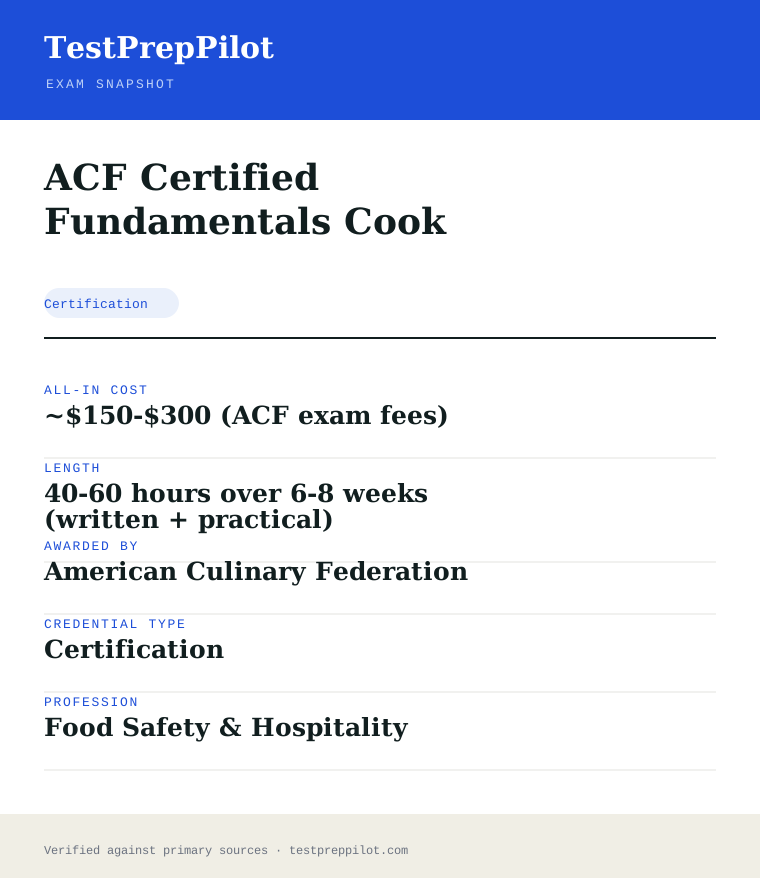
ACF Certified Fundamentals Cook is a certification credential; awarded by American Culinary Federation; the exam fee is ~$150-$300; typical preparation is 40-60 hours over 6-8 weeks (written + practical); holders typically earn $28,000-$45,000 (35-2014 median $32,390).
| Credential | ACF Certified Fundamentals Cook |
|---|---|
| Abbreviation | CFC |
| Type | Certification |
| Profession | Food Safety & Hospitality |
| Specialty | Food Safety & Culinary |
| Awarded by | American Culinary Federation |
| Difficulty | Entry to Applied |
| Typical prep time | 40-60 hours over 6-8 weeks (written + practical) |
| All-in cost | ~$150-$300 (ACF exam fees) |
| Typical salary range | $28,000-$45,000 (35-2014 median $32,390) |
| Credential | ACF Certified Fundamentals Cook |
| Awarding body | American Culinary Federation |
| Exam format | Proctored, computer-based |
| Validity | Valid 5 years (renewal with continuing education) |
| Languages | Varies — see awarding body |
| Scope | National / Multi-state |
Real questions
Frequently asked questions about the ACF Certified Fundamentals Cook
How do I register for the ACF Certified Fundamentals Cook exam?
Register through American Culinary Federation's official portal or an authorized test provider (e.g., Pearson VUE or Prometric where applicable). Create an account, select the exam, pay the fee, and schedule a date.
How much does the exam cost?
Fees vary by location and currency. Confirm the current fee on the official registration page before scheduling.
How long is the credential valid, and how do I renew?
Validity varies by credential (commonly 2–3 years). Renewal usually requires continuing education or a recertification exam — see American Culinary Federation's policy.
What if I do not pass?
Most bodies allow retakes after a waiting period and payment of the full or partial fee. Check American Culinary Federation's retake policy before rescheduling.
How do I register for a American Culinary Federation credential?
Register through the official website, select your exam, pay the fee, and schedule a date.
How do I renew a credential?
Renewal policies vary by credential; check the specific program page for requirements and cycles.
In short
Is the ACF Certified Fundamentals Cook worth it?
- ACF Certified Fundamentals Cook is awarded by American Culinary Federation.
- Validates job-ready competence in Beauty, Food, Security & Recreation.
- Registration is through the awarding body or an authorized test provider.
- Renewal and retake policies vary — confirm before scheduling.
Trust
Where does this information come from?
Everything above is taken from the awarding body's own published material. Fees, question counts and domain weights are revised regularly — check the official page before you pay.
Research confidence: medium · Last reviewed 2026-08