The short version
What is the USPS Virtual Entry Assessment 474 and is it worth it?
USPS Virtual Entry Assessment 474 is a professional credential administered by United States Postal Service. It validates job-ready knowledge and skills in the Legal & Government field and is used for career entry, advancement, or compliance.
- Recognized credential from United States Postal Service
- Demonstrates verified competence in Legal & Government
- Supports career advancement and may satisfy licensing or employer requirements
What is it?
What exactly is the USPS Virtual Entry Assessment 474?
USPS Virtual Entry Assessment 474 — Legal & Government credential from United States Postal Service
A USPS pre-employment assessment for mail handler and distribution roles measuring work scenarios, personality and situational judgment. Offered by United States Postal Service, it is designed for candidates who need to demonstrate verified competence in the Legal & Government field. The credential is commonly used for career entry, advancement, regulatory compliance, or employer requirements. Candidates should review the official handbook for eligibility, exam format, and scoring before registering.
The path in brief
- Confirm you meet any eligibility or prerequisites
- Review the official handbook and study materials
- Register and pay through the awarding body or authorized provider
- Schedule and take the exam (test center or online proctoring)
- Receive your score and, if passed, your credential
Before you book
Who is eligible to sit the USPS Virtual Entry Assessment 474?
Eligibility varies; many credentials are open to all, while others require coursework, work experience, or sponsorship.
Who it is for: Professionals and candidates seeking to validate Legal & Government competence.
The test itself
What is the format of the USPS Virtual Entry Assessment 474?
The USPS Virtual Entry Assessment 474 is administered by United States Postal Service and runs ~30-45 minutes (no strict time limit; must be completed within 72 hours of invitation) and requires 70% passing score (USPS publishes no cohort pass rates) to pass.
| Administered by | United States Postal Service |
|---|---|
| Questions | Scenario-based assessment — no traditional question count (job preview, work-situation items, accuracy items, and personal-style sections) |
| Time limit | ~30-45 minutes (no strict time limit; must be completed within 72 hours of invitation) |
| Pass mark | 70% passing score (USPS publishes no cohort pass rates) |
| Exam fee | Free — no registration fee; the exam is included in the USPS application |
| Format | Online, self-administered on your own device (computer, laptop, tablet, or smartphone) |
Content outline
What topics are on the USPS Virtual Entry Assessment 474?
The USPS Virtual Entry Assessment 474 covers 4 content domains.
Weightings come from the official exam outline. Study time is best allocated in roughly these proportions rather than evenly across domains.
- Substantive law / procedure
Topic area tested on the exam; see the official blueprint for the detailed breakdown.
- Research & writing
Topic area tested on the exam; see the official blueprint for the detailed breakdown.
- Ethics & rules
Topic area tested on the exam; see the official blueprint for the detailed breakdown.
- Practice & compliance
Topic area tested on the exam; see the official blueprint for the detailed breakdown.
The path
How do you register for the USPS Virtual Entry Assessment 474?
- 1
Visit the awarding body’s official website and create an account
- 2
Select the credential and review its specific requirements
- 3
Complete any required eligibility (education, experience, or training)
- 4
Pay the registration fee
- 5
Schedule the exam at a test center or online
- 6
Take the exam and receive your results
The fine print
What are the retake and renewal rules for the USPS Virtual Entry Assessment 474?
- Proctoring & delivery
- Proctored, computer-based delivery (test center or remote online proctoring), varying by exam.
- Retake policy
- Varies by credential — most bodies permit retakes after a waiting period and full or partial fee.
- Score reporting
- Scores are reported per the body’s timeline, typically electronically after the exam.
- Recertification
- Varies; many credentials require renewal every 2–3 years via continuing education or a recertification exam.
What it pays
How much does this credential pay?
Postal service workers earned a May 2024 BLS median of $57,870, and passing the VEA 474 is the screening gate for mail-carrier roles at the USPS.
The salary answer for the USPS VEA 474 is an employment-screening story: the BLS Occupational Outlook Handbook reports a May 2024 median annual wage of $57,870 for SOC 43-5050 Postal Service Workers, and a passing score on the Virtual Entry Assessment for Mail Carrier is what keeps you in consideration for city carrier assistant and rural carrier associate roles, which the BLS classifies under postal service mail carriers (SOC 43-5052). The BLS groups the three postal worker occupations together — mail carriers, mail sorters and processors, and postal clerks — and reports the group median of $57,870, with the wage scale set by the USPS pay schedule rather than by the assessment; the assessment score determines eligibility and ranking, not pay. Employment in postal service is large but shrinking: BLS counted about 500,000 postal service worker jobs in 2024, with about 319,400 mail carriers, 106,400 sorters and processors, and 74,200 clerks, and projects a 5 percent employment decline from 2024 to 2034 — yet about 34,500 openings a year are projected, almost entirely replacement demand as carriers and clerks retire and leave, so the hiring pipeline stays active even as total jobs decline. The assessment itself never appears in wage data, because BLS classifies by job duties rather than by exam score, and the USPS pay schedule, union contract and seniority set actual earnings. Two caveats anchor the picture: carrier roles are often entry positions like City Carrier Assistant that convert to regular career positions over time, so starting pay is lower than the career median, and the VEA is only the screening gate — passing it does not guarantee an offer. For a candidate asking whether the USPS carrier job pays, the direct answer is that the postal worker group median of $57,870 is the baseline, with the USPS pay schedule and seniority determining your actual wage.
| Measure | Figure | Source / note |
|---|---|---|
| Median annual wage, postal service workers | $57,870 | BLS OOH, Postal Service Workers (SOC 43-5050), May 2024 |
| Mail carriers, 2024 employment | ~319,400 jobs | SOC 43-5052, largest postal occupation |
| Employment growth, 2024-2034 | -5% (decline) | Replacement openings keep the pipeline active |
| Projected annual openings | ~34,500 | Mostly replacement demand (BLS 2024-2034) |
| Assessment role | Screening gate, not pay | Score determines eligibility, not wage |
Job growth.BLS projects a 5 percent employment decline for postal service workers from 2024 to 2034, with about 34,500 openings a year from replacement demand.
Source: BLS Occupational Outlook Handbook - Postal Service Workers
Your odds
What are the pass rates?
USPS publishes the 70% passing score for the VEA but no cohort pass rate — and the real bar is the 72-hour deadline and the one-year retest rule.
The direct answer on pass rates is that USPS publishes the passing score for the Virtual Entry Assessment — you must score at least 70 percent to pass — but it does not publish cohort pass rates for the VEA, so we cannot and will not quote what percentage of candidates pass; any figure circulating online is a private estimate. What USPS publishes and what actually governs outcomes are the process rules: after you apply for a job that requires the VEA, USPS emails you instructions, and you have three days (72 hours) from the email invitation to complete the assessment; missing the deadline removes you from consideration for that position, though you can apply to other positions and test in the future. If you score below 70 percent, you cannot be considered for that position or any other position in the same job group, and you cannot retake that version of the VEA for one year, though you can take a different version if you apply for a job that requires it. The VEA is taken online on a computer, laptop, tablet or smartphone, does not require study, and generally takes about 30 to 45 minutes, with no strict time limit, though USPS recommends completing it in one sitting in a quiet place with a good internet connection. The assessment is not a traditional academic exam: for the Mail Carrier version (474) it combines a realistic job preview, work-situation items, a checking-for-accuracy component, and the personal-style and experience sections that USPS describes as What Motivates You, Tell Us Your Story and Describe Your Work Style. The practical read: the passing score of 70 percent is the published bar, and the two structural risks are the 72-hour deadline and the one-year retest ban, so the honest preparation is reading the official candidate guide and answering the behavioral items consistently rather than hunting for a pass-rate statistic.
Read this before quoting the number.USPS publishes the 70% passing score for the VEA but no cohort pass rate. The published process rules — the 72-hour completion window and the one-year ban on retaking a failed version — are the verifiable structure to plan around.
Your schedule
How long should I study for it?
3-5 hours over 1-3 days of focused study
The VEA 474 does not require content study in the traditional sense, so the efficient plan is a short, structured preparation of three to five hours that covers the official candidate guide, the section types, and your own work-history narrative, because the assessment rewards consistent, honest behavioral answers rather than memorized facts. USPS itself states that you do not need to study for the VEA, and the assessment is untimed, but candidates who understand the format and prepare their work-history answers perform more consistently than candidates who start cold. Day one, about two hours: read the official Virtual Entry Assessment Candidate Guide, which describes the exercise types — the realistic job preview, work situations, checking for accuracy, What Motivates You, Tell Us Your Story and Describe Your Work Style — and note that not every exercise is in every version. Day two, about one to two hours: prepare the personal sections, because Tell Us Your Story asks about your work history, attendance and reliability, and Describe Your Work Style asks for consistent, service-oriented answers, so review your job history and frame the stable, dependable behaviors the USPS looks for in a mail carrier — reliability, route discipline and customer contact. Day three, about one hour: review the checking-for-accuracy and work-situation item styles with free sample items, then confirm the logistics: the assessment must be completed within 72 hours of the invitation email, in one sitting if possible, in a quiet place with a reliable internet connection, and you can take it on a computer, laptop, tablet or smartphone. The day of the assessment, start as soon as possible after the invitation, because the 72-hour window is real and a failed or missed assessment removes you from that job group for a year. Candidates who already have delivery or customer-service work history can compress the plan; candidates with limited work history should spend extra time preparing the Tell Us Your Story answers.
- Day 12
Official candidate guide and format
- Read the USPS VEA Candidate Guide
- Learn the exercise types and that sections vary by version
- Note the 72-hour window and 70% passing score
- Review free sample VEA items
- Day 22
Work-history and style preparation
- Review your job history for Tell Us Your Story
- Frame reliable, service-oriented answers for Describe Your Work Style
- Prepare consistent answers for the motivation items
- Identify what a mail-carrier day actually involves
- Day 31
Accuracy drills and logistics
- Drill the checking-for-accuracy item style
- Confirm a quiet location and reliable internet
- Start the assessment as soon as possible after the invitation
- Complete it in one sitting within the 72-hour window
Adjusting the pace
Limited work history.Add an hour on the Tell Us Your Story section; frame volunteer, school or delivery experience as evidence of reliability.
Returning applicant after a retest ban.If you failed a previous VEA, note the one-year wait on that version and focus on consistency in the behavioral sections this time.
How to study
How do I prepare most effectively?
The dominant prep strategy for the VEA 474 is treating it as a structured self-assessment rather than a study exam, because the Mail Carrier version evaluates behavioral consistency, work history and attention to accuracy, and USPS states that you do not need to study. First, read the official Virtual Entry Assessment Candidate Guide before anything else, because it is the only authoritative description of the exercise types and the process rules, including the 72-hour window and the one-year retest ban. Second, prepare your work-history narrative, because the Tell Us Your Story section asks about your past experience, attendance and reliability, and the Describe Your Work Style section rewards consistent, service-oriented answers that match the dependable profile of a mail carrier. Third, answer the work-situation items the way a reliable postal employee would — follow procedure, communicate, complete tasks on time and keep the mail and customers first — because the situational-judgment items score the choice that matches USPS expectations. Fourth, practice the checking-for-accuracy items, because the assessment includes an accuracy component and careful comparison work is coachable. Fifth, manage the 72-hour window as the real deadline: start the assessment as soon as possible after the invitation email, in a quiet place with a reliable connection, and complete it in one sitting. Finally, do not overthink the personal-style sections: the goal is consistent, honest answers, and flipping between extremes in the motivation and style items signals inconsistency, which the assessment is designed to detect. The pattern across all of these strategies is that the assessment rewards honesty and consistency rather than cleverness, so the preparation habit of reading the official guide, framing your work history and drilling the accuracy items matters more than any paid resource, and candidates who treat the assessment as a structured self-description rather than a test to beat arrive at the window with the format familiar rather than surprising. The mail-carrier context also helps: answers that reflect route reliability, customer contact and schedule adherence score better than generic self-help phrasing.
Read the official candidate guide first
It defines the exercise types and the 72-hour, one-year retest rules.
Prepare your work-history narrative
Tell Us Your Story asks about experience, attendance and reliability.
Answer work situations as a reliable employee
Follow procedure, communicate, and keep mail and customers first.
Drill the accuracy items
The checking-for-accuracy component is coachable comparison work.
Respect the 72-hour window
Start as soon as possible after the invitation; complete it in one sitting.
Answer personal-style items consistently
Flipping between extremes signals inconsistency the assessment detects.
What to buy
Which study resources are worth paying for?
USPS VEA prep resources are almost entirely free, because USPS explicitly says you do not need to study for the assessment and the official candidate guide is the only authoritative document, so the buying logic is to spend nothing until you have read it and worked the free samples. The official USPS Virtual Entry Assessment Candidate Guide is free and defines the exercise types, the 70 percent passing score, the 72-hour window and the one-year retest rule; every candidate should read it first. Free sample items and format guides from reputable job-prep sites add drilling volume for the accuracy and work-situation item styles and are the right way to check your readiness. Paid prep packages, roughly $20 to $60, offer extra practice sets and score interpretation, but they add little beyond the free material because the VEA is a behavioral assessment with published format guidance rather than a content test, and no legitimate provider has live assessment items. There is no registration fee for the VEA — the USPS never charges for the exam or the application — so the only costs are your time and the risk of missing the 72-hour window. For candidates applying to multiple jobs, note that the VEA is tied to the job group, so the 474 version covers mail-carrier roles and a different version covers other job groups. Prices below are list prices as of mid-2026 and change frequently; we rank nothing by commission. Finally, remember that the real cost of a failed VEA is time, not money, because the one-year retest ban on the version and the 72-hour window are the structural risks, so the highest-value preparation is reading the free official guide and taking the assessment early in the window rather than buying anything. A candidate who spends the prep time on the free material and answers the behavioral items consistently has addressed the actual failure modes of this assessment, and the savings can be spent on nothing at all because the exam itself is free.
| Resource | Price | Format | Best for |
|---|---|---|---|
| USPS VEA Candidate Guide | Free | Official USPS PDF | The authoritative format and process rules |
| Free sample items from job-prep sites | Free | Online quizzes | Format familiarity and accuracy practice |
| Paid VEA prep packages | $20-60 | Online practice sets | Extra drilling volume; optional beyond the free material |
| VEA registration and testing | Free | Online, any device | The real assessment; USPS never charges for the exam |
List prices as of mid-2026 and change frequently; the VEA itself is free, and no legitimate third party sells live assessment items. We rank nothing by commission.
Avoid these
What mistakes do candidates most often make?
The most common mistakes on the USPS VEA 474 are process errors and behavioral inconsistency rather than content failures, because the assessment is untimed and largely behavioral, and the failures that actually remove candidates are administrative. The first mistake is missing the 72-hour deadline: USPS emails the assessment invitation and you have three days to complete it, and missing the window removes you from consideration for that position. The second is treating the behavioral sections like a test to game, when the Describe Your Work Style and What Motivates You sections reward consistent, honest answers and inconsistent extremes are detected. The third is skipping the work-situation preparation and answering without considering the USPS perspective, when the situational-judgment items score the choice that matches postal expectations of reliability and customer service. A fourth mistake is ignoring the accuracy component, when careful comparison work is a coachable share of the assessment. The fifth is failing to plan the testing environment — starting in a noisy or unreliable-connection setting, or splitting the assessment across sittings, when USPS recommends a quiet place and one sitting. Finally, some candidates forget the one-year retest rule and waste time applying to the same job group after a fail, when a failed version cannot be retaken for a year. The pattern across all of these failures is treatable: the deadline is a calendar task, the behavioral sections are a consistency task, and the accuracy items are a practice task, so a candidate who treats the assessment as a structured checklist rather than a knowledge test removes the vast majority of the reasons candidates are removed from consideration. Read the official guide, prepare the work-history answers, and start early, and the process becomes routine.
✕Missing the 72-hour deadline
✓Start the assessment as soon as possible after the invitation email; the window is real.
✕Trying to game the behavioral sections
✓Answer consistently and honestly; the style and motivation items detect inconsistent extremes.
✕Skipping work-situation preparation
✓Answer as a reliable postal employee would: procedure, communication and customer service first.
✕Ignoring the accuracy component
✓Drill the checking-for-accuracy item style; careful comparison work is coachable.
✕Using a poor testing environment
✓Choose a quiet place with a reliable connection and complete the assessment in one sitting.
✕Forgetting the one-year retest rule
✓A failed version cannot be retaken for one year; reapply to other job groups with different versions instead.
What you'll face
What question types will I see?
The USPS Virtual Entry Assessment 474 is an untimed online assessment that takes about 30 to 45 minutes, and its sections vary by version, with the Mail Carrier version combining a realistic job preview, work-situation items, an accuracy component, and the personal-style and experience sections. The realistic job preview is informational and not scored; it describes what the carrier job involves so you can make an informed choice. The work-situation section presents workplace scenarios and asks you to choose the best and worst responses, scoring the judgment a reliable postal employee would show. The accuracy section asks you to check and compare information, testing careful attention to detail. The personal sections — What Motivates You, Tell Us Your Story and Describe Your Work Style — ask about your work history, attendance, reliability and preferences, with consistency the key. You must score at least 70 percent to pass, and the assessment is tied to the job group: 474 covers mail-carrier roles, and a failed version cannot be retaken for one year. The three samples below illustrate the item style of the published guide; they are editor-written illustrations of the published format, not live assessment items. The assessment is delivered entirely online with no proctor in most cases and no registration fee, and the result is reported through the USPS system after completion, with candidates who pass remaining in consideration and candidates who score below 70 percent removed from the job group for a year. Candidates should confirm the current section mix in the official candidate guide, because the versions vary and the guide is the authoritative description of what each job group’s assessment contains, and the guide also states the 72-hour window that governs when the assessment must be finished.
Information about the carrier job so you can decide if it fits.
Choose the best and worst responses to workplace scenarios.
Compare and check information carefully for errors.
What Motivates You, Tell Us Your Story and Describe Your Work Style.
Try these
Q1You are sorting mail for your route when you notice you may have placed a letter in the wrong delivery slot. What should you do?
Answer:B
Correcting the error immediately reflects the accuracy and accountability the job requires. Leaving the mistake, hiding it, or shifting your work to someone else each fail the reliability standard a mail carrier is expected to show.
Q2A customer asks you a question about a postal service you are unsure of. The most appropriate response is to:
Answer:B
Directing the customer to the correct source or a supervisor is the honest, helpful response. Making up an answer, ignoring the customer, or denying the service exists all provide wrong information and fail the customer-service standard.
Q3Which pair of addresses is identical?
Answer:A
Only option A shows two identical addresses. B differs in the street suffix, C adds an apartment number, and D reverses the digits, so each of the others contains a difference the accuracy section expects you to catch.
Samples are editor-written illustrations of the published format, not live assessment items.
The big day
What should I expect on exam day?
The USPS VEA 474 is taken entirely online, on your own device, and the direct plan is to start it as soon as possible after the invitation email arrives, because you have exactly 72 hours from the email to complete it and the USPS will not let you retake a failed version for one year. Choose a quiet place with a reliable internet connection and give yourself an uninterrupted 30 to 45 minutes, because USPS recommends completing the assessment in one sitting. The assessment works on a computer, laptop, tablet or smartphone, and you do not need any registration fee or test-center visit; the USPS never charges for the exam or the application. Before you start, close other browser tabs and notifications so nothing distracts you, and confirm you are in the account tied to the job application that generated the invitation. The assessment begins with the realistic job preview, then moves through the scored sections; there is no strict time limit, so read each item carefully and answer consistently. The pass threshold is at least 70 percent, and you will receive the result through the USPS system after completion; on a pass, you remain in consideration and may receive a Notice of Result, and on a fail or a missed deadline you are removed from that job group. Monitor your spam folder for the invitation email, because USPS warns that assessment instructions sometimes land there, and do not wait until the last hours of the window, when connection problems can cost you the assessment.
Bring
- Your device with a reliable internet connection
- The email invitation with the assessment link
- A quiet, distraction-free place for 30-45 minutes
- Your job application details for the account login
Leave at home
- Other browser tabs and notifications that could distract you
- Any second attempt on a failed version — the retest ban is one year
- Waiting until the last hours of the 72-hour window
- Any registration fee — the USPS never charges for the exam
How the day runs
Rules in the room
- You have 72 hours from the invitation email to complete the VEA; missing the window removes you from that position.
- You must score at least 70% to pass.
- A failed version cannot be retaken for one year; other job-group versions are available if you apply for those jobs.
- The USPS never charges a fee to take the assessment or to apply.
- The assessment is untimed but should be completed in one sitting in a quiet place with a reliable connection.
Afterwards.After submitting the VEA, the result comes through the USPS system; on a pass, you remain in consideration for the mail-carrier position and may receive a Notice of Result, while the USPS ranks eligible candidates and proceeds with additional hiring steps. On a fail, you are not eligible for that position or any other in the same job group, and you cannot retake that version for one year, so your options are to apply to positions in a different job group that use a different VEA version. Keep the email and account credentials until the process concludes, and monitor the USPS careers account for the next steps, because the assessment is only the screening gate and the hiring process continues with other steps. For the career wage picture, the BLS postal service worker median of $57,870 is the baseline for the field, with the USPS pay schedule and seniority determining actual earnings.
Reference
What are the key facts about the USPS Virtual Entry Assessment 474?
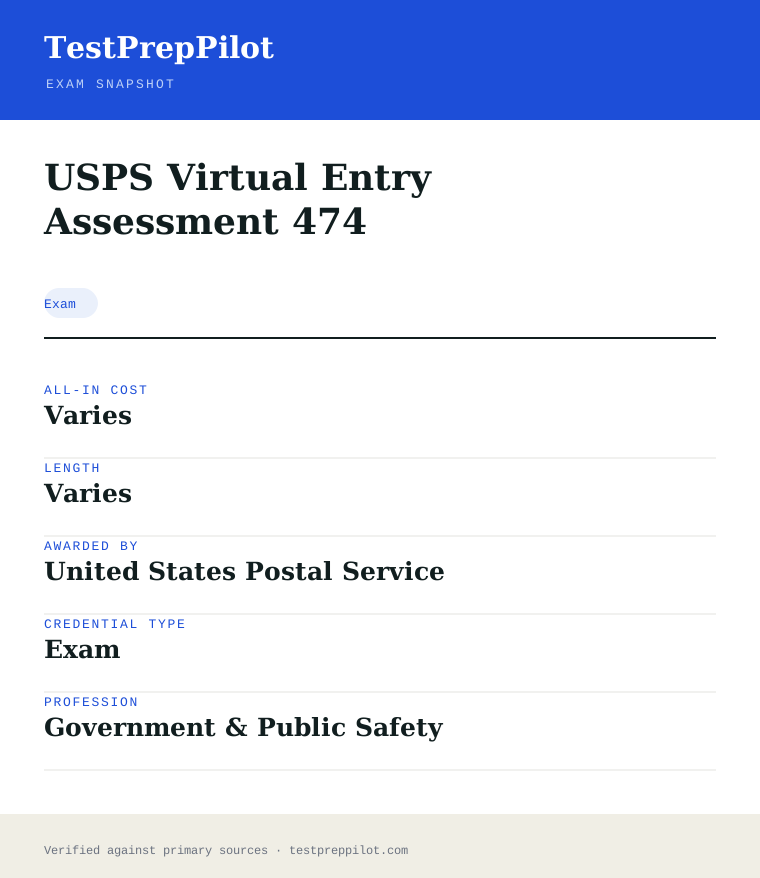
USPS Virtual Entry Assessment 474 is a exam credential; awarded by United States Postal Service; the exam fee is Free — no registration fee; the exam is included in the USPS application; typical preparation is Varies.
| Credential | USPS Virtual Entry Assessment 474 |
|---|---|
| Abbreviation | VEA 474 |
| Type | Exam |
| Profession | Government & Public Safety |
| Specialty | Federal Hiring & Civil Service |
| Awarded by | United States Postal Service |
| Difficulty | Specialized |
| Typical prep time | Varies |
| All-in cost | Varies |
| Credential | USPS Virtual Entry Assessment 474 |
| Awarding body | United States Postal Service |
| Exam format | Proctored, computer-based |
| Validity | Varies by credential (commonly 2–3 years) |
| Languages | Varies — see awarding body |
| Scope | National / Multi-state |
| Also known as | VEA 474 |
Real questions
Frequently asked questions about the USPS Virtual Entry Assessment 474
How do I register for the USPS Virtual Entry Assessment 474 exam?
Register through United States Postal Service's official portal or an authorized test provider (e.g., Pearson VUE or Prometric where applicable). Create an account, select the exam, pay the fee, and schedule a date.
How much does the exam cost?
Fees vary by location and currency. Confirm the current fee on the official registration page before scheduling.
How long is the credential valid, and how do I renew?
Validity varies by credential (commonly 2–3 years). Renewal usually requires continuing education or a recertification exam — see United States Postal Service's policy.
What if I do not pass?
Most bodies allow retakes after a waiting period and payment of the full or partial fee. Check United States Postal Service's retake policy before rescheduling.
How do I register for a United States Postal Service credential?
Register through the official website, select your exam, pay the fee, and schedule a date.
How do I renew a credential?
Renewal policies vary by credential; check the specific program page for requirements and cycles.
In short
Is the USPS Virtual Entry Assessment 474 worth it?
- USPS Virtual Entry Assessment 474 is awarded by United States Postal Service.
- Validates job-ready competence in Legal & Government.
- Registration is through the awarding body or an authorized test provider.
- Renewal and retake policies vary — confirm before scheduling.
Trust
Where does this information come from?
Everything above is taken from the awarding body's own published material. Fees, question counts and domain weights are revised regularly — check the official page before you pay.
- United States Postal Service Awarding body
Research confidence: low · Last reviewed 2026-08