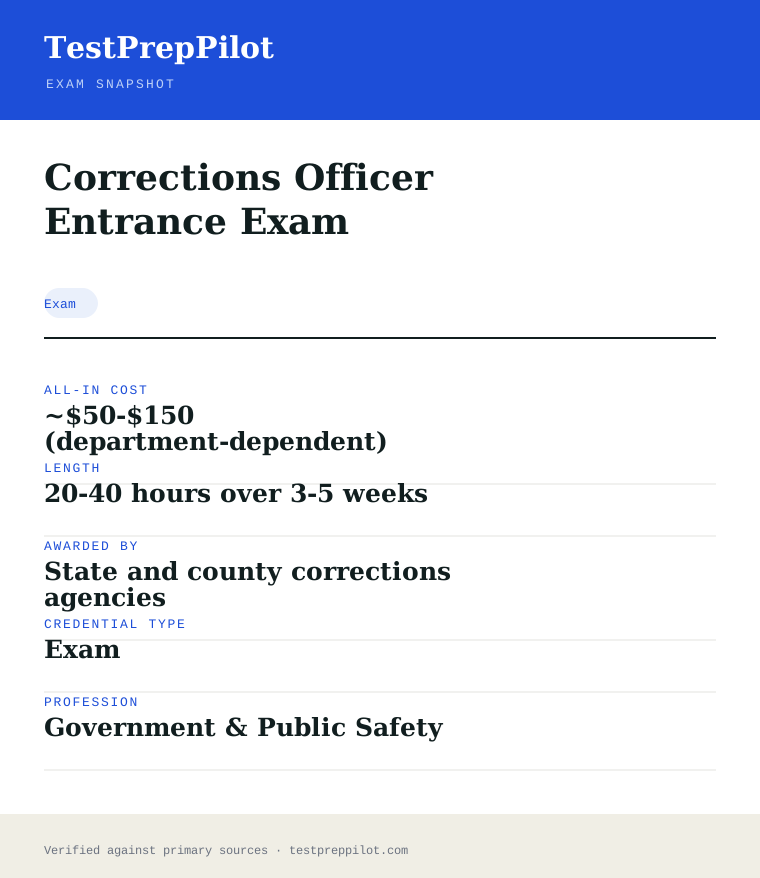
The short version
What is the Corrections Officer Entrance Exam and is it worth it?
Corrections Officer Entrance Exam is a professional credential administered by State and county corrections agencies. It validates job-ready knowledge and skills in the Public Safety field and is used for career entry, advancement, or compliance.
- Recognized credential from State and county corrections agencies
- Demonstrates verified competence in Public Safety
- Supports career advancement and may satisfy licensing or employer requirements
What is it?
What exactly is the Corrections Officer Entrance Exam?
Corrections Officer Entrance Exam — Public Safety credential from State and county corrections agencies
A written and physical exam for correctional officer candidates assessing judgment, reading, situational awareness and fitness. Offered by State and county corrections agencies, it is designed for candidates who need to demonstrate verified competence in the Public Safety field. The credential is commonly used for career entry, advancement, regulatory compliance, or employer requirements. Candidates should review the official handbook for eligibility, exam format, and scoring before registering.
The path in brief
- Confirm you meet any eligibility or prerequisites
- Review the official handbook and study materials
- Register and pay through the awarding body or authorized provider
- Schedule and take the exam (test center or online proctoring)
- Receive your score and, if passed, your credential
Before you book
Who is eligible to sit the Corrections Officer Entrance Exam?
Eligibility varies; many credentials are open to all, while others require coursework, work experience, or sponsorship.
Who it is for: Professionals and candidates seeking to validate Public Safety competence.
The test itself
What is the format of the Corrections Officer Entrance Exam?
The Corrections Officer Entrance Exam is administered by State and county corrections agencies and runs ~2-3 hours.
| Administered by | State and county corrections agencies |
|---|---|
| Questions | Varies by agency (often 100+ questions) |
| Time limit | ~2-3 hours |
| Pass mark | Passing score set by the awarding body; see the official score report |
| Exam fee | Department-dependent |
| Format | Proctored, computer-based (test center or online remote proctoring) |
Content outline
What topics are on the Corrections Officer Entrance Exam?
The Corrections Officer Entrance Exam covers 4 content domains.
Weightings come from the official exam outline. Study time is best allocated in roughly these proportions rather than evenly across domains.
- Legal authority & procedures
Topic area tested on the exam; see the official blueprint for the detailed breakdown.
- Emergency response
Topic area tested on the exam; see the official blueprint for the detailed breakdown.
- Investigation
Topic area tested on the exam; see the official blueprint for the detailed breakdown.
- Community & safety
Topic area tested on the exam; see the official blueprint for the detailed breakdown.
The path
How do you register for the Corrections Officer Entrance Exam?
- 1
Visit the awarding body’s official website and create an account
- 2
Select the credential and review its specific requirements
- 3
Complete any required eligibility (education, experience, or training)
- 4
Pay the registration fee
- 5
Schedule the exam at a test center or online
- 6
Take the exam and receive your results
The fine print
What are the retake and renewal rules for the Corrections Officer Entrance Exam?
- Proctoring & delivery
- Proctored, computer-based delivery (test center or remote online proctoring), varying by exam.
- Retake policy
- Varies by credential — most bodies permit retakes after a waiting period and full or partial fee.
- Score reporting
- Scores are reported per the body’s timeline, typically electronically after the exam.
- Recertification
- Varies; many credentials require renewal every 2–3 years via continuing education or a recertification exam.
What it pays
How much does this credential pay?
$57,950 median for correctional officers and jailers (BLS May 2024) — employment declining 7%, but ~31,900 openings a year from replacement
The wage that fits this exam is the median for correctional officers and jailers, which BLS reports as $57,950 per year in May 2024 (about $27.86 an hour) when the occupation is grouped with bailiffs, with the specific correctional officers and jailers series at $57,970, the lowest 10 percent under $41,750 and the highest 10 percent over $93,000. The honest career framing is that the entrance exam is the gate to a stable, shift-based government job whose pay is set by agency salary schedules rather than by exam performance: federal correctional officers earned a median of about $74,190 in May 2024 versus roughly $57,970 in local government and $57,580 in state government, so the agency you choose affects the wage more than your score does. The outlook is the most important number on this page and it is genuinely mixed: BLS projects employment of correctional officers and bailiffs to decline 7 percent from 2024 to 2034, driven by criminal-justice reforms that reduce prison populations, shorter sentences and alternatives to incarceration — yet despite that decline, about 31,900 openings a year are still projected, every one of them from replacement need as officers transfer out or retire, so hiring continues and the exam is still administered on regular cycles. For candidates, the practical implication is that corrections remains an accessible entry into public safety with steady turnover-driven hiring, but the long-term direction of the occupation is contraction, which argues for treating the job as a stable step rather than planning a thirty-year career in it. The exam itself is the first filter in a process that also includes physical abilities testing, a background investigation, a medical and psychological evaluation and academy training, and the written test’s function is to screen for the reading, math, judgment and memory skills the job actually uses.
| Measure | Figure | Source / note |
|---|---|---|
| Median annual wage, correctional officers and jailers (33-3012) | $57,970 | BLS OOH, May 2024 ($27.86/hr for the grouped series) |
| Reference: grouped with bailiffs | $57,950 | BLS OOH Quick Facts, May 2024 |
| Lowest 10 percent | less than $41,750 | BLS OOH Pay tab, May 2024 |
| Highest 10 percent | more than $93,000 | BLS OOH Pay tab, May 2024 |
| Employment, 2024 | 406,500 jobs (grouped series) | BLS OOH Quick Facts, 2024 |
| Projected annual openings | ~31,900 per year | BLS OOH Job Outlook, 2024-34 — all from replacement need |
Job growth.-7% projected change 2024-34 (decline), yet ~31,900 replacement openings a year keep hiring cycles running; the occupation is contracting long-term, so treat the role as a stable step, not a guaranteed thirty-year career
Source: BLS Occupational Outlook Handbook — Correctional Officers and Bailiffs
Your odds
What are the pass rates?
No national pass rate is published — the typical passing standard is about 70% on a scaled written exam, set by each agency or state
There is no single published pass rate for the corrections officer entrance exam because the exam is administered by states and agencies through standardized providers rather than by one national body, and each jurisdiction sets its own passing standard — the most commonly cited written-exam minimum is about 70 percent on a scaled score, and agencies that rank candidates by score will hire from the top of the band, so a passing-but-low score can still leave you off the interview list. What is published and consistent is the structure: the written exam typically runs 60 to 100 multiple-choice questions over two to three hours, covering reading comprehension (roughly 20 to 25 percent of scored questions), situational judgment, basic math and counting, memory and observation, report writing and applying written rules, and in some cases ethics and code-of-conduct items. The testing providers differ meaningfully: CPS HR tests lean heavily on reading comprehension and situational judgment, while the National Testing Network’s version includes a video-based component in which candidates watch a scenario and answer questions about what they observed, so knowing which provider your target agency uses changes your preparation. Because the written exam screens out a meaningful share of applicants before the physical test, prep providers publish first-attempt pass-rate estimates — commonly cited as a 54 percent national first-attempt figure for state DOC exams, though this is an industry estimate, not an official statistic — and agencies themselves rarely publish their local pass rates. The useful numbers for planning are the typical 70 percent line, the 60 to 100 question range, the two-to-three-hour window and the provider your agency uses, all of which are discoverable before you apply.
Read this before quoting the number.No official national pass-rate statistic is published. The ~70% scaled passing standard, the 60-100 question range and the content-domain breakdowns come from provider and state-published materials; the 54% first-attempt figure is an industry prep-site estimate, not a government statistic, and each agency’s exact passing score and ranking practice should be confirmed with that agency.
Source: National Testing Network — Correctional Officer testing
Your schedule
How long should I study for it?
40-60 hours over 6-8 weeks (or 3-4 weeks if you are a strong reader) of focused study
Plan for 6 to 8 weeks and 40 to 60 hours of study if you are preparing cold, or 3 to 4 weeks if you are a strong reader, because the corrections officer written exam is a cognitive skills test in which reading comprehension, situational judgment and memory items dominate and the passing line is typically about 70 percent on a scaled score. The exam usually runs 60 to 100 multiple-choice questions over two to three hours, and the content domains are consistent across providers: reading comprehension on policy excerpts and incident reports, situational judgment on inmate-interaction scenarios, basic math and counting (headcounts, schedules, ratios), memory and observation from a passage or scenario, report writing and applying written rules, and in some versions ethics and code-of-conduct items. The effective sequence is: first, identify which testing provider your target agency uses — CPS HR, the National Testing Network with its video-based component, or a state-specific exam — because the question types differ; second, take a timed diagnostic practice test to locate your weak domains; third, build the reading and rule-application side by drilling policy-style passages and learning to extract the operative facts from written rules; fourth, work situational judgment deliberately, because these items test judgment more than knowledge and reward picking the professionally sound response over the personally satisfying one; fifth, drill memory and observation by practising recalling details from short scenarios, and basic math word problems in corrections contexts; and sixth, in the final two weeks, take two or three full timed practice exams and confirm the written exam fee, schedule and retake policy for your agency. Note that the written exam is only the first stage — the process also includes a physical abilities test (often a timed obstacle course, dummy drag and stair climb), a background investigation, drug screening and a medical and psychological evaluation, so plan the written-study window inside the full hiring timeline rather than as the whole preparation.
- Weeks 1-26-8 hrs/week
Provider research and reading comprehension
- Identify your agency’s testing provider (CPS HR, National Testing Network, or state-specific)
- Take a timed diagnostic practice exam and log every miss
- Drill policy-style passages: extract the operative facts and rules
- Weeks 3-47-9 hrs/week
Situational judgment and rule application
- Work scenario questions: pick the professionally sound response, not the personally satisfying one
- Practise applying written rules and schedules to described situations
- Learn the code-of-conduct and ethics items your provider includes
- Week 56-8 hrs
Math, memory and observation
- Drill corrections-context math: headcounts, shift schedules, ratios, counting problems
- Practise memory and observation recall from short scenarios
- Time every set; these sections punish slowness as much as errors
- Week 68-10 hrs
Report writing and full timed exams
- Practise report-writing items: grammar, clarity and chronological ordering
- Take two full timed practice exams under test conditions
- Re-study the weak domains your second exam still exposes
- Final days4-6 hrs
Taper
- Light review of weak domains and situational-judgment principles
- Confirm exam logistics, fee and what to bring
- Rest — the written exam is the start of a longer physical process
Adjusting the pace
Physical test is your weak stage.The written exam is only the first gate; the physical abilities test (obstacle course, dummy drag, stair climb) eliminates many candidates. Start functional fitness training eight to twelve weeks before your test date, in parallel with the written prep, because corrections physical standards often are not age- or gender-adjusted.
Strong reader, weak on judgment items.Four weeks. Compress reading review and spend the recovered time on situational judgment and ethics scenarios, since the professionally sound response is a specific skill that improves with deliberate practice.
Applying to multiple agencies.Research each agency’s provider before studying. If your agencies use different providers — one CPS HR, one NTN with video scenarios — rehearse both formats, because the video-based observation component is a distinct skill you will not get from a text-only question bank.
How to study
How do I prepare most effectively?
The strategy that moves the corrections officer written exam is "match your prep to the provider, weight the reading and judgment sections, and run timed exams," because the exam is a cognitive-screening test in which reading comprehension and situational judgment together dominate the scored items and the exact format varies by testing provider. The highest-yield step is identifying whether your agency uses CPS HR, the National Testing Network or a state-specific exam before you study, because an NTN video-based observation component is a different skill from a text-only reading-and-judgment test, and preparing for the wrong format wastes hours. A second proven approach is treating situational judgment as a drillable skill rather than common sense: the professionally sound response to an inmate-interaction or security scenario — safety first, policy adherence, de-escalation, report the incident — is a pattern you can rehearse, and candidates who practise it outscore candidates who rely on instinct. Third, build reading comprehension against corrections-style material: policy excerpts, incident reports and written rules, because the exam rewards extracting operative facts from exactly that genre of prose. Fourth, drill memory and observation deliberately, since recall items from a passage or scenario are pure technique that improves with practice. Finally, run full timed practice exams, because the two-to-three-hour format is a stamina test and the 70 percent line is a pass line you should reach on practice before you pay the application fee and schedule the real thing.
Match your prep to the testing provider
CPS HR exams lean on reading comprehension and situational judgment; National Testing Network versions include a video-based component where you watch a scenario and answer observation questions. Find out which provider your agency uses first, and rehearse that format.
Drill situational judgment as a skill
The professionally sound response — safety first, follow policy, de-escalate, document — is a pattern, not instinct. Practise inmate-interaction, contraband and use-of-force scenarios until the professional choice is your first choice, because judgment items dominate and separate candidates.
Read corrections-style material
The reading section draws on policy excerpts, incident reports and written rules. Practise extracting the operative facts — what happened, what rule applies, what the officer must do — from that genre of prose, not from generic reading passages.
Train memory and observation
Memory recall from a passage or scenario is technique. Practise reading or watching a short scenario once and reconstructing the details, then answering recall items — this section improves quickly with deliberate repetition.
Run full timed practice exams
The written exam typically runs two to three hours. Take at least two or three full timed practice exams and confirm you can hold the roughly 70 percent line under the real format before scheduling the exam.
Start physical prep in parallel
The written exam is the first gate, not the last. The physical abilities test — timed obstacle course, dummy drag, stair climb — eliminates candidates who ignored it, so start functional fitness training eight to twelve weeks out, while you study.
What to buy
Which study resources are worth paying for?
Corrections officer prep is dominated by free and low-cost resources because the exam content is largely skill-based — reading comprehension, situational judgment, math and memory — and the official materials you need are your agency’s hiring page, the testing provider’s published format and sample items, and in many states a published study guide. The comparison below separates free and paid resources with prices current to this review. The rule that works: use the provider’s official format description and sample items to learn the exact question types, use one commercial practice-test bank for volume and timing, and buy a course only if a timed diagnostic shows you need structured instruction rather than practice.
| Resource | Price | Format | Best for |
|---|---|---|---|
| Agency hiring page and testing provider sample items | Free | Official format description and sample questions | The authoritative format for your exact agency and provider |
| State department of corrections study guides | Free | PDF guides | The domains and standards your state actually scores |
| Commercial practice-test banks (e.g. JobTestPrep, 240 Tutoring-style providers) | ~$25-70, frequently discounted | Online timed practice tests with explanations | Volume, pacing and provider-matched practice |
| Corrections officer prep courses | ~$50-150 | Video and/or book course | Candidates who want structured pacing; buy only after a timed diagnostic |
| The written exam and application fee | ~$0-75, often refundable | Proctored exam plus application | Required — the gate itself |
Prices checked 2026-08 in USD before tax; application and exam fees vary by state and are sometimes waived or refundable, and practice-test providers run frequent sales. We do not rank by commission.
Avoid these
What mistakes do candidates most often make?
The most common mistake is preparing for the wrong test format — studying text-only question types when your agency’s provider uses video-based observation items, or vice versa. The second is treating situational judgment as common sense instead of a drillable skill, when the professionally sound response is a specific pattern. A third recurring error is focusing on the written exam and ignoring the physical abilities test, which eliminates a large share of candidates who passed the written. Candidates also routinely fail to run timed full-length practice exams, arriving at a two-to-three-hour test with no pace, and many neglect the memory and observation section, which is pure technique that improves quickly. Finally, some candidates study without checking the passing and ranking practice of their agency, preparing to scrape a 70 when the agency ranks candidates and interviews only the top scorers.
✕Preparing for the wrong provider format
✓CPS HR tests are text-heavy; National Testing Network versions include video-based observation items. Confirm your agency’s provider before you study, and rehearse the exact format — a text-only question bank will not train you for video scenarios.
✕Treating situational judgment as instinct
✓The professionally sound response — safety first, follow policy, de-escalate, document — is a drillable pattern. Practise scenario sets until the professional choice is your first choice; judgment items dominate and instinct under-scores on them.
✕Ignoring the physical abilities test
✓The written exam is the first gate, and the physical test eliminates candidates who passed it. Start functional fitness training for the obstacle course, dummy drag and stair climb eight to twelve weeks out, in parallel with written prep, and note that corrections standards often are not age- or gender-adjusted.
✕Never running a timed practice exam
✓The written exam runs two to three hours. Take at least two or three full timed practice exams and hold the roughly 70 percent line before scheduling the real thing, or pacing and fatigue will be the test.
✕Skipping memory and observation practice
✓Memory recall from a passage or scenario is pure technique and improves fast. Practise reconstructing details from short scenarios daily; candidates who skip it leave easy points on the table.
✕Studying without knowing the ranking practice
✓Confirm whether your agency hires strictly at the passing line or ranks candidates by score. Ranked agencies interview top scorers first, so a scrape-by 70 can leave you off the list — build a practice target above the line.
What you'll face
What question types will I see?
The corrections officer entrance exam is a written cognitive test, typically 60 to 100 multiple-choice questions completed in two to three hours, with the exact format set by the testing provider your agency uses — CPS HR versions are text-heavy, while National Testing Network versions include a video-based component in which candidates watch a scenario and answer questions about what they observed. The passing standard is commonly about 70 percent on a scaled score, set by the agency, and the content domains are consistent: reading comprehension on policy excerpts and incident reports, situational judgment on inmate-interaction and security scenarios, basic math and counting in corrections contexts, memory and observation recall, report writing, and applying written rules, with ethics and code-of-conduct items appearing in many versions. The samples below are editor-written illustrations of the published question styles, not live exam items.
Policy excerpts, incident reports and written rules followed by questions on the operative facts, the applicable rule and the required action.
Inmate-interaction, contraband and security scenarios; pick the professionally sound response. The dominant differentiator between candidates.
Headcounts, shift schedules, ratios and counting problems in corrections contexts — simple arithmetic under time pressure.
Recall details from a passage or, on NTN versions, a video scenario. Pure technique that improves with practice.
Grammar, clarity and chronological ordering in report-writing items, plus applying written rules and schedules to scenarios.
PREA awareness, use-of-force policy and professional conduct items, weighted by provider.
Try these
Q1During a count, you notice that the number of inmates in a housing unit does not match the count sheet. What is the most appropriate immediate action?
Answer:B
An accurate count is a security-critical control, and a discrepancy must be resolved immediately by re-counting and reporting to supervision — which is the professionally sound, policy-aligned response B describes. A falsifies a security record by leaving the sheet uncorrected. C delegates a security determination to inmates and is unreliable. D leaves a known discrepancy unresolved, which is exactly the outcome policy exists to prevent. Situational-judgment items reward the response that protects security first and escalates the issue, not the convenient one.
Q2An inmate tells you, "I will make a complaint about you if you do not bring me extra food." Which response is most appropriate?
Answer:B
The appropriate response is professional, non-confrontational and policy-based: acknowledge the statement without conceding, continue assigned duties, and let the complaint process run if the inmate files one — which B does. A rewards manipulation and violates policy on food distribution. C escalates a verbal statement into a personal threat and risks a use-of-force or conduct situation. D fails the professional-contact standard by ignoring a direct statement without acknowledgment. Judgment items consistently reward de-escalation and policy adherence over both appeasement and aggression.
Q3A shift schedule states that cell block C is checked every 15 minutes. The previous check was at 2:45 PM. What is the earliest time the next check should occur?
Answer:B
A check every 15 minutes means 15 minutes after the last check: 2:45 plus 15 minutes is 3:00 PM, which is the earliest time the next check should occur — exactly B. A (2:55) is only 10 minutes and falls short of the interval. C (3:05) and D (3:15) both exceed the required interval and would leave the block unobserved longer than policy allows. Math-and-counting items are simple arithmetic applied to corrections schedules; the trap is speed, not difficulty, and missing the unit conversion from minutes to clock time is the most common error.
Samples are editor-written illustrations of the published corrections officer exam question styles; they are not live exam items.
The big day
What should I expect on exam day?
The corrections officer entrance exam day is a proctored written exam, typically 60 to 100 multiple-choice questions completed in two to three hours at a testing centre or agency facility, and because the exam is state-administered through providers like CPS HR or the National Testing Network, the first thing to confirm is the exact delivery format: some versions are computer-based, some are paper-and-pencil, and NTN versions include a video-based observation component that the proctor will explain before you start. Bring a valid government-issued photo ID matching your registration, your admission letter or scheduling confirmation, and the application fee payment if it is due at the test site — many states collect the fee online and some refund it, but confirm what the day requires. Leave phones, smartwatches, notes and study materials at home or in your vehicle, because the exam is closed-book and proctored, and leave any anxiety about the physical test for later — the written is a separate appointment in most processes. Arrive at least 30 minutes early so check-in, ID verification and any provider orientation are done before the clock starts. On the exam, work steadily and flag items you are unsure of rather than dwelling; reading passages reward a careful first read, judgment items reward picking the professional response over the instinctive one, and math and memory items reward speed. If your provider uses the video component, watch each scenario once with full attention and reconstruct the details before answering. Results are typically delivered according to your agency’s schedule — providers often report scores to the agency quickly and the agency notifies you — and passing moves you to the next stage of the process: physical abilities testing, background, medical and psychological evaluation and academy training.
Bring
- Valid government-issued photo ID matching your registration
- Admission letter or scheduling confirmation
- Any application fee payment due at the test site
- Comfortable clothing appropriate for a seated proctored exam
- Your agency’s contact information in case of a scheduling question
Leave at home
- Phones, smartwatches, fitness trackers and earbuds
- All notes, study guides and printed materials — the exam is closed book
- Food and drink beyond what the testing centre permits
- Bags and coats beyond what the venue permits
- The expectation that the physical test will happen the same day — confirm your agency’s sequence
How the day runs
Rules in the room
- The exam is closed book and proctored; no notes, references or electronic devices are permitted.
- The typical format is 60-100 multiple-choice questions over 2-3 hours, with the exact structure set by your agency’s testing provider.
- The passing standard is commonly about 70% on a scaled score, set by the agency; some agencies rank candidates and interview top scorers first.
- NTN versions include a video-based observation component; the proctor will explain it before the exam.
- The written exam is separate from the physical abilities test, background investigation, medical and psychological evaluation and academy training.
Afterwards.Your agency receives your written-exam result and notifies you according to its schedule, and a passing score moves you to the next stage of the corrections hiring process: physical abilities testing, a background investigation, drug screening, a medical and psychological evaluation, and finally academy training. Because employment in the occupation is projected to decline 7 percent while roughly 31,900 openings a year remain from replacement, the hiring process is competitive but real — agencies still hire on regular cycles even as the workforce contracts, so a passing, competitive score on a current exam puts you in the pipeline at the right moment. If you fall short, confirm your agency’s retake and waiting-period policy, identify which domain dragged your score down — reading, judgment, math or memory — and re-study that domain specifically, because the content is finite and drillable. The practical career note stands: corrections is a stable, shift-based public-safety entry with steady turnover-driven hiring, but the long-term direction of the occupation is contraction, so use the job as a solid step — the experience, the certification and the public-safety record transfer well to police, probation, security and emergency-management careers if you decide to move.
Reference
What are the key facts about the Corrections Officer Entrance Exam?
Corrections Officer Entrance Exam is a exam credential; awarded by State and county corrections agencies; the exam fee is Department-dependent; typical preparation is 20-40 hours over 3-5 weeks; holders typically earn $40,000-$75,000 (33-3012 median $57,950).
| Credential | Corrections Officer Entrance Exam |
|---|---|
| Abbreviation | CO Exam |
| Type | Exam |
| Profession | Government & Public Safety |
| Specialty | Corrections & Security-adjacent Public Safety |
| Awarded by | State and county corrections agencies |
| Difficulty | Specialized |
| Typical prep time | 20-40 hours over 3-5 weeks |
| All-in cost | ~$50-$150 (department-dependent) |
| Typical salary range | $40,000-$75,000 (33-3012 median $57,950) |
| Credential | Corrections Officer Entrance Exam |
| Awarding body | State and county corrections agencies |
| Exam format | Proctored, computer-based |
| Validity | Score validity varies by agency |
| Languages | Varies — see awarding body |
| Scope | National / Multi-state |
| Also known as | Correctional Officer Exam |
Real questions
Frequently asked questions about the Corrections Officer Entrance Exam
How do I register for the Corrections Officer Entrance Exam exam?
Register through State and county corrections agencies's official portal or an authorized test provider (e.g., Pearson VUE or Prometric where applicable). Create an account, select the exam, pay the fee, and schedule a date.
How much does the exam cost?
Fees vary by location and currency. Confirm the current fee on the official registration page before scheduling.
How long is the credential valid, and how do I renew?
Validity varies by credential (commonly 2–3 years). Renewal usually requires continuing education or a recertification exam — see State and county corrections agencies's policy.
What if I do not pass?
Most bodies allow retakes after a waiting period and payment of the full or partial fee. Check State and county corrections agencies's retake policy before rescheduling.
How do I register for a State and county corrections agencies credential?
Register through the official website, select your exam, pay the fee, and schedule a date.
How do I renew a credential?
Renewal policies vary by credential; check the specific program page for requirements and cycles.
In short
Is the Corrections Officer Entrance Exam worth it?
- Corrections Officer Entrance Exam is awarded by State and county corrections agencies.
- Validates job-ready competence in Public Safety.
- Registration is through the awarding body or an authorized test provider.
- Renewal and retake policies vary — confirm before scheduling.
Trust
Where does this information come from?
Everything above is taken from the awarding body's own published material. Fees, question counts and domain weights are revised regularly — check the official page before you pay.
Research confidence: low · Last reviewed 2026-08