The short version
What is the Pro Board Firefighter I and is it worth it?
Pro Board Firefighter I is a professional credential administered by National Board on Fire Service Professional Qualifications. It validates job-ready knowledge and skills in the Public Safety field and is used for career entry, advancement, or compliance.
- Recognized credential from National Board on Fire Service Professional Qualifications
- Demonstrates verified competence in Public Safety
- Supports career advancement and may satisfy licensing or employer requirements
What is it?
What exactly is the Pro Board Firefighter I?
Pro Board Firefighter I — Public Safety credential from National Board on Fire Service Professional Qualifications
A Pro Board accredited Firefighter I credential aligned with NFPA 1001 for structural firefighting minimum job performance requirements. Offered by National Board on Fire Service Professional Qualifications, it is designed for candidates who need to demonstrate verified competence in the Public Safety field. The credential is commonly used for career entry, advancement, regulatory compliance, or employer requirements. Candidates should review the official handbook for eligibility, exam format, and scoring before registering.
The path in brief
- Confirm you meet any eligibility or prerequisites
- Review the official handbook and study materials
- Register and pay through the awarding body or authorized provider
- Schedule and take the exam (test center or online proctoring)
- Receive your score and, if passed, your credential
Before you book
Who is eligible to sit the Pro Board Firefighter I?
Eligibility varies; many credentials are open to all, while others require coursework, work experience, or sponsorship.
Who it is for: Professionals and candidates seeking to validate Public Safety competence.
The test itself
What is the format of the Pro Board Firefighter I?
The Pro Board Firefighter I is administered by National Board on Fire Service Professional Qualifications and runs Varies by academy (written ~2 hours + stations).
| Administered by | National Board on Fire Service Professional Qualifications |
|---|---|
| Questions | Written exam + practical skills stations |
| Time limit | Varies by academy (written ~2 hours + stations) |
| Pass mark | Passing score set by the awarding body; see the official score report |
| Exam fee | Varies by academy |
| Format | Proctored, computer-based (test center or online remote proctoring) |
Content outline
What topics are on the Pro Board Firefighter I?
The Pro Board Firefighter I covers 4 content domains.
Weightings come from the official exam outline. Study time is best allocated in roughly these proportions rather than evenly across domains.
- Legal authority & procedures
Topic area tested on the exam; see the official blueprint for the detailed breakdown.
- Emergency response
Topic area tested on the exam; see the official blueprint for the detailed breakdown.
- Investigation
Topic area tested on the exam; see the official blueprint for the detailed breakdown.
- Community & safety
Topic area tested on the exam; see the official blueprint for the detailed breakdown.
The path
How do you register for the Pro Board Firefighter I?
- 1
Visit the awarding body’s official website and create an account
- 2
Select the credential and review its specific requirements
- 3
Complete any required eligibility (education, experience, or training)
- 4
Pay the registration fee
- 5
Schedule the exam at a test center or online
- 6
Take the exam and receive your results
The fine print
What are the retake and renewal rules for the Pro Board Firefighter I?
- Proctoring & delivery
- Proctored, computer-based delivery (test center or remote online proctoring), varying by exam.
- Retake policy
- Varies by credential — most bodies permit retakes after a waiting period and full or partial fee.
- Score reporting
- Scores are reported per the body’s timeline, typically electronically after the exam.
- Recertification
- Varies; many credentials require renewal every 2–3 years via continuing education or a recertification exam.
What it pays
How much does this credential pay?
$59,530 median for firefighters (SOC 33-2011, BLS May 2024)
The wage that fits this credential is the median for firefighters (SOC 33-2011), which was $59,530 per year in May 2024, with the lowest 10 percent earning less than $36,050 and the highest 10 percent earning more than $93,320 — a wide spread driven mostly by geography, department size and whether the department is career or volunteer. Firefighter I is the entry-level certification, so the honest career framing is that this credential qualifies you to work as a firefighter rather than earning you a premium on top of a salary; the money follows the job, the department and the promotion path, not the certificate itself. The certification matters because the Pro Board and IFSAC are the two national accreditors for fire-service professional qualifications, and a Pro Board Firefighter I certification is portable evidence that your training met the NFPA 1001 standard, which agencies in other jurisdictions recognize when they evaluate out-of-state applicants. Employment of firefighters is projected to grow about 3 percent from 2024 to 2034, roughly as fast as the average for all occupations, with about 22,700 openings a year, nearly all from replacement need as firefighters retire, transfer or leave the occupation. The caveat is structural: a large share of the fire service is volunteer or part-paid, and career-firefighter hiring is competitive and often local, so the BLS median describes an occupation where a certification like Firefighter I is a gate you must pass rather than a differentiator that guarantees a raise. The practical takeaway for candidates is that the certification is a prerequisite for employment at most career departments and the skills it validates — SCBA use, hose operations, laddering, forcible entry and live-fire suppression — are the actual content of the job, so its value is measured in employability and portability more than in a BLS wage line.
| Measure | Figure | Source / note |
|---|---|---|
| Median annual wage, firefighters (33-2011) | $59,530 | BLS OOH Quick Facts, May 2024 ($28.62/hr) |
| Lowest 10 percent | less than $36,050 | BLS OOH Pay tab, May 2024 |
| Highest 10 percent | more than $93,320 | BLS OOH Pay tab, May 2024 |
| Employment, 2024 | 322,600 jobs | BLS OOH Quick Facts, 2024 |
| Projected annual openings | ~22,700 per year | BLS OOH Job Outlook, 2024-34 — nearly all from replacement need |
Job growth.3% projected change 2024-34 (about as fast as average), with ~22,700 openings a year; Firefighter I certification is a hiring gate at most career departments, and the Pro Board accreditation makes it portable across jurisdictions
Your odds
What are the pass rates?
No national pass rate is published — certification is state-administered with a typical 70% written cut score and pass-or-fail practical stations
Neither the Pro Board nor IFSAC publishes a national pass rate for Firefighter I certification, and one national number would be misleading anyway, because the certification is administered by accredited state and local agencies under the NFPA 1001 standard and each jurisdiction sets its own written-exam passing line. The structures states publish are consistent: a written exam of 100 multiple-choice questions based on the knowledge requirements of NFPA 1001, commonly with a minimum passing score of 70 percent, plus a practical skills exam of roughly five to eight stations — Vermont, for example, publishes 100 written questions with a passing score of 70 and five skill stations for Firefighter I, while Kansas publishes a 100-question written test and up to eight skill stations — and candidates must pass both parts to be certified. The written exam is referenced to the NFPA 1001 standard and commonly to the IFSTA Essentials of Fire Fighting textbook, which gives candidates a concrete syllabus to study from, and many states allow two attempts at the written exam and two attempts per skill station before requiring retraining. The practical exam is pass-or-fail at each station rather than averaged, which means one failed station requires retesting that station and sometimes an additional random station. The reason there is no useful single pass rate is that candidates sit the exam only after completing an accredited Firefighter I course, so the exam is a verification gate on top of training rather than an independent hurdle, and the state agencies that publish results report local numbers. What is published and actionable is the structure: expect a 100-question NFPA 1001-referenced written test at a 70 percent line and a multi-station practical exam covering SCBA, hose, ladders, forcible entry and rescue, with two attempts per component at most states.
Read this before quoting the number.No national pass-rate statistic is published by the Pro Board or IFSAC. The 100-question written format, the commonly published 70 percent passing line, and the five-to-eight practical-station structures come from state certification materials (Vermont, Kansas, New York and others); confirm your own state’s exact question count, passing score and station count, which vary by jurisdiction.
Source: National Board on Fire Service Professional Qualifications (Pro Board)
Your schedule
How long should I study for it?
60-120 hours of review over 6-10 weeks, on top of completing the accredited Firefighter I course of focused study
The practical reality of Firefighter I certification is that the written exam and the skills exam test what you did in an accredited Firefighter I training course, so the study plan assumes you have completed or are completing that course and are using the weeks before certification to consolidate it — plan for 6 to 10 weeks of review at 8 to 12 hours a week if you are preparing outside a course that runs alongside your training. The written exam is typically 100 multiple-choice questions referenced to NFPA 1001 and commonly to the IFSTA Essentials of Fire Fighting textbook, so the highest-yield reading is the standard itself and the textbook your state names, because the question bank is drawn from that material. The practical exam is the other half of the gate: five to eight stations (the count varies by state) covering SCBA donning and operation, hose advancement, ladder raises, forcible entry, search and rescue, and in many states a live-fire suppression verification that is a prerequisite to the certification exam rather than a station. The effective sequence is: first, take a practice written exam against the state’s published question format to find your weak knowledge areas; second, read the NFPA 1001 job-performance requirements and the referenced textbook chapters for those weak areas; third, move to the skills, because stations are pass-or-fail and muscle memory carries the score — drill each station to the state’s published skill sheet until the steps are automatic and you can talk through the safety priorities while performing them; fourth, in the final two weeks, run timed written practice exams and a full skills rehearsal in turnout gear if the venue allows it; and fifth, confirm your state’s exact prerequisites — several states require hazardous materials awareness and operations certification and a live-fire verification before you can sit the Firefighter I exam at all.
- Weeks 1-28-10 hrs/week
Written baseline and NFPA 1001 foundations
- Take a timed practice written exam and log every miss
- Read the NFPA 1001 job-performance requirements for Firefighter I
- Start the IFSTA Essentials chapters your state references
- Weeks 3-510-12 hrs/week
Knowledge areas: fire behavior, PPE, tools
- Fire behavior, building construction and the fire tetrahedron
- SCBA, PPE and the safety priorities on every operation
- Hose, nozzles, ladders, forcible entry and ventilation theory
- Weeks 6-710-14 hrs/week
Practical skill stations
- Drill each skill station to your state’s published skill sheet
- Practise donning SCBA and advancing hose until the steps are automatic
- Rehearse search and rescue and victim removal in full gear if possible
- Week 810-12 hrs
Timed written exams and full skills rehearsal
- Two timed written practice exams at the 70% line or above
- A full skills rehearsal covering every station end to end
- Re-drill the one or two stations that still feel slow
- Final days4-6 hrs
Prerequisites and taper
- Confirm HazMat awareness and operations and live-fire verification are in order
- Light written review of the highest-weight chapters
- Rest; the practical exam is physical, so arrive recovered
Adjusting the pace
Challenge exam (equivalent training, no recent course).Add three weeks and focus on the skill sheets first. Challenge candidates pass the same written and practical exams but rarely have recent repetition on the stations, and muscle memory is what carries pass-or-fail practical scores.
Volunteer department candidate.Study to the same standard but expect longer practical windows. Volunteer departments often certify members through state courses with the same NFPA 1001 exams, and the written question count and 70% line typically match the career path.
Already working toward Firefighter II.If your state combines I and II into one course, the written exam may run 150 questions and the practical exam 10 stations rather than 5; build the plan around the combined structure and treat Firefighter I as the first half of the material.
How to study
How do I prepare most effectively?
The strategy that reliably passes Firefighter I certification is "read the standard, drill the stations, and rehearse in gear," because the written exam is referenced to NFPA 1001 and the IFSTA textbook, while the practical exam is pass-or-fail at each station and rewards repetition over study. Candidates who only read lose the practical; candidates who only drill lose the written. The highest-yield habit is running every skill to the state’s published skill sheet — the same sheet the proctors score against — until the steps are automatic, because a station is not scored on smoothness but on completing the listed steps in order with safety priorities intact. A second proven approach is talking through each evolution as you perform it: verbalising the safety check before advancing a hose line or the accountability check before entering a structure fixes the sequence in memory and mirrors how the exam is graded. Third, study fire behavior and building construction as the written backbone, since questions about the fire tetrahedron, smoke behaviour and construction types recur and are the areas where course-completers are weakest. Fourth, take timed written practice exams, because the 100-question format at 70 percent is a pass line you can rehearse. Finally, respect the prerequisites: in several states, hazardous materials awareness and operations certification and a live-fire suppression verification must be completed before you are even eligible to sit the Firefighter I certification, and a candidate who trains hard but misses a prerequisite wastes the entire testing window.
Drill the practical stations to the published skill sheets
Every accredited state publishes the skill sheet proctors score against. Perform each station — SCBA donning, hose advancement, ladder raise, forcible entry, search — to that sheet until the steps are automatic and in order. Pass-or-fail stations are won by repetition, not by reading.
Talk through each evolution as you perform it
Verbalise the safety checks: air check before entry, accountability before advancement, water on before attack. Graders score the listed steps and safety priorities, and narrating them forces you to hit every one under pressure — the same habit that keeps you alive on a real fireground.
Read the standard and the referenced textbook
The written exam is drawn from NFPA 1001 and commonly the IFSTA Essentials of Fire Fighting. Study fire behavior, building construction, the fire tetrahedron and PPE topics from those sources rather than from generic test banks, because the question language tracks the source material.
Run timed written practice exams
A 100-question written exam at a 70 percent passing line is a specific pace and format. Run at least three timed practice exams and review every miss against the textbook, because course-completers fail the written most often on topics they skimmed, not on material they never saw.
Rehearse in full gear whenever possible
The practical exam is physical and the clock is real. Practise hose advancement, stair climbs and victim removal in turnout gear and SCBA, because the weight changes timing, and stations have time limits or repetition counts that surprise candidates who only trained in gym clothes.
Confirm prerequisites before you train for the exam
Several states require hazardous materials awareness and operations certification and a live-fire suppression verification before the Firefighter I exam is even available. Check your state’s eligibility list first, so a paperwork gap does not invalidate your testing window.
What to buy
Which study resources are worth paying for?
The buying decision for Firefighter I certification is smaller than it looks, because the essential materials are your accredited course’s curriculum, the NFPA 1001 standard and the state’s published skill sheets, and the certification exam itself is commonly bundled with your training course. The comparison below separates the state-administered exam from the study materials around it, with prices current to this review. The rule that works: use your state’s published skill sheets and question format as the syllabus, use the IFSTA textbook your state references as the knowledge source, and treat commercial question banks as optional volume practice rather than the primary material.
| Resource | Price | Format | Best for |
|---|---|---|---|
| State fire-training agency certification exam | ~$30-200 depending on state and residency, plus a ~$20 Pro Board certificate fee | Proctored written exam plus practical stations | Required — the certification itself |
| NFPA 1001, Standard for Fire Fighter Professional Qualifications | ~$50-70 for the standard | Printed or PDF standard | The authoritative job-performance requirements the exam is built on |
| IFSTA Essentials of Fire Fighting (current edition) | ~$100-150 | Textbook with companion online resources | The referenced study text for the written exam in most states |
| Your state’s published skill sheets and exam prep guide | Free | PDF skill sheets and preparation guides | The exact stations and steps the practical exam scores |
| Commercial question banks and prep courses | ~$20-80, frequently discounted | Online practice questions and video review | Volume practice on the written format; optional if you have the course curriculum |
Prices checked 2026-08 in USD before tax; certification fees vary sharply by state and by resident status, and the Pro Board certificate fee is separate from the exam fee at most agencies. We do not rank by commission.
Avoid these
What mistakes do candidates most often make?
The most common mistake is treating Firefighter I certification as a written-only exam when the practical stations are pass-or-fail and half the gate. The second is skipping prerequisite verification — hazardous materials awareness and operations and live-fire suppression must be complete in several states before you can sit the exam at all. A third recurring error is rehearsing skills in gym clothes instead of full gear, so timing and fatigue arrive as surprises on the station floor. Candidates also routinely cram the written exam from generic question banks rather than the NFPA 1001 standard and IFSTA textbook the questions are drawn from, and many fail to run timed written practice, arriving at a 100-question test with no sense of pace. Finally, some candidates treat a station failure as a full failure, not knowing that most states allow two attempts per station before retraining is required.
✕Skipping the practical half of preparation
✓The practical exam is pass-or-fail at each station and is half the gate. Drill every station to your state’s published skill sheet until the steps are automatic; a candidate who only reads for the written exam fails on the floor.
✕Ignoring prerequisites until it is too late
✓Hazardous materials awareness and operations certification and a live-fire suppression verification are prerequisites to the certification exam in several states. Confirm your state’s eligibility list at the start, not the week before your testing window.
✕Rehearsing without full gear
✓Stations are timed and the equipment is heavy. Practise hose advancement, stair climbs and victim removal in turnout gear and SCBA, because the weight changes your timing and the clock does not adjust for your training wardrobe.
✕Studying from generic question banks instead of the source
✓The written exam is referenced to NFPA 1001 and commonly the IFSTA Essentials of Fire Fighting. Read those sources for fire behavior, building construction and PPE topics; a generic bank teaches you the format but not the answer language.
✕Never running a timed written exam
✓A 100-question written exam at a 70 percent line is a real pace. Run at least three timed practice exams and review every miss against the textbook before scheduling the real thing.
✕Treating a station failure as the end
✓Most states allow two attempts at the written exam and two attempts per skill station, with a retest window of 14 to 60 days, before retraining is required. A single failed station is a known, fixable gap — re-drill that station and retest rather than repeating the whole course.
What you'll face
What question types will I see?
The Firefighter I certification exam has two parts: a written exam, typically 100 multiple-choice questions based on the knowledge requirements of NFPA 1001 and commonly referenced to the IFSTA Essentials of Fire Fighting textbook, and a practical skills exam of roughly five to eight stations that is pass-or-fail at each station. The written exam is scored with a commonly published minimum of 70 percent, and candidates must pass both parts to be certified. The knowledge content tracks the NFPA 1001 job-performance requirements: fire behavior and building construction, personal protective equipment and SCBA, hose and nozzle operations, ladder operations, forcible entry, ventilation, search and rescue, and safety and incident command fundamentals. The practical stations mirror those same requirements, with skill sheets that name the exact steps graded. The samples below are editor-written illustrations of the published question styles and station logic, not live exam items.
The fire tetrahedron, smoke behaviour, flashover and backdraft indicators, and the safety priorities that govern every operation. Drawn from NFPA 1001 knowledge requirements and the referenced textbook.
Hose, nozzles, ladders, forcible entry tools, ventilation and search techniques. Questions reward knowing the correct tool and procedure for a described situation.
SCBA donning, hose advancement, ladder raises, forcible entry, search and rescue, and related evolutions graded against the published skill sheet with safety priorities checked at each step.
Signed verification from your fire chief or training officer that you completed live-fire suppression and other course requirements before the certification exam is administered.
Try these
Q1A firefighter opens a door to a smoke-filled space and fresh air triggers an explosive ignition of accumulated unburned gases. Which fire event does this describe?
Answer:B
A backdraft occurs when oxygen is suddenly introduced to a space filled with heated, unburned combustion gases, causing an explosive ignition — exactly the described scenario, and it is why crews control door operations and cool the atmosphere before opening. A is wrong because flashover is the near-simultaneous ignition of all exposed combustibles from radiated heat, not an oxygen-driven explosion. C, rollover, is the ignition of gases in the upper layer before full flashover. D, thermal layering, describes how hot gases stratify near the ceiling, which is a fire-behaviour fact but not an ignition event. This is a classic safety-priority question where the correct answer protects the crew.
Q2A crew arrives at a working structure fire and must advance a charged hoseline to the fire floor. What is the correct order of the core steps?
Answer:B
The skill sheet and safety priorities demand SCBA and an air check before entry, controlled door operations to manage air flow, line advancement to the fire area, and nozzle operation at the doorway or point of attack — which is exactly B. A reverses the order and exposes the crew without protection. C wastes water and disrupts thermal layering before the line is positioned. D removes the door check that prevents a backdraft. Station graders score these steps in order, which is why the verbalised sequence matters on the practical exam as much as on the written.
Q3Which factor is the primary reason firefighters wear full personal protective equipment and SCBA at structure fires?
Answer:B
PPE and SCBA exist to protect the firefighter from the toxic by-products of combustion, thermal injury and physical hazards — the core protective purpose that NFPA 1001 and every safety policy state. A is backwards: full gear slows movement. C is dangerous: gear does not extend safe work time without rehabilitation and air management, and crews cycle through rehab to manage fatigue. D is a by-product (visibility aids accountability) but not the reason the gear exists. The exam rewards the safety-first answer, and in this question the safety rationale is the entire point.
Samples are editor-written illustrations of the NFPA 1001-referenced question styles; they are not live exam items.
The big day
What should I expect on exam day?
The Firefighter I certification exam day typically runs a written exam and a practical skills exam on the same or adjacent days at your state or regional fire-training agency, and the practical part is physical, so arrive recovered: a written morning of 100 multiple-choice questions at a commonly published 70 percent line, then a practical afternoon of five to eight pass-or-fail stations in turnout gear. The first thing to confirm is your state’s exact schedule and what the practical requires you to bring, because some agencies provide gear and others expect your department’s turnout gear and SCBA, and the equipment list is usually in the preparation guide. Bring a valid photo ID, your admission letter or application confirmation, and any required verification forms — several states require a local verification form and a live-fire suppression verification signed by your fire chief or training officer before the exam is administered. Leave phones, smartwatches and study materials in your vehicle, and leave the idea of last-minute cramming at the door, because the written rewards what you have retained and the practical rewards what your body can do. On the written, work steadily through the 100 questions with enough time to return to flagged items, and answer every question rather than leaving blanks. On the practical, perform each station to the skill sheet: announce your steps, hit the safety checks in order, and if you stumble on one station, know that most states allow a second attempt before retraining is required. Afterward, certification is entered into the Pro Board registry (submissions are quarterly, so there can be a delay between passing and appearing in the registry), and the certificate itself is the document employers and other jurisdictions verify.
Bring
- Valid government-issued photo ID
- Your admission letter or exam application confirmation
- Signed local verification and live-fire suppression forms, if your state requires them
- Turnout gear, SCBA and any station equipment your state’s preparation guide lists
- Water and a snack for between the written and practical portions
Leave at home
- Phones, smartwatches and earbuds
- All notes, cheat sheets and study materials — both exams are closed
- Jewelry or loose items that interfere with gear
- Anything that requires you to leave the testing area mid-exam
- The expectation of a quick pass without having rehearsed the stations
How the day runs
Rules in the room
- Both the written and practical exams are closed and proctored; no notes or devices are permitted.
- The written exam is typically 100 multiple-choice questions with a commonly published minimum passing score of 70 percent; the exact line is set by your state.
- The practical exam is pass-or-fail at each station; one failed station does not average against a passed one.
- Most states allow two attempts at the written exam and two attempts per skill station, with retesting typically permitted 14 to 60 days after the first attempt.
- Several states require hazardous materials awareness and operations certification and a live-fire suppression verification before the certification exam is administered.
- Certification is entered into the Pro Board registry, with state submissions made quarterly.
Afterwards.Passing both parts earns the Pro Board Firefighter I certification, and your state submits your name to the Pro Board registry, usually on a quarterly schedule, so there can be a lag between your pass and your appearance in the public registry — employers verify certification against that registry and your certificate. The certification is the portable evidence that your training met NFPA 1001, and it transfers across jurisdictions that recognise the Pro Board accreditation, which is the main reason to keep the certificate and registry record current. If you fail a component, most states let you retest the failed written exam or skill stations within a defined window rather than repeating the course, so the path back is a targeted one: re-drill the station or re-read the knowledge area that failed, retest within the window, and keep the rest of the credential intact. From there the next rungs are Firefighter II certification, then the officer and instructor certifications built on the same NFPA standards, and on the job side, the hiring process at career departments that treat the certification as the entry requirement for the academy and probationary service.
Reference
What are the key facts about the Pro Board Firefighter I?
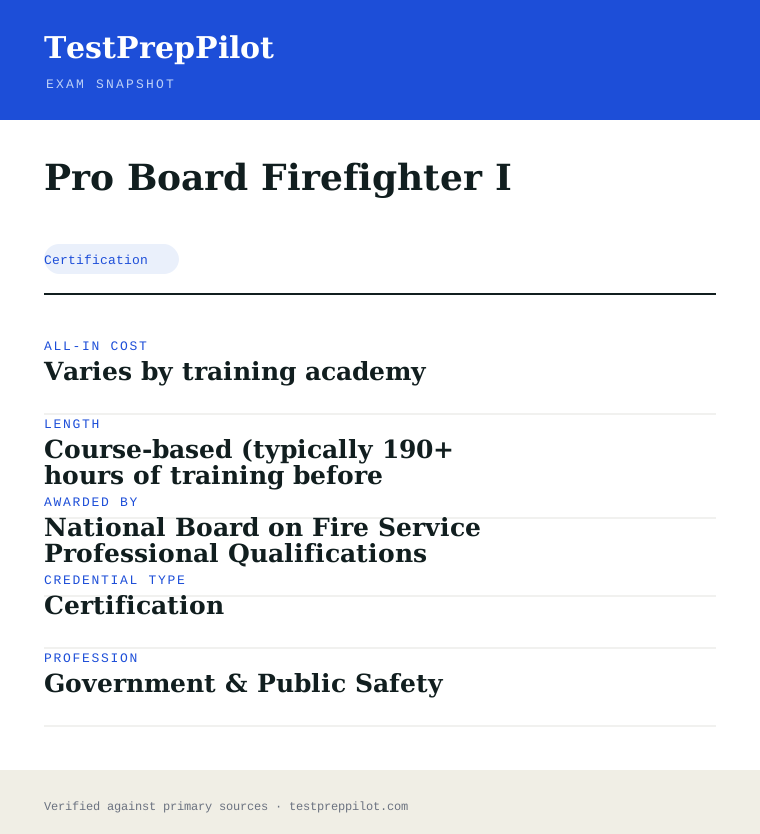
Pro Board Firefighter I is a certification credential; awarded by National Board on Fire Service Professional Qualifications; the exam fee is Varies by academy; typical preparation is Course-based (typically 190+ hours of training before testing); holders typically earn $40,000-$75,000 (33-2011 median $59,530).
| Credential | Pro Board Firefighter I |
|---|---|
| Abbreviation | FF I |
| Type | Certification |
| Profession | Government & Public Safety |
| Specialty | Firefighter |
| Awarded by | National Board on Fire Service Professional Qualifications |
| Difficulty | Specialized |
| Typical prep time | Course-based (typically 190+ hours of training before testing) |
| All-in cost | Varies by training academy |
| Typical salary range | $40,000-$75,000 (33-2011 median $59,530) |
| Credential | Pro Board Firefighter I |
| Awarding body | National Board on Fire Service Professional Qualifications |
| Exam format | Proctored, computer-based |
| Validity | Pro Board certification is permanent (agency-specific renewal may apply) |
| Languages | Varies — see awarding body |
| Scope | National / Multi-state |
| Also known as | Pro Board FF I |
Real questions
Frequently asked questions about the Pro Board Firefighter I
How do I register for the Pro Board Firefighter I exam?
Register through National Board on Fire Service Professional Qualifications's official portal or an authorized test provider (e.g., Pearson VUE or Prometric where applicable). Create an account, select the exam, pay the fee, and schedule a date.
How much does the exam cost?
Fees vary by location and currency. Confirm the current fee on the official registration page before scheduling.
How long is the credential valid, and how do I renew?
Validity varies by credential (commonly 2–3 years). Renewal usually requires continuing education or a recertification exam — see National Board on Fire Service Professional Qualifications's policy.
What if I do not pass?
Most bodies allow retakes after a waiting period and payment of the full or partial fee. Check National Board on Fire Service Professional Qualifications's retake policy before rescheduling.
How do I register for a National Board on Fire Service Professional Qualifications credential?
Register through the official website, select your exam, pay the fee, and schedule a date.
How do I renew a credential?
Renewal policies vary by credential; check the specific program page for requirements and cycles.
In short
Is the Pro Board Firefighter I worth it?
- Pro Board Firefighter I is awarded by National Board on Fire Service Professional Qualifications.
- Validates job-ready competence in Public Safety.
- Registration is through the awarding body or an authorized test provider.
- Renewal and retake policies vary — confirm before scheduling.
Trust
Where does this information come from?
Everything above is taken from the awarding body's own published material. Fees, question counts and domain weights are revised regularly — check the official page before you pay.
Research confidence: low · Last reviewed 2026-08