Government & Public Safety • Certification
Emergency Medical Dispatch
Emergency Medical Dispatch — Public Safety credential from International Academies of Emergency Dispatch
Researched and maintained by TestPrepPilot Editorial BoardPublic safety & emergency communications desk · Figures last verified August 2026
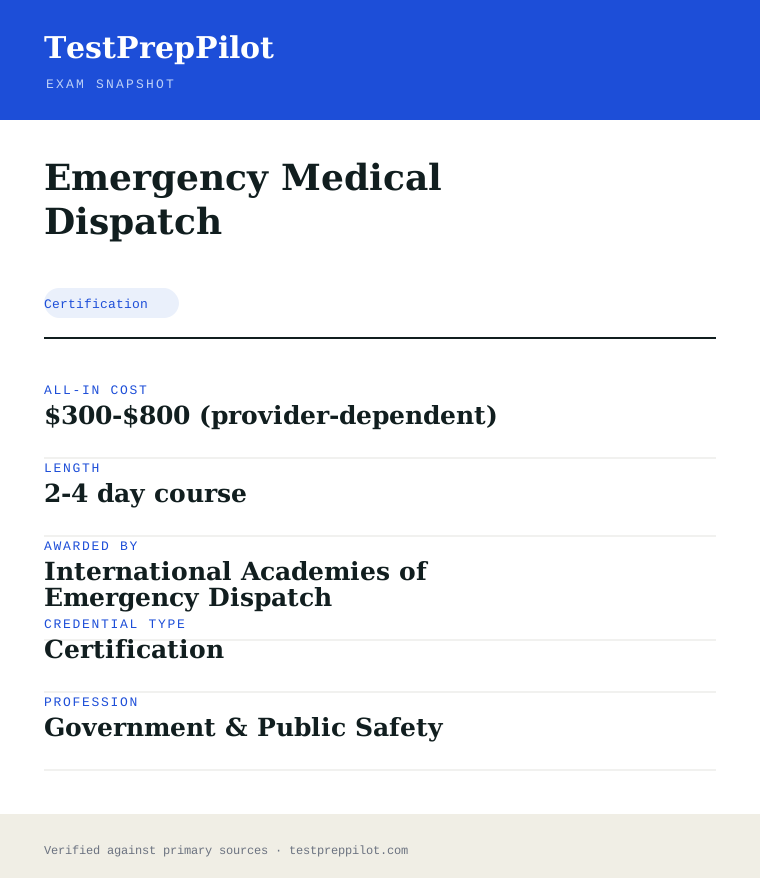
The short version
What is the Emergency Medical Dispatch and is it worth it?
Emergency Medical Dispatch is a professional credential administered by International Academies of Emergency Dispatch. It validates job-ready knowledge and skills in the Public Safety field and is used for career entry, advancement, or compliance.
- Recognized credential from International Academies of Emergency Dispatch
- Demonstrates verified competence in Public Safety
- Supports career advancement and may satisfy licensing or employer requirements
What is it?
What exactly is the Emergency Medical Dispatch?
Emergency Medical Dispatch — Public Safety credential from International Academies of Emergency Dispatch
A certification for dispatchers who use the MPDS protocols to triage medical calls and give pre-arrival instructions to callers. Offered by International Academies of Emergency Dispatch, it is designed for candidates who need to demonstrate verified competence in the Public Safety field. The credential is commonly used for career entry, advancement, regulatory compliance, or employer requirements. Candidates should review the official handbook for eligibility, exam format, and scoring before registering.
The path in brief
- Confirm you meet any eligibility or prerequisites
- Review the official handbook and study materials
- Register and pay through the awarding body or authorized provider
- Schedule and take the exam (test center or online proctoring)
- Receive your score and, if passed, your credential
Before you book
Who is eligible to sit the Emergency Medical Dispatch?
None (course)
Who it is for: Professionals and candidates seeking to validate Public Safety competence.
The test itself
What is the format of the Emergency Medical Dispatch?
The Emergency Medical Dispatch is administered by International Academies of Emergency Dispatch and runs Within the course and contains 50 (80% passing) questions.
| Administered by | International Academies of Emergency Dispatch |
|---|---|
| Questions | 50 (80% passing) |
| Time limit | Within the course |
| Pass mark | Passing score set by the awarding body; see the official score report |
| Exam fee | $300-$800 |
| Format | Proctored, computer-based (test center or online remote proctoring) |
Content outline
What topics are on the Emergency Medical Dispatch?
The Emergency Medical Dispatch covers 4 content domains.
Weightings come from the official exam outline. Study time is best allocated in roughly these proportions rather than evenly across domains.
- Legal authority & procedures
Topic area tested on the exam; see the official blueprint for the detailed breakdown.
- Emergency response
Topic area tested on the exam; see the official blueprint for the detailed breakdown.
- Investigation
Topic area tested on the exam; see the official blueprint for the detailed breakdown.
- Community & safety
Topic area tested on the exam; see the official blueprint for the detailed breakdown.
The path
How do you register for the Emergency Medical Dispatch?
- 1
Visit the awarding body’s official website and create an account
- 2
Select the credential and review its specific requirements
- 3
Complete any required eligibility (education, experience, or training)
- 4
Pay the registration fee
- 5
Schedule the exam at a test center or online
- 6
Take the exam and receive your results
The fine print
What are the retake and renewal rules for the Emergency Medical Dispatch?
- Proctoring & delivery
- Proctored, computer-based delivery (test center or remote online proctoring), varying by exam.
- Retake policy
- Varies by credential — most bodies permit retakes after a waiting period and full or partial fee.
- Score reporting
- Scores are reported per the body’s timeline, typically electronically after the exam.
- Recertification
- Varies; many credentials require renewal every 2–3 years via continuing education or a recertification exam.
What it pays
How much does this credential pay?
EMD certification is the standard for 911 dispatch roles: public safety telecommunicators earned a mean of about $48,670 in May 2024 (BLS)
The IAED Emergency Medical Dispatch (EMD) certification is the international standard for emergency dispatchers who take 911 calls and provide pre-arrival medical instructions; the related EFD (fire) and EPD (police) certifications cover the other dispatch disciplines. It is a professional certification rather than a job license for one occupation, so no single BLS SOC code attaches to it; the salary story belongs to the dispatch occupation it serves. BLS reported that public safety telecommunicators (SOC 43-5031) - the occupational title for 911 dispatchers - had a mean wage of about $48,670 in May 2024, with the occupation employing about 300,000 people and projected to grow roughly 3 percent from 2024 to 2034; public-safety agencies across the US and internationally embed IAED certification in their hiring and continuing-education requirements, and many agencies require the EMD (and often EFD/EPD) certifications as conditions of employment or promotion within the dispatch center. BLS classifies workers by job duty, not certifications, so no certificate maps to a specific wage; the value is the professional standard in a role where certification is a de facto hiring requirement and where agencies pay dispatcher wages set by municipal salary schedules. For a candidate entering dispatch, the EMD certification (earned through an agency-sponsored or open course) is the recognized entry credential, and the honest framing is that the certificate evidences the protocol-driven dispatch competency that agencies require, with the wage following the agency job.
| Measure | Figure | Source / note |
|---|---|---|
| Public safety telecommunicators mean wage, May 2024 | ~$48,670 | BLS OEWS, SOC 43-5031 (mean; median similar) |
| All-occupation median, May 2024 | $49,500 | BLS OEWS |
| Protective service occupations median, May 2024 | $50,580 | BLS OEWS occupational group |
| IAED certification family | EMD, EFD, EPD | International Academies of Emergency Dispatch |
Job growth.Public-safety-telecommunicator employment is projected to grow about 3 percent from 2024 to 2034; certification is a standard hiring requirement in dispatch centers.
Source: BLS Occupational Outlook Handbook - Public Safety Telecommunicators
Your odds
What are the pass rates?
The IAED EMD certification requires a passing score of 80 percent on a 50-question exam after a 2-4 day course; IAED publishes no pass rates
The International Academies of Emergency Dispatch (IAED) does not publish a national pass-rate statistic for the EMD certification, but the certification mechanics are public. The EMD certification is earned by completing the Emergency Medical Dispatch course (typically 2-4 days, delivered in person by IAED-accredited instructors or through the approved online pathway), which trains dispatchers in the Medical Priority Dispatch System (MPDS): structured call-taking, the Chief Complaint codes, the Key Questions, post-dispatch and pre-arrival instructions, and the dispatch-life-support protocols. The course ends with a certification exam - commonly 50 multiple-choice questions with a passing score of 80 percent (40 of 50) - and candidates who pass become certified EMDs. The certification is valid for two years, and renewal requires completing continuing education (the IAED requires a specified number of continuing-dispatch-education hours within the two-year cycle) and re-certification. In practice, most candidates who complete the course pass, because the content is protocol-driven and the course is the preparation, but the exam is real and the 80 percent bar means the protocol details must be learned, not skimmed. The honest summary is that the bar is 40 of 50 on the certification exam, the certification is valid two years with continuing education for renewal, and the MPDS protocols are the exam’s entire content.
Read this before quoting the number.IAED publishes no pass rates; the EMD exam requires 80% (40/50) with a 2-year validity and continuing-education renewal.
Your schedule
How long should I study for it?
Course (2-4 days) + 10-20 hours self-study of focused study
The EMD certification plan is driven by the course: 2-4 days of in-person (or approved online) training followed by the certification exam, with 10-20 hours of self-study around it. The content is the Medical Priority Dispatch System: the structure of the emergency call (caller verification, Chief Complaint selection), the 32 Chief Complaint codes and their Key Questions, the response determinants (which units are dispatched), and the pre-arrival instructions and dispatch-life-support protocols (CPR, hemorrhage control, childbirth, airway management). A realistic plan: before the course, review the MPDS protocol cards and the course materials the agency or IAED provides (2-4 hours), because the course moves fast and prior familiarity with the protocol structure doubles retention. During the course, complete the practical call-taking drills and the scenario practice, because the exam includes protocol-application items and the drills are the practice. After the course, study the protocol cards with a focus on the Key Questions and the dispatch-life-support instructions (5-10 hours), then take the certification exam. The single most important thing to master is the protocol flow: Chief Complaint selection, Key Questions in order, and the pre-arrival instructions that follow, because the exam tests whether the candidate applies the protocols in the prescribed sequence. Renewal every two years requires continuing-education hours, so the study habit should continue through the certification cycle.
- Before the course3
Protocol familiarity
- Review the MPDS protocol cards
- Course materials from the provider
- The course24
EMD training
- Attend the 2-4 day course
- Call-taking drills and scenario practice
- After the course8
Exam preparation
- Key Questions and dispatch-life-support review
- Take the 50-question exam (80%)
Adjusting the pace
Agency-sponsored.Most dispatchers are certified through agency-sponsored courses; open-enrollment courses are also available.
EFD and EPD.Fire (EFD) and police (EPD) dispatch certifications follow the same structure with their own protocol systems.
How to study
How do I prepare most effectively?
The most effective EMD strategies treat the MPDS protocols as the entire curriculum. Strategy one: learn the protocol flow as a sequence - caller verification, Chief Complaint selection, Key Questions in order, and pre-arrival instructions - because the exam tests whether the candidate applies the steps in the prescribed order, and dispatchers who memorize facts without the flow miss the application items. Strategy two: memorize the dispatch-life-support instructions (CPR, airway, hemorrhage, childbirth) because they carry the highest stakes and recur across the exam; the exact instruction sequence must be learned, not paraphrased. Strategy three: practice with scenario calls, because the exam presents call situations and asks which Chief Complaint code, Key Question or instruction applies; working through real-style scenarios with the protocol cards is the highest-yield practice. Strategy four: complete the course’s practical drills seriously - the call-taking practice is where the protocol flow becomes automatic. Strategy five: study the protocol cards between sessions rather than only during the course, because the volume of codes and questions is large and steady review beats cramming. Strategy six: plan the two-year renewal from the start - track the continuing-education requirements - because lapsed certification matters in a role where certification is a condition of employment.
Learn the protocol flow
Verification, Chief Complaint, Key Questions, instructions - in order.
Memorize dispatch-life-support
CPR, airway, hemorrhage and childbirth sequences.
Practice scenario calls
Match call situations to codes and questions.
Plan the 2-year renewal
Continuing-education hours keep the certification current.
What to buy
Which study resources are worth paying for?
The EMD resource market is organized around IAED and the accredited training providers. The IAED website provides the certification overview, the course catalog and the MPDS information - the protocol system itself is proprietary to IAED, and the protocol cards and materials are provided through the course (included in the course fee, which is typically $300-$800 depending on the provider and delivery, with agency-sponsored courses often paid by the employer). The certification exam is included in the course. Free resources are limited because the MPDS protocols are proprietary, but the IAED site and the course preview materials provide orientation. Continuing education for renewal is delivered through IAED-approved channels. Third-party study guides for the EMD exam are scarce and unnecessary because the course materials are the complete content. The honest ranking: the accredited course and its materials (the required purchase), the protocol cards for study, and IAED’s renewal channels. Prices here are current as of 2025-26 and vary by provider.
| Resource | Price | Format | Best for |
|---|---|---|---|
| Accredited EMD course | $300-$800 typical | In-person/approved online | The required training, exam, and materials |
| MPDS protocol cards | Included with course | Print/electronic | The complete study content |
| IAED continuing education | Per renewal cycle | IAED channels | Renewal every 2 years |
| Third-party study guides | Rare/unnecessary | Print/online | The course materials suffice |
Prices dated 2025-26 and vary by provider; agency-sponsored courses are often employer-paid. No commission-based ranking.
Avoid these
What mistakes do candidates most often make?
The most common EMD mistakes come from studying facts instead of the protocol flow. Mistake one: memorizing Chief Complaint codes without the sequence; the exam tests whether the dispatcher applies the Key Questions in order and gives the right pre-arrival instructions, and candidates who know the codes but not the flow miss the application items. Mistake two: paraphrasing the dispatch-life-support instructions; the exam and the real role require the exact instruction sequence, and paraphrasing fails both. Mistake three: skipping the scenario practice; the exam presents call situations, and candidates who only read the cards without practicing scenarios underperform. Mistake four: treating the course as passive attendance; the practical call-taking drills are where the flow becomes automatic, and candidates who coast through them struggle on the exam. Mistake five: ignoring the two-year renewal and continuing-education requirements; a lapsed certification is a compliance problem in a role where certification is a condition of employment. Mistake six: underestimating the exam’s specificity; the 80 percent bar (40 of 50) means the protocol details must be learned precisely, and candidates who study casually retake. Finally, dispatchers should practice the calm, structured call-taking voice, because the certification and the job both reward protocol discipline under pressure.
✕Memorizing codes without the flow
✓Learn the protocol sequence and application.
✕Paraphrasing life-support instructions
✓Memorize the exact instruction sequences.
✕Skipping scenario practice
✓Work call scenarios with the protocol cards.
✕Coasting through the drills
✓The call-taking practice builds the automatic flow.
✕Ignoring the renewal cycle
✓Track continuing-education hours for the 2-year renewal.
What you'll face
What question types will I see?
The IAED EMD certification exam is commonly 50 multiple-choice questions with a passing score of 80 percent (40 of 50), delivered at the end of the accredited course. Content covers the Medical Priority Dispatch System: call structure and caller verification, Chief Complaint code selection, Key Questions in the prescribed order, response determinants, pre-arrival instructions, and dispatch-life-support protocols. Most items are scenario-application questions presenting a call situation. Samples below are editor-written illustrations of the published course content, not live exam items.
Verifying the caller and the situation.
Code selection and the questions in order.
Which dispatch resources the case warrants.
The exact instruction sequences (CPR, hemorrhage, airway, childbirth).
Try these
Q1A caller reports an adult is not breathing after collapsing. After verifying the address, which is the most appropriate next step in the dispatch protocol?
Answer:A
A non-breathing adult is a priority medical dispatch case requiring immediate dispatch-life-support instructions (CPR); the protocol prioritizes life-support instructions over administrative questions.
Q2A caller describes a child who is choking and unable to speak. Which Chief Complaint category is most appropriate?
Answer:A
Choking is a distinct Chief Complaint category with its own Key Questions and pre-arrival instructions; the protocol requires selecting the most specific applicable category.
Q3After dispatching for a hemorrhage case, the dispatcher should ______.
Answer:A
The protocol requires giving the appropriate pre-arrival instructions (here, hemorrhage control) while units are en route; ending the call or transferring abandons the caller during the emergency.
Samples are editor-written illustrations of the published course content, not live exam items.
The big day
What should I expect on exam day?
The EMD certification exam is delivered at the end of the accredited course - the final session of the 2-4 day training - in person or through the approved online pathway with proctoring. Candidates must complete the full course before the exam, bring photo ID, and follow the provider’s rules (no notes or protocol cards during the closed-book exam). The exam is commonly 50 questions with an 80 percent passing line, and results are typically available shortly after. After passing, the certification is valid two years, and renewal requires the continuing-education hours within the cycle plus re-certification. For dispatchers, the certification is usually part of agency employment or training requirements, so the record must be maintained with the agency. Afterwards, continue the continuing-education schedule from the start of the cycle, and if the agency requires the EFD or EPD certifications as well, plan those courses on the same rhythm.
Bring
- Photo ID
- Course completion record
- Provider instructions
- A rested, focused mindset for the exam
Leave at home
- Protocol cards or notes (closed-book exam)
- Phone and personal electronics
- Distractions - the exam follows the course directly
How the day runs
Rules in the room
- The full course must be completed before the exam.
- The exam is closed-book; 80% (40/50) passes.
- The certification is valid 2 years with continuing education.
- Agency requirements may add the EFD and EPD certifications.
Afterwards.Maintain the certification record with the agency, schedule the continuing-education hours across the 2-year cycle, and plan the EFD/EPD certifications if the agency requires them.
Reference
What are the key facts about the Emergency Medical Dispatch?
Emergency Medical Dispatch is a certification credential; awarded by International Academies of Emergency Dispatch; the exam fee is $300-$800; typical preparation is 2-4 day course; holders typically earn $35,000-$60,000 (public safety telecommunicators).
| Credential | Emergency Medical Dispatch |
|---|---|
| Abbreviation | EMD |
| Type | Certification |
| Profession | Government & Public Safety |
| Specialty | Emergency Management & Dispatch |
| Awarded by | International Academies of Emergency Dispatch |
| Difficulty | Specialized |
| Typical prep time | 2-4 day course |
| All-in cost | $300-$800 (provider-dependent) |
| Typical salary range | $35,000-$60,000 (public safety telecommunicators) |
| Credential | Emergency Medical Dispatch |
| Awarding body | International Academies of Emergency Dispatch |
| Exam format | Proctored, computer-based |
| Validity | Varies by credential (commonly 2–3 years) |
| Languages | Varies — see awarding body |
| Scope | National / Multi-state |
| Also known as | EMD |
Real questions
Frequently asked questions about the Emergency Medical Dispatch
How do I register for the Emergency Medical Dispatch exam?
Register through International Academies of Emergency Dispatch's official portal or an authorized test provider (e.g., Pearson VUE or Prometric where applicable). Create an account, select the exam, pay the fee, and schedule a date.
How much does the exam cost?
Fees vary by location and currency. Confirm the current fee on the official registration page before scheduling.
How long is the credential valid, and how do I renew?
The EMD certification is the standard for 911 dispatch and requires 80% (40 of 50) on the certification exam after the accredited course.
What if I do not pass?
Most bodies allow retakes after a waiting period and payment of the full or partial fee. Check International Academies of Emergency Dispatch's retake policy before rescheduling.
How do I register for a International Academies of Emergency Dispatch credential?
Register through the official website, select your exam, pay the fee, and schedule a date.
How do I renew a credential?
Renewal policies vary by credential; check the specific program page for requirements and cycles.
In short
Is the Emergency Medical Dispatch worth it?
- Emergency Medical Dispatch is awarded by International Academies of Emergency Dispatch.
- Validates job-ready competence in Public Safety.
- Registration is through the awarding body or an authorized test provider.
- Renewal and retake policies vary — confirm before scheduling.
Trust
Where does this information come from?
Everything above is taken from the awarding body's own published material. Fees, question counts and domain weights are revised regularly — check the official page before you pay.
Research confidence: low · Last reviewed 2026-08