Government & Public Safety • Training
NIMS ICS-800
NIMS ICS-800 — Public Safety credential from FEMA Emergency Management Institute
Researched and maintained by TestPrepPilot Editorial BoardEmergency management & NIMS desk · Figures last verified August 2026
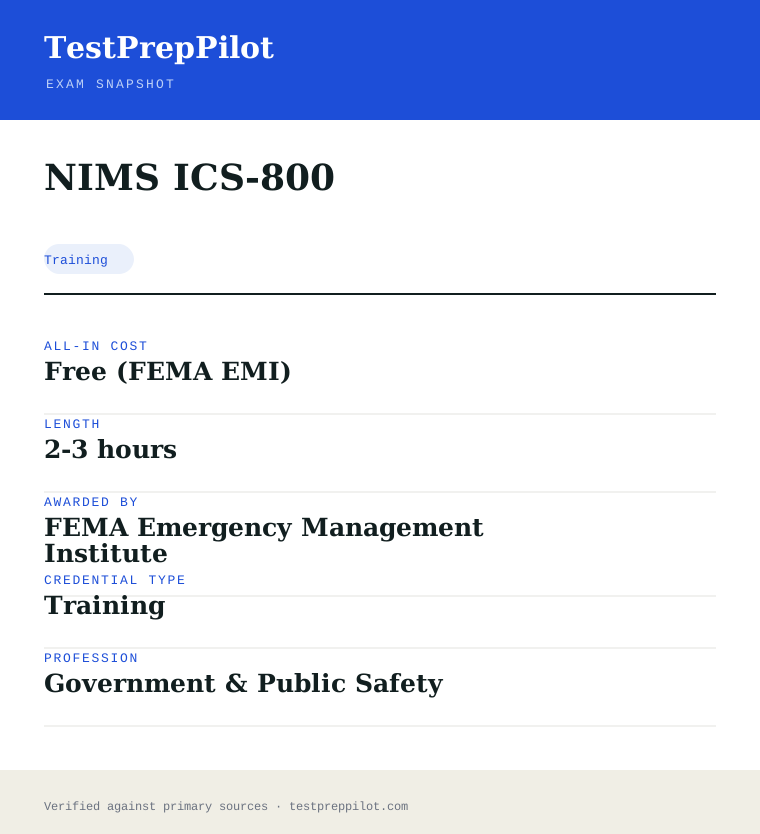
The short version
What is the NIMS ICS-800 and is it worth it?
NIMS ICS-800 is a professional credential administered by FEMA Emergency Management Institute. It validates job-ready knowledge and skills in the Public Safety field and is used for career entry, advancement, or compliance.
- Recognized credential from FEMA Emergency Management Institute
- Demonstrates verified competence in Public Safety
- Supports career advancement and may satisfy licensing or employer requirements
What is it?
What exactly is the NIMS ICS-800?
NIMS ICS-800 — Public Safety credential from FEMA Emergency Management Institute
The national response framework course explaining how communities and agencies coordinate during domestic incident response. Offered by FEMA Emergency Management Institute, it is designed for candidates who need to demonstrate verified competence in the Public Safety field. The credential is commonly used for career entry, advancement, regulatory compliance, or employer requirements. Candidates should review the official handbook for eligibility, exam format, and scoring before registering.
The path in brief
- Confirm you meet any eligibility or prerequisites
- Review the official handbook and study materials
- Register and pay through the awarding body or authorized provider
- Schedule and take the exam (test center or online proctoring)
- Receive your score and, if passed, your credential
Before you book
Who is eligible to sit the NIMS ICS-800?
Eligibility varies; many credentials are open to all, while others require coursework, work experience, or sponsorship.
Who it is for: Professionals and candidates seeking to validate Public Safety competence.
The test itself
What is the format of the NIMS ICS-800?
The NIMS ICS-800 is administered by FEMA Emergency Management Institute and runs Untimed open-book and contains 25 questions.
| Administered by | FEMA Emergency Management Institute |
|---|---|
| Questions | 25 questions |
| Time limit | Untimed open-book |
| Pass mark | Passing score set by the awarding body; see the official score report |
| Exam fee | Free (FEMA EMI) |
| Format | Proctored, computer-based (test center or online remote proctoring) |
Content outline
What topics are on the NIMS ICS-800?
The NIMS ICS-800 covers 4 content domains.
Weightings come from the official exam outline. Study time is best allocated in roughly these proportions rather than evenly across domains.
- Legal authority & procedures
Topic area tested on the exam; see the official blueprint for the detailed breakdown.
- Emergency response
Topic area tested on the exam; see the official blueprint for the detailed breakdown.
- Investigation
Topic area tested on the exam; see the official blueprint for the detailed breakdown.
- Community & safety
Topic area tested on the exam; see the official blueprint for the detailed breakdown.
The path
How do you register for the NIMS ICS-800?
- 1
Visit the awarding body’s official website and create an account
- 2
Select the credential and review its specific requirements
- 3
Complete any required eligibility (education, experience, or training)
- 4
Pay the registration fee
- 5
Schedule the exam at a test center or online
- 6
Take the exam and receive your results
The fine print
What are the retake and renewal rules for the NIMS ICS-800?
- Proctoring & delivery
- Proctored, computer-based delivery (test center or remote online proctoring), varying by exam.
- Retake policy
- Varies by credential — most bodies permit retakes after a waiting period and full or partial fee.
- Score reporting
- Scores are reported per the body’s timeline, typically electronically after the exam.
- Recertification
- Varies; many credentials require renewal every 2–3 years via continuing education or a recertification exam.
What it pays
How much does this credential pay?
No direct occupation — IS-800 (National Response Framework) is a FEMA training course required in many emergency-management and public-safety roles, where emergency management directors earn a median of $86,130 (BLS, May 2024)
The direct answer is that IS-800 has no salary of its own — it is a free FEMA online training course (National Response Framework, An Introduction), not a job credential, and no BLS occupation corresponds to holding it. The honest salary story is about the roles that list it as a training requirement: emergency management directors (SOC 11-9161), at a May 2024 median annual wage of $86,130 with the highest 10 percent above about $150,000; emergency management specialists and coordinators at the state and local level; and public-safety personnel in police, fire, and healthcare whose agencies mandate NIMS training as a condition of grant funding. BLS projects about 4 percent growth for emergency management directors from 2024 to 2034, with a few thousand openings per year. The practical read is that IS-800 is the "how the nation responds" companion to the ICS courses: it explains the National Response Framework — the doctrine that lays out how federal, state, tribal, and local governments coordinate with private and nonprofit partners during major incidents — and most agencies bundle it with IS-100/IS-200/IS-700 as the standard NIMS training package. Completing it costs nothing, takes a few hours, and is a checkbox that keeps your training record compliant, which matters for promotion eligibility in many public-safety agencies. The pay effect is indirect but real: the course sits in the required-training block that public-safety and emergency-management candidates must clear to be eligible for the roles with the wages quoted above. For most candidates the smartest framing is compliance-plus-knowledge: complete the course free, keep the certificate in your training file, and treat it as the doctrinal context for the ICS operational training that follows.
| Measure | Figure | Source / note |
|---|---|---|
| Median annual wage, emergency management directors | $86,130 | BLS Occupational Outlook Handbook, May 2024 (SOC 11-9161) |
| Highest 10 percent, emergency management directors | >$150,000 | BLS OOH, May 2024 |
| Projected growth, 2024-34 | +4% | BLS Employment Projections |
| The course itself | No direct occupation | Free FEMA EMI online course (IS-800) |
Job growth.BLS projects about 4% growth for emergency management directors from 2024 to 2034, with annual openings driven mainly by replacement.
Your odds
What are the pass rates?
No pass rate is published — IS-800 is an open-book online course with a final exam, and the real gate is completing it on the FEMA EMI platform, not a cohort percentage
The core fact is that FEMA does not publish pass rates for IS-800, and none exists as a meaningful statistic, because the course is self-paced online training with an open-book final exam — the kind of assessment nearly everyone completes. What is published is the course structure: IS-800 is delivered on the FEMA Emergency Management Institute independent-study platform, contains roughly 25 to 35 minutes of reading and graphics per unit across about seven units, and ends with a final exam of 25 multiple-choice questions. The final exam requires a score of 75 percent or higher to pass, is open-book (you may keep the course text open while answering), and you must complete it in a single session on the EMI site. Because the material is directly drawn from the course text, the practical pass rate approaches universal for candidates who read the units, and the common failure mode is failing to finish the exam in one sitting or rushing without reading. What actually matters beyond the pass is the completion record: FEMA issues a certificate of completion with your name, course number, and date, which agencies file for NIMS compliance and grant-condition documentation. The honest preparation advice is therefore to read each unit rather than skim, use the course’s built-in unit reviews, and take the final with the text available — the exam is a comprehension check on the National Response Framework’s key concepts (the five framework guiding principles, core capabilities, the roles of federal and state agencies, and the Emergency Support Functions). If you fail the first attempt at the 75 percent cut, the EMI platform allows retakes after reviewing the course.
Read this before quoting the number.No official pass rate is published; the final exam is open-book with a 75% cut score set by FEMA.
Source: FEMA EMI — IS-800 course page
Your schedule
How long should I study for it?
2-3 hours total of focused study
Plan for roughly 2 to 3 hours of total course time — the IS-800 reading plus the 25-question final — and complete it in one or two sittings, because the exam is open-book and draws directly from the text. The course covers the National Response Framework (NRF): the doctrine governing how the nation responds to all-hazards incidents, including the framework’s guiding principles (engaged partnership, tiered response, scalable and flexible operational capabilities, unity of effort through unified command), the roles of local, state, tribal, territorial, and federal governments, the five mission areas (prevention, protection, mitigation, response, recovery), core capabilities, and the Emergency Support Functions (ESFs) that group federal assistance. The highest-yield study sequence is: first, read the course overview and the unit on the framework’s principles, since those concepts recur throughout the exam; second, work through the unit on roles and responsibilities, learning who does what at each level of government; third, review the ESFs and core capabilities with the course’s own summaries; and fourth, take the final with the text open, using the course search function to verify answers. Because the course is the doctrinal companion to the ICS series, the best preparation is having completed IS-100, IS-200, or IS-700 first — the concepts of unified command and incident management carry over, and IS-800 explicitly builds on them. Budget the 75 percent cut score into your approach: 25 questions means you can miss up to 6 and still pass, so if a question stumps you, mark your best answer and move on rather than losing time. Save the certificate immediately after passing and file it with your agency training records.
- Sitting 1 (60-90 min)1.5
Course reading
- Read the IS-800 units on the EMI platform
- Note the five guiding principles and mission areas
- Review the ESF list
- Sitting 2 (30-45 min)0.75
Final exam
- Take the 25-question open-book final
- Verify answers against the course text
- Download the certificate
Adjusting the pace
NIMS training bundle.Agencies typically pair IS-800 with IS-100, IS-200, and IS-700 as the standard required package.
Classroom-delivered versions.Some agencies teach IS-800 content in instructor-led sessions; the online course remains the standard record.
How to study
How do I prepare most effectively?
The strategy that makes IS-800 a low-stress completion is "read the units actively, then take the open-book final with the text available" — and the single biggest error is treating the course like a closed-book test and panicking over the 75 percent cut score. Because the final is open-book, the actual skill being tested is locating information efficiently, so learn the course text’s layout — where the principles, mission areas, and ESFs are described — before you start the exam. A second proven approach is completing the ICS prerequisite courses first, because IS-800 explicitly assumes familiarity with unified command and incident management, and candidates who skip them spend more time decoding the terminology. Third, take notes on the five framework guiding principles and the five mission areas, since those two lists appear in multiple exam items in different wording. Fourth, use the EMI platform’s course search function during the final to verify any answer you are unsure about; there is no penalty for checking. Fifth, do not over-prepare — this is a 2-to-3-hour course, and spending 10 hours on it is a misallocation compared with the ICS operational courses that follow. Finally, keep the certificate accessible in two places and confirm your agency files it, because the record — not the pass itself — is what NIMS compliance checks verify.
Read actively, then use the text
The final is open-book; the skill tested is finding information efficiently.
Do the ICS prerequisites first
IS-100/IS-200/IS-700 familiarity makes the NRF terminology decode faster.
Memorise the two key lists
The five guiding principles and five mission areas recur across exam items.
Use the course search during the final
There is no penalty for verifying answers against the text.
Keep the certificate on file
Agencies file the completion record for NIMS compliance checks.
What to buy
Which study resources are worth paying for?
IS-800 is a free FEMA course, so the entire preparation budget is effectively zero, and the official EMI platform is the only source that produces the valid certificate. The comparison below separates the official course, companion ICS courses, and optional third-party summaries, with prices current to this review. The buying rule is simple: complete the official course for the certificate, and use free NIMS reference materials rather than paying for commercial summaries of public-domain doctrine.
| Resource | Price | Format | Best for |
|---|---|---|---|
| FEMA EMI IS-800 course | Free | Self-paced online + open-book final | The valid certificate itself |
| Companion ICS courses (IS-100, IS-200, IS-700) | Free | Self-paced online | The standard NIMS bundle |
| FEMA National Response Framework document | Free | Deeper doctrinal reference | |
| Third-party NIMS study guides | ~$10-30 | Book or PDF | Optional review of public-domain content |
All prices approximate and dated to this review; the official FEMA course is free and the only source of the valid certificate.
Avoid these
What mistakes do candidates most often make?
The most common mistake is treating IS-800 as a closed-book exam and skipping the reading, which converts an open-book course into a guessing exercise; the second is taking the final without the course text accessible and losing points on easily verified answers. A third recurring error is missing the 75 percent cut score by rushing — 25 questions means six misses fail the course, so spending 30 minutes on the final is normal. Candidates also routinely confuse the National Response Framework (the doctrinal document IS-800 teaches) with the ICS operational system taught in the ICS courses, and mix up the five mission areas. Finally, many candidates complete the course but never download or file the certificate, leaving their NIMS training record incomplete when the agency checks it.
✕Skipping the reading
✓Read the units; the open-book final draws directly from the text.
✕Taking the final without the text
✓Keep the course text open and use search to verify answers.
✕Rushing past the cut score
✓Six misses fail the 25-question exam; budget 30 minutes for the final.
✕Mixing up NRF and ICS
✓IS-800 teaches the response doctrine; the ICS courses teach operational command — keep them separate.
✕Not filing the certificate
✓Download the completion record and file it with your agency for NIMS compliance.
What you'll face
What question types will I see?
The IS-800 final exam contains 25 multiple-choice questions testing the National Response Framework’s key concepts: the five guiding principles, the five mission areas, the levels of government and their roles, core capabilities, and the Emergency Support Functions. Most items are recall-style with scenario dressing — for example, identifying which level of government leads a response, or which mission area a described action belongs to. There are no essays or simulations; the exam is a straightforward comprehension check. The samples below are editor-written illustrations of the course content, not live exam items.
Engaged partnership, tiered response, scalable capabilities, unity of effort.
Local, state, tribal, territorial, and federal roles in response.
Prevention, protection, mitigation, response, recovery.
How federal assistance is grouped and delivered.
Purpose and structure of the NRF.
Try these
Q1Which of the five NRF guiding principles describes the ability to adjust the response to the incident’s size and complexity?
Answer:C
The NRF’s principles include scalable, flexible, and adaptable operational capabilities, allowing the response to match the incident.
Q2Which level of government has the primary responsibility for incident response at the scene?
Answer:B
The NRF recognises that incident response begins and ends at the local level, with state and federal support scaled to need.
Q3Planning, public information, and warning fall under which mission area?
Answer:D
Protection includes capabilities such as planning, public information, and warning that safeguard communities from hazards.
Samples are editor-written illustrations of the course content, not live exam items.
The big day
What should I expect on exam day?
There is no scheduled exam day for IS-800 — the entire course, including the final, is completed online at your convenience on the FEMA EMI platform, and the final must be completed in a single session. The core rules: log in to the EMI independent-study site, work through the course units, and take the 25-question final with a 75 percent passing score; the exam is open-book and there is no time limit reported by the platform for most candidates. Because it is online and self-paced, the "exam-day" discipline is choosing a block of 60 to 90 minutes without interruptions, having the course text open in a second window, and finishing the final without closing the browser mid-exam. After passing, the EMI platform generates your certificate of completion; download it immediately and save a copy, since the site retains records but agencies want the document in your file. If you fail the first attempt, review the course and retake; the platform permits retesting. The most useful habits are reading the units in the order presented, using the built-in unit reviews, and verifying uncertain answers against the text during the final rather than guessing.
Bring
- FEMA EMI login
- Course text open in a second window
- 60-90 minutes of uninterrupted time
Leave at home
- Distractions — the final must be completed in a single session
- The assumption of a closed-book test
How the day runs
Rules in the room
- Open-book final with the course text
- 75% cut score (25 questions)
- Single-session final
- Retakes permitted after review
Afterwards.Passing issues the IS-800 certificate of completion, filed with your agency for NIMS compliance; pair it with IS-100/IS-200/IS-700 for the standard training package.
Reference
What are the key facts about the NIMS ICS-800?
NIMS ICS-800 is a training credential; awarded by FEMA Emergency Management Institute; the exam fee is Free (FEMA EMI); typical preparation is 2-3 hours; holders typically earn $86,130 median, emergency mgmt directors (BLS May 2024).
| Credential | NIMS ICS-800 |
|---|---|
| Abbreviation | ICS-800 |
| Type | Training |
| Profession | Government & Public Safety |
| Specialty | Emergency Management & Dispatch |
| Awarded by | FEMA Emergency Management Institute |
| Difficulty | Specialized |
| Typical prep time | 2-3 hours |
| All-in cost | Free (FEMA EMI) |
| Typical salary range | $86,130 median, emergency mgmt directors (BLS May 2024) |
| Credential | NIMS ICS-800 |
| Awarding body | FEMA Emergency Management Institute |
| Exam format | Proctored, computer-based |
| Validity | Completion record kept for NIMS compliance |
| Languages | Varies — see awarding body |
| Scope | National / Multi-state |
| Also known as | ICS-800 |
Real questions
Frequently asked questions about the NIMS ICS-800
How do I register for the NIMS ICS-800 exam?
Register through FEMA Emergency Management Institute's official portal or an authorized test provider (e.g., Pearson VUE or Prometric where applicable). Create an account, select the exam, pay the fee, and schedule a date.
How much does the exam cost?
Fees vary by location and currency. Confirm the current fee on the official registration page before scheduling.
How long is the credential valid, and how do I renew?
Validity varies by credential (commonly 2–3 years). Renewal usually requires continuing education or a recertification exam — see FEMA Emergency Management Institute's policy.
What if I do not pass?
Most bodies allow retakes after a waiting period and payment of the full or partial fee. Check FEMA Emergency Management Institute's retake policy before rescheduling.
How do I register for a FEMA Emergency Management Institute credential?
Register through the official website, select your exam, pay the fee, and schedule a date.
How do I renew a credential?
Renewal policies vary by credential; check the specific program page for requirements and cycles.
In short
Is the NIMS ICS-800 worth it?
- NIMS ICS-800 is awarded by FEMA Emergency Management Institute.
- Validates job-ready competence in Public Safety.
- Registration is through the awarding body or an authorized test provider.
- Renewal and retake policies vary — confirm before scheduling.
Same awarding body
What other credentials does FEMA Emergency Management Institute award?
Worth comparing
How does the NIMS ICS-800 compare with similar credentials?
Trust
Where does this information come from?
Everything above is taken from the awarding body's own published material. Fees, question counts and domain weights are revised regularly — check the official page before you pay.
- FEMA Emergency Management Institute Awarding body
Research confidence: low · Last reviewed 2026-08