Government & Public Safety • Exam
Law Enforcement Physical Ability Test
Law Enforcement Physical Ability Test — Public Safety credential from Law enforcement agencies
Researched and maintained by TestPrepPilot Editorial BoardPublic safety & law enforcement hiring desk · Figures last verified August 2026
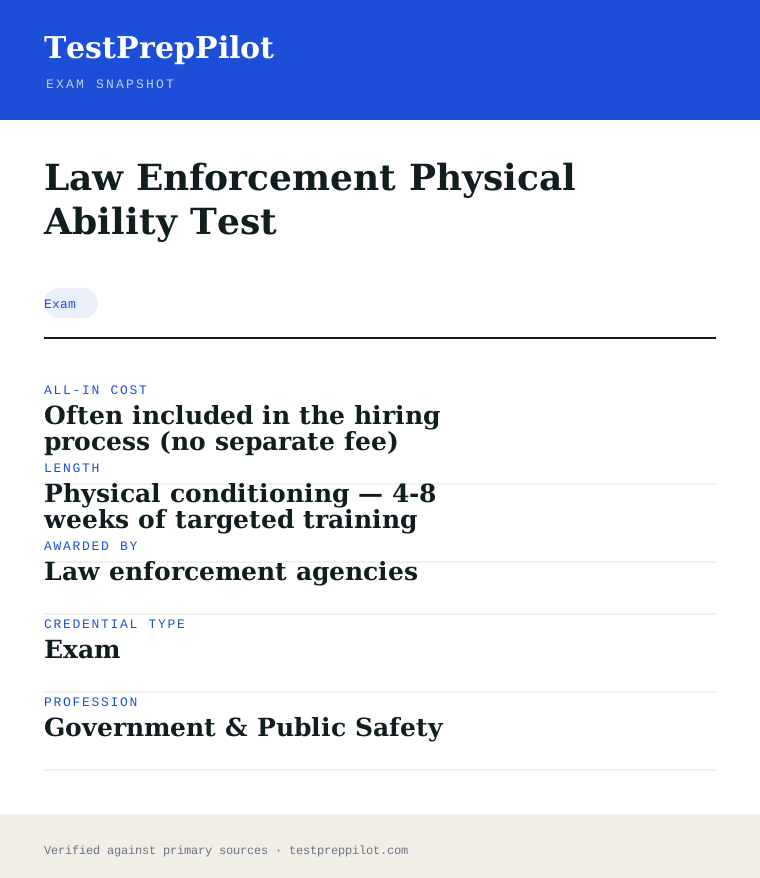
The short version
What is the Law Enforcement Physical Ability Test and is it worth it?
Law Enforcement Physical Ability Test is a professional credential administered by Law enforcement agencies. It validates job-ready knowledge and skills in the Public Safety field and is used for career entry, advancement, or compliance.
- Recognized credential from Law enforcement agencies
- Demonstrates verified competence in Public Safety
- Supports career advancement and may satisfy licensing or employer requirements
What is it?
What exactly is the Law Enforcement Physical Ability Test?
Law Enforcement Physical Ability Test — Public Safety credential from Law enforcement agencies
A job-task physical test for police candidates covering running, push-ups, sit-ups and an obstacle or pursuit course simulation. Offered by Law enforcement agencies, it is designed for candidates who need to demonstrate verified competence in the Public Safety field. The credential is commonly used for career entry, advancement, regulatory compliance, or employer requirements. Candidates should review the official handbook for eligibility, exam format, and scoring before registering.
The path in brief
- Confirm you meet any eligibility or prerequisites
- Review the official handbook and study materials
- Register and pay through the awarding body or authorized provider
- Schedule and take the exam (test center or online proctoring)
- Receive your score and, if passed, your credential
Before you book
Who is eligible to sit the Law Enforcement Physical Ability Test?
Eligibility varies; many credentials are open to all, while others require coursework, work experience, or sponsorship.
Who it is for: Professionals and candidates seeking to validate Public Safety competence.
The test itself
What is the format of the Law Enforcement Physical Ability Test?
The Law Enforcement Physical Ability Test is administered by Law enforcement agencies and runs ~1 hour.
| Administered by | Law enforcement agencies |
|---|---|
| Questions | Physical test battery (agency-specific) |
| Time limit | ~1 hour |
| Pass mark | Passing score set by the awarding body; see the official score report |
| Exam fee | No separate fee typically |
| Format | Proctored, computer-based (test center or online remote proctoring) |
Content outline
What topics are on the Law Enforcement Physical Ability Test?
The Law Enforcement Physical Ability Test covers 4 content domains.
Weightings come from the official exam outline. Study time is best allocated in roughly these proportions rather than evenly across domains.
- Legal authority & procedures
Topic area tested on the exam; see the official blueprint for the detailed breakdown.
- Emergency response
Topic area tested on the exam; see the official blueprint for the detailed breakdown.
- Investigation
Topic area tested on the exam; see the official blueprint for the detailed breakdown.
- Community & safety
Topic area tested on the exam; see the official blueprint for the detailed breakdown.
The path
How do you register for the Law Enforcement Physical Ability Test?
- 1
Visit the awarding body’s official website and create an account
- 2
Select the credential and review its specific requirements
- 3
Complete any required eligibility (education, experience, or training)
- 4
Pay the registration fee
- 5
Schedule the exam at a test center or online
- 6
Take the exam and receive your results
The fine print
What are the retake and renewal rules for the Law Enforcement Physical Ability Test?
- Proctoring & delivery
- Proctored, computer-based delivery (test center or remote online proctoring), varying by exam.
- Retake policy
- Varies by credential — most bodies permit retakes after a waiting period and full or partial fee.
- Score reporting
- Scores are reported per the body’s timeline, typically electronically after the exam.
- Recertification
- Varies; many credentials require renewal every 2–3 years via continuing education or a recertification exam.
What it pays
How much does this credential pay?
$76,290 median for police and sheriff’s patrol officers — the occupation a passing PAT unlocks (BLS, May 2024)
The national median wage for police and sheriff’s patrol officers was $76,290 in May 2024 (BLS, SOC 33-3051), and that is the occupation a passing law enforcement Physical Ability Test leads into — the PAT is not a credential with its own salary, it is the physical screening gate on the path to a patrol-officer job. The lowest 10 percent of police and detectives earned less than $48,230 in May 2024 and the highest 10 percent more than $120,460, and BLS counted 698,800 patrol-officer jobs in 2024, projecting 3 percent growth from 2024 to 2034 with roughly 53,700 openings over the decade, almost all from replacement need. Two caveats apply to reading that number against a PAT. First, the median is national and spans every agency, from rural departments to large municipal forces; specific agencies pay to their own contracts, so the number that matters to you is the published salary schedule of the department you are applying to, not the national median. Second, the PAT is a filter, not a wage driver: it qualifies you to continue in a hiring process or to enter an academy, and it has no earnings effect by itself. The practical reading is that passing the PAT is a prerequisite to a job with a well-documented median well above the all-occupation figure of $49,500, and the competition to reach it is driven by the very large applicant pools typical of law enforcement hiring — which is precisely why the physical test is a meaningful filter rather than a formality.
| Measure | Figure | Source / note |
|---|---|---|
| Median annual wage, police and sheriff’s patrol officers | $76,290 | BLS OOH, SOC 33-3051, May 2024 |
| Lowest 10 percent, police and detectives | Under $48,230 | BLS OOH Pay tab, May 2024 |
| Highest 10 percent, police and detectives | Above $120,460 | BLS OOH Pay tab, May 2024 |
| Employment, patrol officers, 2024 | 698,800 jobs | BLS OOH Quick Facts, 2024 |
| Projected openings, 2024-2034 | ~53,700 over the decade | BLS/O*NET projection, nearly all replacement need |
Job growth.BLS projects 3 percent growth for patrol officers from 2024 to 2034, with roughly 53,700 openings over the decade, almost entirely from replacement need.
Source: BLS Occupational Outlook Handbook - Police and Detectives
Your odds
What are the pass rates?
There is no national pass rate and no national standard — each agency sets its own PAT components and pass/fail lines
There is no national pass rate for the law enforcement Physical Ability Test, and more fundamentally there is no single national test: the PAT is a family of agency-specific physical fitness and job-task assessments, and each agency publishes its own components, standards and pass/fail lines, so any single percentage would be meaningless. We state that plainly rather than quoting a figure. What is published, and what candidates should study instead of a pass rate, is the component mix. The most common pattern is a battery of basic fitness events — push-ups, sit-ups and a 1.5-mile run appear across agencies — often anchored to an accepted norm set such as the Cooper Institute standards, with the pass line expressed as a percentile-for-age-and-gender. The New York State Police, for example, require sit-ups, push-ups and the 1.5-mile run at the 50th percentile of Cooper norms for entry; Pennsylvania’s academy entrance uses a four-event battery at the 30th percentile; Fort Worth’s entry assessment is a pass/fail battery of push-ups, a 500-meter row, sit-ups and a 1.5-mile run. Many agencies also use task-based courses that simulate the job — barrier climbs, stair climbs, victim drags and restraint simulations — timed as a whole, such as the NYPD Job Standards Test with its 4-minute-28-second pass time. The honest summary: the only pass rate that matters is your agency’s published standard, which you should download in full and train to specifically. That document typically states the event order, the form rules, the pass lines and the percentile set they are drawn from, and it is the single most informative page a candidate can read — it tells you exactly which events will decide your result and how far your current fitness sits from each line. Two further facts keep the pass-rate question in perspective. First, because standards are age-and-gender normed in most agencies, the same test has different pass lines for different candidates, which makes any aggregate percentage doubly meaningless. Second, the test is usually a gate on a longer process: passing the PAT qualifies a candidate to continue toward the academy or the job offer, and the attrition that agencies actually report happens across the whole pipeline, not at the PAT alone. The practical takeaway is to measure yourself against your agency’s printed numbers, not against anyone else’s score, and to train until every event clears its line with room to spare.
Read this before quoting the number.No national pass rate or standard exists for the PAT; standards are set per agency and commonly anchored to Cooper Institute percentiles for age and gender. We have deliberately left the pass-rate table empty.
Source: New York State Police - Physical Ability Test fitness requirements
Your schedule
How long should I study for it?
40-80 training hours over 6-12 weeks, plus the specific event rehearsal of focused study
A defensible PAT training plan runs six to ten weeks for a reasonably fit candidate and twelve or more for someone starting from a sedentary baseline, and it must be built backward from the exact agency document you will be tested on. Week 1 is diagnosis: obtain your agency’s official PAT standards sheet, run each event once to establish your current numbers against the pass lines, and note the gaps — most candidates discover the 1.5-mile run or the maximum-rep push-up event is their binding constraint. Weeks 2-4 build the base: three to four training sessions a week of running (interval and steady-state work toward the required 1.5-mile time), plus push-ups and sit-ups three times a week in rep or timed-max format, using the exact form the agency requires because improper form does not count. Weeks 5-7 shift to specificity: practise the exact events in the exact order on the same course dimensions the agency publishes, including the job-task elements — barrier climbs, stair climbs, drags and restraint simulations — under a timer, because task-based courses reward rehearsal of the specific movements, not general fitness. Weeks 8-10 are taper and dress rehearsal: two full batteries at the real standard with the real timing, then a light final week. The two planning errors that matter most are training without the agency document (standards vary wildly, so a generic plan can train the wrong things) and stopping the plan at the test — academies run their own fitness curriculum and many enforce graduation standards at the 70th percentile, so the training should be treated as the start of an academy standard, not the finish line.
- Week 15
Standards and baseline
- Download your agency’s official PAT standards sheet
- Run every event once to baseline against the pass lines
- Identify the binding constraint (usually the run or max-rep events)
- Weeks 2-412
Base conditioning
- 3-4 weekly sessions of running toward the required 1.5-mile time
- Push-ups and sit-ups 3x/week in timed or rep-max format
- Use the agency’s exact form; improper reps do not count
- Weeks 5-715
Event-specific rehearsal
- Practise the exact events in the exact order
- Rehearse job-task elements under a timer
- Progressively close the gap to the pass line on each event
- Weeks 8-1010
Full batteries and taper
- Two full batteries at the real standard and timing
- Correct form review with a partner or coach
- Light taper week before the test date
Adjusting the pace
Test-only battery (push-ups, sit-ups, 1.5-mile run).If the agency tests only the three-event battery, training is mostly the run plus rep-form work; a 1.5-mile time is the usual binding constraint.
Task-based course (barrier, stairs, drag, restraint).If the agency uses a continuous job-task course with a total time, rehearsal of the specific movements on the actual course dimensions matters more than gym fitness.
Starting from a sedentary baseline.Add four to six weeks before Week 1 of walking-to-jogging progression and bodyweight basics; rushing the plan risks injury and failure.
How to study
How do I prepare most effectively?
The PAT is a pass/fail gate with published numbers, so the dominant strategy is specificity: train the exact events, the exact form and the exact pass lines your agency publishes, because nothing else guarantees a result. First, obtain the agency document before writing any training plan — components range from three-event batteries to continuous job-task courses, and standards vary from the 30th to the 70th percentile of norm sets, so a generic program can train the wrong things entirely. Second, make the 1.5-mile run a priority, because it is the most common binding constraint: agencies typically require times anchored to percentiles for age and gender, and candidates who can run the standard comfortably pass; those who cannot fail regardless of strength. Third, drill push-ups and sit-ups in the exact form the agency counts — elbows to knees, shoulders to the floor, locked or 3-inch push-up positions — because reps that do not meet form are simply not counted, and practising sloppy form inflates practice scores that vanish on test day. Fourth, rehearse the job-task elements under a timer if your agency uses a course: barrier climbs, stair climbs, victim drags and restraint simulations reward repeated practice of the specific movements and pacing, not general gym work. Fifth, rehearse the full battery in order and under the real timing at least twice, because the fatigue profile of the whole sequence is part of the test. Finally, treat the test as an entrance to academy fitness, not a finish line — academies typically enforce their own graduation standards, so the conditioning should continue through training.
Train from the agency document
Components and pass lines vary by agency; download the official standards sheet before writing any plan.
Make the run the priority
The 1.5-mile time is the most common binding constraint; candidates who cannot run the standard fail regardless of strength.
Drill the exact counted form
Agency form rules decide whether reps count; practising sloppy form inflates practice scores that vanish on test day.
Rehearse task-based elements under a timer
Barrier climbs, stairs, drags and restraint simulations reward repeated rehearsal of the specific movements.
Run full batteries twice
The fatigue profile of the whole sequence in order is part of the test; rehearse it.
Train past the test
Academies enforce their own graduation standards, often higher than entry; keep conditioning through training.
What to buy
Which study resources are worth paying for?
PAT preparation is nearly free, because the essential resource is your agency’s published standards sheet, which is an official document and costs nothing, and the training is bodyweight running and calisthenics. The agency pages typically publish the course diagram, the event order and the pass lines, plus video demonstrations in many cases — all free. A basic stopwatch and a measured track (or a GPS app) cover the timing needs for a few dollars or nothing. Optional paid resources are a gym membership for strength work (roughly $10-50 a month), a personal trainer or coach for form and programming (roughly $40-100 an hour, usually a handful of sessions), and commercial prep books or apps (roughly $10-40) whose value is structure and accountability rather than unique content. Some candidates train at the agency’s own public fitness facilities or open practice sessions where offered. The honest budget is under $50 for most candidates, and a free plan built from the official standards sheet plus the published video demonstrations is the benchmark against which every paid option should be judged. Prices below are current as of mid-2026 and vary by region; we rank nothing by commission. The pattern to notice is that nothing in the table substitutes for the agency document: a trainer can programme you, a book can motivate you, but only the standards sheet tells you whether your push-up form counts, whether your agency uses the three-event battery or a continuous course, and what percentile line you need to clear. That is why the recommended sequence starts with the free official materials and treats paid options as supplements — a gym or trainer adds strength and structure, but a candidate who trains the wrong events on a generic programme has spent money to prepare for a different test. The timing resource deserves particular attention: the run needs a measured track or a calibrated GPS app, and practising the 1.5-mile distance at the required pace on the real course dimensions is the highest-yield free activity available. Candidates who are organised can complete the entire preparation for under $50, and the agencies themselves frequently publish training videos and pre-academy programmes that make even that spending optional.
| Resource | Price | Format | Best for |
|---|---|---|---|
| Agency PAT standards sheet and videos | Free | Official documents and video | The authoritative events, form and pass lines |
| Stopwatch and measured track / GPS app | Free-$5 | Timing tool | Running to the exact required time |
| Bodyweight training plan (running, push-ups, sit-ups) | Free | Self-directed | The core conditioning the battery tests |
| Gym membership | $10-50/month | Facility access | Strength work beyond bodyweight |
| Personal trainer / coach | $40-100/session | One-on-one | Form correction and event-specific programming |
| Commercial prep books and apps | $10-40 | Print or app | Structure and accountability, not unique content |
Prices current as of mid-2026 and vary by region; the official standards sheet is free and is the benchmark resource. No commission-based ranking.
Avoid these
What mistakes do candidates most often make?
The most common PAT mistake is training a generic fitness program instead of the agency’s actual events and pass lines: candidates lift weights for weeks and then fail the 1.5-mile run, or train the run and fail the max-rep push-up event because their form does not match the agency count. The fix is to build every session from the official standards sheet. The second mistake is under-training the run, which is the most common binding constraint. Third, candidates practise sloppy event form, so practice scores do not transfer to test day where reps are counted strictly. Fourth, many candidates never rehearse the full battery in order and under the real timing, so they hit the fatigue profile cold. Fifth, candidates stop training the moment they pass, and then struggle in an academy whose graduation standards exceed entry standards. Finally, candidates ignore the medical side: no agency should require a physical test without clearance, and training straight into a test after years of inactivity risks injury that resets the entire hiring process — a gradual ramp and a medical check-up belong in the plan. Beyond the six core errors, two process mistakes compound them. The first is ignoring the pass lines in training: candidates who train hard but never measure their push-up count, sit-up count and run time against the printed numbers cannot know whether they are ready, and readiness on a pass/fail test is precisely a question of clearing the lines. The second is failing to rehearse the test-day conditions — the same time of day, the same event order, the same rest intervals — because a battery passed in a comfortable gym at noon can fail on a test morning with a different course and a different surface. Candidates who train to the printed numbers, in the published order, under the real conditions are the ones for whom test day contains no surprises, and that is the difference between preparation that produces confidence and preparation that produces hope.
✕Training a generic fitness plan
✓Build every session from the agency’s official events and pass lines.
✕Under-training the run
✓The 1.5-mile time is the most common binding constraint; run to the standard.
✕Practising sloppy form
✓Drill the exact agency form; reps that do not count on test day do not help.
✕Never rehearsing the full battery
✓Run the whole sequence in order under the real timing at least twice.
✕Stopping at the pass
✓Academy graduation standards usually exceed entry; keep conditioning through training.
✕Skipping the medical ramp-up
✓Gradual progression and clearance before a high-intensity battery prevent injury that resets the process.
What you'll face
What question types will I see?
The law enforcement Physical Ability Test is not a question-based exam — it is a performance assessment, so the "question types" are the event formats, and they fall into two families. The first is the basic fitness battery: timed or maximum-repetition events such as push-ups in one minute, sit-ups in one minute, the 300-meter run and the 1.5-mile run, with pass lines commonly expressed as an age-and-gender norm percentile from a set such as the Cooper Institute standards. The second family is the job-task course: continuous, timed simulations of field movements such as barrier surmounts, stair climbs, pursuit runs, victim drags and physical restraint simulations, often completed as a single course with one total pass time, sometimes with weighted gear. Scoring is pass/fail on each event or on the course as a whole — there is no partial credit and no composite average in most agencies, so failing one event fails the test. Which family you face, and the exact numbers, is set entirely by the agency, which is why the first step of preparation is always downloading the official standards sheet. Samples below are editor-written illustrations of the two families of event formats, not a live test; the actual events, order and pass lines come only from your agency. Understanding which family you face changes the training in a practical way. A three-event battery of push-ups, sit-ups and the 1.5-mile run is a pure fitness test: the run sets the ceiling for most candidates, and the max-rep events reward strict form and pacing. A continuous job-task course is a different skill: it tests the ability to sustain effort through a sequence of specific movements — sprinting, climbing, dragging, restraining — and rehearsal of those exact movements on the course dimensions matters more than gym-based fitness, because the total time is what passes or fails. Both families share the same failure modes: candidates who cannot complete an event in the allowed format, who let fatigue accumulate across events, or who train the components separately but never the whole sequence. The practical rule is to read the agency document first, identify the family, and then build the plan around the specific events and the whole-battery rehearsal.
Push-ups and sit-ups in one minute, a 300-meter run and a 1.5-mile run, pass lines anchored to age-and-gender norm percentiles.
Barrier surmounts, stair climbs, pursuit runs, victim drags and restraint simulations completed as one timed course.
Each event or the whole course passes or fails; there is no partial credit or composite average in most agencies.
Try these
Q1A PAT standards sheet lists a one-minute push-up event. The agency’s form rule states the chest must lower to within three inches of the floor and the body must remain straight. A candidate performs 30 reps in the minute, but on 6 of them the hips sag noticeably. How are those 6 reps scored?
Answer:B
PAT form rules define what counts, and hips sagging breaks the straight-body requirement, so the rep is not counted. There is no partial credit in a pass/fail battery, and the test is not restarted; the candidate’s counted score is the compliant reps only.
Q2A candidate’s agency uses a three-event battery: sit-ups in one minute, push-ups in one minute and a 1.5-mile run, each with a pass line at the 40th percentile of an age-and-gender norm set. The candidate passes sit-ups and push-ups comfortably but misses the run time by 20 seconds. The result is:
Answer:B
PAT scoring is pass/fail on each required event in the vast majority of agencies; failing any required event fails the test. There is no majority rule, no composite average and, typically, no retest of a single event.
Q3A job-task PAT course has a single published pass time for the whole sequence: sprint and barrier, stair climb, restraint simulation and victim drag. What does the published pass time refer to?
Answer:B
A continuous job-task course is timed as a whole from start to finish, and the pass line is the total elapsed time for the complete sequence. Per-task times and rest breaks are not part of the standard in this format.
Q4A candidate has eight weeks before a three-event PAT. The candidate is strong at push-ups and sit-ups but has not run regularly in a year. The highest-yield use of training time is:
Answer:A
The run is almost always the binding constraint for candidates who cannot already meet the time, and eight weeks is enough to move a 1.5-mile time meaningfully. The other answers either skip the weakest event, waste the time or neglect the test entirely.
Samples are editor-written illustrations of the two families of PAT event formats, not live test items; only your agency’s standards sheet defines the actual events and pass lines.
The big day
What should I expect on exam day?
PAT day is a physical event, not a desk exam, and the rules that matter are the ones on your agency’s standards sheet and appointment instructions. Arrive at the correct venue with time to spare, already warmed up lightly, and bring the identification and any forms the agency requires — a medical clearance or liability form is common, and missing paperwork can stop you before the first event. Wear the clothing and footwear you have trained in, because test day is not the day to try new shoes or a new routine. Bring water and any authorised snack for between events, and leave phones and valuables secured, because they are not part of the test area. The battery is administered in a published order with rest periods between events, and the standard of form is enforced exactly as written, so do not waste energy arguing a call — complete the rep or the event and move on. Test-day strategy is pacing: on max-rep events, hold strict form and a steady rhythm rather than sprinting out; on the run, settle into the pace you rehearsed; on a continuous course, keep moving through transitions because the clock never pauses. The result is pass/fail per the published lines, usually announced on the day, and on a pass the next step is whatever follows in the agency’s process — academy entry, the remaining hiring stages, or a job-offer list — so keep the training habit running. Test-day strategy should be rehearsed, not improvised: on max-rep events, establish a rhythm you have practised rather than sprinting out and burning the last reps on sloppy form; on the run, settle into the pace you have trained and negative-split if you can; on a continuous course, keep moving through the transitions because rest inside the course is time lost. If an event goes poorly, do not stop the battery — finish the remaining events, because a failed event is already recorded and the other results still tell you where you stand for a re-test. Wear what you trained in, not what looks new, and follow the officials’ instructions on form exactly, because arguing a rep count wastes energy and changes nothing. After the result, ask the agency what a failed event means for re-test timing and cost, and use the full battery times as the baseline for the next training block.
Bring
- Government-issued photo ID and any forms the agency requires (medical clearance or liability forms are common)
- The clothing and running shoes you trained in — test day is not the day for new equipment
- Water and a light authorised snack for between events
- A stopwatch or the agency’s timing sheet if permitted, so you can pace the run
- The printed standards sheet with your target numbers per event
Leave at home
- Phones, smartwatches and valuables — secured, not in the test area
- New or untested footwear and clothing
- Heavy meals within two hours of the start
- Anything on the agency’s prohibited list from the appointment instructions
- Study materials — this is a physical event
How the day runs
Rules in the room
- Every event or the whole course must pass; there is no partial credit or composite average in most agencies.
- Form is enforced exactly as written; reps that do not meet the standard do not count.
- The battery runs in the published order with the published rest periods.
- On a continuous course, the clock does not pause at transitions.
- Required paperwork — clearance or liability forms — must be complete before the first event.
- Pass/fail standards are set by the agency and anchored to published norm sets such as the Cooper Institute.
Afterwards.A PAT result is pass or fail against the published lines, and on a pass the certification is simply that you are cleared for the next stage — it does not expire into a credential on its own; it earns its value by staying attached to an active hiring process or academy placement, so confirm what the pass unlocks in your agency and what its validity window is. If you pass, treat it as the entry floor rather than the goal: academies typically run their own fitness curriculum with graduation standards at or above entry level, so the training schedule you built for the PAT should carry straight into the academy months. If you fail, the first question is which event failed and by how much, because the answer tells you exactly what the next training block must contain — most failures are the run, and most run failures close with eight to twelve weeks of structured running. Re-test eligibility, waiting periods and fees are all set by the agency, so read the appointment rules rather than assuming a policy. Above all, keep the official standards sheet as your reference: agencies revise their batteries, form rules and pass lines, and every future application should begin by downloading the current document rather than reusing last year’s numbers.
Reference
What are the key facts about the Law Enforcement Physical Ability Test?
Law Enforcement Physical Ability Test is a exam credential; awarded by Law enforcement agencies; the exam fee is No separate fee typically; typical preparation is Physical conditioning — 4-8 weeks of targeted training; holders typically earn $55,000-$95,000 (33-3051 median $76,290).
| Credential | Law Enforcement Physical Ability Test |
|---|---|
| Abbreviation | PAT |
| Type | Exam |
| Profession | Government & Public Safety |
| Specialty | Law Enforcement Entrance |
| Awarded by | Law enforcement agencies |
| Difficulty | Specialized |
| Typical prep time | Physical conditioning — 4-8 weeks of targeted training |
| All-in cost | Often included in the hiring process (no separate fee) |
| Typical salary range | $55,000-$95,000 (33-3051 median $76,290) |
| Credential | Law Enforcement Physical Ability Test |
| Awarding body | Law enforcement agencies |
| Exam format | Proctored, computer-based |
| Validity | Pass/fail per agency standards; score validity varies |
| Languages | Varies — see awarding body |
| Scope | National / Multi-state |
| Also known as | PAT, Agility Test |
Real questions
Frequently asked questions about the Law Enforcement Physical Ability Test
How do I register for the Law Enforcement Physical Ability Test exam?
Register through Law enforcement agencies's official portal or an authorized test provider (e.g., Pearson VUE or Prometric where applicable). Create an account, select the exam, pay the fee, and schedule a date.
How much does the exam cost?
Fees vary by location and currency. Confirm the current fee on the official registration page before scheduling.
How long is the credential valid, and how do I renew?
Validity varies by credential (commonly 2–3 years). Renewal usually requires continuing education or a recertification exam — see Law enforcement agencies's policy.
What if I do not pass?
Most bodies allow retakes after a waiting period and payment of the full or partial fee. Check Law enforcement agencies's retake policy before rescheduling.
How do I register for a Law enforcement agencies credential?
Register through the official website, select your exam, pay the fee, and schedule a date.
How do I renew a credential?
Renewal policies vary by credential; check the specific program page for requirements and cycles.
In short
Is the Law Enforcement Physical Ability Test worth it?
- Law Enforcement Physical Ability Test is awarded by Law enforcement agencies.
- Validates job-ready competence in Public Safety.
- Registration is through the awarding body or an authorized test provider.
- Renewal and retake policies vary — confirm before scheduling.
Trust
Where does this information come from?
Everything above is taken from the awarding body's own published material. Fees, question counts and domain weights are revised regularly — check the official page before you pay.
Research confidence: low · Last reviewed 2026-08