Government & Public Safety • Exam
National Police Officer Selection Test
National Police Officer Selection Test — Public Safety credential from Stanard & Associates
Researched and maintained by TestPrepPilot Editorial BoardPublic-safety hiring exams desk · Figures last verified August 2026
The short version
What is the National Police Officer Selection Test and is it worth it?
National Police Officer Selection Test is a professional credential administered by Stanard & Associates. It validates job-ready knowledge and skills in the Public Safety field and is used for career entry, advancement, or compliance.
- Recognized credential from Stanard & Associates
- Demonstrates verified competence in Public Safety
- Supports career advancement and may satisfy licensing or employer requirements
What is it?
What exactly is the National Police Officer Selection Test?
National Police Officer Selection Test — Public Safety credential from Stanard & Associates
A widely used written police entrance exam from Stanard & Associates assessing math, reading, writing and situational judgment. Offered by Stanard & Associates, it is designed for candidates who need to demonstrate verified competence in the Public Safety field. The credential is commonly used for career entry, advancement, regulatory compliance, or employer requirements. Candidates should review the official handbook for eligibility, exam format, and scoring before registering.
The path in brief
- Confirm you meet any eligibility or prerequisites
- Review the official handbook and study materials
- Register and pay through the awarding body or authorized provider
- Schedule and take the exam (test center or online proctoring)
- Receive your score and, if passed, your credential
Before you book
Who is eligible to sit the National Police Officer Selection Test?
Eligibility varies; many credentials are open to all, while others require coursework, work experience, or sponsorship.
Who it is for: Professionals and candidates seeking to validate Public Safety competence.
The test itself
What is the format of the National Police Officer Selection Test?
The National Police Officer Selection Test is administered by Stanard & Associates and runs ~3 hours.
| Administered by | Stanard & Associates |
|---|---|
| Questions | ~200 questions (varies) |
| Time limit | ~3 hours |
| Pass mark | Passing score set by the awarding body; see the official score report |
| Exam fee | Department-dependent |
| Format | Proctored, computer-based (test center or online remote proctoring) |
Content outline
What topics are on the National Police Officer Selection Test?
The National Police Officer Selection Test covers 4 content domains.
Weightings come from the official exam outline. Study time is best allocated in roughly these proportions rather than evenly across domains.
- Legal authority & procedures
Topic area tested on the exam; see the official blueprint for the detailed breakdown.
- Emergency response
Topic area tested on the exam; see the official blueprint for the detailed breakdown.
- Investigation
Topic area tested on the exam; see the official blueprint for the detailed breakdown.
- Community & safety
Topic area tested on the exam; see the official blueprint for the detailed breakdown.
Study materials
Which study guide should you use for the National Police Officer Selection Test?
Start with the exam sponsor's official content outline. If you also want one structured resource to work through, these are the Mometrix titles that match this exam.

This is a general police officer entrance exam guide, not a test-specific edition. Use it for the reading, writing and reasoning skills these exams share.
Affiliate links We may earn a commission if you buy through these links, at no extra cost to you. Mometrix has no say in what our exam guides cover. How we make money.
The path
How do you register for the National Police Officer Selection Test?
- 1
Visit the awarding body’s official website and create an account
- 2
Select the credential and review its specific requirements
- 3
Complete any required eligibility (education, experience, or training)
- 4
Pay the registration fee
- 5
Schedule the exam at a test center or online
- 6
Take the exam and receive your results
The fine print
What are the retake and renewal rules for the National Police Officer Selection Test?
- Proctoring & delivery
- Proctored, computer-based delivery (test center or remote online proctoring), varying by exam.
- Retake policy
- Varies by credential — most bodies permit retakes after a waiting period and full or partial fee.
- Score reporting
- Scores are reported per the body’s timeline, typically electronically after the exam.
- Recertification
- Varies; many credentials require renewal every 2–3 years via continuing education or a recertification exam.
What it pays
How much does this credential pay?
$76,290 median for police and sheriff’s patrol officers (SOC 33-3051, BLS May 2024)
Passing the PELLETB is the entry gate, not the paycheck: the BLS figure that fits this exam is the median for police and sheriff’s patrol officers (SOC 33-3051), which stood at $76,290 per year in May 2024, with a lowest-decile figure under $48,390 and a highest-decile figure over $120,700. Because the PELLETB is the written screening exam used by the great majority of California agencies, the wage story is really a California public-safety story: the same occupational series nationally shows a slightly different median because BLS reports both the patrol-officer series ($76,290) and a broader police-and-detectives grouping ($77,270) that pulls detectives and fish and game wardens into one number. For a candidate choosing between agencies, the more useful comparison is between the state and local employers that use the PELLETB: sheriff’s departments, municipal police departments and the California Highway Patrol all hire through this battery, and their published starting and top-step pay differs by agency even though the BLS median is a useful anchor. The broader occupational outlook is modestly positive: BLS projects 3 percent growth for police and detectives from 2024 to 2034, roughly as fast as the average for all occupations, with about 62,200 openings a year driven almost entirely by replacement need. That growth rate understates how competitive California hiring actually is, because the state’s large agencies draw far more applicants than they can hire and use the PELLETB T-score as an early filter. The honest framing for candidates is that the exam decides whether you enter the hiring pipeline at all, and a strong T-score measurably improves the odds of an interview at agencies that rank candidates by score. What the PELLETB does not do is set your salary: the T-score is a screening tool, and pay is set by the hiring agency’s salary schedule and your rank on its eligibility list.
| Measure | Figure | Source / note |
|---|---|---|
| Median annual wage, police and sheriff’s patrol officers (33-3051) | $76,290 | BLS OEWS, May 2024 ($36.68/hr) |
| Lowest 10 percent | less than $48,390 | BLS OEWS, May 2024 |
| Highest 10 percent | more than $120,700 | BLS OEWS, May 2024 |
| Reference: police and detectives, combined | $77,270 | BLS OOH Quick Facts, May 2024 |
| Employment, 2024 | 826,800 jobs (police and detectives) | BLS OOH, 2024 |
Job growth.3% projected change 2024-34 for police and detectives (about as fast as average), with ~62,200 openings a year, nearly all from replacement need; California hiring remains applicant-heavy regardless
Source: BLS Occupational Outlook Handbook — Police and Detectives
Your odds
What are the pass rates?
No pass rate is published — PELLETB is scored on a T-score scale (mean 50), and each agency sets its own passing cutoff, commonly 42 to 50
POST does not publish a pass rate for the PELLETB, and the concept barely applies, because there is no single passing score: raw results are converted to a T-score scale where 50 is the mean and each 10 points is one standard deviation, and every hiring agency sets the minimum it will accept, commonly somewhere between 42 and 50 depending on the department and the size of its applicant pool. What this means in practice is that "passing" is not a fixed line but a competitive threshold that moves with the agency and the applicant cycle. A T-score of 42 is often described as the baseline floor for less competitive agencies, while large urban departments and the California Highway Patrol frequently screen at 50 or above, and agencies that rank candidates by score will interview the top decile before they reach the bottom of a passing band. The exam itself runs about 2.5 hours and contains roughly 100 to 105 scored questions across the reading and writing sections, with a separate logical reasoning section contributing to the overall T-score and a personality and attitude survey that is not scored as pass or fail but is used at agency discretion. Because reading ability and writing ability each account for roughly half of the scored result, the exam rewards balanced preparation: candidates who are strong readers but weak on spelling, vocabulary and sentence clarity lose an entire half of the battery. Scores are typically valid for about one year, agencies receive results within thirty days of the exam date, and retakes are commonly allowed after a thirty-day waiting period, though the exact policy belongs to the agency that administered the exam. The practical takeaway is that you cannot aim at a published number; you have to find the cutoff for the specific agency you are applying to and prepare until you are safely above it.
Read this before quoting the number.No official pass-rate statistic is published by POST or by the exam administrators. The T-score scale, the mean of 50, the commonly cited 42-50 agency cutoff range and the retake and validity windows come from POST guidance and administered-exam documentation, and every agency’s exact cutoff and retake policy should be confirmed with that agency before you test.
Your schedule
How long should I study for it?
40-70 hours over 6-10 weeks (or 3-4 weeks if you are already a strong reader) of focused study
Plan for 6 to 10 weeks and 40 to 70 hours of study if you are starting from an average reading and writing baseline, because the PELLETB is a language-skills exam before it is anything else: roughly half the scored result is reading comprehension and half is writing ability, so a candidate who reads well but cannot pick the correct spelling or the clearer sentence out of four loses half the battery. The exam runs about 2.5 hours with roughly 100 to 105 scored multiple-choice questions, and the scored sections are Reading Ability (passage comprehension and inference) and Writing Ability (spelling, vocabulary, and sentence clarity), with Logical Reasoning contributing to the T-score and a personality survey that is not pass-or-fail. The most effective sequence is: first, take a timed diagnostic practice test to see where you actually stand; second, build the reading side by working through dense nonfiction passages — news articles, editorials, policy documents — and practising identifying the main idea, supporting detail and inference, since law-enforcement passages are heavy on procedure and policy language; third, drill the writing side deliberately, because spelling and clarity are pure knowledge items: review common law-enforcement report vocabulary, the spellings that recur in incident reports, and grammar rules such as subject-verb agreement and comma placement; fourth, work the logical reasoning section through analogy, sequence and rule-application drills; and fifth, in the final two weeks, take two or three full timed practice exams and target the weakest section. Because agencies set different cutoffs, build your target score from the specific agency’s published minimum plus a margin, and note that the exam fee is often free to applicants since POST agencies commonly cover it.
- Weeks 1-26-8 hrs/week
Baseline and reading comprehension
- Take a timed full-length diagnostic PELLETB practice test and log every miss
- Read dense nonfiction daily and practise extracting main ideas and inferences
- Learn the law-enforcement passage style: procedures, policies and incident narratives
- Weeks 3-57-9 hrs/week
Writing ability: spelling, vocabulary, clarity
- Drill the most commonly misspelled words used in incident reports and police writing
- Review grammar: subject-verb agreement, pronoun usage, comma placement, parallel structure
- Do sentence-correction and sentence-clarity sets — pick the tighter, unambiguous sentence
- Weeks 6-76-8 hrs/week
Logical reasoning
- Practise number sequences, analogies, deductive arguments and pattern recognition
- Learn to apply a stated rule to a scenario step by step before choosing
- Drill timing: reasoning items should run under a minute each
- Week 88-10 hrs
Full timed exams
- Take two full 2.5-hour practice exams under test conditions
- Re-lab every miss and re-study that specific sub-skill
- Confirm your target agency’s cutoff T-score and retake policy
- Final days4-6 hrs
Taper
- Light review of spelling lists and grammar rules only
- Confirm exam logistics, location and what to bring
- Rest and sleep normally the night before
Adjusting the pace
Already a strong reader and writer.Four to five weeks. Take the diagnostic immediately; if you score well above your agency’s cutoff, compress to targeted spelling and clarity review plus two timed full exams. The language-heavy format punishes rust, so keep doing timed drills even if content review is short.
Two or more agencies on your list.Aim for a T-score of 55 or higher rather than any single agency’s minimum. Agencies rank candidates and some run cutoffs at 50; one strong score serves every application for the roughly one-year validity window.
English is a second language.Twelve to fourteen weeks. Spend three extra weeks on vocabulary and grammar fundamentals before the exam-specific work, and practise law-enforcement reading passages daily — the section that most directly tests the English you will use on the job.
How to study
How do I prepare most effectively?
The strategy that moves the PELLETB score is "train both halves of the exam and drill under the clock," because reading and writing each carry about half the scored result and the exam is a speed test as much as a knowledge test at 2.5 hours for over a hundred items. Candidates who only practise reading comprehension miss that the writing section is largely recall — spelling and vocabulary either come instantly or they cost a full minute each — so direct drills on report vocabulary and grammar rules are the highest-yield hours available. A second proven approach is learning to read law-enforcement passages the way the exam scores them: identify the main idea, then extract the supporting fact, then handle the inference, because the passages are drawn from the style of policies, procedures and incident reports you will actually write. Third, treat the personality and attitude survey seriously even though it is not pass-or-fail: answer honestly and consistently, since agencies review it as a supplemental hiring tool. Fourth, time everything from week one, because pacing is where unprepared candidates lose the most — practice tests should be run in a quiet room with no notes and a strict 2.5-hour limit. Finally, research your agency’s cutoff before you study, not after: a candidate preparing to "pass" without knowing whether the target is 42 or 50 is preparing blind.
Balance reading and writing drills from day one
Reading comprehension and writing ability are each roughly 50 percent of the scored result, yet most candidates over-weight reading. Schedule at least half of every study session on spelling, vocabulary and sentence clarity — these are recall items that either come instantly or eat a minute each.
Build law-enforcement-specific vocabulary
The exam pulls heavily from the vocabulary of police report writing: words like corroborate, discrepancy, plausible, and inconsistency. Drill these in context, because the vocabulary items are sentence-based and test whether the word fits the meaning, not just whether you have seen it.
Learn to pick the clearer sentence, not the fancier one
Clarity items ask you to choose between two versions of a sentence. The scored preference is grammatical tightness and lack of ambiguity, not elegance or length. Practise spotting misplaced modifiers, dangling participles and run-ons, and prefer the sentence that says who did what.
Run full-length timed exams with no shortcuts
A quiet room, no notes, a strict 2.5-hour clock. The exam is long enough that fatigue changes performance, and the only way to rehearse that is to simulate it. Take at least three full practice exams before test day.
Apply the rule before you pick the answer
Logical reasoning items give you a rule or definition and a scenario. Write the rule in your head, list the facts, and apply them in order before choosing. This is the section where confident guessers fail and methodical candidates score.
Know your agency’s cutoff before you start
Cutoffs commonly range from 42 to 50 on the T-score scale. Build your target from the specific agency plus a margin, because many agencies rank candidates and interview the top scorers first.
What to buy
Which study resources are worth paying for?
The PELLETB prep market is dominated by commercial practice-test providers, and the buying decision matters less than the discipline: the exam itself is often free at POST agencies, and the official free materials are the California POST Commission’s published test description, sample items and the agency’s own hiring-page guidance. The comparison below separates free and paid resources with prices current to this review. The rule that works: use the free official materials to learn the format, use one commercial practice-test bank for volume and timing, and never buy a course before you have taken one timed diagnostic, because the diagnostic tells you which half of the exam you actually need to buy practice for.
| Resource | Price | Format | Best for |
|---|---|---|---|
| California POST Commission materials and agency hiring pages | Free | Official format description and sample items | The authoritative format and the exact cutoff for your agency |
| The PELLETB exam itself | Often free to applicants | Proctored written exam at the agency or academy | Required — register through your target agency or academy |
| Commercial practice-test banks (e.g. Mometrix, JobTestPrep, police-test sites) | ~$20-50, frequently discounted | Online timed practice tests with explanations | Volume, pacing and repetition across both scored halves |
| PELLETB study guides and prep courses | ~$30-150 | Book and/or video course | Candidates who want structured pacing; buy only after a timed diagnostic |
| Free grammar and vocabulary resources | Free | Online exercises and lists | Drilling the writing half — spelling, clarity and report vocabulary |
Prices checked 2026-08 in USD before tax; practice-test providers run frequent sales and list prices are unreliable outside a promotion, and the exam fee is commonly waived by the hiring agency. We do not rank by commission.
Avoid these
What mistakes do candidates most often make?
The most common mistake is studying the exam as a general aptitude test when it is actually a language-skills exam with reading and writing each carrying about half the scored result. The second is ignoring the writing half entirely — spelling, vocabulary and clarity — because candidates assume their day-to-day writing is good enough. A third recurring error is never running a full timed practice exam, so pacing and fatigue arrive as surprises on test day. Candidates also routinely study without knowing their agency’s cutoff, preparing to "pass" when they need a competitive score, and many treat the personality survey as a checkbox, forgetting agencies review it. Finally, some candidates spend their prep hours on criminal-law and procedure content, which the PELLETB deliberately does not test.
✕Studying police procedures and criminal law
✓The PELLETB explicitly does not test criminal law, police procedures or tactics. It measures reading comprehension, writing ability and reasoning. Spending hours on the law is time stolen from the two halves that actually count.
✕Ignoring the writing section
✓Spelling, vocabulary and sentence clarity carry about half the scored result. Drill report vocabulary, commonly misspelled words and grammar rules directly; candidates who only practise reading comprehension leave half the battery on the table.
✕Never taking a timed full practice exam
✓Take at least three full 2.5-hour practice exams in a quiet room with no notes. The exam is long enough that pacing and fatigue are real variables, and only simulation reveals them.
✕Preparing without a target score
✓Find the cutoff T-score for the specific agency you are applying to — commonly 42 to 50 — and build your practice target above it. Agencies rank candidates by score, so a passing-but-low score can still leave you off the interview list.
✕Treating the personality survey as unimportant
✓The personality and attitude survey is not scored pass-or-fail but is reviewed by agencies as a supplemental hiring tool. Answer honestly and consistently, and do not try to game it, because inconsistencies read worse than honest answers.
✕Rusty on the CLOZE-style reading changes
✓POST removed the CLOZE reading-passage section as of 2025, leaving reading comprehension, writing and reasoning. If your prep material is built around CLOZE fill-in-the-blank items, verify it matches the current format before spending money on it.
What you'll face
What question types will I see?
The PELLETB runs about 2.5 hours with roughly 100 to 105 scored multiple-choice questions, plus a logical reasoning section that contributes to the T-score and a personality and attitude survey that is not scored as pass or fail. The scored result is converted to a T-score where 50 is the mean and each 10 points is one standard deviation, and each agency sets the cutoff it will accept, commonly between 42 and 50. Reading ability and writing ability each account for roughly half of the scored result, which is why the exam rewards balanced preparation. The three scored areas are Reading Comprehension (passage-based main-idea, detail and inference items), Writing Ability (spelling, vocabulary, and sentence clarity), and Logical Reasoning (sequences, analogies, deductive arguments and rule application). The samples below are editor-written illustrations of the published question styles, not live exam items.
Passages in the style of policies, procedures and incident reports, followed by main-idea, supporting-detail and inference questions. All information needed is in the passage; the skill is extracting it fast and correctly.
A sentence with a missing word and four spellings of it; choose the correct one in context. Draws heavily on words used in law-enforcement report writing.
A sentence with an underlined word; choose the closest synonym from four options. Tests report-style vocabulary in context.
Choose the clearer of two sentences for grammar, word choice and sentence structure. The scored preference is tight, unambiguous construction, not elegance.
Sequences, analogies, deductive arguments and applying a stated rule to a policing scenario. Methodical application beats pattern-matching here.
Try these
Q1A police department implemented a foot-patrol strategy in a downtown district known for frequent disturbances. Within two months, calls for service in that district declined noticeably, but adjacent districts reported a moderate increase in similar incidents. Which is the most accurate interpretation of the passage?
Answer:B
The passage says calls declined in the target district while adjacent districts saw a moderate increase — a classic displacement pattern, which B states directly. A overreaches because the passage never says crime increased overall. C is unsupported: the passage says interaction improved but never says it had no effect. D is a recommendation the passage does not make; the department leadership explicitly noted the broader impact required further evaluation.
Q2The investigator documented every __________ in the suspect’s statement. Which word is spelled correctly?
Answer:A
The correct spelling is inconsistency — in-con-sis-ten-cy — which is also the word that fits the meaning of a suspect whose story does not hold together. B and D miss the "sist" syllable, and C has a doubled y that the word does not contain. Candidates often drop the second "s" because the word is pronounced loosely in speech; that is precisely the kind of misspelling the exam punishes.
Q3Which sentence is more clearly written?
Answer:B
B is the only option where the grammatical subject performs the action in a natural, active construction: the officer interviewed the witness and then submitted the statement. A is a passive construction that leaves the sentence dangling — it reads as though the statement interviewed the witness. C is passive and wordy. D is a fragment with two competing subjects and no main verb for the officer. The clarity section consistently rewards the active sentence with a clear agent.
Samples are editor-written illustrations of the published PELLETB question styles; they are not live exam items.
The big day
What should I expect on exam day?
The PELLETB is a paper-and-pencil or administered written exam run about 2.5 hours with roughly 100 to 105 scored multiple-choice questions, delivered at your hiring agency or a testing academy rather than at a national test centre, so the first thing to confirm is where, when and how your agency administers it — some agencies schedule the exam at the academy, and the registration process runs through the agency itself. Bring a valid government-issued photo ID and whatever documentation your agency requires; many agencies require you to register for the exam in advance and will tell you exactly what to bring. Leave phones, smartwatches, notes and study materials at home or in your vehicle, since exam rooms are monitored and the exam is closed book. Arrive at least 30 minutes early so you are checked in and seated before the clock starts, and use the first moments to confirm the time you have per section and the order in which sections are presented. On the test itself, work in order but move briskly: reading passages reward a careful first read, while spelling, vocabulary and clarity items should be answered almost instantly or flagged and skipped rather than dwelt on. Because the personality and attitude survey is not scored pass-or-fail, answer it honestly and quickly, and treat the logical reasoning section with methodical rule application rather than guesswork. Results are typically available to the agency within thirty days, and most agencies must provide them to you within that window; plan your retake and the rest of the hiring process — physical agility, background, polygraph and medical — around the roughly one-year validity of the score.
Bring
- A valid government-issued photo ID matching your registration
- Any registration confirmation or paperwork your agency requires
- Two sharpened pencils and an eraser, unless the agency supplies materials
- A water bottle, if the venue permits it
- Your agency’s contact information in case of a scheduling question
Leave at home
- Phones, smartwatches, fitness trackers and earbuds
- All notes, study guides and printed materials — the exam is closed book
- Criminal-law or procedure study guides — the PELLETB does not test them
- Bags and coats beyond what the venue permits
- Food and drink beyond what the venue permits
How the day runs
Rules in the room
- The exam is closed book and proctored; no notes, references or electronic devices are permitted in the room.
- You are scored on a T-score scale where 50 is the mean; there is no single statewide passing score, and each agency sets its own cutoff, commonly 42 to 50.
- The personality and attitude survey is not scored pass-or-fail but is reviewed at agency discretion.
- Reading and writing ability each account for roughly half of the scored result.
- Scores are typically valid for about one year, and agencies commonly allow a retake after a thirty-day waiting period — confirm the exact policy with your agency.
- Agencies must provide your results within thirty days of the exam date.
Afterwards.Your agency receives your T-score and is required to provide it to you within thirty days of the exam date. If your score clears your agency’s cutoff, you move to the rest of the hiring process — typically a physical agility test, oral board interview, background investigation, polygraph, psychological evaluation and medical exam — and your score is commonly valid for about one year. A strong score is an asset across applications, because several agencies accept a recent PELLETB result and some rank candidates by score, so a high T-score can shorten a wait list. If you fall short of your agency’s cutoff, confirm the retake policy — commonly a thirty-day wait — and target the half of the exam that dragged the T-score down, because the reading and writing halves are each worth roughly half the result and a weakness in one is a solvable, finite gap. A T-score is not a pass-fail verdict but a position on a curve, and every ten points of improvement moves you visibly up the applicant distribution.
Reference
What are the key facts about the National Police Officer Selection Test?
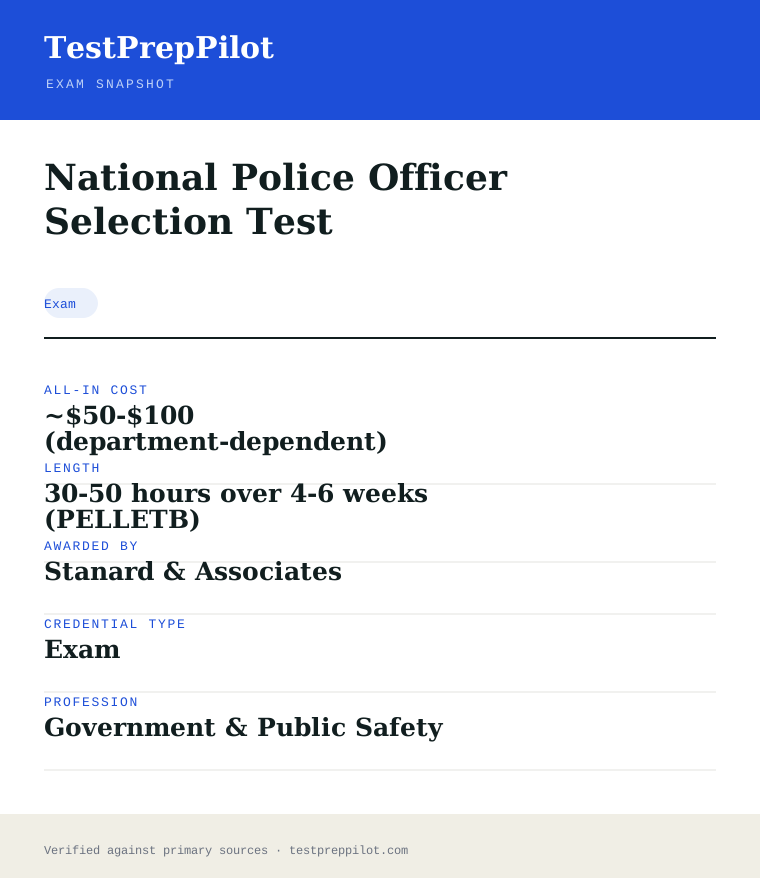
National Police Officer Selection Test is a exam credential; awarded by Stanard & Associates; the exam fee is Department-dependent; typical preparation is 30-50 hours over 4-6 weeks (PELLETB); holders typically earn $55,000-$95,000 (33-3051 median $76,290).
| Credential | National Police Officer Selection Test |
|---|---|
| Abbreviation | POST |
| Type | Exam |
| Profession | Government & Public Safety |
| Specialty | Law Enforcement Entrance |
| Awarded by | Stanard & Associates |
| Difficulty | Specialized |
| Typical prep time | 30-50 hours over 4-6 weeks (PELLETB) |
| All-in cost | ~$50-$100 (department-dependent) |
| Typical salary range | $55,000-$95,000 (33-3051 median $76,290) |
| Credential | National Police Officer Selection Test |
| Awarding body | Stanard & Associates |
| Exam format | Proctored, computer-based |
| Validity | Score validity varies by agency (commonly 6-24 months) |
| Languages | Varies — see awarding body |
| Scope | National / Multi-state |
| Also known as | POST, Police Officer Selection Test |
Real questions
Frequently asked questions about the National Police Officer Selection Test
How do I register for the National Police Officer Selection Test exam?
Register through Stanard & Associates's official portal or an authorized test provider (e.g., Pearson VUE or Prometric where applicable). Create an account, select the exam, pay the fee, and schedule a date.
How much does the exam cost?
Fees vary by location and currency. Confirm the current fee on the official registration page before scheduling.
How long is the credential valid, and how do I renew?
Validity varies by credential (commonly 2–3 years). Renewal usually requires continuing education or a recertification exam — see Stanard & Associates's policy.
What if I do not pass?
Most bodies allow retakes after a waiting period and payment of the full or partial fee. Check Stanard & Associates's retake policy before rescheduling.
How do I register for a Stanard & Associates credential?
Register through the official website, select your exam, pay the fee, and schedule a date.
How do I renew a credential?
Renewal policies vary by credential; check the specific program page for requirements and cycles.
In short
Is the National Police Officer Selection Test worth it?
- National Police Officer Selection Test is awarded by Stanard & Associates.
- Validates job-ready competence in Public Safety.
- Registration is through the awarding body or an authorized test provider.
- Renewal and retake policies vary — confirm before scheduling.
Trust
Where does this information come from?
Everything above is taken from the awarding body's own published material. Fees, question counts and domain weights are revised regularly — check the official page before you pay.
Research confidence: low · Last reviewed 2026-08