Finance & Securities • Exam
Series 24 General Securities Principal Exam
Series 24 General Securities Principal Exam — Finance & Securities credential from Financial Industry Regulatory Authority (FINRA)
Researched and maintained by TestPrepPilot Editorial BoardFINRA licensing & securities supervision desk · Figures last verified August 2026
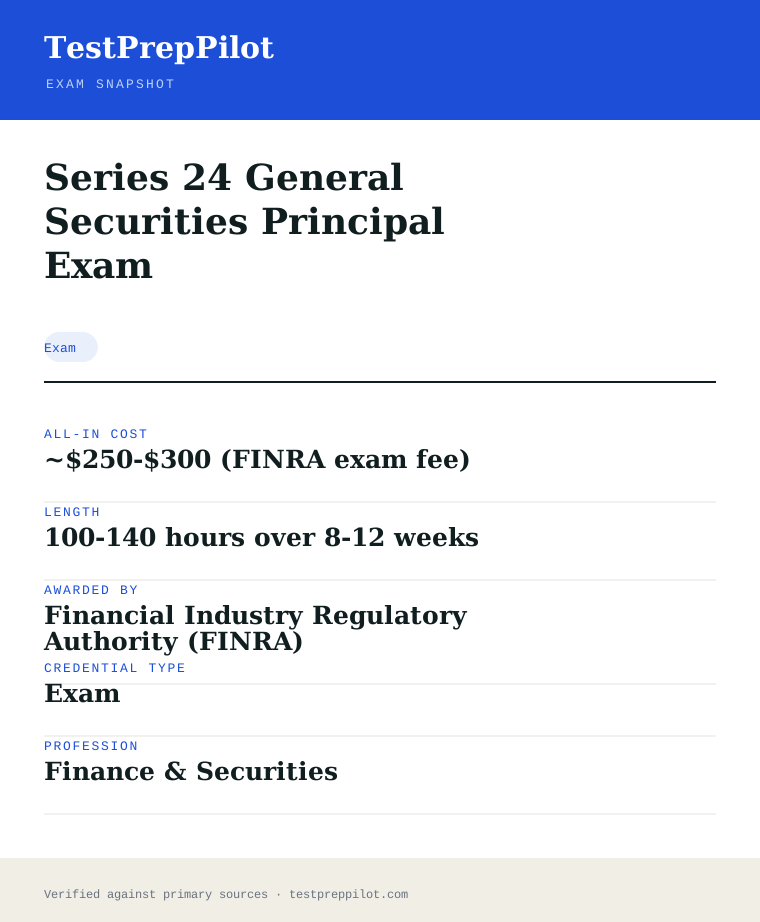
The short version
What is the Series 24 General Securities Principal Exam and is it worth it?
Series 24 General Securities Principal Exam is a professional credential administered by Financial Industry Regulatory Authority (FINRA). It validates job-ready knowledge and skills in the Finance & Securities field and is used for career entry, advancement, or compliance.
- Recognized credential from Financial Industry Regulatory Authority (FINRA)
- Demonstrates verified competence in Finance & Securities
- Supports career advancement and may satisfy licensing or employer requirements
What is it?
What exactly is the Series 24 General Securities Principal Exam?
Series 24 General Securities Principal Exam — Finance & Securities credential from Financial Industry Regulatory Authority (FINRA)
Permits supervision of branch activities, underwriting, trading, market making and advertising at a general securities broker-dealer. Offered by Financial Industry Regulatory Authority (FINRA), it is designed for candidates who need to demonstrate verified competence in the Finance & Securities field. The credential is commonly used for career entry, advancement, regulatory compliance, or employer requirements. Candidates should review the official handbook for eligibility, exam format, and scoring before registering.
The path in brief
- Confirm you meet any eligibility or prerequisites
- Review the official handbook and study materials
- Register and pay through the awarding body or authorized provider
- Schedule and take the exam (test center or online proctoring)
- Receive your score and, if passed, your credential
Before you book
Who is eligible to sit the Series 24 General Securities Principal Exam?
Eligibility varies; many credentials are open to all, while others require coursework, work experience, or sponsorship.
Who it is for: Professionals and candidates seeking to validate Finance & Securities competence.
The test itself
What is the format of the Series 24 General Securities Principal Exam?
The Series 24 General Securities Principal Exam is administered by Financial Industry Regulatory Authority (FINRA) and runs 3h45m and contains 150 questions.
| Administered by | Financial Industry Regulatory Authority (FINRA) |
|---|---|
| Questions | 150 questions |
| Time limit | 3h45m |
| Pass mark | Passing score set by the awarding body; see the official score report |
| Exam fee | ~$250-$300 |
| Format | Proctored, computer-based (test center or online remote proctoring) |
Content outline
What topics are on the Series 24 General Securities Principal Exam?
The Series 24 General Securities Principal Exam covers 4 content domains.
Weightings come from the official exam outline. Study time is best allocated in roughly these proportions rather than evenly across domains.
- Markets & products
Topic area tested on the exam; see the official blueprint for the detailed breakdown.
- Regulation & ethics
Topic area tested on the exam; see the official blueprint for the detailed breakdown.
- Analysis & valuation
Topic area tested on the exam; see the official blueprint for the detailed breakdown.
- Client & risk management
Topic area tested on the exam; see the official blueprint for the detailed breakdown.
Study materials
Which study guide should you use for the Series 24 General Securities Principal Exam?
Start with the exam sponsor's official content outline. If you also want one structured resource to work through, these are the Mometrix titles that match this exam.

Affiliate links We may earn a commission if you buy through these links, at no extra cost to you. Mometrix has no say in what our exam guides cover. How we make money.
The path
How do you register for the Series 24 General Securities Principal Exam?
- 1
Visit the awarding body’s official website and create an account
- 2
Select the credential and review its specific requirements
- 3
Complete any required eligibility (education, experience, or training)
- 4
Pay the registration fee
- 5
Schedule the exam at a test center or online
- 6
Take the exam and receive your results
The fine print
What are the retake and renewal rules for the Series 24 General Securities Principal Exam?
- Proctoring & delivery
- Proctored, computer-based delivery (test center or remote online proctoring), varying by exam.
- Retake policy
- Varies by credential — most bodies permit retakes after a waiting period and full or partial fee.
- Score reporting
- Scores are reported per the body’s timeline, typically electronically after the exam.
- Recertification
- Varies; many credentials require renewal every 2–3 years via continuing education or a recertification exam.
What it pays
How much does this credential pay?
$78,140 median for securities, commodities, and financial services sales agents (BLS, May 2024) — and the Series 24 is what moves you off the sales lane and onto the supervision lane
The direct answer is that there is no BLS occupation called “general securities principal” — the closest official series is Securities, Commodities, and Financial Services Sales Agents (SOC 41-3031), which earned a May 2024 median of $78,140, with the lowest 10 percent below $47,080 and the highest 10 percent above $215,210. That spread is the point for a Series 24 candidate: this occupation has one of the widest wage distributions in the handbook because it mixes commissioned retail brokers with investment bankers whose compensation is dominated by bonuses, and the Series 24 credential is precisely the mechanism by which an experienced representative leaves the commission-only lane and moves into branch management and principal supervision, where base salary plus firm bonus replaces per-trade commissions. BLS counts 514,500 jobs in the occupation as of 2024, projects 3 percent employment growth from 2024 to 2034, and projects about 38,100 openings per year, almost all from replacement need. The career logic of the license is straightforward and worth stating plainly: a Series 7-licensed representative earns on production, while a Series 24-licensed principal earns on the supervisory responsibilities of the role — overseeing the branch, approving communications, supervising trading and accounts — and principals are typically on a base-plus-bonus structure that trades the volatility of commissions for a higher guaranteed floor. The exam is not the reason to change lanes, but it is the gate to changing lanes, and the wage data supports the framing that the median is a sales figure while the supervision lane this license unlocks sits at the upper end of the distribution.
| Measure | Figure | Source / note |
|---|---|---|
| Median annual wage, securities, commodities, and financial services sales agents | $78,140 | BLS OOH, SOC 41-3031, May 2024 ($37.57/hr) |
| Lowest 10 percent | less than $47,080 | BLS OOH Pay tab, May 2024 |
| Highest 10 percent | more than $215,210 | BLS OOH Pay tab, May 2024 |
| Employment, 2024 | 514,500 jobs | BLS OOH Quick Facts, 2024 |
| Projected annual openings | ~38,100 per year | BLS OOH Job Outlook, 2024-34 |
Job growth.3% projected change 2024-34 (about as fast as average); almost all of the ~38,100 annual openings come from replacement need as registered representatives leave or retire
Source: BLS Occupational Outlook Handbook — Securities, Commodities, and Financial Services Sales Agents
Your odds
What are the pass rates?
FINRA publishes no pass rate — it publishes the passing score (70%) and the mechanics that matter: 150 scored questions, 3 hours 45 minutes, closed-book
FINRA does not publish pass-rate statistics for the Series 24, and neither does any independent body with reliable data — the “~70 percent pass rate” figures that circulate in prep materials are industry estimates, not FINRA data, and should be treated as such. What FINRA does publish is the scoring standard and the exam mechanics, and both are more useful than a pass rate. The Series 24 exam consists of 150 scored multiple-choice questions plus 10 additional unscored pretest items distributed randomly, for a total of 160 items you will see; you have 3 hours and 45 minutes, and the passing score is 70 percent, computed by FINRA’s standard-setting process and equated across exam forms so that a harder set of items demands the same underlying ability as an easier one. Scores are rounded down to the next lowest whole number, so a 69.9 percent result is a 69 and a fail — a detail that matters when candidates talk about their practice-test percentages. There is no penalty for guessing, and FINRA’s outline explicitly instructs candidates to attempt every item. The exam is closed-book, administered on computer at a testing centre, and you must be enrolled by a sponsoring FINRA member firm before you can sit it at all. The retake policy is equally concrete: a 30-day waiting period after a first or second failure, extending to six months after a third failure, with the exam fee paid each time. Understanding the 70 percent cut in the context of the exam’s breadth is the practical point: this is a supervision exam, not a product exam, and the items reward identifying the correct supervisory duty, approval or escalation step across many business lines rather than recalling product details.
Read this before quoting the number.FINRA publishes no pass-rate data. Published facts are the 70% passing score (rounded down to the nearest whole percent), the 150 scored plus 10 unscored item structure, the 3h45m time limit, and the 30-day / 6-month retake schedule. Any pass-rate percentage is an industry estimate, not official data.
Source: FINRA — Series 24 General Securities Principal Qualification Exam Content Outline
Your schedule
How long should I study for it?
100-160 hours over 8-12 weeks of focused study
Plan for 8 to 12 weeks and 100 to 160 hours of study, which is the consensus range for candidates studying while working full time, and the honest warning up front: this is not the Series 7 revisited. The Series 24 is a supervision exam — 150 scored questions in 3 hours 45 minutes at a 70 percent passing score — and it tests whether you can act as a general securities principal across the broker-dealer, not whether you can recall product features, so the study plan has to be organised around job functions, not products. The exam outline organises the paper into functions covering supervision of registration and personnel, general broker-dealer activities, customer accounts and sales practices, trading and market making, and investment banking and research, and the plan below follows those functions. Weeks 1-3 build the regulatory base: FINRA rules, the Securities Exchange Act of 1934, the Investment Advisers Act, forms (BD, BR, U4, U5), and the rule numbers a principal must know — and this is the phase where candidates either develop a system for retaining rule numbers or drown in them. Weeks 4-6 cover the highest-weight supervisory content: supervision of general broker-dealer activities, customer accounts, and sales practices, including written supervisory procedures, internal inspections, communications with the public, and the approval and escalation steps that make up most exam scenarios. Weeks 7-8 cover trading and market making supervision and investment banking and research supervision. Weeks 9-10 are timed practice and gap closing: full 3h45m exams, scored against the 70 percent line, with every miss re-labelled to its function. The pacing rule is roughly 1.5 minutes per scored question, and the realistic exam behaviour is that most candidates run out of time on scenario items that describe a supervisory failure and ask what a principal must do, approve or document next.
- Weeks 1-312-14 hrs/week
Regulatory foundation and rule system
- Learn the FINRA rule architecture and the securities laws the outline cites
- Memorise the key forms: BD, BR, U4, U5, and who files what
- Build a flashcard system for rule numbers and the entity each one governs
- Weeks 4-614-16 hrs/week
General supervision and sales practices
- Master written supervisory procedures, internal inspections and OSJ supervision
- Learn communications-with-the-public rules and the approval chain for retail communications
- Drill customer account supervision: suitability, discretionary authority, complaints, free credit balances
- Weeks 7-812-14 hrs/week
Trading, market making, investment banking and research
- Study supervision of trading and market-making activities, including books and records
- Cover investment banking supervision: underwriting, private offerings, conflicts
- Learn research supervision and the approval steps for research reports
- Week 912-14 hrs
Full-length timed exams
- Take two full 3h45m practice exams and score them against the 70% line
- Re-label every miss back to its supervisory function
- Identify the function blocks that drag your score below 70
- Week 1010-12 hrs
Gap closing and rule review
- Drill the weak functions identified in Week 9, especially approval and escalation scenarios
- Final pass over rule numbers, forms, and the 30-day/6-month retake policy
- One quiet day before the exam
Adjusting the pace
Series 7 holder moving to management.Eight weeks at 12-14 hrs/week. Your product knowledge transfers; what is new is thinking as a supervisor — who approves, what must be reviewed, what gets documented and escalated. Spend the recovered time on supervision scenarios rather than product review.
No prior supervision exposure.Twelve to fourteen weeks. Add two weeks of rule-foundation work before the supervision content, because the exam assumes familiarity with supervisory situations and punishes candidates who answer like a representative.
Intensive, sponsored full-time study.Five to six weeks at 25-30 hrs/week. Compress the rule phase and front-load the supervision functions, but preserve at least three full timed exams in the final ten days — pacing under the 3h45m clock is half the battle.
How to study
How do I prepare most effectively?
The strategy that reliably passes the Series 24 is “think like a principal, not like a representative,” because the exam’s scenario items are built around the supervisory duty — who must approve, what must be reviewed, what must be documented, what must be escalated — and candidates who answer with a product or transaction reflex drop the same points every sitting. The single biggest error is treating the Series 24 as a bigger Series 7 and memorising product details; the exam outline is organised by supervisory functions and the items reward regulatory application, not recall. A second proven approach is to build a rule-number system early and maintain it through the plan, because the exam tests whether you can match a situation to the governing rule and the correct next step, and raw recall of rule numbers is the substrate. Third, rehearse the scenario format deliberately: write out, for a sample of scenarios, the sequence a principal follows — confirm the supervisory obligation, identify the required approval or review step, determine the documentation, and decide whether escalation is required — because this exact sequence is what most items reward. Fourth, use full-length timed exams as the calibration tool: the 3h45m clock with 150 scored questions is a real endurance constraint, and practice scores against the 70 percent line are the only honest readiness signal. Finally, know the rounding rule cold: scores are rounded down to the nearest whole percent, so a 69.9 practice score is a fail in spirit, and candidates should train to sit comfortably above 70, not at it.
Answer as a principal, not a representative
The strongest answer is rarely the one describing a product; it is the one identifying who must approve something, what must be reviewed, what must be documented, and what must be escalated. Practise converting scenario stems into that supervisory checklist before reading the answer choices.
Build a rule-number system in week one
The exam tests the interaction of FINRA rules, the Exchange Act, and the Advisers Act. Create a card deck organised by function — registration, supervision, communications, trading, research — and maintain it through the plan rather than cramming rule numbers in the final week.
Rehearse the supervisory decision sequence
For every scenario you practise, write the principal’s required sequence: the obligation, the approval step, the documentation, the escalation trigger. This single habit converts the exam’s hardest item type into a repeatable process.
Train above the 70% line, not to it
Scores round down to the nearest whole percent, so 69.9 is a fail. Aim for 75-80% on practice exams to build the margin that survives the equated, harder real forms.
Run full-length timed exams
150 scored questions in 3h45m is an endurance test and a pacing test. Take at least three full timed exams in the final three weeks; untimed practice does not prepare you for the clock.
Learn the retake rules before you need them
Thirty days after a first or second failure, six months after the third. Firms and timelines are involved, so knowing the schedule shapes whether you study hard the first time or plan the calendar around a resit.
What to buy
Which study resources are worth paying for?
Series 24 preparation is dominated by the commercial exam-prep industry — FINRA itself publishes only the content outline and sample items, which are free and genuinely useful — and the buying decision is between a structured course, a question bank, or both. The consensus of candidates and providers is that this exam rewards continuous testing with answer-rationable review, so the question-bank and simulator products matter more than they do on recall-heavy exams. Pricing below is indicative and current to this review; the biggest real costs for most candidates are the exam fee and the study hours, not the materials.
| Resource | Price | Format | Best for |
|---|---|---|---|
| FINRA Series 24 content outline | Free | Official PDF — functions, item counts, passing score | The authoritative syllabus; start here |
| Exam registration via sponsoring firm | ~$120-255 (typically covered by the firm) | Computer-based at a testing centre | The exam itself — you must be enrolled by a FINRA member firm |
| Prep courses (Pass Perfect, Kaplan, STC, Solomon) | ~$300-600 depending on package | Online course, books and practice exams | Structured study for candidates who want a guided path |
| Question banks and exam simulators | ~$100-300 or bundled with a course | Online timed simulations scored to the 70% line | The highest-yield purchase — rehearsal of scenario items under the 3h45m clock |
| Self-built rule flashcard deck | Free | Your own cards organised by supervisory function | Retaining rule numbers and matching situations to rules |
Prices indicative and dated to this review; course bundles change frequently and the exam fee varies by program year. We do not rank by commission.
Avoid these
What mistakes do candidates most often make?
The most common Series 24 mistakes all stem from treating a supervision exam like a product exam: answering as a representative instead of a principal, memorising product features instead of the supervisory duty, and under-rehearsing the scenario format that dominates the paper. The other recurring errors are process failures — ignoring the rounding-to-the-nearest-whole-percent rule, training to 70 percent instead of above it, and skipping full-length timed exams so the 3h45m clock and the 160-item stamina catch you by surprise on the day.
✕Answering as a representative instead of a principal
✓Representative-level answers focus on the product or the transaction; principal-level answers focus on supervision, approvals, red flags, exception handling and documented follow-up. Rehearse converting every scenario into the supervisory checklist before reading the choices.
✕Studying product details instead of supervisory duties
✓The outline is organised by job functions — registration and personnel, general broker-dealer activities, customer accounts, trading, investment banking, research. Study the duty each scenario imposes, not the product it mentions.
✕Training to 70% instead of above it
✓Scores round down to the nearest whole percent and forms are equated, so a 69.9 is a fail and a harder real form can cost you margin. Train to 75-80% on practice exams.
✕Skipping full-length timed practice
✓150 scored questions in 3h45m, plus 10 unscored items you cannot identify, is a real endurance test. Take at least three full timed exams in the final weeks.
✕Ignoring the retake and sponsorship mechanics
✓You must be sponsored and enrolled by a FINRA member firm, and failures trigger a 30-day wait (6 months after the third). Confirm the enrollment window and the 120-day scheduling window early so the mechanics do not force a rushed sitting.
✕Treating practice-test percentage as the real cut
✓The exam is equated and the passing score is 70% of the scored items on your specific form. Re-label every practice miss back to its supervisory function so you are closing gaps, not chasing a number.
What you'll face
What question types will I see?
The Series 24 exam is 150 scored multiple-choice questions plus 10 unscored pretest items, completed in 3 hours 45 minutes on computer at a testing centre, with a 70 percent passing score and no penalty for guessing. Every item is four-option multiple choice, and the paper is organised by supervisory job functions rather than by product lines, so the item style is dominated by scenario questions: a supervisory situation is described — a failed inspection, a communications approval, a customer-account red flag, a trading practice — and you must identify the correct principal-level response, meaning the required approval, review, documentation or escalation. FINRA’s outline describes the item structures used across its exams, including the closed-stem format (a question with four answers), the open-stem format (an incomplete sentence with four conclusions), and “except” or “not” format questions that require the option that is incorrect or outside the obligation. Because the passing score is 70 percent and there is no penalty for guessing, the pacing rule is approximately 1.5 minutes per scored question and the strategy is to answer everything. The samples below are editor-written illustrations of the published item styles and supervisory content, not live exam items.
A supervisory situation and a question: what must the principal approve, review, document or escalate. Distractors are usually correct-sounding steps that are out of order or out of the principal’s obligation.
An incomplete sentence followed by four conclusions, e.g. “To use customer free credit balances, a firm must …” Rewards knowing the exact regulatory requirement.
The stem asks which option the principal is NOT required to do, or which is the exception. These punish candidates who pattern-match to remembered lists without reading the qualifier.
The stem specifies how many answers to select and scoring is all-or-nothing, common where several supervisory steps together complete a required process.
Try these
Q1A registered principal is conducting the firm’s annual internal inspection of an Office of Supervisory Jurisdiction. Which of the following is the principal NOT required to do as part of the review?
Answer:D
Communications are reviewed as they are developed or used, not blanket-approved for a coming year during the annual inspection — the inspection’s required elements are account-record review, safeguarding-policy testing and supervision evaluation, which are exactly A, B and C. D invents a forward-looking approval obligation that FINRA’s inspection rules do not impose, which is why it is the correct answer to a “NOT required” question. The item tests knowing the precise content of the inspection obligation rather than general supervision duties.
Q2A firm’s supervisor discovers that a registered representative has been borrowing money from a customer. Under FINRA rules, which action must the supervisor take first?
Answer:B
Borrowing from a customer is a red-flag activity that must be evaluated against the firm’s written supervisory procedures and the rules governing private securities transactions and outside business activities; the principal’s obligation is to review, determine the applicable rule, and escalate or act per the firm’s procedures. A wrongly treats a customer loan as approvable as a private transaction — borrowing from customers is prohibited by firm policy and rule in virtually all cases, and approval is not a fix. C ignores a known red flag. D skips the required review; termination may be appropriate after the review but is not the mandated first step.
Q3A branch office manager learns that a subordinate registered representative sold an unsuitable product to a customer. Which documentation step best reflects the supervisory standard the manager is held to?
Answer:B
Supervisory standards require that reviews and corrective actions be documented, and that documentation follows the firm’s written supervisory procedures; a principal who discovers unsuitability must show the review and the response were performed and recorded. A provides no record and fails the documentation obligation. C documents only an external event and misses the internal review that the principal is obligated to perform. D addresses the customer but not the internal supervisory follow-through. The item rewards the full documentation sequence, not a single action.
Samples are editor-written illustrations of the published item styles and supervisory content; they are not live exam items.
The big day
What should I expect on exam day?
The Series 24 is delivered on computer at a testing centre — there is no at-home option — and the day is governed by two facts that shape everything else: you must already be enrolled by your sponsoring FINRA member firm, and you will sit 160 items (150 scored plus 10 unscored) in 3 hours 45 minutes at a 70 percent passing standard. Arrive at least 30 minutes early; testing-centre security is stringent, with ID verification, a palm-vein or other biometric check depending on the centre, and a full ban on personal items — no phone, no watch, no paper, no calculator of your own. The centre provides an erasable noteboard, dry-erase markers and a basic electronic calculator, and you must return them at the end of the session. The exam is closed-book and reference materials are prohibited; there is no scheduled break, and leaving the room does not stop the clock. Pacing is the exam’s real opponent: 150 scored questions across 3 hours 45 minutes is about 1.5 minutes per item, and the scenario items describing a supervisory failure take the longest, so the practical plan is to answer every item, flag the slow ones, and return to them only if time allows — there is no penalty for guessing, so an empty answer is the only unforgivable outcome. FINRA does not release results on the spot; scores are reported after FINRA processes the form, and your firm and registration records reflect the outcome through the CRD system once it posts.
Bring
- Two valid, unexpired forms of ID, one government-issued photo ID, with the name matching your registration exactly
- Your FINRA enrollment confirmation and any centre-specific check-in reference
- Nothing else — phones, watches, bags and notes go in the locker
Leave at home
- Phones, smartwatches, fitness trackers and earbuds — prohibited and locked away
- All notes, cheat sheets and reference material — the exam is closed-book
- Your own pens, pencils, paper and calculators — the centre provides an erasable noteboard, markers and a basic calculator
- Bags, coats, hats, food and drink
- Any item that could be construed as recording or transmitting the exam
How the day runs
Rules in the room
- You must be enrolled by a sponsoring FINRA member firm before you can sit the exam.
- 160 total items — 150 scored and 10 unscored pretest items you cannot identify.
- 3 hours 45 minutes, no scheduled break, and the clock does not stop if you leave.
- 70% passing score, with scores rounded down to the nearest whole percent.
- No penalty for guessing — answer every item.
- Closed-book, computer-based, at a testing centre; no at-home option.
- The centre provides the noteboard, markers and basic calculator; your own items are prohibited.
- Results are reported after FINRA processes the form — not on screen at the end of the session.
Afterwards.Results are reported after FINRA processes your exam form rather than instantly on screen, and the outcome flows through to your firm and your Central Registration Depository (CRD) records; your firm is the first place to see the formal result, and it is the firm that manages what happens next, including any required continuing education under the regulatory element schedule. On a pass, the Series 24 combines with your SIE and representative-level qualifications to confer the General Securities Principal registration, and that registration carries ongoing obligations: firm-element and regulatory-element continuing education, and the supervisory responsibilities the exam tests, which are now yours in practice. On a fail, the retake schedule is the governing fact — a 30-day wait after the first or second failure and a six-month wait after the third, with the fee each time — and the correct response is to use the window deliberately: re-label the practice misses you accumulated back to their supervisory functions and drill the scenario-answer sequence, because candidates who fail this exam usually fail on the scenario format and on answering like a representative rather than a principal, and both are fixable habits rather than knowledge deficits. Because the exam is equated, your next form will be different but calibrated to the same standard, so the preparation that works for a retake is the same preparation that works the first time: function-organised study, full-length timed rehearsals, and a practice average comfortably above 70 percent.
Reference
What are the key facts about the Series 24 General Securities Principal Exam?
Series 24 General Securities Principal Exam is a exam credential; awarded by Financial Industry Regulatory Authority (FINRA); the exam fee is ~$250-$300; typical preparation is 100-140 hours over 8-12 weeks; holders typically earn $55,000-$120,000 (41-3031 median $78,140).
| Credential | Series 24 General Securities Principal Exam |
|---|---|
| Abbreviation | Series 24 |
| Type | Exam |
| Profession | Finance & Securities |
| Specialty | FINRA & Securities Licensing |
| Awarded by | Financial Industry Regulatory Authority (FINRA) |
| Difficulty | Regulated |
| Typical prep time | 100-140 hours over 8-12 weeks |
| All-in cost | ~$250-$300 (FINRA exam fee) |
| Typical salary range | $55,000-$120,000 (41-3031 median $78,140) |
| Credential | Series 24 General Securities Principal Exam |
| Awarding body | Financial Industry Regulatory Authority (FINRA) |
| Exam format | Proctored, computer-based |
| Validity | Registration maintained by the sponsoring firm |
| Languages | Varies — see awarding body |
| Scope | National / Multi-state |
Real questions
Frequently asked questions about the Series 24 General Securities Principal Exam
How do I register for the Series 24 General Securities Principal Exam exam?
Register through Financial Industry Regulatory Authority (FINRA)'s official portal or an authorized test provider (e.g., Pearson VUE or Prometric where applicable). Create an account, select the exam, pay the fee, and schedule a date.
How much does the exam cost?
Fees vary by location and currency. Confirm the current fee on the official registration page before scheduling.
How long is the credential valid, and how do I renew?
Validity varies by credential (commonly 2–3 years). Renewal usually requires continuing education or a recertification exam — see Financial Industry Regulatory Authority (FINRA)'s policy.
What if I do not pass?
Most bodies allow retakes after a waiting period and payment of the full or partial fee. Check Financial Industry Regulatory Authority (FINRA)'s retake policy before rescheduling.
How do I register for a Financial Industry Regulatory Authority (FINRA) credential?
Register through the official website, select your exam, pay the fee, and schedule a date.
How do I renew a credential?
Renewal policies vary by credential; check the specific program page for requirements and cycles.
In short
Is the Series 24 General Securities Principal Exam worth it?
- Series 24 General Securities Principal Exam is awarded by Financial Industry Regulatory Authority (FINRA).
- Validates job-ready competence in Finance & Securities.
- Registration is through the awarding body or an authorized test provider.
- Renewal and retake policies vary — confirm before scheduling.
Same awarding body
What other credentials does Financial Industry Regulatory Authority (FINRA) award?
Worth comparing
How does the Series 24 General Securities Principal Exam compare with similar credentials?
Trust
Where does this information come from?
Everything above is taken from the awarding body's own published material. Fees, question counts and domain weights are revised regularly — check the official page before you pay.
Research confidence: medium · Last reviewed 2026-08