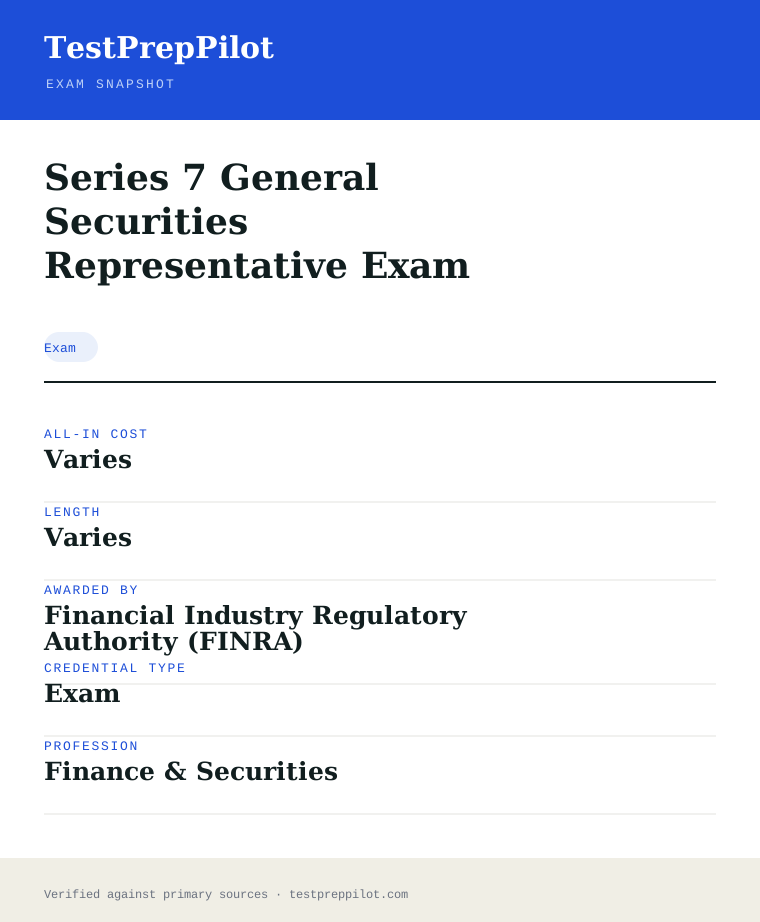
The short version
What is the Series 7 General Securities Representative Exam and is it worth it?
Series 7 General Securities Representative Exam is a professional credential administered by Financial Industry Regulatory Authority (FINRA). It validates job-ready knowledge and skills in the Finance & Securities field and is used for career entry, advancement, or compliance.
- Recognized credential from Financial Industry Regulatory Authority (FINRA)
- Demonstrates verified competence in Finance & Securities
- Supports career advancement and may satisfy licensing or employer requirements
What is it?
What exactly is the Series 7 General Securities Representative Exam?
Series 7 General Securities Representative Exam — Finance & Securities credential from Financial Industry Regulatory Authority (FINRA)
The general securities licence permitting sale of equities, bonds, options, packaged products and municipal securities to customers. Offered by Financial Industry Regulatory Authority (FINRA), it is designed for candidates who need to demonstrate verified competence in the Finance & Securities field. The credential is commonly used for career entry, advancement, regulatory compliance, or employer requirements. Candidates should review the official handbook for eligibility, exam format, and scoring before registering.
The path in brief
- Confirm you meet any eligibility or prerequisites
- Review the official handbook and study materials
- Register and pay through the awarding body or authorized provider
- Schedule and take the exam (test center or online proctoring)
- Receive your score and, if passed, your credential
Before you book
Who is eligible to sit the Series 7 General Securities Representative Exam?
Eligibility varies; many credentials are open to all, while others require coursework, work experience, or sponsorship.
Who it is for: Professionals and candidates seeking to validate Finance & Securities competence.
The test itself
What is the format of the Series 7 General Securities Representative Exam?
The Series 7 General Securities Representative Exam is administered by Financial Industry Regulatory Authority (FINRA) and runs 225 minutes (3 hours 45 minutes) and contains 130 (125 scored + 5 unscored pretest items) questions.
| Administered by | Financial Industry Regulatory Authority (FINRA) |
|---|---|
| Questions | 130 (125 scored + 5 unscored pretest items) |
| Time limit | 225 minutes (3 hours 45 minutes) |
| Pass mark | Passing score set by the awarding body; see the official score report |
| Exam fee | ~$395 |
| Format | Proctored, computer-based (test center or online remote proctoring) |
Content outline
What topics are on the Series 7 General Securities Representative Exam?
The Series 7 General Securities Representative Exam covers 4 content domains.
Weightings come from the official exam outline. Study time is best allocated in roughly these proportions rather than evenly across domains.
- Markets & products
Topic area tested on the exam; see the official blueprint for the detailed breakdown.
- Regulation & ethics
Topic area tested on the exam; see the official blueprint for the detailed breakdown.
- Analysis & valuation
Topic area tested on the exam; see the official blueprint for the detailed breakdown.
- Client & risk management
Topic area tested on the exam; see the official blueprint for the detailed breakdown.
The path
How do you register for the Series 7 General Securities Representative Exam?
- 1
Visit the awarding body’s official website and create an account
- 2
Select the credential and review its specific requirements
- 3
Complete any required eligibility (education, experience, or training)
- 4
Pay the registration fee
- 5
Schedule the exam at a test center or online
- 6
Take the exam and receive your results
The fine print
What are the retake and renewal rules for the Series 7 General Securities Representative Exam?
- Proctoring & delivery
- Proctored, computer-based delivery (test center or remote online proctoring), varying by exam.
- Retake policy
- Varies by credential — most bodies permit retakes after a waiting period and full or partial fee.
- Score reporting
- Scores are reported per the body’s timeline, typically electronically after the exam.
- Recertification
- Varies; many credentials require renewal every 2–3 years via continuing education or a recertification exam.
What it pays
How much does this credential pay?
$78,140 median for securities, commodities and financial services sales agents (BLS, May 2024)
There is no Bureau of Labor Statistics occupation called "Series 7 representative", and anyone quoting such a figure is quoting a job-board aggregate rather than government data. The closest official BLS occupation to a Series 7 General Securities Representative is Securities, Commodities, and Financial Services Sales Agents, and we have chosen it deliberately because the Series 7 is the licence that lets a sponsored individual solicit and handle retail brokerage business for a FINRA member firm — that is sales-agent work. That occupation had a May 2024 median of $78,140, with 514,500 jobs in 2024 and a projected 3 percent growth from 2024 to 2034, about as fast as the average for all occupations; BLS expects roughly 38,100 openings a year, almost all from replacement need. Read the median carefully. Total cash compensation for a producing registered rep is heavily commission- and bonus-driven, so the BLS wage base understates the top of the field, and the distribution is wide: a rep who builds a book and moves into fee-based or advisory work pulls away from the median quickly. For that reason we also show the Financial and Investment Analysts series (SOC 13-2051), because many Series 7 holders settle into research, trading-support or advisory roles where the May 2024 median is $101,350. The honest framing is that the Series 7 is a licence gate, not the job itself: it is what makes the BLS sales-agent (or analyst) wage accessible at a member firm, and it expires the moment you leave the industry, so the wage you are benchmarking is the role, earned only while the licence is active and sponsored.
| Measure | Figure | Source / note |
|---|---|---|
| Median annual wage, securities/commodities/financial-services sales agents | $78,140 | BLS Occupational Outlook Handbook, May 2024 ($37.57/hr) |
| Employment, 2024 | 514,500 jobs | BLS OOH Quick Facts, 2024 |
| Projected annual openings | ~38,100 per year | BLS OOH Job Outlook, 2024-34 — mostly replacement |
| Median, financial and investment analysts (a common adjacent role) | $101,350 | BLS OOH Financial Analysts, SOC 13-2051, May 2024 |
Job growth.3% projected change 2024-34 (about as fast as average); ~38,100 replacement openings a year. The licence only pays while sponsored and active, so benchmark the role, not the exam.
Source: BLS Occupational Outlook Handbook — Securities, Commodities, and Financial Services Sales Agents
Your odds
What are the pass rates?
FINRA publishes no pass rate — but it does publish the passing score: 72% (90 of 125 scored items)
FINRA does not release pass-rate statistics for the Series 7 or for any of its qualification exams, and it never has. Unlike some vendors that publish a first-time rate, FINRA treats that as firm- and candidate-specific and keeps it internal, so any percentage you see circulating online is an estimate, not a published figure, and we will not repeat one. What FINRA does publish is the cut score, and that is more useful than a rumoured rate. The Series 7 is 125 scored questions (plus 5 unscored pretest items, for 130 delivered) and you need 72 percent of the scored items — 90 correct — to pass. The 72 percent is not "get 72 percent on your practice bank" in a clean sense, because the 5 unscored pretest questions are mixed in and do not count, so a 90/125 raw score is what matters; on a full 130-question form, 90 is about 69 percent, which is why candidates who aim for "72 percent of everything" are slightly off. Two policies matter more than a rate. First, eligibility: you cannot sit the Series 7 without a FINRA member firm sponsoring you through Form U4, and the SIE is a co-requisite — you must pass the SIE (or hold a comparable qualification) to earn the Series 7. Second, retakes: under FINRA Rule 1210.06, after a first or second failure you wait 30 calendar days before the next attempt, and after a third or subsequent failure within two years you wait 180 days. FINRA has proposed shortening the wait for its own exams, but the operative rule as of this review is still 30/180, and you are re-paying the full $395 each time, so a failed first attempt is expensive.
Read this before quoting the number.No pass rate is published by FINRA, by Prometric, or by any accrediting body for the Series 7. We have deliberately left the pass-rate table empty. What is published and verifiable is the 72% cut score (90 of 125 scored), the eligibility/sponsorship rule, and the 30/180 retake schedule, which the narrative above covers instead.
Your schedule
How long should I study for it?
80-160 hours of focused study
The single fact that reshapes how you should study for the Series 7 is the weighting: of the 125 scored questions, 73 percent fall in Function 3 — Opens, Transfers, and Closes Accounts; Processes, Maintains, and Services Customer Accounts. Most candidates come from a products, options or sales background and over-invest in Function 1 (Seeks Business, 7 percent) and Function 4 (Solicits, Reviews and Places Orders, 11 percent), then get surprised that the exam is really an operations-and-account-maintenance test. Function 2 (Evaluates Customers' Financial Profiles and Investment Objectives, 9 percent) feeds directly into the suitability questions that sit inside Function 3, so the practical split is roughly: 90 questions on accounts, suitability and servicing, and 35 on business development and order handling combined. The plan below runs ten weeks at 8-16 hours a week and assumes you are studying while sponsored, because you cannot schedule the exam otherwise. If you are not yet sponsored by a member firm, the first task is not studying — it is getting hired or affiliated, since the Form U4 is what opens your 120-day exam window. Validate your knowledge against the four published functions, not against a question bank's topic tags, because banks vary in how they bucket the operations content.
- Week 18-10 hrs
Eligibility, SIE co-requisite, and the exam framework
- Confirm your firm has filed Form U4 and that your SIE is passed or scheduled — the Series 7 will not be awarded without both
- Memorise the four functions and their weights: F1 7%, F2 9%, F3 73%, F4 11%
- Understand the exam format: 125 scored + 5 unscored pretest = 130 questions, 225 minutes, 72% (90/125) to pass
- Build a topic map that puts 90 of your 125 study questions under Function 3 from day one
- Weeks 2-412-16 hrs/week
Function 3 — Accounts, suitability and servicing (73%)
- Account opening and types: cash vs margin, TOD, joint, corporate, trust, and the documentation each requires
- Suitability: the customer profile, KYC, and the orders-tests — quantitative, qualitative and the firm's obligation to document
- Transfers and disbursements: ACATS, the 30-day transfer process, and frozen/blocked accounts
- Margin: Regulation T initial 50%, maintenance, and the math for long and short positions — drill the calculations cold
- Weeks 5-610-12 hrs/week
Function 2 — Customer profiles and investment objectives
- Risk tolerance, time horizon, liquidity needs and tax status as inputs to recommendations
- Investment objectives: growth, income, preservation of capital, speculation
- The intersection with Function 3: how a documented profile defends a suitability determination
- Senior and vulnerable-investor protections and the paperwork they trigger
- Weeks 7-810-12 hrs/week
Function 4 — Orders and Function 1 — Business solicitation
- Order types: market, limit, stop, stop-limit, day vs GTC, and opening vs closing transactions
- Options basics at the rep level: long/short calls and puts, covered vs uncovered, and suitability constraints
- Communications with the public: retail communications, correspondence, and the principal-approval rules
- MSRB and municipal considerations that appear as a minority of items
- Weeks 9-1012-16 hrs/week
Timed full exams and gap closing
- Six to eight full 225-minute practice exams, weighted so the bulk hits Function 3
- Re-lab every miss against the four functions rather than re-reading it
- Drill the margin and suitability math until the calculations are automatic under a clock
- One quiet day before the exam; the 225-minute clock rewards pacing, not cramming
Adjusting the pace
Studying inside a member firm training program.Six to eight weeks. Your firm provides its own curriculum and a sponsored exam window; use this plan to find the 73% Function-3 gap your vendor material under-covers, which is usually operations and margin math rather than products.
Career changer with no securities background.Fourteen to sixteen weeks at 8 hrs/week. Add two weeks before Week 2 purely on the language of accounts, orders and margin, because the exam assumes you already think in those terms; the math is learnable, the vocabulary is not optional.
Already SIE-ready and operations-experienced.Five to six weeks. You likely live in Function 3 already; spend the recovered time on Function 4 order/options detail and on the communications-with-the-public rules, which trip up experienced ops staff more than the account questions do.
How to study
How do I prepare most effectively?
The Series 7 rewards candidates who treat it as a 73-percent operations exam rather than a products exam. The most common failure mode is studying the wrong 70 percent of the blueprint: people who know options and mutual funds inside out, then lose the licence on account-transfer timelines and margin maintenance math they never drilled. Weight your effort at the exam's weight.
Build your study map around Function 3
Seventy-three percent of the scored items sit in Function 3. That is roughly 91 of 125 questions on opening, transferring, closing, maintaining and servicing accounts and on suitability. If your question bank is giving you equal-length quizzes on every topic, re-weight it yourself so the majority of your reps are account- and suitability-driven, and track your misses by function number, not by vendor tag.
Drill the margin and suitability math cold
Regulation T, initial and maintenance margin, long and short equity, and the quantitative suitability test are the highest-density source of cheap, repeatable points — and the highest-density source of avoidable failures. These are calculations, not concepts, so they respond to repetition. Write out every formula on one page, then do twenty problems a day until the arithmetic is automatic under a clock.
Respect the 5 unscored pretest questions
The form delivers 130 questions but only 125 count, and you cannot tell the pretest items apart. Do not try to game the count; answer every item as if it scores. Candidates who obsess over "which are the throwaways" waste attention they should spend on the 90 they need for the 72% cut.
Lock in eligibility before you study the hard parts
The Series 7 is unavailable without a member-firm Form U4 sponsorship and a passed SIE. Confirm both are in place before investing 100+ hours, because no amount of preparation lets you sit the exam unsponsored, and the 120-day window from registration is real.
Pace the 225-minute clock deliberately
You have 225 minutes for 130 items — about 1:40 per question, with margin to spare. Move through the multiple-choice at a steady tempo, flag what you are unsure of, and reserve time for the longest word-problem items, which concentrate in suitability and margin. Running out of clock on a 73%-operations exam is almost always a pacing problem, not a knowledge problem.
Use the diagnostic report if you fail
FINRA gives a pass/fail on screen with a section-level breakdown by function. A failed attempt is expensive given the $395 re-sit and the 30-day wait, but the function breakdown tells you precisely where to aim. Treat it as a study plan, not a verdict, and re-sit on corrected knowledge rather than repeating the same prep.
What to buy
Which study resources are worth paying for?
The decisive buying decision for the Series 7 is sponsorship, not course choice: you cannot take the exam without a member firm's Form U4, and most firms hand you a paid training vendor (Kaplan, STC, Pass Perfect or similar) as part of affiliation. If you are self-funding, the market is mature and the differentiators are question-bank quality and how well the vendor mirrors FINRA's four-function weighting.
| Resource | Price | Format | Best for |
|---|---|---|---|
| FINRA Series 7 page and content outline | Free | Web + PDF | The only authoritative source for functions, weights, time and cut score |
| Firm-provided training (Kaplan / STC / Pass Perfect) | Typically paid by your member firm | eLearning, books, question bank | Sponsored candidates — use what your firm bought; it is mapped to the outline |
| Exam fee | $395 (FINRA Section 4 fee) | Paid via your firm at registration | Required; you re-pay in full on every retake |
| Knopman Marks or similar boutique Q-bank | ~$200-400 for a full course | Video + adaptive Q-bank | Candidates who want a second question style beyond the firm default |
| Solomon Exam Prep (Series 7) | ~$100-250 for book + Q-bank | Print + digital | Self-sponsored study of the operations and suitability content |
| Your own one-page formula sheet (margin, Reg T, suitability) | Free | Self-made | The single highest-leverage artefact for the math-heavy Function 3 items |
Prices checked 2026-08 in USD before tax; the $395 exam fee is set by FINRA Section 4 and re-paid on every attempt. Course prices vary by promotion and by whether your firm covers them. We do not rank by commission.
Avoid these
What mistakes do candidates most often make?
Most Series 7 failures are not knowledge failures — they are weighting and eligibility failures. Candidates study the topics they already know from a sales or products background, neglect the 73-percent operations core, or discover too late that they cannot sit the exam at all without a sponsor.
✕Studying products and options instead of the Function 3 core
✓Function 3 is 73 percent of the scored items. Re-weight your prep so the majority of practice questions are account opening, transfers, servicing, suitability and margin. Options and products are real but they are a minority; a candidate who is brilliant on options and weak on ACATS and maintenance margin will fail.
✕Assuming you can self-register for the Series 7
✓The Series 7 requires a FINRA member firm to file Form U4 and sponsor you; there is no self-sponsored path. If you are between firms, you cannot sit the exam, and the licence goes inactive if you leave the industry. Confirm sponsorship and the SIE co-requisite are in place before committing study hours.
✕Treating the SIE as the same exam
✓The SIE is a co-requisite, not a substitute. It covers foundational securities knowledge with no sponsorship requirement, while the Series 7 is the firm-specific representative licence. You need both; passing the SIE alone gives you nothing to sell or handle. Schedule them so the SIE is done before or alongside Series 7 prep, not assumed.
✕Under-drilling the margin and suitability math
✓Regulation T, initial and maintenance margin, and quantitative suitability appear as scored calculations worth more than any single fact. Practice them as problems, not as read-alouds. The candidates who "understand margin" but cannot compute maintenance on a short position are the ones who miss the 72% cut by a few questions.
✕Mispacing the 225-minute exam
✓With 130 items and 225 minutes you have ample time, so the failure mode is the opposite of a vendor timed test: candidates dawdle on early word problems and then rush the back third. Set a tempo of well under two minutes per item, flag the long ones, and bank time for the suitability and margin scenarios.
✕Forgetting the licence lapses when you leave the firm
✓The Series 7 is tied to industry affiliation. It becomes inactive if you leave a member firm and must generally be re-activated (or, after two years, re-taken) if you return. Plan your study as the first step of a continuous registration, not a one-off certificate you can bank indefinitely.
What you'll face
What question types will I see?
The Series 7 is a 130-question, 225-minute multiple-choice exam: 125 scored items plus 5 unscored pretest questions that are indistinguishable on screen. You need 72 percent of the scored items — 90 correct — to pass. Every question is four-option multiple choice; there are no performance-based or essay items, but the stems are frequently long scenario problems, especially in suitability and margin, where a short question hides a calculation. The four published functions are F1 Seeks Business (7%, ~9 questions), F2 Evaluates Customers' Financial Profiles and Investment Objectives (9%, ~11), F3 Opens, Transfers and Closes Accounts and Processes, Maintains and Services Customer Accounts (73%, ~91), and F4 Solicits, Reviews and Places Customer Orders (11%, ~14). Notice that F3 carries nearly three-quarters of the paper; the product and order-handling material that candidates enjoy studying is concentrated in F1 and F4, which together are only 18 percent. Because the pretest items are mixed in, your raw score is computed on 125 not 130, so aim for 90 correct scored items rather than a 72-percent-of-everything heuristic. The practical pacing rule is to clear the straightforward definitions quickly and reserve the clock for the scenario-based suitability and margin items, which is where the F3 weight actually lives.
Definitions, registration facts and rule recall — account types, communications rules, MSRB basics. Fast to answer; the floor of your score.
A customer profile is given and you must select the appropriate recommendation or identify the violation. These reward documented KYC and the orders-tests rather than product trivia.
Long and short margin, initial vs maintenance, and quantitative suitability. Pure repetition payoff; the math is fixed and learnable.
Order types, transfers (ACATS), disbursements, account documentation and servicing procedures — the operational core that decides most passes.
Try these
Q1A customer's margin account shows the following: market value $20,000, debit balance $8,000, and Regulation T initial requirement of 50%. What is the customer's equity, and is the account above or below the initial requirement?
Answer:A
Equity equals market value minus the debit balance: $20,000 − $8,000 = $12,000. The initial Regulation T requirement is 50% of market value, or $10,000 of equity; the customer's $12,000 equity exceeds it, so the account is above the initial requirement. B miscomputes equity as the debit; C computes equity correctly but wrongly calls it below requirement; D adds rather than subtracts the debit. This is the kind of Function 3 calculation that appears repeatedly and is worth drilling cold.
Q2Under FINRA rules, which statement about the Securities Industry Essentials (SIE) exam and the Series 7 is correct?
Answer:C
The SIE is a co-requisite of the Series 7: passing both (with a firm's Form U4 sponsorship) is what registers someone as a General Securities Representative. A is wrong because the SIE alone grants no representative authority. B is wrong because the Series 7 is not awarded without the SIE. D inverts reality: the SIE has no sponsorship requirement, while the Series 7 requires member-firm sponsorship.
Q3A customer instructs a registered representative to transfer 100 shares of a publicly traded stock from one brokerage firm to another. Which process and approximate timeline apply?
Answer:B
Customer-initiated transfers of securities between broker-dealers are handled through ACATS (Automated Customer Account Transfer Service) and are generally completed within about 30 days under the standard timeline. A is wrong because securities positions are not moved by wire (that moves cash). C describes a largely obsolete certificate process and an incorrect timeline. D applies only to transfers within the same firm, not between firms. This is core Function 3 account-servicing content.
Samples are editor-written illustrations of the published blueprint, not live exam items.
The big day
What should I expect on exam day?
The Series 7 is delivered at Prometric test centres; FINRA qualification exams are not offered by remote proctoring, so plan to travel to a centre. Check-in is strict and tied to your Form U4 registration, so the single most common cause of a lost seat is a name mismatch between your ID and your CRD record. Two things work in your favour. First, you get your result immediately: pass/fail appears on screen when you finish, with a section-level diagnostic by function that turns a failure into an actionable plan. Second, the 225-minute clock is generous for 130 items, so a calm, steady tempo beats last-minute cramming. The thing that goes wrong most often has nothing to do with securities: your government photo ID must match your FINRA registration exactly, and a mismatch cannot be fixed at the desk. Confirm the spelling on your CRD record the week before.
Bring
- Two forms of identification, both unexpired, with the name matching your FINRA/Form U4 registration exactly
- One must be a government-issued photo ID; the second must carry your name and signature (a credit or bank card is usually accepted)
- Your Prometric confirmation number, in case check-in cannot locate the booking
- Nothing else — an electronic calculator and a whiteboard are provided at the seat
Leave at home
- Phones, smartwatches, fitness trackers and earbuds — stored in a locker
- All notes, formula sheets and printed study material — the exam is closed book
- Your own calculator and pens — Prometric provides the permitted tools
- Bags, coats, hats and food beyond what the centre permits
- Any other person; you are seated alone and monitored
How the day runs
Rules in the room
- Passing score is 72% of the 125 scored items — 90 correct; 5 additional unscored pretest questions are mixed in and do not count.
- Two forms of ID are required, one government-issued with photo, names matching your FINRA registration exactly.
- Closed book: an electronic calculator and a whiteboard are provided; you may not bring your own.
- FINRA qualification exams are delivered at Prometric centres; remote proctoring is not offered — confirm your centre when you schedule.
- Retake schedule under FINRA Rule 1210.06: 30 days after a first or second failure, 180 days after a third or subsequent failure within two years; each attempt is paid in full.
- Result and a function-level diagnostic appear on screen immediately upon submission.
Afterwards.Your pass or fail and your function-level diagnostic appear on screen the instant you submit. On a pass, your qualification is recorded in CRD and your firm completes the registration so you can act as a General Securities Representative — the licence is active only while you are affiliated with a member firm and goes inactive if you leave, with re-activation (or, after two years, a re-take) required to return. You also enter FINRA's continuing-education cycle: the Firm Element annually and the Regulatory Element every three years, or the registration lapses. On a fail, do not immediately pay the $395 and re-sit on the same knowledge — FINRA's function breakdown tells you exactly where you fell short, and the 30-day wait is a study window, not a penalty. Target the weak function (almost always Function 3), re-lab your missed practice items against the four functions, and return with corrected prep; a failed first attempt that becomes a pass on the second is far cheaper than a string of rushed re-sits.
Reference
What are the key facts about the Series 7 General Securities Representative Exam?
Series 7 General Securities Representative Exam is a exam credential; awarded by Financial Industry Regulatory Authority (FINRA); the exam fee is ~$395; typical preparation is Varies.
| Credential | Series 7 General Securities Representative Exam |
|---|---|
| Abbreviation | Series 7 |
| Type | Exam |
| Profession | Finance & Securities |
| Specialty | FINRA & Securities Licensing |
| Awarded by | Financial Industry Regulatory Authority (FINRA) |
| Difficulty | Regulated |
| Typical prep time | Varies |
| All-in cost | Varies |
| Credential | Series 7 General Securities Representative Exam |
| Awarding body | Financial Industry Regulatory Authority (FINRA) |
| Exam format | Proctored, computer-based |
| Validity | SIE/Series 7 results are valid for 4 years for registration; registration renews annually via Form U4. |
| Languages | Varies — see awarding body |
| Scope | National / Multi-state |
Real questions
Frequently asked questions about the Series 7 General Securities Representative Exam
How do I register for the Series 7 General Securities Representative Exam exam?
Register through Financial Industry Regulatory Authority (FINRA)'s official portal or an authorized test provider (e.g., Pearson VUE or Prometric where applicable). Create an account, select the exam, pay the fee, and schedule a date.
How much does the exam cost?
Fees vary by location and currency. Confirm the current fee on the official registration page before scheduling.
How long is the credential valid, and how do I renew?
Series 7 results are valid for 4 years for the purpose of obtaining registration, and once registered the licence renews annually through the Form U4 process with your member firm.
What if I do not pass?
Most bodies allow retakes after a waiting period and payment of the full or partial fee. Check Financial Industry Regulatory Authority (FINRA)'s retake policy before rescheduling.
How do I register for a Financial Industry Regulatory Authority (FINRA) credential?
Register through the official website, select your exam, pay the fee, and schedule a date.
How do I renew a credential?
Renewal policies vary by credential; check the specific program page for requirements and cycles.
In short
Is the Series 7 General Securities Representative Exam worth it?
- Series 7 General Securities Representative Exam is awarded by Financial Industry Regulatory Authority (FINRA).
- Validates job-ready competence in Finance & Securities.
- Registration is through the awarding body or an authorized test provider.
- Renewal and retake policies vary — confirm before scheduling.
Same awarding body
What other credentials does Financial Industry Regulatory Authority (FINRA) award?
Worth comparing
How does the Series 7 General Securities Representative Exam compare with similar credentials?
Trust
Where does this information come from?
Everything above is taken from the awarding body's own published material. Fees, question counts and domain weights are revised regularly — check the official page before you pay.
- Financial Industry Regulatory Authority (FINRA) Awarding body
Research confidence: medium · Last reviewed 2026-08