The short version
What is the Series 63 Uniform Securities Agent State Law Exam and is it worth it?
Series 63 Uniform Securities Agent State Law Exam is a professional credential administered by North American Securities Administrators Association (NASAA). It validates job-ready knowledge and skills in the Finance & Securities field and is used for career entry, advancement, or compliance.
- Recognized credential from North American Securities Administrators Association (NASAA)
- Demonstrates verified competence in Finance & Securities
- Supports career advancement and may satisfy licensing or employer requirements
What is it?
What exactly is the Series 63 Uniform Securities Agent State Law Exam?
Series 63 Uniform Securities Agent State Law Exam — Finance & Securities credential from North American Securities Administrators Association (NASAA)
State law paper covering the Uniform Securities Act, registration of agents and issuers, and prohibited sales practices. Offered by North American Securities Administrators Association (NASAA), it is designed for candidates who need to demonstrate verified competence in the Finance & Securities field. The credential is commonly used for career entry, advancement, regulatory compliance, or employer requirements. Candidates should review the official handbook for eligibility, exam format, and scoring before registering.
The path in brief
- Confirm you meet any eligibility or prerequisites
- Review the official handbook and study materials
- Register and pay through the awarding body or authorized provider
- Schedule and take the exam (test center or online proctoring)
- Receive your score and, if passed, your credential
Before you book
Who is eligible to sit the Series 63 Uniform Securities Agent State Law Exam?
Eligibility varies; many credentials are open to all, while others require coursework, work experience, or sponsorship.
Who it is for: Professionals and candidates seeking to validate Finance & Securities competence.
The test itself
What is the format of the Series 63 Uniform Securities Agent State Law Exam?
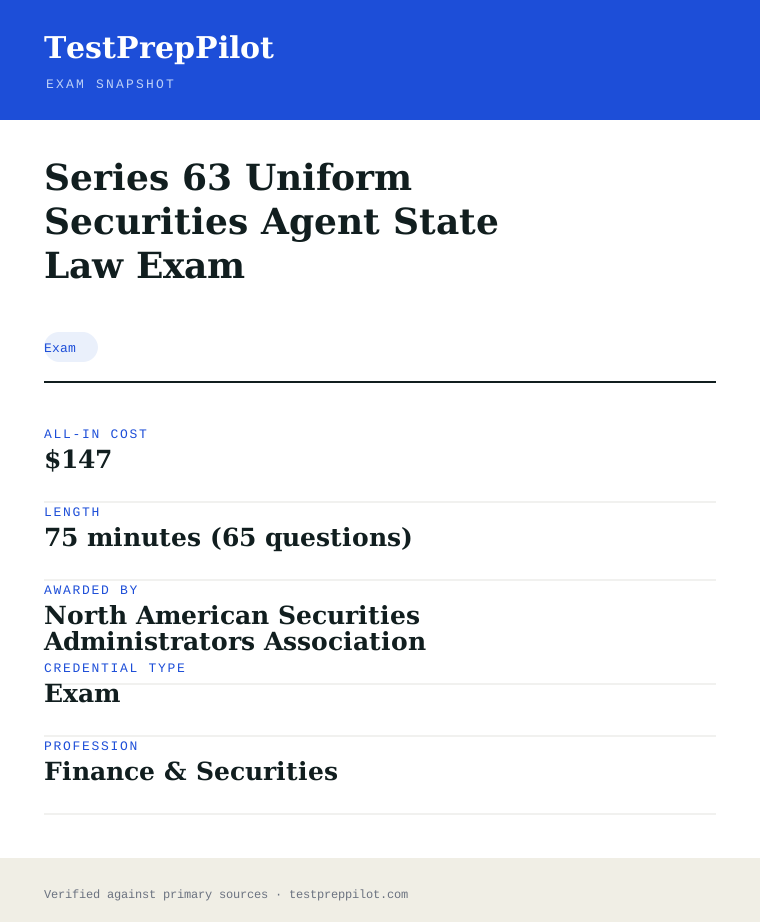
The Series 63 Uniform Securities Agent State Law Exam is administered by North American Securities Administrators Association (NASAA) and runs 75 minutes and contains 65 (60 scored + 5 unscored pretest items) questions.
| Administered by | North American Securities Administrators Association (NASAA) |
|---|---|
| Questions | 65 (60 scored + 5 unscored pretest items) |
| Time limit | 75 minutes |
| Pass mark | Passing score set by the awarding body; see the official score report |
| Exam fee | ~$147 (set by FINRA) |
| Format | Proctored, computer-based (test center or online remote proctoring) |
Content outline
What topics are on the Series 63 Uniform Securities Agent State Law Exam?
The Series 63 Uniform Securities Agent State Law Exam covers 4 content domains.
Weightings come from the official exam outline. Study time is best allocated in roughly these proportions rather than evenly across domains.
- Markets & products
Topic area tested on the exam; see the official blueprint for the detailed breakdown.
- Regulation & ethics
Topic area tested on the exam; see the official blueprint for the detailed breakdown.
- Analysis & valuation
Topic area tested on the exam; see the official blueprint for the detailed breakdown.
- Client & risk management
Topic area tested on the exam; see the official blueprint for the detailed breakdown.
The path
How do you register for the Series 63 Uniform Securities Agent State Law Exam?
- 1
Visit the awarding body’s official website and create an account
- 2
Select the credential and review its specific requirements
- 3
Complete any required eligibility (education, experience, or training)
- 4
Pay the registration fee
- 5
Schedule the exam at a test center or online
- 6
Take the exam and receive your results
The fine print
What are the retake and renewal rules for the Series 63 Uniform Securities Agent State Law Exam?
- Proctoring & delivery
- Proctored, computer-based delivery (test center or remote online proctoring), varying by exam.
- Retake policy
- Varies by credential — most bodies permit retakes after a waiting period and full or partial fee.
- Score reporting
- Scores are reported per the body’s timeline, typically electronically after the exam.
- Recertification
- Varies; many credentials require renewal every 2–3 years via continuing education or a recertification exam.
What it pays
How much does this credential pay?
$78,140 median for securities, commodities and financial services sales agents (BLS, May 2024)
The Series 63 is a state-registration exam, not a job title, so there is no BLS occupation called "Series 63 representative". It registers you as a securities agent in a given state under the Uniform Securities Act, and it is almost always taken alongside a FINRA representative exam such as the Series 6 or Series 7. The closest official BLS occupation is Securities, Commodities, and Financial Services Sales Agents, SOC 41-3031, which had a May 2024 median wage of $78,140. Read that figure correctly: total cash compensation for registered representatives is heavily commission-based, so the BLS median understates what producing agents earn, and the range is wide — from below $41,090 for the lowest tenth to above $213,050 for the top tenth in the May 2024 data. BLS counted 514,500 jobs in the occupation in 2024 and projects 3 percent growth from 2024 to 2034, with roughly 38,100 openings a year, almost all replacement demand. We also list the Financial and Investment Analysts series (SOC 13-2051, May 2024 median $101,350) because Series 63 holders who later move into advisory or analyst roles benchmark against it. The honest summary: the Series 63 is a permission slip that makes the sales-agent wage accessible in a specific state; it produces no wage by itself, and it must be maintained alongside an active FINRA registration to have value.
| Measure | Figure | Source / note |
|---|---|---|
| Median annual wage, securities & financial services sales agents | $78,140 | BLS OOH, SOC 41-3031, May 2024 |
| Lowest 10 percent | Below $41,090 | BLS OOH, SOC 41-3031, May 2024 |
| Highest 10 percent | Above $213,050 | BLS OOH, SOC 41-3031, May 2024 |
| Median, financial and investment analysts (adjacent role) | $101,350 | BLS OOH, SOC 13-2051, May 2024 |
Job growth.BLS projects 3 percent growth for SOC 41-3031 from 2024 to 2034, with about 38,100 openings per year.
Source: BLS Occupational Outlook Handbook - Securities, Commodities, and Financial Services Sales Agents
Your odds
What are the pass rates?
NASAA publishes the cut score — 72% (43 of 60 scored items) — and no pass rate
NASAA, which writes the Series 63, does not publish cohort pass rates, and FINRA does not publish them either, so any percentage you see online is a third-party survey rather than official data; we do not present surveys as authoritative. What is published is the passing standard: the exam contains 60 scored questions plus 5 unscored pretest questions, for 65 total, with a 75-minute time limit, and a candidate must answer at least 43 of the 60 scored items correctly — 72 percent — to pass. The exam is computer-based at Prometric. Two things make the Series 63 structurally different from product exams. First, it tests one statute — the Uniform Securities Act, as adopted by the candidate's state — plus the NASAA model rules, so the material is memorisation-heavy: registration of agents and broker-dealers, exempt securities and exempt transactions, prohibited practices, and administrative provisions. Second, there is no sponsorship requirement to sit: candidates can self-register using Form U10, though most candidates are firm-sponsored and file through a U4. The practical takeaway is that the passing standard is achievable with disciplined memorisation of the act's definitions and exemptions, but the 75-minute window for 60 scored items leaves little room to research answers — you must know the rules cold.
Read this before quoting the number.NASAA and FINRA publish the cut score but no pass rate; any percentage circulating online is a third-party survey.
Source: FINRA - Series 63 Uniform Securities Agent State Law Exam
Your schedule
How long should I study for it?
25-40 hours over 2-4 weeks of focused study
The Series 63 content outline is compact: roughly 60 percent of items cover state securities acts and related rules and regulations, and roughly 40 percent cover ethical practices and fiduciary obligations, including communication with customers and prospects. Because the scope is one statute plus the model rules, the study plan is shorter than for product exams — most candidates need 25 to 40 hours across two to four weeks. Week one should cover the registration framework: what must register, what is exempt, and the definitions that anchor every item (agent, broker-dealer, security, investment adviser under the act). Week two should cover exempt securities and exempt transactions, the prohibited-practices list, and administrative remedies, using flashcards because the exemptions are tested by precise wording. Week three should switch to question-bank drilling with at least 300 items and one or two timed practice exams at 75 minutes. The material is memorisation-heavy, so the plan rewards repetition: same-day review of every miss, weekly re-test of the exemption lists, and a final pass over the definitions the day before the exam. Candidates who pass typically report that the exam feels like a vocabulary and rule test rather than a reasoning test, so structure your time accordingly — read for exact language, not comprehension summaries.
- Week 112
Registration framework
- Agent and broker-dealer registration requirements
- Definition of security and investment adviser under the act
- Administrative structure: administrator powers and remedies
- Week 212
Exemptions and ethics
- Exempt securities and exempt transactions lists
- Prohibited practices and unethical conduct
- Fiduciary obligations and communications with customers
- Weeks 3-414
Drill and timed mocks
- 300+ practice questions, daily error-log review
- Two timed 75-minute practice exams
- Final pass over definitions and exemption lists
Adjusting the pace
Taken right after Series 6 or Series 7.The regulatory vocabulary is fresh; compress to 2 weeks and focus on the exemption lists and ethics items.
Self-sponsored (Form U10).Confirm your state accepts self-registration for the exam before buying prep; the study plan is unchanged.
How to study
How do I prepare most effectively?
The Series 63 rewards precision, so the strongest strategy is to build flashcards around the act's vocabulary — agent, broker-dealer, security, federal covered security, and the distinction between exempt securities and exempt transactions — because most items hinge on applying those exact definitions. Second, drill the exemption lists until they are automatic: the exam loves to present a described offering and ask whether it is exempt, and the answer usually turns on one fact such as the number of offerees, the dollar threshold, or whether the issuer is a government or a non-profit. Third, treat ethics items as a separate study block: they test conduct — what an agent may say, what must be disclosed, what counts as manipulation or fraud — and the wording is often the difference between two similar answers. Fourth, take at least two timed exams at 75 minutes; the window is short enough that candidates who have never timed themselves run out of minutes on the ethics block. Fifth, use a current outline: the Uniform Securities Act and NASAA model rules are stable, but the exam is updated periodically, so buy prep materials no older than two years and confirm the item-count and scoring rules at registration.
Build definition flashcards
Every item leans on the act's exact vocabulary; memorise definitions before anything else.
Automate the exemption lists
Drill exempt securities and exempt transactions until the thresholds are reflexive.
Separate the ethics block
Conduct and communication items need their own drill session; they reward exact wording.
Time yourself twice
Two timed 75-minute mocks are the minimum before the real sitting.
Use current materials
Confirm the outline version at registration; old prep can test retired language.
What to buy
Which study resources are worth paying for?
Because the Series 63 scope is narrow, prep is cheaper and shorter than for product exams. The authoritative free sources are the NASAA content outline and FINRA's exam page, which give the exact scope and scoring rules but no instruction. Third-party packages — Kaplan, STC, Pass Perfect and others — bundle a concise book, practice questions and simulated exams, typically $150 to $400; the question bank is the part that matters most, so a book-plus-bank combo often beats a full video package for this exam. Question-bank-only products are viable for candidates who already understand the act from a Series 7 course, because Series 7 prep already covers much of the federal material and only the state-specific exemptions and NASAA model rules are new. Free quiz sites and YouTube explainers are useful for orientation but insufficient alone for an exam that tests precise statutory wording. A realistic budget is $100 to $400. Prices below are list prices as of mid-2026 and change frequently; we rank nothing by commission.
| Resource | Price | Format | Best for |
|---|---|---|---|
| NASAA/FINRA outlines | Free | PDF outlines | Exact scope and scoring rules |
| Kaplan Series 63 | $150-$300 | Book + QBank + simulated exam | Structured learners who want a course |
| STC Series 63 | $200-$350 | Textbook + online exam simulator | Candidates on a short deadline |
| Question-bank only | $60-$150 | Online adaptive questions | Series 7-holders who need state-law drill |
| Free quiz sites | $0 | Web quizzes | Orientation before buying anything |
List prices as of mid-2026, subject to change; no commission or affiliate ranking is implied.
Avoid these
What mistakes do candidates most often make?
The classic Series 63 mistake is studying it like a product exam: candidates spend hours on investment products and then fail on the statutory material, which is the actual test. The fix is to reallocate time to the act's definitions and exemptions. The second mistake is confusing exempt securities with exempt transactions — the exam tests both lists, and candidates routinely apply the wrong one to a described offering. Third, many candidates ignore the 5 unscored pretest questions but then waste effort trying to identify them; treat all 65 as scored. Fourth, candidates answer ethics items from intuition instead of the model rules; the exam wants the rule-based answer, not the friendly one, and the two are often different. Fifth, slow reading in the 75-minute window: at 60 scored items, you have 75 seconds per item including review, and candidates who read the scenarios twice fall behind on the ethics block. Finally, using outdated prep is a silent killer, because the act and model rules are revised; always confirm the outline version at registration.
✕Studying products instead of the act
✓Reallocate study to definitions, exemptions and ethics — that is the exam.
✕Confusing exempt securities with exempt transactions
✓Maintain two separate lists and drill each with its own threshold facts.
✕Trying to spot the 5 pretest questions
✓Treat all 65 items as scored; pretests are indistinguishable.
✕Answering ethics from intuition
✓Apply the NASAA model rules; the rule-based answer is the graded one.
✕Running out of time on ethics
✓Do two timed 75-minute mocks and practise a steady 70-second pace.
What you'll face
What question types will I see?
The Series 63 is entirely multiple-choice, with most items single-answer and a meaningful share phrased as described situations: a fact pattern about an offering or an agent's conduct, followed by a question about registration, exemption or propriety. Definition items test the act's vocabulary directly. Exemption items present a described security or transaction and ask whether it is exempt and why. Ethics items describe an agent's behaviour and ask whether it violates the act or model rules. There are no performance-based tasks and no essay items. The samples below are editor-written illustrations of the published blueprint, not live exam items; they demonstrate the precision required on definition and exemption questions and the rule-based nature of the ethics items.
Who must register, what is exempt, and administrative provisions under the act.
Prohibited practices, disclosure obligations and customer communications.
Try these
Q1Which of the following is an exempt security under the Uniform Securities Act?
Answer:B
Securities issued by governments with which the U.S. maintains diplomatic relations are among the expressly exempt securities under the Uniform Securities Act. The limited partnership interest, the private-offering note, and the business-trust security are not automatically exempt by those facts alone.
Q2An agent in State X recommends a product that is not suitable for the customer. Under the Uniform Securities Act, this conduct is:
Answer:B
Making unsuitable recommendations is a prohibited practice under state securities law, and the suitability obligation cannot be waived by an accredited-status label or a signed waiver. State law and FINRA rules operate in parallel, so D is incorrect.
Q3Which statement about a broker-dealer's record-keeping duty under the Uniform Securities Act is correct?
Answer:B
The act gives the state administrator authority to inspect a broker-dealer's records during regular business hours. Keeping records beyond the administrator's reach, destroying them after a fixed period, or limiting records to institutional clients all contradict the statutory record-keeping and inspection regime.
Samples are editor-written illustrations of the published blueprint, not live exam items.
The big day
What should I expect on exam day?
The Series 63 is a 75-minute, 65-question computer-based exam taken at a Prometric testing centre; no sponsorship is required to sit, though most candidates are firm-sponsored. Bring a valid government-issued photo ID matching your registration name and your appointment confirmation; everything else — phone, notes, wallet beyond the ID — goes in the locker. Arrive at least 30 minutes early; late arrivals forfeit the appointment and the $147 exam fee. The session includes a tutorial before the clock starts, and there are no scheduled breaks. Your preliminary pass/fail appears on screen immediately; the official result flows to your registration record, and if you fail, the retake wait is 30 days, extending to 180 days after three consecutive failures. Pace yourself at roughly 70 seconds per scored item and flag uncertain items for review rather than lingering. On a pass, the result is valid to register you as an agent in the state where your firm files; the licence has value only alongside an active FINRA registration, and maintaining it is governed by state rules and any continuing-education programme your state adopts.
Bring
- Valid government-issued photo ID matching your registration name
- Appointment confirmation
Leave at home
- Phone, smartwatch and all electronics
- Notes, books and study materials
- Any items the testing centre prohibits beyond an ID
How the day runs
Rules in the room
- No personal electronics in the testing room
- No breaks — the 75-minute clock runs continuously
- Photo ID must match the registration name exactly
Afterwards.On a pass, your firm activates your state registration (or you complete a self-registration). On a fail, wait 30 days (180 after three consecutive failures) to retake. Keep the licence current with any state-required continuing education while registered.
Reference
What are the key facts about the Series 63 Uniform Securities Agent State Law Exam?
Series 63 Uniform Securities Agent State Law Exam is a exam credential; awarded by North American Securities Administrators Association (NASAA); the exam fee is ~$147 (set by FINRA); typical preparation is 75 minutes (65 questions); holders typically earn $45,000-$120,000.
| Credential | Series 63 Uniform Securities Agent State Law Exam |
|---|---|
| Abbreviation | Series 63 |
| Type | Exam |
| Profession | Finance & Securities |
| Specialty | FINRA & Securities Licensing |
| Awarded by | North American Securities Administrators Association (NASAA) |
| Difficulty | Regulated |
| Typical prep time | 75 minutes (65 questions) |
| All-in cost | $147 |
| Typical salary range | $45,000-$120,000 |
| Credential | Series 63 Uniform Securities Agent State Law Exam |
| Awarding body | North American Securities Administrators Association (NASAA) |
| Exam format | Proctored, computer-based |
| Validity | The licence renews while you remain registered with a sponsoring firm; some states have continuing-education requirements. |
| Languages | Varies — see awarding body |
| Scope | National / Multi-state |
Real questions
Frequently asked questions about the Series 63 Uniform Securities Agent State Law Exam
How do I register for the Series 63 Uniform Securities Agent State Law Exam exam?
Register through North American Securities Administrators Association (NASAA)'s official portal or an authorized test provider (e.g., Pearson VUE or Prometric where applicable). Create an account, select the exam, pay the fee, and schedule a date.
How much does the exam cost?
Fees vary by location and currency. Confirm the current fee on the official registration page before scheduling.
How long is the credential valid, and how do I renew?
Series 63 registration renews while you remain associated with a sponsoring firm; most states do not require a separate CE cycle for the 63, but you should confirm your state's specific requirements, since state rules vary.
What if I do not pass?
Most bodies allow retakes after a waiting period and payment of the full or partial fee. Check North American Securities Administrators Association (NASAA)'s retake policy before rescheduling.
How do I register for a North American Securities Administrators Association (NASAA) credential?
Register through the official website, select your exam, pay the fee, and schedule a date.
How do I renew a credential?
Renewal policies vary by credential; check the specific program page for requirements and cycles.
In short
Is the Series 63 Uniform Securities Agent State Law Exam worth it?
- Series 63 Uniform Securities Agent State Law Exam is awarded by North American Securities Administrators Association (NASAA).
- Validates job-ready competence in Finance & Securities.
- Registration is through the awarding body or an authorized test provider.
- Renewal and retake policies vary — confirm before scheduling.
Same awarding body
What other credentials does North American Securities Administrators Association (NASAA) award?
Worth comparing
How does the Series 63 Uniform Securities Agent State Law Exam compare with similar credentials?
Trust
Where does this information come from?
Everything above is taken from the awarding body's own published material. Fees, question counts and domain weights are revised regularly — check the official page before you pay.
Research confidence: low · Last reviewed 2026-08