Finance & Securities • Exam
Financial Risk Manager Exam Part I
Financial Risk Manager Exam Part I — Finance & Securities credential from Global Association of Risk Professionals (GARP)
Researched and maintained by TestPrepPilot Editorial BoardRisk management & financial certifications desk · Figures last verified August 2026
The short version
What is the Financial Risk Manager Exam Part I and is it worth it?
Financial Risk Manager Exam Part I is a professional credential administered by Global Association of Risk Professionals (GARP). It validates job-ready knowledge and skills in the Finance & Securities field and is used for career entry, advancement, or compliance.
- Recognized credential from Global Association of Risk Professionals (GARP)
- Demonstrates verified competence in Finance & Securities
- Supports career advancement and may satisfy licensing or employer requirements
What is it?
What exactly is the Financial Risk Manager Exam Part I?
Financial Risk Manager Exam Part I — Finance & Securities credential from Global Association of Risk Professionals (GARP)
First risk management paper covering foundations of risk, quantitative analysis, financial markets and valuation and risk models. Offered by Global Association of Risk Professionals (GARP), it is designed for candidates who need to demonstrate verified competence in the Finance & Securities field. The credential is commonly used for career entry, advancement, regulatory compliance, or employer requirements. Candidates should review the official handbook for eligibility, exam format, and scoring before registering.
The path in brief
- Confirm you meet any eligibility or prerequisites
- Review the official handbook and study materials
- Register and pay through the awarding body or authorized provider
- Schedule and take the exam (test center or online proctoring)
- Receive your score and, if passed, your credential
Before you book
Who is eligible to sit the Financial Risk Manager Exam Part I?
None (Part I taken first)
Who it is for: Professionals and candidates seeking to validate Finance & Securities competence.
The test itself
What is the format of the Financial Risk Manager Exam Part I?
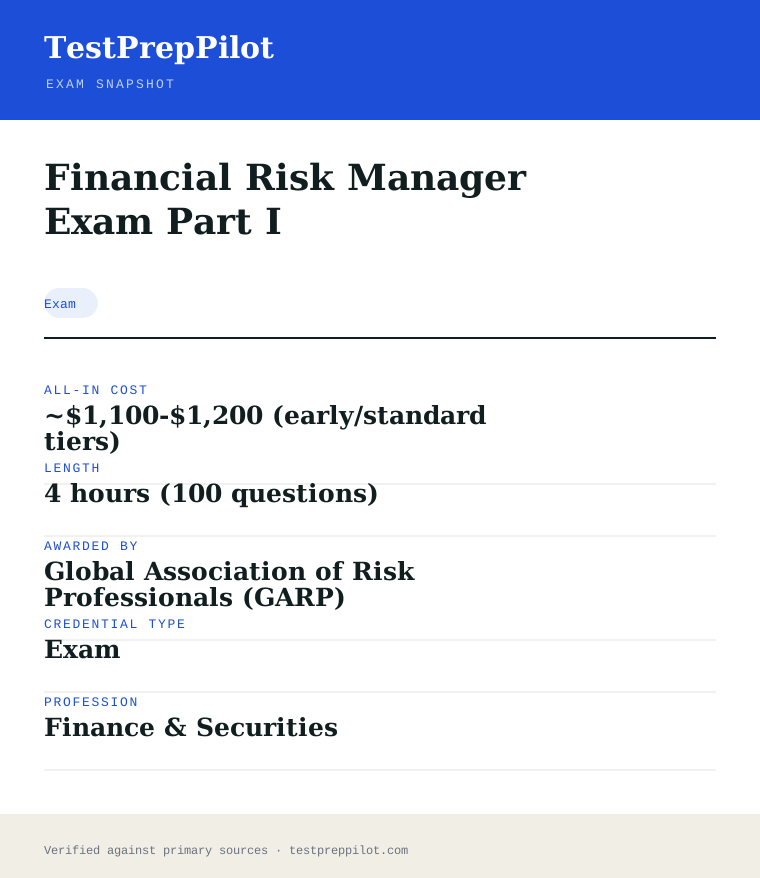
The Financial Risk Manager Exam Part I is administered by Global Association of Risk Professionals (GARP) and runs 4 hours and contains 100 (4 hours) questions.
| Administered by | Global Association of Risk Professionals (GARP) |
|---|---|
| Questions | 100 (4 hours) |
| Time limit | 4 hours |
| Pass mark | Passing score set by the awarding body; see the official score report |
| Exam fee | ~$1,100-$1,200 |
| Format | Proctored, computer-based (test center or online remote proctoring) |
Content outline
What topics are on the Financial Risk Manager Exam Part I?
The Financial Risk Manager Exam Part I covers 4 content domains.
Weightings come from the official exam outline. Study time is best allocated in roughly these proportions rather than evenly across domains.
- Markets & products
Topic area tested on the exam; see the official blueprint for the detailed breakdown.
- Regulation & ethics
Topic area tested on the exam; see the official blueprint for the detailed breakdown.
- Analysis & valuation
Topic area tested on the exam; see the official blueprint for the detailed breakdown.
- Client & risk management
Topic area tested on the exam; see the official blueprint for the detailed breakdown.
The path
How do you register for the Financial Risk Manager Exam Part I?
- 1
Visit the awarding body’s official website and create an account
- 2
Select the credential and review its specific requirements
- 3
Complete any required eligibility (education, experience, or training)
- 4
Pay the registration fee
- 5
Schedule the exam at a test center or online
- 6
Take the exam and receive your results
The fine print
What are the retake and renewal rules for the Financial Risk Manager Exam Part I?
- Proctoring & delivery
- Proctored, computer-based delivery (test center or remote online proctoring), varying by exam.
- Retake policy
- Varies by credential — most bodies permit retakes after a waiting period and full or partial fee.
- Score reporting
- Scores are reported per the body’s timeline, typically electronically after the exam.
- Recertification
- Varies; many credentials require renewal every 2–3 years via continuing education or a recertification exam.
What it pays
How much does this credential pay?
FRM Part I is the first step on the risk-management track: financial and investment analysts earned a $101,350 median in May 2024 (BLS)
The FRM (Financial Risk Manager) Part I exam is the first of two exams in the GARP certification program for financial risk professionals, covering the foundations of risk management, quantitative analysis, financial markets and products, and valuation and risk models. It is a professional certification pathway rather than a job license, so no single BLS SOC code attaches to it; the salary story belongs to the risk and finance occupations it serves. BLS reported that financial and investment analysts (SOC 13-2051) earned a median of $101,350 in May 2024, and financial risk specialists (13-2099) about $101,100 (OEWS May 2024); risk-management roles in banking, insurance, asset management and energy trading sit in these ranges, with senior risk officers and quantitative risk roles paying substantially more. The structural point is that the FRM is one of the two recognized risk-management designations (alongside the PRM), and it is common in job postings for risk analyst, market risk, credit risk and model-risk roles, particularly at banks and financial institutions; Part I establishes the common body of risk knowledge, and the full certification (Part I + Part II + two years of relevant work experience) is the credential employers recognize. BLS classifies workers by occupation, not certifications, so no certificate maps to a specific wage; the value is the domain signal in a market where risk expertise is specialized and well compensated. GARP publishes pass rates for the FRM exams - the honest difference from most certifications - and Part I pass rates in recent years have typically been in the 40-50 percent range.
| Measure | Figure | Source / note |
|---|---|---|
| Financial and investment analysts median, May 2024 | $101,350 | BLS OEWS, SOC 13-2051 |
| Financial risk specialists median, May 2024 | ~$101,100 | BLS OEWS, SOC 13-2099 |
| All-occupation median, May 2024 | $49,500 | BLS OEWS |
| FRM structure | Part I + Part II + 2 yrs experience | GARP, full certification |
Job growth.Financial-analyst employment is projected to grow 7 percent from 2024 to 2034; risk roles follow financial-industry demand.
Source: BLS Occupational Outlook Handbook - Financial Analysts
Your odds
What are the pass rates?
GARP publishes FRM pass rates: Part I first-attempt pass rates have recently been approximately 40-50 percent
GARP is one of the few major certification bodies that publishes exam pass rates, and it reports them by exam and session. For FRM Part I, recent years have shown first-attempt pass rates approximately in the 40-50 percent range (for example, the May and November 2024 administrations were reported around the low-to-mid 40s, and 2023 sessions similar), with some sessions higher; Part II pass rates have generally been higher than Part I. These are cohort statistics that vary by session, and GARP notes that candidates who complete a full course of study typically fare better. The Part I exam is computer-based, 100 multiple-choice questions in 4 hours, with a single sitting in May and November each year. The exam covers four areas: foundations of risk management (20 percent), quantitative analysis (20 percent), financial markets and products (30 percent), and valuation and risk models (30 percent). Scores are reported as pass/fail with a quartile breakdown by topic (GARP reports which quartiles the candidate scored in each area), which gives candidates a diagnostic for retakes; GARP does not publish a numeric passing score, and candidates who fail may retake (there is no limit on attempts, but candidates should verify the current retake policy and fees). Because GARP publishes the pass rates, the honest preparation message is direct: the exam is genuinely selective, and the ~40-50 percent recent Part I pass rate is the realistic context for planning a serious study schedule.
Read this before quoting the number.GARP publishes pass rates; recent FRM Part I first-attempt rates were approximately 40-50%. No numeric passing score is published - results are pass/fail with quartile diagnostics.
Your schedule
How long should I study for it?
200-300 hours over 3-4 months of focused study
A realistic FRM Part I plan runs 200-300 hours over 3-4 months, and GARP’s published pass rates (recently ~40-50 percent for Part I) make clear that this is a serious commitment. The exam is 100 questions in 4 hours covering four areas: foundations of risk management (risk types, governance, the role of risk management), quantitative analysis (probability, statistics, regression, time-series basics), financial markets and products (equities, bonds, derivatives, FX, and the markets they trade in), and valuation and risk models (option pricing, value at risk, and risk-model concepts). Month 1: read the GARP curriculum books (the exam is based on GARP’s own readings) covering foundations and quantitative analysis, with practice questions after each chapter; establish a baseline with GARP’s practice exams. Months 2-3: complete financial markets and products and valuation and risk models, integrating daily practice questions - the standard pattern is 30-50 questions daily with full answer review - and use a question bank for volume. Month 4: two to three full practice exams under timed conditions, targeted review of the quartile diagnostics, and taper. The dominant resources are GARP’s official books and practice exams (included with enrollment), a question bank, and optional third-party study materials; many candidates also take a live or online prep course. The exam fee is roughly $1,100-$1,200 for Part I (early and standard registration tiers; verify current pricing), and candidates should register for the May or November sitting with enough lead time.
- Month 170
Foundations and quant
- GARP books: foundations and quantitative analysis
- Chapter practice questions
- Months 2-3150
Markets and valuation
- Financial markets and products
- Valuation and risk models; 30-50 Qs daily
- Month 460
Practice exams and taper
- 2-3 full timed practice exams
- Quartile-targeted review
Adjusting the pace
Part I and Part II strategy.Some candidates sit Part I and Part II in the same window (Part II has 80 questions); most take Part I first and Part II in a later session.
Work-experience requirement.The full FRM designation requires two years of relevant professional work experience after passing both parts.
How to study
How do I prepare most effectively?
The most effective FRM Part I strategies treat it as a quant-heavy, curriculum-based exam. Strategy one: read the GARP curriculum books as the primary source, because the exam is written against GARP’s own readings, and candidates who study only third-party summaries miss the framing and the specific terminology; the books are included with enrollment. Strategy two: make daily practice questions the backbone - 30-50 questions daily with full review of every answer, because the exam’s 100 questions in 4 hours demand speed and the question style is learned through volume; a question bank is the standard supplement. Strategy three: master quantitative analysis early - probability, statistics and regression underpin the valuation and risk-model content, and candidates who rush the quant foundation struggle in the later topics; the quant area is also the most trainable. Strategy four: weight the two 30-percent areas (financial markets and products, valuation and risk models) appropriately; half the exam comes from them, and the option-pricing and value-at-risk concepts deserve the deepest study. Strategy five: use GARP’s practice exams as the final checkpoint - they are the closest match to the format and the timed 4-hour endurance - and take at least two. Strategy six: manage the retake plan honestly, using the quartile diagnostics to target the weakest areas, because the ~40-50 percent pass rate means many candidates sit twice.
Read the GARP curriculum
The exam is written against GARP’s own books.
Daily question volume
30-50 questions daily with full review.
Master the quant foundation
Probability, statistics and regression underpin the rest.
Weight the 30% areas
Markets and valuation are half the exam.
Use GARP practice exams
The closest format match; take 2-3 timed.
What to buy
Which study resources are worth paying for?
The FRM Part I resource market is anchored by GARP’s official materials, which are included with enrollment. GARP provides the full curriculum books (the official readings), practice exams and study guides as part of the exam fee, which is roughly $1,100-$1,200 for Part I (early and standard registration tiers; verify current pricing). Question banks are the standard paid supplement: the major FRM question banks cost about $150-$400 for a subscription and provide the practice volume that the curriculum alone lacks. Third-party study guides, video courses and live classes ($300-$2,000) add structure and are popular among candidates, with the honest caveat that the exam is curriculum-based and third-party material must stay aligned with the current GARP readings. The free resources include GARP’s practice questions and the published exam outline. The honest ranking: the GARP curriculum and practice exams (included), a question bank for volume, and a course only for structure or for candidates whose quantitative foundation needs support. Prices here are current as of 2025-26 and change annually.
| Resource | Price | Format | Best for |
|---|---|---|---|
| GARP curriculum books | Included with exam fee | Print/ebook | The primary source - the exam is based on them |
| GARP practice exams | Included | Online | Format and timing rehearsal |
| Question bank subscription | $150-$400 | Online | Daily practice volume |
| Prep course (live/online) | $300-$2,000 | Live/on-demand | Structure and quant support |
Prices dated 2025-26; the Part I exam fee is ~$1,100-$1,200 (verify tiers). No commission-based ranking.
Avoid these
What mistakes do candidates most often make?
The most common FRM Part I mistakes come from underestimating the quantitative depth and the curriculum basis. Mistake one: studying third-party summaries instead of the GARP curriculum; the exam is written against GARP’s readings, and candidates who learn from condensed material miss the terminology and framing the exam expects. Mistake two: skipping the quantitative foundation; probability, statistics and regression underpin the valuation content, and candidates who rush the math struggle in the last two areas. Mistake three: low question volume; candidates who read without daily practice questions reach the 4-hour, 100-question exam unpracticed, and the ~40-50 percent pass rate reflects that. Mistake four: ignoring the 4-hour endurance; candidates who never take a full timed practice exam misjudge pacing. Mistake five: assuming the pass rate is like a "normal" certification; GARP publishes the real numbers (recently ~40-50 percent for Part I), and candidates who plan a 200-hour minimum study schedule are the realistic ones. Mistake six: forgetting the full-certification requirements; the FRM designation needs Part II and two years of relevant work experience, so the roadmap should be planned from the start. Finally, candidates should register early for the lower fee tier and confirm the May/November window that fits their study schedule.
✕Skipping the GARP curriculum
✓The exam is based on GARP’s own readings.
✕Rushing the quant foundation
✓Probability and statistics underpin the later topics.
✕Low question volume
✓Daily practice questions are essential.
✕Ignoring the 4-hour endurance
✓Take full timed practice exams.
✕Under-planning the schedule
✓The ~40-50% pass rate calls for 200+ hours.
What you'll face
What question types will I see?
The FRM Part I exam is 100 multiple-choice questions in 4 hours, computer-based, with single-sitting administrations in May and November. The four areas: foundations of risk management (20 percent), quantitative analysis (20 percent), financial markets and products (30 percent), and valuation and risk models (30 percent). Results are pass/fail with quartile diagnostics by topic; GARP publishes cohort pass rates (recently ~40-50 percent for Part I). Samples below are editor-written illustrations of the published exam topics, not live exam items.
Risk types, governance, role of risk management.
Probability, statistics, regression, time series.
Equities, bonds, derivatives, FX.
Option pricing, value at risk, risk models.
Try these
Q1A bank holds a portfolio of corporate bonds. Which risk best describes the potential for losses from a decline in the bonds’ market value?
Answer:B
Market risk is the risk of losses from adverse movements in market prices; credit risk is the risk of counterparty default, and the other options describe different risk categories.
Q2Which measure expresses the worst expected loss over a given horizon at a specified confidence level?
Answer:B
Value at Risk (VaR) is the standard measure of the worst expected loss over a horizon at a confidence level; expected shortfall extends it, but VaR is the definitional answer.
Q3A European call option’s value increases when which input increases?
Answer:B
Higher volatility increases option value (both calls and puts gain from volatility); a higher strike decreases call value, and the rate effect depends on the position and is not universally increasing.
Samples are editor-written illustrations of the published exam topics, not live exam items.
The big day
What should I expect on exam day?
The FRM Part I exam is administered on a single date in May and November each year at authorized test centers worldwide (and, in some regions, online with proctoring for certain administrations; verify the current delivery). Candidates register through GARP with early and standard fee tiers, and on the day arrive 30 minutes early with a valid ID; the exam runs 4 hours for 100 questions with a scheduled break, and personal electronics are not permitted; a calculator from the GARP-approved list is permitted. Results are typically released within about six weeks, reported as pass/fail with quartile diagnostics by topic; GARP publishes the session pass rates. Candidates who fail may retake in a future session (verify the current retake policy and fees). The full FRM designation additionally requires passing Part II and two years of relevant work experience. Afterwards, successful candidates register for Part II with the same study discipline, and all candidates should use the quartile diagnostics to plan any retake.
Bring
- Valid photo ID
- Appointment confirmation
- GARP-approved calculator
- Registration and exam-day instructions
Leave at home
- Phone, smartwatch, and personal electronics
- Notes or study materials
- Unofficial calculators not on the GARP list
How the day runs
Rules in the room
- Valid ID is mandatory; personal electronics are prohibited.
- Only GARP-approved calculators are permitted.
- Results are pass/fail with quartile diagnostics.
- The full designation requires Part II and 2 years of relevant experience.
Afterwards.Use the quartile diagnostics to plan the next step - Part II registration if passed, or a targeted Part I retake - and verify the current retake policy and fees.
Reference
What are the key facts about the Financial Risk Manager Exam Part I?
Financial Risk Manager Exam Part I is a exam credential; awarded by Global Association of Risk Professionals (GARP); the exam fee is ~$1,100-$1,200; typical preparation is 4 hours (100 questions); holders typically earn $75,000-$150,000 (risk management roles).
| Credential | Financial Risk Manager Exam Part I |
|---|---|
| Abbreviation | FRM Part I |
| Type | Exam |
| Profession | Finance & Securities |
| Specialty | Investment & Portfolio Management |
| Awarded by | Global Association of Risk Professionals (GARP) |
| Difficulty | Regulated |
| Typical prep time | 4 hours (100 questions) |
| All-in cost | ~$1,100-$1,200 (early/standard tiers) |
| Typical salary range | $75,000-$150,000 (risk management roles) |
| Credential | Financial Risk Manager Exam Part I |
| Awarding body | Global Association of Risk Professionals (GARP) |
| Exam format | Proctored, computer-based |
| Validity | Varies by credential (commonly 2–3 years) |
| Languages | Varies — see awarding body |
| Scope | National / Multi-state |
Real questions
Frequently asked questions about the Financial Risk Manager Exam Part I
How do I register for the Financial Risk Manager Exam Part I exam?
Register through Global Association of Risk Professionals (GARP)'s official portal or an authorized test provider (e.g., Pearson VUE or Prometric where applicable). Create an account, select the exam, pay the fee, and schedule a date.
How much does the exam cost?
Fees vary by location and currency. Confirm the current fee on the official registration page before scheduling.
How long is the credential valid, and how do I renew?
GARP publishes pass rates - recent FRM Part I first-attempt rates were approximately 40-50%, so plan a serious 200+ hour study schedule.
What if I do not pass?
Most bodies allow retakes after a waiting period and payment of the full or partial fee. Check Global Association of Risk Professionals (GARP)'s retake policy before rescheduling.
How do I register for a Global Association of Risk Professionals (GARP) credential?
Register through the official website, select your exam, pay the fee, and schedule a date.
How do I renew a credential?
Renewal policies vary by credential; check the specific program page for requirements and cycles.
In short
Is the Financial Risk Manager Exam Part I worth it?
- Financial Risk Manager Exam Part I is awarded by Global Association of Risk Professionals (GARP).
- Validates job-ready competence in Finance & Securities.
- Registration is through the awarding body or an authorized test provider.
- Renewal and retake policies vary — confirm before scheduling.
Same awarding body
What other credentials does Global Association of Risk Professionals (GARP) award?
Worth comparing
How does the Financial Risk Manager Exam Part I compare with similar credentials?
Trust
Where does this information come from?
Everything above is taken from the awarding body's own published material. Fees, question counts and domain weights are revised regularly — check the official page before you pay.
- Global Association of Risk Professionals (GARP) Awarding body
Research confidence: low · Last reviewed 2026-08