The short version
What is the CFP Certification Examination and is it worth it?
CFP Certification Examination is a professional credential administered by Certified Financial Planner Board of Standards. It validates job-ready knowledge and skills in the Finance & Securities field and is used for career entry, advancement, or compliance.
- Recognized credential from Certified Financial Planner Board of Standards
- Demonstrates verified competence in Finance & Securities
- Supports career advancement and may satisfy licensing or employer requirements
What is it?
What exactly is the CFP Certification Examination?
CFP Certification Examination — Finance & Securities credential from Certified Financial Planner Board of Standards
Comprehensive financial planning examination covering the planning process, tax, retirement, insurance, investments, estate and ethics. Offered by Certified Financial Planner Board of Standards, it is designed for candidates who need to demonstrate verified competence in the Finance & Securities field. The credential is commonly used for career entry, advancement, regulatory compliance, or employer requirements. Candidates should review the official handbook for eligibility, exam format, and scoring before registering.
The path in brief
- Confirm you meet any eligibility or prerequisites
- Review the official handbook and study materials
- Register and pay through the awarding body or authorized provider
- Schedule and take the exam (test center or online proctoring)
- Receive your score and, if passed, your credential
Before you book
Who is eligible to sit the CFP Certification Examination?
Eligibility varies; many credentials are open to all, while others require coursework, work experience, or sponsorship.
Who it is for: Professionals and candidates seeking to validate Finance & Securities competence.
The test itself
What is the format of the CFP Certification Examination?
The CFP Certification Examination is administered by Certified Financial Planner Board of Standards and runs Full day, 3 sessions and contains 170 questions.
| Administered by | Certified Financial Planner Board of Standards |
|---|---|
| Questions | 170 questions |
| Time limit | Full day, 3 sessions |
| Pass mark | Passing score set by the awarding body; see the official score report |
| Exam fee | ~$925 exam |
| Format | Proctored, computer-based (test center or online remote proctoring) |
Content outline
What topics are on the CFP Certification Examination?
The CFP Certification Examination covers 4 content domains.
Weightings come from the official exam outline. Study time is best allocated in roughly these proportions rather than evenly across domains.
- Markets & products
Topic area tested on the exam; see the official blueprint for the detailed breakdown.
- Regulation & ethics
Topic area tested on the exam; see the official blueprint for the detailed breakdown.
- Analysis & valuation
Topic area tested on the exam; see the official blueprint for the detailed breakdown.
- Client & risk management
Topic area tested on the exam; see the official blueprint for the detailed breakdown.
The path
How do you register for the CFP Certification Examination?
- 1
Visit the awarding body’s official website and create an account
- 2
Select the credential and review its specific requirements
- 3
Complete any required eligibility (education, experience, or training)
- 4
Pay the registration fee
- 5
Schedule the exam at a test center or online
- 6
Take the exam and receive your results
The fine print
What are the retake and renewal rules for the CFP Certification Examination?
- Proctoring & delivery
- Proctored, computer-based delivery (test center or remote online proctoring), varying by exam.
- Retake policy
- Varies by credential — most bodies permit retakes after a waiting period and full or partial fee.
- Score reporting
- Scores are reported per the body’s timeline, typically electronically after the exam.
- Recertification
- Varies; many credentials require renewal every 2–3 years via continuing education or a recertification exam.
What it pays
How much does this credential pay?
Expect personal-financial-advisor pay at a May 2024 median of $99,580 (BLS) — the CFP is the planning profession’s gold-standard credential, and advisors holding it typically earn at the upper end of the occupation
The direct answer is that the CFP certification is the flagship credential of the financial-planning profession, and the occupation it serves, personal financial advisors (SOC 13-2052), earned a May 2024 median annual wage of $99,580, with the lowest 10 percent under about $53,000 and the highest 10 percent above about $171,000. The honest framing is that the BLS occupation includes both registered representatives and planners, and CFP holders cluster toward the upper part of the distribution — the credential is widely cited by industry surveys as associated with higher earnings, and it is the differentiator that lets advisors charge planning fees and move up within firms, though BLS does not publish CFP-specific pay. BLS counted about 242,000 personal financial advisors in 2024 and projects about 7 percent employment growth from 2024 to 2034, faster than average, with roughly 20,000 openings per year. The CFP path itself is a substantial commitment: a bachelor’s degree, the CFP Board-registered education program (typically 4 to 12 months of coursework), 6,000 hours of professional experience (or 4,000 through the apprenticeship pathway), passing the 170-question exam, and the ethics requirement. The practical read is that the CFP is an investment in career positioning rather than a fast credential: the exam pass rates are roughly 60 to 70 percent per window, the cost runs several thousand dollars when education and exam fees are combined, and the payoff is the fee-for-service planning model and the advisor roles that list "CFP preferred or required." For candidates deciding whether to pursue it, the credential makes the most sense for advisors already working in the industry or graduates committed to planning, since the experience requirement alone takes years to satisfy.
| Measure | Figure | Source / note |
|---|---|---|
| Median annual wage, personal financial advisors | $99,580 | BLS OEWS, May 2024 (SOC 13-2052) |
| Lowest 10 percent | ~$52,777 | BLS OEWS, May 2024 |
| Highest 10 percent | ~$171,278 | BLS OEWS, May 2024 |
| Projected growth, 2024-34 | +7% | BLS Employment Projections |
| The certification itself | Professional credential | CFP Board certification with education, exam, and experience requirements |
Job growth.BLS projects about 7% growth for personal financial advisors from 2024 to 2034, faster than average, with roughly 20,000 annual openings.
Your odds
What are the pass rates?
CFP Board publishes pass rates — the November 2025 window reported about 62% of candidates passing; the exam is 170 questions across 3 sessions in one day, with a standards-based passing standard
The direct answer is that the CFP exam does publish pass rates: CFP Board reports results for each testing window, and recent windows have run roughly 60 to 70 percent — the November 2025 exam window reported approximately 62 percent of candidates passing, consistent with the multi-year pattern of pass rates in the low-to-mid 60s. The exam itself is a computer-based test of 170 multiple-choice questions delivered in three sessions (85 questions, 85 questions, and 60 questions) over a single day, with a standards-based passing standard set by CFP Board rather than a fixed percentage; the question set is weighted across the seven principal knowledge areas — professional conduct and regulation, general principles of financial planning, education planning, risk management and insurance planning, investment planning, tax planning, retirement savings and income planning, and estate planning — with investment and retirement planning carrying the largest weights. Candidates must complete a CFP Board-registered education program before sitting, and the exam is offered in multiple windows each year at authorized test centers. The published pass-rate pattern is stable and useful for planning: candidates who complete the education program and a structured exam-prep course (typically 100 to 200 hours of study) sit in the range of the published pass rates, and retakes are permitted with a wait period. The honest preparation implication is that the pass-rate data supports treating the exam as a serious, structured preparation project — the credential’s pass line is real and the exam covers the full planning curriculum, so last-minute cramming is a documented failure mode.
Read this before quoting the number.CFP Board publishes pass rates by exam window; recent windows report roughly 60-70%.
Source: CFP Board — Exam results
Your schedule
How long should I study for it?
150-250 study hours after the education program of focused study
Plan for 12 to 20 weeks and 150 to 250 hours of study for the CFP exam after completing the CFP Board-registered education program, with a structured prep course and mock exams in the final month — the exam’s breadth across seven knowledge areas makes systematic coverage essential. The exam weights the knowledge areas unevenly: investment planning and retirement savings/income planning carry the largest question shares, followed by tax planning and risk management, so study time should be allocated proportionally rather than evenly. The most effective sequence is: first, complete the education program (which is itself 200+ hours); second, run a diagnostic exam to locate weak areas; third, work through the two highest-weight areas — investment and retirement planning — before the others; fourth, drill the tax and estate planning material, which rewards memorised rules; and fifth, take three to four full mock exams under timed, single-day conditions in the final month, since the three-session format is a stamina test as much as a knowledge test. The highest-yield habits are the mock exams and the "case-study" style questions, which appear throughout and reward applying multiple planning areas to one client situation. Budget the final week for light review and rest rather than new material, and plan the exam day logistics — the exam runs a full day across three sessions with scheduled breaks, so practising the full-day format is the single best predictor of finishing strong.
- Weeks 1-460
Diagnostic + high-weight areas
- Take a diagnostic exam
- Study investment planning and retirement planning
- Start the prep course curriculum
- Weeks 5-1090
Full syllabus
- Work tax, estate, risk, education, and regulation content
- Drill case-study questions
- Take two mock exams
- Weeks 11-1460
Mocks + gap closure
- Take two to three full-day mocks
- Re-study weak knowledge areas
- Practise time management across sessions
- Final week15
Taper
- Light review of high-weight formulas
- Confirm exam logistics
- Rest and sleep normally
Adjusting the pace
Apprenticeship pathway.Alternative experience route: 4,000 hours of supervised planning work instead of 6,000 general hours.
Retake strategy.Retakes allowed with a wait period; candidates typically improve with structured mock-exam work.
How to study
How do I prepare most effectively?
The strategy that reliably passes the CFP exam is "allocated study across the seven knowledge areas by weight, then three to four full-day mocks," and the single biggest error is studying the curriculum evenly and skipping the case-study and mock-exam phase. A second proven approach is treating the two highest-weight areas — investment planning and retirement savings — as the study core, since they carry the largest question share and the case studies draw on them. Third, master the tax and estate rules as memorised specifics, because those items reward recall over reasoning and are dependable points. Fourth, practise the case-study format specifically: multi-area client scenarios are the exam’s signature, and candidates who rehearse applying several planning areas to one client outperform those who study topics in isolation. Fifth, run at least two full-day mocks under real timing, including the breaks, so the three-session stamina is familiar. Finally, use the published pass-rate data honestly: with pass rates in the 60 to 70 percent range, treat the exam as a structured 150-hour project with mock validation, not a credential you can rush after the education program.
Allocate study by exam weight
Investment and retirement planning carry the largest question shares.
Master the case-study format
Multi-area client scenarios are the exam’s signature item type.
Memorise the tax and estate rules
These items reward recall and are dependable points.
Run full-day mocks
The three-session day is a stamina test; rehearse it.
Plan 150+ structured hours
The published 60-70% pass range rewards systematic preparation.
What to buy
Which study resources are worth paying for?
The CFP path costs several thousand dollars across education, exam, and prep — the registered education program typically $2,000 to $6,000, the exam fee about $925, and structured prep courses $500 to $2,000 — so budget the full path before starting. The comparison below separates the education program, the exam, and the major prep options, with prices current to this review. The buying rule is to choose a CFP Board-registered education program first, then a prep course with strong mock-exam support, since the mocks are the highest-value prep spend.
| Resource | Price | Format | Best for |
|---|---|---|---|
| CFP Board-registered education program | ~$2,000-6,000 | Online or classroom, 4-12 months | The required prerequisite |
| CFP exam registration | ~$925 | Computer-based, 3 sessions | The exam itself |
| Structured prep courses (e.g. Danko, Dalton, Zahn) | ~$700-2,000 | Live or recorded + question banks | Systematic review and mocks |
| Mock exam packages | ~$100-400 | Full-day simulated exams | Stamina and timing rehearsal |
| Question banks (e.g. CFP Board practice) | ~$50-200 | Online practice questions | Topic drilling |
Prices approximate and dated to this review; the CFP also requires experience (6,000 hours or 4,000 via apprenticeship) and an ethics requirement.
Avoid these
What mistakes do candidates most often make?
The most common mistake is under-allocating study to the two highest-weight areas and over-studying regulation content, which flips the exam’s point distribution; the second is skipping full-day mock exams and then failing on stamina and time management rather than knowledge. A third recurring error is treating the case-study questions as optional practice when they are the exam’s signature format. Candidates also routinely underestimate the education-program commitment and enter the exam window without a structured prep phase, and many ignore the published pass-rate data, assuming the credential is easier than the numbers show. Finally, some candidates neglect the experience and ethics requirements, passing the exam and then discovering the certification has more gates to clear.
✕Misallocating study time
✓Weight study by question share: investment and retirement planning first.
✕Skipping full-day mocks
✓Run three to four mocks; the three-session day is a stamina test.
✕Ignoring case-study items
✓Drill multi-area client scenarios; they are the exam’s signature.
✕Rushing after the education program
✓Budget a structured 12-20 week prep phase with mock validation.
✕Forgetting experience and ethics gates
✓Plan the 6,000-hour experience requirement and ethics review alongside the exam.
What you'll face
What question types will I see?
The CFP exam contains 170 multiple-choice questions across three sessions in one day, weighted by the seven principal knowledge areas, with the largest shares in investment planning and retirement savings/income planning. Item formats include direct knowledge questions, calculation questions, and case-study questions that apply multiple planning areas to a client scenario. The samples below are editor-written illustrations of the published exam blueprint, not live exam items.
Asset allocation, portfolio theory, security analysis.
Qualified plans, Social Security, distribution planning.
Income tax rules, strategies, and calculations.
Life, health, property, and liability coverage.
Wills, trusts, transfer tax, gifting.
Financial statement analysis, cash flow, education funding.
Ethics, duties, and regulatory standards.
Try these
Q1A client in the 32% tax bracket contributes $7,000 to a traditional IRA. What is the immediate tax effect?
Answer:B
A deductible traditional IRA contribution lowers taxable income; at 32%, the tax reduction is 0.32 x $7,000 = $2,240.
Q2Which asset allocation is most appropriate for a client with a 25-year time horizon and high risk tolerance?
Answer:B
A long horizon and high risk tolerance support a growth-oriented allocation weighted to equities with some fixed income for diversification.
Q3Under the CFP Board Code of Ethics, an advisor who learns of a material conflict of interest must:
Answer:B
CFP professionals must act as fiduciaries and disclose material conflicts of interest to the client.
Samples are editor-written illustrations of the published exam blueprint, not live exam items.
The big day
What should I expect on exam day?
The CFP exam is a full-day, computer-based test at an authorized testing center: 170 multiple-choice questions in three sessions (85, 85, and 60 questions) with scheduled breaks, delivered in one day, with a standards-based passing standard. The core rules: bring a valid photo ID, arrive early, and follow the testing center’s rules on personal items; a basic calculator and scratch paper are provided. The exam windows run multiple times per year, and results are typically released within weeks, reported as pass or fail with a diagnostic breakdown for failed candidates. The most useful exam-day habits: rehearse the full-day format in your mocks so the sessions and breaks are familiar, pace the 85-question sessions at about a minute per question, and use the breaks to reset rather than to second-guess. After the exam, plan the remaining certification gates — the experience requirement and ethics review — since passing the exam is one step of several. If you do not pass, CFP Board permits retakes after a wait period, and the diagnostic feedback targets your study plan for the retake.
Bring
- Valid photo ID
- Arrival at the authorized testing center
- A full-day mindset — three sessions with breaks
Leave at home
- Phone, smartwatch, and study materials (testing-center rules)
- The assumption of a half-day exam
How the day runs
Rules in the room
- 170 questions, 3 sessions, one day
- Computer-based at authorized centers
- Standards-based passing standard
- Retakes permitted after a wait period
Afterwards.Passing the exam, combined with the education, experience, and ethics requirements, earns the CFP certification — the planning profession’s flagship credential.
Reference
What are the key facts about the CFP Certification Examination?
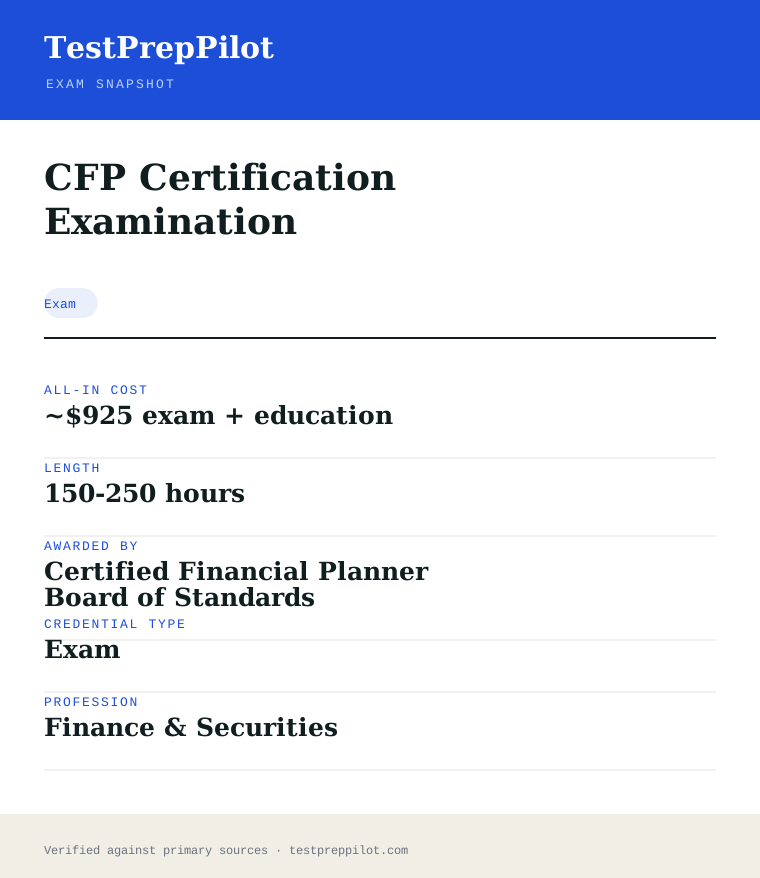
CFP Certification Examination is a exam credential; awarded by Certified Financial Planner Board of Standards; the exam fee is ~$925 exam; typical preparation is 150-250 hours; holders typically earn $99,580 median, personal financial advisors (BLS May 2024).
| Credential | CFP Certification Examination |
|---|---|
| Abbreviation | CFP exam |
| Type | Exam |
| Profession | Finance & Securities |
| Specialty | Financial Planning & Advice |
| Awarded by | Certified Financial Planner Board of Standards |
| Difficulty | Regulated |
| Typical prep time | 150-250 hours |
| All-in cost | ~$925 exam + education |
| Typical salary range | $99,580 median, personal financial advisors (BLS May 2024) |
| Credential | CFP Certification Examination |
| Awarding body | Certified Financial Planner Board of Standards |
| Exam format | Proctored, computer-based |
| Validity | Renewable with continuing education |
| Languages | Varies — see awarding body |
| Scope | National / Multi-state |
Real questions
Frequently asked questions about the CFP Certification Examination
How do I register for the CFP Certification Examination exam?
Register through Certified Financial Planner Board of Standards's official portal or an authorized test provider (e.g., Pearson VUE or Prometric where applicable). Create an account, select the exam, pay the fee, and schedule a date.
How much does the exam cost?
Fees vary by location and currency. Confirm the current fee on the official registration page before scheduling.
How long is the credential valid, and how do I renew?
Validity varies by credential (commonly 2–3 years). Renewal usually requires continuing education or a recertification exam — see Certified Financial Planner Board of Standards's policy.
What if I do not pass?
Most bodies allow retakes after a waiting period and payment of the full or partial fee. Check Certified Financial Planner Board of Standards's retake policy before rescheduling.
How do I register for a Certified Financial Planner Board of Standards credential?
Register through the official website, select your exam, pay the fee, and schedule a date.
How do I renew a credential?
Renewal policies vary by credential; check the specific program page for requirements and cycles.
In short
Is the CFP Certification Examination worth it?
- CFP Certification Examination is awarded by Certified Financial Planner Board of Standards.
- Validates job-ready competence in Finance & Securities.
- Registration is through the awarding body or an authorized test provider.
- Renewal and retake policies vary — confirm before scheduling.
Trust
Where does this information come from?
Everything above is taken from the awarding body's own published material. Fees, question counts and domain weights are revised regularly — check the official page before you pay.
- Certified Financial Planner Board of Standards Awarding body
Research confidence: low · Last reviewed 2026-08