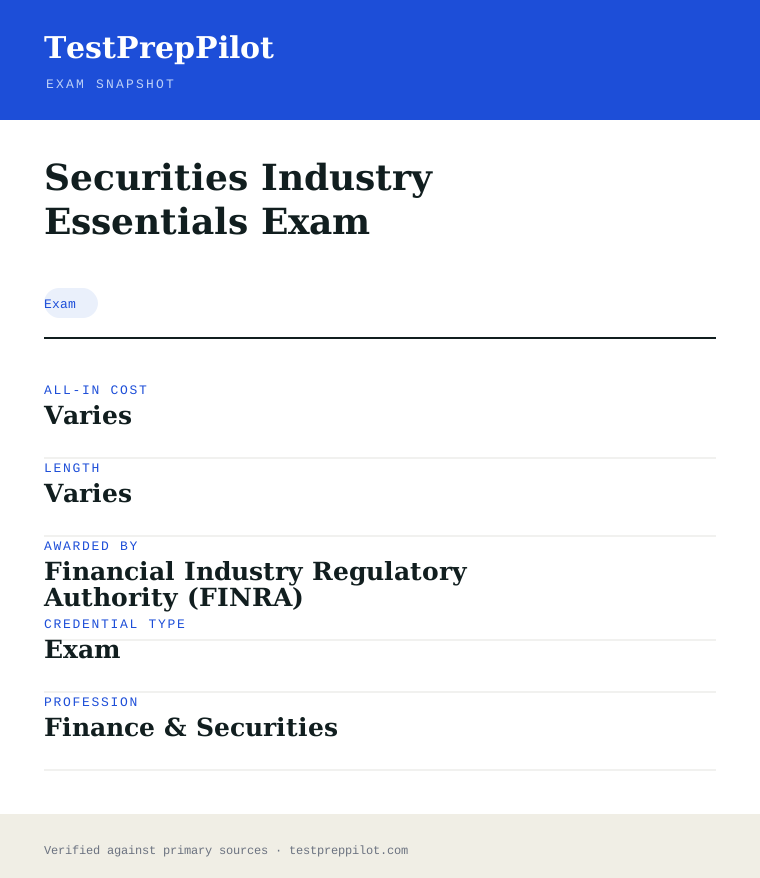
The short version
What is the Securities Industry Essentials Exam and is it worth it?
Securities Industry Essentials Exam is a professional credential administered by Financial Industry Regulatory Authority (FINRA). It validates job-ready knowledge and skills in the Finance & Securities field and is used for career entry, advancement, or compliance.
- Recognized credential from Financial Industry Regulatory Authority (FINRA)
- Demonstrates verified competence in Finance & Securities
- Supports career advancement and may satisfy licensing or employer requirements
What is it?
What exactly is the Securities Industry Essentials Exam?
Securities Industry Essentials Exam — Finance & Securities credential from Financial Industry Regulatory Authority (FINRA)
Entry-level FINRA exam on products, market structure, regulators and prohibited practices that can be taken without firm sponsorship. Offered by Financial Industry Regulatory Authority (FINRA), it is designed for candidates who need to demonstrate verified competence in the Finance & Securities field. The credential is commonly used for career entry, advancement, regulatory compliance, or employer requirements. Candidates should review the official handbook for eligibility, exam format, and scoring before registering.
The path in brief
- Confirm you meet any eligibility or prerequisites
- Review the official handbook and study materials
- Register and pay through the awarding body or authorized provider
- Schedule and take the exam (test center or online proctoring)
- Receive your score and, if passed, your credential
Before you book
Who is eligible to sit the Securities Industry Essentials Exam?
Eligibility varies; many credentials are open to all, while others require coursework, work experience, or sponsorship.
Who it is for: Professionals and candidates seeking to validate Finance & Securities competence.
The test itself
What is the format of the Securities Industry Essentials Exam?
The Securities Industry Essentials Exam is administered by Financial Industry Regulatory Authority (FINRA) and runs 105 minutes (1 hour 45 minutes).
| Administered by | Financial Industry Regulatory Authority (FINRA) |
|---|---|
| Questions | ~75 (some unscored pretest items) |
| Time limit | 105 minutes (1 hour 45 minutes) |
| Pass mark | Passing score set by the awarding body; see the official score report |
| Exam fee | $100 (raised from $80 in January 2026) |
| Format | Proctored, computer-based (test center or online remote proctoring) |
Content outline
What topics are on the Securities Industry Essentials Exam?
The Securities Industry Essentials Exam covers 4 content domains.
Weightings come from the official exam outline. Study time is best allocated in roughly these proportions rather than evenly across domains.
- Markets & products
Topic area tested on the exam; see the official blueprint for the detailed breakdown.
- Regulation & ethics
Topic area tested on the exam; see the official blueprint for the detailed breakdown.
- Analysis & valuation
Topic area tested on the exam; see the official blueprint for the detailed breakdown.
- Client & risk management
Topic area tested on the exam; see the official blueprint for the detailed breakdown.
The path
How do you register for the Securities Industry Essentials Exam?
- 1
Visit the awarding body’s official website and create an account
- 2
Select the credential and review its specific requirements
- 3
Complete any required eligibility (education, experience, or training)
- 4
Pay the registration fee
- 5
Schedule the exam at a test center or online
- 6
Take the exam and receive your results
The fine print
What are the retake and renewal rules for the Securities Industry Essentials Exam?
- Proctoring & delivery
- Proctored, computer-based delivery (test center or remote online proctoring), varying by exam.
- Retake policy
- Varies by credential — most bodies permit retakes after a waiting period and full or partial fee.
- Score reporting
- Scores are reported per the body’s timeline, typically electronically after the exam.
- Recertification
- Varies; many credentials require renewal every 2–3 years via continuing education or a recertification exam.
What it pays
How much does this credential pay?
$101,350 median for financial and investment analysts (BLS, May 2024)
There is no Bureau of Labor Statistics occupation called "SIE candidate" or "securities industry entrant", and the SIE itself is not a job — it is a knowledge exam that opens the door to representative and principal qualifying exams. The closest official wage fit for the careers the SIE feeds is Financial and Investment Analysts (SOC 13-2051), and we have chosen it deliberately because the SIE is the foundational securities-industry exam taken before, or alongside, the role-specific qualifying exams such as the Series 7 or Series 6. A candidate who clears the SIE is typically heading into a registered representative, analyst or operations role where the duties BLS describes — studying financial data, assessing investment products, supporting client accounts — are the daily work. That occupation had a May 2024 median wage of $101,350, with the lowest 10 percent earning under $62,410 and the highest 10 percent earning more than $180,550. The spread is wide because the SIE is a floor credential: it qualifies you to sit for, or work toward, the exams that lead to both junior support roles and senior advisory careers, and the wage figure above measures the whole analyst occupation rather than SIE holders narrowly. BLS projects 6 percent employment growth for financial and investment analysts from 2024 to 2034, about as fast as the average, with roughly 29,900 openings a year from both growth and replacement, and a numeric employment change of about 21,100 over the decade. The most important caveat for an SIE candidate is that passing the SIE alone does not confer a job title or a registration; it is valid for four years and must be paired with a sponsor-backed qualifying exam to become active. Read the wage figure as the destination occupation’s, not as a guaranteed SIE outcome.
| Measure | Figure | Source / note |
|---|---|---|
| Median annual wage, financial and investment analysts | $101,350 | BLS Occupational Outlook Handbook, May 2024 |
| Lowest 10 percent | less than $62,410 | BLS OOH Pay tab, May 2024 |
| Highest 10 percent | more than $180,550 | BLS OOH Pay tab, May 2024 |
| Employment, 2024 | 368,500 jobs | BLS OOH Quick Facts, 2024 |
| Projected annual openings | ~29,900 per year | BLS OOH Job Outlook, 2024-34 |
Job growth.6% projected change 2024-34 (about as fast as average), ~29,900 openings a year, +21,100 net employment; the SIE is a foundational exam for this occupation, not a standalone job credential
Source: BLS Occupational Outlook Handbook — Financial and Investment Analysts
Your odds
What are the pass rates?
FINRA publishes no current SIE pass rate — but the passing score is 70
FINRA does not publish a current pass rate for the Securities Industry Essentials exam, and candidates should treat any "SIE pass rate" percentage circulating on forums with suspicion. What is published and verifiable is the scoring rule. The SIE is scored on a 0 to 100 scale and you must achieve a 70 to pass; there is no published percentage-of-questions figure because the exam includes unscored pretest questions, so a raw count of correct answers does not map linearly to the 70 cut. FINRA includes a small number of unscored pretest questions — historically around five of the roughly 75 items presented — that are being evaluated for future use and do not count toward your score; you cannot tell them apart from scored items, so you must answer every question as if it counts. On retakes, the wait structure is fixed and worth knowing before you sit: after a first or second failed attempt you must wait 30 calendar days before retesting, and after a third or subsequent failure the wait lengthens to 180 calendar days. There is a historical, frequently cited disclosure from FINRA noting that roughly 74 percent of first-time SIE candidates passed in a sample of about 58,000 candidates, but FINRA does not present this as a live, maintained statistic, and the figure is several years old and should not be relied on as today’s rate. We have therefore left the pass-rate table empty and reported only the verifiable 70 passing score and the retake schedule. The practical implication is to study to clear 70 with margin rather than to chase a passing rate that may not describe the current candidate pool.
Read this before quoting the number.FINRA publishes no maintained current SIE pass rate. A historical disclosure cited ~74% of first-time candidates passing in a ~58,000-candidate sample, but it is not a live statistic. What is published and verifiable is the 70 passing score (0-100 scale) and the 30/180-day retake waits. We have not invented a current pass rate.
Your schedule
How long should I study for it?
35-50 hours of self-study of focused study
The SIE is unusual among the exams on this site because it requires no sponsor and no industry experience — anyone 18 or older may sit it, which makes it the natural first step for career-changers and students before they have a firm behind them. That same openness means there is no employer-driven study schedule to lean on, so a self-imposed timetable matters. The exam presents about 75 multiple-choice questions in 105 minutes (one hour and forty-five minutes), of which a handful are unscored pretest items, and you pass at a scaled 70. The content is weighted across four areas: Knowledge of Capital Markets at 16 percent, Understanding Products and Their Risks at 44 percent, Understanding Trading, Customer Accounts and Prohibited Activities at 31 percent, and the Regulatory Framework at 9 percent. Two structural facts should drive your plan. First, the Products and Risks domain alone is nearly half the exam, so it deserves close to half your study time. Second, the SIE is a breadth exam testing recognition of definitions and concepts rather than deep calculation, so spaced repetition across all four areas beats obsessive depth on one. A realistic self-study window is four to six weeks at 8 to 10 hours a week, which is enough to read the outline, drill terminology and sit two or three full timed practice exams. Because the SIE is valid for four years, many candidates take it early — even while still in school — to pair later with a sponsor-backed qualifying exam, and the plan below supports that "pass it and bank it" approach.
- Weeks 1-28-10 hrs/week
Domain foundation and capital markets
- Work the Regulatory Framework (9%) and Knowledge of Capital Markets (16%) first — they are the conceptual base the other domains build on
- Learn the structure of the securities markets: issuers, underwriters, broker-dealers, exchanges, and the role of FINRA and the SEC
- Memorise the basic product types at a definitional level before their risks are introduced
- Build a glossary of terms; the SIE is heavily definitional and recognition is the skill being tested
- Weeks 3-410-12 hrs/week
Products and risks (44%) — the heaviest domain
- Cover equities, fixed income, packaged products (mutual funds, ETFs, UITs), options and the characteristics of each
- Learn the risk profile of every product category — this domain pairs product with risk and is ~44% of the paper
- Drill the suitability and risk-matching logic rather than memorising numbers
- Use flashcards for product definitions; this is the highest-leverage block of the whole exam
- Week 58-10 hrs
Trading, accounts and prohibited activities (31%)
- Study order types, trade execution, customer account openings and the books-and-records expectations
- Learn the prohibited activities and unethical practices section carefully — it is tested sharply and is easy to under-prepare
- Connect the regulatory framework from Week 1 to the conduct rules here
- Do a first full timed practice exam at 105 minutes to establish a baseline
- Week 68-10 hrs
Full exams, retake-rule awareness and gap closing
- Sit two more full timed practice exams and review every miss against the outline
- Re-drill the Products and Risks domain, which is where most points are won or lost
- Confirm you understand the 30/180-day retake waits so a first-attempt miss is not a surprise
- Book the exam and aim to clear 70 with a comfortable margin, accounting for unscored pretest items
Adjusting the pace
Finance student or career-changer with no sponsor.Six weeks self-study. You can sit the SIE at 18 with no firm, so start early and "bank" the pass — it is valid four years and pairs later with a sponsor-backed qualifying exam.
Working in a firm that will sponsor a Series 7 next.Four weeks. Take the SIE first as the prerequisite, concentrate on Products and Risks (44%) since the 7 builds on it, and schedule the SIE close to your 7 study so the product knowledge stays warm.
Experienced in a non-securities finance role.Three to four weeks. Your capital-markets intuition transfers; spend the saved time on the precise FINRA/SEC regulatory definitions and the prohibited-activities list, which trip up people who "know finance" but not the rulebook.
How to study
How do I prepare most effectively?
The SIE rewards breadth and recognition over calculation and depth. It is a definitional exam: most items ask you to identify the correct term, the correct regulatory body, or the risk that attaches to a product, rather than to solve a quantitative problem. The single highest-leverage strategy is therefore to weight your time to match the content weights — the Products and Their Risks domain is 44 percent of the paper and should absorb close to half your effort — and to build fluent recognition of terms across all four areas. Candidates who study evenly across domains, or who over-invest in the small Regulatory Framework slice because it feels foundational, systematically under-prepare the half of the exam that actually delivers the marks.
Weight study time to the content outline, not your comfort
The four areas are weighted 16% / 44% / 31% / 9%. Products and Their Risks alone is 44%, so it deserves close to half your time even if capital markets feels more intuitive. Map every study hour to the outline percentages and resist the urge to over-polish the 9% regulatory slice at the expense of the 44% product domain.
Build a term-recognition system, not a calculation system
The SIE is overwhelmingly definitional. Make flashcards that pair a term with its exact regulatory meaning — issuer vs underwriter, market maker vs specialist, callable vs puttable bond. Recognition under a 105-minute clock is the skill; there is little arithmetic. Drill the glossary until the right term surfaces without thought.
Learn products together with their risks
The 44% domain is structured as product-plus-risk, so study each product type and then immediately its risk profile and suitable-investor fit. The exam asks which risk attaches to which instrument constantly. Treating products and risks as one combined block, rather than two passes, is the difference between a marginal and a comfortable pass.
Treat every question as scored, including pretest items
FINRA includes roughly five unscored pretest questions among the ~75 presented, and you cannot identify them. They do not count, but skipping or rushing them on the assumption they are "the throwaways" risks a scored item by mistake. Answer all 75 as if every one counts, and pace for the full set rather than for 70.
Use full timed practice exams to build the 105-minute endurance
With about 75 questions in 105 minutes you have roughly 84 seconds each — generous, but the volume means mental fatigue in the final third costs cheap points. Sit at least three full-length timed exams in one sitting so the endurance and the steady pace are trained, not discovered on exam day. Review every miss against the outline rather than just noting it.
Know the retake clock before you sit
A first or second fail triggers a 30-day wait; a third or later failure triggers a 180-day wait. This changes strategy: a marginal first attempt is worth a careful, unhurried prep rather than a rushed resit, because the waits are real and the four-year validity means there is no urgency to rush. Plan your first attempt as if it is the only one that should count.
What to buy
Which study resources are worth paying for?
The SIE is a self-study exam with no mandatory course, so the resource decision is about which question bank and outline-aligned material to buy rather than about a gatekept class. The exam fee itself is the fixed cost — $100 as of January 2026, up from $80 — paid to FINRA when you register through a FINRA-member firm or, for unsponsored candidates, through the standard enrollment process. Free official material exists: FINRA publishes the SIE content outline and a handbook, and these are the authoritative blueprint. Paid providers differentiate mainly on practice-question quality and explanations, which matter because the exam is definitional and good distractors teach the boundaries of each term.
| Resource | Price | Format | Best for |
|---|---|---|---|
| FINRA SIE content outline & handbook | Free | PDF / web | The authoritative blueprint — study against it, not instead of it |
| Exam enrollment (FINRA fee) | $100 (rose from $80 in Jan 2026) | Paid at registration | Mandatory — the fixed cost to sit the exam |
| Kaplan SIE prep (book + QBank) | ~$100-250 depending on package | Print/eBook + online QBank | Structured reading plus a large practice-question bank |
| Achievable SIE course | ~$75-150 | Adaptive online course | Budget self-study with spaced-retention built in |
| STC (Securities Training Corporation) SIE | ~$100-200 | Online course + exams | Candidates who want a guided sequence with progress tracking |
| Knopman or comparable boutique QBank | ~$80-180 | Online QBank + videos | Extra question drill and video explanation of weak areas |
Prices checked 2026-08 in USD before tax. The FINRA exam fee is $100 as of January 2026 (previously $80) and is set by FINRA, not by prep vendors. Free official outline material exists, so no paid resource is strictly required to pass. We do not rank by commission.
Avoid these
What mistakes do candidates most often make?
SIE failures cluster around four predictable errors: mis-weighting study time, underestimating the regulatory and prohibited-activities detail, misunderstanding the scoring and retake rules, and treating the exam as a math test when it is a recognition test. None of these is a knowledge gap that the outline does not cover; they are allocation and framing mistakes, and all are cheap to avoid once named.
✕Studying evenly instead of by content weight
✓The four areas are 16% / 44% / 31% / 9%. Candidates who give the 9% regulatory slice as much time as the 44% product domain systematically lose marks where they are densest. Allocate hours to the outline percentages: roughly half your time on Products and Their Risks, a third on Trading/Accounts/Prohibited, and the remainder split between Capital Markets and Regulatory.
✕Underestimating the prohibited-activities and conduct rules
✓The Trading, Customer Accounts and Prohibited Activities domain (31%) is tested sharply and trips up people who "know finance" but not the rulebook. Learn the prohibited and unethical practices explicitly rather than assuming they follow from common sense — the exam asks precisely where conduct rules draw the line.
✕Assuming the passing score is a percentage of questions answered
✓The SIE is scored 0-100 with a 70 cut, and it includes unscored pretest questions, so your raw correct count does not equal your score. Study to clear 70 with margin rather than aiming to "get 70% right", and answer all ~75 items as if scored, because you cannot identify the pretest ones.
✕Not knowing the retake wait before sitting
✓After a first or second fail you wait 30 days; after a third or later failure you wait 180 days. Candidates who treat the SIE as a low-stakes throwaway and rush a marginal first attempt can lock themselves into a long wait. Plan the first attempt as the one that should count, especially since the pass is valid four years.
✕Treating the SIE as a calculation exam
✓The exam is overwhelmingly definitional and conceptual, not quantitative. Candidates who drill formulas waste time the outline does not reward and under-drill the term recognition that actually appears. Build flashcards and recognition drills; only a light familiarity with a few quantitative concepts is needed.
✕Forgetting the SIE is only a foundation, not a registration
✓Passing the SIE alone does not make you registered or employable as a representative; it is valid four years and must be paired with a sponsor-backed qualifying exam (e.g., Series 7 or 6) to become active. Plan the SIE as step one of a sequence, not as a terminal credential, and time it so the four-year window aligns with your sponsor-backed exam.
What you'll face
What question types will I see?
The SIE presents about 75 multiple-choice questions in 105 minutes (one hour and forty-five minutes), scored on a 0 to 100 scale with a passing score of 70. A small number of those ~75 items are unscored pretest questions being evaluated for future use; they are indistinguishable from scored items, so every question must be answered as if it counts, and your raw correct count does not map directly to the 70 cut. The questions are single-answer multiple choice drawn from the four content areas: Knowledge of Capital Markets (16%), Understanding Products and Their Risks (44%), Understanding Trading, Customer Accounts and Prohibited Activities (31%), and the Regulatory Framework (9%). Unlike some FINRA qualifying exams, the SIE has no sponsor requirement and no industry experience prerequisite — any candidate aged 18 or older may sit it. The item style is definitional and conceptual: identify the correct term, the correct regulator, the risk that attaches to a product, or the conduct rule that applies to a scenario. There is little arithmetic. The practical pacing implication is that with roughly 84 seconds per question the clock is comfortable, but the volume means the final third of the exam is where fatigue silently costs recognition points, so full-length timed practice is the right preparation rather than topic-by-topic drilling alone.
Each item has one correct answer drawn from the content outline. Distractors are plausible alternative terms or regulators that test the boundary of each definition.
Asks which risk or suitable-investor fit attaches to a given instrument — equities, fixed income, packaged products, options. Recognition of the pairing is the skill.
A described situation asking which rule, prohibited practice or regulator applies. Rewards precise knowledge of the FINRA/SEC framework over general finance intuition.
Indistinguishable from scored items; included to evaluate future content. Answer all as if scored, since you cannot tell them apart.
Try these
Q1Which of the following best describes a characteristic of a municipal bond?
Answer:B
Municipal bonds are debt securities issued by states, cities and other local government entities, and the interest they pay is frequently exempt from federal (and sometimes state) income tax — the defining attraction for certain investors. A describes a corporate bond, C describes equity/stock, and D describes a derivative such as an index option. The SIE repeatedly tests the issuer and tax character of each product type, which is why knowing the product-plus-characteristic pairing is worth heavy study time.
Q2Under the regulatory framework, which entity is primarily responsible for enforcing federal securities laws and overseeing the SEC’s rulemaking?
Answer:C
The SEC is the federal agency charged with administering and enforcing the federal securities laws and overseeing the self-regulatory organizations, including FINRA. FINRA (A) is a self-regulatory organization that writes and enforces rules for broker-dealers, not the federal overseer. The MSRB (B) writes rules for municipal securities but does not enforce them. The Federal Reserve (D) sets monetary policy and regulates banks, not the securities laws generally. Distinguishing the roles of these bodies is a recurring SIE item.
Q3An associated person recommends a high-risk options strategy to an elderly, risk-averse customer with a fixed income. Under conduct rules, this is most likely a violation of:
Answer:A
Recommendations must be suitable for the customer’s profile, objectives and risk tolerance; steering a risk-averse, fixed-income elderly customer into a high-risk strategy breaches the suitability obligation, a core conduct rule in the Trading/Customer Accounts/Prohibited domain. B, C and D are real regulatory obligations but unrelated to matching a recommendation to a customer profile. The SIE tests the boundary of conduct rules precisely this way — knowing which rule applies to which fact pattern.
Samples are editor-written illustrations of the published FINRA SIE content outline, not live exam items.
The big day
What should I expect on exam day?
The SIE is delivered by Prometric, typically at a test centre, though some candidates enrol through a FINRA-member firm that may offer alternative delivery; confirm your mode when you register. Unlike the open-book CSM, the SIE is a closed-book, proctored exam: about 75 multiple-choice questions in 105 minutes, scored 0-100 with a 70 pass. The logistics therefore resemble a standard certification exam rather than a take-at-home assessment. The risks on the day are mostly about identification and pacing: Prometric requires two forms of ID with a name matching your FINRA registration exactly, and a mismatch can forfeit the sitting. The 105-minute clock is comfortable at ~84 seconds per question, so the discipline to maintain a steady pace and not burn the comfortable buffer early is what protects the final third from fatigue. You receive a preliminary result at the centre, with the official score report following through your FINRA account. Because the SIE requires no sponsor, an unsponsored 18-year-old books and sits it independently, which makes personal calendar and ID discipline the candidate’s own responsibility rather than an employer’s. Plan the attempt as the one that should count, since a third failure triggers a 180-day wait.
Bring
- Two forms of valid identification, one government-issued with photo, names matching your FINRA/SIE registration exactly
- Your SIE exam confirmation and any appointment number from Prometric
- For centre delivery: nothing else — personal items are stored in a locker
- A calm 105-minute block; the exam is closed-book, so no study materials are permitted inside
Leave at home
- Phones, smartwatches, calculators (none needed) and any study notes — stored in the locker
- Any reference material; the SIE is closed-book and proctored
- Second monitors or unauthorised devices; the testing workstation is provided
- Relying on a nickname or mismatched name on your ID — it must match the registration exactly
How the day runs
Rules in the room
- The exam is closed-book and proctored, delivered by Prometric.
- About 75 multiple-choice questions in 105 minutes; pass at a scaled 70 on a 0-100 scale.
- A small number of items are unscored pretest questions indistinguishable from scored ones.
- Two forms of ID are required, one government-issued with photo, names matching registration exactly.
- No sponsor or industry experience is required; candidates must be at least 18.
- Retake waits: 30 days after a first or second fail, 180 days after a third or later failure. The SIE is valid four years.
Afterwards.A preliminary pass or fail appears at the centre, and the official score report follows in your FINRA account. On a pass, the SIE is recorded and remains valid for four years — but note it is only a foundation: to become an active registered representative you must still pair it with a sponsor-backed qualifying exam such as the Series 7 or Series 6 within that window. Diary the four-year validity and plan the sponsored exam while the SIE knowledge is fresh. On a fail, the retake clock is what matters: a first or second failure means a 30-day wait, a third or later means 180 days, so use the wait to re-drill the outline — especially the 44% Products and Their Risks domain — rather than re-sitting on the same preparation. Because FINRA publishes no current pass rate, judge your readiness by full timed practice exams in which you clear 70 with margin, not by comparison to a pass-rate figure that is not maintained. The SIE is the cheapest, most accessible securities exam on this site precisely because it needs no sponsor; treat that independence as a reason for personal discipline, not a reason to rush.
Reference
What are the key facts about the Securities Industry Essentials Exam?
Securities Industry Essentials Exam is a exam credential; awarded by Financial Industry Regulatory Authority (FINRA); the exam fee is $100 (raised from $80 in January 2026); typical preparation is Varies.
| Credential | Securities Industry Essentials Exam |
|---|---|
| Abbreviation | SIE |
| Type | Exam |
| Profession | Finance & Securities |
| Specialty | FINRA & Securities Licensing |
| Awarded by | Financial Industry Regulatory Authority (FINRA) |
| Difficulty | Regulated |
| Typical prep time | Varies |
| All-in cost | Varies |
| Credential | Securities Industry Essentials Exam |
| Awarding body | Financial Industry Regulatory Authority (FINRA) |
| Exam format | Proctored, computer-based |
| Validity | SIE results are valid for 4 years. |
| Languages | Varies — see awarding body |
| Scope | National / Multi-state |
Real questions
Frequently asked questions about the Securities Industry Essentials Exam
How do I register for the Securities Industry Essentials Exam exam?
Register through Financial Industry Regulatory Authority (FINRA)'s official portal or an authorized test provider (e.g., Pearson VUE or Prometric where applicable). Create an account, select the exam, pay the fee, and schedule a date.
How much does the exam cost?
Fees vary by location and currency. Confirm the current fee on the official registration page before scheduling.
How long is the credential valid, and how do I renew?
SIE exam results are valid for 4 years from the passing date, after which you must retake the SIE if you have not yet used it toward a representative registration.
What if I do not pass?
Most bodies allow retakes after a waiting period and payment of the full or partial fee. Check Financial Industry Regulatory Authority (FINRA)'s retake policy before rescheduling.
How do I register for a Financial Industry Regulatory Authority (FINRA) credential?
Register through the official website, select your exam, pay the fee, and schedule a date.
How do I renew a credential?
Renewal policies vary by credential; check the specific program page for requirements and cycles.
In short
Is the Securities Industry Essentials Exam worth it?
- Securities Industry Essentials Exam is awarded by Financial Industry Regulatory Authority (FINRA).
- Validates job-ready competence in Finance & Securities.
- Registration is through the awarding body or an authorized test provider.
- Renewal and retake policies vary — confirm before scheduling.
Same awarding body
What other credentials does Financial Industry Regulatory Authority (FINRA) award?
Trust
Where does this information come from?
Everything above is taken from the awarding body's own published material. Fees, question counts and domain weights are revised regularly — check the official page before you pay.
- Financial Industry Regulatory Authority (FINRA) Awarding body
Research confidence: medium · Last reviewed 2026-08