Workplace Safety • Training
OSHA 510 Occupational Safety and Health Standards for the Construction Industry
OSHA 510 Occupational Safety and Health Standards for the Construction Industry — Safety & Environment credential from OSHA Training Institute Education Centers
Researched and maintained by TestPrepPilot Editorial BoardWorkplace safety & compliance certifications desk · Figures last verified August 2026
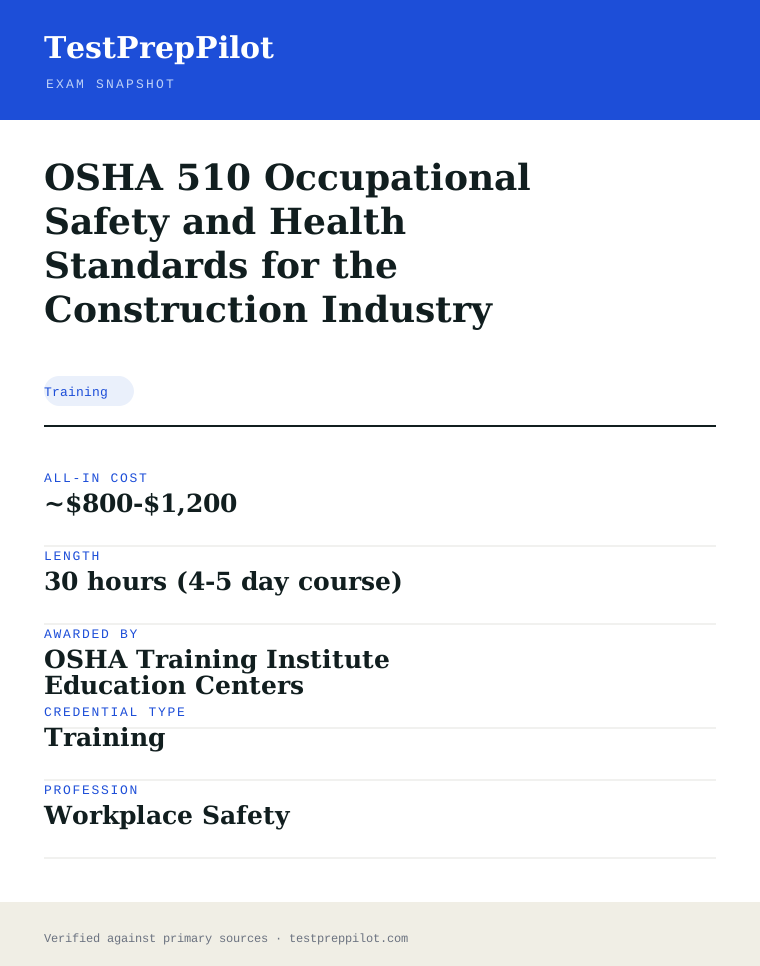
The short version
What is the OSHA 510 Occupational Safety and Health Standards for the Construction Industry and is it worth it?
OSHA 510 Occupational Safety and Health Standards for the Construction Industry is a professional credential administered by OSHA Training Institute Education Centers. It validates job-ready knowledge and skills in the Safety & Environment field and is used for career entry, advancement, or compliance.
- Recognized credential from OSHA Training Institute Education Centers
- Demonstrates verified competence in Safety & Environment
- Supports career advancement and may satisfy licensing or employer requirements
What is it?
What exactly is the OSHA 510 Occupational Safety and Health Standards for the Construction Industry?
OSHA 510 Occupational Safety and Health Standards for the Construction Industry — Safety & Environment credential from OSHA Training Institute Education Centers
Prerequisite course covering 29 CFR 1926 construction standards for candidates preparing to take the OSHA 500 trainer course. Offered by OSHA Training Institute Education Centers, it is designed for candidates who need to demonstrate verified competence in the Safety & Environment field. The credential is commonly used for career entry, advancement, regulatory compliance, or employer requirements. Candidates should review the official handbook for eligibility, exam format, and scoring before registering.
The path in brief
- Confirm you meet any eligibility or prerequisites
- Review the official handbook and study materials
- Register and pay through the awarding body or authorized provider
- Schedule and take the exam (test center or online proctoring)
- Receive your score and, if passed, your credential
Before you book
Who is eligible to sit the OSHA 510 Occupational Safety and Health Standards for the Construction Industry?
Eligibility varies; many credentials are open to all, while others require coursework, work experience, or sponsorship.
Who it is for: Professionals and candidates seeking to validate Safety & Environment competence.
The test itself
What is the format of the OSHA 510 Occupational Safety and Health Standards for the Construction Industry?
The OSHA 510 Occupational Safety and Health Standards for the Construction Industry is administered by OSHA Training Institute Education Centers and runs 30 hours (4-5 day course).
| Administered by | OSHA Training Institute Education Centers |
|---|---|
| Questions | Final exam (standards application) |
| Time limit | 30 hours (4-5 day course) |
| Pass mark | Passing score set by the awarding body; see the official score report |
| Exam fee | Varies by location and currency — confirm on the official registration page |
| Format | Proctored, computer-based (test center or online remote proctoring) |
Content outline
What topics are on the OSHA 510 Occupational Safety and Health Standards for the Construction Industry?
The OSHA 510 Occupational Safety and Health Standards for the Construction Industry covers 4 content domains.
Weightings come from the official exam outline. Study time is best allocated in roughly these proportions rather than evenly across domains.
- Hazards & controls
Topic area tested on the exam; see the official blueprint for the detailed breakdown.
- Regulations & standards
Topic area tested on the exam; see the official blueprint for the detailed breakdown.
- Monitoring & remediation
Topic area tested on the exam; see the official blueprint for the detailed breakdown.
- Emergency response
Topic area tested on the exam; see the official blueprint for the detailed breakdown.
The path
How do you register for the OSHA 510 Occupational Safety and Health Standards for the Construction Industry?
- 1
Visit the awarding body’s official website and create an account
- 2
Select the credential and review its specific requirements
- 3
Complete any required eligibility (education, experience, or training)
- 4
Pay the registration fee
- 5
Schedule the exam at a test center or online
- 6
Take the exam and receive your results
The fine print
What are the retake and renewal rules for the OSHA 510 Occupational Safety and Health Standards for the Construction Industry?
- Proctoring & delivery
- Proctored, computer-based delivery (test center or remote online proctoring), varying by exam.
- Retake policy
- Varies by credential — most bodies permit retakes after a waiting period and full or partial fee.
- Score reporting
- Scores are reported per the body’s timeline, typically electronically after the exam.
- Recertification
- Varies; many credentials require renewal every 2–3 years via continuing education or a recertification exam.
What it pays
How much does this credential pay?
$80,820 median for first-line supervisors of construction trades (BLS, May 2024)
There is no Bureau of Labor Statistics occupation called "OSHA 510" — the OSHA 510 course certifies that a participant can teach the 10- and 30-hour construction Outreach classes and serves the safety-responsible tier of the construction workforce, and the wage question belongs to the occupation you work in with it. The closest official BLS occupation is First-Line Supervisors of Construction Trades and Extraction Workers, SOC 47-1011, which had a May 2024 median wage of $80,820, with the lowest 10 percent under $52,780 and the highest 10 percent above $125,930. The fit is deliberate: the 510 is aimed at construction safety coordinators, supervisors and the workers who become OSHA-authorized trainers, and the supervisory tier is the relevant benchmark. BLS counted 700,400 first-line construction supervisor jobs in 2024 and projects a 2 percent decline from 2024 to 2034, with about 41,400 openings a year. The limitation to state plainly: the 510 is a trainer-authorisation course, not a wage credential, and its value is the authority to teach the Outreach classes and the safety-competence signal for construction safety roles. Read the number as the market for the supervisory occupations the credential serves.
| Measure | Figure | Source / note |
|---|---|---|
| Median annual wage, first-line supervisors of construction trades | $80,820 | BLS OOH, SOC 47-1011, May 2024 |
| Lowest 10 percent | Under $52,780 | BLS OOH, SOC 47-1011, May 2024 |
| Highest 10 percent | Above $125,930 | BLS OOH, SOC 47-1011, May 2024 |
| Projected openings per year | ~41,400 | BLS OOH, SOC 47-1011, 2024-2034 |
Job growth.BLS projects a 2 percent decline for first-line construction supervisors from 2024 to 2034, about 41,400 openings per year.
Source: BLS Occupational Outlook Handbook - First-Line Supervisors of Construction Trades
Your odds
What are the pass rates?
OSHA publishes no pass rate — the 510 is completed by passing the course's final exam and demonstrating the required presentation skills
The OSHA 510 course does not publish cohort pass rates, and third-party estimates are not official data, so we do not treat them as authoritative. What OSHA does publish is the structure: the 510 is a 30-hour OSHA Training Institute course (typically 4-5 days) on the OSHA standards for the construction industry, and completion requires passing the course's final exam and, in most deliveries, demonstrating the ability to present the Outreach material. The course is the prerequisite for becoming an OSHA-authorized Outreach trainer for construction (the 10- and 30-hour construction classes), and the passing standard is set by the course's final assessment. The course content covers the construction standards (29 CFR 1926): the general safety and health provisions, the hazard communication, the personal protective equipment, the scaffolding, the fall protection, the excavation and the electrical standards. The absence of a published pass rate is not an absence of standards: the final exam requires genuine mastery of the standards, and the trainer-authorisation that follows carries the responsibility of teaching the Outreach material accurately.
Read this before quoting the number.OSHA publishes the course structure but no pass rate; completion requires passing the final exam and the presentation component.
Source: OSHA - 510: Occupational Safety and Health Standards for the Construction Industry
Your schedule
How long should I study for it?
30 hours of course instruction (plus pre-course standards review) of focused study
The OSHA 510 is a 30-hour (4-5 day) instructor-led course with a final exam, so the plan is a course-participation and review plan. Step one: review the course description and the 29 CFR 1926 construction standards in advance, especially the high-frequency topics — fall protection, scaffolding, excavation, electrical and PPE — because the course moves through the standards quickly and the prior review compounds the learning. Step two: attend the full course and engage with the standards discussions, because the final exam rewards applying the standards to the scenarios the course presents. Step three: prepare for the presentation component if your delivery includes it — practising presenting the Outreach material is part of the trainer-authorisation path. Step four: pass the final exam and complete the trainer-authorisation paperwork with OSHA (the 510 alone qualifies you for the trainer-track; the 502/503 update courses maintain the authorisation). The plan is standards-heavy because the exam tests the construction standards precisely; candidates who attend passively meet the final exam unprepared.
- Before the course5
Standards review
- Review the 29 CFR 1926 high-frequency topics
- Fall protection, scaffolding, excavation, electrical, PPE
- Prepare questions on the standards
- The course (4-5 days)30
Instruction and exam
- The standards and their applications
- The final exam
- The presentation component
- After the courseVaries
Trainer authorisation
- Complete the OSHA trainer paperwork
- Plan the 502/503 update cycle
- Begin teaching the Outreach classes
Adjusting the pace
Construction safety professional.The standards are familiar from the field; focus on the trainer-authorisation path and the exam format.
Supervisor adding the trainer role.Add a review week on the high-frequency standards before the course.
How to study
How do I prepare most effectively?
The 510 rewards genuine mastery of the construction standards, so the dominant strategy is reviewing the 29 CFR 1926 standards before the course and engaging deeply during it: the final exam tests the standards precisely, and the high-frequency topics — fall protection, scaffolding, excavation, electrical and PPE — carry the most weight. Second, attend the full course and participate in the standards discussions, because the exam rewards the applications the instructor covers. Third, prepare for the presentation component: the trainer-authorisation path includes demonstrating the ability to present the Outreach material, and practising the presentation is part of the course. Fourth, plan the trainer-track deliberately: the 510 qualifies you for the Outreach-trainer authorisation, and the 502 (construction trainer update) and 503 (general-industry update) courses maintain it. Finally, remember the responsibility that follows: as an authorized trainer you teach the Outreach classes, and the accuracy of the material you deliver is part of the role.
Review the standards first
The final exam tests 29 CFR 1926 precisely; pre-review compounds the learning.
Engage in the course
The exam rewards the applications the instructor covers.
Prepare the presentation
The trainer path includes demonstrating the presentation.
Plan the trainer-track
The 502/503 update courses maintain the authorisation.
Respect the responsibility
As a trainer you teach the material; accuracy is part of the role.
What to buy
Which study resources are worth paying for?
The 510 cost is dominated by the course tuition. The OSHA Training Institute Education Centers charge roughly $800 to $1,200 for the 510 course, depending on the center; some employers fund it for safety staff and supervisors. OSHA's publications — the 29 CFR 1926 standards and the construction fact sheets — are free and are the authoritative reference. The trainer-authorisation and the update courses (502/503) add future costs. A realistic total budget is $800 to $1,500 for the course. Prices below are list prices as of mid-2026 and change frequently; we rank nothing by commission.
| Resource | Price | Format | Best for |
|---|---|---|---|
| OTI Education Center 510 course | ~$800-$1,200 | 30-hour instructor-led course | The credential itself |
| 29 CFR 1926 standards | Free | Official regulations | The authoritative reference |
| OSHA construction fact sheets | Free | Official publications | The high-frequency topics in brief |
| 502/503 update courses | ~$400-$700 each | Refresher courses | Maintaining the trainer authorisation |
List prices as of mid-2026, subject to change; course tuition varies by center; no commission or affiliate ranking is implied.
Avoid these
What mistakes do candidates most often make?
The most common 510 mistake is attending the course without the prior standards review: candidates who meet the dense standards content cold find the final exam harder than necessary, because the course moves quickly. The fix is a pre-course review of the high-frequency topics. The second mistake is treating the course as a certificate to collect rather than a trainer-authorisation path: the value is the authority to teach the Outreach classes, and candidates who ignore the presentation and the trainer paperwork leave the value unrealised. Third, some candidates confuse the 510 with the Outreach completion cards — the 510 is the trainer course, not the 10- or 30-hour worker card. Fourth, candidates skip the update-course planning and let the authorisation lapse. Finally, treating the 510 as a general safety credential rather than the construction-trainer gate misses its purpose.
✕Skipping the pre-course review
✓Review the high-frequency standards; the course moves quickly.
✕Collecting the certificate
✓The value is the trainer-authorisation path; complete the paperwork.
✕Confusing it with the Outreach cards
✓The 510 is the trainer course, not the 10/30-hour worker card.
✕Ignoring the update cycle
✓The 502/503 courses maintain the authorisation; plan them.
✕Treating it as a general credential
✓It is the construction-trainer gate; understand its purpose.
What you'll face
What question types will I see?
The OSHA 510 course is assessed with a final exam testing the construction standards, typically multiple-choice and scenario-based items on the 29 CFR 1926 topics, plus the presentation component of the trainer-authorisation path. The samples below are editor-written illustrations of the kind of standards-application items the final exam presents, not official exam items.
Applying 29 CFR 1926 to described construction situations.
Fall protection, scaffolding, excavation, electrical and PPE.
Demonstrating the ability to present the Outreach material.
Try these
Q1A worker is exposed to a fall hazard of 12 feet on a construction site. Under 29 CFR 1926, the employer must provide:
Answer:A
Construction fall protection is required at 6 feet or more under 29 CFR 1926.501 — so a 12-foot exposure requires protection. The 20-foot threshold applies to other standards, and meetings alone do not protect the worker.
Q2Before a worker enters an excavation deeper than 5 feet, the employer must ensure:
Answer:A
Excavations deeper than 5 feet require a protective system (shoring, sloping or shielding) and the required access and egress under the excavation standard. No protection, a vest alone or a waiver each fail the standard.
Q3A scaffold is erected on a construction site. Under the scaffold standard, the scaffold must be:
Answer:A
Scaffolds must support their rated load, be erected by trained workers and be used with the required fall protection under 29 CFR 1926.451. Improvised materials, inspection-only-on-problem or unsecured scaffolds each fail the standard.
Samples are editor-written illustrations of the course's standards-application style, not official exam items.
The big day
What should I expect on exam day?
There is no "exam day" in the traditional sense — the 510 is a 30-hour instructor-led course whose final exam and presentation component are completed during the course. The practical checklist is the course week: confirm the course dates, the pre-course materials the center provides, and the delivery format (in-person or online), then attend the full course, complete the final exam and the presentation, and pass both. On completion, you are eligible to apply for the OSHA Outreach trainer authorisation, which requires the 510/511 (construction/general) as the base and the update courses to maintain it. The afterwards matters: complete the trainer-authorisation application with OSHA, plan the update-cycle training, and begin delivering the Outreach classes your authorisation covers.
Bring
- Identification for the course registration
- The pre-course materials the center provides
- A focus on the trainer-authorisation path, not just the certificate
Leave at home
- Any assumption that the 510 equals the worker Outreach cards
How the day runs
Rules in the room
- The 510 is a 30-hour instructor-led course with a final exam
- The presentation component is part of the trainer-authorisation path
- The 502/503 update courses maintain the authorisation
Afterwards.On completion, apply for the OSHA trainer authorisation, plan the update cycle and begin teaching the Outreach classes.
Reference
What are the key facts about the OSHA 510 Occupational Safety and Health Standards for the Construction Industry?
OSHA 510 Occupational Safety and Health Standards for the Construction Industry is a training credential; awarded by OSHA Training Institute Education Centers; the exam fee is Varies by location and currency — confirm on the official registration page; typical preparation is 30 hours (4-5 day course); holders typically earn $53,000-$126,000.
| Credential | OSHA 510 Occupational Safety and Health Standards for the Construction Industry |
|---|---|
| Abbreviation | OSHA 510 |
| Type | Training |
| Profession | Workplace Safety |
| Specialty | OSHA Outreach & Trainer |
| Awarded by | OSHA Training Institute Education Centers |
| Difficulty | Applied |
| Typical prep time | 30 hours (4-5 day course) |
| All-in cost | ~$800-$1,200 |
| Typical salary range | $53,000-$126,000 |
| Credential | OSHA 510 Occupational Safety and Health Standards for the Construction Industry |
| Awarding body | OSHA Training Institute Education Centers |
| Exam format | Proctored, computer-based |
| Validity | The trainer authorisation is maintained with the 502/503 update courses. |
| Languages | Varies — see awarding body |
| Scope | National / Multi-state |
| Also known as | OSHA 510 |
Real questions
Frequently asked questions about the OSHA 510 Occupational Safety and Health Standards for the Construction Industry
How do I register for the OSHA 510 Occupational Safety and Health Standards for the Construction Industry exam?
Register through OSHA Training Institute Education Centers's official portal or an authorized test provider (e.g., Pearson VUE or Prometric where applicable). Create an account, select the exam, pay the fee, and schedule a date.
How much does the exam cost?
Fees vary by location and currency. Confirm the current fee on the official registration page before scheduling.
How long is the credential valid, and how do I renew?
The 510 qualifies you for the Outreach trainer authorisation, which is maintained with the 502 (construction) and 503 (general industry) update courses.
What if I do not pass?
Most bodies allow retakes after a waiting period and payment of the full or partial fee. Check OSHA Training Institute Education Centers's retake policy before rescheduling.
How do I register for a OSHA Training Institute Education Centers credential?
Register through the official website, select your exam, pay the fee, and schedule a date.
How do I renew a credential?
Renewal policies vary by credential; check the specific program page for requirements and cycles.
In short
Is the OSHA 510 Occupational Safety and Health Standards for the Construction Industry worth it?
- OSHA 510 Occupational Safety and Health Standards for the Construction Industry is awarded by OSHA Training Institute Education Centers.
- Validates job-ready competence in Safety & Environment.
- Registration is through the awarding body or an authorized test provider.
- Renewal and retake policies vary — confirm before scheduling.
Same awarding body
What other credentials does OSHA Training Institute Education Centers award?
Worth comparing
How does the OSHA 510 Occupational Safety and Health Standards for the Construction Industry compare with similar credentials?
Trust
Where does this information come from?
Everything above is taken from the awarding body's own published material. Fees, question counts and domain weights are revised regularly — check the official page before you pay.
Research confidence: medium · Last reviewed 2026-08