Workplace Safety • Training
HAZWOPER 24-Hour Training
HAZWOPER 24-Hour Training — Safety & Environment credential from Employers under OSHA 29 CFR 1910.120
Researched and maintained by TestPrepPilot Editorial BoardEnvironmental & hazardous-materials desk · Figures last verified August 2026
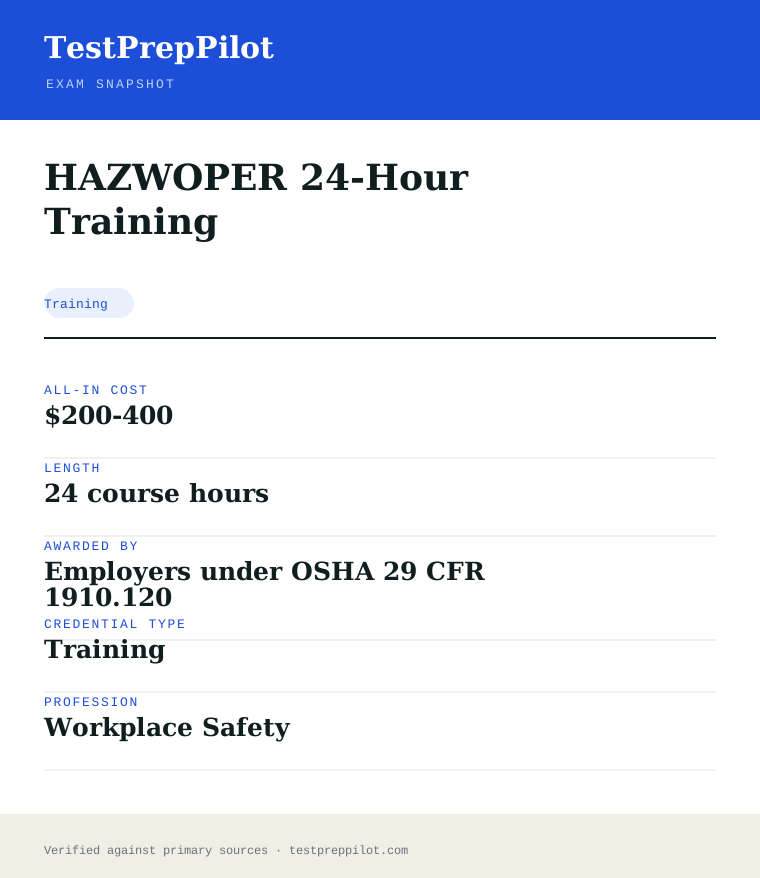
The short version
What is the HAZWOPER 24-Hour Training and is it worth it?
HAZWOPER 24-Hour Training is a professional credential administered by Employers under OSHA 29 CFR 1910.120. It validates job-ready knowledge and skills in the Safety & Environment field and is used for career entry, advancement, or compliance.
- Recognized credential from Employers under OSHA 29 CFR 1910.120
- Demonstrates verified competence in Safety & Environment
- Supports career advancement and may satisfy licensing or employer requirements
What is it?
What exactly is the HAZWOPER 24-Hour Training?
HAZWOPER 24-Hour Training — Safety & Environment credential from Employers under OSHA 29 CFR 1910.120
Training for occasional site workers and visitors unlikely to be exposed above permissible limits on hazardous waste sites. Offered by Employers under OSHA 29 CFR 1910.120, it is designed for candidates who need to demonstrate verified competence in the Safety & Environment field. The credential is commonly used for career entry, advancement, regulatory compliance, or employer requirements. Candidates should review the official handbook for eligibility, exam format, and scoring before registering.
The path in brief
- Confirm you meet any eligibility or prerequisites
- Review the official handbook and study materials
- Register and pay through the awarding body or authorized provider
- Schedule and take the exam (test center or online proctoring)
- Receive your score and, if passed, your credential
Before you book
Who is eligible to sit the HAZWOPER 24-Hour Training?
Eligibility varies; many credentials are open to all, while others require coursework, work experience, or sponsorship.
Who it is for: Professionals and candidates seeking to validate Safety & Environment competence.
The test itself
What is the format of the HAZWOPER 24-Hour Training?
The HAZWOPER 24-Hour Training is administered by Employers under OSHA 29 CFR 1910.120 and runs 24 course hours and contains 30-50 questions (provider-set) questions.
| Administered by | Employers under OSHA 29 CFR 1910.120 |
|---|---|
| Questions | 30-50 questions (provider-set) |
| Time limit | 24 course hours |
| Pass mark | Passing score set by the awarding body; see the official score report |
| Exam fee | $200-400 |
| Format | Proctored, computer-based (test center or online remote proctoring) |
Content outline
What topics are on the HAZWOPER 24-Hour Training?
The HAZWOPER 24-Hour Training covers 4 content domains.
Weightings come from the official exam outline. Study time is best allocated in roughly these proportions rather than evenly across domains.
- Hazards & controls
Topic area tested on the exam; see the official blueprint for the detailed breakdown.
- Regulations & standards
Topic area tested on the exam; see the official blueprint for the detailed breakdown.
- Monitoring & remediation
Topic area tested on the exam; see the official blueprint for the detailed breakdown.
- Emergency response
Topic area tested on the exam; see the official blueprint for the detailed breakdown.
The path
How do you register for the HAZWOPER 24-Hour Training?
- 1
Visit the awarding body’s official website and create an account
- 2
Select the credential and review its specific requirements
- 3
Complete any required eligibility (education, experience, or training)
- 4
Pay the registration fee
- 5
Schedule the exam at a test center or online
- 6
Take the exam and receive your results
The fine print
What are the retake and renewal rules for the HAZWOPER 24-Hour Training?
- Proctoring & delivery
- Proctored, computer-based delivery (test center or remote online proctoring), varying by exam.
- Retake policy
- Varies by credential — most bodies permit retakes after a waiting period and full or partial fee.
- Score reporting
- Scores are reported per the body’s timeline, typically electronically after the exam.
- Recertification
- Varies; many credentials require renewal every 2–3 years via continuing education or a recertification exam.
What it pays
How much does this credential pay?
Expect hazardous-materials-removal pay at a May 2024 median of $48,490 (BLS) — the 24-hour HAZWOPER training is the OSHA-required gate for TSD-facility and limited-site workers, and pay climbs with 40-hour certification and specialisation
The direct answer is that 24-hour HAZWOPER training is the OSHA-required entry training for a defined set of hazardous-waste workers, and the occupation it serves, hazardous materials removal workers (SOC 47-4042), earned a May 2024 median annual wage of $48,490, with the lowest 10 percent under about $34,000 and the highest 10 percent above about $75,000. The honest framing is that the 24-hour course is the lighter of the two HAZWOPER tiers: workers at hazardous-waste treatment, storage, and disposal (TSD) facilities and workers at limited-excavation or certain site operations must complete 24 hours of initial training, while workers who actually engage in cleanup operations at uncontrolled hazardous-waste sites require the 40-hour course plus three days of supervised field experience. Because the training is a compliance gate rather than a credential of record, the pay effect flows from the job category, not from the certificate itself — TSD-facility and site workers in the occupation above earn the quoted median, and pay rises with the 40-hour certification, specialised training, and union or government roles. BLS counted about 45,000 hazardous materials removal workers in 2024 and projects about 8 percent employment growth from 2024 to 2034, faster than average, driven by environmental remediation demand. The practical read: 24-hour HAZWOPER is a short (typically three-day), affordable course (usually $200 to $400, often employer-paid) that makes you employable in a compliance-bound field, and the honest career plan is to treat it as the first rung — many employers then sponsor the 40-hour course and site experience. Note that the training must be refreshed with an annual 8-hour refresher, so factor the recurring cost and time into the decision.
| Measure | Figure | Source / note |
|---|---|---|
| Median annual wage, hazardous materials removal workers | $48,490 | BLS Occupational Outlook Handbook, May 2024 (SOC 47-4042) |
| Lowest 10 percent | less than $34,000 | BLS OOH, May 2024 |
| Highest 10 percent | more than $75,000 | BLS OOH, May 2024 |
| Projected growth, 2024-34 | +8% | BLS Employment Projections |
| The training itself | Compliance gate | OSHA 29 CFR 1910.120 initial training requirement |
Job growth.BLS projects about 8% growth for hazardous materials removal workers from 2024 to 2034, faster than average, driven by environmental remediation demand.
Your odds
What are the pass rates?
No pass rate is published — HAZWOPER training is course-based with a written evaluation, and OSHA sets the hour requirements, not a national exam with a pass rate
The core fact is that there is no published pass rate for 24-hour HAZWOPER training, because OSHA’s standard (29 CFR 1910.120) specifies training hours and content but does not create a national exam — training providers deliver the course and administer their own written evaluation, which most set around a 70 percent passing line, and the standard requires that trainers verify the trainee understands the material. What OSHA publishes is the hour and content structure: the 24-hour course must cover the topics listed in the standard — health and safety hazards of hazardous waste operations, PPE selection and use, air monitoring, decontamination, the site safety plan, drum and container handling, and emergency procedures — delivered by a qualified trainer, with a written assessment that is part of the training record. Because the course is a training record rather than a licence exam, the practical pass rate is very high for candidates who attend, and the common failure mode is treating it as an attendance formality and then being unprepared for the workplace applications the employer will actually test. What matters beyond the pass is the documentation: you receive a certificate of completion naming the course hours and provider, and employers and compliance audits check that certificate, so keep it in your training file. The annual 8-hour refresher is also a requirement, not optional — a lapsed refresher voids your HAZWOPER status for the covered work. The honest preparation advice is to engage with the safety content rather than sit through it, because the written evaluation and, more importantly, the site work both test whether you learned the PPE and decontamination fundamentals.
Read this before quoting the number.No official pass rate is published; training providers administer their own written evaluations.
Source: OSHA — Hazardous Waste Operations and Emergency Response (29 CFR 1910.120)
Your schedule
How long should I study for it?
24 course hours + 2-3 review hours of focused study
Plan for the three-day, 24-hour course itself plus 2 to 3 hours of review for the written evaluation — the training is the study, and the evaluation is drawn from the course content. The 24-hour curriculum follows the OSHA standard’s topic list: recognising health and safety hazards at hazardous-waste operations, the hierarchy of controls, personal protective equipment and its limitations, air monitoring and instruments, decontamination procedures, the site safety and health plan, drum and container handling, and emergency procedures and spill response. The most efficient study approach is to treat each module as job-relevant rather than academic: the highest-yield sections are PPE selection and use, the site safety plan, and decontamination, because those are the content the written evaluation and site practice both emphasise. The day-by-day rhythm is typically day one on hazard recognition and safety plans, day two on PPE and air monitoring, and day three on decontamination, drums, and emergency response, ending with the written evaluation. The best preparation is arriving rested and treating the course as hands-on training — ask questions about the PPE and decontamination demonstrations, since the exam rewards understanding why, not just what. After the course, keep the certificate and plan the annual 8-hour refresher; if your job requires site cleanup work, discuss the employer’s plan for the 40-hour upgrade, which adds two days of training plus supervised field experience under the standard.
- Days 1-324
24-hour course
- Complete all modules: hazards, PPE, air monitoring, decontamination, emergency response
- Participate in PPE and decontamination demonstrations
- Take the written evaluation
- Follow-up1
Compliance
- Keep the certificate in your training file
- Schedule the annual 8-hour refresher
- Discuss 40-hour upgrade if doing site cleanup
Adjusting the pace
40-hour HAZWOPER.The full initial training for site cleanup workers: 40 hours plus three days of supervised field experience.
8-hour annual refresher.Required every 12 months for all covered workers to maintain HAZWOPER status.
How to study
How do I prepare most effectively?
The strategy that gets the most from 24-hour HAZWOPER is "treat it as job training, not a formality — PPE and decontamination comprehension is what the evaluation and the site both test," and the single biggest error is treating attendance as completion. A second proven approach is learning the hierarchy of controls and the PPE selection logic, because the written evaluation and workplace application both ask you to reason from the hazard to the protection. Third, study the site safety and health plan concept — what it must contain and who enforces it — since it is a recurring theme across modules. Fourth, practise the decontamination sequence as an ordered process, because both the evaluation and practical work test the order of steps. Fifth, ask about the air-monitoring instruments during the demonstrations, since instrument readings drive many real decisions and a dependable share of evaluation items. Finally, keep the documentation discipline: file the certificate, calendar the 8-hour refresher before the 12-month deadline, and if the 40-hour upgrade is your path, line it up with the employer so the training and field-experience record stays coherent.
Learn the controls hierarchy
Reasoning from hazard to protection is tested in the evaluation and on site.
Master PPE selection logic
Choosing the right protection for the hazard is core content.
Study the site safety plan
What it must contain and how it governs site work recurs across modules.
Practise decontamination order
The decontamination sequence is tested as an ordered process.
Calendar the annual refresher
A lapsed 8-hour refresher voids HAZWOPER status for covered work.
What to buy
Which study resources are worth paying for?
24-hour HAZWOPER pricing typically runs $200 to $400 for the classroom or online course, with employer-sponsored training common in the industry, and OSHA’s regulation and training guidelines are free official references. The comparison below separates classroom and online delivery, employer sponsorship, and official references, with prices current to this review. The buying rule is to confirm whether your employer covers the training before paying out of pocket, and to prefer providers whose certificates are accepted by the employers you are targeting.
| Resource | Price | Format | Best for |
|---|---|---|---|
| Classroom 24-hour HAZWOPER course | ~$300-500 | 3 days in person | Hands-on PPE and decon practice |
| Online 24-hour HAZWOPER course | ~$150-350 | Self-paced online + evaluation | Flexible scheduling |
| Employer-sponsored training | Often free | In-house or paid provider | Hiring-time candidates |
| OSHA 29 CFR 1910.120 & training guidelines | Free | Regulation text and guidance | Understanding the requirement itself |
| 8-hour annual refresher | ~$50-150 | 1-day course (online or class) | Maintaining HAZWOPER status |
Prices approximate and dated to this review; the 8-hour refresher is required every 12 months.
Avoid these
What mistakes do candidates most often make?
The most common mistake is treating the 24-hour course as an attendance formality and then being unprepared for the written evaluation and the site applications that follow; the second is confusing the 24-hour and 40-hour requirements and showing up with the wrong training for the job. A third recurring error is neglecting the decontamination and PPE content — the sections the evaluation and practical work weight most — in favour of general safety discussion. Candidates also routinely lose track of the annual refresher deadline and let their HAZWOPER status lapse, and many keep no training record, leaving employers unable to verify compliance. Finally, some candidates buy the cheapest online certificate from a provider whose documentation employers do not accept, wasting both money and time.
✕Treating the course as a formality
✓The written evaluation and site work test PPE, decon, and safety-plan comprehension.
✕Confusing 24 vs 40 hours
✓TSD and limited operations need 24; site cleanup needs 40 plus field experience.
✕Under-weighting decon and PPE
✓These are the highest-yield sections of the evaluation and the work.
✕Letting the refresher lapse
✓Calendar the 8-hour refresher before the 12-month deadline.
✕Buying an unrecognised certificate
✓Confirm employers in your field accept the provider’s documentation.
What you'll face
What question types will I see?
The 24-hour HAZWOPER written evaluation is administered by the training provider, typically 30 to 50 multiple-choice questions drawn from the OSHA-required topics: hazard recognition, controls and PPE, air monitoring, decontamination, the site safety plan, drum handling, and emergency response. Item formats include direct knowledge questions and scenario items asking the correct protective or procedural action. The samples below are editor-written illustrations of the standard course content, not live exam items.
Identifying chemical, physical, and safety hazards at hazardous-waste operations.
Selecting protection and applying the hierarchy of controls.
Instrument use and the decontamination sequence.
Plan contents, communication, and enforcement.
Spill response, evacuation, and emergency procedures.
Try these
Q1Which is the FIRST step in the hierarchy of controls for a hazardous-waste operation?
Answer:C
The hierarchy begins with eliminating or substituting the hazard; PPE is the last line of defence.
Q2When selecting PPE for a task, the decision should be based primarily on:
Answer:B
PPE selection is hazard-driven: the protection must match the identified hazards and exposure.
Q3What is the primary purpose of decontamination procedures?
Answer:B
Decontamination stops contamination from leaving the work zone and reaching workers, equipment, or the surrounding environment.
Samples are editor-written illustrations of the standard course content, not live exam items.
The big day
What should I expect on exam day?
The 24-hour HAZWOPER course ends with the provider’s written evaluation, typically 30 to 50 questions with a provider-set passing line (commonly 70 percent), administered in the classroom or online at the end of the third day. The core rules: complete the full 24 hours of training (attendance records are part of the compliance documentation), take the written evaluation, and retain your certificate of completion, which names the course hours and provider. The training record is what employers and OSHA audits check, so keep the certificate in your training file. After the course, the annual 8-hour refresher is required within 12 months, and if your work involves site cleanup, the 40-hour upgrade plus supervised field experience applies. The most useful exam-day habits: review your PPE and decontamination notes before the evaluation, answer every question (providers typically allow retakes of the written evaluation), and relate each question to the course’s demonstrations rather than memorised trivia. If you are taking the course online, complete it in the structured session format the provider requires, since the hour-tracking documentation is part of the compliance record.
Bring
- Photo ID
- Course materials for review
- Provider registration confirmation
Leave at home
- The assumption that attendance alone completes compliance
- An unstructured online "quick pass" approach
How the day runs
Rules in the room
- Full 24 hours of training required
- Provider-set passing line on the written evaluation
- Certificate must name hours and provider
- 8-hour refresher required annually
Afterwards.Completing the 24-hour training and evaluation yields HAZWOPER certification for TSD and limited operations; maintain it with the annual refresher and upgrade to 40-hour for site cleanup work.
Reference
What are the key facts about the HAZWOPER 24-Hour Training?
HAZWOPER 24-Hour Training is a training credential; awarded by Employers under OSHA 29 CFR 1910.120; the exam fee is $200-400; typical preparation is 24 course hours; holders typically earn $48,490 median, hazmat removal workers (BLS May 2024).
| Credential | HAZWOPER 24-Hour Training |
|---|---|
| Abbreviation | HAZWOPER 24 |
| Type | Training |
| Profession | Workplace Safety |
| Specialty | Hazardous Materials & Emergency Response |
| Awarded by | Employers under OSHA 29 CFR 1910.120 |
| Difficulty | Applied |
| Typical prep time | 24 course hours |
| All-in cost | $200-400 |
| Typical salary range | $48,490 median, hazmat removal workers (BLS May 2024) |
| Credential | HAZWOPER 24-Hour Training |
| Awarding body | Employers under OSHA 29 CFR 1910.120 |
| Exam format | Proctored, computer-based |
| Validity | Requires an 8-hour refresher every 12 months |
| Languages | Varies — see awarding body |
| Scope | National / Multi-state |
Real questions
Frequently asked questions about the HAZWOPER 24-Hour Training
How do I register for the HAZWOPER 24-Hour Training exam?
Register through Employers under OSHA 29 CFR 1910.120's official portal or an authorized test provider (e.g., Pearson VUE or Prometric where applicable). Create an account, select the exam, pay the fee, and schedule a date.
How much does the exam cost?
Fees vary by location and currency. Confirm the current fee on the official registration page before scheduling.
How long is the credential valid, and how do I renew?
Validity varies by credential (commonly 2–3 years). Renewal usually requires continuing education or a recertification exam — see Employers under OSHA 29 CFR 1910.120's policy.
What if I do not pass?
Most bodies allow retakes after a waiting period and payment of the full or partial fee. Check Employers under OSHA 29 CFR 1910.120's retake policy before rescheduling.
How do I register for a Employers under OSHA 29 CFR 1910.120 credential?
Register through the official website, select your exam, pay the fee, and schedule a date.
How do I renew a credential?
Renewal policies vary by credential; check the specific program page for requirements and cycles.
In short
Is the HAZWOPER 24-Hour Training worth it?
- HAZWOPER 24-Hour Training is awarded by Employers under OSHA 29 CFR 1910.120.
- Validates job-ready competence in Safety & Environment.
- Registration is through the awarding body or an authorized test provider.
- Renewal and retake policies vary — confirm before scheduling.
Same awarding body
What other credentials does Employers under OSHA 29 CFR 1910.120 award?
Worth comparing
How does the HAZWOPER 24-Hour Training compare with similar credentials?
Trust
Where does this information come from?
Everything above is taken from the awarding body's own published material. Fees, question counts and domain weights are revised regularly — check the official page before you pay.
Research confidence: low · Last reviewed 2026-08