Workplace Safety • Training
OSHA 10-Hour Maritime Industry Outreach Training
OSHA 10-Hour Maritime Industry Outreach Training — Safety & Environment credential from Occupational Safety and Health Administration (OSHA)
Researched and maintained by TestPrepPilot Editorial BoardOccupational safety & maritime training desk · Figures last verified August 2026
The short version
What is the OSHA 10-Hour Maritime Industry Outreach Training and is it worth it?
OSHA 10-Hour Maritime Industry Outreach Training is a professional credential administered by Occupational Safety and Health Administration (OSHA). It validates job-ready knowledge and skills in the Safety & Environment field and is used for career entry, advancement, or compliance.
- Recognized credential from Occupational Safety and Health Administration (OSHA)
- Demonstrates verified competence in Safety & Environment
- Supports career advancement and may satisfy licensing or employer requirements
What is it?
What exactly is the OSHA 10-Hour Maritime Industry Outreach Training?
OSHA 10-Hour Maritime Industry Outreach Training — Safety & Environment credential from Occupational Safety and Health Administration (OSHA)
Ten-hour Outreach course for shipyard, marine terminal and longshoring workers covering hazards under 29 CFR Parts 1915, 1917 and 1918. Offered by Occupational Safety and Health Administration (OSHA), it is designed for candidates who need to demonstrate verified competence in the Safety & Environment field. The credential is commonly used for career entry, advancement, regulatory compliance, or employer requirements. Candidates should review the official handbook for eligibility, exam format, and scoring before registering.
The path in brief
- Confirm you meet any eligibility or prerequisites
- Review the official handbook and study materials
- Register and pay through the awarding body or authorized provider
- Schedule and take the exam (test center or online proctoring)
- Receive your score and, if passed, your credential
Before you book
Who is eligible to sit the OSHA 10-Hour Maritime Industry Outreach Training?
None - training course
Who it is for: Professionals and candidates seeking to validate Safety & Environment competence.
The test itself
What is the format of the OSHA 10-Hour Maritime Industry Outreach Training?
The OSHA 10-Hour Maritime Industry Outreach Training is administered by Occupational Safety and Health Administration (OSHA) and runs Within the course.
| Administered by | Occupational Safety and Health Administration (OSHA) |
|---|---|
| Questions | Trainer-set (commonly 70-80% passing) |
| Time limit | Within the course |
| Pass mark | Passing score set by the awarding body; see the official score report |
| Exam fee | $50-$150 |
| Format | Proctored, computer-based (test center or online remote proctoring) |
Content outline
What topics are on the OSHA 10-Hour Maritime Industry Outreach Training?
The OSHA 10-Hour Maritime Industry Outreach Training covers 4 content domains.
Weightings come from the official exam outline. Study time is best allocated in roughly these proportions rather than evenly across domains.
- Hazards & controls
Topic area tested on the exam; see the official blueprint for the detailed breakdown.
- Regulations & standards
Topic area tested on the exam; see the official blueprint for the detailed breakdown.
- Monitoring & remediation
Topic area tested on the exam; see the official blueprint for the detailed breakdown.
- Emergency response
Topic area tested on the exam; see the official blueprint for the detailed breakdown.
The path
How do you register for the OSHA 10-Hour Maritime Industry Outreach Training?
- 1
Visit the awarding body’s official website and create an account
- 2
Select the credential and review its specific requirements
- 3
Complete any required eligibility (education, experience, or training)
- 4
Pay the registration fee
- 5
Schedule the exam at a test center or online
- 6
Take the exam and receive your results
The fine print
What are the retake and renewal rules for the OSHA 10-Hour Maritime Industry Outreach Training?
- Proctoring & delivery
- Proctored, computer-based delivery (test center or remote online proctoring), varying by exam.
- Retake policy
- Varies by credential — most bodies permit retakes after a waiting period and full or partial fee.
- Score reporting
- Scores are reported per the body’s timeline, typically electronically after the exam.
- Recertification
- Varies; many credentials require renewal every 2–3 years via continuing education or a recertification exam.
What it pays
How much does this credential pay?
OSHA 10 maritime is an entry-level safety requirement in marine operations: water transportation and related roles carry transportation-group medians near $42,740 (BLS, May 2024)
The OSHA 10-hour maritime outreach course is a voluntary-but-widely-required safety training program covering maritime workplace hazards - fall protection, personal protective equipment, hazardous materials, material handling, and the specific hazards of shipyard, marine terminal and longshoring operations. It is a training certificate, not a job license for one occupation, so no single BLS SOC code attaches to it; the salary story belongs to the maritime and transportation occupations that embed it in hiring requirements. BLS reported that transportation and material moving occupations carried a median of $42,740 in May 2024, with maritime-specific roles varying: shipyard and marine-terminal workers, longshore workers, and water-transportation support staff sit across the transportation group, and the specific wage depends on the title and the port. The structural point for workers is that the OSHA 10 certificate functions as an entry-level hireability requirement in many maritime employers’ onboarding: shipyards, marine terminals, port operators and contractors commonly require it before site access, alongside the OSHA 30 for supervisory roles, and it is cheap ($50-$150) and short (10 hours). BLS classifies workers by job duty, not training certificates, so no completion maps to a specific wage; the certificate removes a site-access barrier, and the wage follows the job. For a candidate entering maritime work, the OSHA 10 maritime certificate is the standard first safety credential, and the honest framing is that it satisfies the employer’s training requirement and supports site access, with the wage set by the specific role and port.
| Measure | Figure | Source / note |
|---|---|---|
| Transportation and material moving occupations median, May 2024 | $42,740 | BLS OEWS occupational group |
| All-occupation median, May 2024 | $49,500 | BLS OEWS |
| OSHA 10 course length | 10 hours | OSHA outreach training |
| Certificate validity | Indefinite (no expiry) | OSHA outreach cards do not expire |
Job growth.Transportation and material moving employment is projected to grow about 3 percent from 2024 to 2034; maritime hiring follows port and shipyard demand.
Source: BLS Occupational Outlook Handbook - Transportation and Material Moving Occupations
Your odds
What are the pass rates?
OSHA 10 maritime is training, not an exam: completion requires 10 hours of instruction with per-module quizzes set by the trainer
OSHA does not publish a pass rate for the 10-hour maritime outreach course because it is a training program, not a licensure exam, and OSHA does not administer or score a standardized test. The course is delivered by OSHA-authorized outreach trainers (approved through the OSHA Outreach Training Program) and consists of 10 hours of instruction covering mandatory topics - including an introduction to OSHA, fall protection, personal protective equipment, hazardous materials, and maritime-specific hazard awareness for the shipyard, marine terminal and longshoring industries - plus elective topics at the trainer’s discretion. Each trainer sets the module quizzes and any final assessment; a common pattern is per-module quizzes with a 70-80 percent passing line, and candidates must complete the full 10 hours of instruction to receive the OSHA 10 card. Because there is no standardized exam, the "pass rate" varies by trainer, and the completion card is the deliverable. The course is delivered in person (the traditional format) and online by many authorized trainers (OSHA allows online delivery of the outreach courses when the trainer is authorized). The OSHA 10 card does not expire - it has no formal validity period - though employers and sites may set their own refresher expectations, and some employers prefer a recent training date. The honest summary is that the bar is course completion with the trainer’s assessments, and the legally meaningful facts are the 10-hour requirement, the authorized-trainer delivery, and the non-expiring card.
Read this before quoting the number.No national pass rate exists; each authorized trainer sets its own quizzes. Completion requires the full 10 hours; the card does not expire.
Your schedule
How long should I study for it?
10 hours of instruction + 1 hour self-study of focused study
The OSHA 10 maritime course is 10 hours of training, typically delivered in one or two days in person or split into self-paced modules online, and a study plan is about absorbing the mandatory topics rather than weeks of preparation. The mandatory curriculum covers: an introduction to OSHA and worker rights, fall protection, personal protective equipment, hazardous materials, and maritime-specific hazard awareness (the distinct hazards of shipyard employment, marine terminals and longshoring - including working at heights on vessels, confined spaces, crane and material-handling operations, and the electrical and chemical hazards of the marine environment). A realistic plan: before the course, review the OSHA maritime fact sheets and the course outline (1 hour); during the course, complete each module’s quiz at the trainer’s passing line and ask questions on the topics most relevant to your work; after the course, keep the completion card and the course materials for reference. Because the course is trainer-delivered and the quizzes map to the modules, the failure mode is not difficulty but missing sessions - candidates who skip modules cannot complete the 10-hour requirement and do not receive the card. The most important things to retain are the worker-rights basics (how to report hazards and file complaints) and the maritime-specific hazards (falls, confined spaces, cranes, hazardous materials), because those are what employers verify in site orientations and what the course is designed to teach.
- Before the course1
OSHA basics
- Review OSHA maritime fact sheets
- Review the course outline
- The course10
10-hour training
- Complete all modules
- Module quizzes
- Receive the OSHA 10 card
Adjusting the pace
In-person vs online.Both are accepted when delivered by an authorized trainer; in-person adds interaction, online adds scheduling flexibility.
OSHA 30 for supervisors.Supervisory roles often require the 30-hour course; the 10-hour card is the entry level.
How to study
How do I prepare most effectively?
The most effective strategies for the OSHA 10 maritime course are about engagement and retention rather than exam gaming. Strategy one: attend every session and complete every module, because the 10-hour requirement is the compliance fact - missing a module means the card is not issued, and the trainer documents hours. Strategy two: connect the content to your specific work environment - whether shipyard, terminal or longshore - because the course is most valuable when the maritime-specific hazards (falls from vessels, confined spaces, crane operations, hazardous materials) are tied to the tasks you will actually do, and that linkage is what employers probe in site orientations. Strategy three: learn the worker-rights basics - how to identify hazards, report them, and file a complaint with OSHA - because these are tested in the course and are the practical core of the training. Strategy four: take the module quizzes seriously as the trainer sets them, because they are the assessment and the passing line is real even though it varies by trainer. Strategy five: keep the completion card and the course materials in your training file, because employers and sites verify the card at access, and the materials are the reference for the safety topics. Strategy six: ask the trainer about the site-specific requirements where you will work, because many employers layer their own orientation on top of the OSHA 10.
Complete every module
The 10-hour requirement is the compliance fact.
Connect to your work
Maritime-specific hazards matter most in your tasks.
Learn worker rights
Hazard reporting and complaints are the practical core.
Keep the card and materials
Sites verify the card at access.
What to buy
Which study resources are worth paying for?
The OSHA 10 maritime resource market is anchored by OSHA’s free official materials and the authorized trainers. The OSHA website publishes the maritime fact sheets, the Outreach Training Program requirements and the course outline - all free - and candidates should verify that the chosen trainer is authorized under the OSHA Outreach Training Program, because only authorized trainers can issue the official OSHA 10 card. The course fee is $50-$150 (in-person and online options; employers often pay). Commercial study guides and quiz sites exist at $10-$40 but are largely unnecessary because the course contains the content and the assessments are trainer-set; candidates should not pay extra for "guaranteed card" products, which are not part of the official program. The honest ranking: free OSHA materials, the authorized trainer’s course (the required purchase), and nothing else. Prices here are current as of 2025-26 and vary by trainer.
| Resource | Price | Format | Best for |
|---|---|---|---|
| OSHA maritime fact sheets | Free | PDF at osha.gov | Course content overview |
| Authorized 10-hour course | $50-$150 | In-person/online | The required training and the OSHA 10 card |
| OSHA Outreach Program info | Free | Web | Verifying trainer authorization |
| Commercial study guides | $10-$40 | Print/online | Unnecessary; course contains the content |
Prices dated 2025-26 and vary by trainer; verify OSHA authorization before paying. No commission-based ranking.
Avoid these
What mistakes do candidates most often make?
The most common OSHA 10 maritime mistakes are procedural. Mistake one: taking the course from a trainer who is not OSHA-authorized; the card is not the official OSHA card and may be rejected at site access, so the authorization should be verified before paying. Mistake two: skipping modules or rushing the 10 hours; the trainer documents hours, and the card is not issued without the full requirement. Mistake three: treating the course as a box to check and ignoring the content; the maritime-specific hazards (falls, confined spaces, cranes, hazardous materials) are what the employer’s site orientation and the job itself will probe. Mistake four: losing the card; employers and sites verify it at access, and a lost card requires requesting a replacement through the training program. Mistake five: assuming the course is a license; the OSHA 10 card does not certify competency for any job - it documents training - and the employer’s site-specific requirements still apply. Mistake six: paying extra for "guaranteed card" or unofficial products; the official program delivers the card through authorized trainers, and premium-priced shortcuts are not part of it. Finally, candidates should keep the card and course materials in a personal training file, because the card does not expire but employers may prefer recent training.
✕Using an unauthorized trainer
✓Verify OSHA Outreach Training Program authorization.
✕Skipping modules
✓Complete the full 10 hours; the card requires it.
✕Ignoring the content
✓The maritime hazards are what the job probes.
✕Losing the card
✓Keep it in a personal training file.
✕Paying for unofficial shortcuts
✓Only authorized trainers issue the official card.
What you'll face
What question types will I see?
The OSHA 10 maritime course uses trainer-set module quizzes rather than a standardized national exam; a common pattern is per-module quizzes with a 70-80 percent passing line, and completion requires the full 10 hours of instruction. The mandatory content covers an introduction to OSHA and worker rights, fall protection, personal protective equipment, hazardous materials, and maritime-specific hazard awareness (shipyard, marine terminal and longshoring hazards). Samples below are editor-written illustrations of the published course content, not live exam items.
Hazard recognition, reporting, complaints.
Falls on vessels, personal protective equipment.
Chemical hazards and handling in marine settings.
Shipyard, terminal and longshoring hazards.
Try these
Q1A worker on a vessel sees a fall hazard and reports it to the supervisor, who takes no action. What is the worker’s protected recourse?
Answer:A
Workers have the right to file a complaint with OSHA and are protected from retaliation for exercising their safety rights; the other options are not the protected recourse.
Q2Which topic is a mandatory component of the OSHA 10-hour maritime outreach course?
Answer:A
Fall protection is one of the mandatory topics of the 10-hour maritime outreach curriculum; the others are job skills outside the safety-training scope.
Q3An employer requires an OSHA 10 card for site access. Which statement about the card is correct?
Answer:A
The OSHA 10 card documents completion of the 10-hour training; it is not a license, does not expire, and does not replace the employer’s site-specific requirements.
Samples are editor-written illustrations of the published course content, not live exam items.
The big day
What should I expect on exam day?
The OSHA 10 maritime course has no single exam day; completion requires attending the full 10 hours of training (in person over one or two days, or self-paced online through an authorized trainer) and passing the trainer’s module quizzes. For in-person delivery, attend every session and bring photo ID for the completion record; for online delivery, complete the modules in the provider’s system and the quizzes at the passing line. After completing the course and quizzes, the trainer issues the OSHA 10 card (paper or electronic depending on the provider), and the completion is recorded with the trainer. The card does not expire. Afterwards, keep the card in a personal training file, verify whether the employer or site requires the OSHA 30 for supervisory roles, and retain the course materials as the reference for the safety topics.
Bring
- Photo ID (in-person)
- Course enrollment confirmation
- A schedule that covers the full 10 hours
- Online: stable connection for the provider system
Leave at home
- Assumptions that partial attendance earns the card
- Unofficial "guaranteed card" shortcuts
- The idea that the card is a job license
How the day runs
Rules in the room
- The trainer must be OSHA-authorized.
- The full 10 hours must be completed.
- The card documents training; it is not a license and does not expire.
- Supervisory roles often require the OSHA 30.
Afterwards.Keep the card in your training file, confirm any site-specific orientation, and consider the OSHA 30 if moving into a supervisory role.
Reference
What are the key facts about the OSHA 10-Hour Maritime Industry Outreach Training?
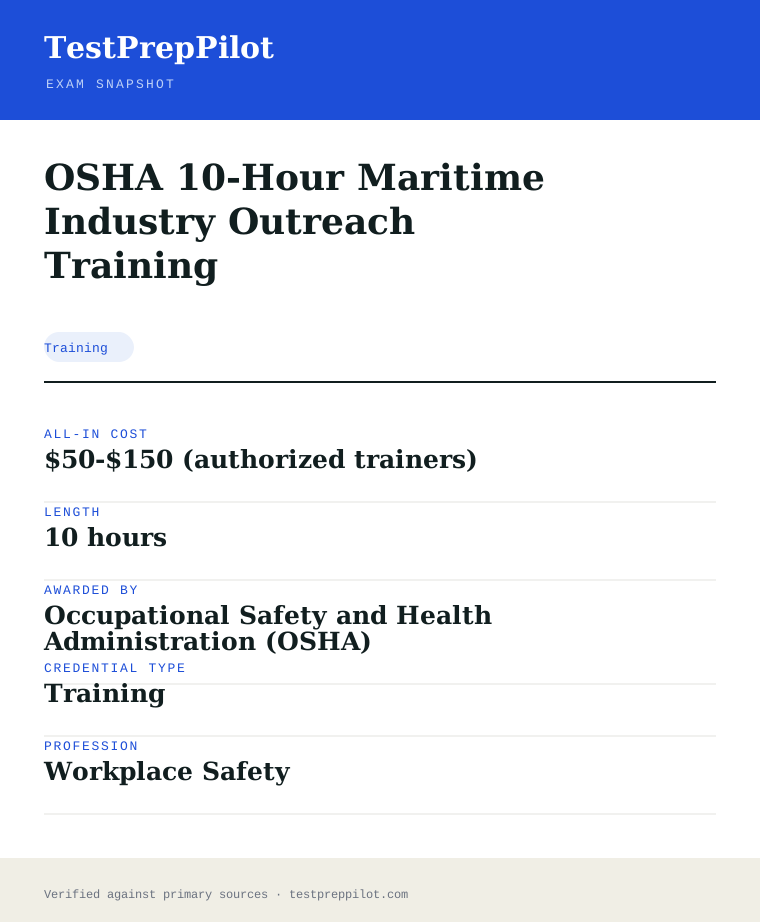
OSHA 10-Hour Maritime Industry Outreach Training is a training credential; awarded by Occupational Safety and Health Administration (OSHA); the exam fee is $50-$150; typical preparation is 10 hours; holders typically earn $35,000-$60,000 (maritime entry roles).
| Credential | OSHA 10-Hour Maritime Industry Outreach Training |
|---|---|
| Abbreviation | OSHA 10 Maritime |
| Type | Training |
| Profession | Workplace Safety |
| Specialty | OSHA Outreach & Trainer |
| Awarded by | Occupational Safety and Health Administration (OSHA) |
| Difficulty | Applied |
| Typical prep time | 10 hours |
| All-in cost | $50-$150 (authorized trainers) |
| Typical salary range | $35,000-$60,000 (maritime entry roles) |
| Credential | OSHA 10-Hour Maritime Industry Outreach Training |
| Awarding body | Occupational Safety and Health Administration (OSHA) |
| Exam format | Proctored, computer-based |
| Validity | Varies by credential (commonly 2–3 years) |
| Languages | Varies — see awarding body |
| Scope | National / Multi-state |
| Also known as | Shipyard Outreach, Marine Terminals Outreach |
Real questions
Frequently asked questions about the OSHA 10-Hour Maritime Industry Outreach Training
How do I register for the OSHA 10-Hour Maritime Industry Outreach Training exam?
Register through Occupational Safety and Health Administration (OSHA)'s official portal or an authorized test provider (e.g., Pearson VUE or Prometric where applicable). Create an account, select the exam, pay the fee, and schedule a date.
How much does the exam cost?
Fees vary by location and currency. Confirm the current fee on the official registration page before scheduling.
How long is the credential valid, and how do I renew?
The OSHA 10 maritime card documents 10 hours of training from an authorized trainer; the card does not expire and is a common site-access requirement.
What if I do not pass?
Most bodies allow retakes after a waiting period and payment of the full or partial fee. Check Occupational Safety and Health Administration (OSHA)'s retake policy before rescheduling.
How do I register for a Occupational Safety and Health Administration (OSHA) credential?
Register through the official website, select your exam, pay the fee, and schedule a date.
How do I renew a credential?
Renewal policies vary by credential; check the specific program page for requirements and cycles.
In short
Is the OSHA 10-Hour Maritime Industry Outreach Training worth it?
- OSHA 10-Hour Maritime Industry Outreach Training is awarded by Occupational Safety and Health Administration (OSHA).
- Validates job-ready competence in Safety & Environment.
- Registration is through the awarding body or an authorized test provider.
- Renewal and retake policies vary — confirm before scheduling.
Same awarding body
What other credentials does Occupational Safety and Health Administration (OSHA) award?
Worth comparing
How does the OSHA 10-Hour Maritime Industry Outreach Training compare with similar credentials?
Trust
Where does this information come from?
Everything above is taken from the awarding body's own published material. Fees, question counts and domain weights are revised regularly — check the official page before you pay.
- Occupational Safety and Health Administration (OSHA) Awarding body
Research confidence: low · Last reviewed 2026-08