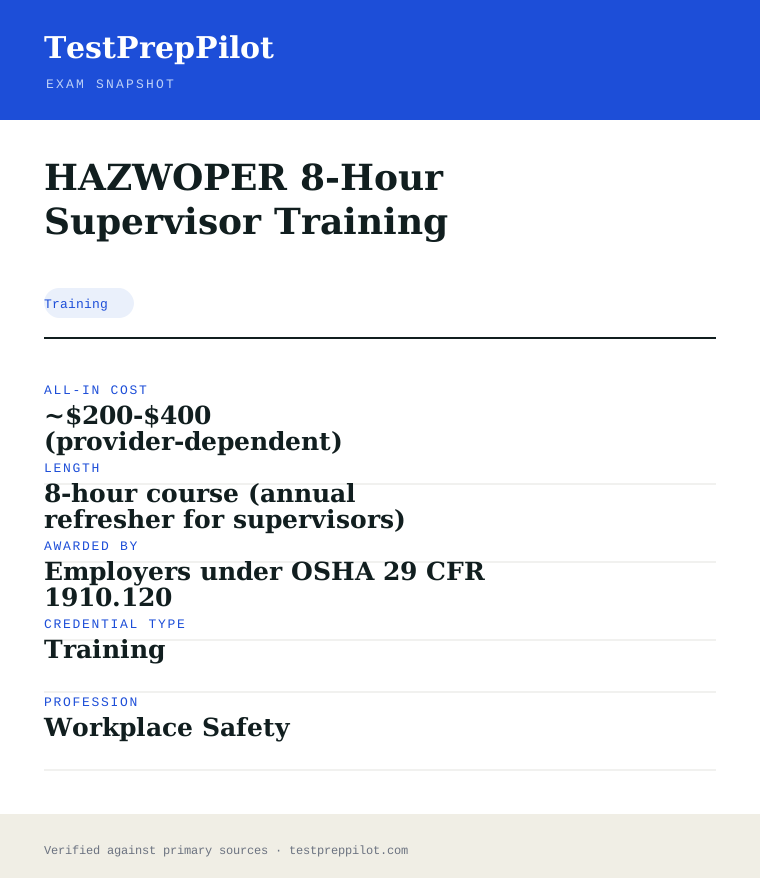
The short version
What is the HAZWOPER 8-Hour Supervisor Training and is it worth it?
HAZWOPER 8-Hour Supervisor Training is a professional credential administered by Employers under OSHA 29 CFR 1910.120. It validates job-ready knowledge and skills in the Safety & Environment field and is used for career entry, advancement, or compliance.
- Recognized credential from Employers under OSHA 29 CFR 1910.120
- Demonstrates verified competence in Safety & Environment
- Supports career advancement and may satisfy licensing or employer requirements
What is it?
What exactly is the HAZWOPER 8-Hour Supervisor Training?
HAZWOPER 8-Hour Supervisor Training — Safety & Environment credential from Employers under OSHA 29 CFR 1910.120
Supplemental training for on-site managers covering health and safety plans, monitoring programmes and spill containment oversight. Offered by Employers under OSHA 29 CFR 1910.120, it is designed for candidates who need to demonstrate verified competence in the Safety & Environment field. The credential is commonly used for career entry, advancement, regulatory compliance, or employer requirements. Candidates should review the official handbook for eligibility, exam format, and scoring before registering.
The path in brief
- Confirm you meet any eligibility or prerequisites
- Review the official handbook and study materials
- Register and pay through the awarding body or authorized provider
- Schedule and take the exam (test center or online proctoring)
- Receive your score and, if passed, your credential
Before you book
Who is eligible to sit the HAZWOPER 8-Hour Supervisor Training?
Eligibility varies; many credentials are open to all, while others require coursework, work experience, or sponsorship.
Who it is for: Professionals and candidates seeking to validate Safety & Environment competence.
The test itself
What is the format of the HAZWOPER 8-Hour Supervisor Training?
The HAZWOPER 8-Hour Supervisor Training is administered by Employers under OSHA 29 CFR 1910.120 and runs 8 hours (one day).
| Administered by | Employers under OSHA 29 CFR 1910.120 |
|---|---|
| Questions | Course assessment (provider-based) |
| Time limit | 8 hours (one day) |
| Pass mark | Passing score set by the awarding body; see the official score report |
| Exam fee | ~$200-$400 |
| Format | Proctored, computer-based (test center or online remote proctoring) |
Content outline
What topics are on the HAZWOPER 8-Hour Supervisor Training?
The HAZWOPER 8-Hour Supervisor Training covers 4 content domains.
Weightings come from the official exam outline. Study time is best allocated in roughly these proportions rather than evenly across domains.
- Hazards & controls
Topic area tested on the exam; see the official blueprint for the detailed breakdown.
- Regulations & standards
Topic area tested on the exam; see the official blueprint for the detailed breakdown.
- Monitoring & remediation
Topic area tested on the exam; see the official blueprint for the detailed breakdown.
- Emergency response
Topic area tested on the exam; see the official blueprint for the detailed breakdown.
The path
How do you register for the HAZWOPER 8-Hour Supervisor Training?
- 1
Visit the awarding body’s official website and create an account
- 2
Select the credential and review its specific requirements
- 3
Complete any required eligibility (education, experience, or training)
- 4
Pay the registration fee
- 5
Schedule the exam at a test center or online
- 6
Take the exam and receive your results
The fine print
What are the retake and renewal rules for the HAZWOPER 8-Hour Supervisor Training?
- Proctoring & delivery
- Proctored, computer-based delivery (test center or remote online proctoring), varying by exam.
- Retake policy
- Varies by credential — most bodies permit retakes after a waiting period and full or partial fee.
- Score reporting
- Scores are reported per the body’s timeline, typically electronically after the exam.
- Recertification
- Varies; many credentials require renewal every 2–3 years via continuing education or a recertification exam.
What it pays
How much does this credential pay?
$48,490 median for hazardous materials removal workers (BLS, May 2024)
The national median wage for hazardous materials removal workers was $48,490 in May 2024 (BLS, SOC 47-4041), and that is the field the HAZWOPER 8-hour supervisor course serves — the course is a training requirement for supervisors and managers at hazardous waste operations, not a credential with its own wage line, so the salary story belongs to the occupation. The lowest 10 percent of hazardous materials removal workers earned less than $36,600 and the highest 10 percent more than $82,590 in the same period, and BLS counted 51,300 jobs in 2024, projecting only 1 percent growth from 2024 to 2034 — slower than the average for all occupations — with about 5,000 openings a year, almost all arising from replacement need as workers retire or move on. Read those numbers with the standard caveats for this field. First, the median spans every sector that employs hazmat removal workers — remediation and waste management services employ the largest share — and pay varies by region and by the hazardous substances involved. Second, a supervisor course does not by itself change wages; its value is regulatory: OSHA requires supervisors and managers at covered operations to complete specified initial and refresher training, so the course keeps the holder employable and compliant in a role that is already held, rather than unlocking a new occupation. Third, BLS classifies by job duties, not by certificate, so no credential maps to a specific wage. The honest framing: this is a compliance training with a modest cost and an annual renewal, taken by people already working in the field, and its wage effect is indirect — staying current keeps a worker and a supervisor employable under the law.
| Measure | Figure | Source / note |
|---|---|---|
| Median annual wage, hazardous materials removal workers | $48,490 | BLS OOH, SOC 47-4041, May 2024 |
| Lowest 10 percent | Under $36,600 | BLS OOH Pay tab, May 2024 |
| Highest 10 percent | Above $82,590 | BLS OOH Pay tab, May 2024 |
| Employment, 2024 | 51,300 jobs | BLS OOH Quick Facts, 2024 |
| Projected annual openings | ~5,000 per year | BLS OOH Job Outlook, 2024-34 — almost all replacement need |
Job growth.BLS projects 1 percent growth for hazardous materials removal workers from 2024 to 2034, with about 5,000 openings a year, almost all from replacement demand.
Source: BLS Occupational Outlook Handbook - Hazardous Materials Removal Workers
Your odds
What are the pass rates?
There is no national pass rate — OSHA requires the training hours, and each provider sets its own assessment
There is no national pass rate for the HAZWOPER 8-hour supervisor course, and we state that plainly: OSHA does not administer the course or publish pass statistics, and the regulation that creates it — 29 CFR 1910.120(e)(4) for the initial eight hours of supervisor training, and 1910.120(e)(8) for the annual eight hours of refresher training required of employees, managers and supervisors — specifies training hours and content, not a standardized examination. What is published is the requirement itself. Under 1910.120(e)(4), on-site management and supervisors who direct employees engaged in hazardous waste operations must receive eight hours of training on the items in paragraph (e)(2) plus the supervisor topics in (e)(4) — the employer’s safety and health program, hazards of the operation, respiratory protection, decontamination procedures and, for supervisors, management’s role in worker health and safety. Under (e)(8), those same employees, managers and supervisors must receive eight hours of refresher training annually, covering the listed topics plus critiques of incidents from the past year. Because the requirement is training hours rather than a standardized exam, each provider sets its own assessment — typically module quizzes and a final exam with a provider-defined passing score such as 70 percent, with unlimited retakes in many courses. The certificate of completion attests to the hours, and it is that certificate, issued by a provider, that employers and auditors look for. The practical reading: verify the provider’s course actually cites the correct section — (e)(4) for initial supervisor training and (e)(8) for the annual refresher — because a generic refresher does not satisfy the supervisor-specific initial requirement.
Read this before quoting the number.OSHA does not publish pass rates for HAZWOPER courses; the regulation requires training hours and content, and providers set their own assessments. We have deliberately left the pass-rate table empty.
Your schedule
How long should I study for it?
8-12 hours of coursework over 2-4 weeks, matching the 8-hour training requirement of focused study
The HAZWOPER 8-hour supervisor course is a short compliance course rather than a career exam, so the study plan is compact: plan for roughly 8 to 12 hours of coursework over two to four weeks, of which eight hours is the course itself, plus review time, and the total is fixed by the requirement rather than by difficulty. Week 1 is orientation: confirm you are taking the right course for your role. The 8-hour supervisor course under 29 CFR 1910.120(e)(4) is the initial supervisor-specific training for on-site management and supervisory personnel who have already completed the 40-hour or 24-hour initial worker training; the separate 8-hour annual refresher under (e)(8) is required every twelve months thereafter. Taking the wrong one leaves you non-compliant, which is the single most expensive mistake. Weeks 1-2 cover the course modules: the HAZWOPER standard and its scope, the employer’s safety and health program, hazard recognition and toxicology, personal protective equipment and respirators, decontamination, site control and work zones, and — specifically for supervisors — management’s role in safety and health, supervision and leadership, and the financial impact of risk management. Work through the modules in order, take the module quizzes as they come, and save any final exam for a single timed pass. Week 3 is the exam and the certificate: complete the final assessment, download the certificate of completion, and file it with your training records. After that, diary the twelve-month renewal date immediately, because missing the annual refresher window may require repeating the full initial training rather than just the refresher.
- Week 12
Confirm the right course
- Confirm the course covers 29 CFR 1910.120(e)(4) for supervisor training and (e)(8) for the annual refresher
- Check the provider’s certificate and renewal terms
- Review the HAZWOPER standard scope and which operations it covers
- Weeks 1-26
Course modules
- The safety and health program, hazard recognition and toxicology
- PPE, respirators, decontamination, site control and work zones
- Supervisor topics: management’s role, leadership, risk management
- Week 32
Exam and certificate
- Complete the provider’s final assessment
- Download and file the certificate of completion
- Diary the 12-month renewal date
Adjusting the pace
Taking the course as initial supervisor training.Under 1910.120(e)(4), supervisors at covered operations complete eight hours of supervisor-specific training in addition to the 40- or 24-hour initial training; this is the supervisor course, not the annual refresher.
Taking it as the annual refresher.Under 1910.120(e)(8), employees, managers and supervisors complete eight hours of refresher training every twelve months; if you have already completed initial supervisor training, this is the renewal course.
Construction-sector worker.The parallel construction standard at 29 CFR 1926.65 imposes the same supervisor and refresher requirements; confirm the provider’s course cites 1926.65(e) if you work in construction.
How to study
How do I prepare most effectively?
Because the HAZWOPER 8-hour supervisor course is a compliance training with a fixed eight-hour requirement rather than a competitive exam, the dominant strategy is confirmation before completion: make sure the course you buy matches your regulatory situation, then work the modules thoroughly and keep the documentation. First, confirm the section citation before paying. The initial supervisor course must satisfy 29 CFR 1910.120(e)(4) (or 1926.65(e)(4) in construction); the annual renewal must satisfy (e)(8) — and a generic worker refresher will not stand in for the supervisor-specific initial training, so read the provider’s stated objectives before enrolling. Second, work the modules in order rather than clicking through: the content is short and applied — hazard recognition, PPE selection, decontamination, site control and the supervisor’s role in the safety and health program — and the module quizzes keep the knowledge in place for the final assessment. Third, take the supervisor material seriously rather than skimming it: the (e)(4) topics on management’s role, supervision and leadership and the financial impact of risk management are what distinguish the supervisor course from the worker refresher, and they are the content an auditor or employer would expect a supervisor to be able to apply. Fourth, treat the final assessment as a timed pass: most providers set a passing score such as 70 percent with unlimited retakes, but a clean first pass is faster and costs nothing. Finally, manage the documentation trail: download the certificate immediately, keep the course records with your training file, and diary the twelve-month renewal — missing the window can mean repeating the full initial training rather than just the refresher.
Confirm the citation before buying
The initial supervisor course must cite (e)(4); the annual renewal must cite (e)(8); a generic worker refresher does not substitute for the supervisor course.
Work the modules in order
The content is short and applied; module quizzes keep the knowledge in place for the final assessment.
Give the supervisor topics weight
Management’s role, leadership and risk management are what distinguish the supervisor course from the worker refresher.
Pass the final assessment cleanly
Most providers set a score such as 70 percent with unlimited retakes, but a clean first pass is faster.
Keep the documentation
Download the certificate, file the records, and diary the 12-month renewal — missing it can mean repeating initial training.
What to buy
Which study resources are worth paying for?
The HAZWOPER 8-hour supervisor course is sold by many online OSHA training providers, and the honest comparison is mostly about price, citation accuracy and certificate handling, because the content is regulated and largely standardised across providers. Online courses typically run from about $40 to $150, include the eight hours of module content plus quizzes and a final exam, and deliver an instantly downloadable certificate of completion valid for twelve months; some add a printed or wallet-size card for a small fee. The authoritative free resources are the regulation itself at 29 CFR 1910.120 and the OSHA HAZWOPER page, which every candidate should read before choosing a provider to verify what the course must cover and which section applies. Employer-sponsored training is the best value where available, because many employers arrange and pay for the course for their staff. The only real trap in the market is the wrong course: buying a worker refresher when you need the supervisor course, or a course that does not cite the correct regulatory section for your sector — that is where candidates waste money, and it is the reason the free OSHA text should come before any purchase. Prices below are list prices as of mid-2026 and change frequently; we rank nothing by commission. The comparison worth making carefully is between the initial supervisor course and the annual refresher: they are different products sold in the same eight-hour form, and the providers that list both make the distinction clearly on the course page — the supervisor course must cite 1910.120(e)(4) and cover the supervisor-specific topics, while the refresher must cite (e)(8). A candidate who enrols in the wrong one has paid for training hours that do not satisfy the requirement. Also compare the certificate itself: the practical difference between providers is less about content than about documentation, so check that the certificate of completion names the course, the regulatory section, the completion date and the provider, because auditors and employers rely on that document to verify compliance. Finally, read the renewal terms before buying: the certificate is valid twelve months, and the annual refresher must be completed within that window, so a course bought late in the cycle may leave very little time before the next renewal is due — a planning detail that quietly triples the annual cost for disorganised candidates.
| Resource | Price | Format | Best for |
|---|---|---|---|
| OSHA HAZWOPER standard, 29 CFR 1910.120 | Free | Official regulation text | Verifying the (e)(4) and (e)(8) requirements before buying |
| Online 8-hour supervisor course | ~$40-150 | Self-paced online modules plus final exam | Meeting the 8-hour supervisor or annual refresher requirement |
| Certificate of completion (with optional card) | Included; optional card ~$10-25 | Downloadable PDF or mailed card | The compliance document employers and auditors check |
| Employer-sponsored training | Often free to the employee | Employer-arranged course | Workers whose employer covers the annual requirement |
| Provider customer support | Included | Email/phone | Questions on citation coverage and renewal terms |
List prices as of mid-2026, subject to change; the regulation text is free and should be read before any purchase. No commission-based ranking.
Avoid these
What mistakes do candidates most often make?
The most common HAZWOPER supervisor-course mistake is buying the wrong course: candidates who need the initial eight hours of supervisor training under 29 CFR 1910.120(e)(4) purchase a generic worker refresher, or workers who need the annual refresher under (e)(8) take a supervisor course, and neither satisfies the requirement. The fix is to read the citation on the provider’s course page before paying. The second mistake is letting the certificate expire: the course is valid for twelve months, and missing the annual window can mean repeating the full 40-hour or 24-hour initial training rather than just the eight-hour refresher. Third, candidates skim the supervisor-specific content — management’s role, leadership and risk management — because they assume it is the same as the worker material, and then cannot apply it on site. Fourth, some candidates fail to keep the certificate and training records, which is a documentation failure that surfaces in audits and site access checks. Finally, candidates choose on price alone without checking the section citation or the provider’s stated coverage, which is how a cheap course becomes a wasted one. The course is short and inexpensive; the expensive mistakes are entirely about selecting the right requirement and keeping the paperwork current. One further mistake deserves separate mention because it is the easiest to make and the hardest to notice: treating the eight-hour refresher as a new initial training. The annual refresher under (e)(8) is not a replacement for the 40-hour or 24-hour initial training, and it is not a supervisor upgrade — it is a maintenance requirement for people who already hold the underlying training, so a worker who has never completed the initial course cannot use the refresher to become compliant. Similarly, the initial supervisor course under (e)(4) sits on top of the worker training and does not replace it, so a supervisor who takes only the supervisor course remains non-compliant at the worker level. Reading the regulatory section of the standard before enrolling eliminates this entire category of error, because the standard itself states who must hold which training, and that text is free. Finally, keep the renewal on the calendar rather than relying on provider reminders, because the twelve-month window is measured from the previous training date and a lapse means repeating the full initial course at a far higher cost in time and money.
✕Buying the wrong course
✓Verify the citation: (e)(4) for initial supervisor training, (e)(8) for the annual refresher, and 1926.65(e) for construction.
✕Letting the certificate lapse
✓Renew within 12 months; missing the window can mean repeating the full initial training.
✕Skimming the supervisor content
✓Management’s role, leadership and risk management are what make it a supervisor course.
✕Losing the documentation
✓Download the certificate and keep it with your training records for audits and site access.
✕Choosing on price alone
✓Check the section citation and stated coverage first; a cheap course that does not fit is a wasted one.
What you'll face
What question types will I see?
The HAZWOPER 8-hour supervisor course is provider-administered rather than a standardized national exam, so the question types are set by each provider, but the pattern is consistent across the major online courses: module quizzes plus a comprehensive final examination, using multiple-choice and true/false items, with a passing score set by the provider — commonly around 70 percent, frequently with unlimited retakes. The content follows the regulated topics of 29 CFR 1910.120(e)(2) and (e)(4): the elements of the employer’s safety and health program; hazard recognition, toxicology and the properties of hazardous substances; selection and use of personal protective equipment and respirators; decontamination procedures; site control and work zones; and, for the supervisor course, management’s role in worker health and safety, supervision and leadership, and the financial impact of risk management. Items tend to be applied rather than theoretical — identifying the correct PPE for a described task, the correct sequence in a decontamination line, or the supervisor’s responsibility in a described site situation. There is no nationally standardized item bank and no national pass rate; the assessment exists to confirm engagement with the training hours, and the certificate of completion is the compliance document that matters. Samples below are editor-written illustrations of the content areas in the published regulation, not live course items. The practical shape of the assessment matters for planning: because the final examination commonly allows unlimited retakes at a provider-set score such as 70 percent, the risk of failing the course is low, and the real risk is the administrative one — completing the modules but never finishing the final exam inside the access window, or finishing but losing the certificate. Candidates should therefore treat the course as a fixed eight-hour commitment with a documentation outcome: work the modules at a steady pace, take the quizzes as they come, complete the final assessment in a single session, and download the certificate immediately. The item style also rewards practical recall rather than memorised regulation numbers: expect questions that describe a site situation and ask for the correct equipment, the correct sequence or the correct supervisor action, so studying the concepts as they apply to real operations beats memorising the text of the standard. Because there is no national item bank, the samples here illustrate the content areas rather than any specific provider’s questions, and the provider’s own demo or sample questions, where offered, are the most accurate preview of the final assessment.
Provider-written items checking engagement with each regulated topic as you go.
A provider-set assessment across the full syllabus, commonly with a ~70% pass line and unlimited retakes.
The right PPE, the correct decontamination sequence or the supervisor’s responsibility in a described site situation.
Try these
Q1A supervisor at a hazardous waste site is asked which elements the employer’s safety and health program must include under the HAZWOPER standard. Which list is correct?
Answer:A
The program elements in 29 CFR 1910.120(b) and the training content in (e)(2) span the safety and health program, hazard recognition, PPE and respirators, decontamination and site control. The other options are single, narrow items that do not constitute the program.
Q2Under 29 CFR 1910.120(e)(4), the supervisor-specific portion of the training must include topics beyond the worker items. Which topic is supervisor-specific?
Answer:A
The (e)(4) supervisor training adds management’s role in worker health and safety, supervision and leadership, and the financial impact of risk management to the (e)(2) worker topics. The other options are general, incidental or simply outside the standard’s training content.
Q3A HAZWOPER-trained worker completed the eight-hour annual refresher on 1 March this year. Under 29 CFR 1910.120(e)(8), when is the next refresher required?
Answer:A
Paragraph (e)(8) requires eight hours of refresher training annually for covered employees, managers and supervisors. The requirement is calendar-based at twelve-month intervals; it does not depend on task changes, project starts or incident history.
Q4A decontamination line at a hazardous waste site requires equipment to be cleaned in a specific sequence. Which statement best describes the supervisor’s responsibility regarding that line?
Answer:A
Site control and decontamination procedures are part of the safety and health program, and the supervisor’s role is to ensure the documented procedures are followed. Discretionary shortcuts and deferred decontamination contradict the standard’s training and program requirements.
Samples are editor-written illustrations of the content areas in 29 CFR 1910.120, not live course items; providers set their own assessments.
The big day
What should I expect on exam day?
The HAZWOPER 8-hour supervisor course is almost always taken online, self-paced, so "exam day" is the session in which you complete the final assessment, and the practical rules are about finishing cleanly and capturing the certificate. Before you start, confirm the course actually covers the right requirement — 29 CFR 1910.120(e)(4) for the initial supervisor course or (e)(8) for the annual refresher, with the construction parallel at 1926.65(e) if that is your sector — and set aside enough uninterrupted time to finish, because most providers require the modules and the final exam to be completed within a defined access window. Bring your own notes from the modules if the provider permits them; the final exam typically draws on the module content, and a passing score such as 70 percent is set by the provider. There is no in-person testing venue for the typical online course, but some employers or classroom providers offer an in-person option, in which case the rules are the classroom trainer’s. On completion, download the certificate of completion immediately and save a copy outside the provider’s platform, because access windows close. Then diary the twelve-month renewal date, and note the certificate in your training records with the course title, provider, date and the regulatory section it satisfies, so that audits and site access checks have what they need. One practical distinction shapes the day: the eight-hour requirement is a duration requirement, so most online providers gate the final assessment behind the full course content and some track elapsed time — candidates should therefore expect to complete the modules before the final exam unlocks, and should set aside the full session rather than trying to rush through. The assessment itself is rarely the obstacle, because unlimited retakes are common, so the failure mode to plan against is the access window closing with the final exam unfinished, or the certificate being lost when the platform account expires. For an employer-sponsored or classroom version, the rules are the trainer’s: attend the full session, complete the in-class exercises, and collect the certificate before leaving. Where online proctoring is offered for the final exam, complete the system check in advance and follow the proctor’s room rules. Finally, the supervisor course and the annual refresher both produce the same kind of document, so keep the certificate with the course name, date and regulatory section visible, and if a site or an auditor asks for proof of the (e)(4) versus (e)(8) distinction, the citation on the certificate is the answer.
Bring
- A reliable internet connection and the provider account you registered with
- The course confirmation and the regulatory section you are satisfying ((e)(4) or (e)(8), or 1926.65(e))
- Notes from the modules if the provider permits them for the final assessment
- A quiet block of uninterrupted time to complete the course and final exam
- A place to save the certificate and your training record file
Leave at home
- No printed admission materials are required for a typical online course
- Distractions for the session — the modules and final exam need focused time
- Any assumption that a certificate from last year satisfies this year’s requirement
- Nothing else — the online format is the entire test venue
How the day runs
Rules in the room
- The training requirement is eight hours of content under 29 CFR 1910.120(e)(4) or (e)(8), or the construction parallel at 1926.65(e).
- Providers set their own assessments; there is no national pass rate or standardized exam.
- The certificate of completion is the compliance document; download and keep it.
- The course is valid for 12 months; the annual refresher must follow within that window.
- Missed renewal may mean repeating the full initial 40- or 24-hour training.
- Confirm the correct citation for your role and sector before purchasing.
Afterwards.Completing the 8-hour HAZWOPER supervisor course or annual refresher produces a certificate of completion, and the value of that document is purely compliance: it attests that you have met the training hours that 29 CFR 1910.120 requires of employees, managers and supervisors at covered hazardous waste operations, and employers and auditors will ask for it. Download it immediately, keep a copy outside the provider’s platform, and record it in your training file with the course title, provider, completion date and the regulatory section it satisfies. The single most important follow-up is the calendar: the certificate is valid for twelve months, the next eight-hour refresher is due within that window under (e)(8), and letting it lapse can mean repeating the full 40-hour or 24-hour initial training rather than taking the shorter renewal — a large, avoidable cost. If you took the initial supervisor course under (e)(4), remember that it sits on top of the 40- or 24-hour worker training and does not replace it, and that your continuing annual refresher must be the (e)(8) course. For construction-sector work, keep the parallel 1926.65(e) requirements in view. The regulatory citation, not the price of the course, is what makes the certificate valid — keep both on record.
Reference
What are the key facts about the HAZWOPER 8-Hour Supervisor Training?
HAZWOPER 8-Hour Supervisor Training is a training credential; awarded by Employers under OSHA 29 CFR 1910.120; the exam fee is ~$200-$400; typical preparation is 8-hour course (annual refresher for supervisors); holders typically earn $38,000-$70,000 (47-4042 median $48,490).
| Credential | HAZWOPER 8-Hour Supervisor Training |
|---|---|
| Abbreviation | HAZWOPER Supervisor |
| Type | Training |
| Profession | Workplace Safety |
| Specialty | Hazardous Materials & Emergency Response |
| Awarded by | Employers under OSHA 29 CFR 1910.120 |
| Difficulty | Applied |
| Typical prep time | 8-hour course (annual refresher for supervisors) |
| All-in cost | ~$200-$400 (provider-dependent) |
| Typical salary range | $38,000-$70,000 (47-4042 median $48,490) |
| Credential | HAZWOPER 8-Hour Supervisor Training |
| Awarding body | Employers under OSHA 29 CFR 1910.120 |
| Exam format | Proctored, computer-based |
| Validity | Annual refresher required per 29 CFR 1910.120 |
| Languages | Varies — see awarding body |
| Scope | National / Multi-state |
Real questions
Frequently asked questions about the HAZWOPER 8-Hour Supervisor Training
How do I register for the HAZWOPER 8-Hour Supervisor Training exam?
Register through Employers under OSHA 29 CFR 1910.120's official portal or an authorized test provider (e.g., Pearson VUE or Prometric where applicable). Create an account, select the exam, pay the fee, and schedule a date.
How much does the exam cost?
Fees vary by location and currency. Confirm the current fee on the official registration page before scheduling.
How long is the credential valid, and how do I renew?
Validity varies by credential (commonly 2–3 years). Renewal usually requires continuing education or a recertification exam — see Employers under OSHA 29 CFR 1910.120's policy.
What if I do not pass?
Most bodies allow retakes after a waiting period and payment of the full or partial fee. Check Employers under OSHA 29 CFR 1910.120's retake policy before rescheduling.
How do I register for a Employers under OSHA 29 CFR 1910.120 credential?
Register through the official website, select your exam, pay the fee, and schedule a date.
How do I renew a credential?
Renewal policies vary by credential; check the specific program page for requirements and cycles.
In short
Is the HAZWOPER 8-Hour Supervisor Training worth it?
- HAZWOPER 8-Hour Supervisor Training is awarded by Employers under OSHA 29 CFR 1910.120.
- Validates job-ready competence in Safety & Environment.
- Registration is through the awarding body or an authorized test provider.
- Renewal and retake policies vary — confirm before scheduling.
Trust
Where does this information come from?
Everything above is taken from the awarding body's own published material. Fees, question counts and domain weights are revised regularly — check the official page before you pay.
Research confidence: low · Last reviewed 2026-08