Workplace Safety • Training
OSHA 3115 Fall Protection
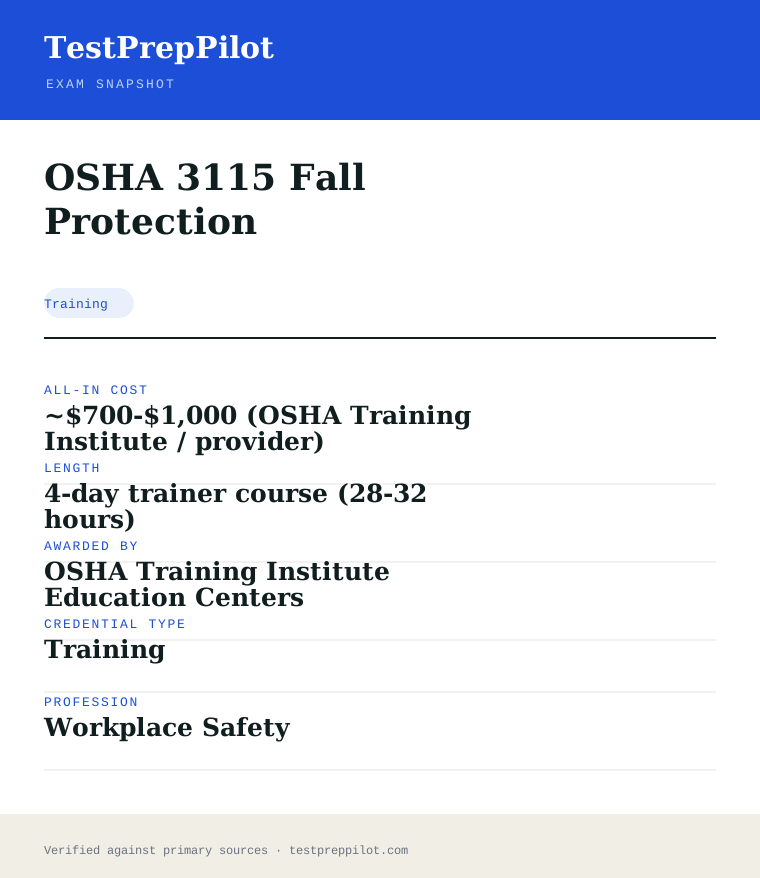
OSHA 3115 Fall Protection — Safety & Environment credential from OSHA Training Institute Education Centers
Researched and maintained by TestPrepPilot Editorial BoardOccupational safety & health training desk · Figures last verified August 2026
The short version
What is the OSHA 3115 Fall Protection and is it worth it?
OSHA 3115 Fall Protection is a professional credential administered by OSHA Training Institute Education Centers. It validates job-ready knowledge and skills in the Safety & Environment field and is used for career entry, advancement, or compliance.
- Recognized credential from OSHA Training Institute Education Centers
- Demonstrates verified competence in Safety & Environment
- Supports career advancement and may satisfy licensing or employer requirements
What is it?
What exactly is the OSHA 3115 Fall Protection?
OSHA 3115 Fall Protection — Safety & Environment credential from OSHA Training Institute Education Centers
Course on fall hazard recognition, guardrail and net systems, personal fall arrest components and rescue planning. Offered by OSHA Training Institute Education Centers, it is designed for candidates who need to demonstrate verified competence in the Safety & Environment field. The credential is commonly used for career entry, advancement, regulatory compliance, or employer requirements. Candidates should review the official handbook for eligibility, exam format, and scoring before registering.
The path in brief
- Confirm you meet any eligibility or prerequisites
- Review the official handbook and study materials
- Register and pay through the awarding body or authorized provider
- Schedule and take the exam (test center or online proctoring)
- Receive your score and, if passed, your credential
Before you book
Who is eligible to sit the OSHA 3115 Fall Protection?
Eligibility varies; many credentials are open to all, while others require coursework, work experience, or sponsorship.
Who it is for: Professionals and candidates seeking to validate Safety & Environment competence.
The test itself
What is the format of the OSHA 3115 Fall Protection?
The OSHA 3115 Fall Protection is administered by OSHA Training Institute Education Centers and runs 4 days.
| Administered by | OSHA Training Institute Education Centers |
|---|---|
| Questions | Written assessment + teaching demonstration |
| Time limit | 4 days |
| Pass mark | Passing score set by the awarding body; see the official score report |
| Exam fee | ~$700-$1,000 |
| Format | Proctored, computer-based (test center or online remote proctoring) |
Content outline
What topics are on the OSHA 3115 Fall Protection?
The OSHA 3115 Fall Protection covers 4 content domains.
Weightings come from the official exam outline. Study time is best allocated in roughly these proportions rather than evenly across domains.
- Hazards & controls
Topic area tested on the exam; see the official blueprint for the detailed breakdown.
- Regulations & standards
Topic area tested on the exam; see the official blueprint for the detailed breakdown.
- Monitoring & remediation
Topic area tested on the exam; see the official blueprint for the detailed breakdown.
- Emergency response
Topic area tested on the exam; see the official blueprint for the detailed breakdown.
The path
How do you register for the OSHA 3115 Fall Protection?
- 1
Visit the awarding body’s official website and create an account
- 2
Select the credential and review its specific requirements
- 3
Complete any required eligibility (education, experience, or training)
- 4
Pay the registration fee
- 5
Schedule the exam at a test center or online
- 6
Take the exam and receive your results
The fine print
What are the retake and renewal rules for the OSHA 3115 Fall Protection?
- Proctoring & delivery
- Proctored, computer-based delivery (test center or remote online proctoring), varying by exam.
- Retake policy
- Varies by credential — most bodies permit retakes after a waiting period and full or partial fee.
- Score reporting
- Scores are reported per the body’s timeline, typically electronically after the exam.
- Recertification
- Varies; many credentials require renewal every 2–3 years via continuing education or a recertification exam.
What it pays
How much does this credential pay?
$83,910 median for occupational health and safety specialists (BLS, May 2024)
The direct answer is that the closest official occupation to the OSHA 3115 student profile — Occupational Health and Safety Specialists, SOC 19-5011 — had a May 2024 median wage of $83,910, and the broader Specialists and Technicians group (19-5011 and 19-5012 combined) had a median of $78,900. OSHA 3115 is a specialist-level course: it is an OSHA Training Institute (OTI) Education Center course on the Fall Protection Standard for construction, typically taken by safety managers, competent persons, trainers and compliance staff who go on to assess fall protection compliance and develop fall protection programs — which is specialist work, not technician work, so the $83,910 specialist figure is the right benchmark. The distribution is wide and setting-sensitive: BLS puts the lowest 10 percent of specialists below $50,610 and the highest 10 percent above $130,460, and pay varies by industry, with hospitals at the high end and construction and manufacturing in the middle. BLS counted 163,700 jobs in the combined specialists-and-technicians occupation in 2024 and projects 12 percent growth from 2024 to 2034 — much faster than the 3 percent average — with about 18,300 openings a year, and the agency explicitly notes the continued emphasis on worker safety and wellness as a demand driver. The course itself is one credential in a larger safety-career stack — it does not change your BLS classification, it deepens your competence within an occupation that is growing faster than average. The honest framing is that the wage you benchmark is the role, not the course, and the course is a step on a ladder that also includes the OSHA 510/511 and the trainer-level credentials.
| Measure | Figure | Source / note |
|---|---|---|
| Median annual wage, occupational health and safety specialists | $83,910 | BLS OOH, SOC 19-5011, May 2024 |
| Median annual wage, specialists and technicians combined | $78,900 | BLS OOH, SOC 19-5011/19-5012, May 2024 |
| Lowest 10 percent, specialists | Below $50,610 | BLS OOH Pay tab, May 2024 |
| Highest 10 percent, specialists | Above $130,460 | BLS OOH Pay tab, May 2024 |
| Employment, 2024 | 163,700 jobs | BLS OOH Quick Facts, 2024 |
Job growth.BLS projects 12 percent growth for occupational health and safety specialists and technicians from 2024 to 2034, with about 18,300 openings a year.
Source: BLS Occupational Outlook Handbook - Occupational Health and Safety Specialists and Technicians
Your odds
What are the pass rates?
OSHA publishes no national pass rate for 3115 — the completion standard is full attendance plus a written knowledge assessment
The direct answer is that no national pass rate exists for OSHA 3115 Fall Protection, because the course is administered independently by OSHA Training Institute Education Centers across the country rather than by a single national examining body, and OSHA does not collect or publish a nationwide pass statistic. What is published, and consistent across centers, is the completion standard: students must attend the course in full — OTI attendance policy requires 100 percent attendance, with make-up work only for less than 20 percent missed and a full re-attend beyond that — and complete a written knowledge assessment at the end of the course. Some centers publish their own passing threshold for that assessment: the Chesapeake Region Safety Council, which runs 3115 and a companion Fall Protection Trainer course, states that students must pass the exam with an 80 percent or higher to attend the trainer course. But that is a center-specific requirement, not a national standard, and it applies to the trainer add-on rather than to 3115 completion itself. The course is typically delivered over three days — most centers list 18 contact hours — though the framing of the "trainer course" in some marketing reflects pairing the 3-day 3115 with the separate 1-day Fall Protection Trainer course. The honest headline is therefore the published cut that does exist: full attendance plus the written assessment, with an 80 percent threshold published at some centers for progressing to trainer-level work. Because no pass-rate data is published anywhere, we have left the rate itself unstated rather than quoting a number.
Read this before quoting the number.No national pass rate is published for OSHA 3115. The published completion standard is full attendance plus a written knowledge assessment; some centers require 80 percent or higher on that assessment to progress to the Fall Protection Trainer course.
Source: OSHA Training Institute Education Centers - OSHA 3115 Fall Protection course listings
Your schedule
How long should I study for it?
18 contact hours over 3 days, plus 6-10 hours of pre-course reading of focused study
OSHA 3115 is a three-day, 18-contact-hour course rather than a self-study exam, so the "study plan" is really a preparation plan: arrive able to absorb a dense regulatory course and leave able to pass the written assessment and apply the standard. Because attendance is a hard completion requirement — OTI policy requires 100 percent attendance with make-up work only for under 20 percent missed — the first priority is clearing three consecutive days and arriving rested. The course covers the OSHA Fall Protection Standard for construction (29 CFR 1926 Subpart M) plus an overview of fall protection methods: principles of fall protection, components and limitations of fall arrest systems, OSHA standards and policies, workshops on inspecting and using fall protection equipment, residential construction fall protection, training requirements, and developing a fall protection program. Preparation should include reading 29 CFR 1926 Subpart M before the course so the classroom material lands on a framework rather than from scratch, reviewing the difference between fall prevention systems (guardrails, safety nets) and fall arrest systems, and knowing the competent person concept — because the course builds on the 510/511 standard-and-training baseline that many centers recommend as a prerequisite even though 3115 lists no formal prerequisite. The written assessment at the end is based on the course content, so the highest-yield in-course habit is to review each day’s material the same evening rather than letting it accumulate. Centers deliver the course in person or as live instructor-led online sessions, and fees run roughly $680 to $800 at most centers.
- Before the course (1-2 weeks)6-10 hrs total
Pre-course foundation
- Read 29 CFR 1926 Subpart M — the fall protection standard the course is built around
- Review the difference between fall prevention (guardrails, safety nets) and fall arrest systems
- Learn the competent person concept and how it appears in the standard
- Clear three consecutive days for full attendance — attendance is a hard completion requirement
- Day 16 hrs
Principles and the standard
- Attend the full session covering principles of fall protection and the scope and application of the standard
- Take detailed notes on system components and the limitations of fall arrest systems
- Ask how each topic applies to the construction scenarios you see at work
- Review the day’s material the same evening
- Day 26 hrs
Equipment, workshops and residential
- Participate in the equipment inspection and use workshops — these feed the written assessment and the practical skills
- Cover residential construction fall protection and the training requirements of the standard
- Connect the passive and active system content to developing a fall protection program
- Review the day’s material and practice the assessment format
- Day 36 hrs
Programs and written assessment
- Attend the fall protection program development content and the final review
- Take the written knowledge assessment at the end of the course
- If your center sets an 80 percent threshold for the trainer add-on, aim well above it
- Collect your certificate of completion and any CEUs the center reports
Adjusting the pace
No 510/511 background.Add reading of the OSHA 510 construction standards fundamentals before the course; 3115 lists no formal prerequisite but builds on the standards baseline.
Adding the Fall Protection Trainer course.Some centers pair the 3-day 3115 with a separate 1-day Trainer course and require an 80 percent or higher on the 3115 assessment to attend it; register for both if your goal is trainer-level work.
Live online delivery.Many centers offer 3115 as live instructor-led online sessions; attendance requirements and the written assessment still apply, so plan for the same three-day commitment.
How to study
How do I prepare most effectively?
The strategy that reliably gets students through OSHA 3115 is "arrive with the standard read, treat attendance as non-negotiable, and review daily", because the course is a three-day, 18-contact-hour delivery where the written assessment tests the material covered in the classroom and attendance is a hard requirement. Second, read 29 CFR 1926 Subpart M before the course — the classroom lectures move at a pace that assumes some familiarity, and students who have seen the standard absorb the course material far better than those encountering it cold. Third, focus your preparation on the distinction the course is built around: fall prevention systems (guardrails, safety nets, warning lines) versus fall arrest systems (full-body harnesses, lanyards, anchorage), including the components and limitations of each — these are the conceptual spine of the assessment. Fourth, do not treat the equipment workshops as optional; the inspection-and-use workshops are where the practical content that appears on the written assessment is taught. Fifth, review each day’s material the same evening, because the assessment covers all three days and the third day’s program-development content builds on the first two. Finally, if your goal is trainer-level work, confirm your center’s 80 percent threshold on the assessment and aim well above it, and verify the center’s fee and delivery format — fees run roughly $680 to $800 and formats include in-person and live online.
Read the standard before the course
Read 29 CFR 1926 Subpart M in the weeks before. The classroom moves at a pace that assumes familiarity, and prior reading is the strongest predictor of absorbing the course.
Treat attendance as non-negotiable
OTI policy requires 100 percent attendance. Clear three consecutive days; make-up work is only available for under 20 percent missed.
Master prevention vs arrest
The course is built around fall prevention (guardrails, safety nets, warning lines) versus fall arrest (harnesses, lanyards, anchorage), including the components and limitations of each.
Engage in the equipment workshops
The inspection-and-use workshops teach the practical content that appears on the written assessment. Participate fully rather than observing.
Review daily, not at the end
The written assessment covers all three days. Review each day’s material the same evening so the third day builds on a settled foundation.
Confirm your center’s thresholds
Some centers require 80 percent on the assessment to progress to the Fall Protection Trainer course. Verify the threshold, fee and delivery format at registration.
What to buy
Which study resources are worth paying for?
OSHA 3115 is a course, not a self-study exam, so the resource comparison is about choosing a delivery center rather than buying prep materials — the course fee, format and location are the meaningful variables. The course is taught by OSHA Training Institute Education Centers, and each center sets its own schedule, delivery format and fee: listings we reviewed run roughly $680 to $800 for the three-day course, with some centers including lunch and student materials and others charging separately. Delivery formats include in-person classroom and live instructor-led online sessions; the online format removes travel cost but still requires the same three-day attendance commitment and a proctored written assessment. The authoritative resource is the standard itself, 29 CFR 1926 Subpart M, which is free from OSHA and worth reading before the course. OSHA’s own fall protection training materials and the OTI course description are free and useful orientation. There is no meaningful commercial prep course for 3115 because the assessment is written from the course content — the highest-yield "resource" is the center’s own course materials, which are included in the fee. Some employers pay for 3115 as part of a safety professional’s development, and the course feeds the OSHA Construction Safety and Health certificate programs, so confirm reimbursement before registering. Prices below are representative listings as of mid-2026 and vary by center.
| Resource | Price | Format | Best for |
|---|---|---|---|
| OSHA 3115 Fall Protection (OTI Education Center course) | ~$680-$800 (varies by center) | 3-day, 18-contact-hour course, in-person or live online | The course itself — attendance plus written assessment |
| 29 CFR 1926 Subpart M (the standard) | Free | Federal regulation text | Pre-course reading — the framework the course builds on |
| OSHA fall protection training materials | Free | OSHA web pages and publications | Orientation before the course |
| Fall Protection Trainer course (companion) | Additional fee set by center | 1-day trainer add-on | Trainer-level work after passing 3115 with the center’s threshold |
| OSHA 510/511 construction standards | Course fee per center | 4-day standards courses | The standards baseline many 3115 students already hold |
Course fees and schedules are set independently by each OSHA Training Institute Education Center and vary by location and delivery format; prices listed are representative as of mid-2026. We rank nothing by commission.
Avoid these
What mistakes do candidates most often make?
The most common mistake on OSHA 3115 is treating it as a self-study certification and skipping the attendance requirement: the course credit is earned by attending all three days in full, and OTI policy requires make-up work only for under 20 percent missed — candidates who arrive late or leave early lose the completion. The second mistake is arriving without reading the standard, which leaves the classroom material landing on no framework and makes the written assessment harder than it needs to be. Third, students confuse fall prevention with fall arrest systems on the assessment, mixing up guardrails and safety nets with harnesses and anchorage — the core distinction the course is built around. Fourth, candidates treat the equipment workshops as optional when they teach the practical content the assessment draws from. Fifth, students assume the written assessment is a formality; at centers that set an 80 percent threshold for the trainer add-on, a passing-but-mediocre score blocks trainer-level progression. Finally, candidates register for the "trainer course" without checking whether they are enrolling in the 3-day 3115 plus the separate 1-day Trainer course — they are independent registrations at most centers, and the trainer course has its own attendance and threshold requirements.
✕Missing the attendance requirement
✓OTI policy requires 100 percent attendance. Clear three full days and arrive on time every day; late arrival risks the completion.
✕Arriving without reading the standard
✓Read 29 CFR 1926 Subpart M before the course so the classroom material lands on a framework rather than from scratch.
✕Confusing prevention and arrest systems
✓Learn the distinction cold: prevention (guardrails, safety nets, warning lines) versus arrest (harnesses, lanyards, anchorage) and the limitations of each.
✕Skipping the equipment workshops
✓The inspection-and-use workshops teach the practical content the written assessment draws from. Participate fully.
✕Assuming the assessment is a formality
✓Some centers require 80 percent or higher to progress to the trainer course. Aim well above the threshold, not at it.
✕Confusing 3115 with the trainer course
✓The 3-day 3115 and the 1-day Fall Protection Trainer course are independent registrations at most centers — register for both separately if you want trainer-level work.
What you'll face
What question types will I see?
OSHA 3115 does not publish a national question-type breakdown because it is a course with a written knowledge assessment written by each OTI Education Center from its own curriculum, delivered at the end of the three-day, 18-contact-hour course. What is consistent across centers is the shape: the assessment tests the course content — principles of fall protection, the components and limitations of fall arrest systems, the OSHA Fall Protection Standard and policies, equipment inspection and use, residential construction fall protection, training requirements, and fall protection program development — with multiple-choice and applied items drawn from the classroom material and workshops. The samples below are editor-written illustrations of the kind of applied item the course supports, written from the published course description, not live assessment items from any center. The honest guidance is to treat the assessment as a test of whether you can apply the standard to real construction situations — identify the hazard, select the compliant control, and explain what the standard requires — rather than a recall exercise, and to review each day’s material the same evening because the assessment covers the full three days.
The standard, system components, and the limitations of fall arrest systems drawn from the course content.
A construction scenario with a fall hazard; the item asks for the compliant control or what the standard requires.
Inspection and use of fall protection equipment — what to look for and how a system is correctly configured.
Elements of a compliant fall protection program and the training requirements of the standard.
Try these
Q1Workers are performing framing on a residential roof where the eave height exceeds the threshold the standard requires fall protection. Which approach is the primary means the standard contemplates for protecting them?
Answer:B
The standard requires conventional fall protection — guardrails, safety nets or a personal fall arrest system — for workers exposed to falls above the threshold height, including residential construction since the residential exemption was removed. A is wrong because a warning line alone does not protect workers who must work beyond it. C is wrong because a safety monitor alone is a fallback for specific low-slope work, not the primary means. D is wrong because residential construction is no longer exempt.
Q2During an inspection, a worker’s full-body harness is found with a frayed lanyard and a bent snap hook. What is the correct action?
Answer:B
Damaged fall protection equipment must be removed from service immediately and tagged or taken out of use; frayed lanyards and bent snap hooks are defects that defeat the system. A is wrong because continued use exposes the worker to a failed system. C is wrong because field repairs with tape are not an acceptable fix for damaged components. D is wrong because the equipment is defective regardless of the duration of use.
Q3A fall protection program must include, at minimum, which elements under the standard’s training and program requirements?
Answer:A
The program must ensure workers exposed to fall hazards are trained on the hazards and on the specific fall protection system they use. B is wrong because the standard requires training tied to the system in use, not an exhaustive written hazard inventory. C is wrong because a safety monitor is not universally required. D is wrong because the standard requires inspection and maintenance of equipment, not blanket annual replacement.
Samples are editor-written illustrations of the applied item style the OSHA 3115 written assessment supports, based on the published course description; they are not live assessment items from any OTI Education Center.
The big day
What should I expect on exam day?
On the final day of OSHA 3115 you attend the program-development content and take the written knowledge assessment that completes the course, at the same OTI Education Center venue or live-online session you attended the first two days. The completion standard is the assessment at the end of the third day plus full attendance across the course; OTI policy requires 100 percent attendance, with make-up work available only for under 20 percent missed and a full re-attend beyond that, so the "exam day" pressure is really about the whole three-day attendance record. Bring photo identification, which centers require for check-in, and any course materials you used across the first two days. The assessment is written from the course content, so the highest-yield in-course habit is reviewing each evening rather than letting material accumulate. After the assessment, completing the course earns a certificate of completion, and the course carries continuing-education credit — typically reported as IACET CEUs or similar — that feeds safety credential requirements such as the OSHA Construction Safety and Health certificate programs. If your center requires 80 percent or higher to progress to the Fall Protection Trainer course, your score on this assessment determines eligibility, so aim well above the threshold. The afterwards matters: record the completion, bank the CEUs, and confirm any trainer-course registration you planned alongside 3115.
Bring
- Photo identification for check-in
- Your course materials and notes from the first two days
- Any registration confirmation the center requires
Leave at home
- Phones and personal devices during the assessment session
- The assumption that attendance alone completes the course — the written assessment is part of the standard
- Study materials from before the course, which are not relevant to the assessment content
How the day runs
Rules in the room
- 100 percent attendance is required; make-up work is available only for under 20 percent missed
- A written knowledge assessment completes the course
- Some centers require 80 percent or higher on the assessment to progress to the trainer course
- Photo identification is required at check-in
- The 3-day 3115 and the 1-day Trainer course are independent registrations
Afterwards.On completion, record the certificate and bank the CEUs, and confirm any planned trainer-course registration. The course strengthens your ability to assess fall protection compliance and build fall protection programs — the specialist work the occupation demands — and it feeds the OSHA Construction Safety and Health certificate programs if you are on that ladder.
Reference
What are the key facts about the OSHA 3115 Fall Protection?
OSHA 3115 Fall Protection is a training credential; awarded by OSHA Training Institute Education Centers; the exam fee is ~$700-$1,000; typical preparation is 4-day trainer course (28-32 hours); holders typically earn $50,000-$100,000 (19-5011 median $83,910).
| Credential | OSHA 3115 Fall Protection |
|---|---|
| Abbreviation | OSHA 3115 |
| Type | Training |
| Profession | Workplace Safety |
| Specialty | OSHA Outreach & Trainer |
| Awarded by | OSHA Training Institute Education Centers |
| Difficulty | Applied |
| Typical prep time | 4-day trainer course (28-32 hours) |
| All-in cost | ~$700-$1,000 (OSHA Training Institute / provider) |
| Typical salary range | $50,000-$100,000 (19-5011 median $83,910) |
| Credential | OSHA 3115 Fall Protection |
| Awarding body | OSHA Training Institute Education Centers |
| Exam format | Proctored, computer-based |
| Validity | Trainer card valid 4 years (update course required) |
| Languages | Varies — see awarding body |
| Scope | National / Multi-state |
| Also known as | OSHA 3115 |
Real questions
Frequently asked questions about the OSHA 3115 Fall Protection
How do I register for the OSHA 3115 Fall Protection exam?
Register through OSHA Training Institute Education Centers's official portal or an authorized test provider (e.g., Pearson VUE or Prometric where applicable). Create an account, select the exam, pay the fee, and schedule a date.
How much does the exam cost?
Fees vary by location and currency. Confirm the current fee on the official registration page before scheduling.
How long is the credential valid, and how do I renew?
Validity varies by credential (commonly 2–3 years). Renewal usually requires continuing education or a recertification exam — see OSHA Training Institute Education Centers's policy.
What if I do not pass?
Most bodies allow retakes after a waiting period and payment of the full or partial fee. Check OSHA Training Institute Education Centers's retake policy before rescheduling.
How do I register for a OSHA Training Institute Education Centers credential?
Register through the official website, select your exam, pay the fee, and schedule a date.
How do I renew a credential?
Renewal policies vary by credential; check the specific program page for requirements and cycles.
In short
Is the OSHA 3115 Fall Protection worth it?
- OSHA 3115 Fall Protection is awarded by OSHA Training Institute Education Centers.
- Validates job-ready competence in Safety & Environment.
- Registration is through the awarding body or an authorized test provider.
- Renewal and retake policies vary — confirm before scheduling.
Same awarding body
What other credentials does OSHA Training Institute Education Centers award?
Worth comparing
How does the OSHA 3115 Fall Protection compare with similar credentials?
Trust
Where does this information come from?
Everything above is taken from the awarding body's own published material. Fees, question counts and domain weights are revised regularly — check the official page before you pay.
Research confidence: medium · Last reviewed 2026-08