Allied Health & Medical Support • Certification
NHA Certified Pharmacy Technician
NHA Certified Pharmacy Technician — Allied Health credential from National Healthcareer Association (NHA)
Researched and maintained by TestPrepPilot Editorial BoardAllied-health & clinical certification desk · Figures last verified August 2026
The short version
What is the NHA Certified Pharmacy Technician and is it worth it?
NHA Certified Pharmacy Technician is a professional credential administered by National Healthcareer Association (NHA). It validates job-ready knowledge and skills in the Allied Health field and is used for career entry, advancement, or compliance.
- Recognized credential from National Healthcareer Association (NHA)
- Demonstrates verified competence in Allied Health
- Supports career advancement and may satisfy licensing or employer requirements
What is it?
What exactly is the NHA Certified Pharmacy Technician?
NHA Certified Pharmacy Technician — Allied Health credential from National Healthcareer Association (NHA)
Entry-level pharmacy technician credential offered by the NHA (ExCPT)., a nationally recognized professional credential in this field. Offered by National Healthcareer Association (NHA), it is designed for candidates who need to demonstrate verified competence in the Allied Health field. The credential is commonly used for career entry, advancement, regulatory compliance, or employer requirements. Candidates should review the official handbook for eligibility, exam format, and scoring before registering.
The path in brief
- Confirm you meet any eligibility or prerequisites
- Review the official handbook and study materials
- Register and pay through the awarding body or authorized provider
- Schedule and take the exam (test center or online proctoring)
- Receive your score and, if passed, your credential
Before you book
Who is eligible to sit the NHA Certified Pharmacy Technician?
Eligibility varies; many credentials are open to all, while others require coursework, work experience, or sponsorship.
Who it is for: Professionals and candidates seeking to validate Allied Health competence.
The test itself
What is the format of the NHA Certified Pharmacy Technician?
The NHA Certified Pharmacy Technician is administered by National Healthcareer Association (NHA) and runs 2h10m.
| Administered by | National Healthcareer Association (NHA) |
|---|---|
| Questions | ~120 questions (100 scored + 20 pretest) |
| Time limit | 2h10m |
| Pass mark | Passing score set by the awarding body; see the official score report |
| Exam fee | ~$125 |
| Format | Proctored, computer-based (test center or online remote proctoring) |
Content outline
What topics are on the NHA Certified Pharmacy Technician?
The NHA Certified Pharmacy Technician covers 4 content domains.
Weightings come from the official exam outline. Study time is best allocated in roughly these proportions rather than evenly across domains.
- Anatomy & physiology
Topic area tested on the exam; see the official blueprint for the detailed breakdown.
- Clinical procedures
Topic area tested on the exam; see the official blueprint for the detailed breakdown.
- Patient care & safety
Topic area tested on the exam; see the official blueprint for the detailed breakdown.
- Documentation & ethics
Topic area tested on the exam; see the official blueprint for the detailed breakdown.
Study materials
Which study guide should you use for the NHA Certified Pharmacy Technician?
Start with the exam sponsor's official content outline. If you also want one structured resource to work through, these are the Mometrix titles that match this exam.

Affiliate links We may earn a commission if you buy through these links, at no extra cost to you. Mometrix has no say in what our exam guides cover. How we make money.
The path
How do you register for the NHA Certified Pharmacy Technician?
- 1
Visit the awarding body’s official website and create an account
- 2
Select the credential and review its specific requirements
- 3
Complete any required eligibility (education, experience, or training)
- 4
Pay the registration fee
- 5
Schedule the exam at a test center or online
- 6
Take the exam and receive your results
The fine print
What are the retake and renewal rules for the NHA Certified Pharmacy Technician?
- Proctoring & delivery
- Proctored, computer-based delivery (test center or remote online proctoring), varying by exam.
- Retake policy
- Varies by credential — most bodies permit retakes after a waiting period and full or partial fee.
- Score reporting
- Scores are reported per the body’s timeline, typically electronically after the exam.
- Recertification
- Varies; many credentials require renewal every 2–3 years via continuing education or a recertification exam.
What it pays
How much does this credential pay?
$43,460 median annual wage for pharmacy technicians, SOC 29-2052 (BLS Occupational Outlook Handbook, May 2024)
The salary case for the NHA CPhT runs through the occupation it certifies: pharmacy technician. The BLS Occupational Outlook Handbook reports that pharmacy technicians earned a median annual wage of $43,460 in May 2024, with employment of 490,400 and a projected 6 percent change from 2024 to 2034 — faster than the average for all occupations — and roughly 49,000 openings a year, mostly replacement need. The distribution matters for an entry-level credential: the lowest 10 percent of pharmacy technicians earned less than $35,100 and the highest 10 percent earned more than $59,450, and the May 2024 medians varied sharply by setting — ambulatory healthcare services at $49,920, hospitals at $49,310, general merchandise retailers at $46,180, grocery and specialty food retailers at $38,810 and pharmacies and drug retailers at $37,900 — so the certification is a doorway into the occupation, and earnings then follow setting, region and experience rather than the certificate itself. The honest chain: the CPhT credential signals a tested baseline of pharmacy knowledge, many states and employers require or prefer certification, and BLS notes that certification may make it easier to get a job and that many employers pay for their technicians to take the exam — but BLS classifies workers by job duties, not by certification, and does not publish a certified-only wage premium. The credential’s practical economic value is employment access and portability: the pharmacy technician field is state-regulated, several states require national certification for registration or for advanced roles, and certified technicians are eligible for a wider set of openings than uncertified applicants. Caveats worth stating plainly: the occupation pays modestly, retail-chain settings — the largest employer category — sit below the national median, and the 2-year recertification cycle adds a recurring cost in CE hours and fees. The exam is the gate to a published occupation with a BLS May 2024 median of $43,460 and steady projected demand.
| Measure | Figure | Source / note |
|---|---|---|
| Median annual wage, pharmacy technicians (SOC 29-2052) | $43,460 | BLS Occupational Outlook Handbook, May 2024 ($20.90/hr) |
| Lowest 10 percent | less than $35,100 | BLS OOH Pay tab, May 2024 |
| Highest 10 percent | more than $59,450 | BLS OOH Pay tab, May 2024 |
| Employment, 2024 | 490,400 jobs | BLS OOH Quick Facts, 2024 |
| Projected annual openings | ~49,000 per year | BLS OOH Job Outlook, 2024-34 — mostly replacement need |
Job growth.+6% projected change 2024-34 (faster than average), with roughly 49,000 openings a year driven by an aging population and technicians taking on greater roles as pharmacists focus on patient care; certification is a common employer or state requirement.
Source: BLS Occupational Outlook Handbook — Pharmacy Technicians
Your odds
What are the pass rates?
NHA publishes no official pass rate for the ExCPT — the percentages online are third-party estimates (roughly 62% in 2024) — and the published and verifiable facts are the 390 pass point on the 200-500 scale and the exam format
The direct answer is that the National Healthcareer Association does not publish an official pass rate for the ExCPT, the exam behind its CPhT credential — so any specific percentage you see online is a third-party estimate or a vendor’s count of its own customers, not an NHA statistic, and we report it that way rather than as fact. The best-documented third-party estimate is that the ExCPT first-time pass rate has hovered just above 60 percent in recent years, with roughly 62 percent reported for 2024, but that figure is not published by NHA and we flag it as an estimate, not official data. What NHA does publish and verify is the scoring structure: the ExCPT is reported on a scaled score range of 200 to 500, with the passing standard set at 390, and the current test plan — effective for exams scheduled on or after 9 July 2025 — specifies 120 total questions (100 scored and 20 unscored pretest items) in a 2-hour-10-minute continuous session, delivered at PSI test centres or through live remote proctoring. The test plan also publishes the domain weights: the Dispensing Process is the largest domain at 43 of 100 scored items — covering order intake and entry, preparing and dispensing, calculations, and compounding — followed by Role, Responsibilities and General Duties at 15, Laws at 15, Medication and Patient Safety and Quality Assurance at 14, and Drugs and Drug Therapy at 13. Because the pass rate is not official, the practical planning rule is to ignore rumoured percentages and prepare against the verifiable structure: master the Dispensing Process domain where 43 percent of the scored items live, learn the law and safety items precisely, and rehearse the 120-question, 2-hour-10-minute format until timed practice clears the 390 pass point. NHA does publish the passing standard, the format and the domain blueprint, which is more useful than any pass rate anyway — candidates who score 400-plus in practice are not gambling on a statistic.
Read this before quoting the number.NHA publishes no official ExCPT pass rate; the roughly 62% figure for 2024 is a third-party estimate, not NHA data. What NHA publishes and verifies is the 390 pass point on the 200-500 scale, the 120-question (100 scored + 20 pretest), 2-hour-10-minute format, and the current domain blueprint led by the Dispensing Process at 43%.
Source: NHA — Certified Pharmacy Technician (ExCPT) exam information
Your schedule
How long should I study for it?
80-120 hours over 8-12 weeks (roughly 8-12 hrs/week) of focused study
A realistic ExCPT study plan is 8 to 12 weeks at 8 to 12 hours a week, weighted heavily to the Dispensing Process domain — 43 of the 100 scored items — because the current NHA test plan concentrates nearly half the exam in order entry, prescription processing, calculations, compounding and preparing and dispensing, and the fastest way to clear the 390 pass point is to master that domain before anything else. The structure to plan against is published: 120 total questions in 2 hours 10 minutes — 100 scored and 20 unscored pretest — on a 200-to-500 scaled range with a 390 pass point, delivered at PSI test centres or remotely, with an on-screen calculator provided. The domain weights are published too: Dispensing Process at 43 scored items, Role, Responsibilities and General Duties at 15, Laws (regulations and controlled substances) at 15, Medication and Patient Safety and Quality Assurance at 14, and Drugs and Drug Therapy at 13. The most effective sequence: first, take a full timed practice exam to baseline and log every miss by domain; second, work the Dispensing Process block hardest — prescription intake and interpretation, SIG codes and abbreviations, pharmacy calculations (ratios, percentages, dosage and flow-rate problems), compounding basics and unit dose — because calculations are the item type that most reliably separates passing candidates from failing ones; third, cover the law items precisely — federal pharmacy law, controlled-substance schedules and their dispensing rules — because the law questions are factual, finite and bankable; fourth, learn the drug classifications and frequently prescribed medications in the Drugs domain, and the medication-safety items in the Safety domain, including look-alike/sound-alike drugs and error prevention; and fifth, rehearse the full 2-hour-10-minute format at least three times in the final three weeks, because the pacing across 120 questions — about 65 seconds per question — with calculations in the mix is trainable. Budget the roughly $125-129 exam fee, confirm your eligibility path — a high school diploma or GED plus an accredited training program, or at least 1,200 hours of supervised pharmacy work within the past three years — and note the 2-year recertification with 20 CE hours.
- Week 18-10 hrs
Baseline and blueprint map
- Take a full timed practice exam and log every miss by domain
- Confirm eligibility: high school diploma/GED plus an accredited training program, or 1,200 hours of supervised pharmacy work in the past three years
- Get the current NHA test plan and note the weights — Dispensing Process 43%, Laws 15%, Safety 14%, Drugs 13%, Role 15%
- Weeks 2-510-12 hrs/week
Dispensing Process (43 scored items)
- Master prescription order intake and interpretation: SIG codes, abbreviations, high-alert and look-alike/sound-alike drugs
- Drill pharmacy calculations — ratios, percentages, dosage, flow rates and conversions — daily until automatic
- Cover preparing and dispensing: counting, labelling, unit dose, and repackaging
- Practise compounding basics and the workflow steps of order entry to patient counselling handoff
- Weeks 6-78-10 hrs/week
Laws, safety and drugs
- Learn federal pharmacy law: controlled-substance schedules, dispensing records and DEA basics
- Study the medication-safety domain: error prevention, high-alert medications, quality assurance
- Cover drug classifications and frequently prescribed medications in the Drugs domain
- Weeks 8-98-10 hrs/week
Full-format rehearsal and gap closing
- Take two or three full 2-hour-10-minute practice exams under real timing
- Re-lab every miss by domain and re-study the weakest areas — most candidates fall in calculations or law
- Final pass over the calculation problem types and the controlled-substance schedules
- Week 106-8 hrs
Taper and logistics
- One more full exam early in the week if needed
- Light review of the error log only
- Confirm PSI scheduling, the ~$125-129 fee, and ID requirements
Adjusting the pace
Currently working as a pharmacy technician.Four to six weeks. Your daily work covers order entry and dispensing; focus on the calculation drills and the law domain — the two areas working techs most often under-prepare — then run two or three full timed exams.
Coming straight from a training program.Six to eight weeks. Content is fresh; the risk is the format — 120 questions in 2 hours 10 minutes with 20 unscored pretests — so weight the plan toward timed rehearsal and calculation speed.
Working full-time while studying.Stretch to 12-14 weeks at 6-8 hours a week. Make daily calculation practice the non-negotiable habit — it is the item type that most reliably separates passing candidates, and it needs repetition to become fast.
How to study
How do I prepare most effectively?
The strategy that reliably clears the ExCPT is "master the calculations, own the law facts, and rehearse the 120-question format," because the current test plan concentrates 43 of 100 scored items in the Dispensing Process — where pharmacy calculations and prescription interpretation live — and the law and safety items are finite factual content that a prepared candidate can bank completely. Start by baselining with a full timed practice exam and logging every miss by domain, so the plan targets the actual gap. Second, drill pharmacy calculations daily until they are automatic: ratios, proportions, percentages, dosage calculations, flow rates, temperature and metric conversions, and the units-and-rounding conventions the field uses — the on-screen calculator is provided, but speed and knowing which operation to set up are the tested skills, and most candidates who fail lose the calculation items to setup errors rather than arithmetic. Third, learn the law domain as finite facts: the controlled-substance schedules I through V and their dispensing rules, federal record-keeping, and the distinctions the exam asks about — this is the most bankable content on the paper because it does not vary. Fourth, build the medication-safety and drug-classification knowledge: high-alert medications, look-alike/sound-alike drug pairs, error-prevention steps, and the commonly prescribed drug classes in the Drugs domain. Fifth, rehearse the exact format — 120 questions in 2 hours 10 minutes with 20 unscored pretest items indistinguishable from the scored ones — at least three times, because the pacing of about 65 seconds per question with calculations in the mix is trainable and surprises candidates who only drilled domains. Finally, use the pass-rate situation honestly: NHA publishes no official pass rate, so the only number that matters is whether timed practice is consistently clearing the 390 pass point on the 200-500 scale.
Make pharmacy calculations a daily drill
The Dispensing Process domain is 43 scored items, and calculation problems are the item type that most reliably separates passing candidates from failing ones. Practise ratios, percentages, dosage, flow-rate and conversion problems daily — the on-screen calculator is provided, but knowing which operation to set up is the tested skill.
Bank the law facts completely
The Laws domain is finite, factual and stable: controlled-substance schedules I-V and their dispensing rules, federal record-keeping, and the regulatory distinctions the exam asks about. This is the most bankable content on the paper — candidates who study it precisely earn those 15 items outright.
Learn the safety and drug-classification content
Medication and Patient Safety (14 items) covers high-alert medications, look-alike/sound-alike pairs and error prevention, while the Drugs domain covers drug classifications and frequently prescribed medications. These are recognition items that reward a systematic pass through the material.
Rehearse the full 120-question format
120 questions in 2 hours 10 minutes is about 65 seconds per question with calculations in the mix, and 20 unscored pretest items are indistinguishable from the scored ones. Take at least three full timed exams so the pacing and stamina of the real day are trained.
Set the target from the published pass point
NHA publishes no official pass rate — online percentages are estimates. The verifiable standard is 390 on the 200-500 scale, so prepare until timed practice clears it with margin rather than gambling on a rumoured statistic.
What to buy
Which study resources are worth paying for?
ExCPT preparation splits into official NHA materials, third-party question banks and review books, and the training path most candidates already completed, and the buying logic is anchored by one fact: the NHA candidate handbook and the current test plan define the exact domains, the 100-scored-plus-20-pretest format and the 200-500 scale, so the official materials are the syllabus no matter what else you buy. The official set includes the candidate handbook and the NHA practice test — typically in the $50 range for the practice exam — which have the advantage of being built against the actual test plan, and NHA also sells study guides in the $60-70 range. On the third-party side, the market splits between PTCB-oriented and ExCPT-oriented products, and this matters: many pharmacy-technician question banks are built for the PTCB PTCE (90 questions, Pearson VUE), so candidates should confirm a product is ExCPT-aligned — 120 questions, 2 hours 10 minutes, PSI delivery — before buying, because the formats are different. ExCPT-aligned practice banks run roughly $20 to $80 and are useful for volume drilling, especially on calculations and law; review books run $30 to $60; and structured courses range from $50 to $200 for candidates who want a taught framework. The honest rule: buy the official test plan and one ExCPT-aligned practice exam first, add a third-party bank for calculation volume if needed, and spend on a course only if self-study has not cleared 390 in practice. The exam fee itself — roughly $125-129 — plus the 2-year recertification of 20 CE hours and a renewal fee should be budgeted separately. Prices below are approximate and dated to 2026; we rank nothing by commission.
| Resource | Price | Format | Best for |
|---|---|---|---|
| NHA candidate handbook and current ExCPT test plan | Free from NHA | Official PDFs | The authoritative syllabus — domains, weights, format and the 390 pass point |
| NHA practice test and study guides | ~$50-70 | Online practice and printed guide | Format-accurate practice built against the actual ExCPT test plan |
| The ExCPT exam itself | ~$125-129 per attempt | PSI test centre or remote proctoring, 120 questions in 2h10m | Required — the credential-earning event |
| Third-party ExCPT-aligned question banks | ~$20-80 | Online question bank | Volume drilling — especially calculations and law; confirm the bank is ExCPT-aligned, not PTCB-aligned |
| Structured pharmacy-technician courses | ~$50-200 | Video course with practice | Candidates wanting a taught framework, particularly for the 43-item Dispensing Process domain |
Prices approximate and dated to 2026; the exam fee is roughly $125-129, and 2-year recertification requires 20 CE hours plus a renewal fee. Confirm any third-party product is aligned to the ExCPT (120 questions, 2h10m, PSI) rather than the PTCB PTCE (90 questions, Pearson VUE). We do not rank by commission.
Avoid these
What mistakes do candidates most often make?
The most common ExCPT mistake is studying with PTCB-oriented material, because the two CPhT exams are different products — the NHA ExCPT is 120 questions in 2 hours 10 minutes at PSI with a 390 pass point, while the PTCB PTCE is 90 questions in 1 hour 50 minutes at Pearson VUE — and candidates who drilled PTCE format arrive mis-calibrated on pacing, question count and scale. The second is neglecting the calculation drills: the Dispensing Process domain is 43 of 100 scored items, and calculation problems are the item type that most reliably separates passing candidates, yet candidates routinely defer them because they are the hardest to practise. A third recurring error is treating the law domain as skimmable, when the 15 law items are finite factual content that a prepared candidate can bank completely — and a candidate who skips them loses the most recoverable points on the paper. Candidates also routinely ignore the 20 unscored pretest items, spending extra time on them while the clock runs, when they are indistinguishable from scored items and the only correct behaviour is to answer every question at the same pace. Many candidates fail to rehearse the full 2-hour-10-minute format and discover the pacing under about 65 seconds per question too late. Finally, some candidates chase rumoured pass-rate percentages for reassurance instead of measuring themselves against the one number that matters — whether timed practice clears the 390 pass point. A related and common error is underestimating the calculation items’ weight: because the Dispensing Process domain is 43 scored items and many of its questions pair a workflow step with a calculation, candidates who can recite the domain topics but cannot set up a dosage or flow-rate problem quickly arrive at a paper that feels nothing like their studying.
✕Studying with PTCB-oriented material
✓The NHA ExCPT and the PTCB PTCE are different exams: 120 questions in 2h10m at PSI versus 90 questions in 1h50m at Pearson VUE, with different scales and pass points. Confirm any bank or book is ExCPT-aligned before buying, or your pacing and scoring calibration will be wrong.
✕Deferring the calculation drills
✓The Dispensing Process domain is 43 scored items and calculation problems are the item type that most reliably separates passing candidates. Make daily calculation practice — ratios, percentages, dosage, flow rates — non-negotiable; the on-screen calculator is provided, but knowing which operation to set up is the tested skill.
✕Skimming the law domain
✓The 15 law items — controlled-substance schedules, dispensing rules, federal record-keeping — are finite factual content that a prepared candidate can bank completely. Study them precisely: they are the most recoverable points on the paper and an entire domain can be the margin around the 390 pass point.
✕Slowing down on the unscored pretest items
✓20 of the 120 questions are unscored pretests, but they are indistinguishable from scored items and there is no way to identify them. Answer every question at the same pace — slowing down to "be careful" on a pretest item just burns clock you need for scored ones.
✕Never rehearsing the full 2h10m format
✓120 questions in 2 hours 10 minutes is about 65 seconds per question with calculations in the mix. Take at least three full timed exams so the pacing and stamina of the real day are trained, not discovered on test day.
✕Planning around rumoured pass rates
✓NHA publishes no official pass rate — the percentages online are third-party estimates. Measure yourself against the published standard of 390 on the 200-500 scale, and prepare until timed practice clears it with margin.
What you'll face
What question types will I see?
The NHA ExCPT is 120 total questions in 2 hours 10 minutes — 100 scored and 20 unscored pretest items — reported on a 200-to-500 scaled range with a 390 pass point, delivered at PSI test centres or through live remote proctoring with an on-screen calculator provided. The current test plan (effective for exams on or after 9 July 2025) allocates the 100 scored items across five domains: the Dispensing Process at 43 items — order intake and entry, preparing and dispensing, calculations, and compounding, unit dose and repackaging — Role, Responsibilities and General Duties at 15, Laws (regulations and controlled substances) at 15, Medication and Patient Safety and Quality Assurance at 14, and Drugs and Drug Therapy at 13. The item style is overwhelmingly multiple choice, but the questions behave differently by domain: the calculation items require setting up a problem and using the on-screen calculator, the law items are factual recall of schedules and rules, the safety items test recognition of high-alert medications and error-prevention steps, and the dispensing items combine interpretation of a prescription or order with a workflow or calculation step — which is why candidates who prepare only fact-recognition miss the combined items. The practical pacing is about 65 seconds per question across the full 120, with the 20 unscored pretests indistinguishable from the scored ones, so every question should be answered at the same pace. The combined workflow-and-calculation items are the paper’s defining feature and the reason the Dispensing Process domain rewards applied practice over memorisation. The samples below are editor-written illustrations of the published blueprint, not live exam items.
Prescription and order interpretation, preparing and dispensing, pharmacy calculations, and compounding, unit dose and repackaging. The combined workflow-plus-calculation items are the hardest on the exam.
The technician’s scope, daily responsibilities, customer service and workflow roles — knowledge items that reward a clear picture of the job.
Federal pharmacy law, controlled-substance schedules and their dispensing rules, and record-keeping — finite factual content that a prepared candidate can bank completely.
High-alert medications, look-alike/sound-alike pairs, error prevention and quality-assurance steps — recognition items that reward a systematic pass.
Drug classifications and frequently prescribed medications — the most recall-like content on the paper.
Try these
Q1A prescription reads "amoxicillin 500 mg, one capsule by mouth three times daily for 10 days." How many capsules should be dispensed for the full course?
Answer:B
Three times daily for 10 days is 3 × 10 = 30 capsules. This is the classic prescription-quantity calculation: multiply the daily frequency by the days of therapy. A (20) would be a twice-daily course. C (40) would be four times daily. D (10) is the days of therapy without the daily frequency. The item combines prescription interpretation with a basic calculation — exactly the combined style of the Dispensing Process domain, where the trap is misreading the SIG or the day count rather than the arithmetic.
Q2Which controlled-substance schedule includes drugs with a currently accepted medical use and a high potential for abuse that may lead to severe psychological or physical dependence?
Answer:B
Schedule II drugs have a currently accepted medical use and a high potential for abuse that may lead to severe psychological or physical dependence — examples include opioids like oxycodone and stimulants. A (Schedule I) is wrong because Schedule I drugs have no currently accepted medical use. C and D are wrong because the abuse potential and dependence risk are described as lower for Schedule III and IV substances. This is a law-domain knowledge item: the schedules and their definitions are finite, stable and exactly the kind of content a prepared candidate banks outright.
Q3A technician is preparing to dispense a medication and notices the bottle label contains a drug name that is look-alike and sound-alike with the drug on the prescription. Which is the most appropriate action?
Answer:B
Look-alike and sound-alike (LASA) drug name confusion is a known error source, and the correct action is to verify the intended drug against the prescription and the stock, then follow the pharmacy’s error-prevention procedures before dispensing. A ignores a recognised safety risk. C exceeds the technician’s authority and invents a correction. D substitutes a drug without authorisation. This is a medication-safety scenario item — the 14-item Safety domain tests whether the candidate recognises the risk and applies the correct workflow rather than a memorised definition.
Samples are editor-written illustrations of the published blueprint, not live exam items.
The big day
What should I expect on exam day?
The NHA ExCPT is a 2-hour-10-minute, 120-question computer-delivered test — 100 scored and 20 unscored pretest items — taken at a PSI test centre or through live remote proctoring, reported on a 200-500 scale with a 390 pass point, with an unofficial result available immediately at the end and the official result posted to your NHA account within a few business days. The first thing to confirm is your eligibility status, because NHA requires a high school diploma or GED plus either an accredited training program or at least 1,200 hours of supervised pharmacy work in the past three years, and you must be fully eligible before you test — there is no provisional-certification option on this exam. The second is the exam fee of roughly $125-129 and the venue or remote-proctoring requirements. Bring a current, valid, unexpired government-issued photo ID whose name matches your NHA account exactly, and your scheduling confirmation; leave phones, smartwatches, notes and personal calculators, because the test provides an on-screen calculator and personal electronics are prohibited. Arrive at least 30 minutes early for a testing centre so check-in and the tutorial are complete before the clock starts, and for remote proctoring run the system check in advance and clear the room per the proctor’s specifications. When the exam begins, pace for the full 120 questions at about 65 seconds each: the 20 unscored pretest items are indistinguishable from the scored ones, so answer every question at the same pace, flag anything that runs long, and use the provided on-screen calculator for the calculation items without losing time on arithmetic you can do in your head. Budget the final minutes to revisit flagged items, then submit. The unofficial result appears on screen at the end, and the official score report follows through your NHA account — which you will use to plan the retake or the 2-year recertification cycle.
Bring
- Current, valid, unexpired government-issued photo ID matching your NHA account exactly
- Your scheduling confirmation and NHA account details
- For remote proctoring: a cleared, private room and a system that passed the PSI Bridge check
- A pacing plan — about 65 seconds per question across 120 questions and 2 hours 10 minutes
Leave at home
- Phones, smartwatches and all personal electronics
- All notes, formula sheets and study materials
- Personal calculators — the exam provides an on-screen calculator
- For remote proctoring, any other person in the room
How the day runs
Rules in the room
- The exam is 120 total questions — 100 scored and 20 unscored pretest — in 2 hours 10 minutes.
- The pass point is 390 on NHA’s 200-500 scaled range.
- An on-screen calculator is provided; personal calculators and electronics are prohibited.
- A current government-issued photo ID is required, with the name matching your NHA account.
- Eligibility must be fully met before testing — there is no provisional-certification option on the ExCPT.
- The unofficial result appears on screen at the end; the official report posts to your NHA account within a few business days.
Afterwards.The unofficial result appears on screen the moment you submit, and the official score report posts to your NHA account within a few business days — on a pass, your CPhT credential is active immediately, and the first thing to do is record the 2-year recertification cycle, because the CPhT requires 20 hours of continuing education — including one hour of pharmacy law and one hour of patient safety — plus a renewal fee every two years. On a fail, use the score report’s domain breakdown to identify the one or two domains that dragged the result — for most candidates that is the calculation items in the Dispensing Process or the law facts — re-study those specifically, and re-sit after timed practice clears 390, keeping the exam fee in mind since each attempt costs the full price. Either way, the occupation behind the credential is steady and expanding: a BLS May 2024 median of $43,460 with 6 percent projected growth and roughly 49,000 openings a year, with technicians taking on a greater role as pharmacists focus on patient care — and because several states and many employers require or prefer national certification, the credential is the practical ticket to the wider set of openings in that growing field.
Reference
What are the key facts about the NHA Certified Pharmacy Technician?
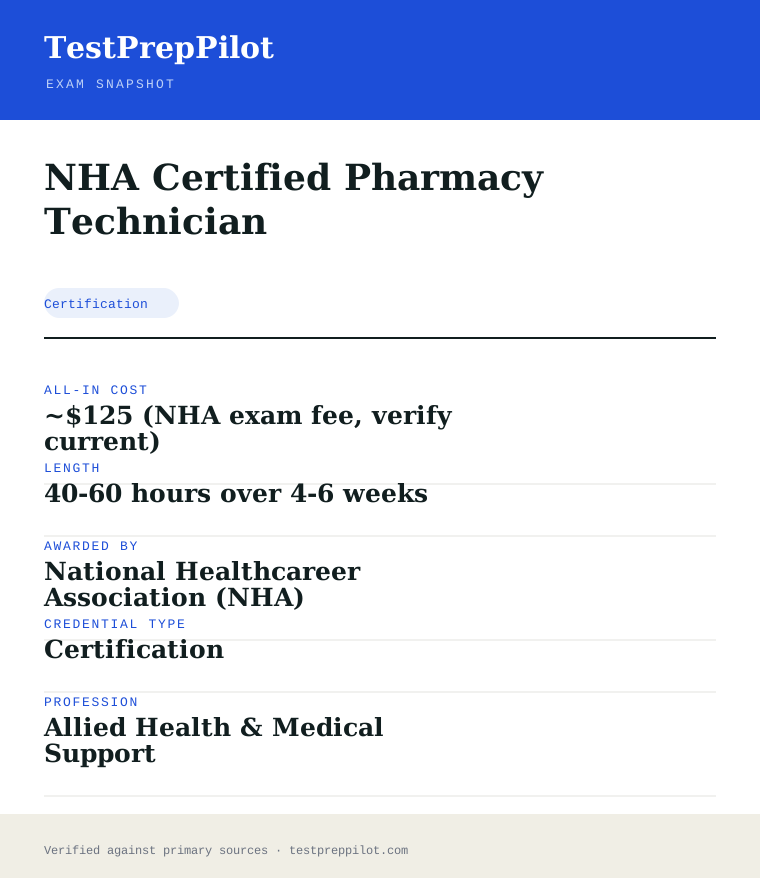
NHA Certified Pharmacy Technician is a certification credential; awarded by National Healthcareer Association (NHA); the exam fee is ~$125; typical preparation is 40-60 hours over 4-6 weeks; holders typically earn $33,000-$56,000 (29-2052 median $43,460).
| Credential | NHA Certified Pharmacy Technician |
|---|---|
| Abbreviation | CPhT |
| Type | Certification |
| Profession | Allied Health & Medical Support |
| Specialty | Pharmacy Support |
| Awarded by | National Healthcareer Association (NHA) |
| Difficulty | Applied |
| Typical prep time | 40-60 hours over 4-6 weeks |
| All-in cost | ~$125 (NHA exam fee, verify current) |
| Typical salary range | $33,000-$56,000 (29-2052 median $43,460) |
| Credential | NHA Certified Pharmacy Technician |
| Awarding body | National Healthcareer Association (NHA) |
| Exam format | Proctored, computer-based |
| Validity | Valid 2 years (renewal with 20 CEUs) |
| Languages | Varies — see awarding body |
| Scope | National / Multi-state |
Real questions
Frequently asked questions about the NHA Certified Pharmacy Technician
How do I register for the NHA Certified Pharmacy Technician exam?
Register through National Healthcareer Association (NHA)'s official portal or an authorized test provider (e.g., Pearson VUE or Prometric where applicable). Create an account, select the exam, pay the fee, and schedule a date.
How much does the exam cost?
Fees vary by location and currency. Confirm the current fee on the official registration page before scheduling.
How long is the credential valid, and how do I renew?
Validity varies by credential (commonly 2–3 years). Renewal usually requires continuing education or a recertification exam — see National Healthcareer Association (NHA)'s policy.
What if I do not pass?
Most bodies allow retakes after a waiting period and payment of the full or partial fee. Check National Healthcareer Association (NHA)'s retake policy before rescheduling.
How do I register for a National Healthcareer Association (NHA) credential?
Register through the official website, select your exam, pay the fee, and schedule a date.
How do I renew a credential?
Renewal policies vary by credential; check the specific program page for requirements and cycles.
In short
Is the NHA Certified Pharmacy Technician worth it?
- NHA Certified Pharmacy Technician is awarded by National Healthcareer Association (NHA).
- Validates job-ready competence in Allied Health.
- Registration is through the awarding body or an authorized test provider.
- Renewal and retake policies vary — confirm before scheduling.
Same awarding body
What other credentials does National Healthcareer Association (NHA) award?
Worth comparing
How does the NHA Certified Pharmacy Technician compare with similar credentials?
Trust
Where does this information come from?
Everything above is taken from the awarding body's own published material. Fees, question counts and domain weights are revised regularly — check the official page before you pay.
Research confidence: low · Last reviewed 2026-08