Allied Health & Medical Support • Certification
AHIMA Certified Coding Specialist
AHIMA Certified Coding Specialist — Allied Health credential from American Health Information Management Association (AHIMA)
Researched and maintained by TestPrepPilot Editorial BoardAllied health & health-information certifications desk · Figures last verified August 2026
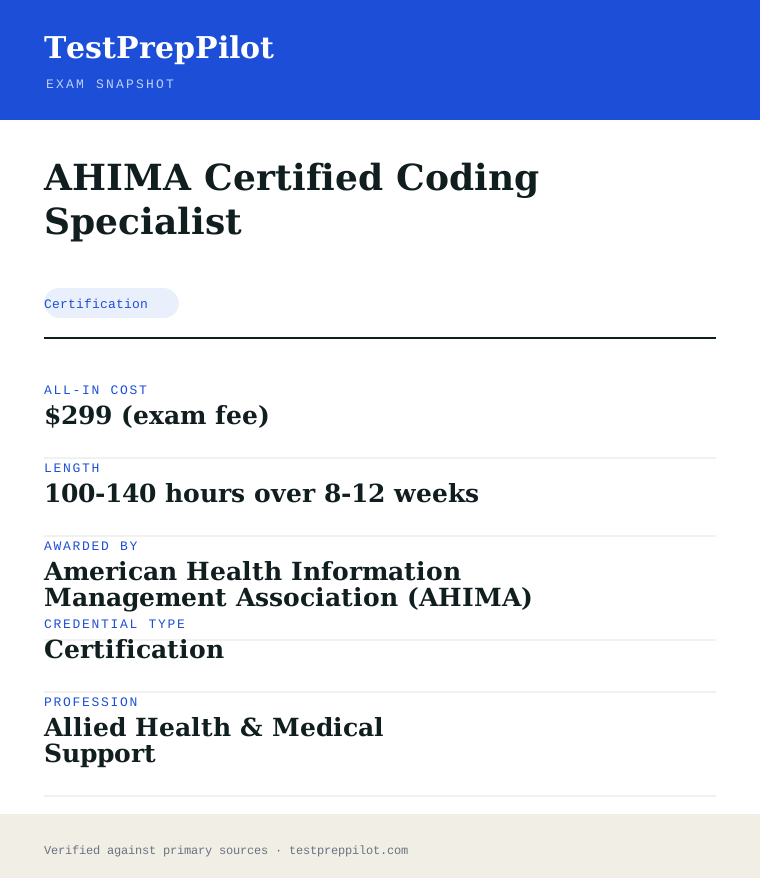
The short version
What is the AHIMA Certified Coding Specialist and is it worth it?
AHIMA Certified Coding Specialist is a professional credential administered by American Health Information Management Association (AHIMA). It validates job-ready knowledge and skills in the Allied Health field and is used for career entry, advancement, or compliance.
- Recognized credential from American Health Information Management Association (AHIMA)
- Demonstrates verified competence in Allied Health
- Supports career advancement and may satisfy licensing or employer requirements
What is it?
What exactly is the AHIMA Certified Coding Specialist?
AHIMA Certified Coding Specialist — Allied Health credential from American Health Information Management Association (AHIMA)
Advanced hospital coding credential for diagnosis and procedure classification., a nationally recognized professional credential in this field. Offered by American Health Information Management Association (AHIMA), it is designed for candidates who need to demonstrate verified competence in the Allied Health field. The credential is commonly used for career entry, advancement, regulatory compliance, or employer requirements. Candidates should review the official handbook for eligibility, exam format, and scoring before registering.
The path in brief
- Confirm you meet any eligibility or prerequisites
- Review the official handbook and study materials
- Register and pay through the awarding body or authorized provider
- Schedule and take the exam (test center or online proctoring)
- Receive your score and, if passed, your credential
Before you book
Who is eligible to sit the AHIMA Certified Coding Specialist?
Eligibility varies; many credentials are open to all, while others require coursework, work experience, or sponsorship.
Who it is for: Professionals and candidates seeking to validate Allied Health competence.
The test itself
What is the format of the AHIMA Certified Coding Specialist?
The AHIMA Certified Coding Specialist is administered by American Health Information Management Association (AHIMA) and runs 4 hours and contains 97 questions (incl. 2 medical scenarios) questions.
| Administered by | American Health Information Management Association (AHIMA) |
|---|---|
| Questions | 97 questions (incl. 2 medical scenarios) |
| Time limit | 4 hours |
| Pass mark | Passing score set by the awarding body; see the official score report |
| Exam fee | $299 |
| Format | Proctored, computer-based (test center or online remote proctoring) |
Content outline
What topics are on the AHIMA Certified Coding Specialist?
The AHIMA Certified Coding Specialist covers 4 content domains.
Weightings come from the official exam outline. Study time is best allocated in roughly these proportions rather than evenly across domains.
- Anatomy & physiology
Topic area tested on the exam; see the official blueprint for the detailed breakdown.
- Clinical procedures
Topic area tested on the exam; see the official blueprint for the detailed breakdown.
- Patient care & safety
Topic area tested on the exam; see the official blueprint for the detailed breakdown.
- Documentation & ethics
Topic area tested on the exam; see the official blueprint for the detailed breakdown.
Study materials
Which study guide should you use for the AHIMA Certified Coding Specialist?
Start with the exam sponsor's official content outline. If you also want one structured resource to work through, these are the Mometrix titles that match this exam.

Affiliate links We may earn a commission if you buy through these links, at no extra cost to you. Mometrix has no say in what our exam guides cover. How we make money.
The path
How do you register for the AHIMA Certified Coding Specialist?
- 1
Visit the awarding body’s official website and create an account
- 2
Select the credential and review its specific requirements
- 3
Complete any required eligibility (education, experience, or training)
- 4
Pay the registration fee
- 5
Schedule the exam at a test center or online
- 6
Take the exam and receive your results
The fine print
What are the retake and renewal rules for the AHIMA Certified Coding Specialist?
- Proctoring & delivery
- Proctored, computer-based delivery (test center or remote online proctoring), varying by exam.
- Retake policy
- Varies by credential — most bodies permit retakes after a waiting period and full or partial fee.
- Score reporting
- Scores are reported per the body’s timeline, typically electronically after the exam.
- Recertification
- Varies; many credentials require renewal every 2–3 years via continuing education or a recertification exam.
What it pays
How much does this credential pay?
$50,250 median for medical records specialists (SOC 29-2072, BLS May 2024) — the occupation that employs most CCS holders
The closest official occupation to the Certified Coding Specialist role is Medical Records Specialists, SOC 29-2072, and it had a May 2024 median wage of $50,250, with the lowest 10 percent earning less than $35,780 and the highest 10 percent more than $80,950. That fit is deliberate: medical records specialists "compile, process and maintain patient files" and, per BLS, "interpret medical documentation to assess diagnoses, which they then code into a patient’s medical record" — which is the exact work a CCS performs, and AHIMA’s own description positions the CCS as a mastery-level coding credential for hospital inpatient and outpatient coding. BLS projects 7 percent employment growth for medical records specialists from 2024 to 2034, faster than the 3 percent all-occupations average, with about 14,200 openings a year — a steady, recession-resistant tailwind driven by the aging population, the shift to electronic health records and the volume of coded claims that flows through hospitals and payers. The caveats matter. First, the median reflects all medical records specialists, many of whom are not CCS-certified; because employers routinely pay a premium for the CCS over entry-level credentials like the CCA, a CCS holder with hospital inpatient coding experience should expect to sit above the median — but BLS does not measure the certificate premium, so we will not invent one. Second, the realistic career path from CCS runs toward senior coding specialist, coding supervisor, clinical documentation integrity, and health information management roles, several of which have their own BLS codes with higher medians, so the $50,250 figure is the entry anchor for the occupation, not the ceiling for the credential. Third, the exam requires you to bring current-year ICD-10-CM, ICD-10-PCS and CPT code books to the testing centre, which is a reminder that the credential’s value is tied to staying current with the coding systems the occupation lives in.
| Measure | Figure | Source / note |
|---|---|---|
| Median annual wage, medical records specialists | $50,250 | BLS OOH, SOC 29-2072, May 2024 |
| Lowest 10 percent | less than $35,780 | BLS OOH Pay tab, May 2024 |
| Highest 10 percent | more than $80,950 | BLS OOH Pay tab, May 2024 |
| Employment, 2024 | 194,800 jobs | BLS OOH Quick Facts, 2024 |
| Projected annual openings | ~14,200 per year | BLS OOH Job Outlook, 2024-34 |
Job growth.7% projected change 2024-34 (faster than average), with ~14,200 openings a year; the CCS sits above this occupation’s median in practice because employers pay a certification premium
Source: BLS Occupational Outlook Handbook — Medical Records Specialists
Your odds
What are the pass rates?
AHIMA publishes CCS pass rates — 84% of first-time test-takers passed in 2025, up from 55% in 2022, on AHIMA’s own certification page
AHIMA is one of the few certifying bodies in this category that publishes annual pass rates, and its Certified Coding Specialist page shows the first-time pass rate has climbed sharply in recent years: 55 percent in 2022, 64 percent in 2023, 71 percent in 2024 and 84 percent in 2025, with 6,331 first-time test-takers sitting in 2025 and 37,778 certified CCS professionals on the books as of 31 December 2025. The trend is worth understanding rather than just quoting: older third-party sites still circulate 40-to-50 percent figures for the CCS, but those appear to date from earlier exam revisions or to conflate retake-inclusive aggregates, and they do not match AHIMA’s current published data. The exam itself is 107 total items — 97 scored questions plus 10 unscored pretest items — completed in four hours, delivered on computer at Pearson VUE testing centres, scored on a scaled 100-to-400 scale with a passing score of 300, and priced at $299 for AHIMA members and $399 for non-members, with a 30-day wait before a retake application is approved. The exam is open-codebook: you bring current-year ICD-10-CM, ICD-10-PCS and CPT code books to the testing centre, and exams taken on or after 1 May 2026 require the 2026 editions, so the edition rule must be checked against your exam date before you sit. The high recent pass rate should be read with care — it partly reflects candidates self-selecting after AHIMA’s eligibility relaxation, and the medical-scenario section, where candidates assign codes from real discharge summaries and operative reports, remains the place most failures happen, so the climbing rate is not a reason to under-prepare the scenario format.
Read this before quoting the number.AHIMA publishes annual first-time pass rates on its certification page — 84% in 2025 across 6,331 first-time test-takers. The 300 passing score, four-hour duration, 107 total items and $299/$399 member/non-member fees are the published figures this narrative relies on alongside them.
Your schedule
How long should I study for it?
100-140 hours over 10-12 weeks of focused study
Plan for ten to twelve weeks and 100 to 140 hours of study after you have met the eligibility requirement, and spend the largest share of that time assigning codes from real charts rather than memorising guidelines — the CCS is an open-codebook exam, so the skill being tested is finding and applying the right code, which only improves with practice on real discharge summaries and operative reports. The exam is four hours for 107 total items — 97 scored questions plus 10 unscored pretest items — delivered on computer at Pearson VUE, and it has two components: a multiple-choice section on coding guidelines and a medical-scenario section that presents real inpatient and outpatient records and asks you to assign complete code combinations, often in a multiple-choice/multiple-response format where you select all applicable codes from a list. Because the exam is open-codebook, you must be fluent in your code books before you sit: ICD-10-CM for diagnoses, ICD-10-PCS for inpatient procedures, and CPT for outpatient services, with current-year editions required — and the edition rule (2026 editions for exams on or after 1 May 2026) must be checked against your exam date. The plan below runs in five blocks: eligibility and code-book setup, ICD-10-CM, ICD-10-PCS and CPT, reimbursement and DRG context, then two weeks of timed full exams. It assumes you have coding experience or a prior credential such as the CCA, which the eligibility pathways require. If you do not, stop and satisfy the eligibility first — the exam assumes you can already read a chart and navigate a code book at professional speed.
- Weeks 1-210-12 hrs/week
Eligibility, code books and baseline
- Confirm which eligibility pathway applies to you — coursework plus one year of coding experience, or two years of experience, or CCA plus one year, or another coding credential plus one year
- Order the current-year ICD-10-CM, ICD-10-PCS and CPT code books and learn the index, guidelines and conventions in each
- Take one timed practice exam and log every miss to a content area
- Set up your study environment and calendar the four-hour exam format from week one
- Weeks 3-511-13 hrs/week
Diagnosis coding (ICD-10-CM)
- Work ICD-10-CM guidelines: chapter-specific guidelines, combination codes, sequencing and principal diagnosis selection
- Practise assigning codes from outpatient and emergency records
- Learn the index conventions, excludes notes and extension characters
- Build a personal error log of the guideline points you miss repeatedly
- Weeks 6-811-13 hrs/week
Procedure coding (ICD-10-PCS and CPT)
- Master ICD-10-PCS root operations and the seven-character structure for inpatient procedures
- Work CPT for outpatient and physician-based services, including modifiers
- Practise full case scenarios: read the operative report, assign the complete code set
- Drill the medical-scenario format specifically — this is where most failures happen
- Weeks 9-1010-12 hrs/week
Reimbursement, DRGs and compliance
- Cover MS-DRG assignment and how coded data drives hospital reimbursement
- Learn query principles, documentation integrity and coding ethics
- Re-drill your error log with fresh practice cases
- Time yourself on 100-question sets to build the four-hour stamina
- Weeks 11-1210-12 hrs/week
Timed full exams and gap closing
- Two or three full four-hour practice exams with your code books, exactly as on the day
- Re-lab every miss to the specific guideline or root operation rather than the general topic
- Confirm your 2026-edition code books if your exam date is on or after 1 May 2026
- One quiet day before the exam
Adjusting the pace
Already working as a hospital coder.Six to eight weeks. Your day job is the practice; spend the time on guideline depth, the medical-scenario format, and timed four-hour rehearsals, which working coders still find painful on first exposure.
Coming from the CCA credential.The CCA plus one year of experience meets eligibility. Budget the full ten to twelve weeks, because the CCS tests mastery-level inpatient and scenario coding the CCA only samples.
Coming from an AAPC CPC.Your CPT/outpatient strength transfers; the gap is ICD-10-PCS and inpatient DRG work. Front-load Weeks 6-8 and the medical-scenario format and you close the differentiator quickly.
How to study
How do I prepare most effectively?
The strategy that reliably moves a CCS score is "practise full chart-to-code scenarios with your real code books under real timing", and the single biggest error is studying guidelines as text when the exam is an open-book, applied test of finding and applying codes. The exam is four hours for 107 items with 97 scored, and the medical-scenario section — where you read a discharge summary or operative report and assign complete code combinations, often selecting all applicable codes in a multiple-response format — is where most failures happen, so that format must be the centre of your preparation rather than an afterthought. The second proven approach is code-book fluency: because the exam is open-codebook, candidates who have to hunt through the index lose minutes per question, and the four-hour clock is exactly where that waste shows up; practise finding codes at speed in the physical books you will bring on exam day. Third, build and maintain an error log organised by guideline, root operation and convention, because your personal error patterns are the highest-yield study material you own. Fourth, master the reimbursement context — MS-DRG assignment, principal-diagnosis selection and how codes drive payment — because scenario items frequently test why a code sequence is correct, not just which codes exist. Finally, rehearse the four-hour format end to end with the code books you will actually carry, because stamina and book-handling under the clock are skills in their own right, and confirm the code-book edition rule against your exam date before the final week.
Centre your study on full scenario cases
The medical-scenario section assigns codes from real discharge summaries and operative reports and is where most failures happen. Work complete chart-to-code cases every week — read the record, assign the full code combination, compare against the answer — rather than studying guidelines as text.
Build code-book fluency, not memory
The CCS is open-codebook, so the skill tested is navigating ICD-10-CM, ICD-10-PCS and CPT at speed. Practise finding codes in the physical books you will bring on exam day until the index, conventions and guidelines are paths you can walk without hesitation.
Keep a guideline error log
Log every miss by guideline, root operation and convention. Your personal error patterns are the highest-yield study material you own — re-drill the log before re-doing anything else, because the exam repeats guideline traps you have already fallen into.
Learn the reimbursement context
Know how coded data drives MS-DRG assignment and hospital payment. Scenario items frequently test why a sequence is correct — principal diagnosis selection, combination codes, query principles — not just which codes exist in the book.
Rehearse the four-hour format with your books
Run full timed practice exams with the exact code books you will carry on the day. Four hours with heavy book handling is a stamina test, and candidates who have never simulated it run out of time on the last scenarios.
What to buy
Which study resources are worth paying for?
The CCS buying decision is dominated by two required costs: the exam fee of $299 for AHIMA members or $399 for non-members, and the current-year code books, which you must physically bring to the testing centre — a realistic total outlay of roughly $700 to $1,100 for a first-time member after membership, books and prep materials. The code books are the non-negotiable purchase, because the exam is open-codebook and every candidate must carry current-year ICD-10-CM, ICD-10-PCS and CPT editions, and the edition rule (2026 editions for exams on or after 1 May 2026) must be checked against your exam date. The table below compares the main options with prices current to this review, and the honest cost ranking is: the code books and the AHIMA-authored preparation materials are the value core, membership is a saving that often pays for itself through the $100 exam discount, and third-party question banks are optional calibration. Three buying rules follow from how the exam actually works. First, because the exam is open-book and applied, the physical code books are not an optional extra — a candidate who trains only on digital tools will be slower in the physical books on the day. Second, the AHIMA member price of $299 versus $399 for non-members makes membership a genuine saving for anyone who will also maintain the credential on the two-year renewal cycle. Third, the one category to treat with suspicion is braindump-style question banks: AHIMA rotates and refreshes item pools, and the scenario-heavy, open-book format rewards genuine chart practice rather than memorised questions.
| Resource | Price | Format | Best for |
|---|---|---|---|
| CCS exam registration (AHIMA) | $299 member / $399 non-member | Computer-based at Pearson VUE | The exam itself — required |
| Current-year code books (ICD-10-CM, ICD-10-PCS, CPT) | ~$250-400 new for the set | Printed books (required for the test centre) | The mandatory open-book resource; confirm the edition matches your exam date |
| AHIMA membership | ~$70-150/year depending on category | Member association | The $100 exam discount alone can cover the membership cost |
| AHIMA CCS Exam Preparation textbook and practice materials | ~$90-120 for the official text | Printed study guide | Structured, AHIMA-authored review aligned to the content outline |
| Third-party practice exams and scenario casebooks | ~$50-150 | Online questions and printed case studies | Building the chart-to-code scenario habit before the real exam |
Prices checked 2026-08 in USD before tax; code book editions must match the exam date — exams on or after 1 May 2026 require 2026 editions — and many hospital employers reimburse exam fees and code books, so ask before paying out of pocket.
Avoid these
What mistakes do candidates most often make?
The most common CCS mistakes all trace back to treating an open-book, applied exam as a closed-book memory test: studying guidelines as text instead of practising chart-to-code scenarios, arriving without code-book fluency and burning the four-hour clock hunting through the index, and neglecting the medical-scenario section where most failures actually happen. Candidates also routinely lose points on principal-diagnosis selection and code sequencing, and some study with outdated editions or forget the edition rule entirely, forfeiting exam fees when they arrive with the wrong code books. A sixth pattern is treating the climbing published pass rate — 84 percent first-time in 2025 — as a reason to relax, when the medical-scenario section still fails a meaningful share of candidates and the scaled 300 cut gives no partial credit for incomplete code sets. The common thread across these failures is preparing at the wrong depth for an exam that rewards applied coding under the clock: the paper rewards chart-to-code practice, code-book fluency and sequencing precision, and every mistake above is a way of avoiding one of those demands. A candidate who works real cases weekly, drills the index at speed, learns the sequencing rules as decisions and confirms the code-book edition has addressed the entire list at once.
✕Studying guidelines instead of practising scenarios
✓The CCS is open-book and applied: you read real charts and assign codes. Make full chart-to-code practice the centre of your plan — discharge summaries, operative reports, complete code sets — and treat guideline reading as the support material, not the main event.
✕Arriving without code-book fluency
✓The four-hour clock punishes slow book navigation. Practise finding codes at speed in the physical books you will bring, until the index, conventions and guideline sections are paths you walk without hesitation. Hunting through the book on exam day is how candidates run out of time on the last scenarios.
✕Neglecting the medical-scenario section
✓The scenario section, where you assign codes from real records, is where most failures happen. Drill it weekly in the multiple-choice/multiple-response format, because it is a different skill from guideline recall and only practice builds it.
✕Getting principal diagnosis and sequencing wrong
✓Reimbursement questions turn on why a code sequence is correct — principal diagnosis selection, combination codes, the relationship between diagnosis and DRG. Learn the sequencing rules as decision rules you apply to a chart, not as text you skim.
✕Bringing the wrong edition of the code books
✓Exams on or after 1 May 2026 require 2026 editions, and bringing the wrong books can forfeit your exam fees. Check the edition rule for your exam date, verify the books match, and re-check the date as it approaches.
What you'll face
What question types will I see?
The CCS exam is four hours for 107 total items — 97 scored questions plus 10 unscored pretest items — delivered on computer at Pearson VUE, scored on a scaled 100-to-400 scale with a passing score of 300, and it is an open-codebook exam: candidates bring current-year ICD-10-CM, ICD-10-PCS and CPT code books to the testing centre, with the edition rule checked against the exam date. The paper has two components: a multiple-choice section testing coding guidelines, classification conventions and reimbursement concepts, and a medical-scenario section that presents real inpatient and outpatient records — discharge summaries, operative reports, physician documentation — and requires assigning complete, correct code combinations, frequently in a multiple-choice/multiple-response format where you select all applicable codes from a list. The scenario section is what makes the CCS distinctive among coding credentials: it is functionally fill-in-the-blank coding against real charts, using the code books you brought, and it is where most failures happen because it demands applied code assignment rather than guideline recall. The multiple-choice section rewards guideline fluency and knowing where each rule lives in the book, and the reimbursement items test why a code sequence is correct, tying codes to MS-DRG assignment and hospital payment. The 10 unscored pretest items are randomly distributed and have no effect on the result, so every question must be treated as if it counts. AHIMA publishes the official content outline defining the competency domains and their weights, and candidates should study from that outline rather than guessing at emphasis. The samples below are editor-written illustrations of the published blueprint’s question styles, not live exam items.
Questions on ICD-10-CM and ICD-10-PCS guidelines, conventions, and classification rules, answered with the code book open. These reward guideline fluency and knowledge of where each rule lives in the book.
A real discharge summary or operative report with a request to assign the complete code set, selecting all applicable codes from a list. This is functionally applied coding against the chart and the main source of failures.
Questions linking coded data to MS-DRG assignment and hospital payment, testing why a sequence is correct. These reward understanding the reimbursement context, not just the codes.
Randomly distributed pilot items with no effect on the result, indistinguishable from scored items. Treat every question as if it counts and you are never wrong.
Try these
Q1A patient with type 2 diabetes mellitus is admitted for diabetic cataract extraction of the right eye. The cataract is the reason for the admission. Which is the correct principal diagnosis?
Answer:B
The principal diagnosis is the condition established after study to be chiefly responsible for the admission. The diabetic cataract is the reason the patient was admitted for surgery, so it is the principal diagnosis; the type 2 diabetes mellitus is reported as a secondary, comorbid diagnosis. A inverts the ordering. C is wrong because the ICD-10-CM guidelines require the condition chiefly responsible for the admission to be sequenced first. D is wrong because a screening code describes testing without signs, which does not apply here.
Q2During an inpatient procedure, the surgeon performs a partial resection of the stomach and reconnects the remaining portion to the small intestine. Which ICD-10-PCS root operation applies to the gastric resection?
Answer:B
Resection is the root operation for cutting out or off, without replacement, all of a body part. The procedure resects part of the stomach, and in ICD-10-PCS a partial resection of a body part that takes the entire portion being resected is coded as Resection when all of the affected portion is removed. A is wrong because Excision is cutting out or off, without replacement, a portion of a body part — the distinction turns on whether the entire body part or only a portion is removed, and the coding guidance for partial organ resections points to Resection in the described circumstance. C is wrong because Extraction pulls or strips out all or part of a body part without cutting. D is wrong because Division cuts into a body part without taking it out.
Q3A coding specialist must assign the correct ICD-10-CM code for an initial encounter for a closed fracture of the right tibia without fracture displacement. Which element must the coder verify to assign the correct code?
Answer:B
Fracture codes in ICD-10-CM require laterality (right or left), the 7th character for the type of encounter (initial, subsequent, sequela), and the displacement or non-displacement status — all stated in the scenario. A is wrong because payer information is administrative, not clinical, and never determines the diagnosis code. C is wrong because height and weight are not part of fracture code assignment. D is wrong because the facility number is irrelevant to diagnosis coding.
Samples are editor-written illustrations of the published blueprint, not live exam items.
The big day
What should I expect on exam day?
The CCS exam is four hours for 107 total items — 97 scored plus 10 unscored — delivered on computer at a Pearson VUE testing centre, scored on a scaled 100-to-400 scale with a passing score of 300, and it is an open-codebook exam: you must physically bring current-year ICD-10-CM, ICD-10-PCS and CPT code books, and exams on or after 1 May 2026 require the 2026 editions. There is no remote-proctoring option for this credential, so exam day means travelling to a testing centre, and the preparation has three parts: confirm the edition rule for your exam date, pack the correct physical code books plus a valid government-issued photo ID, and arrive early enough for check-in and the secure-room process — plan for roughly 45 minutes before the appointment, because the check-in, ID verification, digital signature and locker process take time. The four-hour clock starts when the exam loads, and the pacing reality is different from most exams: the medical-scenario items, where you read real charts and assign complete code sets while handling your books, consume far more time than the guideline multiple-choice items, so the plan is to move briskly through the guideline items, keep the scenario items in budget, and flag anything unresolved for a final pass in the closing minutes. No electronic references are permitted and no internet is available in the testing room, so your physical books are your only reference, and a candidate who has rehearsed finding codes at speed in those exact books has removed the day’s biggest time risk. Scores are released immediately after the exam at the testing centre, which means you walk out knowing the outcome — and on a fail, the 30-day retake wait and the $299/$399 retake fee make the walk back to study a deliberate, planned one.
Bring
- Current-year ICD-10-CM, ICD-10-PCS and CPT code books — physical editions, matching your exam date (2026 editions for exams on or after 1 May 2026)
- A valid, government-issued photo ID matching your registration name exactly
- Your AHIMA exam confirmation and any authorisation-to-test letter
- Water and a snack for the break, per test centre policy
- Plan for the centre’s locker process — valuables and bags do not enter the testing room
Leave at home
- Phones, smartwatches, fitness trackers and earbuds — locker at the centre
- Any electronic reference devices, tablets or open-code-book apps — only physical books are permitted
- Notes, highlighters beyond what the centre allows, and loose study materials
- Out-of-date code books — the edition rule is enforced and wrong editions can forfeit the exam fee
- Bags, coats and food beyond the centre’s permitted break arrangements
How the day runs
Rules in the room
- Four hours for 107 total items — 97 scored plus 10 unscored pretest items; the clock does not stop.
- The passing score is 300 on a scaled 100-to-400 scale.
- The exam is open-codebook: you must bring current-year physical ICD-10-CM, ICD-10-PCS and CPT code books.
- The edition rule is enforced — exams on or after 1 May 2026 require 2026 editions, and the wrong books can forfeit the exam fee.
- The exam is computer-based at Pearson VUE testing centres only; there is no remote-proctoring option.
- After a failed attempt, you must wait at least 30 days before a retake application is approved.
- The certification is renewed every 2 years with 20 continuing education units and a recertification fee.
Afterwards.Your scaled score appears at the testing centre immediately after you submit, so you know the outcome before you leave the building. On a pass, your CCS credential is active and you must maintain it on AHIMA’s two-year renewal cycle with 20 continuing education units and a recertification fee — diary the cycle from day one, because the CEUs are easiest to bank from real work rather than to scramble for in the final months. On a fail, AHIMA requires a 30-day wait before a retake application, and the retake is paid at the same $299/$399 rate, so the correct response is a deliberate gap-closing sprint: reconstruct the scenarios you struggled with, re-drill the guideline error log, practise the medical-scenario format under the four-hour clock with the same code books, and re-sit when the books and the format both feel automatic. CCS holders sit in a stable, growing occupation — BLS projects 7 percent growth for medical records specialists through 2034 — and the credential is the standard signal for hospital inpatient coding roles, so candidates who pass typically pair it with inpatient experience and move toward senior coding, clinical documentation integrity or health information management positions.
Reference
What are the key facts about the AHIMA Certified Coding Specialist?
AHIMA Certified Coding Specialist is a certification credential; awarded by American Health Information Management Association (AHIMA); the exam fee is $299; typical preparation is 100-140 hours over 8-12 weeks; holders typically earn $40,000-$75,000 (29-2072 median $50,250).
| Credential | AHIMA Certified Coding Specialist |
|---|---|
| Abbreviation | CCS |
| Type | Certification |
| Profession | Allied Health & Medical Support |
| Specialty | Coding and HIM |
| Awarded by | American Health Information Management Association (AHIMA) |
| Difficulty | Applied |
| Typical prep time | 100-140 hours over 8-12 weeks |
| All-in cost | $299 (exam fee) |
| Typical salary range | $40,000-$75,000 (29-2072 median $50,250) |
| Credential | AHIMA Certified Coding Specialist |
| Awarding body | American Health Information Management Association (AHIMA) |
| Exam format | Proctored, computer-based |
| Validity | CEU cycle renewal (2 years) |
| Languages | Varies — see awarding body |
| Scope | National / Multi-state |
Real questions
Frequently asked questions about the AHIMA Certified Coding Specialist
How do I register for the AHIMA Certified Coding Specialist exam?
Register through American Health Information Management Association (AHIMA)'s official portal or an authorized test provider (e.g., Pearson VUE or Prometric where applicable). Create an account, select the exam, pay the fee, and schedule a date.
How much does the exam cost?
Fees vary by location and currency. Confirm the current fee on the official registration page before scheduling.
How long is the credential valid, and how do I renew?
Validity varies by credential (commonly 2–3 years). Renewal usually requires continuing education or a recertification exam — see American Health Information Management Association (AHIMA)'s policy.
What if I do not pass?
Most bodies allow retakes after a waiting period and payment of the full or partial fee. Check American Health Information Management Association (AHIMA)'s retake policy before rescheduling.
How do I register for a American Health Information Management Association (AHIMA) credential?
Register through the official website, select your exam, pay the fee, and schedule a date.
How do I renew a credential?
Renewal policies vary by credential; check the specific program page for requirements and cycles.
In short
Is the AHIMA Certified Coding Specialist worth it?
- AHIMA Certified Coding Specialist is awarded by American Health Information Management Association (AHIMA).
- Validates job-ready competence in Allied Health.
- Registration is through the awarding body or an authorized test provider.
- Renewal and retake policies vary — confirm before scheduling.
Same awarding body
What other credentials does American Health Information Management Association (AHIMA) award?
Worth comparing
How does the AHIMA Certified Coding Specialist compare with similar credentials?
Trust
Where does this information come from?
Everything above is taken from the awarding body's own published material. Fees, question counts and domain weights are revised regularly — check the official page before you pay.
Research confidence: low · Last reviewed 2026-08