The short version
What is the AAPC Certified Professional Coder and is it worth it?
The CPC is AAPC's core credential for outpatient professional coding. It is a 100-question, 4-hour open-book exam with a 70% passing standard, and the member exam fee is $425 (or $499 with a second attempt bundled). The credential is valid for two years and requires 36 CEUs to renew.
- Recognized by nearly every US outpatient and physician-group employer as the baseline coding credential.
- Open-book format lets you use ICD-10-CM, CPT, and HCPCS manuals, testing real code-application skill.
- Serves as the prerequisite for AAPC specialty credentials such as COC, CIC, CRC, and CPB.
- AAPC salary data places CPC holders' average around $57,200, roughly $25,000 above uncertified coders.
- Unlocks remote and on-site roles, including the fast-growing risk-adjustment coding space.
What is it?
What exactly is the AAPC Certified Professional Coder?
The baseline credential for physician-office and outpatient professional coding.
The Certified Professional Coder (CPC) is AAPC's flagship credential for coders working in physician offices, outpatient clinics, and group practices. The exam validates mastery of CPT, ICD-10-CM, and HCPCS Level II across evaluation and management, surgery, radiology, pathology, and medicine. Employers treat the CPC as the standard qualification for professional-fee coding, and it is the pathway most coders pursue before specializing. Because it is open-book, the test measures judgment and accurate code selection under time pressure rather than memorization.
The path in brief
- Confirm AAPC membership
- Study CPT, ICD-10-CM, HCPCS
- Book the open-book exam
- Pass 70 of 100 questions
- Maintain with 36 CEUs / 2yr
Before you book
Who is eligible to sit the AAPC Certified Professional Coder?
AAPC does not gate the CPC by education or experience; it is open to anyone who has prepared for it. Most candidates complete an AAPC prep course, an allied-health degree, or self-study before booking. Membership is required to register and to keep the credential active.
Who it is for: Aspiring and current outpatient professional coders.
The test itself
What is the format of the AAPC Certified Professional Coder?
The AAPC Certified Professional Coder is administered by AAPC online proctored or in-person event and runs 4 hours, contains 100 (open book) questions and requires 70% (70 questions) to pass.
| Administered by | AAPC online proctored or in-person event |
|---|---|
| Questions | 100 (open book) |
| Time limit | 4 hours |
| Pass mark | 70% (70 questions) |
| Exam fee | $425 ($499 with second attempt) |
| Format | Multiple choice, open code-book |
Content outline
What topics are on the AAPC Certified Professional Coder?
The AAPC Certified Professional Coder covers 7 content domains.
Weightings come from the official exam outline. Study time is best allocated in roughly these proportions rather than evenly across domains.
- Evaluation and Management
Office, outpatient, and other E/M coding
- Anesthesia
ASA crosswalk and time-based codes
- Surgery
Integumentary, musculoskeletal, cardiovascular, digestive, and other systems
- Radiology
Diagnostic imaging and interventional radiology
- Pathology and Laboratory
Lab, anatomic pathology, and blood bank
- Medicine
Injections, physical medicine, psychiatry, and more
- ICD-10-CM and HCPCS
Diagnostic and supply/modifier coding
Money & time
How much does the AAPC Certified Professional Coder cost?
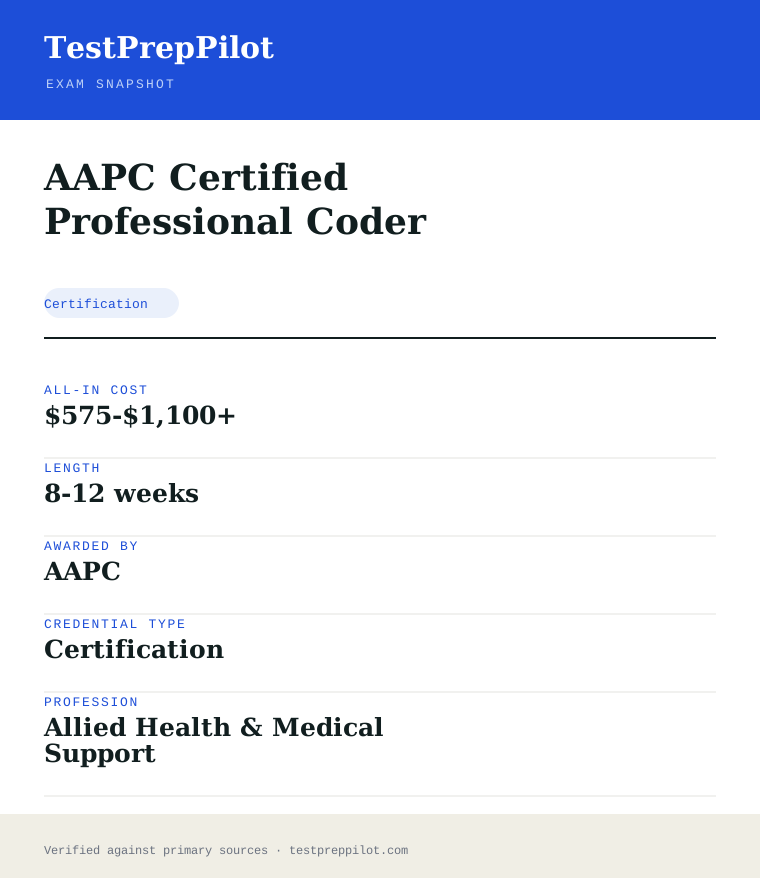
For the AAPC Certified Professional Coder, the exam fee is $425 ($499 with second attempt); the all-in cost is typically $575-$1,100+; most candidates spend 8-12 weeks preparing.
Cost breakdown
| Exam fee (member, one attempt) | $425 |
|---|---|
| Second attempt (bundled) | $74 |
| AAPC membership (annual) | ~$199 |
| Study guide and practice exams | $150-$400 |
| Typical total | $575-$1,100+ |
Member rate shown; $499 covers two attempts. Membership is required to sit and renew. Prices current as of 2026.
Timeline
- Prep 8-12 weeks
- Book exam 1-2 weeks
- Sit exam 4 hours
- Result within days
- Maintain every 2 years
Typical prep: 8-12 weeks
The path
How do you register for the AAPC Certified Professional Coder?
- 1
Create an AAPC account and membership10 minutes
AAPC membership is required to register for certification exams and to keep the credential active; join at aapc.com before booking.
- 2
Choose your credential and prep pathvaries
Most candidates enroll in an AAPC course or self-study with the official study guide and code books relevant to the credential.
- 3
Book the exam in your account15 minutes
Exams are delivered as proctored, open-book, online sessions or at in-person proctored events. You can bundle a second attempt at checkout.
- 4
Prepare your approved code booksprep phase
The exam is open book, so gather current ICD-10-CM, CPT, and HCPCS Level II manuals. No handwritten notes, blank tabs, or sticky notes are allowed.
- 5
Sit and pass the examtest day
Complete the timed exam (commonly 100 questions over 4 hours) under live proctoring. Results are reported by AAPC and a certificate is issued on passing.
The fine print
What are the retake and renewal rules for the AAPC Certified Professional Coder?
- Proctoring & delivery
- AAPC certification exams are delivered online with live proctoring through AAPC's testing platform or at in-person proctored events. They are open-book: approved coding manuals (ICD-10-CM, CPT, HCPCS Level II) are permitted, but handwritten notes and electronic lookup are not. Online testers need a webcam, government photo ID, and a quiet room.
- Retake policy
- Candidates may bundle a second attempt with the initial registration at the two-attempt price. After both attempts are used, additional retakes require a new exam voucher. Vouchers carry a validity window (commonly 12 months) from purchase.
- Score reporting
- Exams are scored as a raw percentage with a 70% passing standard (for example, 70 of 100 questions). AAPC reports the result shortly after the exam and issues a certificate on passing. Scaled scoring is not used.
- Recertification
- AAPC credentials renew every two years and require 36 continuing education units (CEUs) - including a compliance component - plus the membership/renewal fee. Lapsed credentials can be reinstated within a grace period for a fee.
Context
AAPC core coding credentials compared
| Credential | Primary setting | Questions | Member fee | |
|---|---|---|---|---|
| CPC | Physician office | 100 / 4h | $425 | |
| COC | Hospital outpatient | 100 / 4h | $425 | |
| CIC | Hospital inpatient | 40 MCQ + 7 cases | $425 | |
| CRC | Risk adjustment | 100 / 4h | $425 | |
| CPB | Medical billing | 135 | $425 |
What it pays
How much does this credential pay?
$48,890 median for medical records specialists (BLS, May 2024)
There is no Bureau of Labor Statistics occupation called "CPC" — the AAPC Certified Professional Coder credential validates outpatient medical-coding skill, and the wage question belongs to the occupation you perform with it. The closest official BLS occupation is Medical Records Specialists, SOC 29-2072, which had a May 2024 median wage of $48,890, with the lowest 10 percent under $32,140 and the highest 10 percent above $79,260. The fit is direct: CPC holders work as outpatient medical coders in physician practices, clinics and billing companies, coding diagnoses and procedures for reimbursement, and BLS counted 198,100 medical records specialist jobs in 2024, projecting 7 percent growth from 2024 to 2034 with about 17,600 openings a year. The limitation to state plainly: the BLS median covers the whole occupation at all levels, credentialed or not, and coding pay rises with the credential tier and specialty — certified coders with experience and specialty certifications (surgical, anesthesia, evaluation-and-management) earn above the median, while entry-level coders earn below it. Read the number as the market for the occupation, with the CPC as the standard entry credential for outpatient coding.
| Measure | Figure | Source / note |
|---|---|---|
| Median annual wage, medical records specialists | $48,890 | BLS OOH, SOC 29-2072, May 2024 |
| Lowest 10 percent | Under $32,140 | BLS OOH, SOC 29-2072, May 2024 |
| Highest 10 percent | Above $79,260 | BLS OOH, SOC 29-2072, May 2024 |
| Projected openings per year | ~17,600 | BLS OOH, SOC 29-2072, 2024-2034 |
Job growth.BLS projects 7 percent growth for medical records specialists from 2024 to 2034, about 17,600 openings per year.
Source: BLS Occupational Outlook Handbook - Medical Records Specialists
Your odds
What are the pass rates?
AAPC publishes pass rates by year — historically around 50-60% for first-time CPC candidates, with prep courses lifting the pass rate substantially
The AAPC publishes annual pass-rate information for its certification exams, and the reported CPC pass rate has historically sat in the roughly 50-60 percent range, with the AAPC's own framing that candidates who complete structured preparation programs pass at materially higher rates than the overall average. We present the published figure as the body's own reporting and note that it reflects all candidates, including those who sit without formal preparation. What the AAPC also publishes is the format: the CPC exam has 100 multiple-choice questions with a 4-hour time limit, delivered by computer at AAPC test sites or through online proctoring, and the exam is open book — candidates may bring the current ICD-10-CM, CPT and HCPCS code books. The exam covers the full outpatient coding scope: evaluation and management coding, anesthesia, surgery (integumentary, musculoskeletal, cardiovascular, and the other surgery sections), radiology, pathology and laboratory, and medicine. The practical reading: the pass rate is a signal to prepare seriously — a structured prep course plus practice exams is the standard path, and the open-book format means knowing how to use the code books matters as much as knowing the codes.
Read this before quoting the number.AAPC publishes annual pass-rate data and reports that prepared candidates pass at higher rates; the exact figure varies by year and candidate pool.
Your schedule
How long should I study for it?
80-140 hours over 8-12 weeks of focused study
The CPC exam is a 100-question, 4-hour open-book exam covering the full outpatient coding scope, and its curriculum is the current coding systems — ICD-10-CM for diagnoses and CPT for procedures, with HCPCS for supplies and services. A defensible plan runs 80 to 140 hours over 8 to 12 weeks, typically built around an AAPC prep course or an equivalent structured program. Weeks 1-2: the foundations — medical terminology, anatomy and the coding guidelines — because the exam assumes clinical fluency. Weeks 3-4: ICD-10-CM coding — the guidelines, the conventions and diagnosis-coding practice. Weeks 5-8: CPT — the sections in order (evaluation and management, anesthesia, surgery, radiology, pathology/lab, medicine), with heavy practice on the surgery sections, which carry the largest weight. Weeks 9-10: HCPCS, modifier rules and coding scenarios, plus practice exams. Weeks 11-12: timed practice exams at the real 100-question, 4-hour format and targeted review. The plan is practice-heavy because the exam rewards applied coding decisions and book navigation; coding real scenarios under the open-book format is the core skill.
- Weeks 1-225
Foundations
- Medical terminology and anatomy
- The coding guidelines and conventions
- Clinical documentation review basics
- Weeks 3-425
ICD-10-CM
- Diagnosis coding guidelines
- Coding practice in volume
- Documentation-to-code decision drills
- Weeks 5-850
CPT sections
- E/M, anesthesia and the surgery sections
- Radiology, pathology/lab and medicine
- Modifier application practice
- Weeks 9-1025
HCPCS and scenarios
- HCPCS codes and supplies
- Coding scenarios in volume
- First full practice exam
- Weeks 11-1220
Timed mocks
- Two full timed practice exams
- Review weak sections
- Schedule the exam
Adjusting the pace
Recent coding-program graduate.Compress the foundations; the CPT surgery sections and timed practice are the highest-yield focus.
Career-changer without clinical background.Add 3-4 weeks of medical terminology and anatomy before the coding phases.
How to study
How do I prepare most effectively?
The CPC is open book, so the dominant strategy is mastering code-book navigation: the exam rewards knowing where to find a code, how the guidelines apply, and how to use the index and tabular lists quickly — candidates who practise with the physical code books outperform those who only study summaries. Second, cover the CPT surgery sections deliberately: they carry the largest weight, and candidates who under-prepare them lose the biggest block of items. Third, drill the modifier rules and the E/M guidelines, which are tested precisely and are a common source of error. Fourth, use the AAPC prep materials and practice exams, the closest thing to the real item style, and hold yourself to 80 percent-plus on practice because the pass line is a real filter. Fifth, take at least two full timed practice exams at the real 100-question, 4-hour format; the stamina and book-handling rhythm are part of the test. Finally, remember the annual code updates: study with the current-year code books, because the exam is built on the codes in effect at testing.
Master book navigation
The open-book format rewards knowing where to find codes fast.
Cover the surgery sections
CPT surgery carries the largest weight; under-preparing it is the top failure driver.
Drill modifiers and E/M
Both are tested precisely and are common error sources.
Use current-year code books
The exam is built on the codes in effect at testing.
Run two full timed mocks
100 questions in 4 hours; the stamina and book rhythm are part of the test.
What to buy
Which study resources are worth paying for?
CPC prep costs are dominated by the course and the code books. The AAPC's official CPC preparation course runs roughly $1,500-$3,000 depending on format (self-paced, instructor-led or the bundle with the exam); the AAPC also sells standalone study guides and practice exams. The current-year code books — ICD-10-CM, CPT and HCPCS — cost roughly $100-$250 in total and are essential because the exam is open book. Alternative prep includes community-college coding programs ($1,500-$5,000) that also provide the clinical foundation. A realistic total budget is $1,500 to $4,000 including the exam fee (about $399 for AAPC members, $499 for non-members) and the code books. Prices below are list prices as of mid-2026 and change frequently; we rank nothing by commission.
| Resource | Price | Format | Best for |
|---|---|---|---|
| AAPC CPC prep course | $1,500-$3,000 | Self-paced or instructor-led + exam | The standard structured path |
| ICD-10-CM, CPT and HCPCS books | $100-$250 total | Current-year code books | Essential for the open-book exam |
| AAPC study guides and practice exams | $100-$300 | Books and online practice | Applied coding practice |
| Community-college coding program | $1,500-$5,000 | Classroom or online | Clinical foundation plus coding |
| CPC exam | ~$399 member / ~$499 non-member | Computer-based, open book | The certification itself |
List prices as of mid-2026, subject to change; AAPC fees vary by membership; no commission or affiliate ranking is implied.
Avoid these
What mistakes do candidates most often make?
The most common CPC mistake is studying code lists instead of learning to navigate the code books and apply the guidelines: candidates who memorise codes fail the open-book items, which test finding the code and applying the rules under time pressure. The fix is book-based practice from the start. The second mistake is under-preparing the surgery sections, the largest weight on the exam. Third, candidates misapply the modifier rules or the E/M guidelines, which are tested precisely. Fourth, some candidates use prior-year code books and answer items from outdated codes; the exam is built on the current year's codes. Finally, candidates who never run a full timed practice exam underestimate the 4-hour stamina and the book-handling pace; two timed mocks are the minimum.
✕Memorising code lists
✓Practise navigating the books and applying the guidelines under time.
✕Under-preparing surgery
✓The CPT surgery sections carry the largest weight; drill them.
✕Misapplying modifiers and E/M
✓Both are tested precisely; build a modifier and E/M checklist.
✕Using prior-year code books
✓The exam is built on the current year's codes.
✕Skipping timed mocks
✓100 questions in 4 hours; run two full timed practice exams.
What you'll face
What question types will I see?
The CPC exam is a 100-question multiple-choice exam in 4 hours, open book. The items are coding-decision-focused: a clinical documentation excerpt followed by the correct ICD-10-CM diagnosis code, CPT procedure code, HCPCS code, modifier, or the correct coding decision. The exam covers the full outpatient scope with the surgery sections weighted most heavily. Samples below are editor-written illustrations of the published exam content, not live exam items; they show the applied coding style of the real items.
Procedure codes, modifiers and surgical coding.
Diagnosis codes, guidelines and conventions.
Evaluation-and-management levels and supplies.
Try these
Q1A patient undergoes a repair of a 3.0 cm laceration on the forearm with layered closure. The appropriate CPT code family and modifier consideration would be based primarily on:
Answer:A
Repair codes are selected by the repair type (simple, intermediate or complex), the anatomical site and the total wound length. Age, suture count and time are not the primary determinants of the repair code.
Q2When the physician documents "probable pneumonia" without confirmation, the ICD-10-CM coding rule is to:
Answer:A
For outpatient coding, uncertain diagnoses such as "probable" or "rule out" are coded as if they were confirmed at that encounter. Not coding, hospitalisation-only coding or history coding each misapply the outpatient coding guideline.
Q3A procedure is performed on both the left and right kidneys during the same operative session. The appropriate modifier to report the bilateral procedure is:
Answer:A
Modifier 50 reports bilateral procedures performed during the same session. Modifier 51 indicates multiple procedures, 59 a distinct procedural service, and 25 a separately identifiable E/M service.
Samples are editor-written illustrations of the published exam content, not live exam items.
The big day
What should I expect on exam day?
The CPC exam is a 100-question, 4-hour computer-based, open-book exam delivered at AAPC test sites or through online proctoring. Bring the required identification matching your registration and your current-year code books (ICD-10-CM, CPT and HCPCS); personal electronics and phones go in the locker or are prohibited. Arrive early for a test-site session or complete the environment check for online delivery. Pace at about 2.4 minutes per item and budget time for book navigation on the coding items. Your score is reported after the exam, with the official result following. If you do not pass, the AAPC retake policy defines the waiting period and the reduced retake fee. On a pass, the CPC is valid for one year of AAPC membership and is maintained with 36 continuing education units (CEUs) every two years (or the annual member update). The afterwards matters: keep the CEU log, because the AAPC audits renewals, and plan specialty certifications as the next step.
Bring
- Required identification matching your registration
- Current-year ICD-10-CM, CPT and HCPCS code books
- Exam confirmation
Leave at home
- Phone, smartwatch and all electronics
- Notes and study materials — the code books are the only reference
- Personal bags beyond what the site allows
How the day runs
Rules in the room
- The exam is open book — only the current-year code books may be used
- No personal electronics in the testing room
- The credential renews with 36 CEUs every two years
Afterwards.On a pass, your CPC is maintained with 36 CEUs every two years (or the annual update); log them, because the AAPC audits. On a fail, retake per the AAPC policy after additional coding practice.
Reference
What are the key facts about the AAPC Certified Professional Coder?
AAPC Certified Professional Coder is a certification credential; awarded by AAPC; the exam fee is $425 ($499 with second attempt); typical preparation is 8-12 weeks; holders typically earn $48,000-$72,000.
| Credential | AAPC Certified Professional Coder |
|---|---|
| Abbreviation | CPC |
| Type | Certification |
| Profession | Allied Health & Medical Support |
| Specialty | Coding and HIM |
| Awarded by | AAPC |
| Difficulty | Moderate |
| Typical prep time | 8-12 weeks |
| All-in cost | $575-$1,100+ |
| Typical salary range | $48,000-$72,000 |
| Delivery | Online proctored, open-book with approved code books |
| Retake | Second attempt bundled at $499, or new voucher after |
| Validity | 2 years; 36 CEUs to renew |
| Membership | AAPC membership required to sit and maintain |
| Scope | National / Multi-state |
Real questions
Frequently asked questions about the AAPC Certified Professional Coder
How hard is the CPC exam?
Most first-time candidates find it moderately difficult because of the breadth across all CPT sections and the 4-hour open-book pace. Unprepared testers have a low first-attempt pass rate, so structured study is important.
Can I use my code books during the exam?
Yes. The CPC is open book; you may use current ICD-10-CM, CPT, and HCPCS Level II manuals. Handwritten notes, blank tabs, and sticky notes are not allowed, and only printed books - not electronic lookup - may be used.
How long should I study?
Most candidates study 8 to 12 weeks, especially if new to coding. Those with on-the-job experience or a recent coding course often need less, while career changers benefit from a full course plus practice exams.
Does the CPC expire?
Yes. The credential is valid for two years. To renew you must hold AAPC membership and earn 36 continuing education units, including a compliance component, within each renewal cycle.
Is the CPC worth it?
For US outpatient coding roles the CPC is effectively required. AAPC salary data puts credentialed coders well above uncertified peers, and the CPC is the gateway to higher-paying specialty and auditing credentials.
Are AAPC exams open book?
Yes. AAPC coding exams are open book; you may use approved code books (ICD-10-CM, CPT, HCPCS) during the test. Notes, tabs with writing, and electronic lookup are not allowed.
Do I need to be an AAPC member?
Membership is required to register for the certification exams and to maintain the credential. The fees shown are member rates; non-member pricing is higher.
In short
Is the AAPC Certified Professional Coder worth it?
- CPC is the baseline credential for physician-office and outpatient professional coding.
- Open-book, 100 questions, 4 hours, 70% to pass.
- Member fee $425 (or $499 with a second attempt); membership required.
- Renew every two years with 36 CEUs.
Trust
Where does this information come from?
Everything above is taken from the awarding body's own published material. Fees, question counts and domain weights are revised regularly — check the official page before you pay.
- AAPC Awarding body
- Official AAPC Certified Professional Coder exam page Exam page
- AAPC certification programme Programme rules
Research confidence: high · Last reviewed 2026-08