The short version
What is the AAMA Certified Medical Assistant and is it worth it?
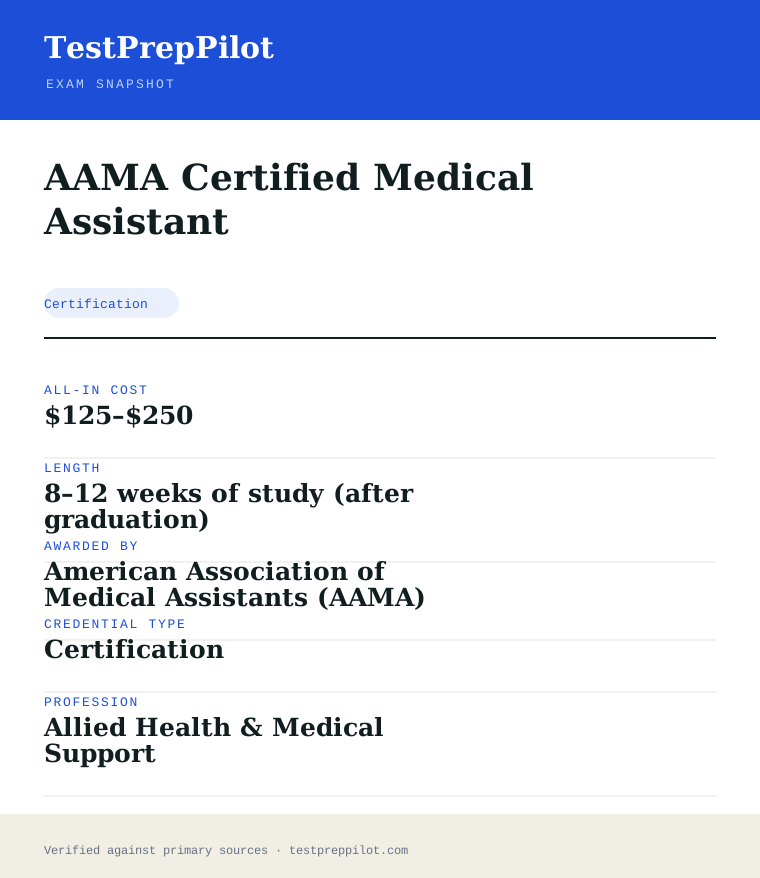
The CMA (AAMA) is a national, NCCA-accredited medical assistant credential from the American Association of Medical Assistants. To earn it you must graduate from a CAAHEP- or ABHES-accredited program and pass a 200-question exam (passing scaled score 405/800) at a PSI test center.
- NCCA-accredited and named specifically by many hospitals and large clinics in their hiring policies
- Recognized in all 50 states; signals graduation from an accredited program
- Longest renewal cycle of the major MA credentials (60 months)
- Immediate pass/fail result on screen, with the official score report in about 24 hours
What is it?
What exactly is the AAMA Certified Medical Assistant?
The NCCA-accredited, accredited-program-only medical assistant credential that hospitals ask for by name.
The Certified Medical Assistant (CMA), awarded by the American Association of Medical Assistants (AAMA), is the most widely recognized medical assisting credential in the U.S. and is accredited by the National Commission for Certifying Agencies (NCCA). It is distinctive because eligibility is restricted to graduates of CAAHEP- or ABHES-accredited programs — there is no work-experience or military route — which is why many hospitals and large health networks specifically prefer it. The exam is a 200-question, computer-based test (160 minutes) delivered at PSI test centers, scored on a 200–800 scale with a passing mark of 405. Once earned, the credential is valid for 60 months and is renewed through continuing education or exam retake. For candidates from accredited programs who want the gold-standard MA credential, the CMA (AAMA) is the one employers name by name.
The path in brief
- Graduate from a CAAHEP- or ABHES-accredited program
- Apply and pay the $125–$250 exam fee
- Get your eligibility verified by AAMA
- Schedule and pass the 200-question exam at a PSI center
- Maintain the credential with 60 CEUs every 60 months
Before you book
Who is eligible to sit the AAMA Certified Medical Assistant?
Eligibility is limited to graduates (or students within 30 days of graduating) of a medical assisting program accredited by CAAHEP or ABHES. AAMA classifies candidates as completing student, recent graduate (within 12 months), or non-recent graduate (more than 12 months ago); documentation requirements differ slightly by category. There is no work-experience, military, or non-accredited-program pathway to sit for the CMA (AAMA).
Who it is for: Graduates of CAAHEP- or ABHES-accredited medical assisting programs entering clinical or administrative roles.
The test itself
What is the format of the AAMA Certified Medical Assistant?
The AAMA Certified Medical Assistant is administered by American Association of Medical Assistants (AAMA), delivered by PSI and runs 160 minutes (four 40-minute segments), contains 200 multiple-choice (includes unscored pretest items) questions and requires Scaled score of 405 on a 200–800 scale to pass.
| Administered by | American Association of Medical Assistants (AAMA), delivered by PSI |
|---|---|
| Questions | 200 multiple-choice (includes unscored pretest items) |
| Time limit | 160 minutes (four 40-minute segments) |
| Pass mark | Scaled score of 405 on a 200–800 scale |
| Exam fee | $125 AAMA student member / recent graduate; $250 all other candidates |
| Format | Computer-based, four-option multiple choice |
Content outline
What topics are on the AAMA Certified Medical Assistant?
The AAMA Certified Medical Assistant covers 3 content domains.
Weightings come from the official exam outline. Study time is best allocated in roughly these proportions rather than evenly across domains.
- General
Anatomy & physiology, medical terminology, psychology, professionalism, and communication
- Administrative
Appointment scheduling, insurance billing, coding, medical records (EHR/EMR), and HIPAA compliance
- Clinical
Vital signs, pharmacology, specimen collection and phlebotomy, infection control, and patient care
The path
How do you register for the AAMA Certified Medical Assistant?
- 1
Confirm you qualify
You must be a graduate (or a student within 30 days of graduating) of a medical assisting program accredited by CAAHEP or ABHES. There is no work-experience or military pathway to the CMA (AAMA).
- 2
Apply and pay the exam feeabout 20 minutes
Create or sign in to your AAMA account, submit the CMA exam application with your program documentation, and pay the fee ($125 for AAMA student members and recent graduates; $250 for all other candidates). The fee is non-refundable.
- 3
Get eligibility verifieda few days to a few weeks
AAMA verifies your graduation documentation, then emails your scheduling authorization. Recent graduates and students are usually cleared quickly; non-recent graduates may need to supply additional proof.
- 4
Schedule at a PSI test center
Once authorized, book a seat at a PSI Services test center. Exams are offered year-round at centers across the U.S.
Remote or at-home proctoring is not available for the CMA (AAMA).
- 5
Take the examabout 3 hours on site
The exam is 200 multiple-choice questions delivered in four 40-minute segments (160 minutes of testing). You'll see your pass/fail result on screen immediately after finishing.
- 6
Receive your credentialwithin a few days of passing
An official score report is emailed about 24 hours after the exam. Once you pass and all requirements are verified, AAMA issues your digital badge and you may use the CMA (AAMA) credential.
The fine print
What are the retake and renewal rules for the AAMA Certified Medical Assistant?
- Proctoring & delivery
- In-person at PSI Services test centers across the U.S. There is no remote/online proctoring option for the CMA (AAMA). A valid photo ID is required at check-in.
- Retake policy
- Up to six (6) exam attempts are allowed within any 12-month period. There is no required waiting period between attempts, but each attempt requires a new application and the full exam fee.
- Score reporting
- A pass/fail result appears on screen immediately after the exam. The official score report is emailed about 24 hours later and is also posted to your AAMA account.
- Recertification
- Valid for 60 months (5 years). Recertify by earning 60 continuing education units (at least 30 must be AAMA-approved) or by retaking the exam. Recertification by CEU costs $65 for AAMA members and $130 for non-members.
- Refunds & rescheduling
- Exam fees are non-refundable.
Context
Medical assistant credentials compared
| Credential | Issuing body | Eligibility | Exam | Renewal | |
|---|---|---|---|---|---|
| CMA (AAMA) | AAMA | CAAHEP/ABHES grad only | 200 Q · 160 min · pass 405/800 | 60 months (60 CEUs or exam) | |
| NHA CCMA | NHA | Accredited program OR 1 yr experience | 180 Q · 3 hr | 24 months | |
| AMT RMA | AMT | Accredited program OR military OR 5 yr exp | 210 Q · 2 hr | Annual | |
| NCCT NCMA | NCCT | Program OR 2 yr exp OR military | 150 Q · 3 hr | 24 months |
What it pays
How much does this credential pay?
$44,200 median (BLS OOH, May 2024)
The Certified Medical Assistant (CMA, AAMA) credential sits on top of one of the fastest-growing support occupations in healthcare. According to the U.S. Bureau of Labor Statistics, medical assistants (SOC 31-9092) earned a median annual wage of $44,200 in May 2024, with employment of 811,000 and a projected 12% growth from 2024 to 2034 — "much faster than average" for all occupations and roughly 112,300 openings per year when replacements are included. The CMA does not automatically reset a graduate’s pay, but it is the credential most often required by hospital-based outpatient practices and large health systems, and it unlocks roles that are closed to uncredentialed or only on-the-job-trained assistants. Geography is the single largest pay lever: BLS shows the top of the range well above the median in outpatient care centers, hospitals, and physicians' offices, and state wages vary sharply. Because the CMA validates both clinical and administrative competence, holders are harder to outsource and better positioned for lead or coordinator roles. Candidates should read the median as a national midpoint, not a promise — entry-level wages in the bottom decile are materially lower, and the top decile reflects experienced assistants in high-cost metro markets and specialized settings. For context, BLS OEWS shows pay varies by industry and state, with outpatient care centers and hospitals generally above the physician-office median, so candidates should benchmark against their local market rather than the single national figure. The CMA return on investment is best measured as expanded eligibility for roles that require the credential and resilience against offshoring of clinical-support work, not as an automatic raise.
| Measure | Figure | Source / note |
|---|---|---|
| Median annual wage | $44,200 | BLS Occupational Outlook Handbook, Medical Assistants (SOC 31-9092), May 2024 |
| Lowest 10% (bottom decile) | Less than $35,020 | BLS OOH wage distribution, Medical Assistants, May 2024 |
| Highest 10% (top decile) | More than $57,830 | BLS OOH wage distribution, Medical Assistants, May 2024 |
| Employment, 2024 | 811,000 | BLS OOH, Medical Assistants, 2024 |
| Projected growth, 2024–2034 | 12% (much faster than average) | BLS OOH Job Outlook, Medical Assistants |
Job growth.12% growth 2024–2034 (BLS OOH, much faster than average); ~112,300 annual openings including replacements.
Source: BLS Occupational Outlook Handbook — Medical Assistants (SOC 31-9092)
Your odds
What are the pass rates?
69% first-time pass rate (Jul 2024–Apr 2025)
The AAMA Certifying Board publishes exam statistics rather than hiding them, which is a genuine advantage for candidates building a study plan. For the testing window July 2024 through April 2025, AAMA reports 4,171 CMA exams administered, of which 2,680 were first-time candidates, and a 69% first-time pass rate. For the prior 12-month period (July 2023–July 2024), AAMA reported 6,575 exams administered, 5,984 first-time candidates, and a 76% first-time pass rate — so the published rate has softened by roughly seven points year over year. Two things matter for interpretation. First, the figure is a first-time pass rate, not a cumulative or eventual pass rate; candidates who retake after a structured prep cycle typically improve. Second, AAMA counts the exam as criterion-referenced and pass/fail on a scaled 200–800 score with a minimum passing score (MPS) of 405, so the rate reflects how many first-time testers cleared that standard, not a fixed quota. As of January 5, 2026, AAMA counted 68,495 active CMAs, a large enough pool that the rate is statistically stable rather than noisy. Treat 69% as the realistic bar: most first-time testers pass, but a meaningful minority do not, and the misses cluster in administrative/billing content that clinically trained candidates under-prepare. Read together, the two windows show the CMA is passable for the majority of first-time testers but not automatic, and the year-over-year dip argues for more deliberate prep. Because AAMA separates scored items from unscored pretest items and reports a scaled standard rather than a raw percentage, the published rate is the cleanest external signal candidates have for calibrating how much practice they need before scheduling.
| Cohort | Pass rate | Source / note |
|---|---|---|
| First-time pass rate (Jul 2024–Apr 2025) | 69% | AAMA Exam Statistics, testing window July 2024–April 2025 (2,680 first-time of 4,171 exams) |
| First-time pass rate (Jul 2023–Jul 2024) | 76% | AAMA Exam Statistics, prior 12-month window (5,984 first-time of 6,575 exams) |
| Minimum passing score (MPS) | 405 (scaled 200–800) | AAMA Certifying Board; published on aama-ntl.org/certification |
| Active CMAs (Jan 5, 2026) | 68,495 | AAMA Exam Statistics, reported January 5, 2026 |
Source: AAMA — CMA (AAMA) Exam Statistics & Certification pages
Your schedule
How long should I study for it?
80–120 hours of focused study
A realistic CMA prep assumes roughly 10–12 weeks at 8–10 hours per week for a recent program graduate, or 14–16 weeks for a career-changer without a medical assisting background. The schedule below weights time to the blueprint: Clinical Competency is 59% of scored items, so it gets the largest block, but the 41% split between General (21%) and Administrative (20%) is where unprepared candidates lose points and must not be shortchanged.
- Weeks 1–210 hrs/week
General domain — law, ethics, communication
- Study HIPAA Privacy Rule, mandated reporting, and consent doctrine
- Drill medical terminology roots/suffixes and A&P systems
- Build a one-page legal/ethical quick reference
- Weeks 3–410 hrs/week
Administrative domain — billing, coding, scheduling
- Learn ICD-10-CM and CPT E/M coding and modifiers
- Practice CMS-1500 / superbill and insurance coordination of benefits
- Memorize scheduling methods (wave, open-access, cluster)
- Weeks 5–712 hrs/week
Clinical A — workflow, vitals, infection control
- Vital signs, OSHA, standard/transmission-based precautions, PPE donning/doffing
- Phlebotomy order of draw and specimen handling
- Safety data sheets and emergency preparedness
- Weeks 8–912 hrs/week
Clinical B — pharmacology & procedures
- Seven rights of med admin, routes, dosage/IV drip math
- ECG lead placement, diagnostic testing, sterile technique
- Practice 3–5 calculation problems per session
- Weeks 10–1110 hrs/week
Full-length simulation
- Two 200-question timed exams in four 40-min blocks
- Review every missed item against the blueprint
- Target weak domains with focused re-drills
- Week 126 hrs/week
Polish & exam logistics
- Light review of high-yield lists only
- Confirm PSI eligibility window and test-center location
- Rest 24h before the exam
Adjusting the pace
Working full-time (no MA background).Stretch to 16 weeks at 6–8 hrs/week; protect two 2-hour weeknight blocks and one 4-hour weekend block.
Recent MA program graduate.Compress to 6–8 weeks at 10 hrs/week, focusing on Administrative and law/ethics weak spots.
How to study
How do I prepare most effectively?
The CMA rewards application over recognition. Because 180 of 200 items are scored across three very different domains, the highest-yield strategies are blueprint-weighted repetition and timed practice, not passive re-reading of a textbook.
Weight study time to the 59% Clinical domain — but protect the 41%
Spend about 55–60% of hours on Clinical Competency, yet deliberately schedule Administrative (20%) and General (21%) blocks. Clinically trained candidates most often fail on billing, coding, and scheduling items they assumed they knew. Build a weekly checklist that touches all three domains every week.
Drill dosage and IV math until it is automatic
AAMA places 3–5 calculation items on the exam and they are easy points if rehearsed. Practice mg/kg, pediatric dosing, and unit conversions from memory; simulate the no-calculator, timed condition so the arithmetic does not cost you on exam day.
Take full-length, four-block simulations
The exam is four 40-minute segments (160 minutes) with 20 unscored pretest items scattered throughout. Train your endurance by sitting two 200-question practice exams in four timed blocks, including the optional breaks, so pacing and fatigue are not surprises.
Turn every missed question into a blueprint tag
After each practice set, log the item to its domain/topic and re-study the underlying rule, not the answer. AAMA notes its practice exam distribution does NOT mirror the real weighting, so use the official Content Outline to keep your coverage honest.
What to buy
Which study resources are worth paying for?
Official AAMA products are the only materials that mirror the certifying board’s own blueprint; third-party books add structure and alternate explanations. Prices below were verified on the publisher/retailer pages cited.
| Resource | Price | Format | Best for |
|---|---|---|---|
| AAMA CMA (AAMA) Certification Practice Exam | $30 (members & nonmembers) | Online, 200 Q in 10 modules, 90-day access, 2 attempts | Realistic pacing drill modeled on the exam |
| AAMA CMA (AAMA) Review Exam | $30 member / $45 nonmember | Online, 200 Q, 30-day access, earns 3 CEUs | Diagnostic check + CEU credit |
| Kaplan Medical Assistant Exam Prep | ~$25.50 (Amazon, list varies) | Print/digital study guide + practice Qs | Structured textbook review for career-changers |
Prices checked 2026-08 from aama-ntl.org and retailer listings; AAMA practice-exam price is flat for members and nonmembers. We do not rank by commission.
Avoid these
What mistakes do candidates most often make?
Most CMA failures are predictable and concentrated in non-clinical content and test mechanics, not in hands-on clinical knowledge.
✕Starving the Administrative (20%) and General (21%) domains
✓Clinically experienced candidates over-study procedures and under-study billing, CPT/ICD-10 coding, scheduling, and HIPAA. Block weekly time for these; they are 41% of the scored exam.
✕Treating pretest items as skippable
✓Twenty of 200 items are unscored pretests that look identical to scored ones. Answer every item as if it counts; you cannot tell them apart.
✕Memorizing practice-question answers instead of rules
✓AAMA’s practice exam distribution does not mirror the real blueprint. Learn the underlying standard (e.g., PPE sequence, order of draw) so you can apply it to novel stems.
✕Skipping full-length timed simulations
✓Four 40-minute blocks over 160 minutes is a stamina test. Simulate it at least once or twice or risk a slow second half.
What you'll face
What question types will I see?
The CMA (AAMA) exam is 200 multiple-choice questions delivered by computer in four 40-minute segments (160 minutes total). Of the 200, 180 are scored and 20 are unscored pretest items. Scoring is criterion-referenced on a scaled 200–800, MPS 405. The blueprint divides scored items into three domains: Clinical Competency 59% (106 items), General 21% (38 items), and Administrative 20% (36 items). Questions are single-best-answer multiple choice that test application of the Content Outline, not rote recall, across topics such as pharmacology, infection control, billing/coding, and law/ethics.
Single best answer across Clinical, General, and Administrative domains; application-oriented stems.
Embedded throughout to evaluate future items; indistinguishable from scored items and not counted.
Try these
Q1A medical assistant is preparing to draw blood for a chemistry panel. Which tube should be drawn FIRST according to the standard order of draw?
Answer:B
The correct order of draw begins with blood cultures, then light-blue (sodium citrate) for coagulation, then serum/red/gold, then green (heparin), then lavender (EDTA), then gray. Light-blue must precede serum and EDTA tubes so anticoagulant contamination does not skew coagulation or CBC results. A (lavender) is a common distractor but comes later; C and D also follow the blue-top tube.
Q2Under HIPAA, which of the following is a permissible disclosure of PHI WITHOUT the patient’s authorization?
Answer:B
HIPAA permits disclosures required by law, including mandated reporting of abuse, neglect, and certain communicable diseases, without patient authorization. Selling PHI for marketing (A) and casual disclosure to a friend (C) are clear violations; even "anonymized" posts (D) risk re-identification and are not a permitted basis. This is a classic General-domain law/ethics item.
Q3Which precaution requires a fit-tested N95 respirator and negative-pressure room?
Answer:D
Airborne precautions (e.g., for TB, measles, varicella) require N95 or higher respirators and a negative-pressure/airborne-infection isolation room. Standard precautions (A) are baseline; contact (B) needs gown/gloves; droplet (C) needs a surgical mask and private room but not N95 or negative pressure. Infection-control categorization is heavily tested in the Clinical domain.
Samples are editor-written illustrations of the published blueprint (Clinical 59% / General 21% / Administrative 20%); they are not live exam items.
The big day
What should I expect on exam day?
The CMA (AAMA) exam is delivered in person by computer at a PSI test center. You schedule within a 90-day eligibility window after AAMA approves your application. Plan to arrive early; the appointment includes a tutorial and optional breaks around the four 40-minute segments.
Bring
- Government photo ID that exactly matches your registration name
- Your PSI appointment confirmation
- Any required documentation if testing under a special accommodation
Leave at home
- Phones, smartwatches, and bags (secured in a locker before entry)
- Study notes, books, and scratch paper (center provides erasable materials)
- Calculators and smart devices (not permitted)
How the day runs
Rules in the room
- 20 unscored pretest items are mixed into the 200; answer all as if scored.
- You may not bring your own scratch paper; the center provides erasable materials collected at the end.
Afterwards.A preliminary pass/fail displays on screen. AAMA issues the official score report; if unsuccessful, review your domain performance and retest within the eligibility window per AAMA retake rules.
Reference
What are the key facts about the AAMA Certified Medical Assistant?
AAMA Certified Medical Assistant is a certification credential; awarded by American Association of Medical Assistants (AAMA); the exam fee is $125 AAMA student member / recent graduate; $250 all other candidates; typical preparation is 8–12 weeks of study (after graduation); holders typically earn $38,000–$50,000 (approx. U.S. median wage for medical assistants; BLS).
| Credential | AAMA Certified Medical Assistant |
|---|---|
| Abbreviation | CMA |
| Type | Certification |
| Profession | Allied Health & Medical Support |
| Specialty | Medical Office |
| Awarded by | American Association of Medical Assistants (AAMA) |
| Difficulty | Moderate |
| Typical prep time | 8–12 weeks of study (after graduation) |
| All-in cost | $125–$250 |
| Typical salary range | $38,000–$50,000 (approx. U.S. median wage for medical assistants; BLS) |
| Credential | CMA (AAMA) — Certified Medical Assistant |
| Issuing body | American Association of Medical Assistants (AAMA) |
| Eligibility | Graduate of a CAAHEP- or ABHES-accredited program |
| Exam length | 200 questions · 160 minutes |
| Passing score | Scaled 405 / 800 |
| Testing partner | PSI Services test centers (U.S.) |
| Attempts | Up to 6 per 12-month period |
| Validity | 60 months (recertify by CEUs or exam) |
| Scope | National / Multi-state |
Real questions
Frequently asked questions about the AAMA Certified Medical Assistant
Who is eligible for the CMA (AAMA) exam?
You must have graduated — or be within 30 days of graduating — from a medical assisting program accredited by CAAHEP or ABHES. Unlike some other MA credentials, AAMA does not offer a work-experience or military pathway; program accreditation is mandatory.
How much does the CMA exam cost?
The fee is $125 for AAMA student members and recent graduates, and $250 for all other candidates. It is non-refundable, and every retake requires paying it again.
What is the passing score?
The exam is scored on a 200–800 scale and the minimum passing scaled score is 405. You see a pass/fail result on screen immediately, with the official score report emailed about 24 hours later.
How many times can I take the exam if I fail?
Up to six attempts are allowed within any 12-month period, and there is no required waiting period between attempts — but each attempt needs a new application and fee.
How do I keep the CMA (AAMA) active?
Recertify every 60 months (5 years) by earning 60 continuing education units (at least 30 from AAMA-approved providers) or by retaking the exam. Recertification by CEU costs $65 for members and $130 for non-members.
Is the CMA (AAMA) accepted in all states?
Yes — the CMA (AAMA) is recognized in all 50 states. A few states have their own scope-of-practice rules for medical assistants, but the credential itself is national.
Does AAMA offer a work-experience pathway?
No. Unlike NHA, AMT, or NCCT, AAMA requires graduation from a CAAHEP- or ABHES-accredited program; on-the-job experience alone does not qualify you to sit for the exam.
How long is the CMA valid and how do I renew?
The credential is valid for 60 months. Renew by earning 60 CEUs (at least 30 AAMA-approved) or by retaking the exam.
In short
Is the AAMA Certified Medical Assistant worth it?
- The CMA (AAMA) is the only medical assistant credential that requires graduation from a CAAHEP- or ABHES-accredited program — no experience pathway exists.
- The exam is 200 multiple-choice questions in 160 minutes; the passing scaled score is 405 on an 800 scale.
- Testing is in person at PSI centers year-round; remote proctoring is not offered.
- Recertify every 60 months via 60 CEUs (at least 30 AAMA-approved) or by exam retake.
Trust
Where does this information come from?
Everything above is taken from the awarding body's own published material. Fees, question counts and domain weights are revised regularly — check the official page before you pay.
Research confidence: high · Last reviewed 2026-08