Allied Health & Medical Support • Certification
ARRT Radiation Therapy Certification
ARRT Radiation Therapy Certification — Allied Health credential from American Registry of Radiologic Technologists (ARRT)
Researched and maintained by TestPrepPilot Editorial BoardRadiologic & medical imaging certifications desk · Figures last verified August 2026
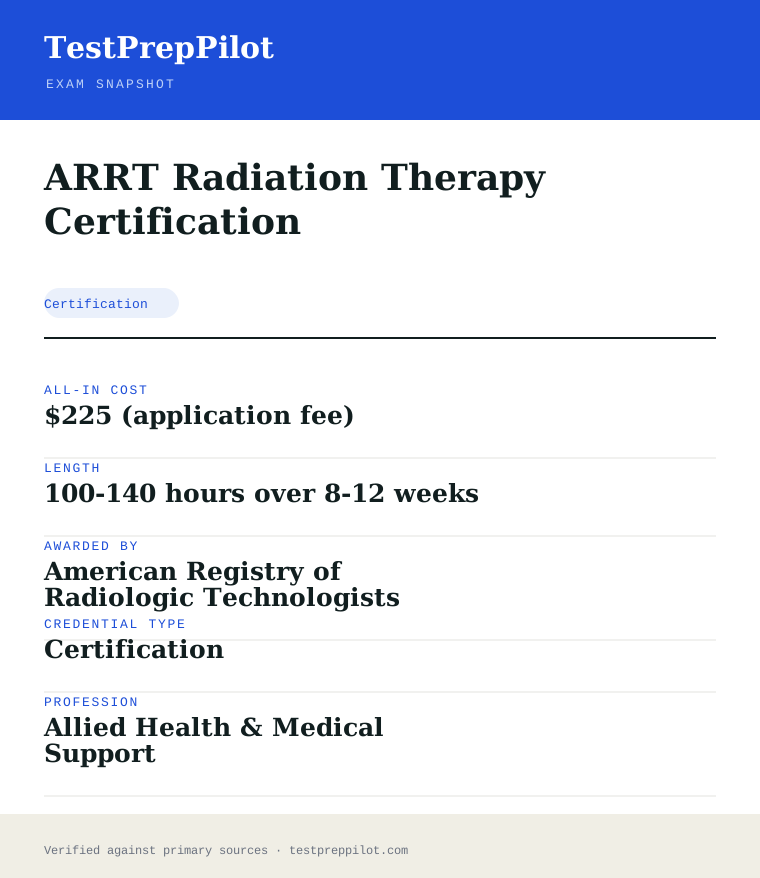
The short version
What is the ARRT Radiation Therapy Certification and is it worth it?
ARRT Radiation Therapy Certification is a professional credential administered by American Registry of Radiologic Technologists (ARRT). It validates job-ready knowledge and skills in the Allied Health field and is used for career entry, advancement, or compliance.
- Recognized credential from American Registry of Radiologic Technologists (ARRT)
- Demonstrates verified competence in Allied Health
- Supports career advancement and may satisfy licensing or employer requirements
What is it?
What exactly is the ARRT Radiation Therapy Certification?
ARRT Radiation Therapy Certification — Allied Health credential from American Registry of Radiologic Technologists (ARRT)
Primary certification for radiation therapists delivering therapeutic radiation oncology treatments. Offered by American Registry of Radiologic Technologists (ARRT), it is designed for candidates who need to demonstrate verified competence in the Allied Health field. The credential is commonly used for career entry, advancement, regulatory compliance, or employer requirements. Candidates should review the official handbook for eligibility, exam format, and scoring before registering.
The path in brief
- Confirm you meet any eligibility or prerequisites
- Review the official handbook and study materials
- Register and pay through the awarding body or authorized provider
- Schedule and take the exam (test center or online proctoring)
- Receive your score and, if passed, your credential
Before you book
Who is eligible to sit the ARRT Radiation Therapy Certification?
Eligibility varies; many credentials are open to all, while others require coursework, work experience, or sponsorship.
Who it is for: Professionals and candidates seeking to validate Allied Health competence.
The test itself
What is the format of the ARRT Radiation Therapy Certification?
The ARRT Radiation Therapy Certification is administered by American Registry of Radiologic Technologists (ARRT) and runs ~4 hours.
| Administered by | American Registry of Radiologic Technologists (ARRT) |
|---|---|
| Questions | ~200 questions (verify current) |
| Time limit | ~4 hours |
| Pass mark | Passing score set by the awarding body; see the official score report |
| Exam fee | $225 |
| Format | Proctored, computer-based (test center or online remote proctoring) |
Content outline
What topics are on the ARRT Radiation Therapy Certification?
The ARRT Radiation Therapy Certification covers 4 content domains.
Weightings come from the official exam outline. Study time is best allocated in roughly these proportions rather than evenly across domains.
- Anatomy & physiology
Topic area tested on the exam; see the official blueprint for the detailed breakdown.
- Clinical procedures
Topic area tested on the exam; see the official blueprint for the detailed breakdown.
- Patient care & safety
Topic area tested on the exam; see the official blueprint for the detailed breakdown.
- Documentation & ethics
Topic area tested on the exam; see the official blueprint for the detailed breakdown.
The path
How do you register for the ARRT Radiation Therapy Certification?
- 1
Visit the awarding body’s official website and create an account
- 2
Select the credential and review its specific requirements
- 3
Complete any required eligibility (education, experience, or training)
- 4
Pay the registration fee
- 5
Schedule the exam at a test center or online
- 6
Take the exam and receive your results
The fine print
What are the retake and renewal rules for the ARRT Radiation Therapy Certification?
- Proctoring & delivery
- Proctored, computer-based delivery (test center or remote online proctoring), varying by exam.
- Retake policy
- Varies by credential — most bodies permit retakes after a waiting period and full or partial fee.
- Score reporting
- Scores are reported per the body’s timeline, typically electronically after the exam.
- Recertification
- Varies; many credentials require renewal every 2–3 years via continuing education or a recertification exam.
What it pays
How much does this credential pay?
Radiation therapists earned a May 2024 BLS median of $101,990 — the highest of the imaging-technologist family.
The salary conclusion for the Radiation Therapy credential is the strongest in imaging technology: the BLS Occupational Outlook Handbook reports a May 2024 median annual wage of $101,990 for SOC 29-1124 Radiation Therapists, with 19,200 jobs counted in 2024, and the role pays above nuclear medicine technologists ($97,020), MRI technologists ($88,180), diagnostic sonographers ($89,340) and general radiologic technologists ($77,660). The BLS classifies by job duty, not by certificate, so the R.T.(T) designation itself does not appear in the wage data — but the ARRT Radiation Therapy exam is the standard route to state licensure in most states, and employers require the credential, so passing it is the practical condition for entry into the occupation the BLS pays at that median. Radiation therapists administer doses of radiation to patients with cancer and other diseases, working in hospitals and outpatient cancer centers, and the pay reflects the combination of technical skill — treatment planning, dose calculation, equipment operation and quality assurance — and the direct responsibility for patient safety in every fraction. BLS projects only 2 percent growth from 2024 to 2034, slower than the average, but still expects about 900 openings a year, almost all of them replacement need, and the field is small, which means the credential holders who enter it are competing for a stable number of well-paid positions. Two caveats anchor the picture: first, most states require radiation therapists to be licensed or certified, and the ARRT credential plus a state license are separate gates, so candidates must check their state board’s requirements; second, the exam is a primary-pathway credential earned through an accredited radiation therapy program, so the salary is the end of a structured education-and-licensure sequence rather than an add-on credential someone can bolt onto another imaging career.
| Measure | Figure | Source / note |
|---|---|---|
| Median annual wage | $101,990 | BLS OOH, Radiation Therapists (SOC 29-1124), May 2024 |
| Employment, 2024 | 19,200 jobs | BLS OOH Quick Facts, 2024 |
| Projected annual openings | ~900 per year | BLS OOH Job Outlook, 2024-34 |
| Typical setting | Hospitals and outpatient cancer centers | BLS OOH Work Environment, 2024 |
Job growth.BLS projects 2 percent growth for radiation therapists (2024-2034), slower than the average, with roughly 900 openings per year, almost all replacement need.
Source: BLS Occupational Outlook Handbook - Radiation Therapists
Your odds
What are the pass rates?
ARRT reported a 77.1% first-attempt pass rate for the Radiation Therapy exam in 2025 after a February 2025 cut-score increase; scaled 75 on a 1-99 scale is the standard.
The direct answer on pass rates is unusually well documented: ARRT publishes pass-rate statistics in its Annual Exam Report, and the 2025 report lists a 77.1 percent first-attempt pass rate for Radiation Therapy, with a mean scaled score of 79.8 for all candidates and 1,250 candidates sitting the exam, 960 of them first-time test-takers. That means roughly three of every four first-time candidates pass, and the passing standard is a scaled score of 75 on ARRT’s 1-to-99 scale — which is not 75 percent correct, because ARRT scales the raw score to equate form difficulty across different exam versions. The most important development for candidates is the February 2025 cut-score change: ARRT raised the passing standard for the Radiation Therapy exam to a level equivalent to roughly seven more correct answers on the referenced exam form, projecting a future first-time pass rate around 73 percent under the new threshold, and the actual 2025 result came in at 77.1 percent, so the exam became measurably harder while remaining passable for most well-prepared candidates. The exam totals 200 scored items across eight categories reported in the 2025 exam report: Patient Interactions and Management (29 items), Patient and Medical Record Management (17), Radiation Physics and Radiobiology (21), Radiation Protection, Equipment Operation, and Quality Assurance (30), Treatment Sites and Tumors (26), Treatment Volume Localization (18), Prescription and Dose Calculation (24), and Treatments (35), with unscored pilot items mixed in. The historical record shows first-attempt pass rates in the high 70s to high 80s across the prior decade — 2020 at 84, 2021 at 79, 2022 at 78, 2023 at 85, 2024 at 83 — before the 2025 cut-score change brought the rate down. ARRT allows up to three attempts within three years, with a new application and fee per attempt. The read for a candidate is that the exam got harder in 2025 and the margin tightened, so the dose-calculation and treatment categories deserve proportional preparation.
Read this before quoting the number.Pass-rate figures are ARRT-published and vary by year; the February 2025 cut-score change lowered the expected pass rate, so confirm the current report on the ARRT website. The scaled passing score of 75 applies to all ARRT exams.
Source: ARRT Annual Exam Report and ARRT Radiation Therapy content specifications
Your schedule
How long should I study for it?
120-160 hours over 10-12 weeks of focused study
An efficient ARRT Radiation Therapy study plan is 10-12 weeks of about 120-160 total hours, because the exam is a broad test with 200 scored items across eight categories, and the clinical treatment content — Treatments (35 items), Radiation Protection, Equipment Operation and Quality Assurance (30), Patient Interactions (29) and Treatment Sites and Tumors (26) — carries the majority of the paper, while Prescription and Dose Calculation (24) and the physics categories reward precise, applied calculation work. The published content specifications are the scope map, and studying the eight categories in proportion to their item counts is the single highest-yield planning decision. Candidates coming from an accredited radiation therapy program should budget the lower end because the content is recent and clinical rotations are fresh; candidates who graduated earlier should budget the upper end because dose calculation and physics decay quickly. The primary-pathway eligibility gates must be finished before the study window: completion of an ARRT-recognized radiation therapy educational program, an associate degree or higher, and compliance with ARRT’s standards of ethics, with the 365-day testing window opening only after application approval. The final three weeks should be question-bank and mock-exam work at the real format, because a several-hour appointment with mixed pilot questions rewards rehearsal: two or three full timed mocks build the pacing discipline the exam demands, and the dose-calculation items — which are the lowest mean category scores in the exam report — are the most common place where candidates lose points. Candidates should also note that the February 2025 cut-score change means the bar is higher than it was for earlier cohorts, so a passing margin that was once comfortable is now the difference between pass and fail.
- Week 1-230
Physics, radiobiology and radiation protection
- Study radiation physics: photon interactions, units and conversions, and dose quantities
- Work radiobiology: fractionation, tissue responses, acute versus late effects
- Cover protection, dose limits, area postings and linac quality-assurance tolerances
- Week 3-425
Patient care and medical record management
- Study patient interactions, education, infection control, urgent situations and side-effect management
- Cover labs, tumor markers, chart documentation and the medical event rule
- Work ethics and legal content: consent, HIPAA, professional standards
- Week 5-630
Treatment sites, tumors and volume localization
- Drill staging and classification, spread patterns and emergencies for the major disease sites
- Study ICRU volumes, CT simulation, setup, immobilization and image guidance
- Cover target delineation concepts and how prescriptions are documented
- Week 7-830
Prescription and dose calculation (24 items)
- Drill dose formulas, fractionation schemes and the dose quantities used in prescriptions
- Work monitor-unit and dose-time calculations, and the weakest-section topics in the exam report
- Practise calculations until they are exact and fast — this is where the pass margin lives
- Week 915
Treatments (35 items) and equipment QA
- Study beam modifiers, typical site prescriptions, image guidance and brachytherapy basics
- Cover equipment operation, linac QA and detector systems
- Take one full timed mock exam
- Week 10-1225
Mocks and readiness
- Take two more full-length timed mocks scoring above scaled 75
- Re-drill the miss log until clean, weighted to dose calculation and treatments
- Confirm Pearson VUE booking, photo ID requirements and the testing window deadline
Adjusting the pace
Recent accredited program graduate.Fastest path; the content is current and clinical rotations are fresh, so weight time toward question-bank volume and full-length mocks rather than re-reading course material.
Graduated more than a year ago.Budget the upper end and add dose-calculation and physics review early; these decay fastest and carry the lowest mean scores in the exam report.
Radiographer or other imaging professional adding T.The primary pathway requires the radiation therapy educational program, not just an imaging credential; plan the education and eligibility first, then weight the study plan toward the clinical and dose-calculation content.
How to study
How do I prepare most effectively?
The dominant prep strategy for ARRT Radiation Therapy is studying the content outline in proportion to question weight and drilling a current question bank at volume, because the 200 scored items follow the published category counts and the February 2025 cut-score change means the bar is measurably higher than it was for earlier cohorts. First, download the current ARRT Radiation Therapy content specifications and use them as the master checklist: score the eight categories and allocate study time in the same proportions, giving Treatments (35 items) and Radiation Protection, Equipment Operation and Quality Assurance (30) the largest blocks rather than studying from front to back of a review book. Second, finish the primary-pathway eligibility gates early — the accredited program, the associate degree, the ethics review and the clinical documentation — because the 365-day testing window opens only at application approval and a late application shrinks study time. Third, drill a current question bank — 600 to 1,200 items with explanations — and build a miss log tied to the content outline, because bank rehearsal converts the outline into recall and the explanations fix the dose-calculation and physics distinctions the exam tests. Fourth, prioritise Prescription and Dose Calculation, the lowest-scoring category in the exam report, by working calculation problems until they are exact and fast under time pressure. Fifth, run at least three full-length timed mocks at the real format, because the appointment runs several hours with pilot items mixed in and candidates who only drill in short blocks mis-pace on the real paper. Finally, book the exam inside the testing window early, so the appointment lands when the miss log is clean rather than when the window forces it, and remember that the 2025 cut-score change makes a comfortable margin the realistic target rather than the minimum.
Study the outline in weight order
Treatments (35), protection and equipment (30), patient interactions (29) and treatment sites (26) carry the paper; allocate time proportionally to the eight published categories.
Finish eligibility gates early
Complete the accredited program, associate degree, ethics review and clinical documentation before the study window; the 365-day testing window only opens at application approval.
Drill a current bank with a miss log
600-1,200 items with explanations, tied to the content outline, converts study into recall and fixes the dose and physics distinctions.
Master Prescription and Dose Calculation
The lowest-mean category in the exam report rewards exact, fast calculation; work problems under time pressure until the formulas are reflex.
Run full-length timed mocks
Three mocks at the real format build the pacing the multi-hour appointment with pilot items demands.
What to buy
Which study resources are worth paying for?
ARRT Radiation Therapy prep resources split into the free official set, current question banks, and the standard review texts, and the buying logic is dominated by currency: ARRT revises its content specifications on a published cycle, and the February 2025 cut-score change makes passing harder, so material published for earlier standards risks under-preparing candidates for the current bar, and the first purchase rule is to verify the edition matches the current blueprint and standard. The free ARRT stack — the content specifications document, the primary eligibility pathway handbook, and the candidate resources on the ARRT website — covers the scope definition completely at zero cost and should anchor every plan. The paid question bank is the standard purchase, with prices typically $60-150 for a subscription that includes explanations, calculation items and mock exams; the bank is the closest thing to the real item style and the miss-log workflow depends on it, and for an exam with a calculation category, a bank with worked dose problems is worth the premium. Standard review texts for radiation therapy physics and dosimetry run $100-200 and are the closest thing to a single ordered reference for the calculation and physics content. Structured courses and live review workshops run $200-600 and add video instruction and pacing, which helps candidates who want external structure or who are weak in physics and dosimetry. The footnote that anchors the comparison: prices below are list prices as of mid-2026 and change frequently, and we rank nothing by commission. Employers are the hidden variable: many cancer centers and hospital radiation-oncology departments pay for or reimburse prep materials because the credential is a condition of the role, so candidates should ask their manager before buying anything, and a cheap readiness check is taking the free sample items ARRT and its vendors publish before purchasing.
| Resource | Price | Format | Best for | |
|---|---|---|---|---|
| ARRT content specifications (official) | Free (PDF) | Official document | The authoritative scope map | Download first and tag every miss to its category |
| ARRT primary eligibility pathway handbook | Free (PDF) | Official document | Eligibility, window and retake rules | Read before applying to avoid a late application |
| Radiation therapy question bank | $60-150 | Online, current items + mocks | Bank-driven rehearsal at volume | The core purchase for a 200-item breadth exam |
| Radiation therapy physics and dosimetry text | $100-200 | Print and eBook | Single ordered calculation and physics reference | Candidates needing the dose-calculation layer taught |
| Structured review course | $200-600 | Video + live sessions | External pacing and instruction | Candidates weak in physics or wanting structure |
| Employer-sponsored prep | Often $0 (reimbursed) | Department-funded | Paid bank or course through the employer | Candidates employed in radiation oncology |
List prices as of mid-2026 and change frequently; we rank nothing by commission. Verify that any paid material matches the current ARRT Radiation Therapy content specification revision and the post-February-2025 passing standard before purchase.
Avoid these
What mistakes do candidates most often make?
The most common mistake on the ARRT Radiation Therapy exam is preparing as if the passing standard had not changed, because ARRT raised the cut score in February 2025 by roughly seven correct answers on the referenced form, and candidates using pre-2025 study targets aim too low; the second is studying the eight categories in review-book order instead of weight order, which starves the Treatments, protection-and-equipment and patient-care categories that carry the majority of the 200 scored items. A third recurring error is treating the scaled score of 75 as 75 percent correct — candidates who aim for 75 percent over-study the easier recall content and under-prepare the dose-calculation and physics items, when the exam report shows Prescription and Dose Calculation as the lowest mean category and the scaled score is not a percentage. Candidates also routinely underestimate the eligibility timeline, letting the accredited-program completion, degree and ethics review run until they collide with the 365-day testing window, which compresses real study time. Another pattern is skipping calculation practice under time pressure, so the formula-and-number work that decides the pass margin is slow and error-prone on exam day. Finally, some candidates fail to keep the miss log current, so the same physics or fractionation distinction costs points repeatedly across practice and on the real exam. Each of these is fixable in one deliberate cycle, and the common thread is that the 2025 standard makes a comfortable margin the target, and a weight-ordered, calculation-heavy plan is what produces it, because candidates who map every practice miss back to the eight published categories find that a small set of recurring gaps — usually dose calculation and the physics layer — explains most of their lost points.
✕Preparing to the pre-2025 standard
✓ARRT raised the cut score in February 2025 by roughly seven correct answers; use current prep material and require practice mocks to clear scaled 75 by a margin that reflects the harder standard.
✕Studying in review-book order
✓Allocate time by question weight: Treatments (35), protection and equipment (30), patient interactions (29) and treatment sites (26) first, then physics, dose calculation and records.
✕Aiming for 75 percent correct
✓The scaled score of 75 is not a percentage of items correct; target mastery of the weighted categories, with Prescription and Dose Calculation as the highest-priority repair target.
✕Letting eligibility gates run late
✓Complete the accredited program, degree, ethics review and clinical documentation before the study window; the 365-day testing window only opens at application approval.
✕Skipping calculation practice under time
✓The dose-calculation category is the lowest mean in the exam report and decides the pass margin; work calculation problems under time pressure until they are exact and fast.
✕Letting the miss log go stale
✓Re-drill every miss until clean and re-test the same physics and fractionation distinctions; a recurring gap is the difference between a near pass and a pass at the new standard.
What you'll face
What question types will I see?
The ARRT Radiation Therapy exam is 200 scored items plus unscored pilot questions delivered by computer at Pearson VUE centers, in a several-hour appointment, and the published format is four-option, single-best-answer multiple choice with a small share of alternative formats such as calculation items and multiple-select items. The scored content follows the eight categories reported in the ARRT Annual Exam Report: Patient Interactions and Management (29 items), Patient and Medical Record Management (17), Radiation Physics and Radiobiology (21), Radiation Protection, Equipment Operation, and Quality Assurance (30), Treatment Sites and Tumors (26), Treatment Volume Localization (18), Prescription and Dose Calculation (24), and Treatments (35). The clinical treatment content dominates — Treatments, Treatment Sites and Tumors, and the protection-and-equipment categories together approach half the paper — and the dose-calculation items are the part most likely to separate candidates, because they reward exact arithmetic and formula fluency rather than recognition, and the exam report lists Prescription and Dose Calculation as the lowest mean category. The exam includes image-based and equipment items in which candidates identify anatomy, recognise setup and immobilization issues, or interpret quality-assurance results, which is why studying with images matters. Because the pilot questions are indistinguishable from scored ones, every item must be treated as live, and because the February 2025 cut-score change raised the bar, the calculation items that build a margin are worth more than their 12 percent share suggests. The samples below illustrate the published item style across three of the categories — a physics item, a dose-calculation item and a treatment item — with four options each. The sample items are editor-written illustrations of the published blueprint, not live exam items.
Four options per item; the dominant format across all eight categories.
Worked dose, monitor-unit and time calculations with the constants supplied; exact arithmetic and formula fluency decide the pass margin.
Identify anatomy, setup issues and QA results on images; rewards atlas and equipment study.
Try these
Q1A patient is treated with a 6 MV photon beam to a tumor dose of 200 cGy per fraction. Which dose quantity most directly describes the dose prescribed to the tumor volume for each fraction?
Answer:A
The prescription dose to the target volume is the quantity the radiation therapist documents and delivers, and the 200 cGy per fraction is exactly that target-volume prescription (A). The skin surface dose (B) is a concern for skin reactions and is not the prescription quantity. The integral dose to the whole body (C) is a measure of total energy absorbed, not the prescribed fraction dose. The dose to the nearest critical organ (D) is limited, not prescribed. This item tests the Prescription and Dose Calculation category: knowing which dose quantity is being prescribed is the foundation of the calculation items, and the exam rewards precision about dose definitions.
Q2A linac delivers 300 monitor units (MU) to treat a patient. If the calibration factor is 1 cGy per MU at the reference depth, what dose in cGy does the patient receive at that point?
Answer:A
With a calibration factor of 1 cGy per MU, the delivered dose is 300 MU times 1 cGy per MU, which equals 300 cGy (A). B (30 cGy) misplaces a decimal, treating 300 as 30. C (3,000 cGy) multiplies instead of cancelling the units. D (100 cGy) is unrelated to the given numbers. This item tests the dose-calculation layer directly: monitor-unit calculations are the exact-arithmetic items that decide the pass margin, and the exam rewards working them correctly under time pressure rather than pattern-matching to a plausible letter.
Q3A radiation therapist is setting up a patient for treatment of a left breast with tangential fields. The patient moves between the simulation position and the treatment position. What is the most appropriate action?
Answer:A
Setup reproducibility is the core of safe radiation therapy, and when the patient is not in the simulation position, the correct action is to reposition using the documented setup and imaging verification before treating (A). Treating in a different position (B) compromises the plan and the OAR limits. Proceeding without verification (C) abandons the QA step that defines the role. Cancelling and discharging without notification (D) is disproportionate and unprofessional. This item tests the Treatments category: setup verification is a daily responsibility, and the best-practice response is to verify before delivering, which is exactly the judgement the exam rewards.
Samples are editor-written illustrations of the published blueprint, not live exam items.
The big day
What should I expect on exam day?
The ARRT Radiation Therapy exam is a computer-based appointment at a Pearson VUE testing center, and the direct exam-day answer is that you will sit 200 scored questions plus unscored pilot items in a several-hour appointment, and a scaled score of 75 on the 1-99 scale is required to pass — a bar that is effectively higher since the February 2025 cut-score change. Arrive with two forms of government-issued photo ID, because Pearson VUE enforces the two-ID rule strictly; check your ARRT Candidate Status Report and the center’s booking confirmation for any additional instructions. The appointment begins with a tutorial and the ARRT nondisclosure agreement, then the clock starts on the test items, with the pilot items indistinguishable from scored ones — answer every question as if it counts. Expect the environment to be quiet and proctored with a visible countdown clock; pace yourself so the calculation items, which take longer because they require working the numbers, do not crowd the clinical categories at the end. There are no scheduled breaks, and the exam cannot be paused, so the full-length mock discipline matters. A preliminary score appears on screen immediately after submission, with the official report following through the ARRT account within about two to four weeks; pass results feed the annual renewal cycle ($65 per credential as of 2026) and the 24-CEU biennial obligation shared across ARRT credentials. If you do not pass, you may reapply — each attempt requires a new application and the $225 fee, with a maximum of three attempts within three years, and the 365-day testing window resets with each new Authorization to Test.
Bring
- Two forms of government-issued photo ID
- ARRT Candidate Status Report and booking confirmation
- Approved glasses or hearing aids if used
- Snacks for before the appointment (not in the test room)
Leave at home
- Phone, smartwatch, and other electronics (stored per center rules)
- Study materials and notes
- Scratch paper from home (the center supplies its own)
- Any item on the Pearson VUE prohibited list
How the day runs
Rules in the room
- Two forms of government-issued photo ID required
- No scheduled breaks; the test clock runs continuously
- No personal electronics in the test room
- Answer every item; pilot questions are indistinguishable from scored ones
Afterwards.A passing scaled score of 75 certifies the R.T.(T) designation. Maintain it with the $65 annual renewal and 24 CEUs per biennium (shared across ARRT credentials), plus the ten-year Continuing Qualifications Requirements. If you fail, you may reapply with a new application and fee, up to three attempts within three years — and note that the February 2025 cut-score change means a narrow fail is more likely than in earlier years, so treat a re-sit as a targeted repair cycle rather than a second roll of the dice.
Reference
What are the key facts about the ARRT Radiation Therapy Certification?
ARRT Radiation Therapy Certification is a certification credential; awarded by American Registry of Radiologic Technologists (ARRT); the exam fee is $225; typical preparation is 100-140 hours over 8-12 weeks; holders typically earn $80,000-$120,000 (29-1124 median ~$98,000).
| Credential | ARRT Radiation Therapy Certification |
|---|---|
| Abbreviation | RT(T) |
| Type | Certification |
| Profession | Allied Health & Medical Support |
| Specialty | Medical Imaging |
| Awarded by | American Registry of Radiologic Technologists (ARRT) |
| Difficulty | Applied |
| Typical prep time | 100-140 hours over 8-12 weeks |
| All-in cost | $225 (application fee) |
| Typical salary range | $80,000-$120,000 (29-1124 median ~$98,000) |
| Credential | ARRT Radiation Therapy Certification |
| Awarding body | American Registry of Radiologic Technologists (ARRT) |
| Exam format | Proctored, computer-based |
| Validity | Annual $65 renewal + 24 CEUs per biennium |
| Languages | Varies — see awarding body |
| Scope | National / Multi-state |
Real questions
Frequently asked questions about the ARRT Radiation Therapy Certification
How do I register for the ARRT Radiation Therapy Certification exam?
Register through American Registry of Radiologic Technologists (ARRT)'s official portal or an authorized test provider (e.g., Pearson VUE or Prometric where applicable). Create an account, select the exam, pay the fee, and schedule a date.
How much does the exam cost?
Fees vary by location and currency. Confirm the current fee on the official registration page before scheduling.
How long is the credential valid, and how do I renew?
Validity varies by credential (commonly 2–3 years). Renewal usually requires continuing education or a recertification exam — see American Registry of Radiologic Technologists (ARRT)'s policy.
What if I do not pass?
Most bodies allow retakes after a waiting period and payment of the full or partial fee. Check American Registry of Radiologic Technologists (ARRT)'s retake policy before rescheduling.
How do I register for a American Registry of Radiologic Technologists (ARRT) credential?
Register through the official website, select your exam, pay the fee, and schedule a date.
How do I renew a credential?
Renewal policies vary by credential; check the specific program page for requirements and cycles.
In short
Is the ARRT Radiation Therapy Certification worth it?
- ARRT Radiation Therapy Certification is awarded by American Registry of Radiologic Technologists (ARRT).
- Validates job-ready competence in Allied Health.
- Registration is through the awarding body or an authorized test provider.
- Renewal and retake policies vary — confirm before scheduling.
Same awarding body
What other credentials does American Registry of Radiologic Technologists (ARRT) award?
Worth comparing
How does the ARRT Radiation Therapy Certification compare with similar credentials?
Trust
Where does this information come from?
Everything above is taken from the awarding body's own published material. Fees, question counts and domain weights are revised regularly — check the official page before you pay.
Research confidence: low · Last reviewed 2026-08