Allied Health & Medical Support • Certification
ARRT Magnetic Resonance Imaging Certification
ARRT Magnetic Resonance Imaging Certification — Allied Health credential from American Registry of Radiologic Technologists (ARRT)
Researched and maintained by TestPrepPilot Editorial BoardAllied health & medical imaging certifications desk · Figures last verified August 2026
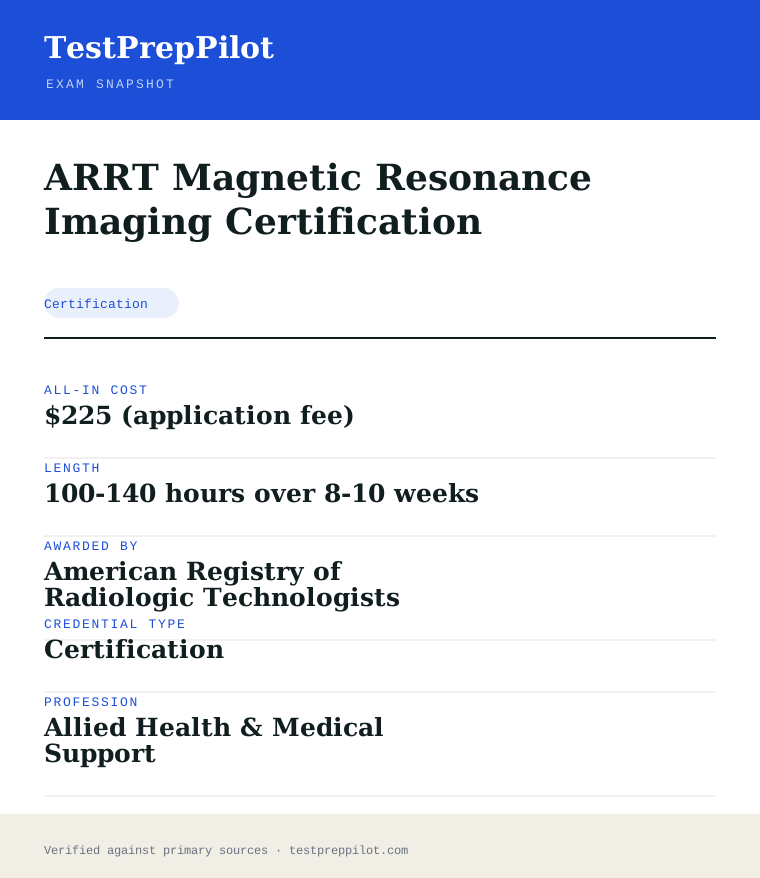
The short version
What is the ARRT Magnetic Resonance Imaging Certification and is it worth it?
ARRT Magnetic Resonance Imaging Certification is a professional credential administered by American Registry of Radiologic Technologists (ARRT). It validates job-ready knowledge and skills in the Allied Health field and is used for career entry, advancement, or compliance.
- Recognized credential from American Registry of Radiologic Technologists (ARRT)
- Demonstrates verified competence in Allied Health
- Supports career advancement and may satisfy licensing or employer requirements
What is it?
What exactly is the ARRT Magnetic Resonance Imaging Certification?
ARRT Magnetic Resonance Imaging Certification — Allied Health credential from American Registry of Radiologic Technologists (ARRT)
Post-primary certification for radiologic technologists performing magnetic resonance imaging. Offered by American Registry of Radiologic Technologists (ARRT), it is designed for candidates who need to demonstrate verified competence in the Allied Health field. The credential is commonly used for career entry, advancement, regulatory compliance, or employer requirements. Candidates should review the official handbook for eligibility, exam format, and scoring before registering.
The path in brief
- Confirm you meet any eligibility or prerequisites
- Review the official handbook and study materials
- Register and pay through the awarding body or authorized provider
- Schedule and take the exam (test center or online proctoring)
- Receive your score and, if passed, your credential
Before you book
Who is eligible to sit the ARRT Magnetic Resonance Imaging Certification?
Eligibility varies; many credentials are open to all, while others require coursework, work experience, or sponsorship.
Who it is for: Professionals and candidates seeking to validate Allied Health competence.
The test itself
What is the format of the ARRT Magnetic Resonance Imaging Certification?
The ARRT Magnetic Resonance Imaging Certification is administered by American Registry of Radiologic Technologists (ARRT) and runs 3.5 hours.
| Administered by | American Registry of Radiologic Technologists (ARRT) |
|---|---|
| Questions | ~195 items (verify current spec) |
| Time limit | 3.5 hours |
| Pass mark | Passing score set by the awarding body; see the official score report |
| Exam fee | $225 |
| Format | Proctored, computer-based (test center or online remote proctoring) |
Content outline
What topics are on the ARRT Magnetic Resonance Imaging Certification?
The ARRT Magnetic Resonance Imaging Certification covers 4 content domains.
Weightings come from the official exam outline. Study time is best allocated in roughly these proportions rather than evenly across domains.
- Anatomy & physiology
Topic area tested on the exam; see the official blueprint for the detailed breakdown.
- Clinical procedures
Topic area tested on the exam; see the official blueprint for the detailed breakdown.
- Patient care & safety
Topic area tested on the exam; see the official blueprint for the detailed breakdown.
- Documentation & ethics
Topic area tested on the exam; see the official blueprint for the detailed breakdown.
The path
How do you register for the ARRT Magnetic Resonance Imaging Certification?
- 1
Visit the awarding body’s official website and create an account
- 2
Select the credential and review its specific requirements
- 3
Complete any required eligibility (education, experience, or training)
- 4
Pay the registration fee
- 5
Schedule the exam at a test center or online
- 6
Take the exam and receive your results
The fine print
What are the retake and renewal rules for the ARRT Magnetic Resonance Imaging Certification?
- Proctoring & delivery
- Proctored, computer-based delivery (test center or remote online proctoring), varying by exam.
- Retake policy
- Varies by credential — most bodies permit retakes after a waiting period and full or partial fee.
- Score reporting
- Scores are reported per the body’s timeline, typically electronically after the exam.
- Recertification
- Varies; many credentials require renewal every 2–3 years via continuing education or a recertification exam.
What it pays
How much does this credential pay?
$88,180 median for magnetic resonance imaging technologists (SOC 29-2035, BLS May 2024) — a direct match for the ARRT MRI credential
Unlike many certifications on this site, the ARRT MRI credential maps to a dedicated BLS occupation: Magnetic Resonance Imaging Technologists, SOC 29-2035, had a May 2024 median wage of $88,180, with the lowest 10 percent earning less than $64,910 and the highest 10 percent more than $121,420. This is a genuine match rather than a proxy — BLS describes MRI technologists as operating MRI scanners, monitoring patient safety and comfort, and viewing images to ensure quality, which is precisely what an R.T.(MR)(ARRT) does, and most MRI jobs are filled by ARRT-certified technologists, so the wage distribution is effectively the credential’s market. BLS projects 7 percent employment growth for MRI technologists from 2024 to 2034, faster than the 5 percent combined figure for radiologic and MRI technologists and faster than the 3 percent all-occupations average, with the combined occupation producing about 15,400 openings a year. The occupational logic is straightforward: the growing older population drives more MRI exams for cancer, brain, spine and musculoskeletal conditions, and each exam needs a technologist who can operate the scanner safely. The caveats matter. First, the MRI credential is a postprimary pathway — most candidates already hold an ARRT credential such as radiography, or a supporting credential from ARDMS or NMTCB — so the realistic salary story is a technologist adding a specialty, which typically moves pay up the distribution rather than starting from the bottom. Second, BLS groups MRI technologists with radiologic technologists in its combined outlook, but the MRI-specific 7 percent projection and the $88,180 median are published separately for SOC 29-2035. Third, the credential’s value is tied to the clinical-experience requirement: ARRT requires roughly 125 MRI procedure repetitions for postprimary candidates, so the exam presupposes you are already working in the modality.
| Measure | Figure | Source / note |
|---|---|---|
| Median annual wage, MRI technologists | $88,180 | BLS OOH, SOC 29-2035, May 2024 |
| Lowest 10 percent | less than $64,910 | BLS OOH Pay tab, May 2024 |
| Highest 10 percent | more than $121,420 | BLS OOH Pay tab, May 2024 |
| Employment, 2024 | 44,100 MRI technologist jobs | BLS OOH, SOC 29-2035, 2024 |
| Projected growth, MRI technologists | 7% (2024-34) | BLS OOH Job Outlook, 2024-34 |
Job growth.7% projected change 2024-34 for MRI technologists (faster than average), with the combined radiologic and MRI occupation producing ~15,400 openings a year
Source: BLS Occupational Outlook Handbook — Radiologic and MRI Technologists
Your odds
What are the pass rates?
ARRT publishes pass rates — 73.1% of first-time MRI candidates passed in 2024, across 3,071 first-time test-takers, per the ARRT 2024 Annual Report of Exams
ARRT publishes annual exam pass rates, and the most recent figure for the MRI postprimary exam is a 73.1 percent first-time pass rate across 3,071 first-time candidates, from the ARRT 2024 Annual Report of Exams. That figure is a useful planning datum: it tells you the exam is demanding but passable for prepared candidates, and it is broadly consistent with the reported pass rates in the mid-70s for the years around it. The exam itself changed structure on 1 February 2025: the current MRI content specifications list 200 scored questions plus 30 unscored pilot items — 230 total items candidates see, with no indication of which are unscored — delivered at a Pearson VUE test centre within a 230-minute appointment window that includes the tutorial, nondisclosure agreement, exam and post-exam survey. The passing standard is a scaled score of 75 on ARRT’s 1-to-99 scaled scoring scale, which is not a percentage of questions correct; ARRT equates exam forms so that the scaled 75 represents the same level of ability across different forms. The postprimary application fee is $225 with an ARRT supporting credential, or $450 if you use an ARDMS or NMTCB supporting credential, with a $200 reapplication fee. Candidates get three attempts within three years before requalification is required, and postprimary candidates must document roughly 125 MRI procedure repetitions, so the eligibility gate and the exam fee are both real. Because ARRT publishes the pass rate and the candidate count, this is one of the better-calibrated exams on this site — but remember the 73.1 percent is first-time candidates, and the overall figure including retakers is lower.
Read this before quoting the number.ARRT publishes first-time pass rates in its Annual Report of Exams — 73.1% for MRI across 3,071 first-time candidates in 2024. The 200 scored plus 30 unscored pilot structure, 230-minute appointment, scaled passing score of 75 and $225/$450 fee tiers are the published figures this narrative relies on alongside it.
Source: ARRT — MRI exam and Annual Report of Exams (pass-rate data)
Your schedule
How long should I study for it?
120-180 hours over 12-16 weeks of focused study
Plan for twelve to sixteen weeks and 120 to 180 hours of study, and weight it to the blueprint rather than to intuition — the current MRI content specifications put Image Production at 53 percent of the 200 scored questions, roughly 106 items, which is more than every other content area combined, so a candidate who starts with procedures is studying in the wrong proportions. The exam is 200 scored questions plus 30 unscored pilot items in a 230-minute appointment, and a scaled score of 75 is required to pass. The four content areas in the specifications effective 1 February 2025 are Image Production at 53 percent, Procedures at 28.5 percent, Safety at 10.5 percent and Patient Care at 8 percent — and candidates routinely report that Image Production, meaning MRI physics, pulse sequences and artifacts, is where first-attempt failures come from, so it must be the largest block of your study calendar. The plan below runs in five blocks: physics and sequences first, then parameters and quality, then procedures, then safety and patient care, closing with timed rehearsal — a shape that puts the 53 percent domain first and the smaller domains last. It assumes you already meet the postprimary eligibility: a supporting ARRT credential or an ARDMS/NMTCB credential, roughly 125 documented MRI procedure repetitions, and structured education in MRI. If you have not completed the clinical experience requirement, that is the gate you must clear first — the exam tests physics and safety at a depth that only makes sense once you have spent real time at the console.
- Weeks 1-310-12 hrs/week
Image Production — physics and sequences (53%)
- Master the physical principles: magnetism, RF excitation, signal formation, T1 and T2 relaxation, and contrast weighting
- Work pulse sequences in depth: spin echo and gradient echo families, TR/TE/flip angle effects, and k-space
- Learn image artifacts by cause — motion, chemical shift, aliasing, susceptibility — and their corrections
- Build a physics-first habit: every session starts with sequences and parameters before any other content
- Weeks 4-610-12 hrs/week
Image Production — parameters and quality (continued)
- Understand how parameter choices trade off SNR, contrast, spatial resolution and scan time
- Cover hardware: magnets, gradients, RF coils, and their effect on image quality
- Work image quality concepts and QA procedures
- Drill scenario items that ask which parameter change produces a stated image effect
- Weeks 7-99-11 hrs/week
Procedures (28.5%)
- Work anatomy and pathology recognition across brain, spine, musculoskeletal and body protocols
- Learn standard protocols and when to use each sequence for a stated clinical indication
- Cover contrast administration and gadolinium considerations
- Connect each procedure back to the physics: why this sequence for this indication
- Weeks 10-118-10 hrs/week
Safety (10.5%) and Patient Care (8%)
- Master MRI safety: zone designations, screening, implants, projectile hazards, SAR and heating
- Learn emergency procedures, contrast reactions and infection control
- Cover patient communication, positioning and comfort in the bore
- These are smaller areas but high-stakes — a wrong safety answer is never a coin flip
- Weeks 12-1410-12 hrs/week
Timed rehearsal and gap closing
- Take two or three full-length timed practice exams replicating the 230-minute appointment
- Re-lab every miss to a content area — most errors will cluster in Image Production, by design
- Re-drill the physics and sequence content with fresh practice sets
- Final pass over safety zones, contraindications and the highest-density physics facts
Adjusting the pace
Working as an MRI technologist daily.Eight to ten weeks. Your day job covers procedures and patient care; spend the recovered time almost entirely on Image Production physics, which working technologists uniformly under-study relative to its 53% weight.
Coming from ARRT radiography.Your radiography base covers patient care and safety concepts; the entire physics-and-sequence world of MRI is new. Budget the full twelve to sixteen weeks and start with physics, not procedures.
Using an ARDMS or NMTCB supporting credential.You pay the higher $450 application tier, so confirm your supporting credential and pathway documentation early, and expect to spend more of the plan on MRI physics, which sonography and nuclear medicine backgrounds touch only lightly.
How to study
How do I prepare most effectively?
The strategy that reliably moves an ARRT MRI score is "weight your study to the blueprint — Image Production is 53 percent — and practise the scenario style that the exam actually uses", and the single biggest error is treating procedures as the largest domain when the content specifications put physics and sequences above everything else combined. Candidates who follow the published weights and build physics-first study habits consistently outperform those who start with anatomy and protocols. The second proven approach is scenario-based practice rather than recall drilling: the exam asks which parameter change produces a stated image effect, which sequence fits a given clinical indication, and what the correct next step is in a described safety situation, so practice questions must be answered in that applied style to be useful. Third, learn safety as decision rules rather than facts: zone designations, screening questions, and contraindication logic are the highest-stakes items on the paper, and a structured decision path beats memorised lists under pressure. Fourth, use the official ARRT content specifications as your roadmap and ignore anyone who teaches to an older weighting — the February 2025 update moved to 30 pilot items and clarified the Image Production dominance. Finally, rehearse the 230-minute appointment end to end, because stamina and pacing across 230 items are skills in their own right and the scaled-75 cut gives no partial credit for good intentions, and confirm the supporting-credential fee tier ($225 or $450) before you apply so the eligibility paperwork does not delay the attempt.
Weight study time to the published blueprint
Image Production is 53% of the 200 scored questions — roughly 106 items — with Procedures at 28.5%, Safety at 10.5% and Patient Care at 8%. Allocate study hours in those proportions; a candidate who treats procedures as the biggest domain is mis-training by design.
Practise in the scenario style
The exam asks applied questions: which parameter change produces this image effect, which sequence for this indication, what is the correct next step in this safety situation. Answer practice questions in that style rather than drilling isolated facts, so the reasoning is trained, not just the recall.
Learn safety as decision rules
MRI safety — zones, screening, implants, projectiles, SAR — carries fewer questions than the physics areas but is the highest-stakes content on the paper. Learn it as a structured decision path you can walk under pressure rather than a list to memorise.
Study from the current content specifications
The February 1, 2025 update set 200 scored plus 30 unscored pilot items and clarified the domain weights. Use the official content specifications as your roadmap and treat anything teaching an older weighting with suspicion.
Rehearse the full 230-minute appointment
230 total items in a 230-minute appointment window is a stamina event. Run full-length timed practice sets replicating the structure, because pacing across the physics-heavy first half is what protects the procedures items at the end.
Connect procedures back to physics
Every procedure question has a physics answer underneath — why spin echo for this anatomy, why this TR/TE for this tissue. When you learn a protocol, learn the sequence logic behind it; the exam asks both halves.
What to buy
Which study resources are worth paying for?
The ARRT MRI buying decision is defined by two official costs and one mandatory habit: the $225 postprimary application fee (or $450 with an ARDMS/NMTCB supporting credential), the reapplication fee of $200 after a failed attempt, and the habit of studying from the official content specifications, which are free. Because the exam is blueprint-driven and the physics weighting is unusual, the most valuable purchase is a resource that actually teaches MRI physics and sequences at registry depth, and the most common wasted purchase is a generic radiologic-technology question bank that under-weights Image Production. The table below compares the main options with prices current to this review, and the honest cost ranking is: the content specifications and your own clinical experience are the value core, a physics textbook such as MRI in Practice is the single best paid purchase, and question banks are optional calibration. Three buying rules follow from how the exam actually works. First, because Image Production is 53 percent of the scored questions, a physics-first resource is worth more per dollar than a broad imaging question bank. Second, the $225 versus $450 fee tier depends on your supporting credential, so confirm the tier before applying and check the reapplication fee of $200 into your budget if a retake is plausible. Third, the one thing no purchase can replace is the ~125 procedure repetitions of clinical experience, which the eligibility review and the safety and procedures content both assume.
| Resource | Price | Format | Best for |
|---|---|---|---|
| ARRT postprimary MRI application | $225 with ARRT credential; $450 with ARDMS/NMTCB credential; $200 reapplication | Pearson VUE computer-based exam | The exam itself — required |
| ARRT MRI content specifications | Free | Official PDF roadmap | The authoritative blueprint; the first thing to download |
| MRI in Practice (Westbrook, Talbot) | ~$60-90 | Textbook | The standard MRI physics reference; the backbone of the Image Production domain |
| ARRT MRI question banks and mock exams | ~$50-150 | Online timed practice | Rehearsing the scenario style and the 230-item stamina |
| Your clinical MRI experience | Cost of employment | On-the-job scanning | The required ~125 procedure repetitions and the only place safety and procedures become real |
Prices checked 2026-08 in USD before tax; the 230-minute appointment includes the tutorial, nondisclosure agreement, exam and post-exam survey, and candidates get three attempts within three years before requalification is required.
Avoid these
What mistakes do candidates most often make?
The most common ARRT MRI mistakes all come from studying the wrong blueprint: treating procedures as the largest domain when Image Production is 53 percent of the scored questions, and drilling facts when the exam asks applied scenario reasoning. Candidates also routinely mislearn safety as a list instead of a decision path, neglect the required clinical-experience and structured-education gates, and underestimate the 230-minute appointment as a stamina event — running out of pacing in the physics-heavy first half and rushing the procedures items at the end. A sixth pattern is treating the published 73.1 percent first-time pass rate as either trivial or frightening, when the right reading is that the exam is demanding but passable with physics-first, scenario-based preparation, and the margin is a scaled score that gives no credit for near misses. The common thread across these failures is preparing in a way that ignores the published weights: the paper rewards physics-first weighting, applied scenario reasoning, safety decision paths and the eligibility gates, and every mistake above is a way of avoiding one of those demands. A candidate who weights the calendar to Image Production, practises the scenario style, learns safety as decisions and confirms the clinical-experience requirement has addressed the entire list at once.
✕Studying procedures as the biggest domain
✓The content specifications put Image Production at 53% of the 200 scored questions — roughly 106 items — versus 28.5% for procedures. Weight your calendar to physics, sequences and artifacts first; candidates who start with anatomy and protocols are mis-training by design.
✕Drilling facts instead of scenarios
✓The exam asks applied questions — which parameter change produces this effect, which sequence for this indication, what is the correct next step. Answer practice items in that applied style so the reasoning is trained, not just the recall of isolated facts.
✕Memorising safety instead of learning decisions
✓Safety carries fewer questions but is the highest-stakes content. Learn zone designations, screening and contraindications as a decision path you can walk under pressure, not a list to recite — the exam rewards correct action in a described situation.
✕Ignoring the eligibility gates
✓The postprimary pathway requires a supporting credential and roughly 125 documented MRI procedure repetitions. Confirm your pathway documentation and clinical-experience record early; the exam fee is wasted if the eligibility review fails after months of study.
✕Underestimating the 230-minute appointment
✓230 items in a 230-minute appointment is a stamina event, and the physics-heavy first half consumes disproportionate time. Rehearse full-length timed sets so pacing protects the procedures items at the end instead of the clock dictating your last hour.
What you'll face
What question types will I see?
The ARRT MRI postprimary exam is 230 total items — 200 scored questions plus 30 unscored pilot items — delivered on computer at a Pearson VUE testing centre within a 230-minute appointment, and a scaled score of 75 is required to pass. The exam is almost entirely multiple choice, and it is dominated by scenario and application items: questions present a described situation and ask which parameter change produces a stated image effect, which sequence fits a clinical indication, what the correct next step is in a safety situation, or which protocol to select for a given anatomy and pathology. The four content areas in the specifications effective 1 February 2025 are Image Production at 53 percent, Procedures at 28.5 percent, Safety at 10.5 percent and Patient Care at 8 percent, and Image Production alone accounts for roughly 106 of the 200 scored questions, so the paper is more physics-heavy than any other ARRT postprimary credential. The 30 unscored pilot items are randomly distributed and indistinguishable from scored items, so every question must be treated as if it counts. Scaled scoring means the passing 75 is not a percentage of items correct, and the scaled standard is held constant across exam forms by equating. The samples below are editor-written illustrations of the published blueprint’s question styles, not live exam items.
Which parameter change produces this image effect — TR, TE, flip angle, slice thickness, matrix — or which sequence fits the indication. The core currency of the 53% physics domain.
Identify the artifact from a described appearance — motion, chemical shift, aliasing, susceptibility — and select the correction. Reward the cause-and-correct pairing rather than the name alone.
Anatomy, pathology and protocol selection: which sequence for this brain, spine, musculoskeletal or body indication, and how to manage contrast. Connect each answer to the physics underneath.
Zone designations, screening, implants and projectile logic in a described situation. The highest-stakes items on the paper; they reward a decision path, not a memorised list.
Communication, positioning, comfort and emergency response around the scan. Smaller in count but never optional — every candidate answers some of these.
Try these
Q1A technologist increases the repetition time (TR) in a spin echo sequence. Which effect would be expected on T1-weighted contrast?
Answer:B
T1 weighting depends on using a short TR so that differences in T1 relaxation between tissues produce contrast. Increasing TR allows more complete longitudinal recovery, which reduces the T1-dependent contrast between tissues — so T1 weighting decreases. A is the direct inversion. C is wrong because TR is a primary determinant of T1 weighting. D overstates the change: at very long TR the image moves toward proton-density weighting, but a single increase does not eliminate T1 contrast entirely.
Q2A patient with a metallic implant is being screened before an MRI scan. Which step is the correct first action?
Answer:B
The correct sequence in MRI safety is always to complete screening and determine whether the implant is MR Safe, MR Conditional or MR Unsafe before scanning begins. A is wrong because implant size alone never determines safety. C is wrong because scanning before screening is the exact failure mode that produces projectile and heating incidents. D is wrong because contrast administration is irrelevant to implant screening and would itself require screening first.
Q3For evaluating the menisci of the knee, which approach is standard in MRI protocols?
Answer:A
Meniscal evaluation uses thin slices and high resolution, with T1 and proton-density/T2 sequences acquired in multiple planes (typically sagittal and coronal) to detect tears and morphology — the standard protocol approach. B is wrong because a single thick-slice sequence cannot resolve meniscal detail. C is wrong because multiplanar imaging is precisely what meniscal work requires. D is wrong because fat suppression and multiple planes are standard for optimising meniscal contrast, and one-plane T2-only acquisition is insufficient.
Samples are editor-written illustrations of the published blueprint, not live exam items.
The big day
What should I expect on exam day?
The ARRT MRI exam is 230 total items — 200 scored plus 30 unscored pilot — delivered on computer at a Pearson VUE testing centre within a 230-minute appointment window, which includes the tutorial, nondisclosure agreement, exam and post-exam survey, so plan to be at the centre for roughly four hours. The passing standard is a scaled score of 75, and ARRT allows three attempts within three years before requalification is required. Exam day means travelling to a Pearson VUE centre with a valid, government-issued photo ID matching your registration, arriving early for check-in and the secure-room process, and leaving all personal items in a locker — no phones, no notes, no reference material of any kind, because the exam is fully closed-book. The 230-minute appointment gives you a real but manageable pace of roughly one minute per scored item once you subtract the tutorial and survey, and the pacing plan should account for the paper’s shape: the Image Production content is physics-heavy and demands more time per item, so the practical approach is to answer briskly, flag the difficult parameter and artifact items, and protect time for the procedures and safety items later in the paper. Results are not immediate — ARRT posts pass or fail to your account within a few business days, and you receive an email when the result is ready.
Bring
- A valid, government-issued photo ID matching your registration name exactly
- Your ARRT confirmation and exam scheduling details
- Water and a snack for before or between any breaks, per the centre’s rules
- Transport plan that gets you to the centre 30-45 minutes early for check-in
Leave at home
- Phones, smartwatches, fitness trackers and earbuds — locker at the centre
- All notes, study materials, formula sheets and printed references — the exam is closed-book
- Bags, coats, food and drink beyond what the centre permits
- Any electronic reference devices, tablets or calculators unless the centre policy explicitly allows them
- Loose paper — the centre supplies any permitted scratch material
How the day runs
Rules in the room
- 230 total items — 200 scored plus 30 unscored pilot items — within a 230-minute appointment window that includes the tutorial, nondisclosure agreement, exam and survey.
- A scaled score of 75 is required to pass; it is not a percentage of items correct.
- The exam is computer-based at Pearson VUE testing centres and fully closed-book.
- The 30 unscored pilot items are indistinguishable from scored items — treat every question as if it counts.
- Candidates get three attempts within three years before requalification is required.
- The postprimary application fee is $225 with an ARRT credential, or $450 with an ARDMS/NMTCB supporting credential, with a $200 reapplication fee.
- Results are posted to your ARRT account within a few business days; you receive an email when they are ready.
Afterwards.Your pass or fail is posted to your ARRT account within a few business days, with an email notification when it is ready — there is no on-the-spot result at this exam. On a pass, your R.T.(MR)(ARRT) credential is registered and must be maintained through ARRT’s annual renewal and the continuing-education cycle of 24 CE credits every two years, so diary the renewal date from day one. On a fail, ARRT’s three-attempts-within-three-years policy means the retake is not a scramble — take stock, spend the gap re-drilling Image Production, which carries 53 percent of the scored questions and is where most first-attempt losses happen, and reapply with the $200 reapplication fee when practice scores are consistently above where you were. The credential sits in a strong market: BLS projects 7 percent growth for MRI technologists through 2034 and a $88,180 median, and the MRI credential is the standard signal for hospital MRI roles, so candidates who pass typically find the credential pays for itself quickly in hiring preference and the pay movement that comes with adding a specialty.
Reference
What are the key facts about the ARRT Magnetic Resonance Imaging Certification?
ARRT Magnetic Resonance Imaging Certification is a certification credential; awarded by American Registry of Radiologic Technologists (ARRT); the exam fee is $225; typical preparation is 100-140 hours over 8-10 weeks; holders typically earn $55,000-$110,000 (29-2035 median $88,180).
| Credential | ARRT Magnetic Resonance Imaging Certification |
|---|---|
| Abbreviation | MR |
| Type | Certification |
| Profession | Allied Health & Medical Support |
| Specialty | Medical Imaging |
| Awarded by | American Registry of Radiologic Technologists (ARRT) |
| Difficulty | Applied |
| Typical prep time | 100-140 hours over 8-10 weeks |
| All-in cost | $225 (application fee) |
| Typical salary range | $55,000-$110,000 (29-2035 median $88,180) |
| Credential | ARRT Magnetic Resonance Imaging Certification |
| Awarding body | American Registry of Radiologic Technologists (ARRT) |
| Exam format | Proctored, computer-based |
| Validity | Annual $65 renewal + 24 CEUs per biennium |
| Languages | Varies — see awarding body |
| Scope | National / Multi-state |
Real questions
Frequently asked questions about the ARRT Magnetic Resonance Imaging Certification
How do I register for the ARRT Magnetic Resonance Imaging Certification exam?
Register through American Registry of Radiologic Technologists (ARRT)'s official portal or an authorized test provider (e.g., Pearson VUE or Prometric where applicable). Create an account, select the exam, pay the fee, and schedule a date.
How much does the exam cost?
Fees vary by location and currency. Confirm the current fee on the official registration page before scheduling.
How long is the credential valid, and how do I renew?
Validity varies by credential (commonly 2–3 years). Renewal usually requires continuing education or a recertification exam — see American Registry of Radiologic Technologists (ARRT)'s policy.
What if I do not pass?
Most bodies allow retakes after a waiting period and payment of the full or partial fee. Check American Registry of Radiologic Technologists (ARRT)'s retake policy before rescheduling.
How do I register for a American Registry of Radiologic Technologists (ARRT) credential?
Register through the official website, select your exam, pay the fee, and schedule a date.
How do I renew a credential?
Renewal policies vary by credential; check the specific program page for requirements and cycles.
In short
Is the ARRT Magnetic Resonance Imaging Certification worth it?
- ARRT Magnetic Resonance Imaging Certification is awarded by American Registry of Radiologic Technologists (ARRT).
- Validates job-ready competence in Allied Health.
- Registration is through the awarding body or an authorized test provider.
- Renewal and retake policies vary — confirm before scheduling.
Same awarding body
What other credentials does American Registry of Radiologic Technologists (ARRT) award?
Worth comparing
How does the ARRT Magnetic Resonance Imaging Certification compare with similar credentials?
Trust
Where does this information come from?
Everything above is taken from the awarding body's own published material. Fees, question counts and domain weights are revised regularly — check the official page before you pay.
Research confidence: low · Last reviewed 2026-08