Allied Health & Medical Support • Exam
DANB Radiation Health and Safety Exam
DANB Radiation Health and Safety Exam — Allied Health credential from Dental Assisting National Board (DANB)
Researched and maintained by TestPrepPilot Editorial BoardDental & allied-health certifications desk · Figures last verified August 2026
The short version
What is the DANB Radiation Health and Safety Exam and is it worth it?
DANB Radiation Health and Safety Exam is a professional credential administered by Dental Assisting National Board (DANB). It validates job-ready knowledge and skills in the Allied Health field and is used for career entry, advancement, or compliance.
- Recognized credential from Dental Assisting National Board (DANB)
- Demonstrates verified competence in Allied Health
- Supports career advancement and may satisfy licensing or employer requirements
What is it?
What exactly is the DANB Radiation Health and Safety Exam?
DANB Radiation Health and Safety Exam — Allied Health credential from Dental Assisting National Board (DANB)
Component exam covering dental radiography safety., a standardized national examination required for this credential. Offered by Dental Assisting National Board (DANB), it is designed for candidates who need to demonstrate verified competence in the Allied Health field. The credential is commonly used for career entry, advancement, regulatory compliance, or employer requirements. Candidates should review the official handbook for eligibility, exam format, and scoring before registering.
The path in brief
- Confirm you meet any eligibility or prerequisites
- Review the official handbook and study materials
- Register and pay through the awarding body or authorized provider
- Schedule and take the exam (test center or online proctoring)
- Receive your score and, if passed, your credential
Before you book
Who is eligible to sit the DANB Radiation Health and Safety Exam?
Eligibility varies; many credentials are open to all, while others require coursework, work experience, or sponsorship.
Who it is for: Professionals and candidates seeking to validate Allied Health competence.
The test itself
What is the format of the DANB Radiation Health and Safety Exam?
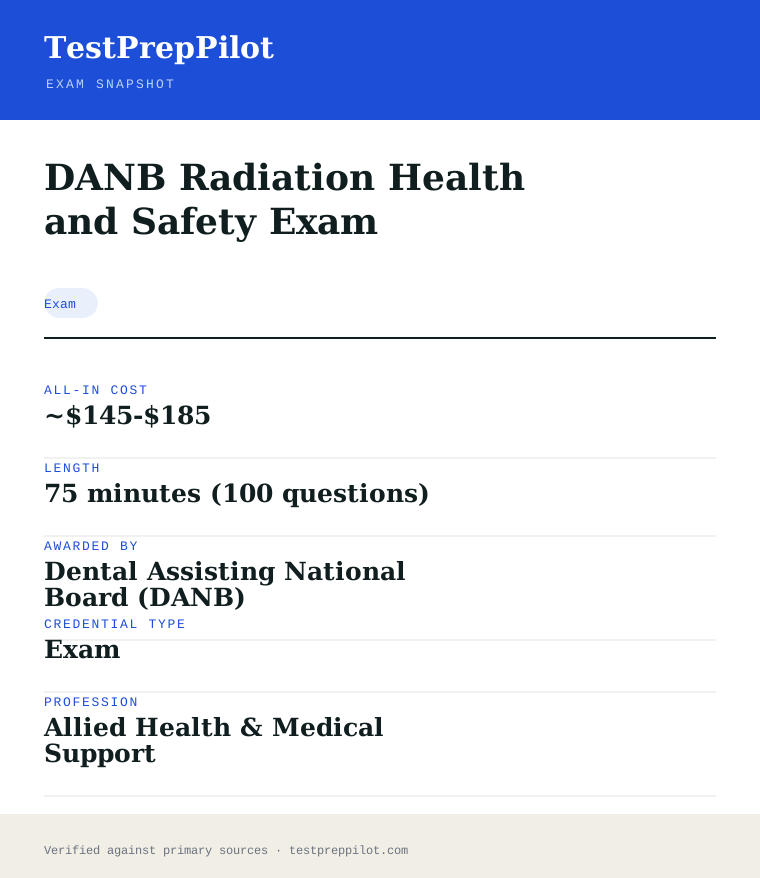
The DANB Radiation Health and Safety Exam is administered by Dental Assisting National Board (DANB) and runs 75 minutes and contains 100 questions.
| Administered by | Dental Assisting National Board (DANB) |
|---|---|
| Questions | 100 |
| Time limit | 75 minutes |
| Pass mark | Passing score set by the awarding body; see the official score report |
| Exam fee | Varies by location and currency — confirm on the official registration page |
| Format | Proctored, computer-based (test center or online remote proctoring) |
Content outline
What topics are on the DANB Radiation Health and Safety Exam?
The DANB Radiation Health and Safety Exam covers 4 content domains.
Weightings come from the official exam outline. Study time is best allocated in roughly these proportions rather than evenly across domains.
- Anatomy & physiology
Topic area tested on the exam; see the official blueprint for the detailed breakdown.
- Clinical procedures
Topic area tested on the exam; see the official blueprint for the detailed breakdown.
- Patient care & safety
Topic area tested on the exam; see the official blueprint for the detailed breakdown.
- Documentation & ethics
Topic area tested on the exam; see the official blueprint for the detailed breakdown.
Study materials
Which study guide should you use for the DANB Radiation Health and Safety Exam?
Start with the exam sponsor's official content outline. If you also want one structured resource to work through, these are the Mometrix titles that match this exam.
 Study guideDANB Exam Secrets Study GuideContent review with practice questions and answer explanations.See the study guide
Prefer another format?
The DANB guide covers all three CDA components (RHS, ICE and GC) in one book.
Affiliate links We may earn a commission if you buy through these links, at no extra cost to you. Mometrix has no say in what our exam guides cover. How we make money.
The path
How do you register for the DANB Radiation Health and Safety Exam?
- 1
Confirm your eligibility pathway1–4 weeks
Review DANB's three CDA pathways (CODA program graduate, 3,500 hours work experience, or dental degree) and secure current hands-on CPR/BLS/ACLS from a DANB-accepted provider.
- 2
Create your DANB account and apply
Complete the online CDA application on danb.org, uploading proof of education/experience and CPR certification. Incomplete applications are the most common cause of delay.
The $75 application fee is nonrefundable and included in your exam fee.
- 3
Pay the exam feeSame day
Pay $450 for the full CDA (GC+RHS+ICE), or choose a single-component ($270) or two-component bundle ($375). Active military pay $425.
- 4
Schedule your exam with Pearson VUEWithin 60 days
After approval, you receive a Test Admission Notice with a link to schedule at a Pearson VUE test center or via live remote online proctoring. You have a 60-day testing window from approval.
- 5
Take the exam and get your score~3 hr 15 min
Arrive with your admission notice and government photo ID. You see a preliminary result immediately; the official scaled score posts to your DANB account about one week later.
- 6
Maintain your credentialOngoing annually
Keep CPR current and earn 12 CDE credits annually (at least 2 in infection control and 1 in bloodborne pathogens) to renew each year.
The fine print
What are the retake and renewal rules for the DANB Radiation Health and Safety Exam?
- Proctoring & delivery
- Computer-based, computer-adaptive testing delivered at Pearson VUE test centers (in person) or through live remote online proctoring that monitors you by webcam and microphone. Candidates choose the method at scheduling.
- Retake policy
- There is no limit on retakes of a failed exam. You must submit a new application and pay the full exam fee again for each attempt. A few state dental boards require additional education after repeated failures — check your state board if retaking for state authorization. A passed exam generally cannot be retaken except in unusual cases (contact DANB).
- Score reporting
- A preliminary result appears on screen immediately after the exam (not official). The official scaled score (100–900; pass = 400 per component) is posted to your DANB online account about one week after testing, and a score report is available there.
- Recertification
- The CDA renews every year. Annually complete 12 CDE credits (at least 2 in infection control and 1 in bloodborne pathogens; maximum 3 non-clinical), maintain current DANB-accepted hands-on CPR/BLS/ACLS, answer background questions, and pay the renewal fee. CDE credits carry over for up to two years; DANB may randomly audit documentation.
- Refunds & rescheduling
- The $75 application fee portion is nonrefundable. If you cancel after your exam is authorized, DANB retains a $40 fee. Rescheduling within 30 days of your appointment may incur a PSI vendor fee. If you miss the 60-day testing window, your application and fees are forfeited and you must reapply.
Context
How the DANB CDA compares to other dental assistant credentials
| Credential | Administered by | Scope | Typical requirement | |
|---|---|---|---|---|
| CDA (Certified Dental Assistant) | DANB | Full credential: chairside + radiography + infection control | Pass GC + RHS + ICE (245 Q, 195 min) | |
| NELDA (National Entry Level Dental Assistant) | DANB | Entry-level: anatomy + RHS + ICE; no chairside | Pass three entry-level components | |
| RHS / ICE (standalone) | DANB | Single competency (radiography or infection control only) | One component exam; no eligibility gate | |
| State RDA license | State dental board | State-specific expanded duties | Varies by state; often builds on DANB components |
What it pays
How much does this credential pay?
$47,840 median for dental assistants (BLS, May 2024)
There is no Bureau of Labor Statistics occupation called "RHS" — the DANB Radiation Health and Safety Exam validates dental-assistant radiography knowledge, and the wage question belongs to the occupation you perform with it. The closest official BLS occupation is Dental Assistants, SOC 31-9091, which had a May 2024 median wage of $47,840, with the lowest 10 percent under $33,900 and the highest 10 percent above $61,420. The fit is direct: DANB-certified dental assistants work in dental offices, clinics and public-health settings, and the RHS credential is one of the components of the DANB Certified Dental Assistant (CDA) certification, which many employers and states require or prefer for taking dental X-rays. BLS counted 338,200 dental assistant jobs in 2024 and projects 9 percent growth from 2024 to 2034, faster than the average for all occupations, with about 28,300 openings a year. The limitation to state plainly: the BLS median covers the whole occupation, credentialed or not, and the certification's value is as an employability and compliance signal — many states require radiography certification for dental assistants taking X-rays, and employers weigh the DANB credentials in hiring. Read the number as the market for the occupation the credential serves.
| Measure | Figure | Source / note |
|---|---|---|
| Median annual wage, dental assistants | $47,840 | BLS OOH, SOC 31-9091, May 2024 |
| Lowest 10 percent | Under $33,900 | BLS OOH, SOC 31-9091, May 2024 |
| Highest 10 percent | Above $61,420 | BLS OOH, SOC 31-9091, May 2024 |
| Projected openings per year | ~28,300 | BLS OOH, SOC 31-9091, 2024-2034 |
Job growth.BLS projects 9 percent growth for dental assistants from 2024 to 2034, about 28,300 openings per year.
Source: BLS Occupational Outlook Handbook - Dental Assistants
Your odds
What are the pass rates?
DANB publishes no single national pass rate — the RHS exam is 100 scored questions in 75 minutes, with the result reported as pass/fail
DANB does not publish a single national pass rate for the RHS exam in a fixed annual figure, and third-party estimates are not official data, so we do not treat them as authoritative. What DANB does publish is the format and the passing standard: the RHS exam is a computer-based test of 100 scored multiple-choice questions with a 75-minute time limit, and the result is reported as pass/fail with a section-by-section performance breakdown. The exam is delivered at Pearson VUE centres or through remote proctoring. The exam content follows the published RHS outline: exposing and evaluating dental radiographs (the exposure techniques, the film/digital sensors and the evaluation of image quality); the radiation health and safety practices (the ALARA principle, the radiation protection for patient, operator and staff); and the legal and ethical responsibilities. The absence of a published pass rate is not an absence of standards: the 100-question format rewards precise knowledge of radiography technique and safety, and DANB's section breakdown lets candidates see exactly where they fell short. The practical reading: study the DANB RHS outline and the radiation-safety practices, and hold yourself to 80 percent-plus on practice, because the licensure-adjacent pass line leaves little margin.
Read this before quoting the number.DANB publishes the format and section performance but no single national pass rate.
Your schedule
How long should I study for it?
30-50 hours over 3-4 weeks of focused study
The DANB RHS exam is a 100-question, 75-minute computer-based exam built on the published outline: exposing and evaluating dental radiographs, radiation health and safety practices, and the legal and ethical responsibilities. A defensible plan runs 30 to 50 hours over 3 to 4 weeks, ideally on top of dental-assisting training or work experience. Week one: the radiography fundamentals — the x-ray production and properties, the film and digital sensors, and the exposure techniques (paralleling, bisecting). Week two: image evaluation — the quality factors (density, contrast, sharpness), the common errors and the retake decisions. Week three: radiation safety — the ALARA principle, the patient and operator protection (lead aprons, thyroid collars, distance and shielding), and the state regulations. Week four: practice-question drilling and timed practice exams at the real 100-question, 75-minute format. The plan is technique-and-safety-heavy because the exam rewards precise knowledge of both the exposure skills and the protection practices; candidates who study only the technique fail the safety items.
- Week 110
Radiography fundamentals
- X-ray production and properties
- Film and digital sensors
- Exposure techniques: paralleling and bisecting
- Week 212
Image evaluation
- Density, contrast and sharpness
- Common exposure errors
- Retake decisions
- Week 312
Radiation safety
- The ALARA principle
- Patient and operator protection
- State regulations and legal duties
- Week 412
Drill and mocks
- Practice-question drilling in volume
- Timed practice exams at the real format
- Review weak outline areas
Adjusting the pace
Working dental assistant.The clinical radiography is familiar; focus study on the exact safety numbers and state rules.
Student completing training.Add 1-2 weeks of radiography fundamentals before the full plan.
How to study
How do I prepare most effectively?
The RHS exam rewards precise knowledge of both radiography technique and radiation safety, so the dominant strategy is balanced coverage: master the exposure techniques (paralleling, bisecting) and the image-quality factors, and the safety practices (the ALARA principle, the patient and operator protection measures, and the state regulations), because the exam tests both. Second, learn the exact protection measures — the lead apron and thyroid collar use, the distance and time principles, and the film-speed or sensor considerations — which are tested precisely. Third, use the DANB RHS outline as the scope map and the DANB practice test as the item-style reference. Fourth, drill the image-evaluation material: the quality factors and the common errors are a distinct block that candidates focused on technique often miss. Finally, take at least two timed practice exams at the real 100-question, 75-minute format; the pace is tight, and the section breakdown on the real exam rewards balanced coverage.
Balance technique and safety
The exam tests both exposure skills and protection practices.
Learn the protection measures
ALARA, aprons, distance and state rules are tested precisely.
Drill image evaluation
Quality factors and common errors are a distinct block.
Use the DANB outline and practice test
The authoritative scope and the closest item style.
Run two timed practice exams
100 questions in 75 minutes is a tight pace; rehearse it.
What to buy
Which study resources are worth paying for?
DANB RHS prep is inexpensive because the official materials are low-cost. The DANB RHS outline (free) and the DANB practice test (about $35) are the core resources; dental-radiography textbooks ($50-$150) cover the material in depth, and many dental-assisting programs bundle review materials. Third-party question banks ($30-$100) add volume. The exam fee is about $145-$185 depending on DANB membership and whether it is taken as part of the CDA bundle. A realistic total budget is $200 to $500 including the exam fee. Prices below are list prices as of mid-2026 and change frequently; we rank nothing by commission.
| Resource | Price | Format | Best for |
|---|---|---|---|
| DANB RHS outline | Free | Official PDF | The authoritative scope; read it first |
| DANB practice test | ~$35 | Official online practice | The closest official item style |
| Dental-radiography textbooks | $50-$150 | Printed or digital book | Technique and safety depth |
| Third-party question banks | $30-$100 | Online practice items | Drilling volume |
| RHS exam | ~$145-$185 | Computer-based exam | The certification itself |
List prices as of mid-2026, subject to change; DANB fees vary by membership and bundle; no commission or affiliate ranking is implied.
Avoid these
What mistakes do candidates most often make?
The most common RHS mistake is studying the technique without the safety: candidates who know the exposure methods but not the ALARA principle, the protection measures or the state rules miss the safety block, which is a large share of the exam. The fix is balanced coverage. The second mistake is mislearning the image-quality factors and the common errors, which are tested precisely and drive the retake decisions. Third, candidates under-prepare the legal and ethical responsibilities, a distinct outline area. Fourth, some candidates never take a timed practice exam and misjudge the 75-minute pace. Finally, candidates treat RHS as a standalone checkbox without understanding it is a component of the broader DANB CDA certification; plan the full credential path.
✕Studying technique without safety
✓ALARA, protection measures and state rules are a large share.
✕Mislearning image-quality factors
✓Density, contrast and common errors are tested precisely.
✕Skipping the legal and ethical duties
✓A distinct outline area; cover it.
✕Skipping timed practice
✓100 questions in 75 minutes; run timed practice exams.
✕Missing the CDA path
✓RHS is a component of the DANB CDA; plan the full credential.
What you'll face
What question types will I see?
The RHS exam is a 100-question multiple-choice exam in 75 minutes. The items test the published outline: exposing and evaluating radiographs, radiation health and safety, and the legal and ethical responsibilities — with a heavy concentration on the technique, the image-quality factors and the protection practices. Samples below are editor-written illustrations of the published outline, not live exam items; they show the radiography-safety style of the real items.
Techniques, sensors and exposure factors.
ALARA, aprons, distance and state rules.
Quality factors, errors and retake decisions.
Try these
Q1Under the ALARA principle, the dental assistant should:
Answer:A
ALARA — as low as reasonably achievable — guides the dental assistant to the lowest exposure that produces an acceptable diagnostic image. Unlimited exposure, skipped protection or standing in the beam path each violate the principle.
Q2Which exposure technique is recommended for periapical radiography to minimise image distortion?
Answer:A
The paralleling technique is the recommended method for periapical radiography — it minimises distortion by keeping the sensor parallel to the tooth. Bisecting-angle, no technique or hand-holding each produce more distortion or more exposure.
Q3A radiograph appears too dark overall. The most likely cause is:
Answer:A
An image that is too dark (excessive density) indicates overexposure — too much time, milliamperage or kilovoltage. Underexposure produces a light image, and sensor or film-speed issues produce different artefacts.
Samples are editor-written illustrations of the published outline, not live exam items.
The big day
What should I expect on exam day?
The DANB RHS exam is a 100-question, 75-minute computer-based exam at a Pearson VUE centre or through remote proctoring. Bring the required identification matching your registration and your exam confirmation; personal items go in the locker. Arrive early — late arrivals may forfeit the appointment and fee. Pace at about 45 seconds per item, flag uncertain items for review, and budget the tight window carefully. Your result is reported as pass/fail after the exam, with the section-by-section performance breakdown. If you do not pass, the DANB retake policy and fee apply. On a pass, the RHS component counts toward the DANB Certified Dental Assistant (CDA) certification, and DANB certifications renew on a cycle with continuing education. The afterwards matters: plan the remaining CDA components and the renewal cycle.
Bring
- Required identification matching your registration
- Exam confirmation
Leave at home
- Phone, smartwatch and all electronics
- Notes and study materials
- Personal bags beyond what the centre allows
How the day runs
Rules in the room
- The exam is computer-based and timed
- 75 minutes for 100 questions; the clock does not pause
- RHS counts toward the DANB CDA certification
Afterwards.On a pass, apply the RHS component toward the CDA and plan the renewal cycle. On a fail, retake per the DANB policy after additional outline study.
Reference
What are the key facts about the DANB Radiation Health and Safety Exam?
DANB Radiation Health and Safety Exam is a exam credential; awarded by Dental Assisting National Board (DANB); the exam fee is Varies by location and currency — confirm on the official registration page; typical preparation is 75 minutes (100 questions); holders typically earn $34,000-$61,000.
| Credential | DANB Radiation Health and Safety Exam |
|---|---|
| Abbreviation | RHS |
| Type | Exam |
| Profession | Allied Health & Medical Support |
| Specialty | Dental Support |
| Awarded by | Dental Assisting National Board (DANB) |
| Difficulty | Applied |
| Typical prep time | 75 minutes (100 questions) |
| All-in cost | ~$145-$185 |
| Typical salary range | $34,000-$61,000 |
| Credential | DANB Radiation Health and Safety Exam |
| Awarding body | Dental Assisting National Board (DANB) |
| Exam format | Proctored, computer-based |
| Validity | DANB certifications renew on a cycle with continuing education. |
| Languages | Varies — see awarding body |
| Scope | National / Multi-state |
Real questions
Frequently asked questions about the DANB Radiation Health and Safety Exam
How do I register for the DANB Radiation Health and Safety Exam exam?
Register through Dental Assisting National Board (DANB)'s official portal or an authorized test provider (e.g., Pearson VUE or Prometric where applicable). Create an account, select the exam, pay the fee, and schedule a date.
How much does the exam cost?
Fees vary by location and currency. Confirm the current fee on the official registration page before scheduling.
How long is the credential valid, and how do I renew?
DANB credentials such as the RHS component renew on the DANB cycle with continuing education; the RHS also counts toward the CDA.
What if I do not pass?
Most bodies allow retakes after a waiting period and payment of the full or partial fee. Check Dental Assisting National Board (DANB)'s retake policy before rescheduling.
How do I register for a DANB credential?
Create an account at danb.org, choose your exam, confirm eligibility, pay the fee, and schedule through the Pearson VUE link in your approval email within the 60-day window.
How do I renew my DANB CDA?
Renew annually in your DANB account by attesting to 12 CDE credits, current CPR, and background questions, and paying the renewal fee. Keep CDE and CPR documentation for two years in case of audit.
Are DANB exams recognized by states?
Yes — DANB certifications are recognized or required in 39 states, the District of Columbia, the U.S. Air Force, and the VA, though specific duties and titles vary by state law.
In short
Is the DANB Radiation Health and Safety Exam worth it?
- DANB Radiation Health and Safety Exam is awarded by Dental Assisting National Board (DANB).
- Validates job-ready competence in Allied Health.
- Registration is through the awarding body or an authorized test provider.
- Renewal and retake policies vary — confirm before scheduling.
Same awarding body
What other credentials does Dental Assisting National Board (DANB) award?
Worth comparing
How does the DANB Radiation Health and Safety Exam compare with similar credentials?
Trust
Where does this information come from?
Everything above is taken from the awarding body's own published material. Fees, question counts and domain weights are revised regularly — check the official page before you pay.
- Dental Assisting National Board (DANB) certification programme Programme rules
Research confidence: low · Last reviewed 2026-08