The short version
What is the DANB Certified Dental Assistant and is it worth it?
The DANB CDA is the flagship U.S. dental assisting certification, earned by passing three component exams (GC, RHS, ICE) totaling 245 questions in 195 minutes, with a scaled passing score of 400 (100–900 scale) on each component.
- Only nationally recognized dental assistant certification in the U.S.; accepted or required in 39 states, DC, the U.S. Air Force, and the VA
- Validates the full chairside + radiography + infection-control skill set employers screen for
- Unlocks expanded functions (radiography, restorative assisting) that many states restrict to certified assistants
- Portable across states and a stepping stone to specialty DANB certificates (COA, CPFDA, CRFDA)
- Typically associated with higher pay than non-certified dental assistant roles
What is it?
What exactly is the DANB Certified Dental Assistant?
The NCCA-accredited national dental assistant credential — three component exams (GC, RHS, ICE) that employers and 39 state boards recognize by name.
The DANB Certified Dental Assistant (CDA) is the only nationally recognized dental assisting certification in the United States, earned by passing three computer-based component exams: General Chairside Assisting (GC), Radiation Health & Safety (RHS), and Infection Control (ICE). Candidates qualify through one of three pathways that pair a CODA-accredited education or 3,500 hours of work experience with current hands-on CPR/BLS/ACLS from a DANB-accepted provider. Employers and 39 state dental boards use the CDA to verify competency for expanded functions such as radiography and restorative assisting, and certified assistants typically earn more than their non-certified peers. It sits at the center of the dental assisting ladder: RHS and ICE can also be earned alone, and the CDA is the gateway to specialty DANB certificates such as COA, CPFDA, and CRFDA.
The path in brief
- Confirm your eligibility pathway (CODA program, work experience, or dental degree)
- Secure current hands-on CPR/BLS/ACLS from a DANB-accepted provider
- Submit the CDA application and pay the $450 fee through danb.org
- Schedule your 60-day testing window with Pearson VUE (test center or online)
- Pass all three components (GC, RHS, ICE) within the window
- Maintain annually with 12 CDE credits and current CPR
Before you book
Who is eligible to sit the DANB Certified Dental Assistant?
DANB offers three eligibility pathways, and every one requires current hands-on CPR/BLS/ACLS from a DANB-accepted provider. Pathway I: graduate of a CODA-accredited dental assisting or dental hygiene program. Pathway II: high school diploma or equivalent plus at least 3,500 hours of approved dental assisting work experience (verified by a supervising dentist) within the past four years. Pathway III: former DANB CDA status, enrollment in or graduation from a CODA-accredited DDS/DMD program, graduation from a dental degree program outside the U.S./Canada, or completion of an approved post-baccalaureate dental program. Note: the RHS and ICE component exams may also be taken independently with no eligibility prerequisites.
Who it is for: Aspiring and current dental assistants seeking the nationally recognized credential for chairside, radiography, and infection-control duties.
The test itself
What is the format of the DANB Certified Dental Assistant?
The DANB Certified Dental Assistant is administered by Dental Assisting National Board (DANB) and runs 195 minutes (3 hr 15 min) — 75 min GC, 60 min RHS, 60 min ICE, contains 245 multiple-choice (95 GC + 75 RHS + 75 ICE) questions and requires Scaled score of 400 on a 100–900 scale for each component (computer-adaptive) to pass.
| Administered by | Dental Assisting National Board (DANB) |
|---|---|
| Questions | 245 multiple-choice (95 GC + 75 RHS + 75 ICE) |
| Time limit | 195 minutes (3 hr 15 min) — 75 min GC, 60 min RHS, 60 min ICE |
| Pass mark | Scaled score of 400 on a 100–900 scale for each component (computer-adaptive) |
| Exam fee | $450 for the full CDA (includes a $75 nonrefundable application fee); single component $270; two-component bundle $375. Active military $425. |
| Format | Computer-based, computer-adaptive testing (CAT) at Pearson VUE test centers or live remote online proctoring |
Content outline
What topics are on the DANB Certified Dental Assistant?
The DANB Certified Dental Assistant covers 3 content domains.
Weightings come from the official exam outline. Study time is best allocated in roughly these proportions rather than evenly across domains.
- General Chairside Assisting (GC)
95 questions, 75 min. Domains: Evaluation (17%), Patient Management & Administration (17%), Chairside Dentistry (50%), Dental Materials (16%).
- Radiation Health & Safety (RHS)
75 questions, 60 min. Domains: Purpose & Technique (50%), Radiation Safety (25%), Infection Prevention & Control (25%).
- Infection Control (ICE)
75 questions, 60 min. Domains: Prevention of Disease Transmission (20%), Prevention of Cross-contamination (34%), Process Instruments & Devices (26%), Occupational Safety & Administration Protocols (20%).
The path
How do you register for the DANB Certified Dental Assistant?
- 1
Confirm your eligibility pathway1–4 weeks
Review DANB's three CDA pathways (CODA program graduate, 3,500 hours work experience, or dental degree) and secure current hands-on CPR/BLS/ACLS from a DANB-accepted provider.
- 2
Create your DANB account and apply
Complete the online CDA application on danb.org, uploading proof of education/experience and CPR certification. Incomplete applications are the most common cause of delay.
The $75 application fee is nonrefundable and included in your exam fee.
- 3
Pay the exam feeSame day
Pay $450 for the full CDA (GC+RHS+ICE), or choose a single-component ($270) or two-component bundle ($375). Active military pay $425.
- 4
Schedule your exam with Pearson VUEWithin 60 days
After approval, you receive a Test Admission Notice with a link to schedule at a Pearson VUE test center or via live remote online proctoring. You have a 60-day testing window from approval.
- 5
Take the exam and get your score~3 hr 15 min
Arrive with your admission notice and government photo ID. You see a preliminary result immediately; the official scaled score posts to your DANB account about one week later.
- 6
Maintain your credentialOngoing annually
Keep CPR current and earn 12 CDE credits annually (at least 2 in infection control and 1 in bloodborne pathogens) to renew each year.
The fine print
What are the retake and renewal rules for the DANB Certified Dental Assistant?
- Proctoring & delivery
- Computer-based, computer-adaptive testing delivered at Pearson VUE test centers (in person) or through live remote online proctoring that monitors you by webcam and microphone. Candidates choose the method at scheduling.
- Retake policy
- There is no limit on retakes of a failed exam. You must submit a new application and pay the full exam fee again for each attempt. A few state dental boards require additional education after repeated failures — check your state board if retaking for state authorization. A passed exam generally cannot be retaken except in unusual cases (contact DANB).
- Score reporting
- A preliminary result appears on screen immediately after the exam (not official). The official scaled score (100–900; pass = 400 per component) is posted to your DANB online account about one week after testing, and a score report is available there.
- Recertification
- The CDA renews every year. Annually complete 12 CDE credits (at least 2 in infection control and 1 in bloodborne pathogens; maximum 3 non-clinical), maintain current DANB-accepted hands-on CPR/BLS/ACLS, answer background questions, and pay the renewal fee. CDE credits carry over for up to two years; DANB may randomly audit documentation.
- Refunds & rescheduling
- The $75 application fee portion is nonrefundable. If you cancel after your exam is authorized, DANB retains a $40 fee. Rescheduling within 30 days of your appointment may incur a PSI vendor fee. If you miss the 60-day testing window, your application and fees are forfeited and you must reapply.
Context
How the DANB CDA compares to other dental assistant credentials
| Credential | Administered by | Scope | Typical requirement | |
|---|---|---|---|---|
| CDA (Certified Dental Assistant) | DANB | Full credential: chairside + radiography + infection control | Pass GC + RHS + ICE (245 Q, 195 min) | |
| NELDA (National Entry Level Dental Assistant) | DANB | Entry-level: anatomy + RHS + ICE; no chairside | Pass three entry-level components | |
| RHS / ICE (standalone) | DANB | Single competency (radiography or infection control only) | One component exam; no eligibility gate | |
| State RDA license | State dental board | State-specific expanded duties | Varies by state; often builds on DANB components |
What it pays
How much does this credential pay?
$47,300 median (BLS OOH, May 2024)
The DANB Certified Dental Assistant (CDA) is the flagship credential for dental assistants, and it sits on one of the steadier allied-health occupations. The U.S. Bureau of Labor Statistics reports dental assistants (SOC 31-9091) earned a median annual wage of $47,300 in May 2024, with 381,900 jobs and a projected 6% growth from 2024 to 2034 — "faster than average" overall, translating to about 52,900 openings per year when replacements are included. The CDA is valuable because many states either require DANB certification or a DANB component exam (notably RHS and ICE) to legally perform expanded functions such as radiography or coronal polish; holding the full CDA therefore widens both the states you can work in and the duties you can bill for. Pay rises with scope: assistants who add radiography, sealants, or orthodontic functions, and those in high-cost metro markets, sit well above the median, while the bottom decile reflects entry-level, limited-scope roles. Candidates should read the median as a national midpoint and expect that the credential’s biggest financial effect is job access and function eligibility rather than an automatic flat raise. Industry and state variation is pronounced: assistants in high-cost metro markets and those permitted to perform expanded functions sit well above the median, while the bottom decile reflects limited-scope, entry-level roles. The CDA financial return is tied to the additional functions it unlocks; in states where the credential or a DANB component is required for those functions, it is effectively a prerequisite for higher-paying work. Candidates should treat the median as a floor for credentialed assistants, not a ceiling.
| Measure | Figure | Source / note |
|---|---|---|
| Median annual wage | $47,300 | BLS Occupational Outlook Handbook, Dental Assistants (SOC 31-9091), May 2024 |
| 10th percentile | $36,190 | BLS OEWS, Dental Assistants (SOC 31-9091), May 2024 |
| 90th percentile | $61,780 | BLS OEWS, Dental Assistants (SOC 31-9091), May 2024 |
| Employment, 2024 | 381,900 | BLS OOH, Dental Assistants, 2024 |
| Projected growth, 2024–2034 | 6% (faster than average) | BLS OOH Job Outlook, Dental Assistants |
Job growth.6% growth 2024–2034 (BLS OOH, faster than average); ~52,900 annual openings including replacements.
Source: BLS Occupational Outlook Handbook — Dental Assistants (SOC 31-9091)
Your odds
What are the pass rates?
GC 75% / RHS 69% / ICE 75% first-attempt (FY2025)
DANB publishes an Exam Pass Rates report every fiscal year, broken out by component exam — the most transparent disclosure of the three credentials covered here. The CDA is earned by passing three component exams: General Chairside Assisting (GC), Radiation Health & Safety (RHS), and Infection Control (ICE), each scored on a scaled 100–900 with a minimum passing score of 400 per component. In DANB’s FY2025 report, first-attempt pass rates were GC 75% (2,767 passed of 3,687 administered), RHS 69% (9,905 passed of 14,272 administered), and ICE 75% (4,807 passed of 6,395 administered). The prior fiscal year (FY2024) ran GC 74%, RHS 66%, and ICE 73%. Two takeaways for candidates: RHS is consistently the hardest component (a ~69% first-attempt rate, the lowest of the three), so radiography physics, exposure, and safety deserve outsized prep; and GC, the largest component, passes at about 75%, meaning roughly one in four first-timers misses. These are first-attempt rates, not eventual rates — candidates who retest after targeted review generally improve. Because the CDA is modular, you can sit components separately, which lets you isolate and retake only the component you fail. Because the CDA is modular, a candidate who fails one component retests only that piece, which improves the odds of eventually earning the CDA versus a single all-or-nothing exam. The practical takeaway is to front-load RHS prep and use DALE practice tests to confirm GC and ICE readiness before scheduling, since first-attempt misses cost both time and retake fees. DANB transparency in publishing component-level rates is itself useful: it tells candidates exactly where to aim study time. Component-level transparency also helps employers and educators: a program can see that RHS is the bottleneck and add radiography lab time accordingly. For the candidate, the practical planning rule is simple — budget the most hours for the component with the lowest published rate, and confirm the others with a timed practice test before paying the scheduling fee.
| Cohort | Pass rate | Source / note |
|---|---|---|
| GC first-attempt pass rate (FY2025) | 75% | DANB FY2025 Exam Pass Rates report (2,767 passed / 3,687 administered) |
| RHS first-attempt pass rate (FY2025) | 69% | DANB FY2025 Exam Pass Rates report (9,905 passed / 14,272 administered) |
| ICE first-attempt pass rate (FY2025) | 75% | DANB FY2025 Exam Pass Rates report (4,807 passed / 6,395 administered) |
| FY2024 comparison (GC/RHS/ICE) | 74% / 66% / 73% | DANB FY2024 Exam Pass Rates report |
| Minimum passing score per component | 400 (scaled 100–900) | DANB component exam scoring; published on danb.org |
Source: DANB — Exam Pass Rates (FY2025 & FY2024) and CDA certification pages
Your schedule
How long should I study for it?
90–110 hours of focused study
Plan CDA prep around the three components and your own eligibility path. A common approach is to sit all three together, which favors a 10–12 week plan at 8–10 hours per week. Weight time to the component blueprints: GC is the largest, RHS the lowest pass rate, and ICE is the most procedural/memorization-heavy.
- Weeks 1–38 hrs/week
ICE — infection control
- Standard precautions, PPE, sterilization workflow
- Occupational safety and aseptic environment
- Take a DALE ICE practice test and log weak topics
- Weeks 4–612 hrs/week
RHS — radiography (lowest pass rate)
- X-ray equipment, exposure factors, image evaluation
- Patient and operator radiation safety
- Drill the physics and safety items RHS over-weights
- Weeks 7–912 hrs/week
GC — chairside assisting
- Chairside procedures, materials, lab procedures
- Patient education, emergency prevention, office management
- Practice with Modern Dental Assisting chapters
- Weeks 10–1110 hrs/week
Integrated simulation
- DALE CDA practice bundle (GC + ICE + RHS) timed sets
- Re-drill weakest component to >80%
- Review instrument transfer and isolation scenarios
- Week 125 hrs/week
Logistics
- Confirm Pearson VUE 60-day eligibility window
- Verify test center and ID
- Light review only
Adjusting the pace
One component at a time.If testing piecewise, compress each block to 3–4 weeks and sit RHS last given its lower pass rate; retake only the failed component.
Recent dental assisting graduate.Compress to 6–8 weeks, concentrating on RHS physics and GC materials/mix ratios.
How to study
How do I prepare most effectively?
DANB’s own data shows RHS is the weakest component, so the highest-yield strategy is to over-prepare radiography and to practice the computerized, timed format until it is comfortable.
Attack RHS first — it has the lowest pass rate
FY2025 RHS first-attempt was 69% vs 75% for GC and ICE. Spend the most hours on radiation physics, exposure errors, mounting/labeling, and patient/operator safety. Candidates who under-study image evaluation and safety are the ones who miss.
Use DALE Foundation practice tests mapped to the outline
The DALE Foundation (DANB’s nonprofit affiliate) builds practice tests that follow DANB’s exam outlines. The CDA bundle combines GC, ICE, and RHS practice sets; aim for 80%+ before scheduling, as DANB’s study-guide research found plan users passed at higher rates.
Master dental materials and mix ratios for GC
GC over-weights chairside procedures (about 45% of that component) and materials. Know working/setting times and why "fixing" a mix with extra water/powder weakens properties — a frequent wrong-answer trap.
Practice the instrument-transfer and isolation scenarios
A common GC trap is touching drawers/phones with contaminated gloves. Drill the full instrument-processing flow (cleaning → packaging → sterilization → storage) and standard-precautions sequencing until it is reflexive.
What to buy
Which study resources are worth paying for?
DANB’s exams are prepared for through the DALE Foundation (its nonprofit affiliate) and a free exam outline; third-party banks add volume. Prices below verified on the cited publisher pages.
| Resource | Price | Format | Best for |
|---|---|---|---|
| DALE Foundation CDA Practice Tests (GC + ICE + RHS) | $85 (6-month access) | Online, 600 Q total (200 per component) | All-in-one timed simulation |
| DALE Foundation single practice test (RHS/ICE/GC) | $39 each | Online, interactive, topic filtering | Isolated component drill |
| DALE Foundation CDA Exam Prep Bundle | $450 | All practice tests + review courses | Full structured prep |
| Exam Edge CDA practice (5-test pack) | $69.75 | Online, 150 Q/test, explanations | Extra question volume |
Prices checked 2026-08 from dalefoundation.org and examedge.com. DANB also publishes free exam outlines and references. We do not rank by commission.
Avoid these
What mistakes do candidates most often make?
CDA misses cluster in radiography and in chairside materials/safety judgment calls rather than in factual recall.
✕Under-preparing RHS radiography
✓RHS has the lowest first-attempt pass rate (~69%). Drill exposure factors, image evaluation, and both patient and operator radiation safety, not just "how to take an X-ray."
✕Memorizing answers instead of the sterilization workflow
✓ICE and GC test the sequence (cleaning → packaging → sterilization → storage) and isolation. Learn the underlying rule so you can apply it to a novel contaminated-glove scenario.
✕Sitting all three cold without timed practice
✓The CDA is computerized and timed. Run at least the DALE CDA bundle in simulation mode so pacing and the interface are not surprises.
✕Missing the 60-day eligibility window
✓Once approved, you must test within DANB’s 60-day window per component; schedule promptly and keep your CPR current for eligibility paths.
What you'll face
What question types will I see?
The CDA is awarded by passing three computer-based component exams at Pearson VUE: General Chairside Assisting (GC), Radiation Health & Safety (RHS), and Infection Control (ICE). Each component is multiple-choice and scored on a scaled 100–900 with a minimum passing score of 400 per component. Candidates may sit components separately or together within DANB’s eligibility window. Questions are application-oriented single-best-answer items drawn from DANB’s published component outlines (for example, the GC outline weights chairside dental procedures ~45%, patient education/prevention ~10–14%, office management ~6%; RHS weights expose/evaluate ~37% and radiation safety ~36%; ICE weights occupational safety ~30% and sterilization/asepsis ~30%).
Single best answer; each component scored 100–900, MPS 400.
All three components passed = CDA; components can be scheduled separately within the eligibility window.
Try these
Q1Which radiation-safety principle most effectively reduces the operator’s dose during exposure?
Answer:B
The operator should stand behind a protective barrier (or at least 6 feet away, out of the primary beam) and use a positioning device/long cone to minimize scattered radiation; this is core RHS radiation-safety content. Holding the film by hand (C) is prohibited, and while higher mA shortens time, it does not replace distance/barrier protection (B).
Q2After a procedure, a dental assistant touches a drawer handle with a contaminated glove. What is the correct sequence?
Answer:B
A contaminated glove transfers microbes to surfaces; standard precautions require removing gloves, performing hand hygiene, and then cleaning/disinfecting the touched surface. Options A, C, and D leave contamination in place and are common ICE/GC wrong answers.
Q3A gypsum mix has begun to set too quickly. Which action is correct?
Answer:C
Altering the water/powder ratio after mixing weakens the set material’s properties; the correct action is to discard and remix to the recommended ratio. This is a classic GC dental-materials trap where "fixing" the mix is the wrong answer.
Samples are editor-written illustrations of the published DANB component blueprints; they are not live exam items.
The big day
What should I expect on exam day?
CDA component exams are delivered in person by computer at Pearson VUE test centers. You schedule each component within DANB’s eligibility window after your application is approved. Arrive early; check-in includes ID verification and a tutorial.
Bring
- Government photo ID matching your Pearson VUE registration exactly
- Your appointment confirmation
- Proof of current CPR if required by your eligibility path (kept with your records)
Leave at home
- Phones, smartwatches, and personal bags (secured in locker)
- Study notes, textbooks, and calculators
- Any food/drink beyond what the center permits on breaks
How the day runs
Rules in the room
- Each component is scored 100–900; you need 400 to pass that component.
- You may not bring your own materials; center provides what is permitted.
Afterwards.Component results post to your DANB record; once GC, RHS, and ICE are all passed you earn the CDA. DANB sends the official score report. Maintain 12 CDE plus current CPR annually to keep the credential active.
Reference
What are the key facts about the DANB Certified Dental Assistant?
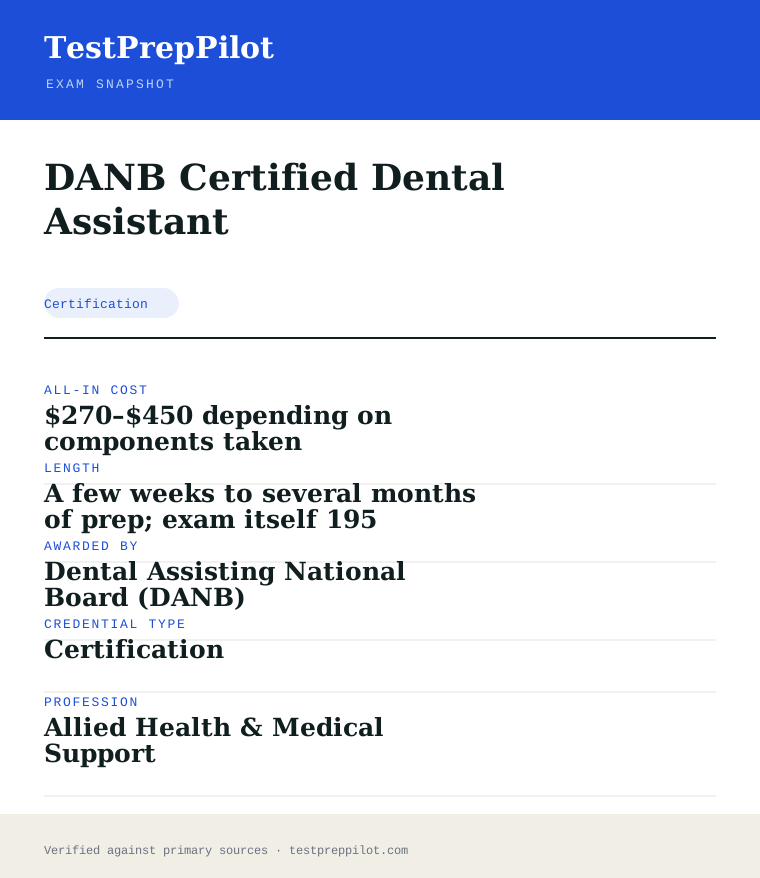
DANB Certified Dental Assistant is a certification credential; awarded by Dental Assisting National Board (DANB); the exam fee is $450 for the full CDA (includes a $75 nonrefundable application fee); single component $270; two-component bundle $375. Active military $425.; typical preparation is A few weeks to several months of prep; exam itself 195 minutes; holders typically earn $44,000–$55,000 (approx. U.S. median wage for dental assistants; BLS).
| Credential | DANB Certified Dental Assistant |
|---|---|
| Abbreviation | CDA |
| Type | Certification |
| Profession | Allied Health & Medical Support |
| Specialty | Dental Support |
| Awarded by | Dental Assisting National Board (DANB) |
| Difficulty | Moderate |
| Typical prep time | A few weeks to several months of prep; exam itself 195 minutes |
| All-in cost | $270–$450 depending on components taken |
| Typical salary range | $44,000–$55,000 (approx. U.S. median wage for dental assistants; BLS) |
| Credential | DANB Certified Dental Assistant (CDA) |
| Component exams | GC + RHS + ICE (245 questions, 195 min) |
| Passing standard | Scaled 400 / 900 per component (CAT) |
| Eligibility | CODA program, 3,500 hrs experience, or dental degree + CPR |
| Renewal | Annually: 12 CDE credits + current CPR |
| Recognition | Accepted/required in 39 states, DC, U.S. Air Force, VA |
| Scope | National / Multi-state |
Real questions
Frequently asked questions about the DANB Certified Dental Assistant
What are the eligibility pathways for the DANB CDA exam?
DANB offers three pathways, each requiring current hands-on CPR/BLS/ACLS from a DANB-accepted provider. Pathway I is graduation from a CODA-accredited dental assisting or dental hygiene program. Pathway II is a high school diploma or equivalent plus at least 3,500 hours of approved dental assisting work experience within the past four years. Pathway III covers former CDAs, CODA-accredited DDS/DMD students or graduates, foreign dental degree graduates, or approved post-baccalaureate dental program completers.
How much does the CDA exam cost?
The full CDA (all three components: GC, RHS, ICE) is $450 as of 2026, which includes a $75 nonrefundable application fee. A single component is $270 and a two-component bundle is $375. Active military candidates pay $425 for the full exam. A $40 fee is retained if you cancel after authorization.
What is the passing score?
Each component exam is scored on a 100–900 scale, and you must reach a scaled score of 400 on each component to pass. The exam uses computer-adaptive testing, and you must pass all three components (GC, RHS, ICE) to earn the CDA. You receive a preliminary result at the test center and the official score in your DANB account about a week later.
How do I renew the CDA, and how long is it valid?
The CDA is valid for one year and renews annually. Each year you must complete 12 Continuing Dental Education (CDE) credits (at least 2 in infection control and 1 covering bloodborne pathogens, with a maximum of 3 non-clinical credits), maintain current DANB-accepted CPR, and pay the renewal fee. CDE credits can carry over for up to two years, and DANB may audit renewal documentation.
What if I fail a component?
There is no limit on retakes of a failed exam. You must submit a new application and pay the full exam fee again for each attempt. Some state dental boards require additional education after repeated failures, so check your state's rules if you are retaking for state authorization.
How do I register for a DANB credential?
Create an account at danb.org, choose your exam, confirm eligibility, pay the fee, and schedule through the Pearson VUE link in your approval email within the 60-day window.
How do I renew my DANB CDA?
Renew annually in your DANB account by attesting to 12 CDE credits, current CPR, and background questions, and paying the renewal fee. Keep CDE and CPR documentation for two years in case of audit.
Are DANB exams recognized by states?
Yes — DANB certifications are recognized or required in 39 states, the District of Columbia, the U.S. Air Force, and the VA, though specific duties and titles vary by state law.
In short
Is the DANB Certified Dental Assistant worth it?
- The DANB CDA is the only nationally recognized U.S. dental assistant certification, combining GC, RHS, and ICE (245 questions, 195 minutes).
- Pass each component at a scaled 400/900; fee is $450 for the full exam (2026), with single-component and military pricing available.
- Three eligibility pathways require CPR plus a CODA education, 3,500 hours of experience, or a dental degree.
- Renew annually with 12 CDE credits and current CPR; accepted or required in 39 states plus the U.S. Air Force and VA.
Trust
Where does this information come from?
Everything above is taken from the awarding body's own published material. Fees, question counts and domain weights are revised regularly — check the official page before you pay.
Research confidence: high · Last reviewed 2026-08