The short version
What is the PTCB Certified Pharmacy Technician and is it worth it?
PTCB Certified Pharmacy Technician is a professional credential administered by Pharmacy Technician Certification Board (PTCB). It validates job-ready knowledge and skills in the Allied Health field and is used for career entry, advancement, or compliance.
- Recognized credential from Pharmacy Technician Certification Board (PTCB)
- Demonstrates verified competence in Allied Health
- Supports career advancement and may satisfy licensing or employer requirements
What is it?
What exactly is the PTCB Certified Pharmacy Technician?
PTCB Certified Pharmacy Technician — Allied Health credential from Pharmacy Technician Certification Board (PTCB)
National entry-level credential for pharmacy technicians in the United States., a nationally recognized professional credential in this field. Offered by Pharmacy Technician Certification Board (PTCB), it is designed for candidates who need to demonstrate verified competence in the Allied Health field. The credential is commonly used for career entry, advancement, regulatory compliance, or employer requirements. Candidates should review the official handbook for eligibility, exam format, and scoring before registering.
The path in brief
- Confirm you meet any eligibility or prerequisites
- Review the official handbook and study materials
- Register and pay through the awarding body or authorized provider
- Schedule and take the exam (test center or online proctoring)
- Receive your score and, if passed, your credential
Before you book
Who is eligible to sit the PTCB Certified Pharmacy Technician?
Eligibility varies; many credentials are open to all, while others require coursework, work experience, or sponsorship.
Who it is for: Professionals and candidates seeking to validate Allied Health competence.
The test itself
What is the format of the PTCB Certified Pharmacy Technician?
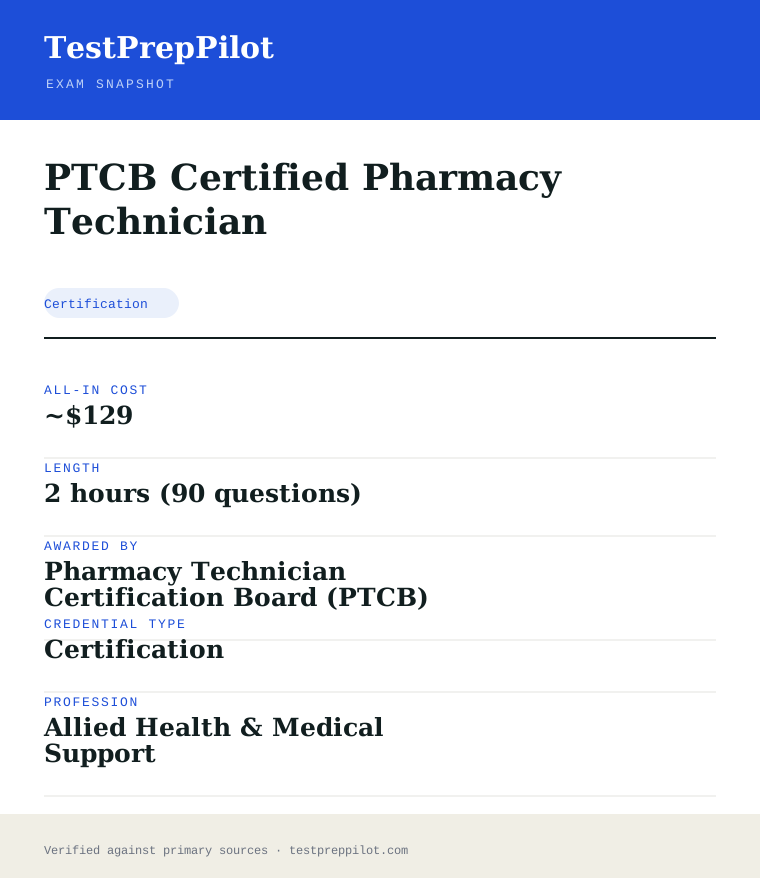
The PTCB Certified Pharmacy Technician is administered by Pharmacy Technician Certification Board (PTCB) and runs 2 hours and contains 90 questions.
| Administered by | Pharmacy Technician Certification Board (PTCB) |
|---|---|
| Questions | 90 |
| Time limit | 2 hours |
| Pass mark | Passing score set by the awarding body; see the official score report |
| Exam fee | Varies by location and currency — confirm on the official registration page |
| Format | Proctored, computer-based (test center or online remote proctoring) |
Content outline
What topics are on the PTCB Certified Pharmacy Technician?
The PTCB Certified Pharmacy Technician covers 4 content domains.
Weightings come from the official exam outline. Study time is best allocated in roughly these proportions rather than evenly across domains.
- Anatomy & physiology
Topic area tested on the exam; see the official blueprint for the detailed breakdown.
- Clinical procedures
Topic area tested on the exam; see the official blueprint for the detailed breakdown.
- Patient care & safety
Topic area tested on the exam; see the official blueprint for the detailed breakdown.
- Documentation & ethics
Topic area tested on the exam; see the official blueprint for the detailed breakdown.
The path
How do you register for the PTCB Certified Pharmacy Technician?
- 1
Visit the awarding body’s official website and create an account
- 2
Select the credential and review its specific requirements
- 3
Complete any required eligibility (education, experience, or training)
- 4
Pay the registration fee
- 5
Schedule the exam at a test center or online
- 6
Take the exam and receive your results
The fine print
What are the retake and renewal rules for the PTCB Certified Pharmacy Technician?
- Proctoring & delivery
- Proctored, computer-based delivery (test center or remote online proctoring), varying by exam.
- Retake policy
- Varies by credential — most bodies permit retakes after a waiting period and full or partial fee.
- Score reporting
- Scores are reported per the body’s timeline, typically electronically after the exam.
- Recertification
- Varies; many credentials require renewal every 2–3 years via continuing education or a recertification exam.
What it pays
How much does this credential pay?
$41,380 median for pharmacy technicians (BLS, May 2024)
There is no Bureau of Labor Statistics occupation called "CPhT" — the PTCB Pharmacy Technician Certification validates pharmacy-technician competency, and the wage question belongs to the occupation you perform with it. The closest official BLS occupation is Pharmacy Technicians, SOC 29-2052, which had a May 2024 median wage of $41,380, with the lowest 10 percent under $31,970 and the highest 10 percent above $52,870. The fit is direct: PTCB-certified technicians work in retail, hospital and mail-order pharmacies, compounding and supporting pharmacists, all inside this occupation. BLS counted 445,300 pharmacy technician jobs in 2024 and projects 5 percent growth from 2024 to 2034, about as fast as the average for all occupations, with about 31,600 openings a year, driven by an ageing population's medication needs. The limitation to state plainly: the BLS median covers the whole occupation, credentialed or not, and the certification's value is as an employability and compliance signal — the PTCB is the most widely recognised pharmacy-technician credential, many employers require it, and several states mandate national certification for registration. Read the number as the market for the occupation, with the credential as the standard entry ticket.
| Measure | Figure | Source / note |
|---|---|---|
| Median annual wage, pharmacy technicians | $41,380 | BLS OOH, SOC 29-2052, May 2024 |
| Lowest 10 percent | Under $31,970 | BLS OOH, SOC 29-2052, May 2024 |
| Highest 10 percent | Above $52,870 | BLS OOH, SOC 29-2052, May 2024 |
| Projected openings per year | ~31,600 | BLS OOH, SOC 29-2052, 2024-2034 |
Job growth.BLS projects 5 percent growth for pharmacy technicians from 2024 to 2034, about 31,600 openings per year.
Source: BLS Occupational Outlook Handbook - Pharmacy Technicians
Your odds
What are the pass rates?
PTCB publishes pass-rate data — the reported first-attempt pass rate for the PTCE is around 70-75% in recent years
The Pharmacy Technician Certification Board publishes pass-rate information for the Pharmacy Technician Certification Exam (PTCE), and the reported first-attempt pass rate has historically clustered in the roughly 70-75 percent range in recent published cycles; we present it as the body's own reporting, noting the figure varies by cycle and year. What the PTCB also publishes is the format: the PTCE has 90 questions with a 2-hour time limit (1 hour 50 minutes of testing time plus a tutorial), delivered by computer at Pearson VUE centres or through remote proctoring, and the result is reported as pass/fail. The exam content follows the published exam outline: pharmacology for technicians; pharmacy law and regulations; sterile and non-sterile compounding; medication safety; pharmacy quality assurance; medication order entry and fill process; pharmacy inventory management; and pharmacy billing and reimbursement. The practical reading: the published pass rate reflects a demanding-but-passable exam, and the strongest predictor of success is structured preparation — candidates who complete a PTCB-recognised education program and work practice exams pass at higher rates than the overall cohort.
Read this before quoting the number.PTCB publishes pass-rate data that varies by cycle; the figure above is the recent reported range, not a fixed number.
Source: PTCB - Pharmacy Technician Certification Exam (PTCE)
Your schedule
How long should I study for it?
60-100 hours over 6-8 weeks of focused study
The PTCE is a 90-question, 2-hour exam covering the published outline: pharmacology, pharmacy law, sterile and non-sterile compounding, medication safety, quality assurance, order entry and fill, inventory management, and billing and reimbursement. A defensible plan runs 60 to 100 hours over 6 to 8 weeks, ideally on top of a PTCB-recognised training program or pharmacy work experience. Weeks 1-2: pharmacology and pharmacy law — the top-200 drugs, their classes and uses, and the federal regulations (including the CSA schedules and HIPAA), because law and pharmacology carry large weights. Weeks 3-4: order entry and fill, and medication safety — prescriptions, sig codes, calculations, and the error-prevention rules. Weeks 5-6: compounding — sterile and non-sterile techniques, beyond-use dating and the safety requirements — and inventory and billing. Weeks 7-8: practice-exam drilling in volume, at least two full timed practice exams at the real 90-question format, with error-log review. The plan is calculation-heavy because the exam tests pharmacy math (dosages, dilutions, percentages) directly; candidates who are weak on math must add a review block.
- Weeks 1-225
Pharmacology and law
- Top-200 drugs: classes, uses, brand/generic
- Federal pharmacy law and CSA schedules
- HIPAA and confidentiality rules
- Weeks 3-425
Order entry, safety, math
- Prescription interpretation and sig codes
- Pharmacy calculations: dosages, dilutions
- Medication safety and error prevention
- Weeks 5-625
Compounding, inventory, billing
- Sterile and non-sterile compounding
- Beyond-use dating and safety
- Inventory management and billing basics
- Weeks 7-820
Drill and mocks
- Practice-exam drilling in volume
- Two full timed practice exams
- Review weak outline areas
Adjusting the pace
Working pharmacy technician.The job accelerates the order-entry and inventory phases; focus study on law, math and compounding.
Career-changer.Add 2-3 weeks of pharmacy fundamentals and math review before the outline work.
How to study
How do I prepare most effectively?
The PTCE rewards accuracy across a broad outline, so the dominant strategy is systematic coverage with calculation fluency: pharmacy math is tested directly, and candidates who are not fluent in dosage, dilution and percentage calculations lose a real block of items. Second, master pharmacology and law early — the top-200 drugs and the federal regulations carry large weights, and the law items reward precise knowledge of schedules, storage and recordkeeping. Third, drill the compounding material deliberately, including the beyond-use dating rules and the sterile technique standards, which are a distinct content area. Fourth, use the PTCB practice tools and recognised prep products, and hold yourself to 80 percent-plus on practice because the pass line is real. Fifth, take at least two full timed practice exams at the real 90-question, 2-hour format; the pacing and the exam interface are part of the test. Finally, confirm your eligibility path early — the PTCB requires meeting one of the eligibility routes (such as completing a recognised education program or equivalent work experience) before you can register.
Build calculation fluency
Pharmacy math is tested directly; drill dosages, dilutions and percentages.
Master pharmacology and law
The top-200 drugs and the federal regulations carry the largest weights.
Drill compounding
Sterile technique and beyond-use dating are a distinct content area.
Hold to 80%+ on practice
The pass line is real; leave no margin on a 90-question exam.
Confirm the eligibility route
The PTCB requires a recognised education program or equivalent experience.
What to buy
Which study resources are worth paying for?
PTCE prep spans the PTCB's official resources and third-party providers. The PTCB exam outline (free) and the PTCB practice exam are the authoritative scope and the closest official item style. The dominant prep providers — including the well-known pharmacy-technician prep companies — sell courses and question banks from roughly $30 for a book to $400 for a full course; many pharmacy-technician education programs bundle the prep with the training. Free resources include the outline, PTCB sample questions and pharmacy-community study groups. A realistic total budget is $200 to $1,500 including the exam fee (about $129, or $80 for PTCB-recognised program graduates in some cases) and the training program if you need one. Prices below are list prices as of mid-2026 and change frequently; we rank nothing by commission.
| Resource | Price | Format | Best for |
|---|---|---|---|
| PTCB exam outline | Free | Official PDF | The authoritative scope; read it first |
| PTCB practice exam | ~$29-$50 | Official online practice | The closest official item style |
| Prep courses and question banks | $30-$400 | Books, courses and online banks | Structured preparation |
| Pharmacy-technician training program | $500-$1,500 | Classroom or online + externship | The eligibility path for new technicians |
| PTCE exam | ~$129 (lower for program grads) | Computer-based exam | The certification itself |
List prices as of mid-2026, subject to change; PTCB fees vary by eligibility route; no commission or affiliate ranking is implied.
Avoid these
What mistakes do candidates most often make?
The most common PTCE mistake is weak pharmacy math: candidates who focus on drug names and skip the calculation items lose a block of directly-testable points. The fix is a dedicated math review. The second mistake is under-preparing pharmacy law, which rewards precise knowledge of the CSA schedules, recordkeeping and storage rules. Third, candidates treat compounding as a minor topic, but sterile and non-sterile compounding is a distinct content area with specific rules. Fourth, some candidates register without confirming their eligibility route and are delayed at application; confirm it early. Finally, candidates who never take a full timed practice exam underestimate the 90-question, 2-hour pacing and the exam interface; two timed mocks are the minimum.
✕Weak pharmacy math
✓Drill dosages, dilutions and percentages until fluent.
✕Under-preparing law
✓Learn the CSA schedules, storage and recordkeeping precisely.
✕Treating compounding as minor
✓Sterile and non-sterile compounding is a distinct tested area.
✕Delaying the eligibility route
✓Confirm the education or experience requirement before studying.
✕Skipping timed mocks
✓90 questions in 2 hours; run two full timed practice exams.
What you'll face
What question types will I see?
The PTCE is a 90-question multiple-choice exam in 2 hours. The items cover the published outline — pharmacology, pharmacy law, compounding, medication safety, order entry and fill, inventory and billing — with a meaningful share of calculation items requiring pharmacy math, and scenario items describing pharmacy situations followed by the correct action. Samples below are editor-written illustrations of the published outline, not live exam items; they show the applied pharmacy style of the real items.
Drug classes, uses and the federal regulations.
Dosages, dilutions, percentages and flow rates.
Order entry, compounding, safety and inventory.
Try these
Q1A prescription calls for a patient to take 500 mg of a medication twice daily for 10 days. How many 500 mg tablets should be dispensed?
Answer:A
Two tablets per day (500 mg twice daily) for 10 days equals 20 tablets. The calculation is dose frequency (2 per day) times duration (10 days); the other options misapply the numbers.
Q2Which federal schedule contains drugs with a high potential for abuse and no currently accepted medical use in the United States?
Answer:A
Schedule I drugs have a high abuse potential and no currently accepted medical use. Schedule II-V drugs have accepted medical uses with decreasing control levels.
Q3A technician notices a look-alike drug in the inventory bin next to the correct medication. The most appropriate action is to:
Answer:A
Look-alike medications are a known safety risk; the correct response is to separate them and report the issue so the pharmacist can manage the inventory. Leaving them, discarding stock or ignoring the risk each fail the medication-safety duty.
Samples are editor-written illustrations of the published outline, not live exam items.
The big day
What should I expect on exam day?
The PTCE is a 90-question, 2-hour computer-based exam at a Pearson VUE centre or through remote proctoring. Bring the required identification matching your registration and your exam confirmation; personal items go in the locker. Arrive early — late arrivals may forfeit the appointment and fee. Pace at about 75 seconds per item, flag uncertain items for review, and budget extra time for the calculation items. Your result is reported as pass/fail on completion, with the official record following. If you do not pass, the PTCB retake policy defines the waiting period. On a pass, the CPhT certification is valid for two years and is renewed by completing 20 hours of continuing education (including at least 1 hour in pharmacy law) or by retaking the exam. The afterwards matters: log your continuing education as you earn it, because the PTCB audits renewals, and confirm your state's registration requirements alongside the national certification.
Bring
- Required identification matching your registration
- Exam confirmation
Leave at home
- Phone, smartwatch and all electronics
- Notes and study materials
- Personal bags beyond what the centre allows
How the day runs
Rules in the room
- The exam is computer-based and timed
- 2 hours for 90 questions; the clock does not pause
- The certification renews every 2 years with 20 CE hours (or a retake)
Afterwards.On a pass, your CPhT is valid for two years; earn 20 CE hours (including 1 law hour) or retake to renew. On a fail, retake per the PTCB policy after additional study.
Reference
What are the key facts about the PTCB Certified Pharmacy Technician?
PTCB Certified Pharmacy Technician is a certification credential; awarded by Pharmacy Technician Certification Board (PTCB); the exam fee is Varies by location and currency — confirm on the official registration page; typical preparation is 2 hours (90 questions); holders typically earn $32,000-$53,000.
| Credential | PTCB Certified Pharmacy Technician |
|---|---|
| Abbreviation | CPhT |
| Type | Certification |
| Profession | Allied Health & Medical Support |
| Specialty | Pharmacy Support |
| Awarded by | Pharmacy Technician Certification Board (PTCB) |
| Difficulty | Applied |
| Typical prep time | 2 hours (90 questions) |
| All-in cost | ~$129 |
| Typical salary range | $32,000-$53,000 |
| Credential | PTCB Certified Pharmacy Technician |
| Awarding body | Pharmacy Technician Certification Board (PTCB) |
| Exam format | Proctored, computer-based |
| Validity | 2 years — renew with 20 CE hours (including 1 law hour) or a retake. |
| Languages | Varies — see awarding body |
| Scope | National / Multi-state |
Real questions
Frequently asked questions about the PTCB Certified Pharmacy Technician
How do I register for the PTCB Certified Pharmacy Technician exam?
Register through Pharmacy Technician Certification Board (PTCB)'s official portal or an authorized test provider (e.g., Pearson VUE or Prometric where applicable). Create an account, select the exam, pay the fee, and schedule a date.
How much does the exam cost?
Fees vary by location and currency. Confirm the current fee on the official registration page before scheduling.
How long is the credential valid, and how do I renew?
The CPhT is valid for 2 years and renews with 20 continuing education hours (including at least 1 hour of pharmacy law) or by retaking the exam.
What if I do not pass?
Most bodies allow retakes after a waiting period and payment of the full or partial fee. Check Pharmacy Technician Certification Board (PTCB)'s retake policy before rescheduling.
How do I register for a Pharmacy Technician Certification Board (PTCB) credential?
Register through the official website, select your exam, pay the fee, and schedule a date.
How do I renew a credential?
Renewal policies vary by credential; check the specific program page for requirements and cycles.
In short
Is the PTCB Certified Pharmacy Technician worth it?
- PTCB Certified Pharmacy Technician is awarded by Pharmacy Technician Certification Board (PTCB).
- Validates job-ready competence in Allied Health.
- Registration is through the awarding body or an authorized test provider.
- Renewal and retake policies vary — confirm before scheduling.
Trust
Where does this information come from?
Everything above is taken from the awarding body's own published material. Fees, question counts and domain weights are revised regularly — check the official page before you pay.
Research confidence: medium · Last reviewed 2026-08