The short version
What is the NREMT Emergency Medical Technician Certification and is it worth it?
NREMT Emergency Medical Technician Certification is a professional credential administered by National Registry of Emergency Medical Technicians (NREMT). It validates job-ready knowledge and skills in the Allied Health field and is used for career entry, advancement, or compliance.
- Recognized credential from National Registry of Emergency Medical Technicians (NREMT)
- Demonstrates verified competence in Allied Health
- Supports career advancement and may satisfy licensing or employer requirements
What is it?
What exactly is the NREMT Emergency Medical Technician Certification?
NREMT Emergency Medical Technician Certification — Allied Health credential from National Registry of Emergency Medical Technicians (NREMT)
National credential for EMTs providing basic emergency medical care., a nationally recognized professional credential in this field. Offered by National Registry of Emergency Medical Technicians (NREMT), it is designed for candidates who need to demonstrate verified competence in the Allied Health field. The credential is commonly used for career entry, advancement, regulatory compliance, or employer requirements. Candidates should review the official handbook for eligibility, exam format, and scoring before registering.
The path in brief
- Confirm you meet any eligibility or prerequisites
- Review the official handbook and study materials
- Register and pay through the awarding body or authorized provider
- Schedule and take the exam (test center or online proctoring)
- Receive your score and, if passed, your credential
Before you book
Who is eligible to sit the NREMT Emergency Medical Technician Certification?
Eligibility varies; many credentials are open to all, while others require coursework, work experience, or sponsorship.
Who it is for: Professionals and candidates seeking to validate Allied Health competence.
The test itself
What is the format of the NREMT Emergency Medical Technician Certification?
The NREMT Emergency Medical Technician Certification is administered by National Registry of Emergency Medical Technicians (NREMT) and runs Up to 2 hours (variable by candidate) and contains 70-120 (computer-adaptive, variable per candidate) questions.
| Administered by | National Registry of Emergency Medical Technicians (NREMT) |
|---|---|
| Questions | 70-120 (computer-adaptive, variable per candidate) |
| Time limit | Up to 2 hours (variable by candidate) |
| Pass mark | Passing score set by the awarding body; see the official score report |
| Exam fee | ~$104 initial cognitive exam (state fees may apply) |
| Format | Proctored, computer-based (test center or online remote proctoring) |
Content outline
What topics are on the NREMT Emergency Medical Technician Certification?
The NREMT Emergency Medical Technician Certification covers 4 content domains.
Weightings come from the official exam outline. Study time is best allocated in roughly these proportions rather than evenly across domains.
- Anatomy & physiology
Topic area tested on the exam; see the official blueprint for the detailed breakdown.
- Clinical procedures
Topic area tested on the exam; see the official blueprint for the detailed breakdown.
- Patient care & safety
Topic area tested on the exam; see the official blueprint for the detailed breakdown.
- Documentation & ethics
Topic area tested on the exam; see the official blueprint for the detailed breakdown.
The path
How do you register for the NREMT Emergency Medical Technician Certification?
- 1
Visit the awarding body’s official website and create an account
- 2
Select the credential and review its specific requirements
- 3
Complete any required eligibility (education, experience, or training)
- 4
Pay the registration fee
- 5
Schedule the exam at a test center or online
- 6
Take the exam and receive your results
The fine print
What are the retake and renewal rules for the NREMT Emergency Medical Technician Certification?
- Proctoring & delivery
- Proctored, computer-based delivery (test center or remote online proctoring), varying by exam.
- Retake policy
- Varies by credential — most bodies permit retakes after a waiting period and full or partial fee.
- Score reporting
- Scores are reported per the body’s timeline, typically electronically after the exam.
- Recertification
- Varies; many credentials require renewal every 2–3 years via continuing education or a recertification exam.
What it pays
How much does this credential pay?
$46,350 median for EMTs and paramedics (BLS SOC 29-2041, May 2024); EMT-specific about $41,340
The Bureau of Labor Statistics classifies both EMTs and paramedics under a single occupation code, SOC 29-2041, and the May 2024 median wage for that combined group was $46,350 a year, or about $22.28 an hour. BLS also reports the two roles separately within that series: the EMT (the entry-level certification this exam leads to) had a median of about $41,340, while paramedics — who hold the higher certification — had a median of about $58,410. The distribution for the combined group spans from the lowest 10 percent earning less than roughly $31,000 to the highest 10 percent earning more than about $79,000, which mainly reflects the EMT-to-paramedic gap and regional differences in pay and call volume. For someone sitting the NREMT EMT exam, the honest expectation is the lower end of that range: an EMT is the entry certification, and the wage rises materially once you progress to paramedic. Employment across EMTs and paramedics was 282,900 jobs in 2024, and BLS projects about 5 percent employment growth from 2024 to 2034 — about as fast as the average for all occupations — driven by population ageing, increasing demand for emergency services, and the expansion of community and interfacility transport. The openings number is the encouraging part for a job-seeker: about 19,000 openings a year, on average, over the decade, arising from both growth and replacement as workers leave the field. EMS has historically high turnover, so replacement demand is a real and steady source of openings. State-by-state pay varies substantially, and BLS publishes SOC 29-2041 figures by state and metro area; we have quoted the national medians here for comparability across the exams on this site, and we name the EMT-specific figure separately because it is the one this certification actually unlocks.
| Measure | Figure | Source / note |
|---|---|---|
| Median annual wage, EMTs and paramedics (combined) | $46,350 | BLS Occupational Outlook Handbook, May 2024 ($22.28/hr) |
| Median annual wage, EMT (entry certification) | about $41,340 | BLS OOH, EMT subset of SOC 29-2041, May 2024 |
| Median annual wage, paramedic | about $58,410 | BLS OOH, paramedic subset of SOC 29-2041, May 2024 |
| Lowest 10 percent (combined) | less than ~$31,000 | BLS OOH Pay tab, May 2024 |
| Highest 10 percent (combined) | more than ~$79,000 | BLS OOH Pay tab, May 2024 |
| Employment, 2024 | 282,900 jobs | BLS OOH Quick Facts, 2024 |
| Projected annual openings | ~19,000 per year | BLS OOH Job Outlook, 2024-34 — growth plus replacement |
Job growth.+5% projected change 2024-34; about 19,000 openings a year, boosted by EMS turnover and replacement demand
Source: BLS Occupational Outlook Handbook — EMTs and Paramedics
Your odds
What are the pass rates?
NREMT publishes no single national pass rate — program-level first-attempt data runs roughly 65-74%
NREMT does not publish a single, clean national pass rate for the EMT cognitive exam, and any one precise national percentage you find online is usually a program-level or first-attempt figure rather than a blended pass rate across all candidates and all attempts. The exam was also substantially relaunched on 7 April 2025, so any pass-rate figure from before that date refers to a different blueprint and should not be carried forward. What is reported in the open literature and by training programs is first-attempt pass data at the program or cohort level, which for recent years has run in the rough band of about 65 to 74 percent for first attempts — meaning roughly a quarter to a third of first-time candidates do not pass on the first try, and many pass on a later attempt. NREMT itself reports candidate performance through its own candidate feedback and the score report, not as a headline national rate, so the most honest statement is that a first-attempt pass is not guaranteed and the retake path matters. The practical takeaway is twofold. First, prepare for the exam as written under the 2025 domains rather than trusting old study material, because the relaunched blueprint shifted weight toward assessment and patient-care flow. Second, understand the scoring so a fail is not a mystery: the EMT cognitive exam is scored on a scale of 100 to 1500, with a passing point of 950, and you receive a score report showing performance by the five current content domains. That report tells you exactly where to aim on a retake. We have deliberately not invented a national pass rate; the 65-74% first-attempt band is program-level reporting, not an NREMT-published national figure, and should be read as an order-of-magnitude expectation rather than a guaranteed number.
Read this before quoting the number.NREMT publishes no single national pass rate for the EMT cognitive exam. First-attempt, program-level data reported in the open literature for recent years runs roughly 65-74%; this is a cohort estimate, not an NREMT-published national figure. The 2025 exam relaunch changed the blueprint, so pre-2025 pass rates do not apply. We have not invented a national rate.
Your schedule
How long should I study for it?
60-120 hours (exam-focused; longer if also completing the EMT course) of focused study
The NREMT EMT cognitive exam was relaunched on 7 April 2025 and is built on the 2023 BLS Practice Analysis, so the single most important preparation fact is that older material does not match the current blueprint. The current exam is a computer-adaptive test of 70 to 120 items, including about 10 unscored pilot items, with a two-hour time limit, delivered through Pearson VUE. The content is organised into five domains: Primary Assessment is the largest at 39-43 percent, Patient Treatment and Transport is 20-24 percent, Scene Size-Up and Safety is 15-19 percent, Operations is 10-14 percent, and Secondary Assessment is 5-9 percent. The weighting is the key insight: the exam is dominated by the assessment-to-treatment flow — what you do first, what you find, and what you do about it — rather than by rote anatomy. Critically, the cognitive exam is only half the requirement: you must also pass your state's EMT psychomotor (skills) examination. NREMT did not discontinue the psychomotor requirement for EMT, so plan to prepare for and schedule both. The plan below assumes you have completed or are completing an EMT course and now need focused exam preparation, run over six weeks at roughly 10 to 12 hours a week. If you are studying independently without a course, extend the timeline to cover the full curriculum first. The plan front-loads the two biggest domains — Primary Assessment and Patient Treatment and Transport — because together they are roughly 60 percent of the exam.
- Week 110-12 hrs
Blueprint, test mechanics, and Scene Size-Up & Safety (15-19%)
- Read the NREMT exam content outline and the 7 April 2025 domain weights so you study the current blueprint, not old material
- Scene Size-Up: mechanism of injury, scene safety, resource determination, standard precautions, and the initial impression
- Learn the CAT rules: 70-120 items, ~10 pilot, 2 hours, pass point 950/1500
- Set up a weak-area tracker keyed to the five domains
- Weeks 2-311-13 hrs/week
Primary Assessment (39-43%) — the largest domain
- ABCDE primary assessment: mental status, airway, breathing, circulation, disability, exposure
- Recognition of immediate life threats and the interventions tied to each step
- Triage principles and the decision to escalate (ALS intercept, rapid transport)
- Drill scenario items where you must pick the next assessment or intervention in order
- Weeks 411-13 hrs
Patient Treatment & Transport (20-24%)
- Interventions by patient complaint: airway/breathing, cardiac, trauma, medical, environmental
- Packaging, immobilisation, and the transport decision (destination, mode, priority)
- Pharmacology within the EMT scope: oxygen, aspirin, nitroglycerin, epinephrine, albuterol, glucose, naloxone — indications and contraindications
- Practise applied treatment items, not just drug facts
- Week 511-13 hrs
Secondary Assessment (5-9%) and Operations (10-14%) + psychomotor
- Secondary Assessment: history (SAMPLE/OPQRST), physical exam, vital signs, reassessment
- Operations: EMS systems, medical-legal, documentation, hazardous materials awareness, mass-casualty, vehicle extrication awareness
- Begin psychomotor rehearsal: patient assessment, CPR, bleeding control, airway, splinting, and your state's required skills
- Confirm your state's psychomotor skill list and pass standard
- Week 611-13 hrs
Full mock CATs, TEI practice, and gap closing
- Two or three full 2-hour adaptive simulations and review every rationale
- Practise the new TEI formats — Build List, Drag-and-Drop, and Option/Check Box — because they are new since the relaunch
- Re-tag misses to the five domains and close the weakest one or two
- Schedule the state psychomotor exam and rehearse the full patient-assessment skill under observation
Adjusting the pace
Just finished an EMT course.Four to six weeks. Your course covered the content; use the time for exam technique, full mock CATs, the new TEI formats, and psychomotor rehearsal.
Studying independently without a course.Twelve to sixteen weeks, because you must also learn the full curriculum before the exam. Cover the five domains first, then the exam-prep weeks above, and arrange the state-approved course and psychomotor exam.
Retake after a failed attempt.Three to four weeks, targeted. Read your NREMT score report by domain, attack the weakest domain (usually Primary Assessment), and re-sit after the 15-day wait.
How to study
How do I prepare most effectively?
The NREMT EMT exam is built around assessment flow, and the most common failure mode is studying it like a anatomy-and-pharmacology trivia test. The 2025 blueprint makes this explicit: Primary Assessment alone is 39-43 percent and Patient Treatment and Transport adds another 20-24 percent, so roughly 60 percent of the exam is "what do you do, in what order, and why." That rewards scenario practice and hurts candidates who memorised drug lists but cannot run an organised assessment. The second strategic fact is that the exam changed on 7 April 2025, so legacy question banks and pre-2025 books are misaligned with the current weights — especially the reduced emphasis on isolated Secondary Assessment facts and the new Technology-Enhanced Item (TEI) formats. The third fact, and the one candidates most often get wrong, is that the cognitive exam is necessary but not sufficient: you must also pass your state psychomotor exam, and NREMT did not drop that requirement. The strategies below are ordered by point swing; the first three address the mistakes that actually cause failures.
Study the assessment flow, not trivia
Primary Assessment (39-43%) plus Patient Treatment and Transport (20-24%) is about 60% of the exam. Drill the ABCDE sequence and the linked interventions until choosing the next action in a scenario is reflexive. Candidates who know drug facts but cannot run an organised assessment lose the largest block of points.
Use only post-7-April-2025 material
The relaunched exam shifted domain weights and added TEI item types. Pre-2025 books and qbanks are misaligned, especially on the heavier Primary Assessment weighting and the reduced Secondary Assessment share. Check the publication or revision date on anything you buy; if it predates the relaunch, treat it as partial reference only.
Do not assume the psychomotor exam was discontinued
NREMT did not eliminate the state EMT psychomotor (skills) examination; you must pass both the cognitive and your state's psychomotor exam. Plan and schedule the skills exam deliberately, and rehearse the full patient-assessment skill plus your state's required stations, because a passed cognitive exam alone does not certify you.
Practise the new TEI formats
The relaunched exam added Technology-Enhanced Items — Build List, Drag-and-Drop, and Option/Check Box — that were not on the older exam. They test ordering and selection rather than single-answer recall, and candidates who have never seen them lose time and points. Use a qbank that includes TEIs so the format is familiar on test day.
Take timed 2-hour adaptive mocks
The cognitive exam is 70-120 items in two hours. Timed simulation builds pacing and surfaces weak domains via your score report. Review every rationale, including correct items, because the distractors in assessment and treatment questions are clinically plausible.
Master the EMT-scope pharmacology as decisions
For each EMT-scope drug (oxygen, aspirin, nitroglycerin, epinephrine, albuterol, glucose, naloxone), know the indication, the contraindication, the dose form, and when you would or would not give it. Pharmacology shows up inside treatment scenarios, not as isolated recall, so learn it as a decision rule.
What to buy
Which study resources are worth paying for?
The EMT study market is dominated by a few long-standing names, and the most important buying decision after the NREMT exam itself is whether your resource reflects the 7 April 2025 blueprint. Anything dated before the relaunch is misaligned on domain weights and lacks the new TEI formats, so confirm the edition or the qbank's "current NREMT" labelling before you pay. The second decision is qbank volume versus instruction: the cognitive exam rewards scenario repetition, so a strong qbank with good rationales is worth more than a thick textbook for most candidates, though you still need one authoritative content reference. The third decision is the psychomotor component, which no cognitive qbank covers — you need hands-on lab time and, ideally, a partner to run the patient-assessment skill. Unlike the RN exam, there is no single official NREMT practice exam sold the way NCSBN sells one, so the commercial qbanks are the main source of simulated items; none contain live exam content.
| Resource | Price | Format | Best for |
|---|---|---|---|
| NREMT exam fee (cognitive) | $104 per attempt | Pearson VUE test centre | Required - paid each time you sit the cognitive exam |
| Your state EMT psychomotor exam | Set by your state EMS office; commonly low cost or included with the course | In-person skills station | Mandatory second half of certification - not optional |
| Kettering EMT Premier / Crash Course | ~$150-400 depending on package | Live or online course plus materials | Strategy-heavy instruction for the assessment-flow style of the exam |
| Limmer EMTReview / EmtPrep qbank | ~$40-150 for a subscription | Online qbank with rationales | High-volume scenario practice aligned to the current blueprint |
| Fisdap EMT Practice Tests | Varies by program; often through your school | Online exams with diagnostics | Program-linked practice with domain feedback |
| Emergency Care and Transportation of the Sick and Injured (AAOS) | ~$80-110 | Textbook | The standard content reference; confirm it is the current edition |
| A skills partner and a lab/ambulance bay | Free to low cost | In person | The only way to rehearse the psychomotor patient-assessment skill |
Prices checked 2026-08 in USD before tax and vary by promotion, program and state. The $104 NREMT cognitive fee is set by the registry; state psychomotor fees are set by the state EMS office. Confirm any resource is labelled for the post-7-April-2025 NREMT blueprint. We do not rank by commission, and no third party sells live exam items.
Avoid these
What mistakes do candidates most often make?
EMT candidates fail in predictable ways, and most of the failures trace back to three errors: studying the wrong blueprint, studying the wrong kind of content, and forgetting that the cognitive exam is only half the requirement. The blueprint error is time-sensitive — the exam relaunched on 7 April 2025, so anyone using pre-2025 books is preparing for a test that no longer exists, especially on the heavier Primary Assessment weighting and the new TEI item types. The content error is treating the exam as a memorisation test when it is an assessment-flow test; candidates who know facts but cannot choose the next action in order lose the largest domains. The requirement error is the most costly: believing the psychomotor exam was discontinued, when NREMT did not drop it, so a passed cognitive exam leaves the candidate uncertified until they also pass state skills. The list below collects these and the smaller logistics mistakes that still cost seats.
✕Using pre-7-April-2025 study material
✓The exam relaunched on 7 April 2025 with new domain weights (Primary Assessment 39-43%, Secondary Assessment down to 5-9%) and new TEI formats. Anything older is misaligned. Check the edition or revision date on books and qbanks; if it predates the relaunch, use it only as a content reference, not as a blueprint.
✕Memorising facts instead of assessment flow
✓Roughly 60% of the exam is Primary Assessment plus Patient Treatment and Transport. Drill the ABCDE sequence and the linked interventions so you can choose the next action in a scenario. Candidates who know drug facts but cannot run an organised assessment lose the biggest point blocks.
✕Assuming the psychomotor exam was discontinued
✓NREMT did not eliminate the state EMT psychomotor examination. You must pass both the cognitive exam and your state's skills exam to be certified. Schedule and rehearse the psychomotor patient-assessment skill and your state's required stations; a passed cognitive alone does not certify you.
✕Never practising the new TEI formats
✓Build List, Drag-and-Drop and Option/Check Box items are new since the relaunch and were not on the older exam. They cost time and points if unfamiliar. Use a qbank that includes TEIs so the ordering and selection mechanics are routine on test day.
✕Burning attempts with no domain feedback
✓The EMT cognitive exam is scored 100-1500 with a 950 pass point and returns a score report by domain. After a fail, study that report and attack the weakest domain rather than re-sitting on the same preparation. You are limited to six attempts and must complete remedial training after three failures, so each attempt is expensive.
✕Letting the ATT or eligibility window lapse
✓Your Authorization to Test is valid for 90 days and your exam eligibility runs two years from course completion. Schedule within the ATT window and complete both exams before eligibility expires, or you may have to retake the course. Confirm both deadlines with NREMT and your state.
What you'll face
What question types will I see?
The NREMT EMT cognitive exam, relaunched 7 April 2025, is a computer-adaptive test of 70 to 120 items including about 10 unscored pilot items, with a two-hour limit, delivered at Pearson VUE. It is scored on a scale of 100 to 1500 with a passing point of 950. The content follows five domains drawn from the 2023 BLS Practice Analysis: Primary Assessment (39-43%), Patient Treatment and Transport (20-24%), Scene Size-Up and Safety (15-19%), Operations (10-14%), and Secondary Assessment (5-9%). Since the relaunch the exam includes Technology-Enhanced Items (TEIs) alongside traditional multiple choice: Build List (order steps), Drag-and-Drop, and Option/Check Box items, in addition to standard single-best-answer and multiple-response questions. The exam is adaptive, so the number of items you receive and their difficulty adjust to your performance, and it ends once the engine has enough information to place you above or below the 950 pass point. The three worked samples below illustrate the assessment-flow style and one TEI format on the published blueprint; they are editor-written and are not live exam items.
A scenario with four options; you select the best next action or the correct fact. Distractors are clinically plausible alternative actions, so assessment order matters more than recall.
Build List (put steps in correct order), Drag-and-Drop, and Option/Check Box items that test sequencing and selection rather than single-answer recall.
More than one option is correct; you must select all that apply. Common in treatment and operations scenarios.
A performance exam of practical skills (patient assessment, airway, CPR, bleeding control, splinting, etc.) set by the state. NREMT did not discontinue this requirement for EMT.
Try these
Q1You arrive on scene of a 54-year-old who collapsed while mowing the lawn. Bystanders state he suddenly grabbed his chest and fell. He is conscious, pale, diaphoretic, and holding his chest. His airway is open and breathing is rapid at 28/min. What is your NEXT action?
Answer:C
This is a Primary Assessment item (the largest domain). The patient has a patent airway and is breathing, so compressions (A) are not yet indicated, and you do not jump to a specific intervention before completing the assessment and gathering vitals. Nitroglycerin (B) is not given by the EMT without the proper prescribed protocol and a completed assessment, and you would not administer it blindly to a conscious chest-pain patient without checking blood pressure and contraindications. D skips the assessment entirely. C follows the assessment flow: confirm circulation status, get vitals, attach monitoring/defibrillation capability, and support breathing with oxygen per protocol — the correct next step for an alert patient with signs of cardiac compromise.
Q2TEI-style (Build List): Place the steps of the adult primary assessment in the correct order. Select and order all that apply.
Answer:A, B, C, D, E
The Build List item tests the ordered flow of the primary assessment, which is the single largest exam domain. The correct sequence is: form a general impression (A) on approach, assess mental status with AVPU (B), then airway and breathing (C), then circulation (D), and finally use that information to determine priority and call for the resources the patient needs (E). Candidates who scramble the order — for example putting resource activation before completing the ABC survey — miss the point the item is measuring. TEIs award credit for the correct sequence, so practising the order matters as much as knowing the steps exist.
Q3At a motor-vehicle collision, you note downed power lines across the road and a hissing sound from the damaged vehicle. The MOST important initial action is to:
Answer:B
This is a Scene Size-Up and Safety item (15-19% of the exam). Downed power lines and a possible fuel leak make the scene hazardous, and rescuer safety comes first — you establish a safe perimeter and call utility (power company) and extrication resources before approaching. A is dangerous: extricating near live wires risks electrocution. C inverts the priority — you do not triage before the scene is safe. D exposes the rescuer to the hazard. The theme across the domain is that the first correct action at many EMS scenes is making the scene safe, not treating.
Samples are editor-written illustrations of the published 2025 blueprint, not live exam items.
The big day
What should I expect on exam day?
The NREMT EMT cognitive exam is delivered by appointment at a Pearson VUE test centre; there is no at-home/remote option for the NREMT EMT cognitive exam. Your appointment is two hours for the items themselves, but allow extra time for check-in. The exam is computer adaptive — it serves 70 to 120 items including about 10 unscored pilot items and stops once the engine is confident you are above or below the 950 pass point, so the number of items you answer varies and is not a score signal. Results are typically posted about two business days after the exam, and your score report breaks performance down by the five domains, which is what you use to target a retake if needed. Remember that the cognitive exam is only one half: you must also pass your state's psychomotor skills exam, which is scheduled separately through your state EMS office and is not taken at the Pearson VUE centre. The most common non-clinical failure on the day is the ID rule — you need valid, government-issued photo identification with a name matching your NREMT registration exactly, or you will be turned away and the attempt forfeited. Confirm both the ID and the validity of your Authorization to Test (valid 90 days) before you leave.
Bring
- Valid, government-issued photo ID with a name matching your NREMT registration exactly
- Your Authorization to Test (ATT) confirmation and appointment confirmation number
- Prescription glasses if you need them for screen reading; the centre provides a locker for everything else
- A snack and water for after the exam, stored in the locker
- Arrive early — Pearson VUE requires check-in time before your scheduled start
Leave at home
- Phones, smartwatches, calculators and any electronic device — locked in the centre locker
- All notes, books, and any reference material; the exam is closed-book
- Bags, coats and outerwear beyond what fits in the locker
- Food or drink inside the testing room
- Another person; guests are not permitted in the centre
How the day runs
Rules in the room
- Delivered at a Pearson VUE test centre; no at-home/remote option for the NREMT EMT cognitive exam.
- Computer-adaptive: 70-120 items including ~10 unscored pilot, two-hour limit, scored 100-1500 with a 950 pass point.
- You cannot skip and return to items; each is locked once submitted, so read carefully before confirming.
- Valid government photo ID with a name matching your NREMT registration exactly is required, or you are turned away.
- A separate state EMT psychomotor (skills) exam is still required — NREMT did not discontinue it; schedule it through your state EMS office.
- Retest: 15-day wait between attempts, maximum six attempts, and remedial training (about 24 hours for EMT) required after three failures.
- Your ATT is valid 90 days and exam eligibility runs two years from course completion.
Afterwards.Results are typically posted about two business days after the cognitive exam, with a score report that breaks your performance down by the five domains — Primary Assessment, Patient Treatment and Transport, Scene Size-Up and Safety, Operations, and Secondary Assessment. On a cognitive pass, you are still not certified until you also pass your state's psychomotor skills exam; schedule that promptly through your state EMS office, because both halves are required and the ATT/eligibility clocks keep running. On a fail, the domain report is the tool: attack the weakest domain (most often Primary Assessment) rather than re-sitting on the same preparation. You must wait 15 days between attempts, you are limited to six attempts, and after three failures you must complete remedial training (about 24 hours for EMT) before the next attempt — so each attempt is genuinely expensive and should be prepared for deliberately. If your two-year eligibility window or your 90-day ATT is close to expiring, prioritise scheduling, because letting it lapse may force a course retake. Both exams passed, your NREMT EMT certification is granted and listed; note the recertification cycle (currently a 2-year cycle with required continuing education and, at renewal, a cognitive requirement) so you do not lapse.
Reference
What are the key facts about the NREMT Emergency Medical Technician Certification?
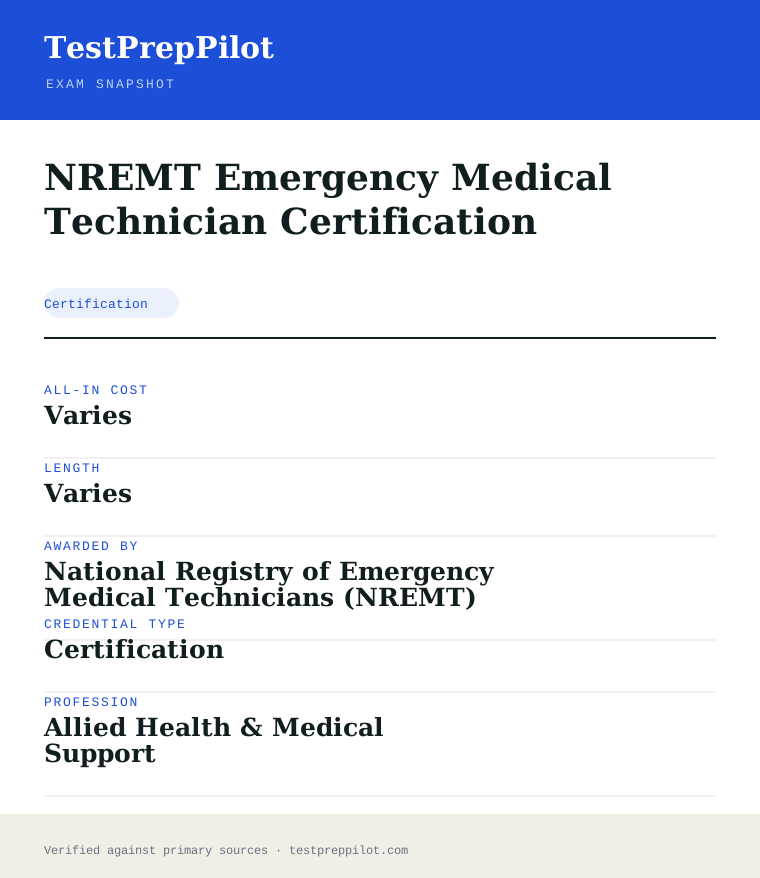
NREMT Emergency Medical Technician Certification is a certification credential; awarded by National Registry of Emergency Medical Technicians (NREMT); the exam fee is ~$104 initial cognitive exam (state fees may apply); typical preparation is Varies.
| Credential | NREMT Emergency Medical Technician Certification |
|---|---|
| Abbreviation | EMT |
| Type | Certification |
| Profession | Allied Health & Medical Support |
| Specialty | EMS |
| Awarded by | National Registry of Emergency Medical Technicians (NREMT) |
| Difficulty | Applied |
| Typical prep time | Varies |
| All-in cost | Varies |
| Credential | NREMT Emergency Medical Technician Certification |
| Awarding body | National Registry of Emergency Medical Technicians (NREMT) |
| Exam format | Proctored, computer-based |
| Validity | NREMT certification renews every 2 years (by continuing education or recertification exam). |
| Languages | Varies — see awarding body |
| Scope | National / Multi-state |
Real questions
Frequently asked questions about the NREMT Emergency Medical Technician Certification
How do I register for the NREMT Emergency Medical Technician Certification exam?
Register through National Registry of Emergency Medical Technicians (NREMT)'s official portal or an authorized test provider (e.g., Pearson VUE or Prometric where applicable). Create an account, select the exam, pay the fee, and schedule a date.
How much does the exam cost?
Fees vary by location and currency. Confirm the current fee on the official registration page before scheduling.
How long is the credential valid, and how do I renew?
NREMT certification is valid for 2 years and is renewed by completing the National Continued Competency Program (continuing education) or by passing the cognitive recertification exam; state licensing runs alongside the NREMT cycle.
What if I do not pass?
Most bodies allow retakes after a waiting period and payment of the full or partial fee. Check National Registry of Emergency Medical Technicians (NREMT)'s retake policy before rescheduling.
How do I register for a National Registry of Emergency Medical Technicians (NREMT) credential?
Register through the official website, select your exam, pay the fee, and schedule a date.
How do I renew a credential?
Renewal policies vary by credential; check the specific program page for requirements and cycles.
In short
Is the NREMT Emergency Medical Technician Certification worth it?
- NREMT Emergency Medical Technician Certification is awarded by National Registry of Emergency Medical Technicians (NREMT).
- Validates job-ready competence in Allied Health.
- Registration is through the awarding body or an authorized test provider.
- Renewal and retake policies vary — confirm before scheduling.
Trust
Where does this information come from?
Everything above is taken from the awarding body's own published material. Fees, question counts and domain weights are revised regularly — check the official page before you pay.
Research confidence: low · Last reviewed 2026-08