Allied Health & Medical Support • Certification
NCCT Technician Specialist Certification
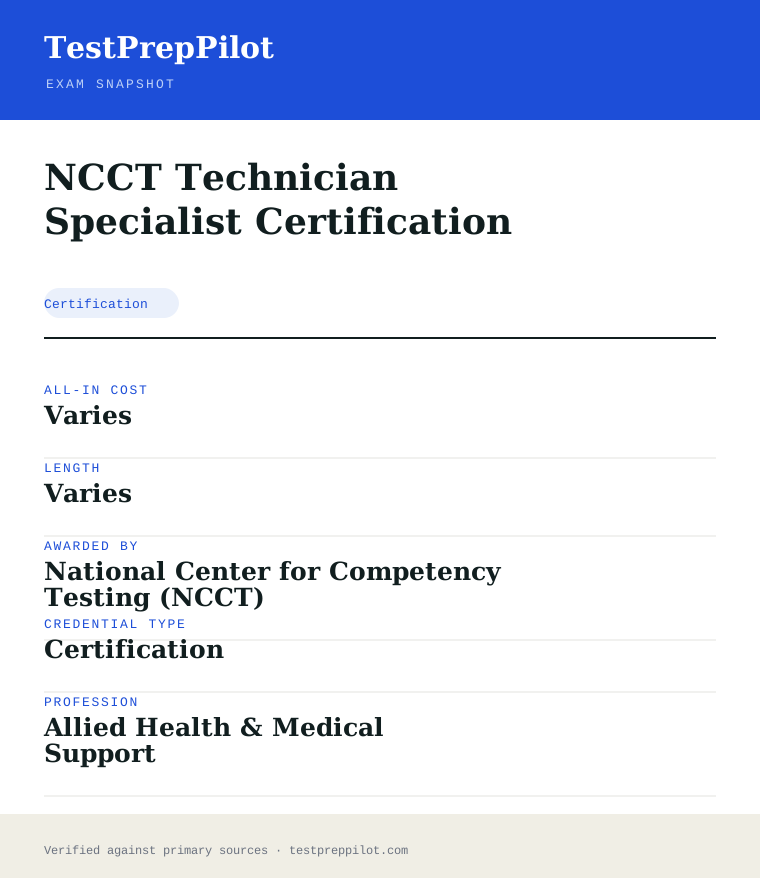
NCCT Technician Specialist Certification — Allied Health credential from National Center for Competency Testing (NCCT)
Researched and maintained by TestPrepPilot Editorial BoardAllied-health & surgical support certifications desk · Figures last verified August 2026
The short version
What is the NCCT Technician Specialist Certification and is it worth it?
NCCT Technician Specialist Certification is a professional credential administered by National Center for Competency Testing (NCCT). It validates job-ready knowledge and skills in the Allied Health field and is used for career entry, advancement, or compliance.
- Recognized credential from National Center for Competency Testing (NCCT)
- Demonstrates verified competence in Allied Health
- Supports career advancement and may satisfy licensing or employer requirements
What is it?
What exactly is the NCCT Technician Specialist Certification?
NCCT Technician Specialist Certification — Allied Health credential from National Center for Competency Testing (NCCT)
Credential for medical technicians specializing in clinical support functions., a nationally recognized professional credential in this field. Offered by National Center for Competency Testing (NCCT), it is designed for candidates who need to demonstrate verified competence in the Allied Health field. The credential is commonly used for career entry, advancement, regulatory compliance, or employer requirements. Candidates should review the official handbook for eligibility, exam format, and scoring before registering.
The path in brief
- Confirm you meet any eligibility or prerequisites
- Review the official handbook and study materials
- Register and pay through the awarding body or authorized provider
- Schedule and take the exam (test center or online proctoring)
- Receive your score and, if passed, your credential
Before you book
Who is eligible to sit the NCCT Technician Specialist Certification?
Eligibility varies; many credentials are open to all, while others require coursework, work experience, or sponsorship.
Who it is for: Professionals and candidates seeking to validate Allied Health competence.
The test itself
What is the format of the NCCT Technician Specialist Certification?
The NCCT Technician Specialist Certification is administered by National Center for Competency Testing (NCCT) and runs Varies by exam.
| Administered by | National Center for Competency Testing (NCCT) |
|---|---|
| Questions | Varies by exam — see the official handbook |
| Time limit | Varies by exam |
| Pass mark | Passing score set by the awarding body; see the official score report |
| Exam fee | Varies by location and currency — confirm on the official registration page |
| Format | Proctored, computer-based (test center or online remote proctoring) |
Content outline
What topics are on the NCCT Technician Specialist Certification?
The NCCT Technician Specialist Certification covers 4 content domains.
Weightings come from the official exam outline. Study time is best allocated in roughly these proportions rather than evenly across domains.
- Anatomy & physiology
Topic area tested on the exam; see the official blueprint for the detailed breakdown.
- Clinical procedures
Topic area tested on the exam; see the official blueprint for the detailed breakdown.
- Patient care & safety
Topic area tested on the exam; see the official blueprint for the detailed breakdown.
- Documentation & ethics
Topic area tested on the exam; see the official blueprint for the detailed breakdown.
The path
How do you register for the NCCT Technician Specialist Certification?
- 1
Visit the awarding body’s official website and create an account
- 2
Select the credential and review its specific requirements
- 3
Complete any required eligibility (education, experience, or training)
- 4
Pay the registration fee
- 5
Schedule the exam at a test center or online
- 6
Take the exam and receive your results
The fine print
What are the retake and renewal rules for the NCCT Technician Specialist Certification?
- Proctoring & delivery
- Proctored, computer-based delivery (test center or remote online proctoring), varying by exam.
- Retake policy
- Varies by credential — most bodies permit retakes after a waiting period and full or partial fee.
- Score reporting
- Scores are reported per the body’s timeline, typically electronically after the exam.
- Recertification
- Varies; many credentials require renewal every 2–3 years via continuing education or a recertification exam.
What it pays
How much does this credential pay?
$62,830 median for surgical technologists (BLS SOC 29-2055, May 2024)
The salary case for the NCCT Tech in Surgery (TS-C) credential runs through the occupation it certifies: surgical technologists, which BLS classifies under SOC 29-2055 with a May 2024 median annual wage of $62,830, about $30.21 an hour. That makes surgical technology one of the better-paid entry credentials in allied health, and the honest framing is that the TS-C does not change the occupation-level number; it is the employer-recognised proof of competency that widens which operating-room doors you can enter. BLS reports the lowest 10 percent of surgical technologists earned less than $43,290 and the highest 10 percent more than $90,700, so the distribution is wide and follows setting, region and experience: hospitals, state and private, paid about $63,260 in May 2024, outpatient care centres about $63,270, and offices of physicians about $61,350, which means a technologist working in a hospital operating room is near the middle of the occupation while travel or specialised roles push toward the top. BLS counted 115,600 surgical technologist jobs in 2024 and projects 4 percent growth from 2024 to 2034 for the occupation (5 percent for surgical technologists and surgical assistants combined), about as fast as the average for all occupations, with roughly 8,700 openings a year for the combined group driven by an ageing population needing more surgical procedures and the expansion of ambulatory surgery centres. Certification is the standard employment gate: many hospitals and all of the states that regulate the role require or strongly prefer it, and the two nationally recognised credentials in the space are the NBSTSA CST and the NCCT TS-C, which most employers treat as equivalent. The practical economics are favourable for a two-year or certificate pathway: a $199 exam fee against a six-figure-topping top decile and steady replacement demand makes the TS-C one of the strongest returns among the allied-health credentials this site covers.
| Measure | Figure | Source / note |
|---|---|---|
| Median annual wage, surgical technologists | $62,830 | BLS Occupational Outlook Handbook, May 2024 |
| Lowest 10 percent | less than $43,290 | BLS OOH Pay tab, May 2024 |
| Highest 10 percent | more than $90,700 | BLS OOH Pay tab, May 2024 |
| Employment, 2024 | 115,600 jobs | BLS OOH Quick Facts, 2024 |
| Projected annual openings (techs and assistants) | ~8,700 per year | BLS OOH Job Outlook, 2024-34 |
| Certification status | Required or preferred by most employers | States that regulate the role require national certification (CST or TS-C) |
Job growth.+4% projected change 2024-34 for surgical technologists (5% combined with surgical assistants), with roughly 8,700 openings a year; an ageing population and ambulatory surgery growth drive demand.
Source: BLS Occupational Outlook Handbook — Surgical Assistants and Technologists
Your odds
What are the pass rates?
NCCT publishes route-specific first-time pass rates in its annual reporting — third-party summaries cite a 2024 first-time rate near 73% — and the passing standard is a scaled score of 70
The direct answer on pass rates is that NCCT reports first-time pass rates by eligibility route in its annual statistics rather than as a single always-visible percentage, in the same pattern as its other credentials, and independent compilations of the 2024 data cite an overall first-time rate near 73 percent for the TS-C, with the caveat that the route split matters — an education-route candidate from an NCCT-authorized surgical technology program and an experienced technologist qualifying through work history are different populations and the published rates differ accordingly. Because NCCT’s reporting is annual, a candidate should verify the current figures on the NCCT site rather than treat any fixed percentage as gospel. What is stable and fully published is the scoring structure: NCCT reports TS-C results on a scaled basis with a passing standard of 70, and the detailed test plan — published by NCCT and the authoritative source for this credential — states that the exam contains 175 scored items plus 25 unscored pretest items for 200 questions total, with 4 hours to complete it, composed of roughly 95-98 percent standard four-option multiple-choice items and 2-5 percent alternative items such as drag-and-drop, multi-select and hotspot. The content is organised around the phases of surgical care: Preoperative Care and Preparation (55 scored items), Perioperative Care and Preparation (68), Intraoperative Care and Preparation, and Postoperative Care and Preparation. Retake policy is published too: candidates who do not pass may retake up to four times, each retake at the full application fee. The practical planning rule is to read the pass-rate figures as cohort context and prepare against the published scaled-70 standard by taking timed practice exams, because the single most useful readiness number is whether you are consistently clearing the bar on the current format.
Read this before quoting the number.NCCT reports first-time pass rates by eligibility route in its annual reporting; third-party compilations cite a 2024 first-time rate near 73%, which should be verified on the NCCT site for the current year. The verifiable official standard is the scaled passing score of 70, and we have not invented a single pass rate NCCT does not publish.
Source: NCCT — Tech in Surgery, Certified (TS-C) certification and detailed test plan
Your schedule
How long should I study for it?
80-140 hours over 10-14 weeks (roughly 8-12 hrs/week) of focused study
A realistic TS-C study plan runs 10 to 14 weeks at 8 to 12 hours a week, weighted to the perioperative and preoperative content that dominates the exam, because the NCCT detailed test plan puts Perioperative Care and Preparation at 68 scored items and Preoperative Care and Preparation at 55, and a candidate who studies all four phases equally will under-prepare the block that decides the pass. The structure to plan against is published: 200 total questions in 4 hours — 175 scored and 25 unscored pretest — with roughly 95-98 percent standard multiple choice and a small share of drag-and-drop, multi-select and hotspot items, reported on a scaled basis with a passing standard of 70. The most effective sequence: first, get the NCCT detailed test plan and baseline with a timed practice exam, logging every miss to a competency; second, work the perioperative block hardest — sterilisation methods and indicators, package integrity, liquid sterilants and disinfectants, preference cards, environmental safety including RACE and PASS, laser safety, biohazard spills, specimen handling, medication and solution reporting, and the basic-science grounding in anatomy, asepsis and transmission precautions — because 68 scored items live there; third, master the preoperative block — instrument and equipment assembly, patient safety including the surgical Time Out, sterile technique, surgical hand scrub, gowning and gloving, and draping sequence — because 55 more live there; fourth, cover the intraoperative and postoperative competencies — supporting the surgeon, retraction, anticipating needs, sutures and needles, skin closure, dressings, casts and splints, postoperative complications and room turnover — plus the alternative item types, which punish candidates who only drilled four-option multiple choice; and fifth, rehearse the full 4-hour format at least twice, because pacing 200 questions with dense surgical stems is a trainable skill. Budget the $199 application fee and confirm your eligibility route — NCCT-authorized program, work experience, or military training — before studying hard.
- Week 18-10 hrs
Baseline and blueprint map
- Take a full timed practice exam and log every miss to a competency area
- Confirm your eligibility route — NCCT-authorized program, work experience, or military training
- Get the NCCT detailed test plan and note the item counts, led by Perioperative Care at 68
- Weeks 2-410-12 hrs/week
Perioperative Care and Preparation (68 items)
- Master sterilisation methods, biological and chemical indicators, and package integrity
- Cover preference cards, environmental safety (RACE and PASS), laser safety and biohazard spills
- Learn specimen handling, medication and solution reporting, and the 5 rights of medication administration
- Weeks 5-710-12 hrs/week
Preoperative Care and Preparation (55 items)
- Study instrument and equipment assembly, and setup for surgical procedures
- Cover patient safety: the surgical Time Out, safe transfer and positioning
- Drill sterile technique: hand scrub, gowning and gloving, and the draping sequence
- Weeks 8-98-10 hrs/week
Intraoperative and postoperative care
- Learn supporting the surgeon: retraction, anticipation, sponging and suctioning
- Cover skin closure, dressings, casts and splints, and postoperative complications
- Study room turnover, instrument decontamination and sterilisation preparation
- Week 108-10 hrs
Alternative item types and mixed drilling
- Practise drag-and-drop, multi-select and hotspot formats explicitly
- Run a second full timed exam and re-drill the weakest competency
- Review the anatomy and transmission-precaution basics the basic-science items test
- Weeks 11-148-10 hrs/week
Full-format rehearsal and gap closing
- Two full 4-hour practice exams under real timing
- Re-lab every miss by competency and re-study the weakest areas
- Final pass over sterilization, Time Out, and the count verification steps
Adjusting the pace
Surgical technology graduate (NCCT-authorized program).Eight to ten weeks. Your program covers the content; the risk is the format — 200 questions in 4 hours with dense stems — so weight the plan toward timed rehearsal and the alternative item types.
Working surgical technologist qualifying by experience.Six to eight weeks. Your day job covers most competencies; focus on the written rules — sterilisation parameters, indicators, RACE and PASS, Time Out — and run two full timed exams.
Military-trained candidate.Eight to ten weeks. Confirm your documentation route early; then concentrate on the civilian facility standards and terminology differences from the service setting.
How to study
How do I prepare most effectively?
The strategy that reliably passes the TS-C is "learn the surgical phases in order, memorise the sterilisation and safety rules cold, and rehearse the 4-hour format," because the NCCT detailed test plan weights Perioperative Care at 68 scored items and Preoperative Care at 55, and the exam is a test of safe perioperative practice rather than instrument vocabulary. Start by baselining with a timed practice exam and logging every miss to a competency, so the plan targets the actual gap. Second, treat sterilisation and asepsis as the highest-yield topic on the paper: the Spaulding classification, immediate-use steam sterilisation limits, biological versus chemical indicators, packaging integrity and event-related sterility appear across the perioperative block, and the correct response to a compromised package or a break in technique is one of the most tested decision styles — the exam rewards surgical conscience, meaning you correct it, replace the item, announce the break where appropriate, and protect the patient. Third, memorise the exact safety sequences: the surgical Time Out, RACE and PASS for fire response, laser safety, and the biohazard-spill actions, because these are scored and easily memorised. Fourth, study instruments by use rather than by name — group them by cutting, grasping, clamping, retracting, suctioning and suturing — so that scenario items about anticipating the surgeon’s needs are answered from function. Fifth, drill the alternative item types explicitly, because drag-and-drop and multi-select items are all-or-nothing and cannot be guessed with the same tactics as four-option multiple choice. Finally, rehearse the full 4-hour paper at least twice, because 200 dense surgical stems are an endurance test and candidates who only drilled sections routinely fade in the back half, exactly where the harder intraoperative items cluster.
Learn the surgical phases in order
Preoperative, perioperative, intraoperative and postoperative. The test plan weights Perioperative Care at 68 scored items and Preoperative Care at 55, so study the phases in the order a case actually runs.
Make sterilisation and asepsis the priority topic
Spaulding classification, immediate-use steam limits, biological vs chemical indicators and package integrity drive many perioperative items. A compromised package is not sterile even if the instrument inside looks clean — that is the tested response.
Memorise the exact safety sequences
The surgical Time Out, RACE and PASS, laser safety and biohazard-spill actions are scored and easily memorised. These are cheap points that working technologists routinely drop because the tasks are automatic.
Study instruments by use, not name
Group instruments by cutting, grasping, clamping, retracting, suctioning and suturing. Scenario items about anticipating the surgeon are answered from function, not from memorised names.
Drill the alternative item types explicitly
Drag-and-drop, multi-select and hotspot items make up 2-5% of the exam and are all-or-nothing. Practise the formats so points are not lost to interface rather than content.
Rehearse the full 4-hour format
200 questions with dense surgical stems is an endurance test. Run at least two full timed exams so pacing and back-half fatigue are trained, not discovered on test day.
What to buy
Which study resources are worth paying for?
TS-C preparation splits into the NCCT official materials, third-party surgical technology products, and the program or workplace you came from, and the buying logic is anchored by one fact: the NCCT detailed test plan defines the four competencies, the 175-scored-and-25-pretest format and the scaled-70 standard, so the official document is the syllabus no matter what else you buy. The official set includes the detailed test plan, the candidate handbook and sample questions, all available from NCCT, and NCCT sells its own practice exam and review system, typically in the $50-100 range, built against the actual test plan. On the third-party side, CST/TS-C question banks and books run roughly $30-100 and are useful for volume drilling, with the caveat that many products are written primarily for the NBSTSA CST exam; the content overlaps heavily with the TS-C blueprint, so CST-oriented banks are a legitimate supplement, but candidates should confirm the product tracks the four-phase structure. Video review courses, $100-250, help with the sterilisation, instrumentation and case-preparation content and are most useful to candidates coming from outside the operating room. The honest rule: buy the official detailed test plan and one NCCT-aligned practice exam first, add a question bank for volume, and spend on a course only if self-study has not cleared the bar in practice. The exam application fee itself — $199 — plus the annual recertification of 14 contact hours and roughly $89 a year should be budgeted separately. Many candidates come through an NCCT-authorized program whose tuition already includes review materials; in that case the marginal purchase is usually just the practice exam and full-format timed rehearsal. Prices below are approximate and dated to 2026; we rank nothing by commission.
| Resource | Price | Format | Best for |
|---|---|---|---|
| NCCT detailed test plan, candidate handbook and sample questions | Free from NCCT | Official PDFs | The authoritative syllabus — competencies, format and the scaled-70 standard |
| NCCT practice exam and review system | ~$50-100 | Online practice and review | Format-accurate drilling built against the actual test plan |
| The TS-C exam itself | $199 per attempt | Proctored, 200 questions in 4 hours | Required — up to 4 total attempts with the full fee each time |
| Third-party CST/TS-C question banks and books | ~$30-100 | Online question banks or printed books | Volume drilling; confirm the product tracks the four-phase structure |
| Surgical technology video review courses | ~$100-250 | Video course with practice | Candidates wanting taught coverage of sterilisation and instrumentation |
Prices approximate and dated to 2026; the exam application fee is $199 per attempt, retakes cost the full fee, and annual recertification requires 14 contact hours and about $89. Many prep products target the NBSTSA CST and are legitimate supplements to the TS-C blueprint — confirm fit before buying. We do not rank by commission.
Avoid these
What mistakes do candidates most often make?
The most common TS-C mistake is treating the exam as an instrument-vocabulary test when it is actually a test of safe perioperative practice: candidates who memorise instrument names but cannot reason about a compromised package, a break in sterile technique or the correct sequence of a surgical Time Out lose the scenario items that dominate the paper. The second is underweighting the sterilisation content, because sterilisation methods, biological and chemical indicators, packaging integrity and event-related sterility recur across the perioperative block, and the correct response to questionable sterility — correct it, replace it, announce the break, protect the patient — is one of the most tested decision styles. A third recurring error is confusing cleaning, disinfection and sterilisation: the exam tests the Spaulding classification and which process is required for which item, and working technologists routinely blur the three because the tasks are automatic in the day job. Candidates also routinely skip the alternative item types, losing points to drag-and-drop, multi-select and hotspot formats they never practised, when those items are all-or-nothing. Another pattern is underestimating the 4-hour pacing: 200 questions with dense surgical stems across four hours rewards trained endurance, and candidates who only drilled short sets fade in the back half where the harder intraoperative items cluster. Many candidates also fail to confirm their eligibility route’s documentation early and lose scheduling weeks to application back-and-forth. Finally, some candidates study only the CST-oriented products without checking that the material tracks the TS-C four-phase blueprint, or misread the scaled-70 standard as a percentage and misjudge their practice performance entirely.
✕Studying instruments without the decision scenarios
✓The exam rewards safe perioperative judgement, not vocabulary. Drill the scenario style — compromised package, break in technique, count discrepancy — and the correct safety response for each.
✕Underweighting sterilisation content
✓Sterilisation methods, indicators, packaging integrity and event-related sterility drive many perioperative items. A compromised package is not sterile; know the corrective response exactly.
✕Confusing cleaning, disinfection and sterilisation
✓Learn the Spaulding classification and which process is required for which item. The exam distinguishes the three precisely, even when your day job blurs them.
✕Skipping the alternative item types
✓Drag-and-drop, multi-select and hotspot items are all-or-nothing. Practise the formats explicitly — the points lost to interface are entirely avoidable.
✕Underestimating the 4-hour pacing
✓200 questions with dense stems is an endurance test. Run at least two full timed exams so pacing and back-half fatigue are trained, not discovered.
✕Ignoring the eligibility-route paperwork
✓Your route — program, work experience or military — has specific documentation. Submit it early, because application processing can push your exam date.
What you'll face
What question types will I see?
The NCCT TS-C exam is 200 total questions in 4 hours — 175 scored and 25 unscored pretest items — with roughly 95-98 percent standard four-option multiple choice and 2-5 percent alternative item types such as drag-and-drop, multi-select and hotspot, reported on a scaled basis with a passing standard of 70. The content is organised around the phases of surgical care: Preoperative Care and Preparation (55 scored items), Perioperative Care and Preparation (68), Intraoperative Care and Preparation, and Postoperative Care and Preparation, so the paper reads as a case-in-progress rather than as isolated recall — a sterilisation decision, a break-in-technique response, a Time Out sequence, an anticipation scenario, a count discrepancy or a postoperative complication. The standard multiple-choice items test both knowledge (sterilisation parameters, indicator types, instrument functions, the Spaulding classification) and application (what to do when a package is compromised, which action preserves the sterile field, which process is required for which item). The alternative item types test the same content in different formats: drag-and-drop items ask you to order steps such as the gowning sequence or the draping sequence, multi-select items ask you to choose all correct options and are all-or-nothing, and hotspot items ask you to identify a location or item on an image. The practical pacing is about 72 seconds per question across a long sitting, with the 25 unscored pretest items indistinguishable from the scored ones, so every question should be answered at full effort. Because the weighting toward perioperative and preoperative care is so lopsided, a prepared candidate is answering about sterile technique, patient safety and surgical conscience rather than recalling definitions, which is why scenario drilling converts study hours into pass points more efficiently than instrument-list review. The samples below illustrate the scenario style; they are editor-written to the published blueprint and are not live exam items.
A case in progress — a sterilisation decision, a Time Out, an anticipation scenario, a count discrepancy — with the correct next action. The perioperative and preoperative competencies are tested mostly this way.
Sterilisation methods, biological and chemical indicators, package integrity, Spaulding classification and the response to a break in technique.
Instrument functions, medication and solution facts, anatomy, and the modes of transmission behind contact precautions.
Drag-and-drop for sequences (gowning, draping), multi-select for all-correct options, and hotspot for identifying items or locations — all-or-nothing formats that reward practice.
Try these
Q1During a surgical procedure, the surgical technologist notices the sterile field may have been contaminated when the circulating nurse brushed against the sterile drape. What is the most appropriate action?
Answer:B
Surgical conscience requires that a suspected break in sterile technique be announced, corrected and documented promptly — replace the contaminated item and protect the patient. A ignores a known contamination risk, C delays an action that should be immediate, and D documents without correcting the problem. The item tests the perioperative decision style that dominates the exam: recognising a sterility threat and responding with the safe, corrective sequence rather than the convenient one.
Q2Which of the following is the correct sequence for the surgical hand scrub, gowning and gloving?
Answer:B
The correct sequence is the surgical hand scrub first, then donning the sterile gown, then applying sterile gloves using closed-glove technique so the hands never touch the outside of the gown. A and D put the gown or gloves before the scrub, and C gloves before gowning, which breaks the sterile boundary between glove and gown cuff. The item tests the exact-sequence pre-operative content that is heavily weighted — order questions like this reward memorised sequences.
Q3The surgeon asks the surgical technologist for a cutting instrument to divide dense tissue. Which instrument best matches the request?
Answer:B
Cutting instruments include the scalpel and Mayo scissors, which divide tissue — that is the correct response to a request to divide dense tissue. A, the Kelly clamp, is a clamping and haemostasis instrument; C, the DeBakey forceps, is a grasping instrument; D, the suction tip, clears the field. The item tests the instrument-by-function approach: anticipating the surgeon’s needs means knowing what each instrument does, not just its name, which is how intraoperative items are built.
Samples are editor-written illustrations of the published blueprint, not live exam items.
The big day
What should I expect on exam day?
The NCCT TS-C exam is a 4-hour, 200-question computer-delivered test — 175 scored and 25 unscored pretest items — taken at a proctored testing centre or through remote proctoring, reported on a scaled basis with a passing standard of 70, with the result available at the end of the appointment at institution-based sites and within about 48 hours at other centres. The first thing to confirm is your eligibility-route documents, because your application must be approved and your scheduling authorisation issued before you can book — a step candidates underestimate and then lose weeks to — and the second is the $199 application fee and the venue or remote-proctoring requirements. Bring a current, valid, unexpired government-issued photo ID whose name matches your application exactly, and your scheduling confirmation; leave phones, smartwatches, notes and personal calculators, because personal electronics are prohibited and the test provides its own on-screen tools where needed. Arrive at least 30 minutes early for a testing centre so check-in and the tutorial are complete before the clock starts, and for remote proctoring run the system check in advance and clear the room per the proctor’s specifications. When the exam begins, pace for the long sit: 200 questions in 240 minutes is about 72 seconds per question, and the 25 unscored pretest items are indistinguishable from the scored ones, so answer every question at full effort. Read each surgical stem for the role, the phase of care and the safety issue before choosing; flag anything over about 80 seconds and budget the final minutes to revisit flagged items, then submit. Your pass or fail result appears on screen, and your official score report with competency-level performance follows through your NCCT account, which is the diagnostic tool to use if you have to retake.
Bring
- Current, valid, unexpired government-issued photo ID matching your application exactly
- Your scheduling authorisation and confirmation details
- For remote proctoring: a cleared, private room and a system that passed the proctor’s check
- A pacing plan — about 72 seconds per question across 200 questions and 4 hours
Leave at home
- Phones, smartwatches and all personal electronics
- All notes, cheat sheets and study materials
- Personal calculators — the test provides its own on-screen tools where needed
- For remote proctoring, any other person in the room
How the day runs
Rules in the room
- The exam is 200 total questions — 175 scored and 25 unscored pretest — in 4 hours.
- The passing standard is a scaled score of 70.
- The result is available at the end of the appointment at institution-based sites and within ~48 hours elsewhere.
- A current government-issued photo ID is required, with the name matching your application.
- Personal electronics and personal calculators are prohibited; the test provides its own on-screen tools where needed.
- Candidates have up to 4 total attempts; each retake costs the full $199 application fee.
Afterwards.Your pass or fail appears on screen, and the official score report with competency-level performance follows through your NCCT account — on a pass, the certification is issued within a few business days, and the first thing to do is record the annual recertification cycle, because the TS-C requires 14 continuing-education hours and about $89 every year to stay active, and it remains valid for five years only if maintained annually. On a fail, use the competency-level report as it is designed to be used: identify the one or two competency areas that dragged the result — for most candidates that is the sterilisation-and-asepsis content or the alternative item types — re-study those specifically, and re-sit after timed practice clears the scaled-70 standard, keeping in mind the retake policy of up to four total attempts with the full $199 fee each time. Either way, the occupation behind the credential is one of the strongest stories in entry-level allied health — surgical technologists earned a BLS median of $62,830 in May 2024 with a top decile above $90,700 and roughly 8,700 openings a year — and the TS-C, alongside the NBSTSA CST, is the employer-recognised credential that widens the operating-room openings you can apply for, which is the practical return on the $199 application fee and the annual maintenance cost.
Reference
What are the key facts about the NCCT Technician Specialist Certification?
NCCT Technician Specialist Certification is a certification credential; awarded by National Center for Competency Testing (NCCT); the exam fee is Varies by location and currency — confirm on the official registration page; typical preparation is Varies.
| Credential | NCCT Technician Specialist Certification |
|---|---|
| Abbreviation | TS |
| Type | Certification |
| Profession | Allied Health & Medical Support |
| Specialty | Medical Office |
| Awarded by | National Center for Competency Testing (NCCT) |
| Difficulty | Applied |
| Typical prep time | Varies |
| All-in cost | Varies |
| Credential | NCCT Technician Specialist Certification |
| Awarding body | National Center for Competency Testing (NCCT) |
| Exam format | Proctored, computer-based |
| Validity | Varies by credential (commonly 2–3 years) |
| Languages | Varies — see awarding body |
| Scope | National / Multi-state |
Real questions
Frequently asked questions about the NCCT Technician Specialist Certification
How do I register for the NCCT Technician Specialist Certification exam?
Register through National Center for Competency Testing (NCCT)'s official portal or an authorized test provider (e.g., Pearson VUE or Prometric where applicable). Create an account, select the exam, pay the fee, and schedule a date.
How much does the exam cost?
Fees vary by location and currency. Confirm the current fee on the official registration page before scheduling.
How long is the credential valid, and how do I renew?
Validity varies by credential (commonly 2–3 years). Renewal usually requires continuing education or a recertification exam — see National Center for Competency Testing (NCCT)'s policy.
What if I do not pass?
Most bodies allow retakes after a waiting period and payment of the full or partial fee. Check National Center for Competency Testing (NCCT)'s retake policy before rescheduling.
How do I register for a National Center for Competency Testing (NCCT) credential?
Register through the official website, select your exam, pay the fee, and schedule a date.
How do I renew a credential?
Renewal policies vary by credential; check the specific program page for requirements and cycles.
In short
Is the NCCT Technician Specialist Certification worth it?
- NCCT Technician Specialist Certification is awarded by National Center for Competency Testing (NCCT).
- Validates job-ready competence in Allied Health.
- Registration is through the awarding body or an authorized test provider.
- Renewal and retake policies vary — confirm before scheduling.
Same awarding body
What other credentials does National Center for Competency Testing (NCCT) award?
Worth comparing
How does the NCCT Technician Specialist Certification compare with similar credentials?
Trust
Where does this information come from?
Everything above is taken from the awarding body's own published material. Fees, question counts and domain weights are revised regularly — check the official page before you pay.
Research confidence: low · Last reviewed 2026-08