Insurance & Risk • Exam
CPCU 500: Becoming a Leader in Risk Management and Insurance
CPCU 500: Becoming a Leader in Risk Management and Insurance — Insurance & Risk credential from The Institutes
Researched and maintained by TestPrepPilot Editorial BoardRisk management & insurance education desk · Figures last verified August 2026
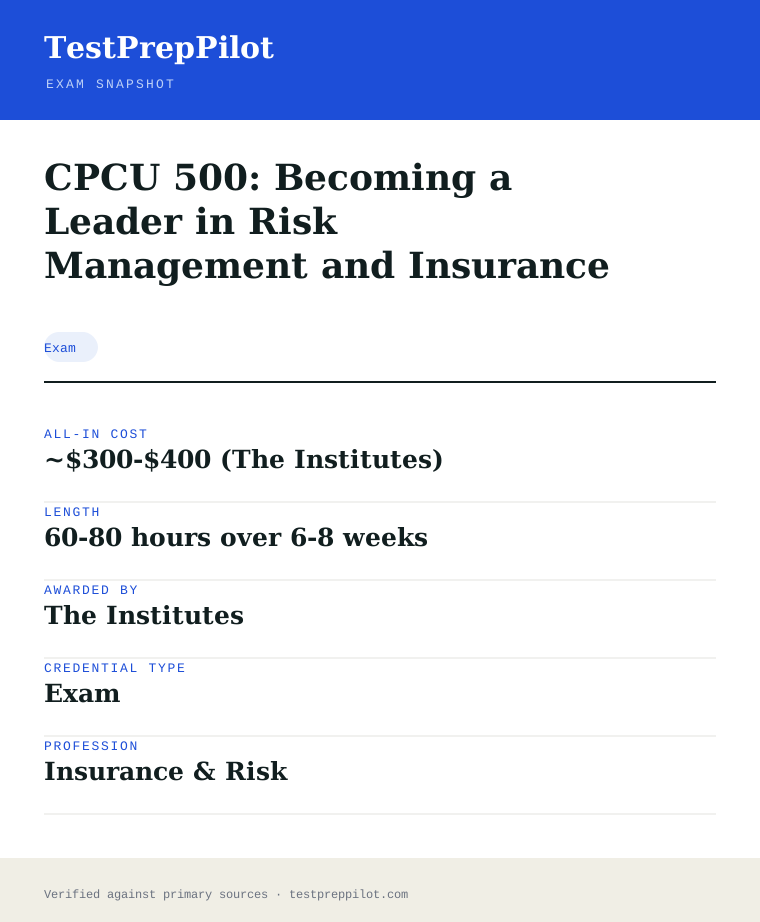
The short version
What is the CPCU 500: Becoming a Leader in Risk Management and Insurance and is it worth it?
CPCU 500: Becoming a Leader in Risk Management and Insurance is a professional credential administered by The Institutes. It validates job-ready knowledge and skills in the Insurance & Risk field and is used for career entry, advancement, or compliance.
- Recognized credential from The Institutes
- Demonstrates verified competence in Insurance & Risk
- Supports career advancement and may satisfy licensing or employer requirements
What is it?
What exactly is the CPCU 500: Becoming a Leader in Risk Management and Insurance?
CPCU 500: Becoming a Leader in Risk Management and Insurance — Insurance & Risk credential from The Institutes
Core CPCU course exam on risk essentials, critical thinking, insurance as a risk solution and strategic decision making. Offered by The Institutes, it is designed for candidates who need to demonstrate verified competence in the Insurance & Risk field. The credential is commonly used for career entry, advancement, regulatory compliance, or employer requirements. Candidates should review the official handbook for eligibility, exam format, and scoring before registering.
The path in brief
- Confirm you meet any eligibility or prerequisites
- Review the official handbook and study materials
- Register and pay through the awarding body or authorized provider
- Schedule and take the exam (test center or online proctoring)
- Receive your score and, if passed, your credential
Before you book
Who is eligible to sit the CPCU 500: Becoming a Leader in Risk Management and Insurance?
Eligibility varies; many credentials are open to all, while others require coursework, work experience, or sponsorship.
Who it is for: Professionals and candidates seeking to validate Insurance & Risk competence.
The test itself
What is the format of the CPCU 500: Becoming a Leader in Risk Management and Insurance?
The CPCU 500: Becoming a Leader in Risk Management and Insurance is administered by The Institutes and runs 2 hours.
| Administered by | The Institutes |
|---|---|
| Questions | ~100 questions |
| Time limit | 2 hours |
| Pass mark | Passing score set by the awarding body; see the official score report |
| Exam fee | ~$300-$400 |
| Format | Proctored, computer-based (test center or online remote proctoring) |
Content outline
What topics are on the CPCU 500: Becoming a Leader in Risk Management and Insurance?
The CPCU 500: Becoming a Leader in Risk Management and Insurance covers 4 content domains.
Weightings come from the official exam outline. Study time is best allocated in roughly these proportions rather than evenly across domains.
- Products & coverage
Topic area tested on the exam; see the official blueprint for the detailed breakdown.
- Underwriting
Topic area tested on the exam; see the official blueprint for the detailed breakdown.
- Regulation & ethics
Topic area tested on the exam; see the official blueprint for the detailed breakdown.
- Claims & risk management
Topic area tested on the exam; see the official blueprint for the detailed breakdown.
The path
How do you register for the CPCU 500: Becoming a Leader in Risk Management and Insurance?
- 1
Visit the awarding body’s official website and create an account
- 2
Select the credential and review its specific requirements
- 3
Complete any required eligibility (education, experience, or training)
- 4
Pay the registration fee
- 5
Schedule the exam at a test center or online
- 6
Take the exam and receive your results
The fine print
What are the retake and renewal rules for the CPCU 500: Becoming a Leader in Risk Management and Insurance?
- Proctoring & delivery
- Proctored, computer-based delivery (test center or remote online proctoring), varying by exam.
- Retake policy
- Varies by credential — most bodies permit retakes after a waiting period and full or partial fee.
- Score reporting
- Scores are reported per the body’s timeline, typically electronically after the exam.
- Recertification
- Varies; many credentials require renewal every 2–3 years via continuing education or a recertification exam.
What it pays
How much does this credential pay?
$79,880 median for insurance underwriters (BLS, May 2024) — and the CPCU is the senior designation that moves experienced insurance professionals to the top of the occupation’s wage distribution
The direct answer is that the CPCU designation has no BLS occupation of its own — it is a professional designation, not a job title — but the career it crowns sits inside insurance underwriting and the senior risk-management roles above it, and insurance underwriters (SOC 13-2053) earned a May 2024 median of $79,880, with the lowest 10 percent below $51,640 and the highest 10 percent above $138,020. The CPCU is not an entry credential: it is an 18-to-24-month program of advanced courses built for experienced insurance professionals, and its value is the move it enables from the middle of the underwriting wage distribution to its upper end — the senior underwriting, claims management, brokerage leadership and risk-management roles that sit in the top quartile and decile of the BLS range. BLS counts about 127,000 insurance underwriter jobs in 2024 and projects a 3 percent employment decline from 2024 to 2034 as automated underwriting software absorbs routine decisions, which sharpens the credential’s case: the work being automated is the standard-risk, rule-following part of underwriting, while the complex, judgement-heavy work that automation does not displace is exactly the work CPCU-level training addresses. Employers in this field routinely subsidise the designation — tuition reimbursement and study-time allowances are common in insurance — which changes the cost-benefit calculation for candidates: the direct outlay is materials and exam fees in the low four figures, and the career effect is movement onto a different compensation track rather than a small bump on the same one. The honest framing is that CPCU 500, the first course, is the gateway: it establishes the risk-management and insurance foundation the other core courses build on, and every exam passed is a step toward the designation that the industry treats as its gold standard.
| Measure | Figure | Source / note |
|---|---|---|
| Median annual wage, insurance underwriters | $79,880 | BLS OOH, SOC 13-2053, May 2024 ($38.40/hr) |
| Lowest 10 percent | less than $51,640 | BLS OOH Pay tab, May 2024 |
| Highest 10 percent | more than $138,020 | BLS OOH Pay tab, May 2024 |
| Employment, 2024 | 127,000 jobs | BLS OOH Quick Facts, 2024 |
| Projected annual openings | ~8,200 per year | BLS OOH Job Outlook, 2024-34 — all from replacement need |
Job growth.-3% projected change 2024-34 (decline) as automated underwriting absorbs routine decisions; the complex, judgment-heavy work that remains is where CPCU-level expertise is concentrated
Source: BLS Occupational Outlook Handbook — Insurance Underwriters
Your odds
What are the pass rates?
The Institutes publishes no CPCU pass rates — it publishes a 70% passing grade on a timed, closed-book, virtually proctored exam
The Institutes does not publish pass-rate statistics for the CPCU exams, so there is no current official figure to quote for CPCU 500 — the historically cited pass rates of roughly 70 percent for the old CPCU 520 and similar figures for earlier course versions are now more than a decade old and refer to exam formats that have since been redesigned, so any current percentage is an estimate rather than a published fact. What is published, clearly, is the passing standard and the exam mechanics. CPCU exams are delivered virtually and proctored — The Institutes moved the whole designation portfolio to virtual proctoring to reinforce the value of the credential — and each exam is timed, closed-book, and graded against a 70 percent passing grade. Item-count reporting is where honesty matters: The Institutes does not publish a fixed number of questions for CPCU 500 on its course page, and the prep ecosystem reports 50 to 60 questions in a 65-minute sitting for the current virtual format, so the defensible statement is that the exam is a timed, multiple-choice-format assessment of roughly 50-60 items rather than a specific published count. The exam is taken inside one of four quarterly testing windows — January 15 to March 15, April 15 to June 15, July 15 to September 15, and October 15 to December 15 — and The Institutes periodically offers free-retake promotions on the core CPCU courses, so a failed attempt is frequently a same-window retake at no extra exam cost. The practical readiness signal, as with all The Institutes exams, is the simulated credentialing exam included with each course, which mimics the structure and difficulty of the real assessment.
Read this before quoting the number.The Institutes publishes no pass-rate statistics for CPCU exams. Published facts are the 70% passing grade, the timed closed-book format, virtual proctoring, and the four quarterly testing windows. The item count is not published by The Institutes; prep providers report roughly 50-60 questions in about 65 minutes for the current virtual format.
Source: The Institutes — CPCU 500: Becoming a Leader in Risk Management and Insurance
Your schedule
How long should I study for it?
60-90 hours over 6-8 weeks for CPCU 500 of focused study
Plan for 6 to 8 weeks and 60 to 90 hours of study for CPCU 500 specifically, working at The Institutes’ suggested course cadence of 6-8 weeks per course, because this is the first of the five required core courses in an 18-to-24-month designation program and the foundation the other four assume. CPCU 500 is titled “Becoming a Leader in Risk Management and Insurance” and its course content is organised around building the foundation, understanding risk essentials, anticipating what could go wrong, the insurance solution, leading with critical thinking, communicating and collaborating as a leader, and strategic decision making — which tells you the exam tests applied judgement across the risk-management process, not recall of policy forms. The exam is timed and closed-book, virtually proctored, graded at 70 percent, and taken inside one of four quarterly testing windows, and the course package includes assignment quizzes, practice exams and a simulated credentialing exam, which is the closest available rehearsal. Weeks 1-2 cover the foundation and risk essentials: the risk management process, how loss exposures are identified and analysed, and the vocabulary of risk financing. Weeks 3-4 cover “anticipating what could go wrong” and “the insurance solution”: loss exposure analysis in practice, how insurance functions as a risk transfer mechanism, and how policies are structured to cover the exposures. Weeks 5-6 cover the leadership and decision-making content: critical thinking applied to risk decisions, communication and collaboration, and strategic decision making. Weeks 7-8 are the exam-cadence phase: run the course’s simulated credentialing exam, drill the assignments it flags, and sit the real exam inside your registered window. The pacing rule is simple — roughly 60-70 seconds per question if the exam sits near 50-60 items in 65 minutes — and the strategic point is that scenario items asking what a leader should recommend punish candidates who study definitions without practising application.
- Weeks 1-212-14 hrs/week
Foundation and risk essentials
- Study the risk management process: identify, analyse, evaluate, treat, monitor
- Learn how loss exposures are classified and analysed across the organisation
- Build the course vocabulary — pure vs speculative risk, risk control vs risk financing
- Weeks 3-412-14 hrs/week
Anticipating loss and the insurance solution
- Study how loss exposures manifest across operations, people, property and liability
- Learn how insurance transfers risk and how policy structures respond to exposures
- Drill scenario questions that connect a described exposure to the right coverage concept
- Weeks 5-610-12 hrs/week
Leadership, communication and strategic decisions
- Study critical thinking applied to risk decisions and how leaders weigh trade-offs
- Learn the communication and collaboration skills the course frames as leadership competencies
- Connect risk-management insight to organisational strategy
- Weeks 7-810-12 hrs/week
Simulated exam and real exam window
- Run the course’s simulated credentialing exam and score it against the 70% line
- Re-read the assignments the simulation flags as weak
- Sit the real exam inside your registered quarterly window
Adjusting the pace
Full CPCU program planning.Map all five core courses (500, 520, 530, 540, 550) plus electives and ethics across 18-24 months and one course per testing window, so each exam is a fixed milestone rather than a series of independent decisions.
Experienced underwriter with deep P&C background.Four to five weeks. Your daily work covers much of the exposure-analysis and insurance-solution content; spend the recovered time on the leadership and strategic-decision modules, which are the parts of 500 that even experienced candidates underprepare.
New to insurance operations.Eight to ten weeks. Add two weeks on the insurance-solution fundamentals before the leadership content, because the scenario questions assume a working grasp of how insurers structure coverage.
How to study
How do I prepare most effectively?
The strategy that reliably passes CPCU 500 is “study the course fully and rehearse with the simulated exam,” because CPCU exams are written from The Institutes’ course objectives and the exam rewards applied judgement — scenario-based items that present a risk situation and ask what a leader should recommend, do, or prioritise — rather than recall of definitions. The single biggest error is studying the textbook like a reference and skipping the application practice, because the exam’s scenario items will not quote the material directly and candidates who only review notes fail to recognise the reasoning pattern. A second proven approach is to use the course’s own assignment quizzes as the diagnostic: every miss maps to an assignment to re-read, and the simulated credentialing exam provides the only true-to-format rehearsal before the real sitting. Third, practise the decision logic explicitly: for each scenario, name the risk-management step at issue (identification, analysis, evaluation, treatment, monitoring) and the strategic trade-off the question is really asking about, because the exam rewards naming the correct step and the correct trade-off over producing a remembered answer. Fourth, manage the exam format deliberately — a timed, closed-book sitting of roughly 50-60 items in 65 minutes means the pacing is about a minute per question, and scenario items run longest, so answer everything and flag the slow ones. Finally, treat the quarterly testing window as the planning constraint: register early for the early-bird rate, finish the course before the window closes, and know whether your sitting is covered by a free-retake promotion before you need it.
Read the course fully and rehearse application
CPCU exams are written from the course objectives and the items apply them to situations rather than quoting them. One full read plus scenario practice beats highlight-only review, because the exam rewards recognising the reasoning pattern, not the sentence.
Use the simulated exam as the readiness gate
The course package includes a simulated credentialing exam that mimics the real assessment’s structure and difficulty. Run it before the real sitting and re-read the assignments it flags — it is the closest available rehearsal and the most reliable readiness signal.
Name the risk-management step in every scenario
For each practice scenario, identify whether the item is testing identification, analysis, evaluation, treatment or monitoring, and the strategic trade-off underneath. The exam rewards naming the correct step and trade-off over recalling a remembered answer.
Pace the timed sitting deliberately
A closed-book sitting of roughly 50-60 items in 65 minutes is about a minute per question. Scenario items run longest; answer everything, flag the slow ones, and return only if time allows.
Plan around the testing windows and retake terms
Exams run in four quarterly windows with early-bird pricing. Know the free-retake promotion terms for the core courses before you sit, so a failed attempt is a planned same-window retake rather than a surprise.
Link 500 to the full CPCU path
CPCU 500 is the first of five core courses plus electives and ethics. Keep every score report and map the next course to the next window so the 18-to-24-month program stays a sequence of fixed milestones.
What to buy
Which study resources are worth paying for?
CPCU preparation is built around The Institutes’ own course package — the online course, a printed or digital course book, a printable study outline, assignment quizzes, practice exams, a simulated credentialing exam, flashcards and discussion boards — and the buying rule is that the course is the content: CPCU exams are written from The Institutes’ objectives, so third-party products are supplements for drilling, not substitutes for the course. The main costs are the course package and the exam fee, with The Institutes listing materials at roughly $419-519 and the exam at roughly $359-439, with early-bird pricing for registering before the testing window opens and periodic free-retake promotions on the core courses. Employers in insurance frequently reimburse both, which is the first thing to ask about before buying anything.
| Resource | Price | Format | Best for |
|---|---|---|---|
| CPCU 500 course package (recommended or online-only) | ~$419-519 | Online course, course book, study outline, quizzes, practice exams, simulated exam, flashcards | All candidates — the course IS the exam content |
| CPCU 500 exam registration | ~$359-439, early-bird discounts and free-retake promotions on core courses | Timed, closed-book, virtually proctored exam in a quarterly window | The exam itself |
| Third-party CPCU prep products (e.g. prep courses, question banks) | ~$100-400 depending on provider | Summaries, videos and practice question banks | Supplemental drilling after the course has been read once |
| The Institutes’ study groups and discussion boards | Included with the course | Facilitated study groups and candidate forums | Accountability and shared interpretation of the material |
| Self-built study guide from the course | Free | Your own shorthand notes per assignment | Retaining the detail the exam’s application items assume |
Prices checked 2026-08 in USD and vary by package and early-bird timing; The Institutes publishes current pricing on its course pages. We do not rank by commission.
Avoid these
What mistakes do candidates most often make?
The most common CPCU 500 mistakes are process errors rather than knowledge gaps: studying definitions without practising application, skipping the simulated exam, and letting scenario items consume the clock in a timed, closed-book sitting. The rest are planning errors — underestimating the leadership and strategic-decision modules, registering for a testing window before the course is finished, and ignoring the free-retake and early-bird terms until they are needed.
✕Studying definitions without practising application
✓CPCU items apply the course material to situations and rarely quote it directly. Rehearse naming the risk-management step at issue in each scenario and the strategic trade-off beneath it, because the exam rewards the reasoning pattern, not the sentence.
✕Skipping the simulated credentialing exam
✓The course’s simulated exam is the only true-to-format rehearsal and the most reliable readiness signal available. Run it, score it against the 70% line, and re-read the assignments it flags before the real sitting.
✕Letting scenario items eat the clock
✓A timed, closed-book sitting of roughly 50-60 items in 65 minutes is about a minute per question. Answer everything, flag the slow scenario items, and return only if time allows.
✕Underpreparing the leadership and decision modules
✓CPCU 500 explicitly includes critical thinking, communication, collaboration and strategic decision making. Experienced underwriters routinely underprepare these modules because they assume their daily work covers the content — it covers the exposure analysis, not the leadership framing.
✕Registering for a window before the course is finished
✓Exams run in four quarterly windows with early-bird pricing. Schedule the course against the window end date and register for the next window if you finish late, rather than sitting unprepared to hit a deadline.
✕Ignoring the retake and pricing terms
✓The Institutes periodically offers free retakes on the core CPCU courses and early-bird exam discounts. Confirm both before you sit so a failed attempt is a planned same-window retake rather than a surprise second payment.
What you'll face
What question types will I see?
The CPCU 500 exam is a timed, closed-book, virtually proctored assessment delivered inside one of four quarterly testing windows, graded against a 70 percent passing grade. The Institutes does not publish a fixed item count on its course page; the prep ecosystem reports roughly 50-60 multiple-choice-format items in about 65 minutes for the current virtual format, and the exam is built from the course’s educational objectives. The defining item style is the scenario: a risk situation is described and you select the best recommendation, decision or priority for a risk-management leader, with distractors that are defensible-sounding steps that are out of order or out of scope for the described exposure. Because the passing grade is 70 percent and there is no penalty for guessing, the pacing rule is about a minute per question and the strategy is to answer everything. The samples below are editor-written illustrations of the published course content and item style; they are not live exam items.
A described risk situation with the best recommendation, decision or priority as the answer. Distractors are usually correct-sounding steps that address the wrong stage of the risk management process or the wrong exposure.
Direct questions on the course’s vocabulary — risk control vs risk financing, pure vs speculative risk, exposure analysis. These reward knowing the definitions exactly as the course frames them.
Questions on critical thinking, communication, collaboration and strategic decision making, asking what a leader should weigh or recommend when trade-offs conflict.
Items asking for the correct order of steps — for example, the sequence within the risk management process or the structure of a decision. These reward knowing the process, not just its parts.
Try these
Q1A manufacturer identifies that a key production line could be shut down by a fire in its warehouse. Under the risk management process, what should the organisation do immediately after identifying this loss exposure?
Answer:B
The risk management process is sequential: identify potential risks, analyse them (assess frequency and severity), evaluate and select treatment alternatives, implement the chosen techniques, and monitor and review. Analysis must precede treatment because you cannot choose sensibly between risk control and risk financing without knowing how often and how badly the exposure can strike. A and C jump to a treatment — insurance and transfer — before analysis. D also selects a treatment prematurely, and skipping analysis to rush risk control is the same process error in a different costume. The item rewards knowing the process order, not the best single answer in isolation.
Q2An organisation can either install automatic sprinklers in its warehouse or self-insure the potential fire loss through a funded reserve. Which pair of risk treatment categories do these two options represent?
Answer:B
Installing sprinklers reduces the frequency or severity of a loss — that is risk control, the class of techniques that lowers loss. Self-insuring through a funded reserve is risk financing, the class that funds the losses that occur, here through retention rather than transfer. A and C mislabel the sprinklers as avoidance or transfer, neither of which fits reducing a retained exposure. D gets the financing label right for the reserve but mislabels sprinklers as retention rather than control. The item tests the course’s core vocabulary of risk treatment techniques.
Q3A risk manager must present a case for a new risk-financing programme to the executive team, which is sceptical of the cost. Which approach best reflects the course’s framing of leadership in risk decisions?
Answer:B
The course frames leadership in risk decisions as balancing risk, opportunity and long-term goals — presenting the trade-offs and the reasoning, not the conclusion. B does exactly that: it connects the financing choice to cost, risk tolerance and strategy and shows the analysis, which is how a risk leader earns a sceptical executive’s support. A substitutes authority for reasoning and offers no alternatives. C abandons the risk function’s responsibility. D implements without the decision or the consent the scenario requires. The item tests the strategic-decision module, the part of CPCU 500 that even experienced candidates underprepare.
Samples are editor-written illustrations of the published course content and item style; they are not live exam items.
The big day
What should I expect on exam day?
A CPCU 500 exam day is a virtual, timed, closed-book session delivered through The Institutes’ platform inside the quarterly testing window you registered for — January 15 to March 15, April 15 to June 15, July 15 to September 15, or October 15 to December 15 — and you can sit at any time within the window. Because the designation portfolio now uses virtual proctoring, the practical preparation is technical and environmental: log in through the latest supported browser, confirm your webcam and microphone, and set up a quiet, cleared workspace with no other people and no unauthorised material within reach, because the proctor records you and your screen for the duration. Before the clock starts you complete any NDA and environment checks the platform requires; once the timed session begins — roughly 50-60 items in about 65 minutes per the prep ecosystem’s reporting, at a 70 percent passing grade — work at about a minute per question, flag the scenario items that run longest, and answer everything, because there is no penalty for guessing. The result is reported in the My Courses & Exams area of your account, and a passing grade records the course toward your CPCU designation. The window, not a test centre, is the appointment, which is the exam’s scheduling advantage: a course finished between windows waits for the next opening, and a same-window retake after a failure is governed by the retake terms you confirmed at registration, including whether a free-retake promotion covers it.
Bring
- Your The Institutes account credentials and the exam link in the My Courses & Exams area
- The latest supported browser, a working webcam and microphone, and a reliable connection
- A quiet, cleared workspace where you will not be interrupted or recorded with others present
- Your registration confirmation, including the window dates and any free-retake promotion terms
Leave at home
- Notes, textbooks and study materials — the exam is closed-book under the integrity terms
- Other people in the room — virtual proctoring records your environment
- Phones and other devices within reach of the workspace
- Open tabs and unrelated applications — the proctor records your screen
- Anything you would not want visible on a recording of the session
How the day runs
Rules in the room
- Virtual, timed, closed-book, with virtual proctoring across the designation portfolio.
- Delivered inside one of four quarterly testing windows; you sit at any time within the window you registered for.
- 70% passing grade, reported in the My Courses & Exams area of your account.
- No penalty for guessing — answer every item.
- Latest supported browser, working webcam and microphone, and a cleared workspace are required.
- The item count is not published by The Institutes; prep providers report roughly 50-60 items in about 65 minutes.
- Confirm the free-retake promotion terms for the core courses before you sit.
Afterwards.Your result appears in the My Courses & Exams area of your account, and a passing grade of 70 percent or higher records CPCU 500 as completed toward the CPCU designation — the first of five required core courses, plus the electives and ethics component that together take most candidates 18 to 24 months. On a pass, keep the score report and map the next core course to the next quarterly window so the designation stays a sequence of fixed milestones; CPCU courses also carry credit toward related designations, so the record is reusable. On a fail, the grade report’s performance-by-assignment view is the diagnostic — it maps which course assignments cost you points, so the correct response is to re-read those assignments and sit a same-window retake if your registration’s retake terms allow, including a free-retake promotion if one covers your course. Because the designation is a long program, the habit that matters is cadence: one course per window, simulated exam before every real sitting, and a score report kept for every pass. CPCU 500 is where that rhythm is set, and candidates who treat the first course as the pattern for the next seven exams typically carry the same discipline through the designation to the senior roles it unlocks.
Reference
What are the key facts about the CPCU 500: Becoming a Leader in Risk Management and Insurance?
CPCU 500: Becoming a Leader in Risk Management and Insurance is a exam credential; awarded by The Institutes; the exam fee is ~$300-$400; typical preparation is 60-80 hours over 6-8 weeks; holders typically earn $55,000-$95,000 (13-2053 median $77,860).
| Credential | CPCU 500: Becoming a Leader in Risk Management and Insurance |
|---|---|
| Type | Exam |
| Profession | Insurance & Risk |
| Specialty | Insurance Designations |
| Awarded by | The Institutes |
| Difficulty | Regulated |
| Typical prep time | 60-80 hours over 6-8 weeks |
| All-in cost | ~$300-$400 (The Institutes) |
| Typical salary range | $55,000-$95,000 (13-2053 median $77,860) |
| Credential | CPCU 500: Becoming a Leader in Risk Management and Insurance |
| Awarding body | The Institutes |
| Exam format | Proctored, computer-based |
| Validity | CPCU designation requires all 8 exams + ethics |
| Languages | Varies — see awarding body |
| Scope | National / Multi-state |
Real questions
Frequently asked questions about the CPCU 500: Becoming a Leader in Risk Management and Insurance
How do I register for the CPCU 500: Becoming a Leader in Risk Management and Insurance exam?
Register through The Institutes's official portal or an authorized test provider (e.g., Pearson VUE or Prometric where applicable). Create an account, select the exam, pay the fee, and schedule a date.
How much does the exam cost?
Fees vary by location and currency. Confirm the current fee on the official registration page before scheduling.
How long is the credential valid, and how do I renew?
Validity varies by credential (commonly 2–3 years). Renewal usually requires continuing education or a recertification exam — see The Institutes's policy.
What if I do not pass?
Most bodies allow retakes after a waiting period and payment of the full or partial fee. Check The Institutes's retake policy before rescheduling.
How do I register for a The Institutes credential?
Register through the official website, select your exam, pay the fee, and schedule a date.
How do I renew a credential?
Renewal policies vary by credential; check the specific program page for requirements and cycles.
In short
Is the CPCU 500: Becoming a Leader in Risk Management and Insurance worth it?
- CPCU 500: Becoming a Leader in Risk Management and Insurance is awarded by The Institutes.
- Validates job-ready competence in Insurance & Risk.
- Registration is through the awarding body or an authorized test provider.
- Renewal and retake policies vary — confirm before scheduling.
Same awarding body
What other credentials does The Institutes award?
Trust
Where does this information come from?
Everything above is taken from the awarding body's own published material. Fees, question counts and domain weights are revised regularly — check the official page before you pay.
Research confidence: medium · Last reviewed 2026-08