Insurance & Risk • Certification
Managed Healthcare Professional
Managed Healthcare Professional — Insurance & Risk credential from America's Health Insurance Plans (AHIP)
Researched and maintained by TestPrepPilot Editorial BoardRisk management & insurance education desk · Figures last verified August 2026
The short version
What is the Managed Healthcare Professional and is it worth it?
Managed Healthcare Professional is a professional credential administered by America's Health Insurance Plans (AHIP). It validates job-ready knowledge and skills in the Insurance & Risk field and is used for career entry, advancement, or compliance.
- Recognized credential from America's Health Insurance Plans (AHIP)
- Demonstrates verified competence in Insurance & Risk
- Supports career advancement and may satisfy licensing or employer requirements
What is it?
What exactly is the Managed Healthcare Professional?
Managed Healthcare Professional — Insurance & Risk credential from America's Health Insurance Plans (AHIP)
Designation programme covering managed care organisation structures, provider networks, utilisation management and quality measurement. Offered by America's Health Insurance Plans (AHIP), it is designed for candidates who need to demonstrate verified competence in the Insurance & Risk field. The credential is commonly used for career entry, advancement, regulatory compliance, or employer requirements. Candidates should review the official handbook for eligibility, exam format, and scoring before registering.
The path in brief
- Confirm you meet any eligibility or prerequisites
- Review the official handbook and study materials
- Register and pay through the awarding body or authorized provider
- Schedule and take the exam (test center or online proctoring)
- Receive your score and, if passed, your credential
Before you book
Who is eligible to sit the Managed Healthcare Professional?
Eligibility varies; many credentials are open to all, while others require coursework, work experience, or sponsorship.
Who it is for: Professionals and candidates seeking to validate Insurance & Risk competence.
The test itself
What is the format of the Managed Healthcare Professional?
The Managed Healthcare Professional is administered by America's Health Insurance Plans (AHIP) and runs 2 hours and contains 100 questions.
| Administered by | America's Health Insurance Plans (AHIP) |
|---|---|
| Questions | 100 questions |
| Time limit | 2 hours |
| Pass mark | Passing score set by the awarding body; see the official score report |
| Exam fee | ~$100-$200 |
| Format | Proctored, computer-based (test center or online remote proctoring) |
Content outline
What topics are on the Managed Healthcare Professional?
The Managed Healthcare Professional covers 4 content domains.
Weightings come from the official exam outline. Study time is best allocated in roughly these proportions rather than evenly across domains.
- Products & coverage
Topic area tested on the exam; see the official blueprint for the detailed breakdown.
- Underwriting
Topic area tested on the exam; see the official blueprint for the detailed breakdown.
- Regulation & ethics
Topic area tested on the exam; see the official blueprint for the detailed breakdown.
- Claims & risk management
Topic area tested on the exam; see the official blueprint for the detailed breakdown.
The path
How do you register for the Managed Healthcare Professional?
- 1
Visit the awarding body’s official website and create an account
- 2
Select the credential and review its specific requirements
- 3
Complete any required eligibility (education, experience, or training)
- 4
Pay the registration fee
- 5
Schedule the exam at a test center or online
- 6
Take the exam and receive your results
The fine print
What are the retake and renewal rules for the Managed Healthcare Professional?
- Proctoring & delivery
- Proctored, computer-based delivery (test center or remote online proctoring), varying by exam.
- Retake policy
- Varies by credential — most bodies permit retakes after a waiting period and full or partial fee.
- Score reporting
- Scores are reported per the body’s timeline, typically electronically after the exam.
- Recertification
- Varies; many credentials require renewal every 2–3 years via continuing education or a recertification exam.
What it pays
How much does this credential pay?
$60,370 median for insurance sales agents (BLS, May 2024) — but the MHP is a managed-care operations credential, and the roles it supports sit across health-plan administration and provider contracting
The direct answer is that the Managed Healthcare Professional (MHP) designation has no BLS occupation of its own — it is a three-course professional credential in managed-care operations — and the closest single reference point, insurance sales agents (SOC 41-3021), earned a May 2024 median of $60,370, with the lowest 10 percent below $36,390 and the highest 10 percent above $135,660. That occupation is only an imperfect fit, and it is worth saying so plainly: the MHP is designed for health-plan staff, provider-network professionals and managed-care administrators — the people who work inside insurance and health-plan operations on network design, care management, quality measurement and value-based payment — not for the field sales force that the insurance-sales-agent series mostly describes. The more honest wage context is the range of health and business-operations occupations the credential feeds: underwriting and health-care administration roles with medians in the $70,000-80,000 range sit above the sales-agent median, and the BLS distribution for insurance sales agents is a useful caution about how much compensation varies by role and by pay structure, since much of it is commission-based. The credential’s value proposition is therefore different from a salary-ticket: it documents expertise in managed-care operations for candidates who are already employed in health plans, insurers and provider networks, and it functions as a professionalisation signal for the operations and contracting roles that employers staff with people who understand how managed care actually works. The cost of the program is modest relative to its career function — three courses at roughly $220-280 per course depending on AHIP membership — and the audience is explicitly the working professional who needs documented, current knowledge of HMO/PPO/EPO/POS plan designs, provider contracting, quality measurement and value-based payment models.
| Measure | Figure | Source / note |
|---|---|---|
| Median annual wage, insurance sales agents | $60,370 | BLS OOH, SOC 41-3021, May 2024 ($29.02/hr) |
| Lowest 10 percent | less than $36,390 | BLS OOH Pay tab, May 2024 |
| Highest 10 percent | more than $135,660 | BLS OOH Pay tab, May 2024 |
| Employment, 2024 | 568,800 jobs | BLS OOH Quick Facts, 2024 |
| Projected annual openings | ~47,000 per year | BLS OOH Job Outlook, 2024-34 |
Job growth.4% projected change 2024-34 for insurance sales agents (about as fast as average); the MHP itself is an operations credential whose value tracks the growth of managed-care, value-based payment and health-plan administration
Source: BLS Occupational Outlook Handbook — Insurance Sales Agents
Your odds
What are the pass rates?
AHIP publishes no MHP pass rate — it publishes a 70% per-course passing standard on roughly 100-question exams, with up to three attempts per exam
AHIP does not publish pass-rate statistics for the Managed Healthcare Professional designation or its component exams, so there is no official figure to quote — and the candidates who claim a pass rate for the MHP are extrapolating from the separate AHIP Medicare certification, which is a different assessment with a different 90 percent passing standard, not from MHP data. What is documented about the MHP is the structure and the passing standard. The MHP requires three Academy for Healthcare Management courses, each with its own online exam of roughly 100 multiple-choice questions and a passing score of 70 percent or higher, with up to three attempts per exam. The common course combination is AHM250 (Healthcare Management: An Introduction), AHM510 (Governance, Legal Issues, Medicare & Medicaid) and AHM540 (Medical Management), and the exams are taken online inside AHIP’s Insurance Education portal within the course-access window, which is typically 180 days per course. The absence of a published pass rate has two practical consequences. First, the readiness signal is your performance on the course’s own practice questions and any simulated exams, scored against the 70 percent line, because that is the only defensible benchmark available. Second, because the program is course-anchored — the exams test the course content directly — the pass outcome is much more controllable than on a norm-referenced licensing exam: candidates who complete the course material and score above 70 on practice work pass, and candidates who skim the material and sit anyway fail, which is the pattern the exam is designed to reward. The three-attempt limit and the 180-day course window shape the plan: a failed attempt is a scheduling event inside the window, not a career event.
Read this before quoting the number.AHIP publishes no pass-rate statistics for the MHP designation. Documented facts are the three-course structure, the roughly 100-question online exams, the 70% per-course passing standard, the three-attempt limit per exam, and the ~180-day course-access window. Any pass-rate percentage for the MHP is unsourced.
Source: AHIP Insurance Education — Managed Healthcare Professional (MHP) designation
Your schedule
How long should I study for it?
80-110 hours over 12-16 weeks of focused study
Plan for 12 to 16 weeks and 80 to 110 hours of study across the three required courses, working one course at a time at roughly 4-6 hours per week, because each course has its own exam and the program is designed for working health-plan and managed-care professionals rather than full-time students. The structure is fixed: three Academy for Healthcare Management courses — the common combination is AHM250 (Healthcare Management: An Introduction), AHM510 (Governance, Legal Issues, Medicare & Medicaid) and AHM540 (Medical Management) — each ending in an online exam of roughly 100 multiple-choice questions with a 70 percent passing standard and up to three attempts, taken within a course-access window of roughly 180 days. Weeks 1-3 cover AHM250, the foundation: the managed-care plan archetypes (HMO, PPO, EPO, POS), how each handles networks, referrals and out-of-network care, and the fundamentals of health-plan operations. Weeks 4-6 cover AHM510: the regulatory and legal layer — Medicare and Medicaid managed-care rules, ERISA preemption, HIPAA, the ACA medical-loss-ratio thresholds (80 percent for individual and small group, 85 percent for large group) and state Department of Insurance oversight. Weeks 7-9 cover AHM540: medical management — utilization and care management, prior authorization and case management, disease management, quality measurement including HEDIS and CAHPS, and how CMS Medicare Advantage Star Ratings work. Weeks 10-12 are the exam-cadence phase: for each course, complete the practice questions and any simulated exam, score yourself against the 70 percent line, re-read the weak modules, and sit the real exam inside the course window. The pacing rule for the exam itself is roughly 1.2 minutes per question on a 100-question exam, and because the exams are course-anchored, the study method that works is reading the course, testing each module, and retesting the modules you miss rather than reading in a single pass.
- Weeks 1-37-9 hrs/week
AHM250 — Healthcare management fundamentals
- Learn the managed-care plan archetypes: HMO, PPO, EPO, POS and how each handles networks, referrals and out-of-network care
- Study the fundamentals of health-plan operations and the roles within them
- Complete the course practice questions and score against the 70% line
- Weeks 4-67-9 hrs/week
AHM510 — Governance, legal issues, Medicare & Medicaid
- Learn Medicare and Medicaid managed-care rules and how MA plans and Part D fit the market
- Study ERISA preemption, HIPAA and the ACA medical-loss-ratio thresholds
- Cover state Department of Insurance oversight and network adequacy requirements
- Weeks 7-97-9 hrs/week
AHM540 — Medical management
- Study utilization and care management: prior authorization, concurrent and retrospective review, case management
- Learn disease management and chronic-care programs
- Cover quality measurement: HEDIS domains, CAHPS, and CMS Medicare Advantage Star Ratings
- Weeks 10-126-8 hrs/week
Exam execution inside the course windows
- Sit each course’s exam inside its ~180-day access window
- For any module you score below 70 on, re-read the course before retaking
- Use the three-attempt limit deliberately rather than as permission to sit unprepared
Adjusting the pace
Already working in a health plan or managed-care role.Eight to ten weeks. Your daily context covers a large share of AHM250 and AHM540; spend the recovered time on AHM510’s regulatory specifics, which rarely surface in operations work.
New to managed care.Sixteen to twenty weeks. Add two weeks of Medicare and Medicaid fundamentals before AHM510, because that course assumes working familiarity with the programs.
Bundling with employer reimbursement.Spread the three courses across the calendar year to match a study budget, sitting each exam as soon as you score above 70 on practice work rather than waiting for a test date.
How to study
How do I prepare most effectively?
The strategy that reliably passes the MHP course exams is “course-first study, score every practice module against the 70 percent line, and sit only when practice says you are ready,” because the exams are course-anchored — they test the content of each Academy for Healthcare Management course directly — and the pass outcome is therefore controllable rather than lottery-like. The single biggest error is treating the three courses like continuing-education refreshers and skimming them; the exams test the details of managed-care operations, and the 70 percent standard over roughly 100 questions leaves little room for guessing across an entire module you skipped. A second proven approach is to memorise the numeric anchors the exams repeat: the plan archetypes and their network rules, the MLR thresholds (80/85 percent), the HEDIS domains and which ones feed Star Ratings, and the CMS-HCC risk-adjustment model, because these recur across all three courses and are reliable scoring territory. Third, use the practice questions as a diagnostic map: every miss points to a module to re-read, and the 180-day access window gives you the time to re-read it before the real attempt. Fourth, manage the three-attempt limit deliberately — an exam you fail on practice should not be sat for real; a real attempt should happen only after a practice score above 70. Finally, because the MHP overlaps heavily with the AHIP Medicare certification’s subject matter but uses a different standard (70 percent here versus 90 percent there), keep the two programs’ content straight in your head, and use the overlap as a study asset rather than a confusion source.
Study the course, not the summaries
MHP exams test the course content directly across roughly 100 questions at a 70% standard. Reading each course and testing each module beats skimming, because the pass is earned on details, not on general familiarity with managed care.
Memorise the numeric anchors
The plan archetypes and their network rules, the MLR thresholds (80% individual/small group, 85% large group), the HEDIS domains and Star Rating linkage, and the CMS-HCC model recur across the courses and are reliable scoring territory.
Use practice questions as the diagnostic
Every practice miss maps to a module to re-read within the ~180-day course window. Score each module against the 70% line and re-read the misses before the real attempt.
Sit only when practice says you are ready
With up to three attempts per exam, a failed attempt is a scheduling event, not a career event — but it is also avoidable. Do not sit a real exam on a module you have never scored above 70 on in practice.
Keep the MHP separate from the AHIP Medicare certification
The MHP uses a 70% standard on roughly 100-question exams; the separate AHIP Medicare certification is 50 open-book questions at 90%. The subject matter overlaps, which helps you study both, but mixing the standards up costs points.
Use the 180-day window as a schedule, not a deadline
The course-access window defines when exams can be taken. Plan the three exams across the windows so each course is finished before its window lapses, and register only when practice scores justify sitting.
What to buy
Which study resources are worth paying for?
MHP preparation is built around AHIP’s own course materials — each Academy for Healthcare Management course is the exam content, and the practice questions bundled with each course are the readiness tool — so the buying rule is to buy the three courses and use the practice material, because the exams are course-anchored and no third-party product can replace the course itself. The main costs are the three course registrations, priced at roughly $220 per course for AHIP members and $280 for non-members, with the full three-course designation running roughly $660-840 depending on membership status, and employers in health plans and insurance frequently reimburse or discount the courses. Third-party prep adds practice volume, but it is a supplement, not a substitute, and candidates who study a third-party summary in place of the course are studying the wrong syllabus.
| Resource | Price | Format | Best for |
|---|---|---|---|
| The three MHP course registrations (AHM250, AHM510, AHM540) | ~$220/course for members, ~$280 for non-members | Online courses with practice questions and exams in a ~180-day window | All candidates — the courses ARE the exam content |
| MHP exam attempts | Included in the course; up to 3 attempts per exam | Online, ~100 multiple-choice questions, 70% passing | The exams themselves |
| AHIP membership | Member pricing on courses and other benefits | Professional membership organisation | Candidates taking multiple AHIP programs or buying courses repeatedly |
| Third-party MHP practice questions | Free to ~$50 depending on provider | Online practice banks mapped to the course topics | Supplemental drilling after each course is read once |
| Employer reimbursement and study support | Often free or discounted via health-plan employers | Tuition reimbursement and study-time policies | The first thing to ask about — it changes the real cost |
Prices checked 2026-08 in USD and vary by AHIP membership status and promotions; confirm current pricing on the AHIP Insurance Education site before enrolling. We do not rank by commission.
Avoid these
What mistakes do candidates most often make?
The most common MHP mistakes come from treating the designation like a refresher course rather than what it is: three course-anchored exams at a 70 percent standard. Skimming the material, skipping the practice questions, confusing the MHP’s 70 percent standard with the separate AHIP Medicare certification’s 90 percent, and sitting a real attempt before practice scores justify it are the recurring errors, and each is fixable with a deliberate process change rather than more hours.
✕Skimming the courses like continuing education
✓MHP exams test course content directly at a 70% standard over roughly 100 questions. Read each course once, test each module, and re-read the modules you miss — skimming produces the same result every time.
✕Skipping the practice questions
✓The practice material bundled with each course is the diagnostic. Score every module against the 70% line and use the misses as the re-reading map; a candidate who has never scored a module above 70 is not ready to sit it for real.
✕Confusing the MHP and AHIP Medicare standards
✓The MHP uses 70% on roughly 100-question exams; the separate AHIP Medicare certification is 50 open-book questions at 90%. They overlap in content but not in standard — prepare for the exam you are actually sitting.
✕Sitting a real exam on a module you cannot pass in practice
✓With up to three attempts per exam and a 180-day course window, the correct sequence is practice above 70, then sit. Burning an attempt to confirm a gap you already know is a wasted attempt.
✕Ignoring the course-access window
✓Each course’s exams must be taken inside its access window. Plan the three courses so each is finished and examined before its window lapses, rather than discovering the deadline while still on course two.
✕Studying a third-party summary in place of the course
✓Third-party practice adds volume; it does not replace the course, because the exam is written from AHIP’s course content. Read the course first, then use outside practice to drill.
What you'll face
What question types will I see?
Each MHP course exam is an online assessment of roughly 100 multiple-choice questions, taken inside AHIP’s Insurance Education portal within the course’s access window, with a passing standard of 70 percent and up to three attempts per exam. The exams are course-anchored — items are drawn from the Academy for Healthcare Management course content — and the item style is dominated by scenario and application questions that test managed-care operations: which plan type handles out-of-network care a certain way, what the correct utilisation-management step is, how a quality measure is calculated, or what the regulatory requirement is in a described situation. Because the program spans three courses, the subject matter runs from plan design and operations (AHM250) through governance and regulation (AHM510) to medical management and quality (AHM540), and the numeric anchors — MLR thresholds, HEDIS domains, Star Rating methodology, risk-adjustment basics — recur as reliable scoring territory. The samples below are editor-written illustrations of the published course content and item style; they are not live exam items.
A described managed-care situation and the best action, recommendation or classification. Distractors are usually correct-sounding steps that misapply the plan type, the regulation or the care-management process.
Direct questions on the courses’ vocabulary — plan archetypes, network adequacy, utilization management, risk adjustment. These reward knowing the definitions exactly as the course frames them.
Items testing the MLR thresholds, HEDIS domains, Star Rating categories and similar anchors. These are dependable scoring territory for candidates who memorise them.
Questions on Medicare and Medicaid managed-care rules, ERISA preemption, HIPAA and state oversight, asking what the compliant action is in a described circumstance.
Try these
Q1A patient belongs to an HMO and is referred by their primary care physician to a specialist who is not in the plan’s network. How is the out-of-network specialist care typically treated under the HMO model?
Answer:B
The HMO model is built around a defined network and a gatekeeping primary care physician; care from an out-of-network provider is generally not covered except in emergencies or other circumstances the plan’s benefit design defines. A and C invert the HMO’s core economics — HMOs control cost precisely by steering care into the network, so out-of-network coverage is the exception, not the rule. D invents a supplemental-premium mechanism the HMO model does not use. The item tests the plan-archetype knowledge that anchors the first course.
Q2A large-group plan’s medical loss ratio falls below the ACA threshold, requiring the insurer to pay rebates to enrollees. What is the applicable MLR threshold for large-group coverage?
Answer:D
The ACA medical-loss-ratio rule requires 85 percent for large-group coverage and 80 percent for individual and small-group coverage, with insurers owing rebates when the ratio of premium spent on medical care and quality falls below the threshold. C is the individual and small-group figure, the most common distractor for candidates who memorise only one number. A and B are not ACA MLR thresholds. The item tests the numeric anchor that appears in AHM510 and is a reliable scoring point.
Q3A health plan wants to improve its Medicare Advantage Star Rating on measures it controls through member outreach and care management. Which category of measures would the plan most directly influence through these activities?
Answer:B
Star Ratings include experience-of-care measures built substantially from CAHPS member-survey responses, which member outreach and care-management activities can directly improve through better communication, access and follow-up. A is a network design matter, not a measure the same outreach improves. C is a solvency and regulatory filing outside the Star Rating methodology. D concerns marketing compliance, not clinical or experience scores. The item tests the quality-measurement content of AHM540, where HEDIS and CAHPS feed the Star Ratings candidates are expected to understand.
Samples are editor-written illustrations of the published course content and item style; they are not live exam items.
The big day
What should I expect on exam day?
An MHP exam day is an online session inside AHIP’s Insurance Education portal, taken within the course’s access window — roughly 180 days per course — with each course’s exam running about 100 multiple-choice questions at a 70 percent passing standard, and up to three attempts per exam. The practical preparation is environmental and technical: log into the portal from a reliable browser, set up a quiet, cleared workspace where you will not be interrupted, and confirm you have the course materials and notes you are allowed to use — the exam terms for AHIP’s education programs are documented in the course itself, so confirm them before the session rather than assuming. Once the session starts, work the questions at about 1.2 minutes each, flag the scenario items that run longest, and answer everything, because the 70 percent standard over roughly 100 questions leaves little room for skipped items. Because the exams are untimed in the sense of being self-paced within the window, the pacing discipline is about finishing within a reasonable sitting rather than racing a countdown — but the passing standard is fixed, so a candidate who runs long and rushes the final questions loses the same points a timed format would take. The result is reported in the portal, and a passing score records that course toward the designation. The three-attempt limit per exam is the planning rule: a failed attempt leaves two more inside the window, which is time to re-read the failed modules and retake, not time to gamble on a third attempt without studying.
Bring
- Your AHIP Insurance Education portal credentials and the exam link for the course
- A reliable browser and connection, in a quiet workspace where you will not be interrupted
- The course materials, if the exam’s terms permit reference to them — confirm from the course documentation
- A plan for the session: ~100 questions at a 70% standard, worked deliberately
Leave at home
- Other people in the room — the exam is yours to sit alone
- Open tabs and unrelated applications that could interfere with the session
- A rushed approach — the 70% standard over ~100 questions punishes a hasty final pass
- Anything that violates the exam terms documented in the course
How the day runs
Rules in the room
- Three courses, each with its own exam of roughly 100 multiple-choice questions.
- 70% per-course passing standard, with up to three attempts per exam.
- Exams are taken online inside the course’s access window (~180 days per course).
- The exam terms, including any permitted materials, are documented in the course — confirm before sitting.
- A passing score records the course toward the MHP designation.
- A failed attempt leaves two more inside the window — use the time to re-read the failed modules.
Afterwards.Your result is reported in the AHIP Insurance Education portal, and a passing score of 70 percent or higher records that course toward the Managed Healthcare Professional designation — three Academy for Healthcare Management courses completed, typically across a year of part-time study, after which the designation documents your managed-care operations expertise for employers in health plans, insurers and provider networks. On a pass, keep the score reports: the MHP sits inside AHIP’s broader education portfolio, and the courses and subject matter overlap with the AHIP Medicare certification and other AHIP programs, so the knowledge and the records compound. On a fail, the three-attempt limit and the 180-day course window govern the response: re-read the modules the practice questions flagged, score them above 70 in practice, and retake inside the window — a failed attempt is a scheduling event, not a career event, and the second attempt is cheap relative to the cost of a third. Because the program is course-anchored, the discipline that passes it is unglamorous and fully controllable: read the course, test every module, and sit only when practice says you are ready. That is the same discipline managed-care professionals use on the job, which is presumably why the designation is built this way.
Reference
What are the key facts about the Managed Healthcare Professional?
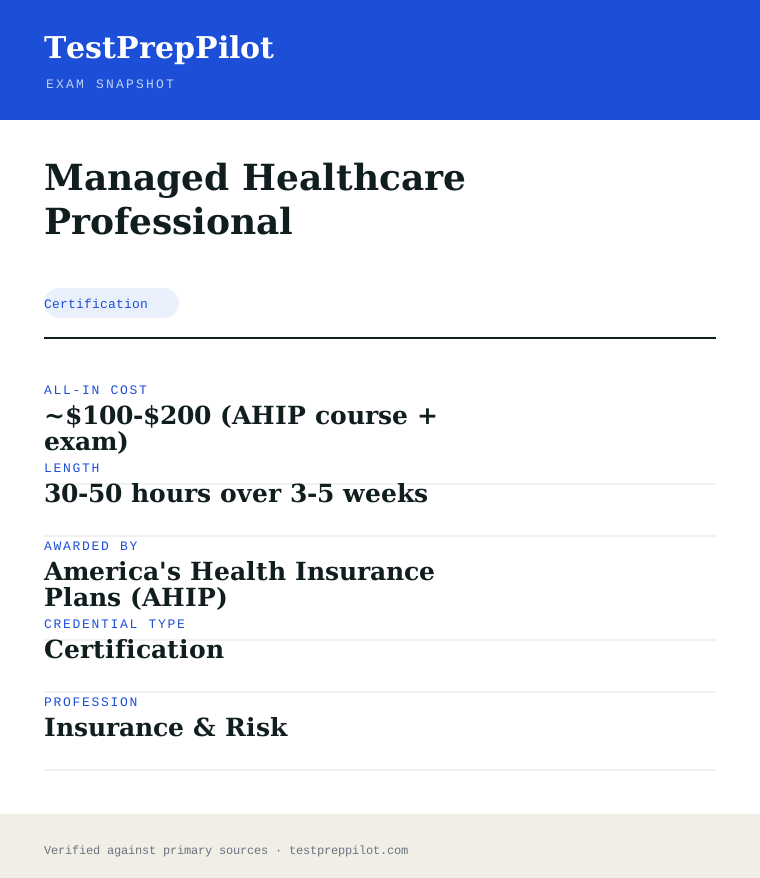
Managed Healthcare Professional is a certification credential; awarded by America's Health Insurance Plans (AHIP); the exam fee is ~$100-$200; typical preparation is 30-50 hours over 3-5 weeks; holders typically earn $35,000-$80,000 (41-3021 median $60,370).
| Credential | Managed Healthcare Professional |
|---|---|
| Abbreviation | MHP |
| Type | Certification |
| Profession | Insurance & Risk |
| Specialty | Life & Health Designations |
| Awarded by | America's Health Insurance Plans (AHIP) |
| Difficulty | Regulated |
| Typical prep time | 30-50 hours over 3-5 weeks |
| All-in cost | ~$100-$200 (AHIP course + exam) |
| Typical salary range | $35,000-$80,000 (41-3021 median $60,370) |
| Credential | Managed Healthcare Professional |
| Awarding body | America's Health Insurance Plans (AHIP) |
| Exam format | Proctored, computer-based |
| Validity | Valid 2 years (renewal with updates) |
| Languages | Varies — see awarding body |
| Scope | National / Multi-state |
Real questions
Frequently asked questions about the Managed Healthcare Professional
How do I register for the Managed Healthcare Professional exam?
Register through America's Health Insurance Plans (AHIP)'s official portal or an authorized test provider (e.g., Pearson VUE or Prometric where applicable). Create an account, select the exam, pay the fee, and schedule a date.
How much does the exam cost?
Fees vary by location and currency. Confirm the current fee on the official registration page before scheduling.
How long is the credential valid, and how do I renew?
Validity varies by credential (commonly 2–3 years). Renewal usually requires continuing education or a recertification exam — see America's Health Insurance Plans (AHIP)'s policy.
What if I do not pass?
Most bodies allow retakes after a waiting period and payment of the full or partial fee. Check America's Health Insurance Plans (AHIP)'s retake policy before rescheduling.
How do I register for a America's Health Insurance Plans (AHIP) credential?
Register through the official website, select your exam, pay the fee, and schedule a date.
How do I renew a credential?
Renewal policies vary by credential; check the specific program page for requirements and cycles.
In short
Is the Managed Healthcare Professional worth it?
- Managed Healthcare Professional is awarded by America's Health Insurance Plans (AHIP).
- Validates job-ready competence in Insurance & Risk.
- Registration is through the awarding body or an authorized test provider.
- Renewal and retake policies vary — confirm before scheduling.
Same awarding body
What other credentials does America's Health Insurance Plans (AHIP) award?
Worth comparing
How does the Managed Healthcare Professional compare with similar credentials?
Trust
Where does this information come from?
Everything above is taken from the awarding body's own published material. Fees, question counts and domain weights are revised regularly — check the official page before you pay.
Research confidence: low · Last reviewed 2026-08