Insurance & Risk • Certification
Associate in Insurance
Associate in Insurance — Insurance & Risk credential from The Institutes
Researched and maintained by TestPrepPilot Editorial BoardRisk management & insurance education desk · Figures last verified August 2026
The short version
What is the Associate in Insurance and is it worth it?
Associate in Insurance is a professional credential administered by The Institutes. It validates job-ready knowledge and skills in the Insurance & Risk field and is used for career entry, advancement, or compliance.
- Recognized credential from The Institutes
- Demonstrates verified competence in Insurance & Risk
- Supports career advancement and may satisfy licensing or employer requirements
What is it?
What exactly is the Associate in Insurance?
Associate in Insurance — Insurance & Risk credential from The Institutes
Foundational designation programme covering insurance principles, policy structure, coverages and operations across lines of business. Offered by The Institutes, it is designed for candidates who need to demonstrate verified competence in the Insurance & Risk field. The credential is commonly used for career entry, advancement, regulatory compliance, or employer requirements. Candidates should review the official handbook for eligibility, exam format, and scoring before registering.
The path in brief
- Confirm you meet any eligibility or prerequisites
- Review the official handbook and study materials
- Register and pay through the awarding body or authorized provider
- Schedule and take the exam (test center or online proctoring)
- Receive your score and, if passed, your credential
Before you book
Who is eligible to sit the Associate in Insurance?
Eligibility varies; many credentials are open to all, while others require coursework, work experience, or sponsorship.
Who it is for: Professionals and candidates seeking to validate Insurance & Risk competence.
The test itself
What is the format of the Associate in Insurance?
The Associate in Insurance is administered by The Institutes and runs 2 hours per exam.
| Administered by | The Institutes |
|---|---|
| Questions | ~100 questions per course exam |
| Time limit | 2 hours per exam |
| Pass mark | Passing score set by the awarding body; see the official score report |
| Exam fee | ~$300-$400 per course |
| Format | Proctored, computer-based (test center or online remote proctoring) |
Content outline
What topics are on the Associate in Insurance?
The Associate in Insurance covers 4 content domains.
Weightings come from the official exam outline. Study time is best allocated in roughly these proportions rather than evenly across domains.
- Products & coverage
Topic area tested on the exam; see the official blueprint for the detailed breakdown.
- Underwriting
Topic area tested on the exam; see the official blueprint for the detailed breakdown.
- Regulation & ethics
Topic area tested on the exam; see the official blueprint for the detailed breakdown.
- Claims & risk management
Topic area tested on the exam; see the official blueprint for the detailed breakdown.
The path
How do you register for the Associate in Insurance?
- 1
Visit the awarding body’s official website and create an account
- 2
Select the credential and review its specific requirements
- 3
Complete any required eligibility (education, experience, or training)
- 4
Pay the registration fee
- 5
Schedule the exam at a test center or online
- 6
Take the exam and receive your results
The fine print
What are the retake and renewal rules for the Associate in Insurance?
- Proctoring & delivery
- Proctored, computer-based delivery (test center or remote online proctoring), varying by exam.
- Retake policy
- Varies by credential — most bodies permit retakes after a waiting period and full or partial fee.
- Score reporting
- Scores are reported per the body’s timeline, typically electronically after the exam.
- Recertification
- Varies; many credentials require renewal every 2–3 years via continuing education or a recertification exam.
What it pays
How much does this credential pay?
$79,880 median for insurance underwriters (BLS, May 2024) — the AINS is the entry designation that moves new insurance staff onto a professional track
The direct answer is that the Associate in Insurance (AINS) designation has no BLS occupation of its own — it is an education credential — but the roles it serves sit inside insurance underwriting and its adjacent operations functions, and insurance underwriters (SOC 13-2053) earned a May 2024 median of $79,880, with the lowest 10 percent below $51,640 and the highest 10 percent above $138,020. AINS is explicitly an entry designation: The Institutes positions it for people new to risk management and insurance, including recent graduates and career changers, and it is the credential a service representative, claims handler or new underwriter earns to demonstrate they understand how insurers assess risk, price coverage and run their operations. The wage distribution matters because the designation’s value is professionalising a role that otherwise reads as clerical: BLS classifies the broader insurance operations workforce at lower wage levels than underwriters, and employers use credentials like AINS to distinguish staff who understand the business from staff who only process it. BLS counts about 127,000 insurance underwriter jobs in 2024, projects an 8,200-per-year opening flow driven entirely by replacement, and projects a 3 percent employment decline from 2024 to 2034 as automated underwriting software takes over routine decisions — which is precisely why the designation question matters: AINS signals the foundational understanding that lets a professional move toward the complex, judgment-heavy underwriting that automation does not displace, and toward the claims and customer-facing roles that still need people who can explain a policy. The credential is also unusually cheap to pursue, which is why its cost-benefit case is strong: three courses plus an ethics component, completed in three to six months, typically covered or reimbursed by employers.
| Measure | Figure | Source / note |
|---|---|---|
| Median annual wage, insurance underwriters | $79,880 | BLS OOH, SOC 13-2053, May 2024 ($38.40/hr) |
| Lowest 10 percent | less than $51,640 | BLS OOH Pay tab, May 2024 |
| Highest 10 percent | more than $138,020 | BLS OOH Pay tab, May 2024 |
| Employment, 2024 | 127,000 jobs | BLS OOH Quick Facts, 2024 |
| Projected annual openings | ~8,200 per year | BLS OOH Job Outlook, 2024-34 — all from replacement need |
Job growth.-3% projected change 2024-34 (decline), with ~8,200 replacement openings a year; automated underwriting is shrinking the routine work while complex and judgment-based roles remain
Source: BLS Occupational Outlook Handbook — Insurance Underwriters
Your odds
What are the pass rates?
The Institutes no longer publishes AINS pass rates — it publishes a 70% passing grade on a 50-question, 65-minute virtual exam
The Institutes no longer publicly publishes pass rates for its designation exams, including AINS, so there is no current official statistic to quote — the historically cited figures of roughly 72-80 percent pass rates for the AINS courses are now more than a decade old and refer to exam formats that have since been redesigned, so any current pass-rate percentage is an estimate rather than a published fact. What The Institutes does publish, clearly, is the exam mechanics and the passing standard. AINS exams are virtual, timed, and consist of 50 questions completed in 65 minutes; you must score 70 percent or higher to pass; and each course’s exam is taken inside a quarterly testing window — January 15 to March 15, April 15 to June 15, July 15 to September 15, and October 15 to December 15 — so you register for a window and sit at any time within it. The question types mix single-answer multiple choice, multi-answer multiple choice, fill-in-the-blank and drag-and-drop, and the exams are delivered online through The Institutes’ platform, with virtual proctoring now in place across the designation portfolio. The practical consequences of the missing pass-rate data are simple: the readiness signal is your own performance on the simulated exam The Institutes provides with each course — students who take it score higher on the real exam, per The Institutes’ own materials — and because you have up to four attempts per course per calendar year and one retake per testing window, a narrow fail is a scheduling problem rather than a career event. The Institutes also notes the average course runs 6-9 hours of study and the full designation three to six months, which frames the realistic commitment.
Read this before quoting the number.The Institutes no longer publishes pass-rate statistics for its exams. Published facts are the 70% passing grade, the 50-question / 65-minute virtual exam format, the four quarterly testing windows, and the four-attempts-per-year limit. Treat any pass-rate percentage as an unsourced estimate.
Source: The Institutes — Associate in Insurance designation page
Your schedule
How long should I study for it?
60-90 hours over 9-12 weeks (one course at a time) of focused study
Plan for 9 to 12 weeks overall and 60 to 90 hours of study to complete all three AINS courses plus the ethics component, working one course at a time — The Institutes’ own materials frame each course at roughly 6-9 hours of direct study, with the full designation completing in three to six months, and the realistic pattern for working professionals is one course every three to four weeks. The program structure is fixed: one core course (AINS 101, Risk Management Principles and Practices), one concentration course from AINS 102 (personal insurance) or AINS 103 (commercial insurance), one elective from the approved list, and the ethics course, with each course ending in a 50-question, 65-minute virtual exam at a 70 percent passing grade. Weeks 1-2 cover AINS 101, which establishes the foundation — risk management principles, the law of large numbers, how insurers assess risk and price coverage, and how policies are structured — and this is the course to finish first because the later courses assume it. Weeks 3-4 take the concentration course: choose AINS 102 or 103 based on whether your employer’s book of business is personal or commercial lines, because the concentration you choose also becomes the elective option that gives you the broadest view. Weeks 5-6 cover the second insurance course and the ethics component, which you can complete online with the same exam mechanics. Weeks 7-8 are the exam-cadence phase: for each course, run The Institutes’ simulated exam before the real one — students who do score higher, per The Institutes’ own materials — then sit the real exam inside your chosen testing window. The pacing rule for the exam itself is simple: 50 questions in 65 minutes is 1.3 minutes per question, and the multi-answer and drag-and-drop items take longest, so answer everything and flag the slow ones. Because the exams are tied to quarterly windows, the plan must be scheduled backward from the window you register for, and a course finished between windows simply waits for the next one.
- Weeks 1-210-12 hrs/week
AINS 101 core course
- Study risk management principles and the fundamentals of how insurers assess and price risk
- Read the course material once fully — AINS exams test details, not highlights
- Take the end-of-assignment quizzes and the course simulated exam
- Weeks 3-410-12 hrs/week
Concentration course (AINS 102 or 103)
- Choose personal (102) or commercial (103) based on your employer’s book of business
- Study the coverage types, policies and underwriting logic of your chosen line
- Run the simulated exam before the real one and drill the missed topics
- Weeks 5-68-10 hrs/week
Elective and ethics course
- Complete the elective course and the ETHICS 311 component
- Use the elective that also feeds other designations if you plan a CPCU or ARM path
- Take the simulated exams for both before sitting the real ones
- Weeks 7-86-8 hrs/week
Exam window execution
- Sit the course exams inside your registered quarterly testing window
- If you fail one, use the one-retake-per-window rule within the same window
- Keep the four-attempts-per-year limit in mind as the outer bound
Adjusting the pace
Employer-sponsored, one course per window.Spread the three courses across three testing windows over roughly nine months. Slower but realistic for staff whose employers tie reimbursement to a study budget.
Fast-track, no other commitments.Five to six weeks. Compress to two weeks per course, but never skip the simulated exam before the real one — it is the single most reliable readiness signal available.
Planned CPCU or ARM progression.Choose the electives that carry credit toward the next designation and keep every passing score report, because completed courses and passing exams transfer as credit toward related designations.
How to study
How do I prepare most effectively?
The strategy that reliably passes AINS course exams is “read the course once, fully, and test yourself with the simulated exam,” because AINS exams test details from the course rather than broad concepts, and the exam questions are developed directly from the educational objectives in the study materials. The single biggest error is skimming — candidates who skim the online course or rely on chapter summaries lose points on the specific, minute details that the 50-question exam draws from across the assignments. A second proven approach is to take the simulated exam The Institutes includes with each course before sitting the real one: The Institutes’ own materials state that students who take it score 6-9 points higher on the real AINS exams, and it is the closest available proxy for the exam’s structure and item style. Third, manage the exam format deliberately: the 65-minute clock over 50 questions is 1.3 minutes per question, and the multi-answer and drag-and-drop items consume the most time, so flag the slow items and return to them rather than letting a single item burn five minutes. Fourth, use the assignment quizzes as a diagnostic map — every miss points to an assignment to re-read, and the exam’s “Performance by Assignment” reporting on the grade report makes the same mapping explicit if you fail. Finally, treat the testing windows as the planning constraint: register early for the early-bird discount, sit inside the window you registered for, and know that you have one retake per window and four attempts per year, which makes a failed attempt a scheduling event rather than a setback.
Read the course fully, once, and take notes
AINS exams are developed from the course’s educational objectives and test minute details. Skimming or relying on summaries is the most common cause of failure; one full read with shorthand notes beats three highlight-only passes.
Take the simulated exam before the real one
The Institutes’ own materials report that students who take the included simulated exam score 6-9 points higher on the real exam. It is the closest available proxy for format and item style, and it tells you which assignments to re-read.
Use assignment quizzes as a diagnostic
Every quiz miss maps to an assignment to re-read. Keep the mapping explicit rather than re-reading the whole course, and on a failed exam, the grade report’s performance-by-assignment view gives you the same map.
Pace the 65-minute exam deliberately
50 questions in 65 minutes is 1.3 minutes per question. Multi-answer and drag-and-drop items take the longest; answer everything, flag the slow ones, and return only if time allows.
Plan around the testing windows
Exams run in four quarterly windows. Register before the window opens for the early-bird rate, sit inside the window you chose, and know the retake limits — one retake per window, four attempts per year.
Match electives to your career plan
The concentration and elective you choose should map to your employer’s book of business and to any next designation, because completed AINS courses carry credit toward related credentials like the CPCU and ARM.
What to buy
Which study resources are worth paying for?
AINS preparation is built around The Institutes’ own materials — the online course, printed course book, study outline, assignment quizzes, practice exams, simulated credentialing exam, flashcards and discussion boards are all bundled into the course package — and the buying rule is to buy the course, because the course is the exam content. Third-party prep products add practice questions and summaries, but they are supplements rather than replacements, because AINS exams are written from The Institutes’ course objectives and a candidate who skips the course to use a third-party guide is studying the wrong syllabus. The main costs are the course packages and the exam fees, with early-bird pricing for registering before the window opens.
| Resource | Price | Format | Best for |
|---|---|---|---|
| AINS course package (recommended or online-only) | Online course, printed or digital course book, study outline, quizzes, simulated exam, flashcards | The course IS the exam content — buy this as the primary resource | All candidates; the simulated exam alone is worth the package |
| AINS exam registration | Exam fee per course, with early-bird discount for registering before the window opens | 50-question, 65-minute virtual exam in a quarterly testing window | Each of the three course exams plus the ethics exam |
| Third-party AINS prep products (e.g. AssociatePI, prep sites) | ~$50-150 per course | Summaries, practice questions and videos | Supplemental drilling for candidates who have read the course once and want volume |
| The Institutes’ free AINS sample course | Free | 10-30 minute sample with real AINS 101 content | Deciding whether the designation and format fit before you buy |
| Self-built study guide from the course | Free | Your own shorthand notes per assignment | Retaining the minute details the exams test |
Prices checked 2026-08 in USD and vary by package and early-bird timing; The Institutes publishes current pricing on its course pages. We do not rank by commission.
Avoid these
What mistakes do candidates most often make?
The most common AINS mistakes are study-process errors rather than knowledge gaps: skimming the course instead of reading it fully, skipping the simulated exam, and letting a single slow item burn the 65-minute clock. The rest are planning errors — registering for a testing window without finishing the course, choosing the wrong concentration for the employer’s book of business, and ignoring the retake limits (one per window, four per year) until a failed attempt forces a schedule change.
✕Skimming the course instead of reading it fully
✓AINS exams are written from the course’s educational objectives and test minute details. Read every assignment once, take shorthand notes, and treat the end-of-assignment quizzes as the comprehension gate rather than a formality.
✕Skipping the simulated exam
✓The Institutes reports that students who take the included simulated exam score 6-9 points higher on the real exam. It is the single most reliable readiness signal available, and skipping it removes the only true-to-format rehearsal you get.
✕Letting one item eat the clock
✓50 questions in 65 minutes is 1.3 minutes per question. Multi-answer and drag-and-drop items run long; answer everything, flag the slow ones, and return only if time allows, because there is no penalty for guessing.
✕Choosing the wrong concentration course
✓Pick AINS 102 (personal) or AINS 103 (commercial) based on your employer’s actual book of business, and verify the elective carries credit toward any next designation you plan. The wrong choice costs study relevance, not just time.
✕Registering for a window before the course is finished
✓Exams are tied to quarterly windows. Schedule the course against the window end date, and if you finish late, register for the next window rather than sitting unprepared to hit a deadline.
✕Ignoring the retake and attempt limits
✓You have one retake per testing window and four total attempts per course per calendar year. Plan a failed attempt as a same-window retake after targeted re-reading, not as an open-ended re-study project.
What you'll face
What question types will I see?
Each AINS course exam is a timed, 50-question virtual exam completed in 65 minutes inside a quarterly testing window, with a 70 percent passing grade. The item mix, as described in The Institutes’ exam documentation, combines single-answer multiple choice (select the best answer), multi-answer multiple choice (select all correct answers), fill-in-the-blank, and drag-and-drop items, and the questions are developed directly from the course’s educational objectives, which is why studying the course itself is the syllabus. The exams are delivered online through The Institutes’ platform with virtual proctoring, and you register for a window and sit at any time within it. Because there is no penalty for guessing and the passing grade is 70 percent, the pacing rule is 1.3 minutes per question with the multi-answer and drag-and-drop items consuming the most time. The samples below are editor-written illustrations of the published item types and the content of a foundational insurance course; they are not live exam items.
A stem with four options and one best answer. These test both direct knowledge and application — the insurance principle or the correct next step in a described situation.
The stem specifies how many answers to select and scoring is all-or-nothing. Common where several conditions together define a correct answer, such as the elements of a complete insurance transaction.
You type a term or value into a blank rather than choosing from options. These reward knowing the exact terminology of the course.
You arrange items into a correct sequence or category, such as ordering the steps of a risk management process. These test process knowledge rather than recognition.
Try these
Q1Which of the following best describes the primary societal function of insurance?
Answer:C
Insurance exists to transfer the financial burden of potential losses from the insured to the insurer in exchange for a premium — the risk-transfer function is the defining purpose of insurance. A describes a business outcome, not the societal function, and profit is not the reason insurance exists. B is wrong because insurance does not eliminate risk, only its financial impact. D mistakes a complementary tool for a replacement of social programs. The item tests the conceptual foundation of the course rather than a technical detail.
Q2Under the principle of utmost good faith (uberrimae fidei), the parties to an insurance contract are expected to:
Answer:A
Utmost good faith requires both parties — particularly the applicant, who knows the risk best — to disclose all material facts that would influence the insurer’s decision to accept the risk and set the premium. B understates the duty: the applicant must volunteer material facts, not wait to be asked. C transfers a duty that rests on the applicant. D confuses the insurance relationship with an investment partnership. The item rewards knowing the doctrine’s content, a fixture of the foundational courses.
Q3An insurer must be able to predict losses accurately enough to set premiums that keep the company solvent while remaining competitive. Which principle makes this prediction possible?
Answer:B
The law of large numbers states that as the number of exposure units grows, actual loss experience converges on expected loss experience, which is what lets an insurer price risk accurately across a large pool. A (indemnity) limits recovery to the amount of the loss, and C (subrogation) lets an insurer pursue the party at fault — neither supports loss prediction. D governs disclosure, not prediction. The item tests the mathematical foundation of insurance, a core topic of the AINS 101 curriculum.
Samples are editor-written illustrations of the published item types and foundational insurance content; they are not live exam items.
The big day
What should I expect on exam day?
An AINS exam day is a virtual, 65-minute, 50-question session delivered through The Institutes’ platform inside the quarterly testing window you registered for — January 15 to March 15, April 15 to June 15, July 15 to September 15, or October 15 to December 15 — and you can sit at any time within the window, which is the exam’s great scheduling advantage. Because the exams are now virtually proctored across the designation portfolio, the practical preparation is technical: log into The Institutes’ site in the latest supported browser (Chrome, Edge or Firefox), confirm your webcam and microphone work, and set up a quiet, cleared space with a working connection, because the proctor records you and your screen. Before the exam, sign the attestation confirming you will abide by the ethical guidelines; the exam itself is not recorded for its entire length in the same way for every course, but the integrity terms apply throughout. Once the 65-minute clock starts, work the 50 questions at roughly 1.3 minutes each, flag the multi-answer and drag-and-drop items that run long, and answer everything — there is no penalty for guessing. The result is reported through the My Courses & Exams area of your account, and a passing score of 70 percent or higher records the course toward your designation, with grade reports available in your account showing performance by assignment if you need to interpret a near-miss. The one planning rule that governs the whole experience: the window, not the exam centre, is the appointment, so a course finished between windows simply waits for the next opening.
Bring
- Your The Institutes account credentials and the exam link in your My Courses & Exams area
- The latest version of Chrome, Edge or Firefox, with a working webcam and microphone
- A quiet, cleared workspace with a reliable internet connection
- The attestation readiness — you will confirm adherence to the exam’s ethical guidelines
Leave at home
- Notes and study materials — the exam is closed-book under the integrity terms
- Other people in the room — virtual proctoring records your environment
- Phones and other devices within reach of the workspace
- Open tabs and other applications — the proctor records your screen
- Anything you would not want on a recording of the session
How the day runs
Rules in the room
- 50 questions in 65 minutes, delivered virtually inside a quarterly testing window.
- 70% passing grade; the result is pass or fail in your account.
- Closed-book under the integrity terms, with virtual proctoring across the designation portfolio.
- Latest Chrome, Edge or Firefox required; webcam and microphone needed for proctoring.
- One retake per testing window, up to four total attempts per course per calendar year.
- No penalty for guessing — answer every item.
- You register for a window and may sit at any time within it.
Afterwards.Your result appears in the My Courses & Exams area of your account, and a passing grade of 70 percent or higher records that course toward your AINS designation — three courses plus the ethics component, typically completed in three to six months — with the certificate issued once all requirements are met. On a pass, keep the score report: AINS courses carry credit toward related designations such as the CPCU and ARM, and a record of completed courses smooths any later application. On a fail, the grade report’s performance-by-assignment view is the diagnostic tool — it maps exactly which course assignments the exam drew from and where you lost points, so the correct response is to re-read those assignments and sit the one-retake-per-window opportunity in the same testing window rather than deferring. Because the exam questions differ on each attempt and you are capped at four attempts per course per calendar year, treat a failed attempt as a scheduled, targeted re-study project with a hard deadline, not as an open-ended one. The designation itself is lifelong once earned, but the professional habit the exam enforces — reading the course once, fully, and testing against the simulated exam — is the skill that actually moves a career in underwriting and insurance operations forward.
Reference
What are the key facts about the Associate in Insurance?
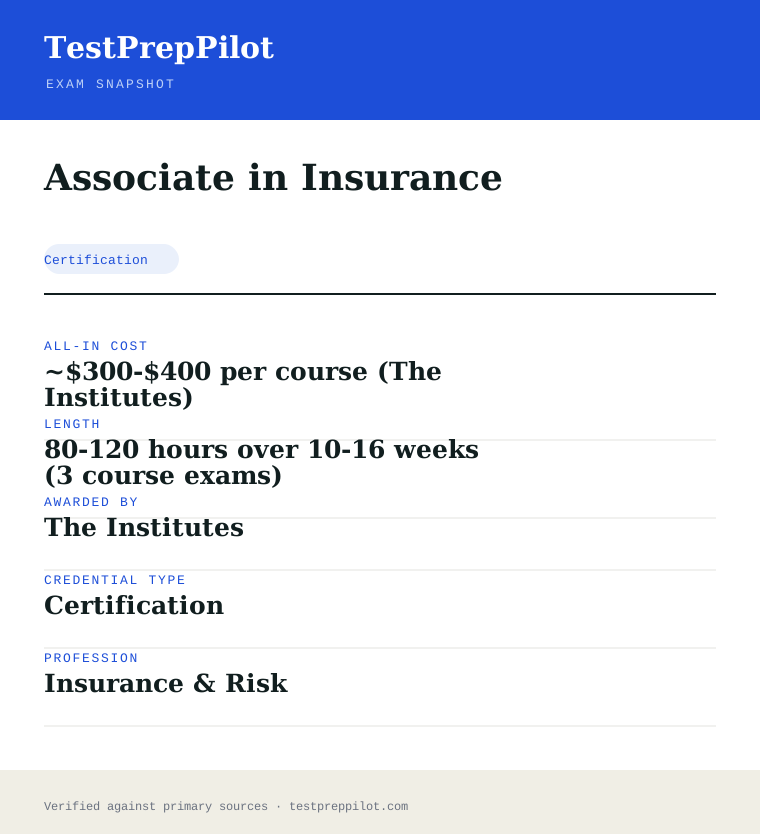
Associate in Insurance is a certification credential; awarded by The Institutes; the exam fee is ~$300-$400 per course; typical preparation is 80-120 hours over 10-16 weeks (3 course exams); holders typically earn $55,000-$95,000 (13-2053 median $77,860).
| Credential | Associate in Insurance |
|---|---|
| Abbreviation | AINS |
| Type | Certification |
| Profession | Insurance & Risk |
| Specialty | Insurance Designations |
| Awarded by | The Institutes |
| Difficulty | Regulated |
| Typical prep time | 80-120 hours over 10-16 weeks (3 course exams) |
| All-in cost | ~$300-$400 per course (The Institutes) |
| Typical salary range | $55,000-$95,000 (13-2053 median $77,860) |
| Credential | Associate in Insurance |
| Awarding body | The Institutes |
| Exam format | Proctored, computer-based |
| Validity | No expiration (The Institutes designation) |
| Languages | Varies — see awarding body |
| Scope | National / Multi-state |
Real questions
Frequently asked questions about the Associate in Insurance
How do I register for the Associate in Insurance exam?
Register through The Institutes's official portal or an authorized test provider (e.g., Pearson VUE or Prometric where applicable). Create an account, select the exam, pay the fee, and schedule a date.
How much does the exam cost?
Fees vary by location and currency. Confirm the current fee on the official registration page before scheduling.
How long is the credential valid, and how do I renew?
Validity varies by credential (commonly 2–3 years). Renewal usually requires continuing education or a recertification exam — see The Institutes's policy.
What if I do not pass?
Most bodies allow retakes after a waiting period and payment of the full or partial fee. Check The Institutes's retake policy before rescheduling.
How do I register for a The Institutes credential?
Register through the official website, select your exam, pay the fee, and schedule a date.
How do I renew a credential?
Renewal policies vary by credential; check the specific program page for requirements and cycles.
In short
Is the Associate in Insurance worth it?
- Associate in Insurance is awarded by The Institutes.
- Validates job-ready competence in Insurance & Risk.
- Registration is through the awarding body or an authorized test provider.
- Renewal and retake policies vary — confirm before scheduling.
Same awarding body
What other credentials does The Institutes award?
Trust
Where does this information come from?
Everything above is taken from the awarding body's own published material. Fees, question counts and domain weights are revised regularly — check the official page before you pay.
- The Institutes Awarding body
Research confidence: medium · Last reviewed 2026-08