Insurance & Risk • Certification
Certified Insurance Counselor
Certified Insurance Counselor — Insurance & Risk credential from Risk and Insurance Education Alliance
Researched and maintained by TestPrepPilot Editorial BoardInsurance industry credentialing desk · Figures last verified August 2026
The short version
What is the Certified Insurance Counselor and is it worth it?
Certified Insurance Counselor is a professional credential administered by Risk and Insurance Education Alliance. It validates job-ready knowledge and skills in the Insurance & Risk field and is used for career entry, advancement, or compliance.
- Recognized credential from Risk and Insurance Education Alliance
- Demonstrates verified competence in Insurance & Risk
- Supports career advancement and may satisfy licensing or employer requirements
What is it?
What exactly is the Certified Insurance Counselor?
Certified Insurance Counselor — Insurance & Risk credential from Risk and Insurance Education Alliance
Designation programme of five course exams across commercial casualty, commercial property, personal lines, life and agency management. Offered by Risk and Insurance Education Alliance, it is designed for candidates who need to demonstrate verified competence in the Insurance & Risk field. The credential is commonly used for career entry, advancement, regulatory compliance, or employer requirements. Candidates should review the official handbook for eligibility, exam format, and scoring before registering.
The path in brief
- Confirm you meet any eligibility or prerequisites
- Review the official handbook and study materials
- Register and pay through the awarding body or authorized provider
- Schedule and take the exam (test center or online proctoring)
- Receive your score and, if passed, your credential
Before you book
Who is eligible to sit the Certified Insurance Counselor?
Eligibility varies; many credentials are open to all, while others require coursework, work experience, or sponsorship.
Who it is for: Professionals and candidates seeking to validate Insurance & Risk competence.
The test itself
What is the format of the Certified Insurance Counselor?
The Certified Insurance Counselor is administered by Risk and Insurance Education Alliance and runs ~2 hours per exam.
| Administered by | Risk and Insurance Education Alliance |
|---|---|
| Questions | ~100 questions per institute |
| Time limit | ~2 hours per exam |
| Pass mark | Passing score set by the awarding body; see the official score report |
| Exam fee | $400-600 per institute |
| Format | Proctored, computer-based (test center or online remote proctoring) |
Content outline
What topics are on the Certified Insurance Counselor?
The Certified Insurance Counselor covers 4 content domains.
Weightings come from the official exam outline. Study time is best allocated in roughly these proportions rather than evenly across domains.
- Products & coverage
Topic area tested on the exam; see the official blueprint for the detailed breakdown.
- Underwriting
Topic area tested on the exam; see the official blueprint for the detailed breakdown.
- Regulation & ethics
Topic area tested on the exam; see the official blueprint for the detailed breakdown.
- Claims & risk management
Topic area tested on the exam; see the official blueprint for the detailed breakdown.
The path
How do you register for the Certified Insurance Counselor?
- 1
Visit the awarding body’s official website and create an account
- 2
Select the credential and review its specific requirements
- 3
Complete any required eligibility (education, experience, or training)
- 4
Pay the registration fee
- 5
Schedule the exam at a test center or online
- 6
Take the exam and receive your results
The fine print
What are the retake and renewal rules for the Certified Insurance Counselor?
- Proctoring & delivery
- Proctored, computer-based delivery (test center or remote online proctoring), varying by exam.
- Retake policy
- Varies by credential — most bodies permit retakes after a waiting period and full or partial fee.
- Score reporting
- Scores are reported per the body’s timeline, typically electronically after the exam.
- Recertification
- Varies; many credentials require renewal every 2–3 years via continuing education or a recertification exam.
What it pays
How much does this credential pay?
Expect insurance-sales and underwriting pay at a May 2024 median of $60,370 for sales agents (BLS) — the CIC is the agency-side designation, and holders typically advance into the higher-paying producer and agency-management tiers
The direct answer is that the Certified Insurance Counselor (CIC) designation is one of the most recognised credentials for insurance agents and agency professionals, and the occupations it serves — insurance sales agents (SOC 41-3021), at a May 2024 median annual wage of $60,370, and insurance underwriters (SOC 13-2053), at $77,860 — sit below what experienced CIC holders typically earn, because the designation is the documented pathway to senior producer, agency-principal, and commercial-lines leadership roles that sit at the top of those occupations. The honest framing is that BLS has no CIC-specific pay data, and industry surveys consistently associate the designation with higher earnings for producers, but the pay effect comes from the production and leadership roles it unlocks rather than from the credential itself. BLS counted about 306,000 insurance sales agents in 2024 and projects about 6 percent employment growth from 2024 to 2034. The designation itself is a substantial commitment: candidates complete five institutes — commercial casualty, commercial property, personal lines, life and health, and agency management — each a 2.5-day course ending with a closed-book exam, typically completed over two to three years while working. The practical read: the CIC is a career investment for working insurance professionals — most candidates are sponsored by their agencies, the cost runs several thousand dollars across the five institutes, and the payoff is the credential’s weight in agency careers and the production roles it positions holders for. For candidates deciding whether to pursue it, the designation makes the most sense for producers and agency staff committed to the commercial-lines side of the industry.
| Measure | Figure | Source / note |
|---|---|---|
| Median annual wage, insurance sales agents | $60,370 | BLS OEWS, May 2024 (SOC 41-3021) |
| Median annual wage, insurance underwriters | $77,860 | BLS OEWS, May 2024 (SOC 13-2053) |
| Projected growth, insurance sales agents, 2024-34 | +6% | BLS Employment Projections |
| The designation itself | Professional designation | 5 institutes over 2-3 years, typically employer-sponsored |
Job growth.BLS projects about 6% growth for insurance sales agents from 2024 to 2034, with roughly 27,000 annual openings.
Your odds
What are the pass rates?
The National Alliance publishes no pass rates — each CIC exam is a closed-book assessment at the end of a 2.5-day institute, and completion is tracked rather than reported as cohort data
The core fact is that The National Alliance for Insurance Education & Research does not publish pass rates for CIC exams, and none is available from an independent source, because the program reports designation completion rather than cohort pass percentages. What is published is the exam structure: each CIC institute is a 2.5-day course delivered by faculty, ending with a closed-book exam (typically 100 multiple-choice questions, about 2 hours) that must be passed to earn credit for the institute; the exam covers the institute’s material — commercial casualty, commercial property, personal lines, life and health, and agency management — and candidates who do not pass may retake the exam, usually at a later institute or through a make-up option. Because the exams are course-anchored and the institutes are taught by faculty who cover the exam material, the practical pass rate is high among candidates who attend and study the course materials; the classic failure mode is treating the institute as a seminar and skipping the evening study, then missing the application items. The designation requires passing all five institutes (plus an ethics course component in the current format), with the five completed over a two-to-three-year period. The honest advice is to treat each institute as a study project — attend the sessions, review the course materials in the evenings, and take the exam with the course-anchored content in mind — and to pace the designation across the institutes rather than compressing it.
Read this before quoting the number.No cohort pass rates are published; each institute ends with a closed-book exam.
Your schedule
How long should I study for it?
~15-20 hours per institute (course + study); 5 institutes over 2-3 years of focused study
Plan for each CIC institute as a 2.5-day course plus 3 to 5 hours of evening study per day during the institute, with the course materials as the authoritative source — the exam is taken at the end of each institute and covers its material. The five institutes are commercial casualty, commercial property, personal lines, life and health, and agency management, typically completed in that flexible order over two to three years while working. The most effective study rhythm per institute is: first, complete the assigned pre-reading the week before, since the course moves fast; second, attend every session and take structured notes on the coverage concepts and policy specifics; third, study the course manual in the evenings, underlining the key concepts and endorsements; and fourth, take the closed-book exam with the course-anchored content fresh. The highest-yield habits are the pre-reading (the institutes assume baseline familiarity) and the evening manual review, since the exam rewards the specifics the faculty cover. Budget the designation timeline around your work schedule — most candidates complete two to three institutes per year — and confirm employer sponsorship, which is common in the agency world. After passing all five institutes and the ethics component, the CIC designation is awarded, with continuing-education requirements for renewal.
- Before each institute4
Pre-reading
- Complete the assigned pre-reading
- Review the institute outline
- Confirm logistics
- Institute days (2.5 days)15
Course + exam
- Attend every session and take notes
- Study the manual each evening
- Take the closed-book exam
- Between institutes2
Designation pacing
- Plan the next institute date
- Confirm employer sponsorship
- Track progress toward all 5
Adjusting the pace
Ethics component.The current CIC format includes an ethics course element alongside the five institutes.
Related designations.The National Alliance also offers CRM (risk manager) and other credentials that pair with CIC.
How to study
How do I prepare most effectively?
The strategy that reliably passes each CIC institute exam is "do the pre-reading, study the manual each evening, and take the exam with the course content fresh," and the single biggest error is treating the institute as a seminar to sit through. A second proven approach is mastering the coverage specifics — the exam rewards knowing the exact policy forms, endorsements, and coverage concepts the faculty teach, so structured notes are high-yield. Third, attend every session rather than selecting topics, since the exam samples the whole institute. Fourth, use the evening hours for manual review and self-quizzing on the day’s content, which cements the material before the exam. Fifth, pace the designation as a two-to-three-year commitment: one institute per quarter while working is the sustainable rhythm, and cramming multiple institutes in a compressed window is a documented failure mode. Finally, confirm employer sponsorship early — agencies commonly fund CIC institutes, and the sponsorship culture is part of the designation’s practical value.
Do the pre-reading
The institutes assume baseline familiarity; pre-reading keeps pace.
Study the manual each evening
The exam rewards the specifics the faculty cover.
Attend every session
The exam samples the whole institute.
Pace the designation
Two to three institutes per year is the sustainable rhythm.
Confirm employer sponsorship
Agencies commonly fund CIC institutes; ask early.
What to buy
Which study resources are worth paying for?
Each CIC institute costs roughly $400 to $600 including the course and exam, with the full five-institute designation several thousand dollars — and employer sponsorship is common in the agency world. The comparison below separates the institute cost, the materials, and the designation path, with prices current to this review. The buying rule is to confirm sponsorship before paying, since agencies commonly fund the program.
| Resource | Price | Format | Best for |
|---|---|---|---|
| CIC institute (per institute) | ~$400-600 | 2.5-day course + closed-book exam | The required institute |
| Course manual | Included | Printed course materials | The exam source |
| Employer-sponsored enrollment | Often free | Sponsored program | Working agency professionals |
| Related designations (CRM etc.) | ~$400-600/institute | Similar format | Specialised risk credentials |
Prices approximate and dated to this review; the designation requires 5 institutes plus an ethics component.
Avoid these
What mistakes do candidates most often make?
The most common mistake is treating the institute as a seminar and skipping the evening study, which shows on the closed-book exam; the second is compressing multiple institutes into a short window and stalling the designation. A third recurring error is relying on field experience instead of the course-specific coverage concepts the exam tests. Candidates also routinely skip the pre-reading and struggle with the fast course pace, and many ignore the ethics component until the end, delaying the designation. Finally, some candidates fail to confirm employer sponsorship and pay out of pocket unnecessarily.
✕Seminar mentality
✓Study the manual each evening; the exam is closed-book.
✕Compressing the timeline
✓Pace two to three institutes per year.
✕Field experience over course content
✓The exam tests the course-specific coverage concepts.
✕Skipping the pre-reading
✓Complete the assigned reading before each institute.
✕Forgetting the ethics component
✓Include it in the designation plan from the start.
What you'll face
What question types will I see?
Each CIC institute exam is a closed-book, multiple-choice assessment (typically about 100 questions in 2 hours) covering the institute’s material, with a mix of coverage-concept, endorsement, and application items. The samples below are editor-written illustrations of the published institute content, not live exam items.
Policy forms, coverages, and endorsements.
Applying coverage knowledge to insured scenarios.
Identifying and managing client exposures.
Agency management, ethics, and client service.
Try these
Q1Which coverage in a commercial property policy responds to business income lost during a covered shutdown?
Answer:B
Business income coverage reimburses lost income during a covered property-caused shutdown.
Q2A client’s employee is injured on the job. Which policy responds?
Answer:B
Workers compensation covers workplace injuries under state law.
Q3Which duty of the agent is central to the agency’s legal relationship with the insured?
Answer:B
Agents owe duties of good faith and loyalty within the agency relationship.
Samples are editor-written illustrations of the published institute content, not live exam items.
The big day
What should I expect on exam day?
Each CIC institute ends with a closed-book exam, typically about 100 multiple-choice questions in 2 hours, administered at the institute site at the end of the 2.5-day course. The core rules: bring photo ID, attend the full institute, and take the exam with the course materials covered; the exam is closed-book. Results are typically available within a few weeks, and passing earns credit for that institute; candidates who do not pass may retake. The designation requires passing all five institutes plus the ethics component, and continuing education maintains it. The most useful exam-day habits: review the manual and your notes the morning of the exam, answer every question (no penalty for guessing), and on scenario items apply the course’s coverage concepts rather than field habit. After each pass, track your progress toward the five, plan the next institute, and confirm the continuing-education schedule for the designation’s maintenance.
Bring
- Photo ID
- Course manual and notes for review
- Attendance at the full institute
Leave at home
- Study materials during the closed-book exam
- Field-habit answers where the course differs
How the day runs
Rules in the room
- Closed-book exam per institute
- ~100 questions, ~2 hours
- 5 institutes + ethics required
- CEUs maintain the designation
Afterwards.Passing all five CIC institutes plus the ethics component earns the Certified Insurance Counselor designation, a leading agency-side credential maintained with continuing education.
Reference
What are the key facts about the Certified Insurance Counselor?
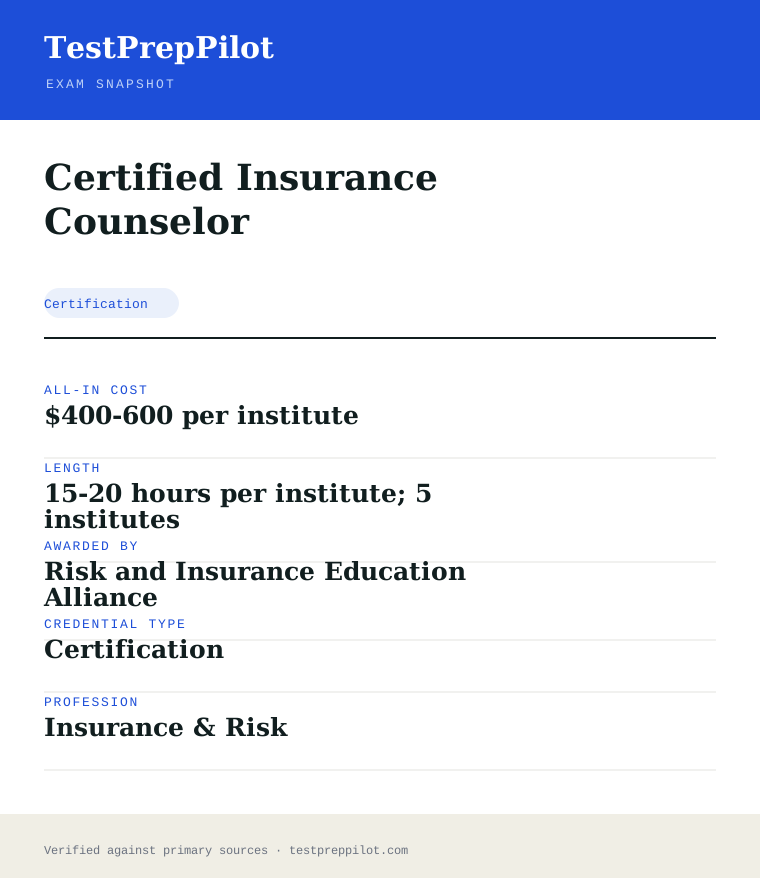
Certified Insurance Counselor is a certification credential; awarded by Risk and Insurance Education Alliance; the exam fee is $400-600 per institute; typical preparation is 15-20 hours per institute; 5 institutes; holders typically earn $60,370 median, insurance sales agents (BLS May 2024).
| Credential | Certified Insurance Counselor |
|---|---|
| Abbreviation | CIC |
| Type | Certification |
| Profession | Insurance & Risk |
| Specialty | Risk & Compliance |
| Awarded by | Risk and Insurance Education Alliance |
| Difficulty | Regulated |
| Typical prep time | 15-20 hours per institute; 5 institutes |
| All-in cost | $400-600 per institute |
| Typical salary range | $60,370 median, insurance sales agents (BLS May 2024) |
| Credential | Certified Insurance Counselor |
| Awarding body | Risk and Insurance Education Alliance |
| Exam format | Proctored, computer-based |
| Validity | Maintained with continuing education |
| Languages | Varies — see awarding body |
| Scope | National / Multi-state |
Real questions
Frequently asked questions about the Certified Insurance Counselor
How do I register for the Certified Insurance Counselor exam?
Register through Risk and Insurance Education Alliance's official portal or an authorized test provider (e.g., Pearson VUE or Prometric where applicable). Create an account, select the exam, pay the fee, and schedule a date.
How much does the exam cost?
Fees vary by location and currency. Confirm the current fee on the official registration page before scheduling.
How long is the credential valid, and how do I renew?
Validity varies by credential (commonly 2–3 years). Renewal usually requires continuing education or a recertification exam — see Risk and Insurance Education Alliance's policy.
What if I do not pass?
Most bodies allow retakes after a waiting period and payment of the full or partial fee. Check Risk and Insurance Education Alliance's retake policy before rescheduling.
How do I register for a Risk and Insurance Education Alliance credential?
Register through the official website, select your exam, pay the fee, and schedule a date.
How do I renew a credential?
Renewal policies vary by credential; check the specific program page for requirements and cycles.
In short
Is the Certified Insurance Counselor worth it?
- Certified Insurance Counselor is awarded by Risk and Insurance Education Alliance.
- Validates job-ready competence in Insurance & Risk.
- Registration is through the awarding body or an authorized test provider.
- Renewal and retake policies vary — confirm before scheduling.
Same awarding body
What other credentials does Risk and Insurance Education Alliance award?
Worth comparing
How does the Certified Insurance Counselor compare with similar credentials?
Trust
Where does this information come from?
Everything above is taken from the awarding body's own published material. Fees, question counts and domain weights are revised regularly — check the official page before you pay.
- Risk and Insurance Education Alliance Awarding body
Research confidence: low · Last reviewed 2026-08