Insurance & Risk • Certification
Certified Insurance Service Representative
Certified Insurance Service Representative — Insurance & Risk credential from Risk and Insurance Education Alliance
Researched and maintained by TestPrepPilot Editorial BoardInsurance & risk-management education desk · Figures last verified August 2026
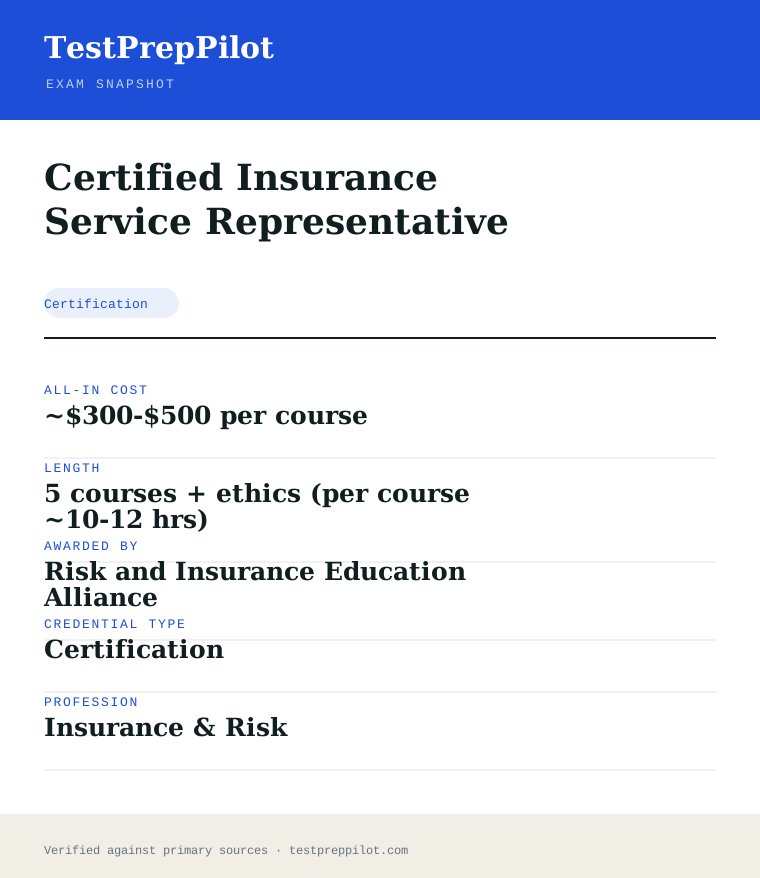
The short version
What is the Certified Insurance Service Representative and is it worth it?
Certified Insurance Service Representative is a professional credential administered by Risk and Insurance Education Alliance. It validates job-ready knowledge and skills in the Insurance & Risk field and is used for career entry, advancement, or compliance.
- Recognized credential from Risk and Insurance Education Alliance
- Demonstrates verified competence in Insurance & Risk
- Supports career advancement and may satisfy licensing or employer requirements
What is it?
What exactly is the Certified Insurance Service Representative?
Certified Insurance Service Representative — Insurance & Risk credential from Risk and Insurance Education Alliance
Designation programme of five course exams drawn from nine service topics covering coverage analysis and account management. Offered by Risk and Insurance Education Alliance, it is designed for candidates who need to demonstrate verified competence in the Insurance & Risk field. The credential is commonly used for career entry, advancement, regulatory compliance, or employer requirements. Candidates should review the official handbook for eligibility, exam format, and scoring before registering.
The path in brief
- Confirm you meet any eligibility or prerequisites
- Review the official handbook and study materials
- Register and pay through the awarding body or authorized provider
- Schedule and take the exam (test center or online proctoring)
- Receive your score and, if passed, your credential
Before you book
Who is eligible to sit the Certified Insurance Service Representative?
None
Who it is for: Professionals and candidates seeking to validate Insurance & Risk competence.
The test itself
What is the format of the Certified Insurance Service Representative?
The Certified Insurance Service Representative is administered by Risk and Insurance Education Alliance and runs ~1 hour per course and contains 50 per course (70% passing) questions.
| Administered by | Risk and Insurance Education Alliance |
|---|---|
| Questions | 50 per course (70% passing) |
| Time limit | ~1 hour per course |
| Pass mark | Passing score set by the awarding body; see the official score report |
| Exam fee | ~$300-$500 per course |
| Format | Proctored, computer-based (test center or online remote proctoring) |
Content outline
What topics are on the Certified Insurance Service Representative?
The Certified Insurance Service Representative covers 4 content domains.
Weightings come from the official exam outline. Study time is best allocated in roughly these proportions rather than evenly across domains.
- Products & coverage
Topic area tested on the exam; see the official blueprint for the detailed breakdown.
- Underwriting
Topic area tested on the exam; see the official blueprint for the detailed breakdown.
- Regulation & ethics
Topic area tested on the exam; see the official blueprint for the detailed breakdown.
- Claims & risk management
Topic area tested on the exam; see the official blueprint for the detailed breakdown.
The path
How do you register for the Certified Insurance Service Representative?
- 1
Visit the awarding body’s official website and create an account
- 2
Select the credential and review its specific requirements
- 3
Complete any required eligibility (education, experience, or training)
- 4
Pay the registration fee
- 5
Schedule the exam at a test center or online
- 6
Take the exam and receive your results
The fine print
What are the retake and renewal rules for the Certified Insurance Service Representative?
- Proctoring & delivery
- Proctored, computer-based delivery (test center or remote online proctoring), varying by exam.
- Retake policy
- Varies by credential — most bodies permit retakes after a waiting period and full or partial fee.
- Score reporting
- Scores are reported per the body’s timeline, typically electronically after the exam.
- Recertification
- Varies; many credentials require renewal every 2–3 years via continuing education or a recertification exam.
What it pays
How much does this credential pay?
CISR is the agency-staff standard: insurance sales agents earned a $60,370 median in May 2024 (BLS)
The Certified Insurance Service Representative (CISR) designation, offered by The Institutes, is the leading education program for insurance agency and company staff - customer service representatives, account managers and support professionals in property-casualty insurance. It is a designation rather than a job license, so no single BLS SOC code attaches to it; the salary story belongs to the insurance occupations it serves. BLS reported that insurance sales agents (SOC 41-3021) earned a median of $60,370 in May 2024, and insurance underwriters (13-2053) about $77,860 (OEWS May 2024); agency service and account-management roles span these ranges, with pay varying by agency size, book of business and market. The structural point is that the CISR is the standard education credential for agency staff - the program’s five courses cover personal and commercial lines, agency operations and ethics - and many agencies embed it in hiring and promotion criteria, with some offering pay bumps or bonuses for completion; it is also a common stepping stone toward the CPCU designation for career advancement. BLS classifies workers by occupation, not designations, so no certificate maps to a specific wage; the value is the professional standard in an industry where education credentials are recognized in hiring and advancement. The CISR consists of five courses (each a one-day seminar plus a 50-question exam at 70 percent passing) completed within five years, plus an ethics course for the full designation.
| Measure | Figure | Source / note |
|---|---|---|
| Insurance sales agents median, May 2024 | $60,370 | BLS OEWS, SOC 41-3021 |
| Insurance underwriters median, May 2024 | ~$77,860 | BLS OEWS, SOC 13-2053 |
| All-occupation median, May 2024 | $49,500 | BLS OEWS |
| CISR structure | 5 courses + ethics within 5 years | The Institutes |
Job growth.Insurance-sales employment is projected to grow about 5 percent from 2024 to 2034; agency education credentials remain a recognized differentiator.
Source: BLS Occupational Outlook Handbook - Insurance Sales Agents
Your odds
What are the pass rates?
Each CISR course exam requires 70 percent (35 of 50); The Institutes publishes no pass rates
The Institutes does not publish pass rates for the CISR designation, but the assessment mechanics are public. The CISR consists of five courses, each delivered as a one-day seminar (in person or live online) followed by an exam of 50 multiple-choice questions; the passing score is 70 percent, meaning at least 35 of 50 correct. Candidates who do not pass an exam may retake it (a retake fee applies after the first attempt in most formats; verify the current policy), and the exam is based on the course workbook, which candidates receive with the course. The five courses cover: personal residential property, personal automobile, commercial casualty, commercial property, and agency operations (with an ethics course required for the full designation in addition to the five). Candidates must complete the five courses and the ethics component within five years to earn the designation; each course can be taken in any order, and the designation remains in effect as long as the completion requirements are met (continuing education for renewal varies by state, and some states recognize CISR courses for their own CE credit). Because the exam is drawn from the course workbook and the courses are one-day seminars, the realistic pass picture is strong for candidates who attend and study the workbook; the 70 percent bar is the number that matters, and the workbook is the complete study source.
Read this before quoting the number.The Institutes publishes no pass rates; each course exam requires 70% (35/50), with 5 courses plus ethics completed within 5 years.
Source: The Institutes - CISR program
Your schedule
How long should I study for it?
~10-12 hours per course (reading + seminar + review + exam); 5 courses over 1-3 years of focused study
The CISR is a course-based designation, and a study plan runs alongside the course schedule: each course is a one-day seminar with a 50-question exam, and the full designation is five courses plus ethics within five years. A realistic per-course plan: before the seminar, read the course workbook chapter by chapter (3-5 hours), because the seminar moves fast and the workbook is the exam source; during the seminar, attend fully and take notes on the instructor’s emphasis, which flags the high-yield content; after the seminar, review the workbook’s key concepts and take the exam (2-4 hours of review). The five courses cover: personal residential property (homeowners coverage), personal automobile (auto policies and coverages), commercial casualty (general liability, workers comp, commercial auto), commercial property (commercial property forms and coverages), and agency operations (agency workflow, errors and omissions, ethics). Candidates typically take one course per quarter or per renewal cycle, spreading the designation over one to three years; the five-year completion window is generous. The ethics course is a separate requirement for the full designation. The dominant resources are the course workbook (included) and the instructor-led seminar; third-party study materials are unnecessary because the exam is drawn from the workbook.
- Before the seminar4
Workbook reading
- Read the course workbook chapter by chapter
- Seminar day8
Instructor-led course
- Attend the one-day seminar
- Note the instructor’s high-yield emphasis
- After the seminar3
Review and exam
- Review the workbook key concepts
- Take the 50-question exam (70%)
Adjusting the pace
Order flexibility.The five courses can be taken in any order; many agencies schedule them in a recommended sequence.
Ethics requirement.The full CISR designation requires the ethics course in addition to the five courses.
How to study
How do I prepare most effectively?
The most effective CISR strategies are workbook-driven. Strategy one: read the course workbook before the seminar, because the seminar moves fast and the workbook is the exam source; candidates who arrive having read the chapters retain the instructor’s emphasis far better than those seeing the material for the first time. Strategy two: take notes on the instructor’s emphasis during the seminar, because the instructor flags the high-yield content and the exam rewards that emphasis. Strategy three: learn the coverage distinctions that the exams most test - personal auto vs commercial auto, the homeowners forms, the commercial property forms, general liability basics - because the courses test applied coverage knowledge, not just definitions. Strategy four: review the workbook’s key concepts after the seminar and take the exam promptly, because the material is fresh and the 70 percent bar is achievable with a focused review. Strategy five: use the exam retake option strategically - a first attempt is a real data point, and a targeted review of the failed areas beats a rushed retake. Strategy six: plan the five-course sequence with the five-year window in mind - one course per quarter spreads the work and keeps the material applicable to the job, which is the point of the designation.
Read the workbook first
The seminar moves fast; arrive having read the chapters.
Note the instructor’s emphasis
The instructor flags the high-yield content.
Learn the coverage distinctions
The exams test applied coverage knowledge.
Take the exam promptly
Fresh material and a focused review clear the 70% bar.
What to buy
Which study resources are worth paying for?
The CISR resource market is organized around The Institutes, the official provider. Each course includes the workbook and the one-day seminar, with the exam included in the course registration; the per-course cost is roughly $300-$500 (seminar plus materials; verify current pricing), with the ethics course similarly priced. The Institutes offers the courses in-person and live-online, and many agencies pay for staff education as a professional-development benefit, so candidates should ask their employer before paying. The workbook is the complete study source, and no third-party materials are needed; free resources are limited to the program description and course outlines on The Institutes website. State continuing-education credit varies by state, and some states recognize CISR courses toward their CE requirements, which adds value for licensed staff. The honest ranking: the official course and workbook (the required purchase), employer reimbursement if available, and nothing else. Prices here are current as of 2025-26 and vary by delivery format.
| Resource | Price | Format | Best for |
|---|---|---|---|
| CISR course (seminar + workbook + exam) | $300-$500 per course | In-person/live online | The required path to each course exam |
| Ethics course | ~$300-$400 | In-person/live online | The designation requirement |
| Employer sponsorship | Often available | Workplace benefit | Reducing out-of-pocket cost |
| Third-party materials | Unnecessary | Print/online | The workbook is the complete source |
Prices dated 2025-26 and vary by format; verify current fees on The Institutes site. No commission-based ranking.
Avoid these
What mistakes do candidates most often make?
The most common CISR mistakes come from treating the courses as attendance events. Mistake one: skipping the pre-seminar reading; the seminar moves fast, and candidates who see the workbook for the first time in class retain less and struggle on the exam. Mistake two: not taking the exam promptly after the seminar; the material fades, and a delayed exam means re-reviewing from scratch. Mistake three: studying definitions instead of coverage applications; the exams test applied coverage knowledge (which form covers what, in which situation), and candidates who memorize without applying miss the scenario items. Mistake four: ignoring the five-year completion window; candidates who start the designation and let years pass without finishing lose the investment and may need to re-take courses under the current editions. Mistake five: skipping the ethics course and assuming the five courses are the whole designation; the ethics requirement is part of earning the CISR. Mistake six: paying out of pocket without checking employer sponsorship; many agencies fund CISR education, and asking first is the obvious step.
✕Skipping the pre-reading
✓Read the workbook before the seminar.
✕Delaying the exam
✓Take it promptly while the material is fresh.
✕Definitions without application
✓Learn which coverage applies in which situation.
✕Losing the five-year window
✓Complete the 5 courses plus ethics within 5 years.
✕Forgetting the ethics course
✓It is part of earning the designation.
What you'll face
What question types will I see?
Each CISR course exam is 50 multiple-choice questions with a passing score of 70 percent (35 of 50), based on the course workbook. The five courses cover personal residential property (homeowners coverages), personal automobile (auto policy and coverages), commercial casualty (general liability, commercial auto, workers compensation), commercial property (commercial property forms), and agency operations (workflow, E&O, ethics). Most items are coverage-application scenarios. Samples below are editor-written illustrations of the published course content, not live exam items.
Homeowners and personal auto coverages.
General liability, commercial auto, property forms.
Workflow, errors and omissions, ethics.
Try these
Q1A homeowner’s policy covers the dwelling for fire damage. Which coverage section also applies to detached structures such as a shed?
Answer:A
Other Structures (Coverage B) covers detached structures like sheds and garages; Personal Property covers contents, Loss of Use covers extra living costs, and Medical Payments covers guest injuries.
Q2A commercial auto policy is being reviewed for a business whose employees drive their own cars for work. Which coverage addresses this exposure?
Answer:A
Hired and Non-Owned Auto (HNOA) coverage addresses liability for vehicles the business hires or that employees drive on company business; the other coverages address different exposures.
Q3An agency must handle a customer complaint about a coverage dispute. Which agency-operations concept is most directly relevant?
Answer:A
Handling complaints and coverage disputes is part of errors-and-omissions exposure management for agencies; the other options concern different operational areas.
Samples are editor-written illustrations of the published course content, not live exam items.
The big day
What should I expect on exam day?
Each CISR course exam is delivered at the end of the one-day seminar - in person for classroom delivery or proctored online for live-online delivery. Candidates receive the exam at the course site or through the online proctoring platform; the exam is 50 multiple-choice questions with a 70 percent passing line (35 of 50), and the time allowance is set by the course format (typically about an hour). Candidates who do not pass may retake (a retake fee applies after the first attempt in most formats; verify the current policy). Results are typically available shortly after, and the course completion is recorded with The Institutes. Candidates complete five courses plus the ethics course within five years to earn the designation; each course counts toward the designation as completed. Afterwards, track the completion record, ask the employer about reimbursement and any pay-scale recognition, and plan the next course in the sequence.
Bring
- Course registration confirmation
- Photo ID
- The course workbook for study
- Online: verified system and quiet room
Leave at home
- Notes during the proctored exam (verify the policy)
- Phone and personal electronics
- An assumption that attendance alone earns the course
How the day runs
Rules in the room
- Each course requires passing the 50-question exam at 70%.
- The designation requires 5 courses plus ethics within 5 years.
- Retakes are available (fees apply after the first attempt).
- Employer sponsorship is commonly available.
Afterwards.Track the completion record, ask about employer reimbursement and pay recognition, and plan the next course in the five-course sequence.
Reference
What are the key facts about the Certified Insurance Service Representative?
Certified Insurance Service Representative is a certification credential; awarded by Risk and Insurance Education Alliance; the exam fee is ~$300-$500 per course; typical preparation is 5 courses + ethics (per course ~10-12 hrs); holders typically earn $40,000-$80,000 (agency service and account roles).
| Credential | Certified Insurance Service Representative |
|---|---|
| Abbreviation | CISR |
| Type | Certification |
| Profession | Insurance & Risk |
| Specialty | Risk & Compliance |
| Awarded by | Risk and Insurance Education Alliance |
| Difficulty | Regulated |
| Typical prep time | 5 courses + ethics (per course ~10-12 hrs) |
| All-in cost | ~$300-$500 per course |
| Typical salary range | $40,000-$80,000 (agency service and account roles) |
| Credential | Certified Insurance Service Representative |
| Awarding body | Risk and Insurance Education Alliance |
| Exam format | Proctored, computer-based |
| Validity | Varies by credential (commonly 2–3 years) |
| Languages | Varies — see awarding body |
| Scope | National / Multi-state |
Real questions
Frequently asked questions about the Certified Insurance Service Representative
How do I register for the Certified Insurance Service Representative exam?
Register through Risk and Insurance Education Alliance's official portal or an authorized test provider (e.g., Pearson VUE or Prometric where applicable). Create an account, select the exam, pay the fee, and schedule a date.
How much does the exam cost?
Fees vary by location and currency. Confirm the current fee on the official registration page before scheduling.
How long is the credential valid, and how do I renew?
The CISR designation requires five one-day courses (each with a 50-question exam at 70%) plus the ethics course, completed within five years.
What if I do not pass?
Most bodies allow retakes after a waiting period and payment of the full or partial fee. Check Risk and Insurance Education Alliance's retake policy before rescheduling.
How do I register for a Risk and Insurance Education Alliance credential?
Register through the official website, select your exam, pay the fee, and schedule a date.
How do I renew a credential?
Renewal policies vary by credential; check the specific program page for requirements and cycles.
In short
Is the Certified Insurance Service Representative worth it?
- Certified Insurance Service Representative is awarded by Risk and Insurance Education Alliance.
- Validates job-ready competence in Insurance & Risk.
- Registration is through the awarding body or an authorized test provider.
- Renewal and retake policies vary — confirm before scheduling.
Same awarding body
What other credentials does Risk and Insurance Education Alliance award?
Worth comparing
How does the Certified Insurance Service Representative compare with similar credentials?
Trust
Where does this information come from?
Everything above is taken from the awarding body's own published material. Fees, question counts and domain weights are revised regularly — check the official page before you pay.
Research confidence: low · Last reviewed 2026-08