Trades, Construction & Engineering • Certification
NCCER Concrete Finisher
NCCER Concrete Finisher — Trades & Construction credential from NCCER
Researched and maintained by TestPrepPilot Editorial BoardTrades & skilled-licensure desk · Figures last verified August 2026
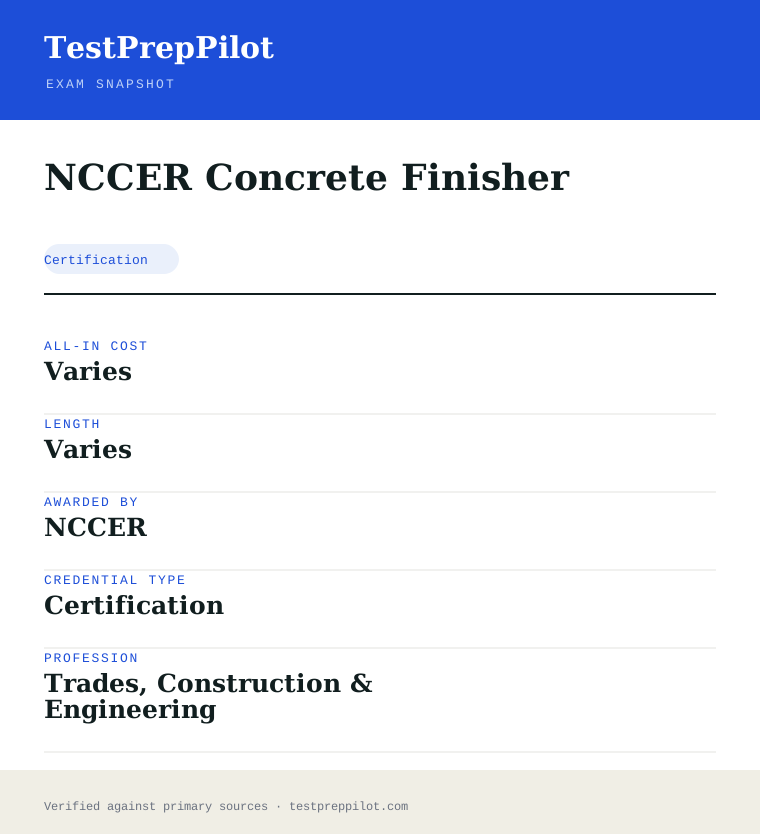
The short version
What is the NCCER Concrete Finisher and is it worth it?
NCCER Concrete Finisher is a professional credential administered by NCCER. It validates job-ready knowledge and skills in the Trades & Construction field and is used for career entry, advancement, or compliance.
- Recognized credential from NCCER
- Demonstrates verified competence in Trades & Construction
- Supports career advancement and may satisfy licensing or employer requirements
What is it?
What exactly is the NCCER Concrete Finisher?
NCCER Concrete Finisher — Trades & Construction credential from NCCER
Craft training in placing, finishing, jointing and curing concrete flatwork and structures. Offered by NCCER, it is designed for candidates who need to demonstrate verified competence in the Trades & Construction field. The credential is commonly used for career entry, advancement, regulatory compliance, or employer requirements. Candidates should review the official handbook for eligibility, exam format, and scoring before registering.
The path in brief
- Confirm you meet any eligibility or prerequisites
- Review the official handbook and study materials
- Register and pay through the awarding body or authorized provider
- Schedule and take the exam (test center or online proctoring)
- Receive your score and, if passed, your credential
Before you book
Who is eligible to sit the NCCER Concrete Finisher?
Eligibility varies; many credentials are open to all, while others require coursework, work experience, or sponsorship.
Who it is for: Professionals and candidates seeking to validate Trades & Construction competence.
The test itself
What is the format of the NCCER Concrete Finisher?
The NCCER Concrete Finisher is administered by NCCER and runs 2 hours (written assessment), contains 100 items (written assessment) plus hands-on performance verification questions and requires 70% minimum passing score (written assessment) to pass.
| Administered by | NCCER |
|---|---|
| Questions | 100 items (written assessment) plus hands-on performance verification |
| Time limit | 2 hours (written assessment) |
| Pass mark | 70% minimum passing score (written assessment) |
| Exam fee | Assessment-center fee varies by center — confirm with your program; trainee guide ~$60-100 |
| Format | Proctored written assessment (closed book) plus hands-on performance verification |
Content outline
What topics are on the NCCER Concrete Finisher?
The NCCER Concrete Finisher covers 4 content domains.
Weightings come from the official exam outline. Study time is best allocated in roughly these proportions rather than evenly across domains.
- Trade fundamentals
Topic area tested on the exam; see the official blueprint for the detailed breakdown.
- Tools & materials
Topic area tested on the exam; see the official blueprint for the detailed breakdown.
- Codes & safety
Topic area tested on the exam; see the official blueprint for the detailed breakdown.
- Hands-on procedures
Topic area tested on the exam; see the official blueprint for the detailed breakdown.
The path
How do you register for the NCCER Concrete Finisher?
- 1
Visit the awarding body’s official website and create an account
- 2
Select the credential and review its specific requirements
- 3
Complete any required eligibility (education, experience, or training)
- 4
Pay the registration fee
- 5
Schedule the exam at a test center or online
- 6
Take the exam and receive your results
The fine print
What are the retake and renewal rules for the NCCER Concrete Finisher?
- Proctoring & delivery
- Proctored, computer-based delivery (test center or remote online proctoring), varying by exam.
- Retake policy
- Varies by credential — most bodies permit retakes after a waiting period and full or partial fee.
- Score reporting
- Scores are reported per the body’s timeline, typically electronically after the exam.
- Recertification
- Varies; many credentials require renewal every 2–3 years via continuing education or a recertification exam.
What it pays
How much does this credential pay?
$54,660 median for cement masons and concrete finishers (BLS, May 2024)
The NCCER Concrete Finisher credential is the training-and-verification backbone for the concrete finishing workforce, so the directly relevant occupation is Cement Masons and Concrete Finishers, SOC 47-2051. That occupation had a May 2024 median annual wage of $54,660, with the lowest 10 percent earning about $38,290 and the highest 10 percent about $87,620 per the BLS OEWS distribution, and the credential itself does not appear in wage data because the BLS classifies by job duty rather than by certificate. The distribution deserves careful reading because concrete finishing pay is strongly shaped by geography, project type and specialization: finishers working on large commercial and industrial flatwork, including the industrial and superflat floor work the NCCER curriculum teaches, sit toward the top of the range, while residential flatwork and smaller pours sit near or below the occupation median depending on the region and the employer, and weather and seasonal construction cycles affect hours and annual earnings. BLS counted about 206,700 cement masons and concrete finishers in 2024 and projects 2 percent employment growth from 2024 to 2034, slower than the average for all occupations, with roughly 14,300 openings a year, most from replacement demand as workers retire or leave the trade, so the job market is steady rather than booming and the path to the median runs through the hands-on skill and the job-site reputation a finisher builds. The practical reading for an NCCER candidate is that the credential is a verification ladder within that steady market: NCCER’s Concrete Finishing curriculum and the journey-level assessment document the structured training and the passing written test, and pairing the credential with actual finishing hours and employer requirements is how you move from helper pay toward the median and beyond. Two honest caveats anchor the picture: the BLS median is national and blends residential and commercial work, so actual pay follows the local market and the project mix, and the NCCER credential is the education-and-verification leg, not a state license, so state or employer requirements beyond it vary.
| Measure | Figure | Source / note |
|---|---|---|
| Median annual wage, cement masons and concrete finishers | $54,660 | BLS OOH masonry workers page / OEWS, SOC 47-2051, May 2024 |
| Lowest 10 percent | ~$38,290 | BLS OEWS 10th percentile, May 2024 |
| Highest 10 percent | ~$87,620 | BLS OEWS 90th percentile, May 2024 |
| Employment, 2024 | ~206,700 jobs | BLS Employment Projections, 2024 |
| Projected annual openings | ~14,300 per year | BLS projections, 2024-34, mostly replacement demand |
Job growth.+2% projected change 2024-34 (slower than average), ~14,300 openings a year, mostly replacement demand. Industrial and commercial flatwork finishers sit toward the top of the pay range; residential work sits near or below the median.
Source: BLS Occupational Outlook Handbook - Masonry Workers (cement masons and concrete finishers)
Your odds
What are the pass rates?
NCCER publishes no pass rate — the Concrete Finisher written assessment is set to a 70% threshold by convention
NCCER does not publish a pass-rate statistic for the Concrete Finisher credential, and there is no single national passing score to report: NCCER sets the assessment framework while the training program, community college, apprenticeship sponsor or assessment center delivers the curriculum and administers the tests. The verifiable facts come from the official NCCER Concrete Finisher assessment specification sheet: the written assessment is a two-hour closed-book examination of 100 items, a basic-function non-printing calculator is permitted, no extra papers, books or study materials are allowed, and the minimum passing score is 70, with a corresponding hands-on performance verification available as the second half of the credential. Because the credential is referenced to NCCER’s first edition Concrete Finishing curriculum, the content is defined by the module list on the specification sheet: introduction to concrete construction and finishing, safety requirements, properties of concrete, tools and equipment, preparing for placement, placing concrete, finishing, curing and protecting, troubleshooting, estimating, forming, site concrete, industrial and superflat floors, surface treatments, quality control, repairs and paving, with each module carrying a stated number of test items that sum to the 100-item assessment. The performance verification is the hands-on half: an evaluator verifies the finisher’s execution of concrete placement and finishing tasks against a checklist, and the completed assessment and verification are recorded in the NCCER registry, the portable credential employers and programs verify. The honest reading is that "passing" here is a low, manageable bar per test, 70 percent on a closed-book written assessment plus satisfactory completion of the hands-on verification, and the difficulty is the breadth of the concrete knowledge rather than any single item. We state plainly that NCCER publishes no pass-rate statistics at all, and any percentage seen in forums is a program-level figure, not an NCCER national number.
Read this before quoting the number.NCCER publishes no pass-rate statistics. The verifiable facts are the Concrete Finisher written assessment: 2 hours, closed book, 100 items, 70% minimum passing score, plus a corresponding hands-on performance verification, both recorded in the NCCER registry.
Source: NCCER - Concrete Finisher assessment specification sheet
Your schedule
How long should I study for it?
30-45 hours over 3-5 weeks, plus hands-on rehearsal of focused study
An efficient NCCER Concrete Finisher plan is 30 to 45 hours of study and hands-on rehearsal over three to five weeks, because the credential combines a 100-item closed-book written assessment at a 70 percent bar with a hands-on performance verification, and the fastest score gains come from studying the specification-sheet modules in weight order while rehearsing the finishing tasks the verification checks. The written assessment is referenced to NCCER’s first edition Concrete Finishing curriculum, and the specification sheet lists the modules with their item counts, so the plan should weight the study toward the largest modules: properties of concrete, safety, curing and protecting, placing, and finishing, which carry the most items, with the estimating, forming and specialty-floor modules getting deliberate attention because the flatwork and repair content is where written-test candidates lose points. The study window should split into content coverage, weeks one and two covering the concrete-science modules, and application drilling, weeks three and four covering the placement, finishing, curing and troubleshooting content plus practice items, with the final week running a timed practice of the 100-item format and rehearsing the hands-on tasks. The performance verification is the second half of the credential and it is hands-on, so candidates should use any open lab time or job-site exposure to practise screeding, floating, troweling and edging until the checklist is automatic, because watching demonstrations is not executing and the verification is pass/fail on execution. Candidates with strong finishing experience can budget the lower end and weight time toward the concrete-science and code-reference content; candidates new to concrete should budget the upper end and add job-site exposure. Two structural facts shape the approach: first, the credential is a single journey-level assessment rather than a level-by-level ladder, so the study is concentrated; second, the NCCER Core Curriculum is the usual prerequisite for journey-level craft assessments, so confirm the prerequisite with your training sponsor before scheduling.
- Weeks 1-214-18 hours
Concrete science and safety
- Study properties of concrete: components, admixtures, mix design and workability
- Cover safety requirements and the tools and equipment modules
- Learn slump testing, air content and curing principles
- Review the specification-sheet module list to map the item weights
- Weeks 3-414-18 hours
Placing, finishing and troubleshooting
- Study preparing for placement, placing concrete and finishing techniques
- Cover curing and protecting, estimating, forming and site concrete
- Study industrial floors, superflat floors, surface treatments and repairs
- Work practice items on the largest modules
- Week 58-10 hours
Timed practice and hands-on verification
- Run a full timed practice of the 100-item written format
- Re-drill the miss log tied to the specification modules
- Rehearse screeding, floating, troweling and edging hands-on
- Schedule the assessment and the performance verification with the sponsor
Adjusting the pace
Through an apprenticeship or training sponsor.Follow the program calendar; use the sponsor’s lab time for the hands-on verification and ask for rehearsal on the finishing tasks.
Experienced finisher seeking the credential.Weight study toward the concrete-science and specification content, which experience alone does not cover, and rehearse the verification once to confirm the checklist format.
New to concrete finishing.Budget the upper end and add job-site or lab exposure, because the performance verification assumes hands-on familiarity with placement and finishing.
How to study
How do I prepare most effectively?
Because the NCCER Concrete Finisher credential combines a 100-item closed-book written assessment at a 70 percent bar with a hands-on performance verification, the preparation levers are specification-driven study, finishing-task rehearsal and concrete-science literacy, not a single exam trick. The strategies below are ordered by what actually moves you through the assessment. The first and most important lever is mapping the specification sheet: the official assessment specification lists every module with its item count, so studying the largest modules first, properties of concrete, safety, curing and protecting, placing and finishing, directly targets the highest-yield content and keeps the 100-item test from feeling random. The second lever is the bleed-water rule and the finishing sequence, because the flatwork defects the written test probes, dusting, scaling, blistering and delamination, trace to finishing while bleed water is on the surface, and knowing the no-floating-on-bleed-water rule and the correct floating, troweling and edging order is the highest-weight applied knowledge. The third lever is the concrete-science base: slump and workability, air entrainment for freeze-thaw, water-cement ratio, and the effect of admixtures on mix design, because the properties modules carry a large share of the items and the science is what separates prepared candidates from experienced-but-unstudied ones. The fourth lever is hands-on rehearsal for the performance verification, because the verification is pass/fail on execution and watching demonstrations is not executing, so candidates who use open lab time to rehearse screeding, floating, troweling, edging and curing pass the verification reliably. The fifth lever is the repair and troubleshooting content, because making repairs, surface treatments and quality control carry enough items to decide a near-threshold score, and the repair methods and the defect diagnostics are coachable. Finally, plan the logistics early: confirm the NCCER Core Curriculum prerequisite, the assessment-center booking and the verification schedule with your sponsor, because the credential requires both halves and the registry entry follows both.
Map the specification sheet first
The official assessment specification lists every module with its item count; study the largest modules first so the 100-item test is never random.
Master the bleed-water rule and finishing sequence
Flatwork defects trace to finishing while bleed water is on the surface; know the no-floating-on-bleed-water rule and the correct floating, troweling and edging order.
Build the concrete-science base
Slump and workability, air entrainment, water-cement ratio and admixture effects carry a large share of the items.
Rehearse the finishing tasks hands-on
The performance verification is pass/fail on execution; use open lab time to rehearse screeding, floating, troweling and edging.
Cover repairs and troubleshooting
Making repairs, surface treatments and quality control carry enough items to decide a near-threshold score.
Plan the logistics early
Confirm the Core Curriculum prerequisite, the assessment booking and the verification schedule with your sponsor.
What to buy
Which study resources are worth paying for?
The NCCER Concrete Finisher credential is delivered through NCCER-accredited training programs and assessment centers, so the primary "resource" is your program’s enrollment, which typically includes the curriculum modules, instructors, lab access and the assessments themselves, and the buying logic starts with the fact that the assessment is administered by an accredited center rather than taken at home. The decisions below are about supplements: the NCCER Concrete Finishing trainee guide, the concrete standards references, practice material and any books you buy to study between sessions. The NCCER Concrete Finishing trainee guide, published by Pearson, is the official curriculum companion and the first supplement most candidates need, because the written assessment is referenced to the first edition of that curriculum and the module objectives map to the item counts; the guide runs roughly $60 to $100, and buying the edition the assessment references is essential. The concrete standards references, including the ACI documents the finisher work draws on, roughly $50 to $150 for the current editions, are the second supplement, because the curing, quality control and repair content references the ACI practice guides, and candidates who already hold the relevant ACI references from work can skip the purchase. Practice question products, roughly $30 to $80, add exam-style drilling for the 100-item written assessment and help candidates who need more reps than the trainee guide provides; the products that reference the current NCCER curriculum and the 70 percent threshold are the ones to choose. Open lab time or job-site exposure is usually included in the program and is the single most valuable rehearsal resource, because the performance verification is hands-on. The footnote that anchors the comparison: prices below are list prices as of mid-2026 and change frequently, and we rank nothing by commission. Candidates should confirm the assessment-center fee, which varies by center, and what the program enrollment covers before buying supplements.
| Resource | Price | Format | Best for |
|---|---|---|---|
| NCCER program enrollment (sponsor/college/center) | Varies by program and assessment center | Instructor-led modules, labs, written assessment and verification | Required, because the assessment is administered by an accredited center |
| NCCER Concrete Finishing trainee guide (Pearson) | ~$60-100 | Print + digital with module objectives | The official curriculum companion for the written assessment |
| ACI concrete standards references | ~$50-150 | Print or digital reference | The curing, quality control and repair content base |
| NCCER practice question products | ~$30-80 | Online practice items | Drilling the 100-item written style before the assessment |
| Open lab time / job-site exposure | Usually included | Hands-on rehearsal space | Practising the performance verification tasks |
Prices checked 2026-08 in USD before promotions; assessment-center fees vary and program tuition differs, so confirm your program’s costs and your sponsor’s requirements. We do not rank by commission.
Avoid these
What mistakes do candidates most often make?
The failure modes in the NCCER Concrete Finisher pathway are mostly content-breadth mistakes and hands-on shortcuts, because the credential combines a 100-item closed-book written assessment with a pass/fail performance verification, and the traps below are the recurring ones, all fixable within the program. The most damaging mistake is finishing while bleed water is on the surface, because troweling or floating bleed water back into the surface is the leading cause of dusting, scaling, blistering and delamination, and the written test and the verification both probe it; the fix is to learn the bleed-water rule cold and never float, fresno or trowel while bleed water is present. The second trap is studying only the placement content and skipping the concrete science, because the properties-of-concrete modules carry a large share of the 100 items and the slump, air content and water-cement-ratio questions reward the science, not just the jobsite routine; the fix is to study the specification modules in weight order, with the science modules given their share. The third trap is skipping hands-on rehearsal for the performance verification, because the verification is pass/fail on execution and watching demonstrations is not executing; the fix is to use open lab time and rehearse the screeding, floating, troweling, edging and curing tasks until the checklist is automatic. The fourth trap is using an outdated trainee guide or reference edition, because the written assessment is referenced to the first edition of the Concrete Finishing curriculum and the ACI documents, and studying a mismatched edition produces confidently wrong answers; the fix is to confirm the edition the assessment references and study that one. The fifth trap is neglecting the repair and troubleshooting modules, because repairs, surface treatments and quality control carry enough items to decide a near-threshold score, and candidates who skip them leave points on the table; the fix is to cover the repair methods and the defect diagnostics with the same weight as the placement content. Finally, treating the written assessment as the whole credential misses the verification, so schedule and rehearse both halves.
✕Finishing while bleed water is on the surface
✓Learn the bleed-water rule cold and never float, fresno or trowel while bleed water is present; it is the leading cause of dusting, scaling, blistering and delamination.
✕Skipping the concrete-science modules
✓Study properties of concrete, slump, air content and water-cement ratio in weight order; they carry a large share of the 100 items.
✕Skipping hands-on rehearsal
✓The performance verification is pass/fail on execution; rehearse screeding, floating, troweling, edging and curing until the checklist is automatic.
✕Using an outdated guide or reference edition
✓Confirm the edition the assessment references, the first edition Concrete Finishing curriculum and the current ACI documents, and study that one.
✕Neglecting repairs and troubleshooting
✓Cover repairs, surface treatments and quality control with the same weight as placement; they decide near-threshold scores.
What you'll face
What question types will I see?
The NCCER Concrete Finisher credential combines a written assessment and a hands-on performance verification, so the "question types" a candidate faces are two different skill families, and the preparation for each is different. The written assessment is a two-hour closed-book test of 100 items at a 70 percent minimum passing score, with a basic-function non-printing calculator permitted, and the item mix covers the modules on the official specification sheet: concrete properties, safety, tools and equipment, placement preparation, placing, finishing, curing and protection, troubleshooting, estimating, forming, site concrete, industrial and superflat floors, surface treatments, quality control, repairs and paving. The recurring content shapes are the concrete-science items, which test slump, workability, air content, water-cement ratio and admixture effects; the placement-and-finishing method items, which test the correct sequence of screeding, floating, troweling and edging and the bleed-water rule; the curing-and-protection items, which test when and how to cure and protect the concrete; and the repair-and-troubleshooting items, which test defect diagnosis and the correct repair method. The performance verification is the distinctive second half: an evaluator verifies the finisher’s hands-on execution of concrete placement and finishing tasks against a checklist, graded satisfactory or unsatisfactory on execution, so candidates who only study written material fail the verification while candidates who rehearse the tasks pass it. The samples below are editor-written illustrations of the written-assessment style, not actual NCCER test items, and candidates should review the official trainee guide objectives and the specification-sheet module list for their program’s current curriculum. The math and estimating content deserves deliberate practice, because the estimating and volume-calculation items require knowing the method, and the two halves of the credential are genuinely different skills.
Slump, workability, air content, water-cement ratio and admixture effects on mix design.
Screeding, floating, troweling, edging and the bleed-water rule.
When and how to cure and protect concrete to reach required strength.
Defect diagnosis and the correct repair, rub and patch methods.
Pass/fail execution of placement and finishing tasks against a checklist.
Try these
Q1A finisher is working a concrete slab and bleed water is visible on the surface. What is the correct practice for beginning the finishing operations?
Answer:B
Finishing while bleed water is present works the water back into the surface and causes dusting, scaling, blistering and delamination, so the finisher waits until the bleed water has disappeared before floating or troweling. Adding water, working it in or dusting with dry cement are all practices the curriculum rejects. This is the highest-weight applied rule in the finishing content.
Q2A concrete mix is ordered for a flatwork slab that will be exposed to freeze-thaw cycles. What concrete property is most important to verify in the mix?
Answer:A
Air entrainment provides the air voids that protect concrete from freeze-thaw damage, so verifying adequate air content is the critical property for exterior flatwork in cold climates. Eliminating water, using only fine aggregate or forcing a fast set are not correct mix requirements. This is the shape of the concrete-science items.
Q3A cured concrete slab shows light surface dusting that rubs off under traffic. What is the most likely cause and the appropriate first response?
Answer:B
Dusting is typically caused by finishing while bleed water is present, a weak surface paste or inadequate curing, so the finisher identifies the defect and applies the correct finishing and curing practice going forward. Treating it as normal, changing the mix strength or stopping curing are not the correct diagnostics. This is the shape of the troubleshooting items.
Samples are editor-written illustrations of the module-test style, not actual NCCER test items.
The big day
What should I expect on exam day?
Because NCCER is a credential with two halves, the "exam day" for the Concrete Finisher is both the two-hour closed-book written assessment of 100 items at a 70 percent minimum passing score and the hands-on performance verification, both administered by the accredited training program or assessment center rather than a national testing centre, and the credential is recorded in the NCCER registry after both halves pass. The practical equivalents of exam-day preparation are: confirming with your program the pass threshold, the schedule and the retake policy for the assessment, because the 70 percent bar and the retake rules are set by the program; being physically ready for the performance verification, because the hands-on checklist cannot be rushed and the evaluator verifies execution, not guessing; and bringing the permitted materials, because a basic-function non-printing calculator is allowed on the written assessment while extra papers, books and study materials are not. The written assessment is closed-book and computer-delivered or paper-based at the training center, with the 100 items covering the specification-sheet modules, and the performance verification is a one-on-one evaluation of placement and finishing tasks against the checklist, graded satisfactory or unsatisfactory on execution. After the written passes, the performance verification is the second gate, and the completed credential is submitted to the NCCER registry, which is the portable record employers and programs verify. The most common way candidates stumble is treating the written assessment as the whole story, passing it and then rushing the verification, or vice versa, when the two halves are equal gates and safety steps are part of the verification grading. Treat both halves as equal gates, confirm the Core Curriculum prerequisite with the sponsor, and keep a personal record of the assessment score and the verification date, because the registry entry is the credential employers will check.
Bring
- A basic-function, non-printing calculator if the assessment center permits one
- The PPE required by the program for the hands-on performance verification
- Your program’s materials and confirmation of the assessment schedule and threshold
- Photo ID for the assessment-center check-in
Leave at home
- The assumption that the written assessment is the whole credential, because the performance verification is an equal gate
- Extra papers, books or notes, because the written assessment is closed-book
- Rushed hands-on work, because the verification checklist is pass/fail and safety-critical
- Any personal tools the program does not authorise for the verification
How the day runs
Rules in the room
- The written assessment is 2 hours, closed book, 100 items, with a 70% minimum passing score.
- A basic-function, non-printing calculator is permitted; extra papers, books and notes are not.
- The performance verification is a hands-on pass/fail checklist scored by an evaluator.
- Both halves must be completed for the credential to be recorded in the NCCER registry.
- The NCCER Core Curriculum is the usual prerequisite for journey-level craft assessments.
Afterwards.After the written assessment and the performance verification pass, the credential is recorded in the NCCER registry, the portable, verifiable record that follows you across employers and programs. The strongest next steps are to keep a clean record of the assessment score and verification date, build the concrete-science and finishing knowledge into your working practice, and pursue the job-site hours that turn the credential into a wage premium, because the trade hires the hands-on competence the verification proved, not just the certificate.
Reference
What are the key facts about the NCCER Concrete Finisher?
NCCER Concrete Finisher is a certification credential; awarded by NCCER; the exam fee is Assessment-center fee varies by center — confirm with your program; trainee guide ~$60-100; typical preparation is Varies.
| Credential | NCCER Concrete Finisher |
|---|---|
| Abbreviation | NCCER Concrete |
| Type | Certification |
| Profession | Trades, Construction & Engineering |
| Specialty | NCCER & Craft Training |
| Awarded by | NCCER |
| Difficulty | Hands-on / Applied |
| Typical prep time | Varies |
| All-in cost | Varies |
| Credential | NCCER Concrete Finisher |
| Awarding body | NCCER |
| Exam format | Proctored, computer-based |
| Validity | Varies by credential (commonly 2–3 years) |
| Languages | Varies — see awarding body |
| Scope | National / Multi-state |
Real questions
Frequently asked questions about the NCCER Concrete Finisher
How do I register for the NCCER Concrete Finisher exam?
Register through NCCER's official portal or an authorized test provider (e.g., Pearson VUE or Prometric where applicable). Create an account, select the exam, pay the fee, and schedule a date.
How much does the exam cost?
Fees vary by location and currency. Confirm the current fee on the official registration page before scheduling.
How long is the credential valid, and how do I renew?
Validity varies by credential (commonly 2–3 years). Renewal usually requires continuing education or a recertification exam — see NCCER's policy.
What if I do not pass?
Most bodies allow retakes after a waiting period and payment of the full or partial fee. Check NCCER's retake policy before rescheduling.
How do I register for a NCCER credential?
Register through the official website, select your exam, pay the fee, and schedule a date.
How do I renew a credential?
Renewal policies vary by credential; check the specific program page for requirements and cycles.
In short
Is the NCCER Concrete Finisher worth it?
- NCCER Concrete Finisher is awarded by NCCER.
- Validates job-ready competence in Trades & Construction.
- Registration is through the awarding body or an authorized test provider.
- Renewal and retake policies vary — confirm before scheduling.
Same awarding body
What other credentials does NCCER award?
Worth comparing
How does the NCCER Concrete Finisher compare with similar credentials?
Trust
Where does this information come from?
Everything above is taken from the awarding body's own published material. Fees, question counts and domain weights are revised regularly — check the official page before you pay.
Research confidence: medium · Last reviewed 2026-08