Trades, Construction & Engineering • Certification
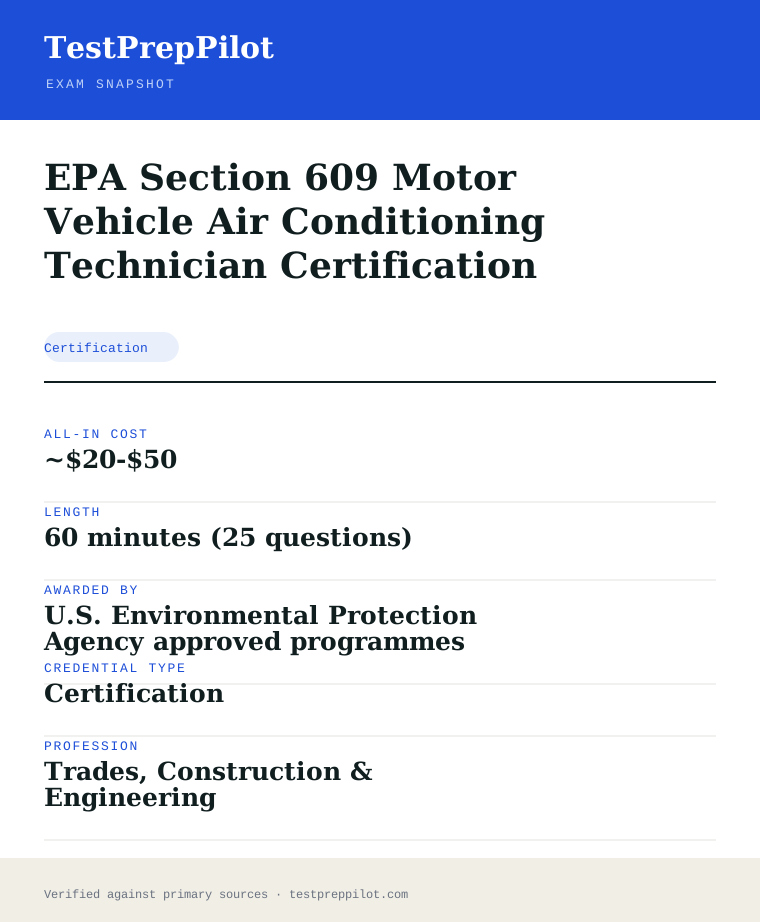
EPA Section 609 Motor Vehicle Air Conditioning Technician Certification
EPA Section 609 Motor Vehicle Air Conditioning Technician Certification — Trades & Construction credential from U.S. Environmental Protection Agency approved programmes
Researched and maintained by TestPrepPilot Editorial BoardSkilled trades & manufacturing certifications desk · Figures last verified August 2026
The short version
What is the EPA Section 609 Motor Vehicle Air Conditioning Technician Certification and is it worth it?
EPA Section 609 Motor Vehicle Air Conditioning Technician Certification is a professional credential administered by U.S. Environmental Protection Agency approved programmes. It validates job-ready knowledge and skills in the Trades & Construction field and is used for career entry, advancement, or compliance.
- Recognized credential from U.S. Environmental Protection Agency approved programmes
- Demonstrates verified competence in Trades & Construction
- Supports career advancement and may satisfy licensing or employer requirements
What is it?
What exactly is the EPA Section 609 Motor Vehicle Air Conditioning Technician Certification?
EPA Section 609 Motor Vehicle Air Conditioning Technician Certification — Trades & Construction credential from U.S. Environmental Protection Agency approved programmes
Federally required credential for technicians who service motor vehicle air conditioning systems and handle automotive refrigerants. Offered by U.S. Environmental Protection Agency approved programmes, it is designed for candidates who need to demonstrate verified competence in the Trades & Construction field. The credential is commonly used for career entry, advancement, regulatory compliance, or employer requirements. Candidates should review the official handbook for eligibility, exam format, and scoring before registering.
The path in brief
- Confirm you meet any eligibility or prerequisites
- Review the official handbook and study materials
- Register and pay through the awarding body or authorized provider
- Schedule and take the exam (test center or online proctoring)
- Receive your score and, if passed, your credential
Before you book
Who is eligible to sit the EPA Section 609 Motor Vehicle Air Conditioning Technician Certification?
Eligibility varies; many credentials are open to all, while others require coursework, work experience, or sponsorship.
Who it is for: Professionals and candidates seeking to validate Trades & Construction competence.
The test itself
What is the format of the EPA Section 609 Motor Vehicle Air Conditioning Technician Certification?
The EPA Section 609 Motor Vehicle Air Conditioning Technician Certification is administered by U.S. Environmental Protection Agency approved programmes and runs 60 minutes and contains 25 questions.
| Administered by | U.S. Environmental Protection Agency approved programmes |
|---|---|
| Questions | 25 |
| Time limit | 60 minutes |
| Pass mark | Passing score set by the awarding body; see the official score report |
| Exam fee | Varies by location and currency — confirm on the official registration page |
| Format | Proctored, computer-based (test center or online remote proctoring) |
Content outline
What topics are on the EPA Section 609 Motor Vehicle Air Conditioning Technician Certification?
The EPA Section 609 Motor Vehicle Air Conditioning Technician Certification covers 4 content domains.
Weightings come from the official exam outline. Study time is best allocated in roughly these proportions rather than evenly across domains.
- Trade fundamentals
Topic area tested on the exam; see the official blueprint for the detailed breakdown.
- Tools & materials
Topic area tested on the exam; see the official blueprint for the detailed breakdown.
- Codes & safety
Topic area tested on the exam; see the official blueprint for the detailed breakdown.
- Hands-on procedures
Topic area tested on the exam; see the official blueprint for the detailed breakdown.
The path
How do you register for the EPA Section 609 Motor Vehicle Air Conditioning Technician Certification?
- 1
Visit the awarding body’s official website and create an account
- 2
Select the credential and review its specific requirements
- 3
Complete any required eligibility (education, experience, or training)
- 4
Pay the registration fee
- 5
Schedule the exam at a test center or online
- 6
Take the exam and receive your results
The fine print
What are the retake and renewal rules for the EPA Section 609 Motor Vehicle Air Conditioning Technician Certification?
- Proctoring & delivery
- Proctored, computer-based delivery (test center or remote online proctoring), varying by exam.
- Retake policy
- Varies by credential — most bodies permit retakes after a waiting period and full or partial fee.
- Score reporting
- Scores are reported per the body’s timeline, typically electronically after the exam.
- Recertification
- Varies; many credentials require renewal every 2–3 years via continuing education or a recertification exam.
What it pays
How much does this credential pay?
$55,040 median for automotive service technicians and mechanics (BLS, May 2024)
There is no Bureau of Labor Statistics occupation called "EPA 609" — the Section 609 certification is a federal requirement for technicians who service motor-vehicle air-conditioning systems, and the wage question belongs to the occupation you perform with it. The closest official BLS occupation is Automotive Service Technicians and Mechanics, SOC 49-3023, which had a May 2024 median wage of $55,040, with the lowest 10 percent under $33,010 and the highest 10 percent above $84,760. The fit is direct: Section 609-certified technicians work in auto shops, dealerships and repair chains servicing vehicle HVAC systems, and the Clean Air Act requires the certification to handle refrigerant. BLS counted 733,900 automotive service technician jobs in 2024 and projects 2 percent growth from 2024 to 2034, with about 62,700 openings a year, almost all replacement demand. The limitation to state plainly: the BLS median covers the whole occupation at all levels, credentialed or not, and the 609 certification carries no wage premium in government data; its value is legal necessity — you cannot work on vehicle AC systems for pay without it, so it is an employability gate for automotive HVAC work. Read the number as the market for the occupation the certification serves.
| Measure | Figure | Source / note |
|---|---|---|
| Median annual wage, automotive service technicians | $55,040 | BLS OOH, SOC 49-3023, May 2024 |
| Lowest 10 percent | Under $33,010 | BLS OOH, SOC 49-3023, May 2024 |
| Highest 10 percent | Above $84,760 | BLS OOH, SOC 49-3023, May 2024 |
| Projected openings per year | ~62,700 | BLS OOH, SOC 49-3023, 2024-2034 |
Job growth.BLS projects 2 percent growth for automotive service technicians from 2024 to 2034, about 62,700 openings per year.
Source: BLS Occupational Outlook Handbook - Automotive Service Technicians and Mechanics
Your odds
What are the pass rates?
EPA publishes the passing standard — 84% (21 of 25) — and the Section 609 program does not publish cohort pass rates
The EPA's Section 609 technician certification program does not publish cohort pass rates for the certification test, and third-party estimates are not official data, so we do not treat them as authoritative. What the program does publish is the format and the passing standard: the Section 609 certification exam has 25 questions with a 60-minute time limit, and a passing score of 84 percent — at least 21 correct answers. The test is administered by EPA-authorized test providers, either on paper or by computer, and passing it is the federal requirement for anyone who services, repairs or disposes of motor-vehicle air-conditioning systems that use refrigerant. The exam content covers the Clean Air Act requirements: the stratospheric-ozone protection rules, the refrigerant types and their environmental effects, proper recovery, recycling and reclamation procedures, and the leak-repair and recordkeeping requirements. The absence of a published pass rate is not an absence of standards: the 84 percent line on 25 questions is a meaningful bar for an entry-level regulatory test, and the exam rewards knowing the procedures exactly, since the law is specific about recovery and recordkeeping. The practical reading: study the official Section 609 training materials, which the test is built from, and aim for 90 percent-plus on practice.
Read this before quoting the number.EPA publishes the 84% passing standard but no cohort pass rate; the test is administered by EPA-authorized providers.
Your schedule
How long should I study for it?
3-8 hours over 1-3 days of focused study
The Section 609 certification is a 25-question, 60-minute test with an 84 percent passing line, and its curriculum is the federal requirements for motor-vehicle AC refrigerant handling: the Clean Air Act and ozone-protection rules, refrigerant identification and the environmental impact of the different refrigerants, the recovery, recycling and reclamation procedures, and the leak-repair, containment and recordkeeping requirements. A defensible plan runs 3 to 8 hours over one to three days, built on the official training materials provided by the test provider. Step one: study the official Section 609 training manual or online module, which covers the procedures the test is built from. Step two: master the refrigerant rules — which refrigerants (R-12, R-134a, R-1234yf) are used, how they affect the ozone layer and climate, and why recovery is required rather than venting. Step three: learn the equipment and procedure specifics — the recovery machine setup, the evacuated-container rules, the leak-repair obligations and the recordkeeping for recovered refrigerant. Step four: take the practice test if the provider offers one, then sit the exam. The plan is short because the scope is a single regulatory program; the exam rewards knowing the procedures precisely.
- Step 1 (1-2 hours)2
The Clean Air Act rules
- The ozone-protection requirements
- Why venting refrigerant is prohibited
- The technician certification requirement
- Step 2 (2-3 hours)3
Refrigerants and equipment
- R-12, R-134a and R-1234yf characteristics
- Recovery, recycling and reclamation differences
- Recovery equipment setup and evacuated containers
- Step 3 (1-2 hours)2
Leaks, records, exam
- Leak-repair obligations and recordkeeping
- Practice questions and review
- Sit the certification test
Adjusting the pace
Working auto technician.The equipment and procedures are familiar from the job; focus study on the regulatory details and recordkeeping.
Student or new technician.Add a session on refrigerant chemistry and the recovery procedure before the exam.
How to study
How do I prepare most effectively?
The Section 609 test rewards precise knowledge of the regulatory procedures, so the dominant strategy is studying the official training materials the test is built from — the test providers all use EPA-aligned content, and the exam items mirror the training module. Second, learn the refrigerant distinctions exactly: R-12, R-134a and R-1234yf differ in their environmental effects and handling, and the exam tests which refrigerant is which and why recovery matters. Third, master the procedure specifics: recovery vs recycling vs reclamation, the evacuated-container rules, and the correct equipment setup, because the exam rewards the exact steps. Fourth, learn the leak-repair and recordkeeping obligations, a distinct block that candidates focused on equipment mechanics often miss. Finally, aim for 90 percent-plus on any practice material, because the 84 percent line on 25 questions leaves only four wrong answers of margin — and remember the certification is one of the few federal requirements in the trade, so the procedures are legally binding, not optional best practice.
Use the official training material
The test is built from the provider's EPA-aligned module.
Learn the refrigerant distinctions
R-12, R-134a and R-1234yf differ in effects and handling.
Master the procedure steps
Recovery vs recycling vs reclamation, and the equipment setup.
Know the leak and record rules
Leak repair and recordkeeping are a distinct tested block.
Aim for 90%+ on practice
The 84% line leaves only four wrong answers of margin.
What to buy
Which study resources are worth paying for?
Section 609 prep is inexpensive because the certification cost is dominated by the test itself, and the training materials are bundled or free. The EPA-authorized test providers charge roughly $20 to $50 for the certification test, and most include the training material in the fee or sell a study module for a few dollars. Free resources include the EPA's Section 609 pages, which describe the requirements, and the refrigerant fact sheets. Many trade schools and employers bundle the 609 certification with training or onboarding. A realistic total budget is $25 to $75 including the test. Prices below are list prices as of mid-2026 and change frequently; we rank nothing by commission.
| Resource | Price | Format | Best for |
|---|---|---|---|
| EPA Section 609 pages | Free | Official government pages | The requirements and program rules |
| Authorized test provider exam | ~$20-$50 | Paper or computer test | The certification itself |
| Provider training module | Often included or ~$10 | Online study material | The content the test is built from |
| Trade-school or employer training | Varies | Classroom training | Bundled with technician training |
List prices as of mid-2026, subject to change; provider fees vary; no commission or affiliate ranking is implied.
Avoid these
What mistakes do candidates most often make?
The most common Section 609 mistake is assuming the exam is about AC repair mechanics rather than the regulatory rules: candidates who know how to fix AC systems but not the refrigerant-handling requirements fail the items on recovery procedures and recordkeeping. The fix is studying the regulatory material, not the mechanical. The second mistake is confusing recovery, recycling and reclamation — the exam tests the distinctions precisely. Third, candidates mislearn which refrigerants are covered and their environmental effects; R-12, R-134a and R-1234yf are tested by name. Fourth, some candidates skip the leak-repair and recordkeeping block, which is a real share of the test. Finally, treating the certification as optional is the costliest misunderstanding — the Clean Air Act requires it for paid work on vehicle AC systems, and employers check for it before hiring.
✕Studying mechanics, not regulations
✓The test is about refrigerant-handling requirements, not AC repair.
✕Confusing recovery, recycling, reclamation
✓The three processes are tested by their distinct definitions.
✕Mislearning the refrigerants
✓R-12, R-134a and R-1234yf are tested by name and effect.
✕Skipping leak and record rules
✓Leak repair and recordkeeping are a real tested block.
✕Treating it as optional
✓The Clean Air Act requires it for paid vehicle-AC work.
What you'll face
What question types will I see?
The Section 609 certification test is a 25-question multiple-choice exam in 60 minutes. The items test the regulatory procedures: the Clean Air Act requirements, refrigerant identification and environmental effects, the recovery, recycling and reclamation procedures, and the leak-repair and recordkeeping obligations. The exam rewards exact procedural knowledge. Samples below are editor-written illustrations of the program content, not live exam items; they show the regulatory style of the real items.
Correct recovery, recycling and reclamation procedures.
R-12, R-134a, R-1234yf and their environmental effects.
Leak-repair obligations and recordkeeping.
Try these
Q1Under Section 609, a technician servicing a motor-vehicle AC system containing refrigerant must:
Answer:A
Section 609 requires recovery of refrigerant with approved equipment before servicing — venting is prohibited under the Clean Air Act. Venting partially charged systems or small systems, or treating the requirement as optional, each violate the law.
Q2Which refrigerant is an ozone-depleting substance (ODS) that triggered the Section 609 rules?
Answer:A
R-12 (CFC-12) is the ozone-depleting refrigerant whose phase-out drove the Section 609 program. R-134a and R-1234yf are later refrigerants with much lower or no ozone-depletion potential, and CO2 is not a refrigerant in this context.
Q3The difference between refrigerant recovery and recycling is that recycling:
Answer:A
Recycling removes contaminants (oil, moisture) for reuse without chemical reprocessing; reclamation is the chemical reprocessing to virgin specification, and recovery is simply removing the refrigerant. The exam tests these three distinctions precisely.
Samples are editor-written illustrations of the program content, not live exam items.
The big day
What should I expect on exam day?
The Section 609 certification test is a 25-question, 60-minute exam administered by an EPA-authorized test provider, on paper or by computer. Bring the required identification matching your registration; the provider sets the check-in procedure. Pace at about 2.4 minutes per item and review flagged questions; the 84 percent line (21 of 25) leaves only four wrong answers of margin, so use the full window. Your result is reported after scoring, and the provider issues the Section 609 certificate on a pass. If you do not pass, the provider defines the retake policy and fee. On a pass, the certification is valid for life — it does not expire — and it travels with you across employers, who ask to see the certificate. The afterwards matters: keep the certificate on file and carry a copy, because employers and some state regulators verify the 609 credential before allowing work on vehicle AC systems.
Bring
- Required identification matching your registration
- Test confirmation from your provider
Leave at home
- Phone and personal electronics
- Notes and study materials — the test is closed book
How the day runs
Rules in the room
- The test is closed book
- 25 questions in 60 minutes; the clock does not pause
- The certification is valid for life
Afterwards.On a pass, your Section 609 certification is permanent; keep it for employer verification. On a fail, retake per the provider's policy after additional study.
Reference
What are the key facts about the EPA Section 609 Motor Vehicle Air Conditioning Technician Certification?
EPA Section 609 Motor Vehicle Air Conditioning Technician Certification is a certification credential; awarded by U.S. Environmental Protection Agency approved programmes; the exam fee is Varies by location and currency — confirm on the official registration page; typical preparation is 60 minutes (25 questions); holders typically earn $33,000-$85,000.
| Credential | EPA Section 609 Motor Vehicle Air Conditioning Technician Certification |
|---|---|
| Abbreviation | EPA 609 |
| Type | Certification |
| Profession | Trades, Construction & Engineering |
| Specialty | Automotive & Diesel |
| Awarded by | U.S. Environmental Protection Agency approved programmes |
| Difficulty | Hands-on / Applied |
| Typical prep time | 60 minutes (25 questions) |
| All-in cost | ~$20-$50 |
| Typical salary range | $33,000-$85,000 |
| Credential | EPA Section 609 Motor Vehicle Air Conditioning Technician Certification |
| Awarding body | U.S. Environmental Protection Agency approved programmes |
| Exam format | Proctored, computer-based |
| Validity | Valid for life. |
| Languages | Varies — see awarding body |
| Scope | National / Multi-state |
| Also known as | Section 609 |
Real questions
Frequently asked questions about the EPA Section 609 Motor Vehicle Air Conditioning Technician Certification
How do I register for the EPA Section 609 Motor Vehicle Air Conditioning Technician Certification exam?
Register through U.S. Environmental Protection Agency approved programmes's official portal or an authorized test provider (e.g., Pearson VUE or Prometric where applicable). Create an account, select the exam, pay the fee, and schedule a date.
How much does the exam cost?
Fees vary by location and currency. Confirm the current fee on the official registration page before scheduling.
How long is the credential valid, and how do I renew?
The Section 609 certification is valid for life and does not expire.
What if I do not pass?
Most bodies allow retakes after a waiting period and payment of the full or partial fee. Check U.S. Environmental Protection Agency approved programmes's retake policy before rescheduling.
How do I register for a U.S. Environmental Protection Agency approved programmes credential?
Register through the official website, select your exam, pay the fee, and schedule a date.
How do I renew a credential?
Renewal policies vary by credential; check the specific program page for requirements and cycles.
In short
Is the EPA Section 609 Motor Vehicle Air Conditioning Technician Certification worth it?
- EPA Section 609 Motor Vehicle Air Conditioning Technician Certification is awarded by U.S. Environmental Protection Agency approved programmes.
- Validates job-ready competence in Trades & Construction.
- Registration is through the awarding body or an authorized test provider.
- Renewal and retake policies vary — confirm before scheduling.
Same awarding body
What other credentials does U.S. Environmental Protection Agency approved programmes award?
Worth comparing
How does the EPA Section 609 Motor Vehicle Air Conditioning Technician Certification compare with similar credentials?
Trust
Where does this information come from?
Everything above is taken from the awarding body's own published material. Fees, question counts and domain weights are revised regularly — check the official page before you pay.
Research confidence: low · Last reviewed 2026-08