Trades, Construction & Engineering • Certification
HVAC Excellence Employment Ready Certification
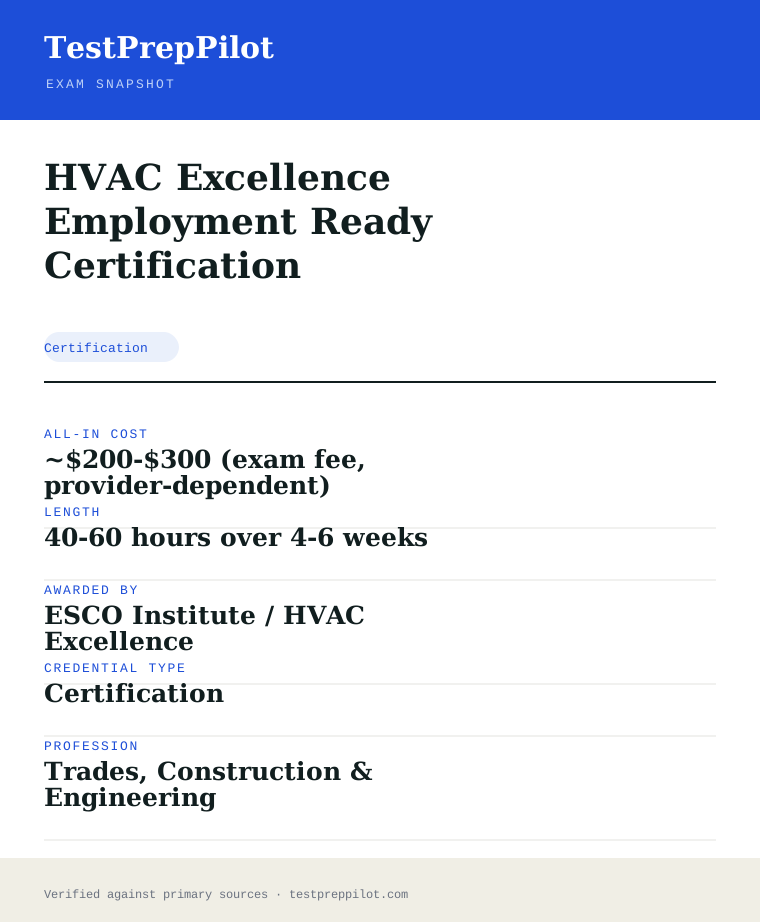
HVAC Excellence Employment Ready Certification — Trades & Construction credential from ESCO Institute / HVAC Excellence
Researched and maintained by TestPrepPilot Editorial BoardTrades & construction certifications desk · Figures last verified August 2026
The short version
What is the HVAC Excellence Employment Ready Certification and is it worth it?
HVAC Excellence Employment Ready Certification is a professional credential administered by ESCO Institute / HVAC Excellence. It validates job-ready knowledge and skills in the Trades & Construction field and is used for career entry, advancement, or compliance.
- Recognized credential from ESCO Institute / HVAC Excellence
- Demonstrates verified competence in Trades & Construction
- Supports career advancement and may satisfy licensing or employer requirements
What is it?
What exactly is the HVAC Excellence Employment Ready Certification?
HVAC Excellence Employment Ready Certification — Trades & Construction credential from ESCO Institute / HVAC Excellence
Entry credential verifying foundational HVACR knowledge for students entering the workforce. Offered by ESCO Institute / HVAC Excellence, it is designed for candidates who need to demonstrate verified competence in the Trades & Construction field. The credential is commonly used for career entry, advancement, regulatory compliance, or employer requirements. Candidates should review the official handbook for eligibility, exam format, and scoring before registering.
The path in brief
- Confirm you meet any eligibility or prerequisites
- Review the official handbook and study materials
- Register and pay through the awarding body or authorized provider
- Schedule and take the exam (test center or online proctoring)
- Receive your score and, if passed, your credential
Before you book
Who is eligible to sit the HVAC Excellence Employment Ready Certification?
Eligibility varies; many credentials are open to all, while others require coursework, work experience, or sponsorship.
Who it is for: Professionals and candidates seeking to validate Trades & Construction competence.
The test itself
What is the format of the HVAC Excellence Employment Ready Certification?
The HVAC Excellence Employment Ready Certification is administered by ESCO Institute / HVAC Excellence and runs ~2 hours per exam.
| Administered by | ESCO Institute / HVAC Excellence |
|---|---|
| Questions | Core + 2 specialty exams |
| Time limit | ~2 hours per exam |
| Pass mark | Passing score set by the awarding body; see the official score report |
| Exam fee | ~$200-$300 |
| Format | Proctored, computer-based (test center or online remote proctoring) |
Content outline
What topics are on the HVAC Excellence Employment Ready Certification?
The HVAC Excellence Employment Ready Certification covers 4 content domains.
Weightings come from the official exam outline. Study time is best allocated in roughly these proportions rather than evenly across domains.
- Trade fundamentals
Topic area tested on the exam; see the official blueprint for the detailed breakdown.
- Tools & materials
Topic area tested on the exam; see the official blueprint for the detailed breakdown.
- Codes & safety
Topic area tested on the exam; see the official blueprint for the detailed breakdown.
- Hands-on procedures
Topic area tested on the exam; see the official blueprint for the detailed breakdown.
The path
How do you register for the HVAC Excellence Employment Ready Certification?
- 1
Visit the awarding body’s official website and create an account
- 2
Select the credential and review its specific requirements
- 3
Complete any required eligibility (education, experience, or training)
- 4
Pay the registration fee
- 5
Schedule the exam at a test center or online
- 6
Take the exam and receive your results
The fine print
What are the retake and renewal rules for the HVAC Excellence Employment Ready Certification?
- Proctoring & delivery
- Proctored, computer-based delivery (test center or remote online proctoring), varying by exam.
- Retake policy
- Varies by credential — most bodies permit retakes after a waiting period and full or partial fee.
- Score reporting
- Scores are reported per the body’s timeline, typically electronically after the exam.
- Recertification
- Varies; many credentials require renewal every 2–3 years via continuing education or a recertification exam.
What it pays
How much does this credential pay?
$59,810 median for heating, air conditioning, and refrigeration mechanics (BLS, May 2024)
The Bureau of Labor Statistics occupation that maps onto an HVAC career is Heating, Air Conditioning, and Refrigeration Mechanics and Installers, SOC 49-9021, which had a May 2024 median annual wage of $59,810. That is the right reference point for this credential, with an important caveat: Employment Ready certification is an entry-level, end-of-course achievement for students and new technicians, and an entry-level technician is more likely to sit in the lower half of the BLS distribution than at the median. BLS reports the lowest 10 percent of the occupation earned less than $39,130 and the highest 10 percent more than $91,020, and the spread is mostly experience, specialisation and whether the technician holds state licensure. The credential’s value in that market is as a standardised signal: HVAC Excellence Employment Ready exams give employers a comparable, nationally consistent measure of what a job applicant retained from training, regardless of which school produced the candidate, and employers, apprenticeship programmes and wholesalers use them to screen for baseline knowledge. The occupational outlook is genuinely strong and is the strongest argument for entering the field. BLS projects 8 percent employment growth for HVAC mechanics and installers from 2024 to 2034, much faster than the average for all occupations, with about 40,100 openings a year — driven by new construction, retrofits and the growing emphasis on energy efficiency that increases demand for climate-control work. That growth supports the case for starting with an Employment Ready credential and stacking professional-level certifications later, because the field is expanding and the credential ladder mirrors the career ladder. The honest caveat: Employment Ready is a training-program benchmark, not a state licence, and most states still require their own licensing for independent contractor work, so the credential should be read as the first rung, not the destination.
| Measure | Figure | Source / note |
|---|---|---|
| Median annual wage, HVAC mechanics and installers | $59,810 | BLS Occupational Outlook Handbook, May 2024 ($28.75/hr) |
| Lowest 10 percent | less than $39,130 | BLS OOH Pay tab, May 2024 |
| Highest 10 percent | more than $91,020 | BLS OOH Pay tab, May 2024 |
| Employment, 2024 | 425,200 jobs | BLS OOH Quick Facts, 2024 |
| Projected annual openings | ~40,100 per year | BLS OOH Job Outlook, 2024-34 |
Job growth.8% projected employment growth 2024-34 (much faster than average) with ~40,100 openings a year; Employment Ready is the entry rung of a credential ladder that mirrors a growing field
Your odds
What are the pass rates?
No national pass rate is published — HVAC Excellence publishes a 70% passing threshold per exam and no aggregate statistics
HVAC Excellence does not publish national pass-rate statistics for its Employment Ready certification exams, and neither does its parent organisation, the ESCO Group. There is no annual report of first-attempt pass percentages comparable to what some other credentialing bodies publish, and any website quoting an "Employment Ready pass rate" is estimating from its own student cohort or guessing. What the official programme materials do state, clearly, is the passing threshold: candidates who score 70 percent or higher on an Employment Ready exam are issued a certificate of achievement, with the option of additional patches in some subject areas. That 70 percent is a criterion-referenced cut score set against the exam content, not a statistic about how many people pass. The absence of a published pass rate matters less than it might because of what Employment Ready exams actually are: discipline-specific, computer-based exams administered at the end of a training module or course, designed to give instructors feedback on whether each participant retained the course material and to give employers a standardised measure of readiness. They are not competitive or norm-referenced gates — they are mastery checks against a 70 percent standard, and retaking the exam after remedial training is a normal part of the design, not a failure event. The exam bank covers a defined set of subject areas — electrical theory, gas heat, electric heat, air conditioning, refrigeration, heat pumps, combustion analysis and others — and candidates earn one certificate per subject passed, so the practical planning question is which combination of core and specialty exams you need, not what the aggregate pass rate is. For candidates deciding how to prepare, the published standard is the useful number: aim consistently above 70 percent on practice material, because that is the exact bar the certificate is issued against.
Read this before quoting the number.No national pass-rate statistics are published by HVAC Excellence or ESCO for the Employment Ready exams. The verifiable standard is a 70% passing threshold per exam, and any figure beyond that is an estimate without an official source.
Source: ESCO Group / HVAC Excellence — Employment Ready certifications
Your schedule
How long should I study for it?
40-60 hours across 6 weeks (core plus two specialty exams) of focused study
The first planning fact is that "Employment Ready" is not one exam — it is a family of discipline-specific, computer-based exams, and the practical question is which combination you need. The programme is built for students at the end of a training course or module: the exams validate that you retained the material, provide the instructor with feedback, and give employers a standardised readiness signal. The pattern described by HVAC Excellence material is that candidates complete a core examination covering the foundational electrical and refrigeration theory that underpins the trade, then add specialty exams in the areas relevant to their program and career — air conditioning, gas heat, electric heat, heat pumps, refrigeration and charging procedures, combustion and others. Each exam is passed independently at a 70 percent threshold, and each pass earns its own certificate of achievement. Because the exams are written to the HVAC Excellence competency and task list — which the major textbooks are cross-walked to — the most reliable study sequence is to follow the course material module by module and test yourself against the task list for each subject, rather than studying a single broad exam. The plan below assumes the common pattern of a core exam plus two specialty exams, and budgets roughly two weeks per exam for a candidate coming straight out of the related course work. If you are taking the exams at the end of a full program, most of the content is already covered by your instructors; the plan focuses on retention, practice and exam mechanics rather than teaching the trade from scratch. Total time is modest because the exams test the material you just learned, but the pacing is real: timed computer-based exams reward candidates who have practised the format, not just the content.
- Weeks 1-214-20 hrs total
Core exam — electrical and refrigeration theory
- Map the core competency and task list to your course textbook using the publisher crosswalk
- Study the electrical theory foundation: circuits, components, meters, motors and capacitors, and reading diagrams
- Study refrigeration fundamentals: the vapour-compression cycle, system components and refrigerant behaviour
- Take the first timed practice exam for the core and log which task areas you under-score
- Weeks 3-412-18 hrs total
First specialty exam — your program focus
- Pick the specialty most central to your training, such as air conditioning or gas heat, and work its task list
- Drill the service and troubleshooting content, not just theory — the task list weights application
- Practise timed exam conditions on that specialty’s question set
- Re-study any task area scoring below 70% on practice until it clears the bar with margin
- Weeks 5-612-18 hrs total
Second specialty exam and final calibration
- Work the second specialty’s task list, weighting whichever of the two is weaker
- Run a full timed practice for each of the three exams you will sit
- Target 80%+ on practice for every exam, because the 70% cut leaves no margin
- Confirm exam logistics with your instructor or proctor, since Employment Ready exams are scheduled through accredited training providers
Adjusting the pace
Taking a single specialty exam only.Two to three weeks. The specialty exams are independent, so a candidate who only needs, say, the air-conditioning credential can compress the plan to that one exam and skip the others.
Core plus three or more specialties.Eight to ten weeks. The core exam overlaps heavily with each specialty, so the marginal time per added specialty shrinks — budget roughly two weeks each after the first.
Coming from work experience rather than a formal program.Four to six weeks of structured review. Your field experience covers application; concentrate on the theory and terminology the task list requires, which experience alone rarely supplies.
How to study
How do I prepare most effectively?
The Employment Ready exams are end-of-course mastery checks written to a published competency and task list, so the winning strategy is to prepare against that task list and to practise the computer-based format under timing. Because the exams are discipline-specific and passed independently at 70 percent, the highest-yield work is the same for every subject: know exactly what the task list says you must know, test yourself against it, and rehearse the timed exam mechanics so the format costs you nothing on the day.
Study to the task list, not to the textbook
Every Employment Ready exam is written against the HVAC Excellence competency and task list, and the major publishers cross-walk their textbooks to it. Open the task list for your subject, use it as your syllabus, and mark off each task as you can perform it. Candidates who study a textbook cover to cover spend hours on material the exam never asks about.
Rehearse the computer-based format under timing
The exams are computer-based and timed, and candidates who have only studied paper questions lose points to the format itself. Run timed practice sessions on a computer, answer the questions in exam order, and practise managing the clock so that finishing every item is routine. A mastery-check exam is won by candidates who are as comfortable with the machine as with the content.
Aim for 80% in practice, not 70%
The passing threshold is 70 percent, and passing with margin is the point of practice. Aim for 80% or higher on practice material so that a bad day — anxiety, a hard form, a misread stem — still leaves you above the bar. Candidates who rehearse at exactly 70% pass on their best day and fail on their worst.
Use the core exam as the foundation for the specialties
The core exam covers the electrical and refrigeration theory that every specialty builds on. Master the core first, even if your program does not require it, because the theory carries into air conditioning, heat pumps, gas heat and refrigeration alike. Candidates who skip the core and jump straight to a specialty frequently find the specialty harder than expected for exactly that reason.
Retake remediation is part of the design
Employment Ready exams are feedback tools for instructors as much as credentials for students — a sub-70% score tells you and your instructor exactly which task areas need remedial training. Treat a failed attempt as a diagnostic report, study the named gaps, and retake with the goal of a clear margin rather than a scraped pass.
Confirm which exams your program requires
Programs differ in which Employment Ready exams they administer and which combination earns the certificate. Ask your instructor for the exact exam set before you study, because preparing for the wrong specialty wastes weeks and costs nothing in exam value. This is the one piece of planning that cannot be recovered by studying harder.
What to buy
Which study resources are worth paying for?
Employment Ready preparation is unusual because the exams are tied to specific training programs: most candidates sit them through a community college, trade school, apprenticeship programme or employer, and the exams are scheduled through the accredited training provider rather than booked independently. That shapes the cost picture. The exam fees themselves are comparatively small — typically in the range of $30 to $50 per exam according to industry guides, though providers can bundle them into program tuition — and the main costs are the course material and any practice resources. Because the exams are cross-walked to the major HVAC textbooks, the textbook you already use in your course is the primary study resource, which keeps preparation costs low.
| Resource | Price | Format | Best for |
|---|---|---|---|
| Employment Ready exams (per exam) | ~$30-50 per exam, often bundled into program tuition | Computer-based, administered through an accredited training provider | Required — the credential itself |
| Your program’s course textbook (major publishers are cross-walked) | Included in course costs or ~$100-200 if bought new | Textbook aligned to the HVAC Excellence task list | The primary study resource for each subject exam |
| HVAC Excellence competency and task list | Free | Official document from ESCO | The authoritative syllabus for every exam — use it as your checklist |
| Practice tests and study guides from your provider | Varies — often free or bundled | Paper or online practice | Rehearsing the 70% bar and the exam format before the real attempt |
| Professional Technician certifications (later step) | ~$25-100 per exam depending on tier | Computer-based, requires 2+ years field experience | The next rung after Employment Ready once you have field experience |
Prices checked 2026-08 in USD; Employment Ready exam fees are set by the administering provider and are frequently included in program tuition, so confirm the exact cost with your school, apprenticeship or employer. We do not rank resources by commission.
Avoid these
What mistakes do candidates most often make?
The mistakes that cost Employment Ready candidates are mostly planning errors rather than knowledge gaps: treating the credential as one exam instead of a set, studying the wrong specialty, preparing from material that is not cross-walked to the task list, and treating a sub-70% practice score as good enough. Each is avoidable and each maps to a concrete fix.
✕Treating "Employment Ready" as a single exam
✓It is a family of discipline-specific computer-based exams — typically a core examination plus specialty exams — and each is passed independently at 70% with its own certificate. Confirm the exact exam set your program requires before you study, because preparing for one big "HVAC exam" that does not exist wastes the whole plan.
✕Studying the wrong specialty or the wrong edition
✓Ask your instructor which specialty exams you will sit and which textbook edition your program uses. The exams are cross-walked to the current editions of the major textbooks; studying an older edition or the wrong subject leaves gaps in exactly the task areas the exam weights.
✕Preparing for the wrong pass threshold
✓The published passing threshold is 70 percent per exam, and it is a criterion-referenced cut, not a class curve. Practise to 80% or higher so a bad day still clears the bar. Candidates who aim at exactly 70% pass on their best form and fail on a hard one.
✕Ignoring the core exam because it is theory
✓The core covers the electrical and refrigeration theory that every specialty assumes. Skipping it leaves you weak on the foundations the specialty exams build on. Master the core first even if your program does not require it — it is the cheapest insurance for every other exam.
✕Skipping timed, computer-based practice
✓The exams are timed and computer-based, and the format costs real points to candidates who only practised on paper at leisure. Run timed practice sessions on a computer so that navigating the exam and managing the clock is routine on the day.
✕Assuming the credential replaces a state licence
✓Employment Ready is a training-program credential and a hiring signal; it is not a state licence to work on HVAC systems independently. Most states require their own licensing or registration for contractor work. Use the credential as the first rung, and check your state’s requirements in parallel so the career path does not stall.
What you'll face
What question types will I see?
The Employment Ready exams are computer-based, discipline-specific assessments written to the HVAC Excellence competency and task list, with a 70 percent passing threshold per exam. The question set is predominantly multiple choice, testing both theoretical knowledge and its application to real service and installation situations, with content drawn from the specific subject — electrical theory, refrigeration, gas heat, air conditioning, heat pumps and the other specialty areas. Because each exam is tied to a course module, the questions track the task list of that module: expect theory questions, component-identification questions, and application questions that describe a system condition and ask for the correct diagnosis, procedure or safety response. There are no published national pass-rate statistics, and the 70 percent figure is a passing threshold rather than a statistic about candidate performance. Candidates should expect between roughly 50 and 100 items depending on the exam and provider administration, all multiple choice, delivered on a computer with a running clock. The samples below are editor-written illustrations of the item styles the task list implies, not live exam items, and are drawn from the electrical and refrigeration core that underpins every specialty.
Electrical circuits, components, the refrigeration cycle, refrigerant behaviour and system fundamentals — the foundation every specialty builds on.
Recognise a component, know what it does and where it sits in the system — the vocabulary of the trade.
A described system condition and the correct diagnosis, procedure or next step — the task list weights application over recall.
Safe handling, correct procedures and the professional standards the task list treats as prerequisites.
Try these
Q1A technician measures the current flowing through a resistive heating element and the voltage across it. Using Ohm’s law, the power consumed by the element is calculated as:
Answer:B
Electrical power in a DC circuit is the product of current and voltage (P = I x V), which for a resistive load equals I-squared times R. A is Ohm’s law rearranged for resistance, not power. C confuses power with the definition of resistance. D is not a recognised power formula. This is a core theory question from the electrical fundamentals the task list requires.
Q2During a diagnostic check of a refrigeration system, the technician finds low suction pressure and low discharge pressure together. Which is the most likely cause?
Answer:B
Low suction and low discharge pressures together are the classic signature of a low refrigerant charge — there is simply not enough refrigerant in the system to produce normal pressures on either side. A restricted liquid line or drier typically shows low suction with normal or high head pressure. C shows as high head pressure with abnormal behaviour. D would flood the evaporator and show different pressure behaviour. This is the application-troubleshooting style the specialty exams reward.
Q3Before opening a refrigerant circuit for service, a technician must recover the refrigerant. Which statement describes the correct professional practice?
Answer:B
Professional and regulatory practice requires that refrigerant be recovered with approved recovery equipment rather than vented, under the Clean Air Act and the EPA Section 608 rules that govern technicians. A is a common misconception that is explicitly unlawful. C is wrong — recovery obligations apply across refrigerant types, not only CFCs. D is wrong because owner approval does not override regulatory requirements. Safety and proper practice items like this thread through every Employment Ready exam.
Samples are editor-written illustrations of the published blueprint, not live exam items.
The big day
What should I expect on exam day?
Employment Ready exams are computer-based and administered through your accredited training provider — a community college, trade school, apprenticeship programme, manufacturer or employer — rather than booked independently at a commercial test centre. That changes the exam-day picture considerably: your instructor or programme coordinator is the person who schedules the sitting, tells you which exams you are taking and when, and administers the proctoring. The practical preparation is to confirm the schedule, the exact exam set, and the passing threshold — 70 percent per exam — well in advance. On the day, the exams are timed and computer-based, and because each exam is passed independently, a candidate sitting core plus two specialties will take three separate assessments, typically one after another or across a session arranged by the provider. Arrive with time in hand, bring a photo ID and any admission information your provider requires, and settle into the computer-based format quickly: read each stem for the operative phrase, manage the clock so every item gets answered, and expect the multiple-choice application questions that dominate the specialty exams. There is no published pass rate, so the only number that matters on the day is your own performance against the 70 percent bar, and because the exams are mastery checks, a sub-70 score is a diagnostic outcome — your instructor will use it to prescribe remedial training, and a retake after that training is a normal path, not a dead end. Confirm the retake policy and any retake fee with your provider when you schedule, since policies vary by administering organisation.
Bring
- A photo ID and any admission or confirmation materials your training provider requires
- Confirmation of which exams you are sitting and the order
- Water and a snack for breaks between exams if you are sitting multiple assessments
- The names of any task-list areas you want to re-check in the waiting time before your sitting
Leave at home
- Phones, smartwatches and earbuds — out of reach for the proctored sitting
- Study notes and textbooks — the exams are closed-book assessments
- Any unauthorised reference material at the workstation
- Noise and distractions — the room should be quiet and proctored
- No second devices or screens within reach during the exam
How the day runs
Rules in the room
- Computer-based, timed exams administered through your accredited training provider.
- Passing threshold is 70% per exam; each exam is passed independently and earns its own certificate.
- Closed-book assessments — no notes or references at the workstation.
- No national pass-rate statistics are published; the 70% figure is the passing threshold, not a pass rate.
- Retakes after remedial training are a normal part of the design; confirm the retake policy and fee with your provider.
- The credential is a training-program benchmark, not a state licence — check your state’s requirements separately.
Afterwards.Results are reported through your training provider. On a pass at 70 percent or higher, you receive a certificate of achievement for that exam, and some subject areas also offer patches — stack the certificates for each subject you complete. On a sub-70 score, the outcome is diagnostic rather than terminal: the result identifies the task areas that need remedial training, your instructor prescribes the gap work, and a retake after that training is the designed path. Keep the credential in perspective — Employment Ready is the entry rung of the HVAC Excellence ladder. The Professional Technician certifications, which require two or more years of documented field experience and passing the core plus comprehensive written exams, are the next step, and state licensure remains a separate requirement for independent contractor work. Use the certificate to get in the door and on a jobsite, log the field hours, and plan the Professional Technician step while the momentum is fresh.
Reference
What are the key facts about the HVAC Excellence Employment Ready Certification?
HVAC Excellence Employment Ready Certification is a certification credential; awarded by ESCO Institute / HVAC Excellence; the exam fee is ~$200-$300; typical preparation is 40-60 hours over 4-6 weeks; holders typically earn $40,000-$80,000 (49-9021 median $59,810).
| Credential | HVAC Excellence Employment Ready Certification |
|---|---|
| Abbreviation | HVAC Excellence ER |
| Type | Certification |
| Profession | Trades, Construction & Engineering |
| Specialty | HVAC/Refrigeration & Energy |
| Awarded by | ESCO Institute / HVAC Excellence |
| Difficulty | Hands-on / Applied |
| Typical prep time | 40-60 hours over 4-6 weeks |
| All-in cost | ~$200-$300 (exam fee, provider-dependent) |
| Typical salary range | $40,000-$80,000 (49-9021 median $59,810) |
| Credential | HVAC Excellence Employment Ready Certification |
| Awarding body | ESCO Institute / HVAC Excellence |
| Exam format | Proctored, computer-based |
| Validity | Certification valid 3 years (renewal) |
| Languages | Varies — see awarding body |
| Scope | National / Multi-state |
Real questions
Frequently asked questions about the HVAC Excellence Employment Ready Certification
How do I register for the HVAC Excellence Employment Ready Certification exam?
Register through ESCO Institute / HVAC Excellence's official portal or an authorized test provider (e.g., Pearson VUE or Prometric where applicable). Create an account, select the exam, pay the fee, and schedule a date.
How much does the exam cost?
Fees vary by location and currency. Confirm the current fee on the official registration page before scheduling.
How long is the credential valid, and how do I renew?
Validity varies by credential (commonly 2–3 years). Renewal usually requires continuing education or a recertification exam — see ESCO Institute / HVAC Excellence's policy.
What if I do not pass?
Most bodies allow retakes after a waiting period and payment of the full or partial fee. Check ESCO Institute / HVAC Excellence's retake policy before rescheduling.
How do I register for a ESCO Institute / HVAC Excellence credential?
Register through the official website, select your exam, pay the fee, and schedule a date.
How do I renew a credential?
Renewal policies vary by credential; check the specific program page for requirements and cycles.
In short
Is the HVAC Excellence Employment Ready Certification worth it?
- HVAC Excellence Employment Ready Certification is awarded by ESCO Institute / HVAC Excellence.
- Validates job-ready competence in Trades & Construction.
- Registration is through the awarding body or an authorized test provider.
- Renewal and retake policies vary — confirm before scheduling.
Trust
Where does this information come from?
Everything above is taken from the awarding body's own published material. Fees, question counts and domain weights are revised regularly — check the official page before you pay.
- ESCO Institute / HVAC Excellence Awarding body
Research confidence: low · Last reviewed 2026-08