Trades, Construction & Engineering • Certification
NCCER Core Curriculum
NCCER Core Curriculum — Trades & Construction credential from NCCER
Researched and maintained by TestPrepPilot Editorial BoardTrades & construction certifications desk · Figures last verified August 2026
The short version
What is the NCCER Core Curriculum and is it worth it?
NCCER Core Curriculum is a professional credential administered by NCCER. It validates job-ready knowledge and skills in the Trades & Construction field and is used for career entry, advancement, or compliance.
- Recognized credential from NCCER
- Demonstrates verified competence in Trades & Construction
- Supports career advancement and may satisfy licensing or employer requirements
What is it?
What exactly is the NCCER Core Curriculum?
NCCER Core Curriculum — Trades & Construction credential from NCCER
Introductory craft training covering safety, tools, blueprints, math and communication for all NCCER craft pathways. Offered by NCCER, it is designed for candidates who need to demonstrate verified competence in the Trades & Construction field. The credential is commonly used for career entry, advancement, regulatory compliance, or employer requirements. Candidates should review the official handbook for eligibility, exam format, and scoring before registering.
The path in brief
- Confirm you meet any eligibility or prerequisites
- Review the official handbook and study materials
- Register and pay through the awarding body or authorized provider
- Schedule and take the exam (test center or online proctoring)
- Receive your score and, if passed, your credential
Before you book
Who is eligible to sit the NCCER Core Curriculum?
Eligibility varies; many credentials are open to all, while others require coursework, work experience, or sponsorship.
Who it is for: Professionals and candidates seeking to validate Trades & Construction competence.
The test itself
What is the format of the NCCER Core Curriculum?
The NCCER Core Curriculum is administered by NCCER and runs ~5-6 hours per module.
| Administered by | NCCER |
|---|---|
| Questions | Module assessments (per-module) |
| Time limit | ~5-6 hours per module |
| Pass mark | Passing score set by the awarding body; see the official score report |
| Exam fee | ~$30-$100 per module |
| Format | Proctored, computer-based (test center or online remote proctoring) |
Content outline
What topics are on the NCCER Core Curriculum?
The NCCER Core Curriculum covers 4 content domains.
Weightings come from the official exam outline. Study time is best allocated in roughly these proportions rather than evenly across domains.
- Trade fundamentals
Topic area tested on the exam; see the official blueprint for the detailed breakdown.
- Tools & materials
Topic area tested on the exam; see the official blueprint for the detailed breakdown.
- Codes & safety
Topic area tested on the exam; see the official blueprint for the detailed breakdown.
- Hands-on procedures
Topic area tested on the exam; see the official blueprint for the detailed breakdown.
The path
How do you register for the NCCER Core Curriculum?
- 1
Visit the awarding body’s official website and create an account
- 2
Select the credential and review its specific requirements
- 3
Complete any required eligibility (education, experience, or training)
- 4
Pay the registration fee
- 5
Schedule the exam at a test center or online
- 6
Take the exam and receive your results
The fine print
What are the retake and renewal rules for the NCCER Core Curriculum?
- Proctoring & delivery
- Proctored, computer-based delivery (test center or remote online proctoring), varying by exam.
- Retake policy
- Varies by credential — most bodies permit retakes after a waiting period and full or partial fee.
- Score reporting
- Scores are reported per the body’s timeline, typically electronically after the exam.
- Recertification
- Varies; many credentials require renewal every 2–3 years via continuing education or a recertification exam.
What it pays
How much does this credential pay?
$46,730 median for construction laborers (BLS, May 2024)
The closest Bureau of Labor Statistics occupation to the NCCER Core Curriculum’s immediate payoff is Construction Laborers, SOC 47-2061, which had a May 2024 median annual wage of $46,730. That figure is the right reference point for the entry-level reality of this credential: Core Curriculum is the common prerequisite for entering NCCER craft training, and a person who completes it and moves into the trades is most likely to start near the lower end of a laborer or helper classification before advancing through a craft. BLS reports construction laborers had employment of about 1,457,000 in 2024 and the broader Construction Laborers and Helpers group earned a combined median of $46,050, with the lowest 10 percent under $33,610 and the highest 10 percent over $75,560. The credential’s value is not in the wage it guarantees — no certificate does — but in what it unlocks. NCCER Core is the foundation module for more than 60 craft training programs, and completing it enters you into the NCCER Registry, the national database of verified training credentials that employers, unions and apprenticeship programs recognise across all 50 states and that remains portable when you relocate. The occupational outlook is genuinely strong. BLS projects 7 percent employment growth for construction laborers and helpers from 2024 to 2034, much faster than the average for all occupations, with about 149,400 openings a year, driven by new construction, infrastructure repair and the steady replacement of a retiring workforce. For a career-changer or first-time entrant, the Core Curriculum is the lowest-cost, lowest-risk way to establish a verified construction credential before committing to a multi-year craft apprenticeship, and employers in union and non-union programs alike treat it as the standard baseline. The honest caveat is that Core alone is not a wage credential: it is the entry ticket, and the wage growth comes from the craft training, hours and credentials that follow it.
| Measure | Figure | Source / note |
|---|---|---|
| Median annual wage, construction laborers | $46,730 | BLS OOH, May 2024 |
| Median annual wage, construction laborers and helpers (combined) | $46,050 | BLS OOH, May 2024 |
| Lowest 10 percent, combined group | less than $33,610 | BLS OOH Pay tab, May 2024 |
| Highest 10 percent, combined group | more than $75,560 | BLS OOH Pay tab, May 2024 |
| Projected annual openings | ~149,400 per year | BLS OOH Job Outlook, 2024-34 |
Job growth.7% projected employment growth 2024-34 for construction laborers and helpers (much faster than average), with ~149,400 openings a year — Core is the entry credential that unlocks the craft ladder
Source: BLS Occupational Outlook Handbook — Construction Laborers and Helpers
Your odds
What are the pass rates?
No single national pass rate — NCCER publishes a 70% per-module assessment standard instead
NCCER does not publish a national pass rate for the Core Curriculum, and it never has. There is no aggregate statistic of how many trainees pass Core assessments, and any number a prep vendor quotes as an "NCCER Core pass rate" is an estimate. What NCCER does publish, across its curriculum and assessment materials, is the passing standard for its knowledge assessments: a minimum passing score of 70 percent on each module assessment. That 70 percent standard is stated in NCCER’s published assessment specification sheets — for example, the HVAC technician assessment specification states "minimum passing score is 70" for its two-hour closed-book examination — and the same per-module 70 percent benchmark is the working standard NCCER training sponsors apply to Core module assessments. Three structural facts matter for anyone planning around that number. First, the Core Curriculum is assessed module by module: each of the modules carries its own written knowledge assessment, so the 70 percent applies per module, not to a single aggregate test, and a candidate who clears 70 percent on eight modules but not the ninth holds the modules passed rather than the full Core completion. Second, NCCER assessments are delivered through accredited training sponsors — community colleges, trade schools, apprenticeship programs and employers — and while 70 percent is the standard, individual sponsors may set a higher threshold for their own programs, so confirm the number with your training provider. Third, NCCER knowledge assessments are typically closed-book written tests taken on a computer or in a test environment set by the sponsor, with module assessments timed and completed in one sitting. Because there is no published pass rate, the only number a candidate can plan against is the 70 percent threshold itself, and the sensible preparation target is to score comfortably above it on every module so that a hard form or a bad day still clears the bar.
Read this before quoting the number.No national pass rate is published by NCCER. The published, verifiable standard is a minimum passing score of 70% per module assessment, with individual training sponsors able to set higher thresholds. Any other figure is an estimate without an official source.
Your schedule
How long should I study for it?
60-80 hours over 6-10 weeks (module by module, per NCCER guidelines) of focused study
Plan for six to ten weeks and roughly 60 to 80 hours, depending on whether you are in a full-time program or studying part-time, and understand the structure before you start: the NCCER Core Curriculum is not one exam but a set of modules, each with its own written knowledge assessment, completed at a 70 percent standard per module. The current Core (6th edition) comprises nine published modules — Basic Safety, Introduction to Construction Math, Introduction to Hand Tools, Introduction to Power Tools, Introduction to Construction Drawings, Introduction to Basic Rigging (an elective in some programs), Basic Communication Skills, Basic Employability Skills and Introduction to Materials Handling — with the module assessments administered by an accredited training sponsor. Each module is roughly five to six hours of instruction, and each carries its own written assessment plus, in many programs, a performance verification for the hands-on skills. The highest-yield planning decision is to weight your study to the modules that carry the most assessment weight and the most transferable value: construction math, which underpins every craft and every later NCCER level, and basic safety, which is the OSHA-aligned foundation of the whole program. The plan below runs ten weeks at roughly 6-8 hours a week for a part-time learner and compresses to four to six weeks for a full-time trainee. Because assessments are per-module and administered through your sponsor, you will sit them as you complete each module rather than in one exam event, so the plan follows that rhythm: study the module, pass its assessment at a clear margin, and move on. If you are in an employer or union program, the tuition and assessment fees are often covered; if not, budget the provider costs, which vary widely by sponsor.
- Weeks 1-214-20 hrs
Basic Safety and Construction Math
- Master OSHA-aligned safety content: the Focus Four hazards — falls, struck-by, caught-in/between, electrocution — and the hierarchy of controls from elimination to PPE
- Learn the 16-section structure of Safety Data Sheets and the GHS hazard communication pictograms
- Construction math: fractions, decimals, feet-and-inches conversions, area, volume and the Pythagorean theorem
- Take the module practice assessments for 00101 and 00102 and clear them above 80%
- Weeks 3-412-16 hrs
Hand Tools and Power Tools
- Identify hand tools by sight and learn the safe-use and inspection rule for each category
- Power tools: guards, cords, blades, bits, wheels, batteries, compressed air, and the inspection and storage rules
- Know what unsafe condition requires stopping work — the exam punishes guessing between similar hazards
- Pass the 00103 and 00104 module assessments with margin
- Weeks 5-612-16 hrs
Construction Drawings and Basic Rigging
- Learn drawing types — plan, elevation, section, detail — and how scales, line types, dimensions, symbols and abbreviations work
- Practice reading a small plan set and identifying hidden lines, centerlines and specification references
- Rigging basics: sling and hitch types, sling angle factors, and standard crane hand signals
- Pass the 00105 and 00106 assessments
- Weeks 7-812-16 hrs
Communication, Employability and Materials Handling
- Communication: listening to understand, speaking with clarity, reading written materials and professional writing
- Employability: how the construction industry and employers operate, advancement traits and workplace expectations
- Materials handling: PPE for material handling, proper lifting and stacking technique, and safe use of equipment
- Pass the 00107, 00108 and 00109 assessments
- Weeks 9-1010-14 hrs
Consolidation, performance verification and registry
- Run a full mixed practice simulation covering all nine modules at once
- Re-study any module that scored below 80% in practice until it clears with margin
- Complete the hands-on performance verification items your sponsor requires for each module
- Confirm your sponsor records every passed module in the NCCER Registry so the credential is portable
Adjusting the pace
Full-time trainee in a sponsor program.Four to six weeks. Most full-time Core programs deliver one module per week; the assessments follow the modules and the performance verifications are completed in class.
Experienced worker testing out of Core.Two to four weeks. NCCER sponsors may allow experienced workers to take the module assessments directly; concentrate on the vocabulary and standards the assessments expect rather than field experience.
Secondary/CTE student completing Core alongside other coursework.Ten to fourteen weeks at a slower pace. Study module by module in sync with the class, and do not let assessment gaps accumulate — clear each module’s bar before the next.
How to study
How do I prepare most effectively?
The Core Curriculum is a set of per-module knowledge assessments at a 70 percent standard, so the strategy that works is module-by-module mastery with an emphasis on the two modules that carry the most transferable weight: construction math and basic safety. The assessments are written to NCCER’s curriculum vocabulary and objectives, not to general construction knowledge, so the reliable preparation is to study the official module material, drill the terminology, and rehearse the module assessments until every module clears comfortably above the bar.
Master construction math first
Construction math has the largest item count across the Core assessments and underpins every craft level that follows. Be automatic with feet-to-inches conversions, fractions, decimals, area, volume, slope, ratios and the 3-4-5 triangle. The calculator does not choose the formula or the units — the worker who cannot set up the problem fails even with a calculator in hand.
Study safety the NCCER way, not the general way
Basic Safety is the OSHA-aligned foundation of the whole program. Know the Focus Four hazards — falls, struck-by, caught-in/between, electrocution — the hierarchy of controls, PPE requirements, SDS structure and GHS pictograms, fire extinguisher classes, lockout/tagout purpose, ladder safety and incident reporting. NCCER safety questions punish guessing between similar hazards, so learn the distinctions, not just the topics.
Learn tools by sight and by safe-use rule
Tool questions ask what a tool is for and what safe practice requires, not just the name. Learn the inspection rule for each tool category — what makes a tool unsafe, when to stop work, what guards and cords must be in place. Memorising names without the safety requirement loses exactly the points the assessments weight.
Practise reading drawings and the module vocabulary
Drawings questions test scale, line types, symbols, dimensions and abbreviations, and the assessments use NCCER’s vocabulary. Read a small plan set or sample drawings until you can identify plan, elevation, section and detail views and read a scale. Treat the module objectives as the syllabus — the assessments are written directly to them.
Remediate by module, not by overall score
Because Core is assessed module by module at a 70 percent standard, a low score in one module cannot be hidden by high scores elsewhere. Track your practice scores by module, remediate the module that is dragging, and only sit the assessment once you are clearing 80 percent in practice. Treat each module like a separate exam, because it is.
Use NCCER-aligned practice and official materials
The assessments are written to the NCCER curriculum and objectives, so the most efficient study resources are the module trainee guides and NCCER-aligned practice questions. General "construction knowledge" quizzes miss the vocabulary and standards the assessments expect. If your sponsor offers the official study material, use it first.
What to buy
Which study resources are worth paying for?
The Core Curriculum cost picture is dominated by the training sponsor rather than the exam itself. NCCER assessments and instruction are delivered through accredited training sponsors — community colleges, trade schools, CTE programs, unions and employers — and the fees vary enormously: trade-school programs typically bundle Core into tuition that can run several hundred to over a thousand dollars, while high-school CTE programs, union apprenticeships and employer training are frequently free or fully sponsored. There is no single NCCER-published exam fee, because sponsors set their own pricing for the module assessments and instruction. The buying rule is to check your local options first: a union, employer or CTE route can make Core effectively free, and a trade-school course is the paid alternative. Beyond the program itself, the study resources are the official NCCER trainee guides and NCCER-aligned practice material, both inexpensive relative to the program cost.
| Resource | Price | Format | Best for |
|---|---|---|---|
| NCCER Core through a trade-school program | ~$500-1,500, often bundled into tuition | Instructor-led training plus module assessments | Candidates paying out of pocket for a structured path |
| NCCER Core through a union apprenticeship or employer | Often free or reimbursed | Sponsored training and assessment | Apprentices and employees whose sponsor covers costs |
| High-school or community-college CTE route | Often free or low-cost | Classroom delivery of Core modules | Students and career-changers with local CTE access |
| Official NCCER Core trainee guides (Pearson) | ~$40-80 per module or bundled set | Printed and digital module textbooks | Studying the exact vocabulary and objectives the assessments are written to |
| NCCER-aligned practice questions and simulations | ~$15-50 depending on vendor | Online practice tests | Rehearsing the 70% per-module bar before the real assessment |
| NCCER Registry verification | Included with sponsored training | Online credential record | The portable record of every passed module — the credential itself |
Prices checked 2026-08 in USD; NCCER Core costs are set by the accredited training sponsor and vary widely, from free through CTE and union routes to over a thousand dollars at trade schools. We do not rank resources by commission.
Avoid these
What mistakes do candidates most often make?
The mistakes that cost Core candidates are mostly assessment-planning errors: treating Core as one big exam instead of per-module assessments, studying general construction knowledge instead of NCCER’s specific vocabulary and objectives, neglecting construction math, and assuming field experience substitutes for the standards the assessments expect. Each mistake maps to a concrete fix.
✕Treating Core as a single exam
✓Core is a set of modules, each with its own written knowledge assessment at a 70 percent standard, and a low score in one module cannot be offset by high scores elsewhere. Study and sit module by module, remediate the module that is dragging, and clear every module’s bar before moving on.
✕Studying general construction knowledge instead of NCCER material
✓The assessments are written to NCCER’s curriculum vocabulary and module objectives, not to general construction knowledge. Use the official trainee guides and NCCER-aligned practice questions. A job-site veteran who answers from field experience instead of NCCER vocabulary will lose points on the standards the assessments expect.
✕Skipping construction math because a calculator is allowed
✓The calculator does not choose the formula, the units or the setup. Construction math underpins the whole program and every craft level after it, and the 3-4-5 triangle, feet-and-inches conversions, fractions, area and volume appear throughout. Practise setting problems up by hand until the setup is automatic.
✕Memorising tool names without the safety rules
✓Tool questions test safe purpose and inspection, not just names: what guard, what cord condition, what unsafe condition requires stopping work. Learn the safe-use and inspection rule for every tool category, because the assessments reward the rule, not the label.
✕Assuming field experience substitutes for the assessment
✓Experienced workers fail when they answer from jobsite habit rather than the standard the assessment states. Take the module practice assessments seriously, learn the NCCER vocabulary and the specifics — fall-protection heights, SDS structure, rigging signals — and confirm the 70 percent standard your sponsor actually applies, which can be set higher.
✕Letting passed modules go unrecorded in the Registry
✓The value of Core is the portable, verifiable credential in the NCCER Registry that employers recognise in all 50 states. Confirm your sponsor records every passed module in the Registry before you leave the program — an unrecorded pass is just a class you took.
What you'll face
What question types will I see?
The Core Curriculum assessments are written knowledge tests delivered module by module at a minimum passing score of 70 percent, with the module assessments typically completed on a computer or in a test environment set by the accredited training sponsor. The dominant format is multiple choice, testing the vocabulary, standards and application skills of each module — safety rules and hazard distinctions, math computations, tool identification and safe-use rules, drawing interpretation, communication and employability skills, and materials-handling procedures. The assessments are criterion-referenced: you are tested against the module’s objectives, not against other candidates. Because each module is assessed separately, the question mix shifts as you move through the curriculum, from the math-and-safety heavy first modules to the communication, employability and rigging content at the end. The samples below are editor-written illustrations of the item styles the module objectives imply, not live exam items.
Terminology, standards and facts from the module objectives — what a term means, what a rule requires, what a standard says.
Fractions, decimals, conversions, area, volume, slope and the 3-4-5 triangle — set up the problem, then compute.
A job-site situation and the correct action or standard — what to do when a tool is unsafe, what hazard is present, which procedure applies.
Identify a tool, drawing feature or rigging component by sight and select its correct use or characteristic.
Try these
Q1A worker must protect against falls while working on a flat roof with no guardrails. Per the hierarchy of controls, which approach is the most effective first-line measure?
Answer:B
The hierarchy of controls runs from elimination and substitution down through engineering controls and administrative controls to PPE as the last line. For fall protection, that means removing the hazard or engineering it out — guardrails, covers or other engineered protection — before relying on personal protective equipment. A reverses the hierarchy by making PPE the primary control. C relies on behaviour alone with no control in place. D is an administrative control, which sits below engineering controls in the hierarchy and is not the most effective first-line measure.
Q2A concrete slab measures 12 feet by 10 feet and is 6 inches thick. What is its volume in cubic feet?
Answer:A
Volume is length x width x height, all in the same units. Convert the thickness first: 6 inches is 0.5 feet. Then 12 x 10 x 0.5 = 60 cubic feet. B multiplies 12 x 10 x 6 without converting inches to feet. C computes only the area (12 x 10). D halves the area, which is a common error from confusing area with volume. This is the construction-math setup skill the assessments weight.
Q3While inspecting a power tool before use, a worker finds the ground prong has been removed from the plug. The correct action is to:
Answer:B
A power tool with a missing ground prong is an unsafe condition that requires taking the tool out of service — tag it out and do not use it until it is properly repaired. Using the tool in any condition (A or C) keeps a shock hazard in service, and D removes the protection further by adapting to a non-grounded plug. Tool-safety questions reward the stop-work rule: an unsafe tool is out of service, full stop.
Samples are editor-written illustrations of the published blueprint, not live exam items.
The big day
What should I expect on exam day?
Unlike a single-sitting certification exam, the Core Curriculum is assessed module by module through your accredited training sponsor, so "exam day" is really a series of module assessment sittings spaced across your program. The practical preparation is to confirm the assessment schedule, the per-module format and the passing standard with your sponsor in advance — NCCER’s standard is 70 percent per module, but individual sponsors may set a higher threshold, and knowing the actual bar you are sitting against is the single most useful piece of information. Each module assessment is typically closed book and completed in one sitting on a computer or in a sponsor-managed test environment, and the questions follow the module objectives you just studied. On each sitting, apply the same discipline: read every stem for the operative phrase, watch the math units, and answer every item, because an unanswered question earns nothing against the per-module threshold. The assessments are criterion-referenced, so the only person you are competing with is yourself against the standard. Between sittings, keep a per-module scorecard: which modules cleared with margin, which barely scraped over, and which need a retake after additional study — retake policies are set by the sponsor, so confirm the retake process and any fee when you schedule. The final step after the last module is the one people forget: confirm your sponsor has recorded every passed module in the NCCER Registry, because the credential’s value is the portable, verifiable national record, and an unrecorded pass is a class you simply attended.
Bring
- A photo ID and any admission or confirmation materials your training sponsor requires
- Your per-module scorecard and the modules scheduled for that sitting
- Any calculator or tool the sponsor permits for the math modules
- Water and a snack if you have a full day of assessments
- Confirmation of the passing standard your sponsor applies (70% or higher)
Leave at home
- Phones, smartwatches and earbuds — out of reach during the assessment
- Study notes, module guides and textbooks — the assessments are closed book
- Any unauthorised reference material at the workstation
- Distractions — assessments are proctored by the sponsor
- Second devices or screens within reach during the sitting
How the day runs
Rules in the room
- Core is assessed module by module, not in one sitting; each module has its own written knowledge assessment.
- NCCER’s per-module passing standard is 70%; individual training sponsors may set a higher threshold.
- Module assessments are typically closed book, completed in one sitting, on a computer or in a sponsor-managed test environment.
- No national pass rate is published — the 70% figure is the passing standard, not a pass-rate statistic.
- Retake policies are set by the accredited training sponsor; confirm the retake process and any fee when you schedule.
- Completed modules are recorded in the NCCER Registry, the portable national credential record.
Afterwards.Each module you pass is recorded in the NCCER Registry, and once all Core modules are complete you hold the Core Curriculum credential — the portable, verifiable foundation that more than 60 NCCER craft training programs build on. The credential remains valid and portable across all 50 states through the Registry, which is the asset employers and unions check. On a module you fail, the path is straightforward: confirm the retake policy with your sponsor, remediate the specific module objectives you missed, and sit again with the goal of clearing the bar with margin rather than scraping over. The real next step is the craft program: Core unlocks Electrical, HVAC, Plumbing, Carpentry, Welding and the other craft ladders, and the wages in the trades come from the craft training and hours that follow. If you came through a sponsored route, log the field hours, and if you paid out of pocket, note that many union and employer programs now treat Core completion as the baseline for sponsored apprenticeship entry.
Reference
What are the key facts about the NCCER Core Curriculum?
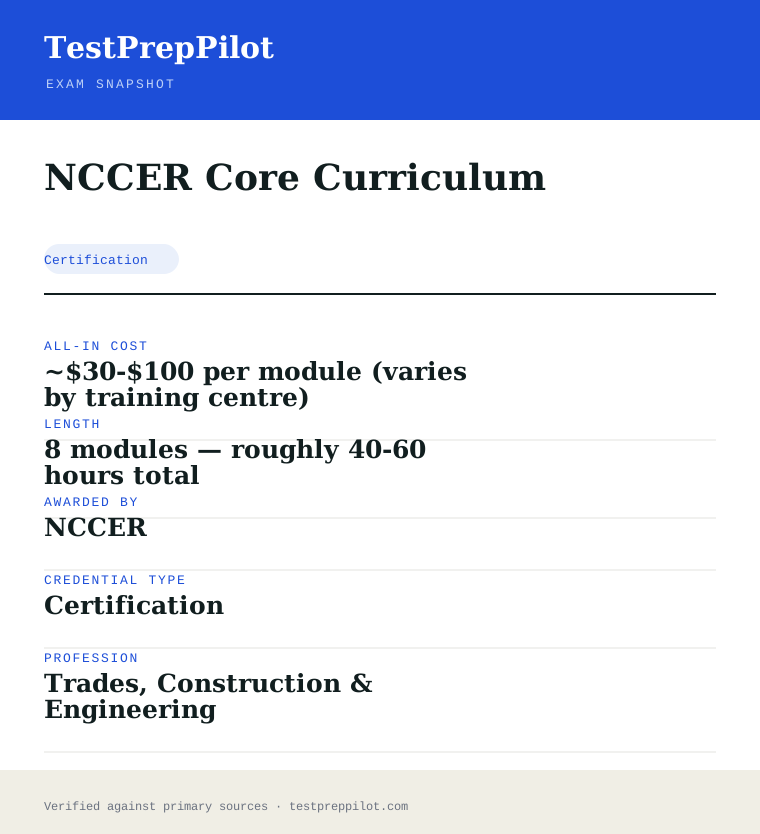
NCCER Core Curriculum is a certification credential; awarded by NCCER; the exam fee is ~$30-$100 per module; typical preparation is 8 modules — roughly 40-60 hours total; holders typically earn $32,000-$65,000 (47-2061 median $46,730).
| Credential | NCCER Core Curriculum |
|---|---|
| Abbreviation | NCCER Core |
| Type | Certification |
| Profession | Trades, Construction & Engineering |
| Specialty | NCCER & Craft Training |
| Awarded by | NCCER |
| Difficulty | Hands-on / Applied |
| Typical prep time | 8 modules — roughly 40-60 hours total |
| All-in cost | ~$30-$100 per module (varies by training centre) |
| Typical salary range | $32,000-$65,000 (47-2061 median $46,730) |
| Credential | NCCER Core Curriculum |
| Awarding body | NCCER |
| Exam format | Proctored, computer-based |
| Validity | NCCER credentials do not expire |
| Languages | Varies — see awarding body |
| Scope | National / Multi-state |
Real questions
Frequently asked questions about the NCCER Core Curriculum
How do I register for the NCCER Core Curriculum exam?
Register through NCCER's official portal or an authorized test provider (e.g., Pearson VUE or Prometric where applicable). Create an account, select the exam, pay the fee, and schedule a date.
How much does the exam cost?
Fees vary by location and currency. Confirm the current fee on the official registration page before scheduling.
How long is the credential valid, and how do I renew?
Validity varies by credential (commonly 2–3 years). Renewal usually requires continuing education or a recertification exam — see NCCER's policy.
What if I do not pass?
Most bodies allow retakes after a waiting period and payment of the full or partial fee. Check NCCER's retake policy before rescheduling.
How do I register for a NCCER credential?
Register through the official website, select your exam, pay the fee, and schedule a date.
How do I renew a credential?
Renewal policies vary by credential; check the specific program page for requirements and cycles.
In short
Is the NCCER Core Curriculum worth it?
- NCCER Core Curriculum is awarded by NCCER.
- Validates job-ready competence in Trades & Construction.
- Registration is through the awarding body or an authorized test provider.
- Renewal and retake policies vary — confirm before scheduling.
Same awarding body
What other credentials does NCCER award?
Worth comparing
How does the NCCER Core Curriculum compare with similar credentials?
Trust
Where does this information come from?
Everything above is taken from the awarding body's own published material. Fees, question counts and domain weights are revised regularly — check the official page before you pay.
Research confidence: medium · Last reviewed 2026-08