IT, Cloud & Cybersecurity • Certification
VMware Certified Professional - Data Center Virtualization
The long-standing vSphere admin exam, now a Legacy but still bookable credential.
Researched and maintained by TestPrepPilot Editorial BoardCloud, IT & cybersecurity certifications desk · Figures last verified August 2026
The short version
What is the VMware Certified Professional - Data Center Virtualization and is it worth it?
VCP-DCV (exam 2V0-21.23) is the classic vSphere administrator certification. It is 70 questions in 135 minutes on a 300 to 500 scale, $250 via Pearson VUE, no training required. Broadcom now labels it Legacy and steers new candidates to VCP-VVF or VCP-VCF Administrator, but you can still book it.
- The most recognized legacy vSphere admin credential
- Flat $250 fee, no mandatory training
- Three-year validity under Broadcom policy
- Pearson VUE centre or online proctoring
- Still bookable for traditional vSphere teams
What is it?
What exactly is the VMware Certified Professional - Data Center Virtualization?
The long-standing vSphere admin exam, now a Legacy but still bookable credential.
The VMware Certified Professional - Data Center Virtualization (VCP-DCV, exam 2V0-21.23) is the classic vSphere administration certification and for years the most common VMware credential. Broadcom has moved new candidates toward VCP-VVF Administrator and VCP-VCF Administrator, and lists VCP-DCV as Legacy, but the exam can still be booked. It validates vSphere installation, configuration, and administration: 70 questions in 135 minutes on a 300 to 500 scale (300 is the pass mark), delivered by Pearson VUE for $250, with no mandatory training. It remains relevant for teams still running traditional vSphere without VCF.
The path in brief
- Confirm VCP-DCV still fits your environment
- Study the 2V0-21.23 blueprint
- Lab vSphere install, config, and admin
- Book 2V0-21.23 with Pearson VUE for $250
- Pass at 300 on the 500 scale
- Consider VCP-VVF/VCF as the forward path
Before you book
Who is eligible to sit the VMware Certified Professional - Data Center Virtualization?
Who it is for: Administrators who run traditional vSphere environments without VCF.
The test itself
What is the format of the VMware Certified Professional - Data Center Virtualization?
The VMware Certified Professional - Data Center Virtualization is administered by Pearson VUE test centre or online proctoring and runs 135 minutes, contains 70 multiple choice questions and requires 300 / 500 scaled to pass.
| Administered by | Pearson VUE test centre or online proctoring |
|---|---|
| Questions | 70 multiple choice |
| Time limit | 135 minutes |
| Pass mark | 300 / 500 scaled |
| Exam fee | $250 |
| Format | Multiple choice, scenario-based |
Content outline
What topics are on the VMware Certified Professional - Data Center Virtualization?
The VMware Certified Professional - Data Center Virtualization covers 5 content domains.
Weightings come from the official exam outline. Study time is best allocated in roughly these proportions rather than evenly across domains.
- Architectures, products, and solutions
VMware portfolio and positioning
- vSphere architectures and technologies
ESXi, vCenter, and core concepts
- Installing, configuring, and setup
Deployment and initial config
- Performance, optimization, and upgrades
Tuning and lifecycle
- Troubleshooting and administrative tasks
Operations and repair
Money & time
How much does the VMware Certified Professional - Data Center Virtualization cost?
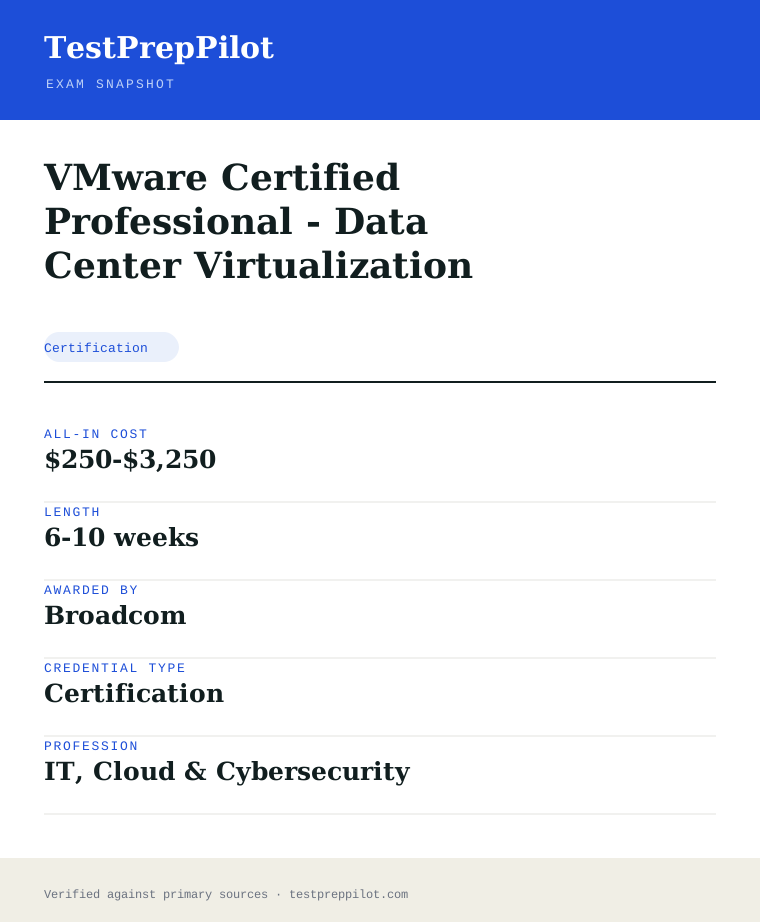
For the VMware Certified Professional - Data Center Virtualization, the exam fee is $250; the all-in cost is typically $250-$3,250; most candidates spend 6-10 weeks preparing.
Cost breakdown
| Exam fee | $250 |
|---|---|
| Training (optional) | $0-$3,000 |
| Home lab (optional) | $0 |
| Typical total | $250-$3,250 |
Listed as Legacy; Broadcom points new candidates to VCP-VVF Administrator and VCP-VCF Administrator instead.
Timeline
- Hands-on vSphere experience 3-6 months
- Focused study 4-6 weeks
- Exam day 135 minutes
Typical prep: 6-10 weeks
The path
How do you register for the VMware Certified Professional - Data Center Virtualization?
- 1
Create a Broadcom Support account10 minutes
Register at Broadcom Support and at Broadcom University so your exam history and badges link to your profile. Use a stable work email.
- 2
Choose the right exam20 minutes
Decide between VTA, VCP (VVF or VCF administrator/architect), VCAP, or VCDX based on your role. New candidates are pointed to VVF and VCF credentials rather than the legacy VCP-DCV.
- 3
Study the exam guideSeveral weeks
Download the official VMware exam guide for your code (for example 2V0-17.25 for VCP-VCF Administrator). It lists every section and the published percentage weights.
- Read objectives
- Lab the tasks
- 4
Schedule through Pearson VUE15 minutes
Broadcom VMware exams are delivered by Pearson VUE at a centre or online. Pay the flat fee ($250 for most, $125 for VCTA) and save the confirmation.
Mandatory training was removed on 6 May 2024, so no course is required before booking.
- 5
Sit the exam and claim your badgeUp to 135 minutes
You get a result immediately on a 300 to 500 scale. Your VMware certification badge posts to your Broadcom account after the score is confirmed.
The fine print
What are the retake and renewal rules for the VMware Certified Professional - Data Center Virtualization?
- Proctoring & delivery
- VMware exams are delivered by Pearson VUE at a test centre or via online proctoring, with a government photo ID and a clear desk. Online proctoring uses your webcam and locks the browser during the test.
- Retake policy
- If you fail a VMware exam, wait at least 2 days (48 hours) before the next attempt; each attempt is paid in full. The same no-training gate applies that has been in place since May 2024.
- Score reporting
- Scores are shown immediately on a 300 to 500 scale (300 is the typical passing mark). The official result posts to your Broadcom account after the exam.
- Recertification
- Broadcom reinstated three-year validity for VMware certifications on 10 March 2025. Recertify by passing a current exam or a higher-level exam before the credential lapses; there is no separate continuing-education requirement.
- Refunds & rescheduling
- Reschedule or cancel through Pearson VUE before the cut-off. Changes inside 24 hours, or no-shows, typically forfeit the fee.
Context
Broadcom VMware certification tiers (2026)
| Tier | Example | Fee | Validity | |
|---|---|---|---|---|
| Technical Associate (VCTA) | VCTA-DCV | $125 | 3 years | |
| Professional (VCP) | VCP-VVF / VCP-VCF | $250 | 3 years | |
| Advanced Professional (VCAP) | VCAP-VCF Admin | $250 | 3 years | |
| Design Expert (VCDX) | VCDX | Fees apply | 3 years |
What it pays
How much does this credential pay?
$96,800 median for network and computer systems administrators (BLS, May 2024)
The direct salary answer for VCP-DCV is $96,800, the May 2024 median for Network and Computer Systems Administrators (SOC 15-1244), the closest Bureau of Labor Statistics occupation to the vSphere administrator role this certification validates. Two caveats belong with that number. First, BLS classifies by job duties rather than by certificate, so the median describes everyone doing server and network administration work — including administrators who have never touched a hypervisor — which means vSphere-focused candidates typically sit above it and first-year hires below it. Second, this occupation is projected to decline 4 percent from 2024 to 2034, with about 14,300 openings a year arising almost entirely from replacement need, and the reason is directly relevant to a VMware candidate: traditional server-room administration is being absorbed into cloud platforms, and within the VMware world specifically the product strategy has consolidated around VMware Cloud Foundation and vSphere Foundation, so the value is shifting toward administrators who can operate the modern stack and pair it with public-cloud skills. The distribution matters for expectations: the lowest 10 percent of this occupation earned less than $60,320 and the highest 10 percent more than $150,320, and VCP-DCV holders who combine the credential with automation, storage and networking depth cluster toward the top of that range. For comparison, computer network architects (SOC 15-1241) earned $130,390 at the median in the same release, which is the direction a VCP-DCV holder moving toward VCAP design work drifts over time, and software developers (SOC 15-1252) earned $133,080. The honest framing is that VCP-DCV is the entry professional credential for a shrinking-but-still-large on-premises and hybrid infrastructure market, and its wage value comes from keeping an administrator employable on the platform of record while the broader administrator occupation declines.
| Measure | Figure | Source / note |
|---|---|---|
| Median annual wage — network and computer systems administrators (SOC 15-1244) | $96,800 | BLS Occupational Outlook Handbook, May 2024 wage data. Closest BLS occupation to a vSphere administrator. |
| Lowest 10 percent | less than $60,320 | BLS OOH Pay tab, May 2024 |
| Highest 10 percent | more than $150,320 | BLS OOH Pay tab, May 2024 |
| Median — computer network architects (SOC 15-1241) | $130,390 | BLS OOH, May 2024. Reference for the VCAP design direction. |
| Employment, 2024 / projected change | 331,500 jobs / -4% (2024-34) | BLS OOH for SOC 15-1244; ~14,300 openings a year, nearly all replacement need |
Job growth.-4% projected change 2024-34 for SOC 15-1244, with ~14,300 replacement openings a year (BLS OOH); modern-stack vSphere and VCF skills are what keep administrators on the employable side of this occupation
Source: BLS Occupational Outlook Handbook — Network and Computer Systems Administrators
Your odds
What are the pass rates?
VMware publishes no pass rate for VCP-DCV — but it does publish the cut score of 300 on a 100-500 scaled range
VMware does not publish pass-rate statistics for the VCP-DCV exam, and it never has; the percentages you will find attached to 2V0-21.23 on forums, blogs and bootcamp pages are anecdotes or vendor marketing, not official data. What VMware does publish is the scoring model, and understanding it is more useful than a rumoured pass rate. The exam is scored on a scaled range of 100 to 500 and you need a 300 to pass. That is deliberately not a simple percentage of questions answered correctly: VMware, like most vendors, equates exam forms so that a harder set of items requires the same underlying ability as an easier one, and the scaled conversion cannot be reverse-engineered from question counts. The practical implication is to stop counting questions in the exam and aim instead to be comfortable with every objective area unaided. One structural fact matters more than the scoring model: VMware does not disclose how many of the 70 questions are unscored pilot items, but candidates should assume some are, which means an impossible-looking question may not count toward the result. There is also no penalty for guessing, so every item should be answered. The retake and rescheduling rules come from the certification portal: failed attempts require a 14-day wait before retaking in most cases, and each attempt is charged the flat $250 exam fee. For a candidate weighing whether the credential is worth it, the honest answer about pass rates is that no official figure exists, and the published numbers that do exist — the 300 cut score, the 70-item, 135-minute format and the $250 fee — are the ones this page can verify.
Read this before quoting the number.No pass rate is published by VMware or Broadcom for the VCP-DCV exam; we have deliberately left the pass-rate table empty. What is published and verifiable on the vendor page: 70 questions, 135 minutes, passing score of 300 on a 100-500 scaled range, and a flat USD $250 exam fee. Retake waits and rescheduling rules are handled through the Broadcom Certification Manager portal and can change without notice.
Your schedule
How long should I study for it?
100-140 hours over 8-12 weeks of focused study
The study-plan answer for VCP-DCV is 100 to 140 hours over eight to twelve weeks for a candidate with the six to twelve months of hands-on vSphere experience the vendor recommends, and the first planning fact is that since May 6, 2024 you no longer need to complete a VMware training course before sitting the exam — the Broadcom-era program made certification by exam only the standard path, which removes the old $4,000-plus training prerequisite and makes a self-built lab the practical foundation of any plan. The current exam is 2V0-21.23, VMware vSphere 8.x Professional, which earns the VCP-DCV 2024 certification; it is 70 questions in 135 minutes with a passing score of 300 on a 100-500 scaled range and a flat $250 fee. The exam guide groups the objectives into five areas: Architecture and Technologies, Products and Solutions, Installing, Configuring and Setup, Performance-tuning, Optimization and Upgrades, and Administrative and Operational Tasks. The plan below assumes you can build a lab — at minimum two ESXi hosts and vCenter — because the exam is heavily operational and candidates who have actually performed the tasks answer the scenario items differently from candidates who have only read about them. Front-load installation and configuration, because it underpins everything else, then architecture and products, then administration and operations, and leave performance tuning and upgrades for the final weeks since they assume the rest. Note that the 2024 program changes also changed validity: certifications earned after May 6, 2024 do not expire, whereas earlier VCP credentials carried a two-year renewal cycle — so the schedule pressure for a new candidate is the exam content, not a countdown to expiry.
- Weeks 1-212-14 hrs/week
Installing, configuring and setup
- Install ESXi on two hosts and deploy vCenter Server Appliance; understand the deployment prerequisites and sizing
- Configure networking: vSphere Standard Switches, then a Distributed Switch with teaming and VLAN configuration
- Configure storage: vSAN, VMFS datastores, NFS and iSCSI targets, and understand the storage policy framework
- Create and configure VMs, templates, clones and content libraries
- Weeks 3-412-14 hrs/week
Architecture and technologies + products and solutions
- Learn the architecture: vSphere components, their roles and how they communicate — vCenter, ESXi, PSC-era services in vCenter, and the client
- Map products and solutions: vSAN, NSX, vSphere Replication, Site Recovery Manager and their relationships to vSphere
- Understand the licensed feature tiers and what each edition enables
- Practise answering architecture scenario questions in writing, not just recognising concepts
- Weeks 5-712-14 hrs/week
Administrative and operational tasks
- Manage the vSphere lifecycle: patching ESXi hosts, upgrades, and vCenter backup and restore
- Configure resource management: CPU and memory allocations, shares, reservations and limits
- Practise HA, DRS and vMotion end to end, including storage vMotion and the constraints that block a migration
- Troubleshoot from real breakage: disconnect a datastore, fail a host, break a cluster rule and fix it from symptoms
- Weeks 8-911-13 hrs/week
Performance-tuning, optimization and upgrades
- Learn performance metrics and tools: esxtop, performance charts, and the key counters for CPU, memory, storage and network
- Practise diagnosing a bottleneck scenario — is it CPU, memory, storage latency or network saturation
- Work through upgrade paths and prerequisites, and what breaks if they are skipped
- Run a full 135-minute practice exam and re-lab the two weakest objective areas
- Week 1010-12 hrs
Timed rehearsal and gap closing
- Two full 135-minute practice exams under exam conditions
- Re-lab every miss rather than re-reading it
- Final pass over the exam guide objectives checklist
- Book through the Broadcom Certification Manager and Pearson VUE, and run the system test if testing online
Adjusting the pace
Working vSphere administrator already.Six to eight weeks. Your day job covers most of the operational objectives; spend the recovered time on the architecture, products and solutions area, which is where experienced admins lose marks to naming and mapping questions.
No hands-on vSphere experience.Fourteen to sixteen weeks. Build the two-host lab in week one and do not advance until ESXi installation, networking and storage are routine; the exam rewards having performed the tasks.
Upgrading from VCP-DCV 2023.Four to five weeks focused on what vSphere 8.x changed versus your version — vSAN improvements, the HTML5 client behaviour, new features and renamed components. The two-year renewal cycle no longer applies to credentials earned after May 2024.
How to study
How do I prepare most effectively?
The strategies that move a VCP-DCV score are the ones that force execution in a real environment, because the exam is operational and the scenario items punish candidates who have only read about the platform. The single highest-yield habit is to build a lab and use it destructively: two ESXi hosts and vCenter, then break things on purpose — fail a host, disconnect a datastore, misconfigure a Distributed Switch, exhaust a resource pool — and fix them from symptoms, because the exam rewards a fixed diagnostic sequence applied under pressure. Second, learn the exam guide objective list as a checklist rather than a syllabus: VMware publishes the objectives for 2V0-21.23, and candidates who tick off each one with a demonstrated task rather than a watched video go in measurably better prepared. Third, practise the naming and mapping questions deliberately, because the Architecture and Technologies plus Products and Solutions areas are where experienced administrators lose marks to items that ask which product does what and how components relate. Fourth, use the official VMware Hands-on Labs and the free evaluation software rather than paying for a course you no longer need — since May 6, 2024 there is no mandatory training prerequisite, so the money that used to go to a $4,000 course can go into lab time and practice tests instead. Fifth, rehearse the timing of a 70-question, 135-minute exam: that is under two minutes per question, which is comfortable until a long scenario item appears, so practise flagging and moving. Sixth, verify your study material matches vSphere 8.x and the current exam code — a course written for 2V0-21.20 teaches a superseded blueprint. Finally, remember the Broadcom portal is the source of truth for registration, rescheduling and results, and old VMware bookmarks may redirect.
Build a lab and break it on purpose
Two ESXi hosts plus vCenter, then sabotage your own environment — fail a host, disconnect a datastore, misconfigure a switch, exhaust a resource pool — and diagnose from symptoms. The operational scenario items reward exactly this fixed diagnostic sequence.
Use the exam guide as a checklist
VMware publishes the 2V0-21.23 objectives. Tick off each one with a demonstrated lab task rather than a watched video, and treat any objective you cannot perform unaided as a gap to close before booking.
Drill the architecture and products mapping
The exam asks which product does what — vSAN, NSX, vSphere Replication, Site Recovery Manager — and how components relate. Experienced admins lose these marks to naming questions, so drill the relationships deliberately.
Spend the money you no longer have to spend
The Broadcom-era program removed the mandatory training prerequisite on May 6, 2024. A self-built lab and practice tests now compete directly with a $4,000 course, and for most candidates the lab wins.
Rehearse the 70-question, 135-minute pace
Under two minutes per question feels comfortable until a long scenario item appears. Practise flagging and moving on, and reserve the final minutes for marked items — there is no penalty for guessing.
Verify your material matches 2V0-21.23
Material written for 2V0-21.20 or older teaches a superseded blueprint. Check the exam code and vSphere version on the cover of anything you buy, and confirm it reflects vSphere 8.x.
What to buy
Which study resources are worth paying for?
The buying decision for VCP-DCV changed fundamentally on May 6, 2024, when Broadcom removed the mandatory training prerequisite: the old program forced candidates to spend $4,000 or more on an official VMware course before they could sit the exam, and that requirement no longer exists, so the resource comparison today is between free official material plus a self-built lab versus paid courses and practice tests that must now justify themselves on quality alone. The official VMware exam guide for 2V0-21.23 is free and is the blueprint; the VMware Hands-On Labs are free interactive environments; and the evaluation software — ESXi and vCenter — runs on a home lab with supported hardware, so the entire content foundation can be free. The justified spend is therefore lab hardware or cloud-lab time, a practice-test bank, and optionally a course if you have no lab and no employer training budget. On the paid side, official VMware training still exists and is the reference-quality option, but at multi-thousand-dollar pricing it is hard to justify when the prerequisite is gone; practice tests from VMware-authorized providers like Pearson, MeasureUp and the usual Udemy market run from $20 to $130 and are the clearest per-dollar buy after the free material. Books written for vSphere 8.x cover the architecture and operational material well for $50-70, with the caveat that any book or course written for 2V0-21.20 teaches a superseded blueprint. The footnote anchoring the comparison: all prices are USD list checked 2026-08 and change; VMware certification exam fees are a flat $250 since May 2024; we take no commission and rank nothing by commercial relationship.
| Resource | Price | Format | Best for | |
|---|---|---|---|---|
| VMware exam guide for 2V0-21.23 (official) | Free | PDF objectives checklist | The blueprint itself; tick each objective with a demonstrated task | Download first — tick each objective with a demonstrated lab task |
| VMware Hands-On Labs (official) | Free | Hosted interactive environments | Practising vSphere tasks without owning hardware | Use these before buying any paid course |
| ESXi and vCenter evaluation software on a home lab | Free (requires compatible hardware) | Self-built two-host lab | The highest-value resource for an operational exam — build it and break it | Build it in week one and break things on purpose |
| Official VMware training courses | Multi-thousand dollars | Instructor-led or on-demand with labs | No longer a prerequisite since May 6, 2024; only worth it with employer funding | Employer-funded only — the prerequisite that made it mandatory is gone |
| Practice tests (MeasureUp / Pearson VUE / Udemy) | $20-130 depending on provider | Timed question banks with explanations | Readiness checks and weak-area identification; confirm the 2V0-21.23 code | Confirm the 2V0-21.23 code on the cover before buying |
| vSphere 8.x study books | ~$50-70 | Print + eBook | Reference coverage of architecture and operational topics | Confirm the book covers vSphere 8.x before buying |
| Exam voucher (2V0-21.23) | $250 flat | Pearson VUE, test centre or online | Required — buy through the Broadcom Certification Manager portal | Buy through the Broadcom Certification Manager portal, not resellers |
Prices checked 2026-08-05, USD list before tax, regional adjustment, sales or employer discounts. VMware certification exam fees are a flat USD $250 for VCTA, VCP and VCAP exams since May 6, 2024. Confirm any third-party course or bank is written for 2V0-21.23 and vSphere 8.x. We take no commission from any provider and order nothing by commercial relationship.
Avoid these
What mistakes do candidates most often make?
The most expensive VCP-DCV mistakes in 2026 are program-era errors that did not exist a few years ago. The first is assuming the old mandatory-training prerequisite still applies and paying thousands for an official course before the exam, when Broadcom removed the requirement on May 6, 2024 — certification by exam only is now the standard path, and that money is better spent on lab time. The second is studying the wrong exam version: material written for 2V0-21.20 or older teaches a superseded blueprint, and the current exam is 2V0-21.23 on vSphere 8.x; a candidate who studied the old version walks in with real gaps. The third is reading about the platform instead of operating it — the exam is operational, and candidates who have never failed a host or fixed a storage issue answer the scenario items from recognition rather than experience. The fourth is skipping the architecture and products mapping questions, which are where experienced administrators lose marks to naming items about vSAN, NSX, vSphere Replication and Site Recovery Manager. The fifth is misreading the scoring model: the 300 cut on a 100-500 scaled range is not a 60 percent-of-questions figure you can compute in your head, and assuming some questions are unscored pilot items is safer than assuming every question counts equally. The sixth is ignoring the flat $250 fee structure and the retake wait — failed attempts cost the full fee and most retakes carry a waiting period, so booking early without readiness is an expensive strategy. The seventh is relying on stale Broadcom portal information: old VMware bookmarks may redirect, and registration, rescheduling and results all flow through the current Certification Manager portal.
✕Paying for the mandatory training prerequisite that no longer exists
✓Since May 6, 2024, VCP-DCV is certification by exam only — no official course is required. Redirect the thousands a course would cost into a two-host lab and practice tests, unless your employer is funding it.
✕Studying for the wrong exam version
✓The current exam is 2V0-21.23 on vSphere 8.x. Confirm the exam code and version on the cover of any course or question bank; material written for 2V0-21.20 teaches a superseded blueprint.
✕Reading about the platform instead of operating it
✓The exam is operational. Build a two-host lab and perform the tasks — install ESXi, configure networking and storage, fail a host, fix a broken datastore — until the sequence is reflex rather than recall.
✕Skipping the architecture and products mapping
✓Items that ask which product does what — vSAN versus NSX, vSphere Replication versus Site Recovery Manager — are where experienced admins lose marks. Drill the relationships deliberately, even if they feel like vocabulary.
✕Misreading the scaled score
✓The passing score is 300 on a 100-500 scaled range, which is not a percentage you can compute from question counts. Answer every item — there is no penalty for guessing — and stop doing arithmetic in the exam.
✕Booking before you are ready because the fee is flat
✓The $250 fee applies to every attempt and retakes carry waiting periods. Treat each attempt as expensive; use a full 135-minute practice exam scoring above the cut before you book.
✕Trusting stale registration information
✓Registration, rescheduling and results flow through the Broadcom Certification Manager portal, and old VMware bookmarks may redirect. Bookmark the current portal and verify voucher validity before buying from third parties.
What you'll face
What question types will I see?
The VCP-DCV exam, code 2V0-21.23, is 70 questions in 135 minutes, in English, delivered proctored through Pearson VUE either at a test centre or online, with a passing score of 300 on a 100-500 scaled range. VMware describes the format as single-choice and multiple-choice, with the multiple-choice items being the majority; there are no performance-based or hands-on-lab items on this exam — it is a knowledge exam that tests whether you know the platform well enough to make operational decisions, which is a different skill from executing the tasks live. The five objective areas from the exam guide are Architecture and Technologies, Products and Solutions, Installing, Configuring and Setup, Performance-tuning, Optimization and Upgrades, and Administrative and Operational Tasks, and the scenario items tend to be framed as real administrator situations: a symptom, a requirement, a constraint — and four plausible actions, only one of which is correct given the constraint. The pacing math matters: 70 questions in 135 minutes is under two minutes per item, which feels generous until a long scenario appears, so the winning rhythm is a brisk first pass with flagging, then a return to the flagged items. Because the passing score is scaled, do not try to convert the 300 cut into a percentage of questions, and because guessing carries no penalty, never leave an item blank. A small share of items may be unscored pilot questions included for statistical purposes, which means an impossible-looking question should not derail you. The samples below are editor-written illustrations of the published objective areas, not live exam items.
One correct answer from the options, often framed as an operational scenario — a symptom, a requirement and a constraint, with three plausible distractors that work in a different context.
Several options are technically capable of solving the problem and one best satisfies the stated constraint — cost, availability, least disruption. Underline the constraint before reading the options.
Questions that ask which product does what or how components relate — vSAN, NSX, vSphere Replication, Site Recovery Manager. These punish candidates who skipped the vocabulary.
A described fault with a symptom and four possible causes or next steps. These reward a fixed diagnostic order rather than pattern-matching to a remembered fix.
Try these
Q1An administrator has a vSphere cluster of four ESXi hosts and needs to ensure that if a single host fails, the virtual machines that were running on it restart automatically on the surviving hosts. The solution must also protect VMs against a host failure inside a single rack. Which configuration best meets the requirement?
Answer:C
The stem has two requirements: restart on host failure and survive a single-rack loss. HA provides the restart-on-failure mechanism, and admission control configured with spare capacity for one host guarantees the restarts will have resources; placing hosts so a rack loss does not take the whole cluster — for example using anti-affinity across racks — addresses the rack-loss clause. A is a partial answer: default HA restarts VMs but without admission-control spare capacity the restarts can fail for lack of resources, and it does nothing about rack placement. B makes restarts worse by disabling admission control, which can overload the survivors. D provides recovery to a second cluster but with a recovery time objective, not the automatic host-failure restart HA provides, and it does not by itself solve resource availability in the same cluster. When the stem pairs an availability mechanism with a placement constraint, the correct option addresses both.
Q2A VM is reporting unusually high storage latency, and the administrator must determine whether the constraint is the datastore, the storage array or the VM itself. Which tool or metric should be used first?
Answer:A
esxtop in its storage-related view presents the three latency figures that separate the layers of a storage bottleneck: guest/virtual-machine latency, device (the ESXi path to the storage) latency and the underlying LUN or datastore latency. Comparing them is the standard first diagnostic step because it tells you immediately whether the delay is inside the VM (guest latency high, device latency low), in the path or array (device or LUN latency high), or a queuing problem on the host. B is a blunt restart that may clear a symptom without diagnosing the cause and risks an unnecessary outage. C targets the network, which is the wrong layer for storage latency unless the storage is networked and the network is suspect — not the first step. D measures uptime, which is unrelated to I/O latency. The exam expects the fixed diagnostic order: identify the layer first, then the cause.
Q3An organisation wants to migrate virtual machines between two datacentres without reconfiguring the guest operating systems, and the VMs must remain powered on during the move where possible. Which vSphere feature should the administrator use?
Answer:A
vSphere vMotion migrates a running VM between ESXi hosts without interruption, and when the two hosts are in different datacentres it performs a cross-datacentre vMotion provided the prerequisites — network connectivity, compatible CPU features or EVC, and storage reachable by both hosts — are met. That matches the two clauses: no guest reconfiguration and the VMs remain powered on. B names storage vMotion, which moves only the virtual disks and typically requires shared or replicated storage, and pairing it with the running-VM requirement leaves the compute migration unaddressed. C and D are disaster-recovery and migration tools with cutover and failover semantics, not live migration of a running workload without reconfiguration. When the stem asks for a live migration with no guest change, vMotion is the feature, and the exam expects you to know both what it does and which prerequisites it demands.
Samples are editor-written illustrations of the published blueprint, not live exam items.
The big day
What should I expect on exam day?
The VCP-DCV exam, code 2V0-21.23, is delivered through Pearson VUE, at a test centre or online, and the direct exam-day answer is 70 questions in 135 minutes with a passing score of 300 on a 100-500 scaled range, registration handled through the Broadcom Certification Manager portal. The test centre versus online decision is the first real choice. A centre gives you a supervised workstation and a physical erasable whiteboard — genuinely useful for sketching a cluster layout or a troubleshooting sequence — and no room scan; the online option gives you your own desk but a stricter environment, with a room scan, a clear desk, and no physical scratch paper unless it was explicitly approved for your booking. Check what your booking allows rather than assuming, because the rules have tightened across proctoring providers and an item that was acceptable a year ago can end your session now. Whichever you choose, arrive or launch check-in thirty minutes early; online check-in can take twenty minutes on a bad day, and a late check-in is a forfeited fee. Inside the exam, the pacing math is under two minutes per question, which is comfortable until a long scenario item appears, so the winning rhythm is a brisk first pass with flagging, then a return to the flagged items with the remaining time divided across them. There is no penalty for guessing, so never leave an item blank, and remember the passing score is scaled — do not spend time trying to convert 300 into a percentage of questions. After the exam, results are typically available quickly through the certification portal rather than on screen in the way some other vendors display them, so plan to check the portal for the official outcome.
Bring
- Government-issued photo ID with your name matching your certification account exactly — a mismatch is a common and expensive turn-away
- A second form of ID at the test centre if your primary is not a passport or driving licence; check your Pearson VUE confirmation for what your country requires
- Your Pearson VUE confirmation and exam registration number
- At a test centre: nothing else; everything else goes into a locker
- For online testing: the phone used for check-in photo upload — it goes out of reach once check-in completes
- For online testing: a physical whiteboard with an erasable marker, only if explicitly permitted on your booking
Leave at home
- Phones, smartwatches, fitness trackers and earbuds — locker at a centre, out of the room entirely for online proctoring
- Your own paper, pens, notebooks and sticky notes
- Second monitors — online proctoring requires a single display, and a disconnected second monitor on the desk is still a violation
- Bags, coats, hats and any headwear not worn for religious reasons
- Food and drink beyond what the centre permits
- Anyone else in the room for online testing — the proctor ends the session if another person is heard or seen
How the day runs
Rules in the room
- 70 questions in 135 minutes, single and multiple choice, delivered proctored through Pearson VUE.
- Passing score is 300 on a 100-500 scaled range; it is not a percentage of questions you can compute in the exam.
- No penalty for guessing — never leave an item blank.
- Some items may be unscored pilot questions; an impossible-looking item should not derail you.
- The exam is closed book; no external references or materials are permitted in the room.
- No scratch paper of your own — centres supply an erasable whiteboard; online candidates get no paper unless a physical whiteboard was explicitly approved on the booking.
- Registration, rescheduling and results flow through the Broadcom Certification Manager portal.
- Certifications earned after May 6, 2024 do not expire under the current program, so there is no post-exam renewal countdown for new candidates.
Afterwards.Results are posted through the Broadcom Certification Manager portal rather than displayed on screen at the test centre, so plan to check the portal for the official outcome and the detailed score breakdown across the objective areas once it is available. If you passed, you earn the VCP-DCV 2024 certification and can claim the digital badge from the certification portal; under the current program, credentials earned after May 6, 2024 do not expire, so there is no two-year renewal countdown as there was for older VMware certifications — the ongoing cost is keeping your skills current with platform releases, and Broadcom recommends staying aligned with the latest version when it becomes available. If you failed, the retake rules come from the certification portal and most retakes carry a waiting period, with the flat $250 fee charged for each attempt, so resist booking an immediate retry on the same knowledge. Use the score breakdown to identify the one or two objective areas that pulled you below the 300 cut — typically the architecture and products mapping or the operational scenarios — spend a fortnight labbing those specifically, then re-sit. A failed attempt on the same study plan is how a $250 voucher becomes a $500 one.
Reference
What are the key facts about the VMware Certified Professional - Data Center Virtualization?
VMware Certified Professional - Data Center Virtualization is a certification credential; awarded by Broadcom; the exam fee is $250; typical preparation is 6-10 weeks; holders typically earn $95,000-$140,000.
| Credential | VMware Certified Professional - Data Center Virtualization |
|---|---|
| Abbreviation | VCP-DCV |
| Type | Certification |
| Profession | IT, Cloud & Cybersecurity |
| Specialty | Virtualisation & Infrastructure |
| Awarded by | Broadcom |
| Difficulty | Moderate |
| Typical prep time | 6-10 weeks |
| All-in cost | $250-$3,250 |
| Typical salary range | $95,000-$140,000 |
| Exam code | 2V0-21.23 |
| Status | Legacy (still bookable) |
| Delivery | Pearson VUE centre or online proctoring |
| Retake | 2-day wait between attempts |
| Validity | 3 years |
| Fee | $250 |
| Scope | National / Multi-state |
| Also known as | VCP-DCV, 2V0-21.23 |
Real questions
Frequently asked questions about the VMware Certified Professional - Data Center Virtualization
Is VCP-DCV still available?
Yes, but Broadcom lists it as Legacy. The exam (2V0-21.23) can still be booked through Pearson VUE. New candidates are encouraged to take VCP-VVF Administrator or VCP-VCF Administrator instead.
How many questions are on VCP-DCV?
Exam 2V0-21.23 is 70 questions in 135 minutes on a 300 to 500 scaled score, with 300 as the typical pass mark.
Do I need training for VCP-DCV?
No. Broadcom removed the mandatory training requirement on 6 May 2024, so you can book the exam directly. Training is still recommended for hands-on readiness.
How much does it cost?
The flat US fee is $250, the same as other VMware professional exams. Only the VCTA level costs less, at $125.
How long is VCP-DCV valid?
Three years. Broadcom reinstated three-year validity on 10 March 2025, and you renew by passing a current or higher-level exam before it lapses.
Should I take VCP-DCV or VCP-VVF Administrator?
If your environment is traditional vSphere, VCP-DCV still fits. If you are adopting vSphere Foundation or VMware Cloud Foundation, the VVF or VCF administrator exams are the forward-looking choice Broadcom now promotes.
Is mandatory training still required for VMware exams?
No. Broadcom removed the mandatory training requirement for first-time VMware candidates on 6 May 2024. You can now book VCP, VCAP, and most exams without first completing a course, though training is still recommended.
How much do VMware exams cost in 2026?
Most VMware exams are a flat $250 in the US. The entry-level VCTA-DCV is $125. There are no longer tiered course-plus-exam bundles required to sit the test.
Are the old VCP-DCV and VCP-NV exams still available?
They are listed as Legacy. VCP-DCV (2V0-21.23) and VCP-NV (2V0-41.24) can still be booked, but Broadcom steers new candidates to VCP-VVF Administrator and VCP-VCF Administrator instead.
In short
Is the VMware Certified Professional - Data Center Virtualization worth it?
- VCP-DCV (2V0-21.23) is the classic vSphere admin certification.
- 70 questions in 135 minutes, 300/500 to pass, $250 via Pearson VUE.
- Listed as Legacy but still bookable; VVF/VCF are the new path.
- Best for admins running traditional vSphere without VCF.
Trust
Where does this information come from?
Everything above is taken from the awarding body's own published material. Fees, question counts and domain weights are revised regularly — check the official page before you pay.
- Broadcom Awarding body
Research confidence: high · Last reviewed 2026-08